‘Trixie’ doesn’t reinvent Debian so much as reaffirm it, with updated packages, subtle polish, and the same rock‑solid base that keeps it the go‑to choice for many serious Linux users.
There’s something special about the gadget that “just works.” Technology can open opportunities for those devices but also complicate and weigh down products that have done just fine without things like sensors and software.
So when a product like the beloved Rubik’s Cube gets stuffed with wires, processors, and rechargeable batteries, there’s demand for it to be not just on par with the original—but markedly better.
The Cubios Rubik’s WOWCube successfully breathes fresh life into the classic puzzle, but it’s also an example of when too much technology can cannibalize a gadget’s main appeal.
A bare-bones Chinese app called “Are You Dead?” — whose entire premise is that solo-living users tap daily to confirm they’re still alive, triggering an alert to an emergency contact after two missed check-ins — has rocketed to the top of China’s app store charts and gone viral globally without spending a dime on advertising.
The app wasn’t built for the elderly, as many assumed; its creators are Gen-Z developers who said they were inspired by the isolation of urban life in a country where one-person households are expected to hit 200 million by 2030. Its rise coincided with China’s birth rate plunging to a record low. Beijing quietly removed the app from Chinese stores last month, and the developers are now crowdsourcing a new name on social media after their first rebrand attempt, “Demumu,” failed to catch on.
Slay the Spire 2 will launch in early access next month. This sequel to the hugely popular 2019 roguelike deckbuilder hits early access on Steam beginning March 5, 2026. Along with releasing the teaser trailer above, developer Mega Crit shared some details about its goals for this phase ahead of the game’s official release.
“Slay the Spire requires a lot of player feedback so we can balance content, add quality of life features, and make sure the game runs without issues,” the developers explained. “Early Access is also a chance for us to test experimental features, try exotic designs, identify niche problems, and helps us make sure the game is headed in the right direction.” Slay the Spire 2 is expected to be in early access for a year or two, or more generally “until the game feels great.”
Mega Crit has also revealed that it will be introducing a new co-op mode where up to four people can team up. This gameplay option will feature some unique cards just for multiplayer as well as some team-wide synergies.
Some of the characters from Slay the Spire will be returning for the sequel alongside new ones. For anyone who hasn’t yet experienced the original game, Slay the Spire is available on iOS, including as part of Apple Arcade. It’s also on consoles and PC.
This article originally appeared on Engadget at https://www.engadget.com/gaming/slay-the-spire-2-will-enter-early-access-on-march-5-210338514.html?src=rss
This is a video from China of a group of young martial artists performing a choreographed routine with little humanoid robots. Admittedly, I did like the part where the robots were flipping off of the springboard. I did not like the part where they were waving swords, even if the swords were flimsy. We shouldn’t be giving them any ideas. And, if the questions my roommate asks ChatGPT are any indication, we’re giving them lots of bad ideas.
We may earn a commission from links on this page. Deal pricing and availability subject to change after time of publication.
When shopping for OLED TVs, brightness is a crucial factor, because it helps overcome ambient lighting and delivers better-looking HDR content. Samsung’s brightest OLED TV thus far, released in 2025, is the S95F, praised for its picture quality and surprisingly impressive sound. Right now, a 65-inch refurbished Samsung 65-Inch S95F OLED TV is just $1,899, which is over $1,000 off its list price.
This TV’s deep blacks, dramatic contrast, and “very bright OLED panel”, as PCMag describes it, are the standout features on this large-screen 4K TV. Beyond improved brightness that maxes out at a striking 2,386 nits, it also features fantastic color performance and a powerful, advanced 4.2.2-channel speaker system that reduces the need for an external speaker or soundbar. The TV has a nearly bezel-less design and a One Connect box to minimize cable clutter.
The S95F also has some of the best anti-glare tech, which is rare for an OLED. While theLG G5 is technically brighter, its anti-glare system doesn’t perform as well. The S95F’s matte anti-reflection coating drastically reduces glare and is designed specifically to perform well in bright rooms, which is a major perk if the room your TV is in gets a lot of daylight. It supports HDR10 and HDR10+ content at 120Hz, with up to 165Hz variable refresh rate and AMD FreeSync Premium Pro. Like other Samsung TVs, this one doesn’t support Dolby Vision.
The TV is covered by Woot’s 90-day limited warranty, and ships free for Amazon Prime users (otherwise, shipping is $6). Since it’s refurbished, it may have minimal signs of wear, but that won’t affect performance.
The Document Foundation announced LibreOffice 25.8.5 today as the fifth maintenance update to the latest LibreOffice 25.8 office suite series with various bug fixes.
Microsoft’s Copilot AI assistant is under fire for summarizing emails flagged as confidential by DLP (data loss prevention) policies specifically intended to prevent AI from accessing them. Per BleepingComputer, Microsoft began rolling out a fix for this problem in early February, and is “continuing to monitor the deployment and is reaching
Diablo II is one of those storied classic PC games that’s pretty much always fun to come back to—so much so that some players have put thousands of hours into the game over more than two decades. Across all those years, though, the game itself has barely changed, becoming something of a familiar, comfortable blanket of hellfire for longtime players.
That makes last week’s introduction of a new playable Warlock class in Diablo II Resurrected’s new “Reign of the Warlock” DLC a pretty big deal. And after playing through a few Acts with the Warlock over the recent holiday weekend, I found the new option to be a great excuse to come back to a game that’s overdue for a shot in the arm.
War-locked in
How your Warlock build goes depends heavily on which of the three main upgrade branches you choose to go down. Of these, I found the Eldritch branch had been the most interesting and fun to explore. That’s in large part because of a new skill that lets you levitate a powerful two-handed weapon in front of you while still holding a strong shield in your hands. It seems like a small change, but my relief was palpable in this playthrough as I was able to avoid these kinds of tough choices between defense and offense as I juggled my inventory.
Merged today to Mesa 26.1 Git is a one-line change to the Intel “ANV” Vulkan driver that is showing to deliver some slight performance benefits or up to 3% noted in some select games…
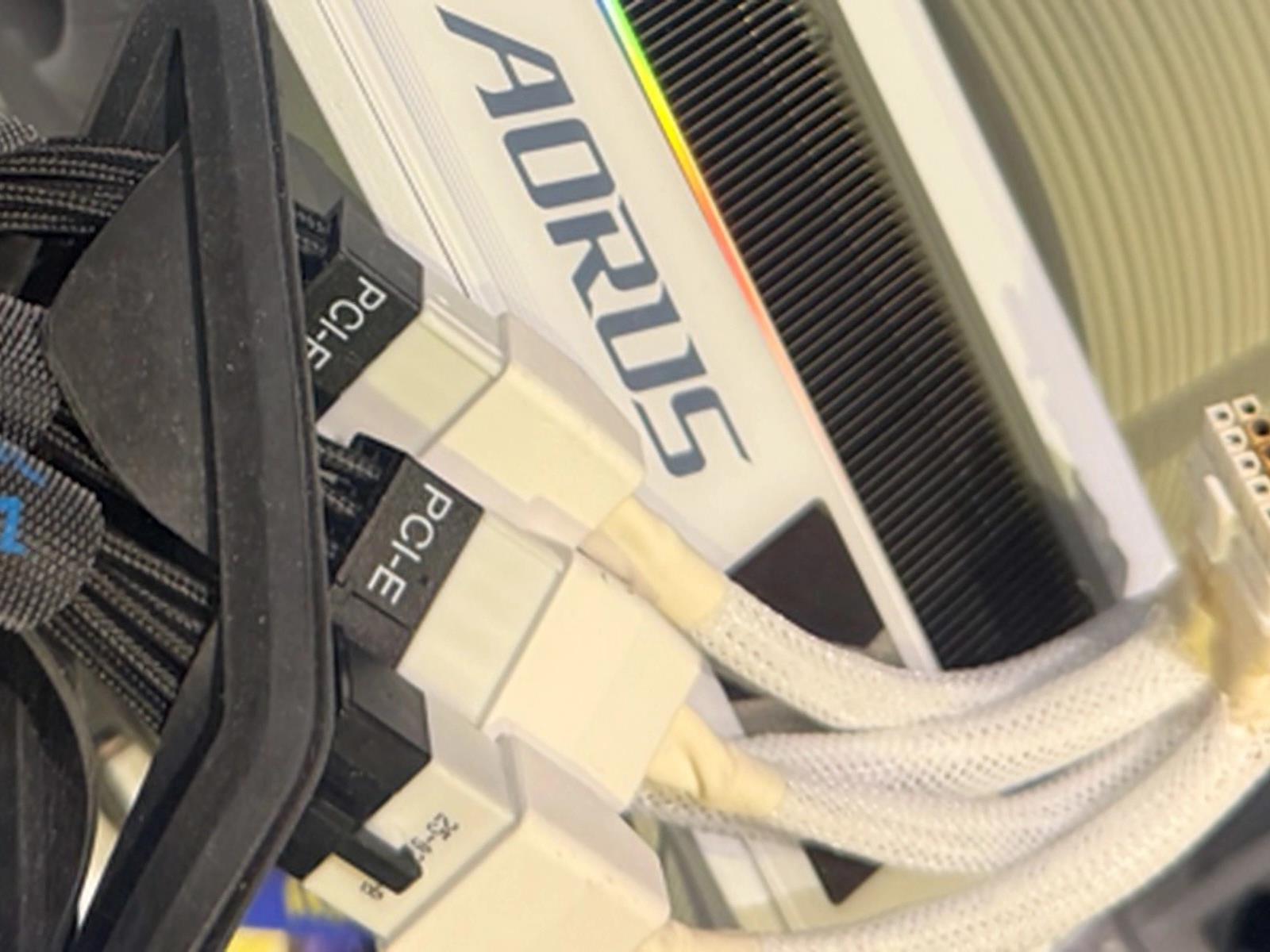
The GeForce RTX 4090 was known to have a problem with melting its 12VHPWR power connectors. In response to this issue, PCI-SIG modified the connector to create the revised 12V-2×6 plug. While this is an improvement, it doesn’t help the fact that most GeForce graphics cards eschew any kind of active load balancing, and neither does the fact
Cybersecurity professionals at Threat Fabric have uncovered a campaign utilizing a new piece of malicious software to target Android users. Massiv, a banking trojan, is described by the security researchers as a “new Device Takeover malware family without direct links to other known threats.”
Does “bouba” sound round to you? How about “maluma”? Neither are real words, but we’ve known for decades that people who hear them tend to associate them with round objects. There have been plenty of ideas put forward about why that would be the case, and most of them have turned out to be wrong. Now, in perhaps the weirdest bit of evidence to date, researchers have found that even newly hatched chickens seem to associate “bouba” with round shapes.
The initial finding dates all the way back to 1947, when someone discovered that people associated some word-like sounds with rounded shapes, and others with spiky ones. In the years since, that association got formalized as the bouba/kiki effect, received a fair bit of experimental attention, and ended up with an extensive Wikipedia entry.
One of the initial ideas to explain it was similarity to actual words (either phonetically or via the characters used to spell them), but then studies with speakers of different languages and alphabets showed that it is likely a general human tendency. The association also showed up in infants as young as 4 months old, well before they master speaking or spelling. Attempts to find the bouba/kiki effects in other primates, however, came up empty. That led to some speculation that it might be evidence of a strictly human processing ability that underlies our capacity to learn sophisticated languages.
Zwift’s Fitness Metrics, initially released in April of 2025, help to answer common questions from endurance athletes: “How am I doing? Can I train more? Should I train less? What’s my potential?”
But if you’re new to riding or running, these metrics may be a bit confusing. So we’re here to help!
If you aren’t sure how to use Zwift’s Fitness Metrics, or what they’re even telling you, read on…
Riders: It Starts with FTP
As a cyclist, if you want your Training Score to be accurate in Zwift, you must have your FTP (functional threshold power) value set accurately in your profile.
What is “FTP”? It is the wattage you can stay below and sustain for longer durations, while going above it causes fatigue to set in very quickly. Most riders, if they put in a steady but maximal effort on fresh legs, can hold their FTP for 40-60 minutes.
Your Training Score is directly based on the Stress Points accumulated with each ride, and Stress Points are calculated from your FTP (see below).
So if your FTP isn’t accurate, your Stress Points won’t be, either, which means your Training Score won’t be accurate.
FTP is also used to calculate power targets in ERG workouts – for example, a VO2 interval may have you ride at 110% of FTP for 4-minute intervals. So you’ll want an accurate FTP value if you’re doing structured workouts on Zwift as well.
Zwift will automatically estimate your FTP based on your power bests as you ride or race in the game. But if you want a more accurate FTP value, I recommend taking an FTP test.
Once your FTP is set accurately, the Stress Points (SP) calculated for each ride will be accurate. SP is just a Zwifty name for TSS, an industry-standard metric developed by TrainingPeaks that combines both time and intensity into one number indicating how much stress a particular workout puts on your body.
You don’t need to know how SP are calculated to use them, although this post has the formula if you’re curious. To give you some idea of typical SP ranges, an easy 1-hour recovery ride may be around 40-50 SP, while a 1-hour race will be closer to 90-100 SP, and a 3-hour endurance ride may be more like 150-180 SP.
If you’re syncing outdoor rides to Zwift, but don’t have a power meter on your outdoor bike, Zwift will do its best to estimate your SP for the ride, much like Strava estimates your power even on rides without power data. If you want your training metrics to be truly dialed in, though, maybe it’s time to get a power meter on your outdoor bike?
I recommend the Favero Assioma pedals. They’re the most respected in the industry, more affordable than most, and easy to install (unlike crank or spider-based power meters).
Zwift uses industry-standard algorithms to compute SP for runs:
If your run includes heart rate data, this is used to calculate the SP for that activity based on the hrTSS formula.
If an outdoor run lacks heart rate data, Zwift uses the RPE (Rate of Perceived Exertion) from that activity as synced from Garmin or Wahoo to estimate SP using the method shown here.
For Zwift activities without heart rate data, SP is calculated with a default RPE of 5 using the method shown here.
Seeing SP in Zwift
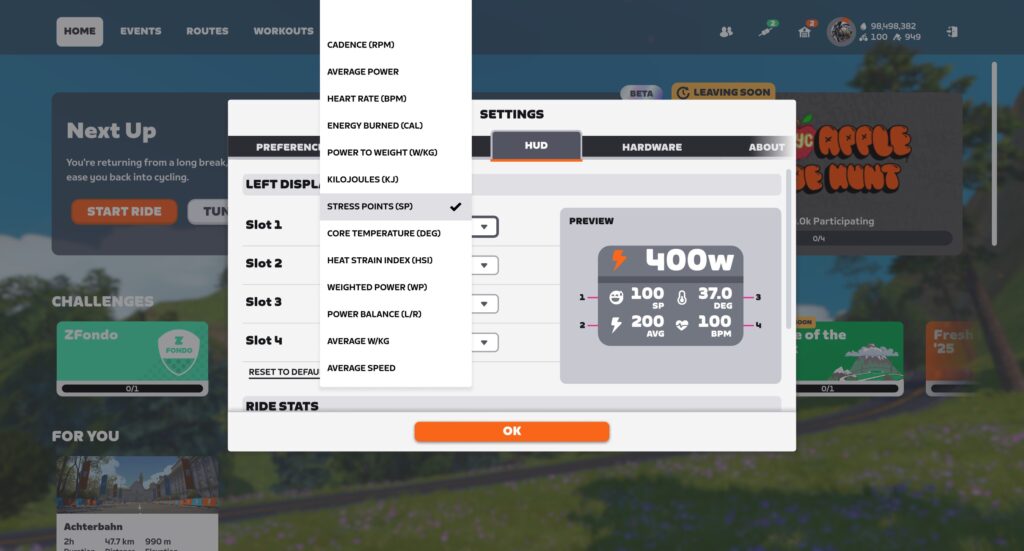
You can show SP in real-time in Zwift’s HUD by selecting it for one of the display metrics via Menu>Settings>HUD:
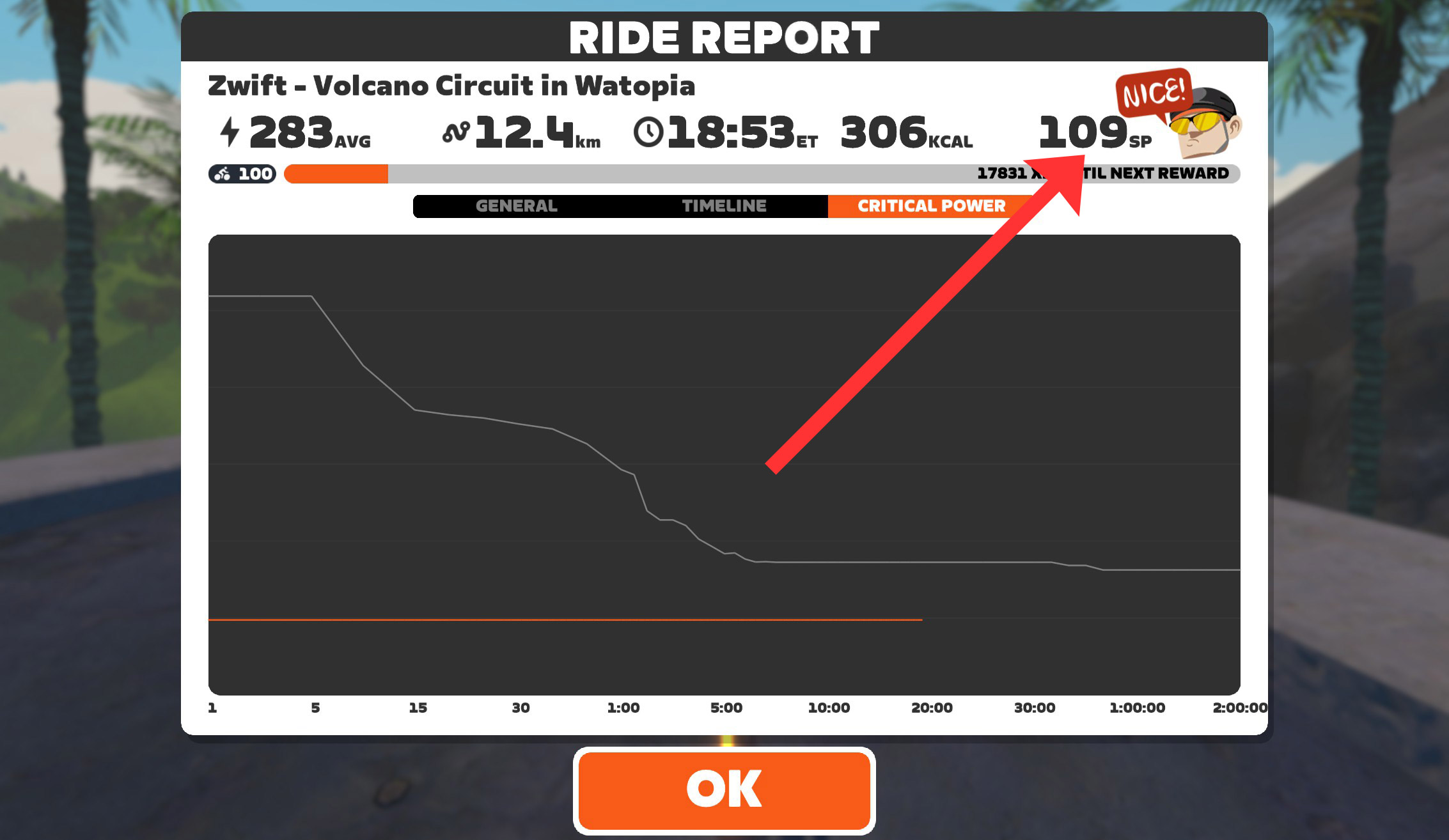
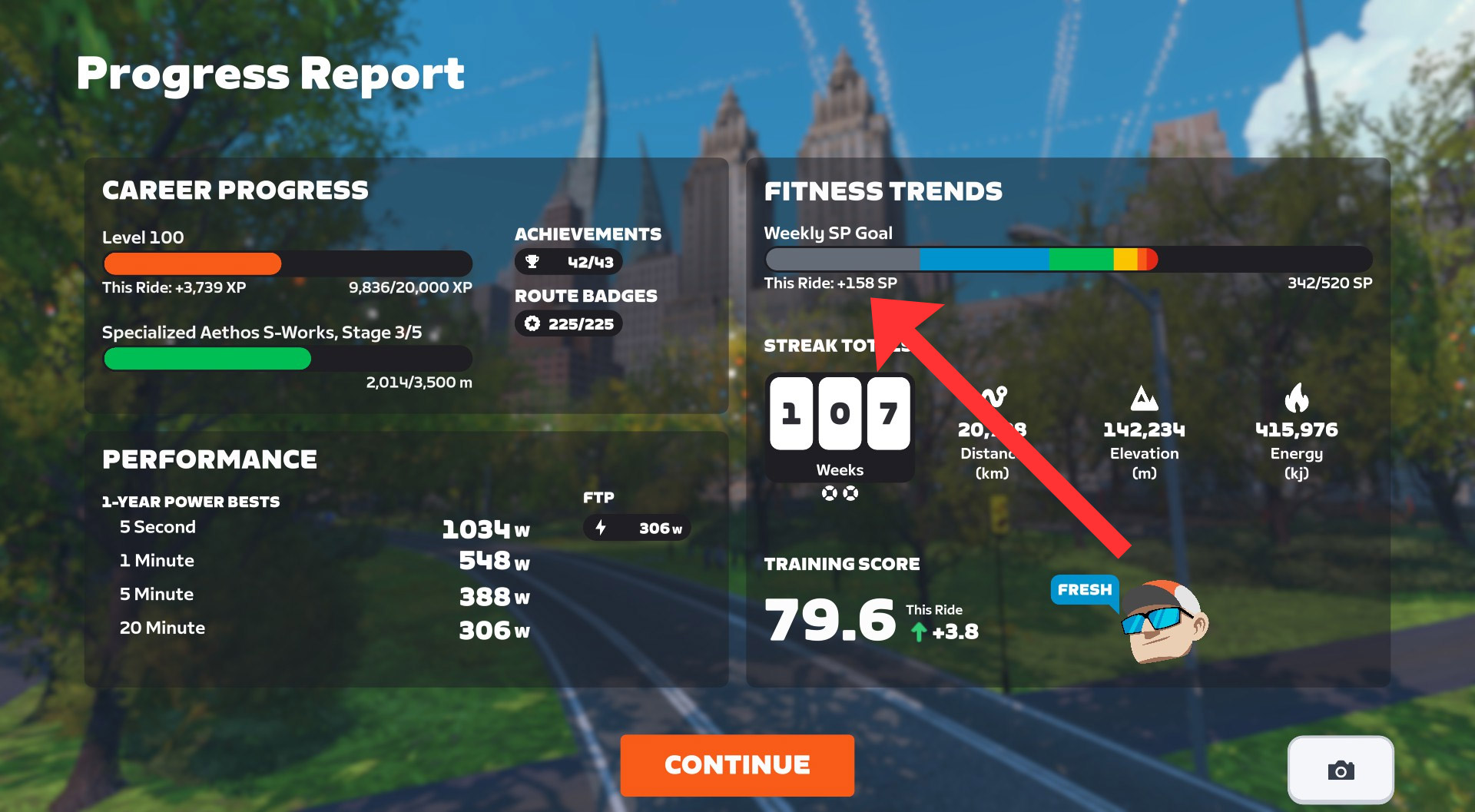
SP are also shown on the Ride/Run Report when completing an activity, and on the Progress Report screen if you’ve set a fitness goal based on SP:
Syncing Outdoor Activities
If you do any outdoor riding or running (and most of us do), you’ll want to get that data into Zwift’s system. Otherwise, your Fitness Metrics won’t be accurate, since they won’t include your outdoor efforts!
You’ll need to record your outdoor session on a device such as a bike computer (aka “head unit”), smart watch, or even your phone. I’m partial to Wahoo’s bike computers, but Zwift supports importing outdoor rides from Garmin, Wahoo, and Hammerhead accounts.
Your Training Score in Zwift is the 42-day exponentially weighted moving average of your training load. What does that mean in simple terms? It means your Training Score is an average of your daily SP, weighted so recent sessions affect the score more than older ones. Note that “Training Score” is more often called “Fitness” in other apps, or “Chronic Training Load/CTL” in TrainingPeaks.
This comment from ZI reader R. Chung (yes, thatChung) unpacks how Training Score is calculated: “The ‘42-day exponentially weighted moving average’ (and the 7-day version) don’t mean they’re an average over the previous 42 days. That’s a common misconception. It means the exponential decay rate is 1/42 days = 2.38% per day (and the 7-day decay rate is 1/7 = 14.28% per day). The 2.38% decay rate means about three-eighths of the TSS from a ride is still around after 42 days, not zero.”
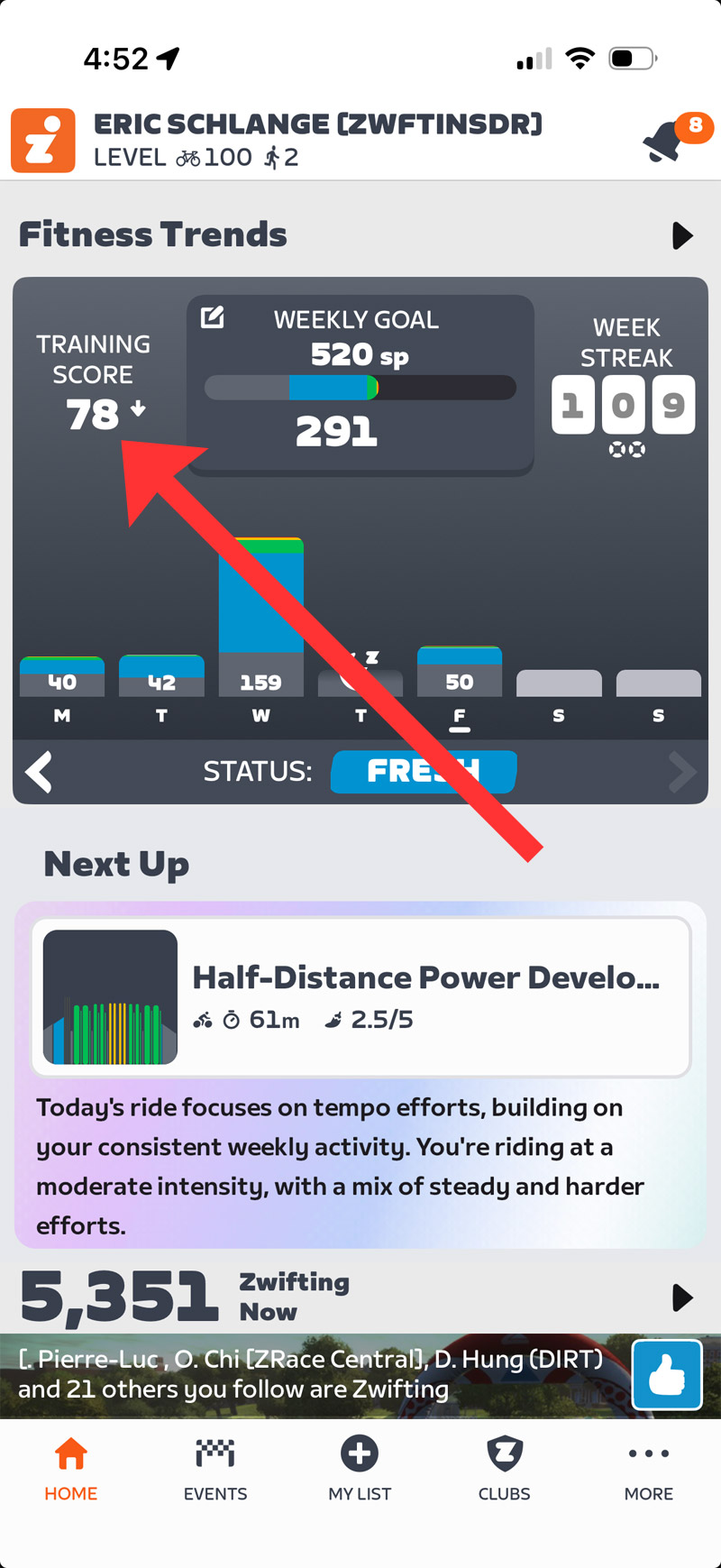
You can see your current Training Score in the Companion app at the top-left of the Fitness Trends box:
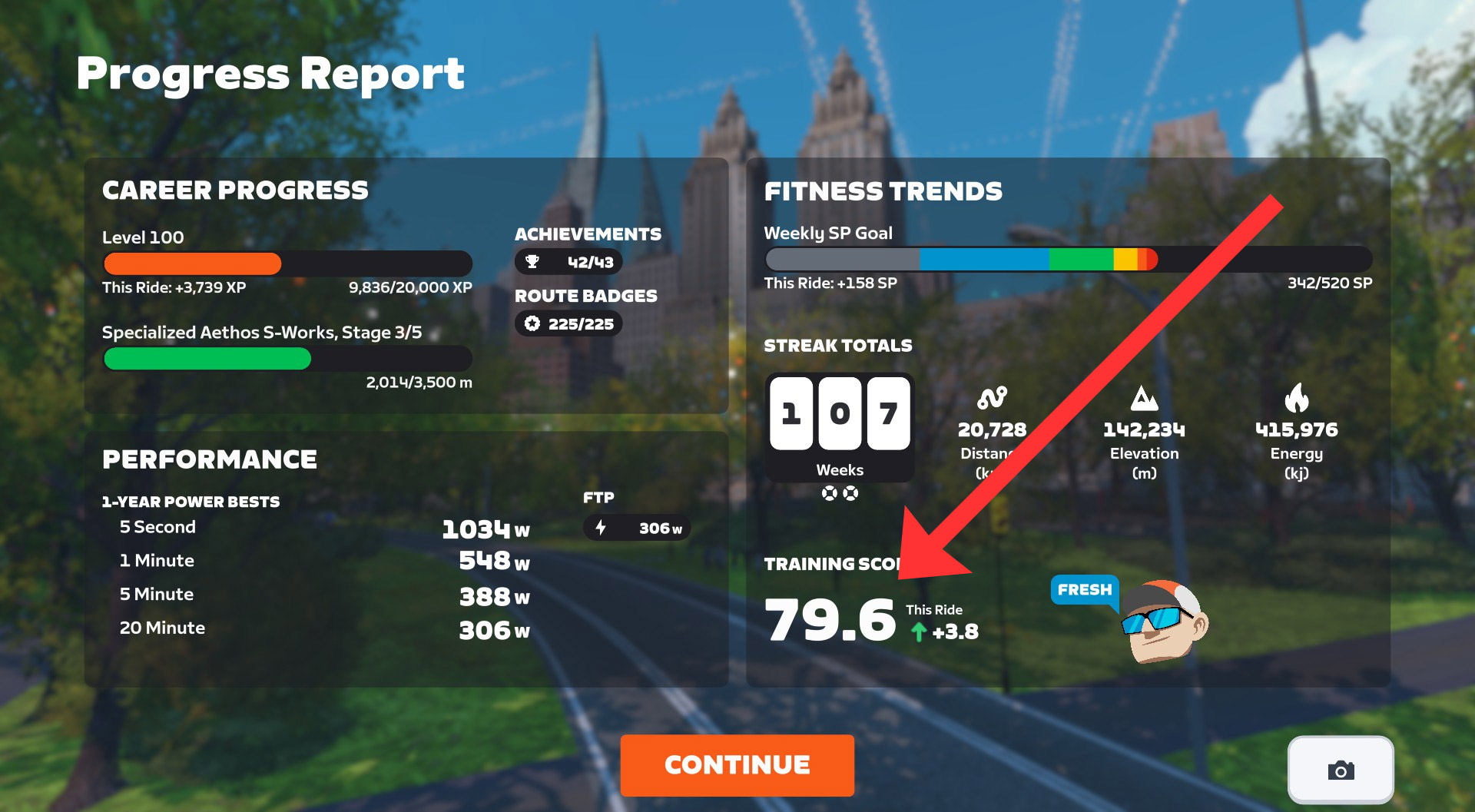
It is also shown on the Progress Report screen, along with a value showing how much your session changed the score:
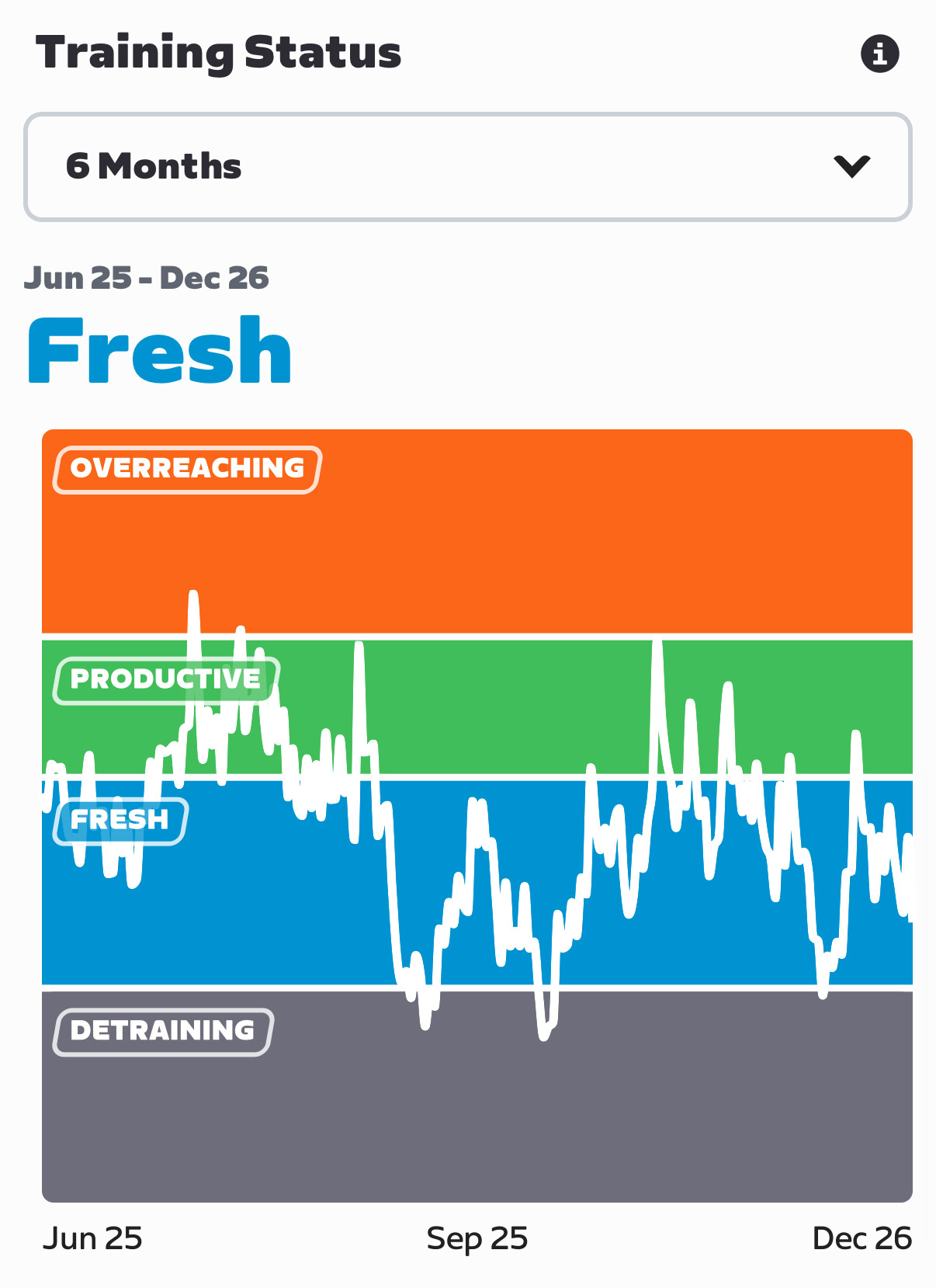
Training Status
Your Training Status is also displayed in the Companion app and Progress Report. It will place you in one of the following categories:
Overreaching: avoid staying here long, or you may become over-trained
Productive: gaining fitness
Fresh: fit and ready to race
Detraining: losing fitness
Ready: new to training, not enough data to categorize you
Zwift Training Status is based on a metric that other apps call “Form” or “Freshness”. This is calculated as your current Training Score minus your current Fatigue. (Fatigue is calculated similarly to Training Score, except it’s only a 7-day exponentially weighted moving average of your training load instead of 42-day.)
Since Zwift likes to keep metrics simple, they don’t display this Form/Freshness value. Instead, they simply chart it in the Companion app under “Fitness Trends”, so you can see where you’re trending:
How To Use It
So that’s how all of Zwift’s Fitness Metrics work. But how do you actually use them?
In some ways, that’s a very individual question, and thus impossible for me to answer. A qualified coach could look at your data and give you some really helpful insights, though!
But there are some general principles, and some obvious use cases, which apply to just about everyone.
First: it’s worth mentioning that your Zwift Training Status is not an indicator of how well you may feel on a given day. If you’re anything like me, Zwift may often say you’re “fresh,” but your legs disagree! That’s OK. Training Status summarizes overall Training Stress Balance (TSB), giving a sort of zoomed-out view of your current freshness, which may not match how you feel on the day.
If your Training Status is “Overreaching”, you’ll want to ease up soon. The great Joe Friel says, “…if you spend much time here you will create great fatigue and are flirting with extreme overreaching that would likely become overtraining if continued for too long.” Typically, you’ll automatically ease up training at this phase, because the body simply can’t keep overreaching. But be careful if you find yourself here.
Zwift’s Fitness Metrics are just a Zwifty (that is, simpler and more colorful) version of the commonly-used Performance Management Chart seen in coaching plans on TrainingPeaks and other platforms. These charts show the detailed results of periodized training plans, where athletes typically go through sections of training in the “productive” zone, take a recovery week to enter the “fresh zone,” then start another block of training. Often, these training plans are structured with a target event in mind, and athletes will taper their training in the week or two leading up to it.
You may not have a coach or the expertise to structure a full training plan, but you can use Zwift’s Fitness Metrics to help determine an effective training load for your situation. The metrics won’t tell you which workout to do each day, but they’ll help you manage your overall training load. And that’s half of the battle! While it’s good to know which specific workouts will help you most, so much of endurance training is about building up a training load. Getting on the bike. Running the planned distance. Putting in the work. Consistency.
So put in the effort to get into the productive zone, then take a week off after 3-4 productive weeks. And if you get into overreaching, don’t panic. But also, don’t keep digging that hole deeper!
Those are just a few tips and thoughts, but training management is a huge topic with plenty of rabbit holes. So I’ll leave it here for now.
What’s Next?
Lastly, it’s worth mentioning that these metrics are just one part of the more robust training platform Zwift is building. You can see the pieces coming together: first, third-party workout syncing brought all the big training plan providers to the table. Then revamped automatic FTP detection made it easier to set your power zones. Next, Zwift added outdoor rides and began computing training metrics. Then run activities were added to the mix!
To what end? We don’t know for sure, but Zwift recently released Personalized Recommendations, and there’s much, much more that could be done in this space…
Questions or Comments?
Did this post help you better understand and utilize Zwift’s Fitness Metrics? Still got questions? Comments? Share below!
Toy Fair 2026 just wrapped earlier this week and while I would have liked to spend even more time there, I have my own kids (and all their toys and trinkets) to look after. That said, there were a ton of cool new products on display at the Javits Center in New York City that set the stage for the rest of the year, so here’s a quick look at some of the most interesting releases from the largest toy show in the Western Hemisphere.
To celebrate the 40th anniversary of Transformers: The Movie, Hasbro is launching an apology tour to make up for traumatizing theatergoers with the death of the most beloved Autobot back in 1986. To kick things off, Hasbro is releasing a handful of new figures alongside re-releases for some popular bots including Astrotrain, Skywarp, Snarl and Shockwave. I want to give a special shout-out to the model for Kranix, which looks incredibly accurate, as if he just leapt off the movie screen. And even though his duck-billed spaceship alt-mode might look a bit awkward, I wouldn’t have it any other way.
The crown jewel of the line might be a near-life-size version of The Matrix of Leadership, which measures more than 15 inches wide and even plays Stan Bush’s iconic song “The Touch” with the push of a button. Unfortunately, the appeal of the Matrix is so powerful that it’s already sold out, including at third-party retailers like Big Bad Toy Store, which thankfully is still taking pre-orders for the rest of the lineup after the initial stock from Hasbro dried up.
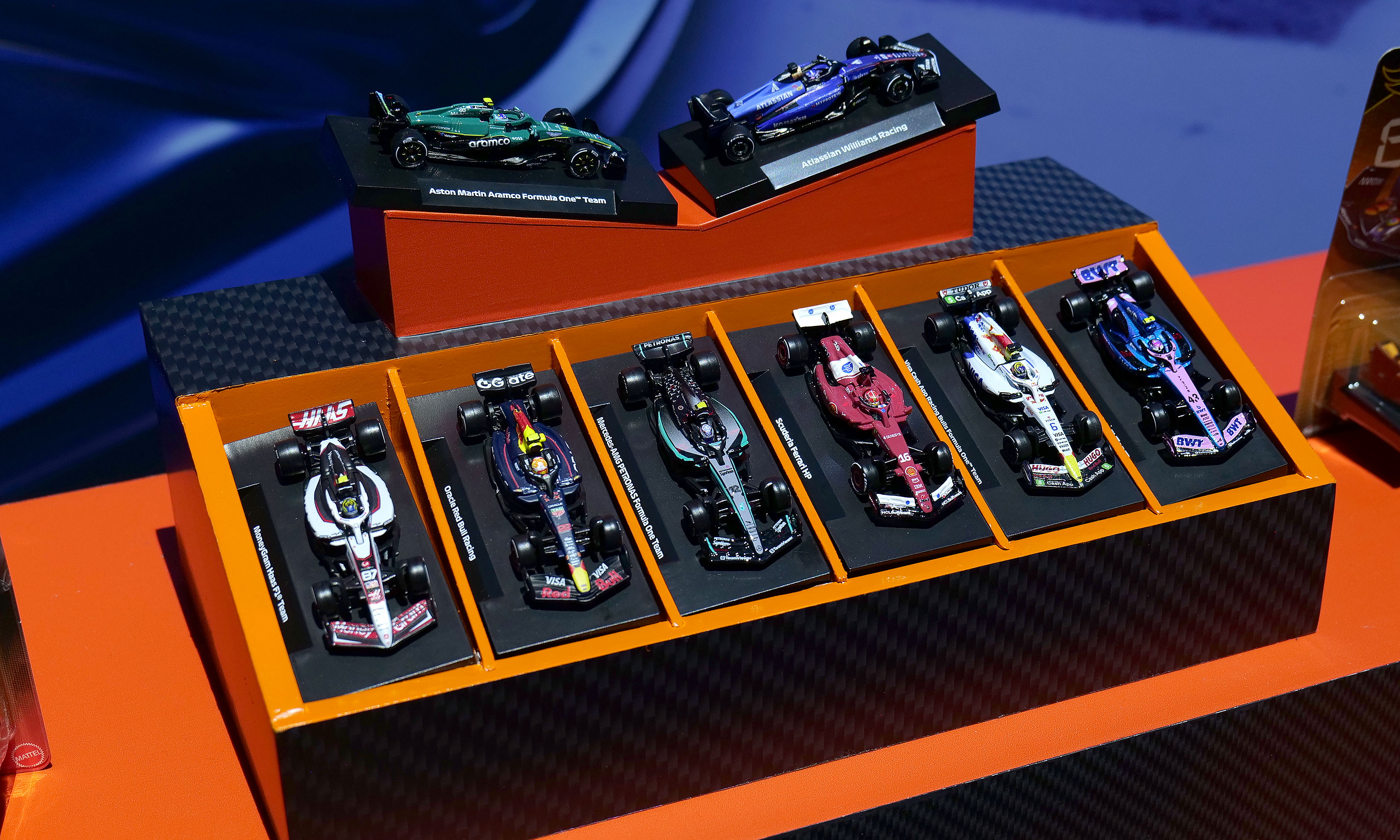
A collection of some of the new F1 Hot Wheels cars for 2026.
Sam Rutherford for Engadget
Hot Wheels has big plans for 2026 including a new line of Pantone-colored cars, Brick Shop models like the Elite Series Aston Martin (which comes with its own 1:64 scale car) and a Monster Truck Mutant Chaos set with actual slime. However, I’d argue the company’s new F1 offerings are the cream of the crop. Not only are there a bunch of incredibly detailed 1:64 scale racecars with metal bodies, real rubber tires and accurate livery for all the big teams, there’s also a new Downhill Circuit Race course that comes with three official vehicles (Mercedes, Haas and Ferrari) featuring multiple levels and the ability to overtake or crash into other cars. If you’re like a lot of Americans who have recently fallen down the F1 rabbit hole due to Netflix’s Drive to Survive, these new officially licensed miniatures are sure to hit the spot.
The first five-pack set of cars is available now, with more arriving later this spring before the Downhill Circuit Race course drives by sometime this fall.
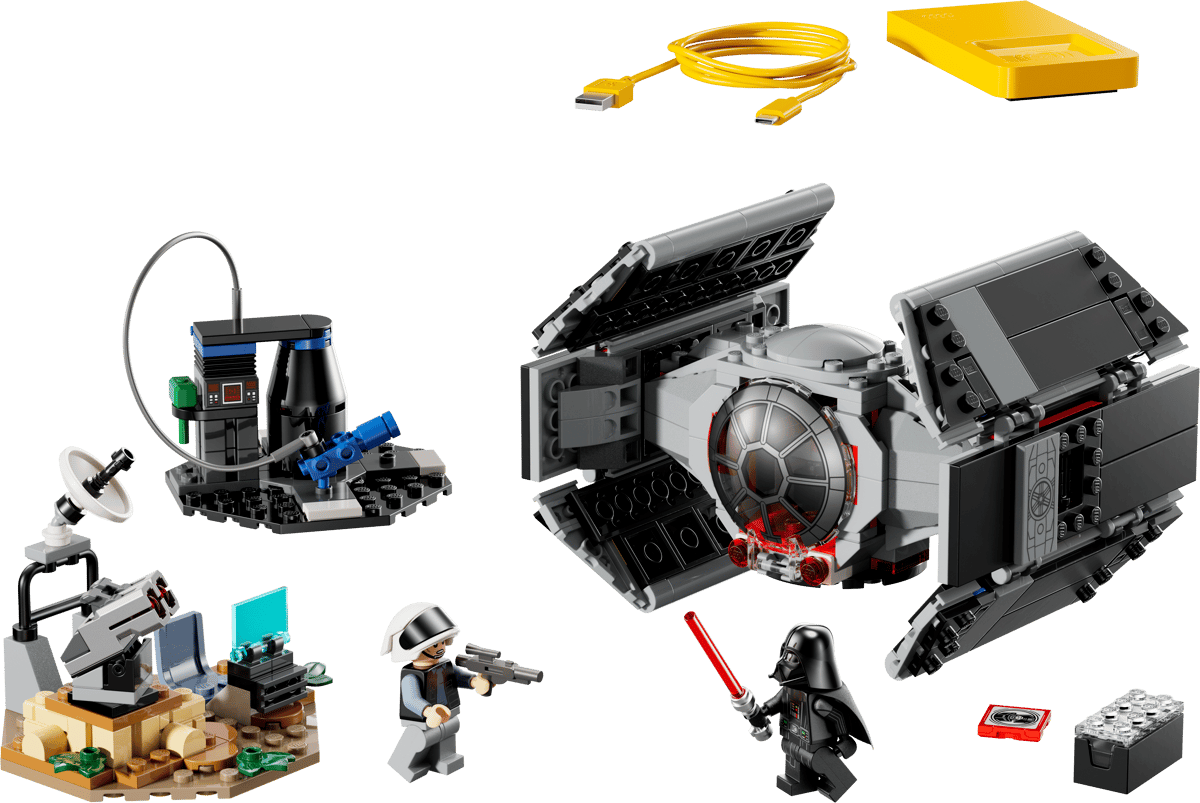
Darth Vader’s TIE fighter is an all-in-one set, which means it comes included with one of Lego’s Smart Bricks, which isn’t true for every kit.
Lego
We’ve been eagerly awaiting the first batch of playsets featuring Lego’s nifty Smart Brick after it debuted at CES. But now that the company has detailed eight new sets featuring its latest innovation, we’re even more intrigued. For me, the three standout kits are the Millennium Falcon, Luke’s Red Five X-Wing and Darth Vader’s TIE fighter because acting out the Death Star trench run complete with reactive lights and sounds will never get old. I also have a soft spot for the Ewok minifigs that come with the AT-ST set. Alternatively, the Mos Eisley Cantina kit seems like a great way to highlight the smart brick’s ability to play music or kick out some rowdy droids. The one thing to look out for, though, is the tag on the set that says whether it’s Smart Play compatible or if it’s an all-in-one set, because the former will need Smart Bricks from other kits to deliver Lego’s newfound interactivity.
Pre-orders for these are live now, with sets slated to ship on March 1.
All the new K-pop Demon Hunters toys
The HUNTR/X Battle Rumi Deluxe Fashion Doll (right) might be my favorite of the bunch.
Sam Rutherford for Engadget
Rumi, Mira and Zoey may have been the biggest breakout stars of 2025 and Mattel is looking to keep that momentum going with a ton of new toys and figures for everyone’s favorite demon hunters. There are three new singing dolls that can belt out the trio’s hit “Golden” at the touch of a button and a deluxe figure of Rumi complete with her Four Tiger Sword. There are also a ton of other dolls and miniatures showcasing HUNTR/X, the Saja Boys and more. The one downside is that these products aren’t coming out until the fall, so you’ll have to tide yourself over with other K-pop-themed products for now.
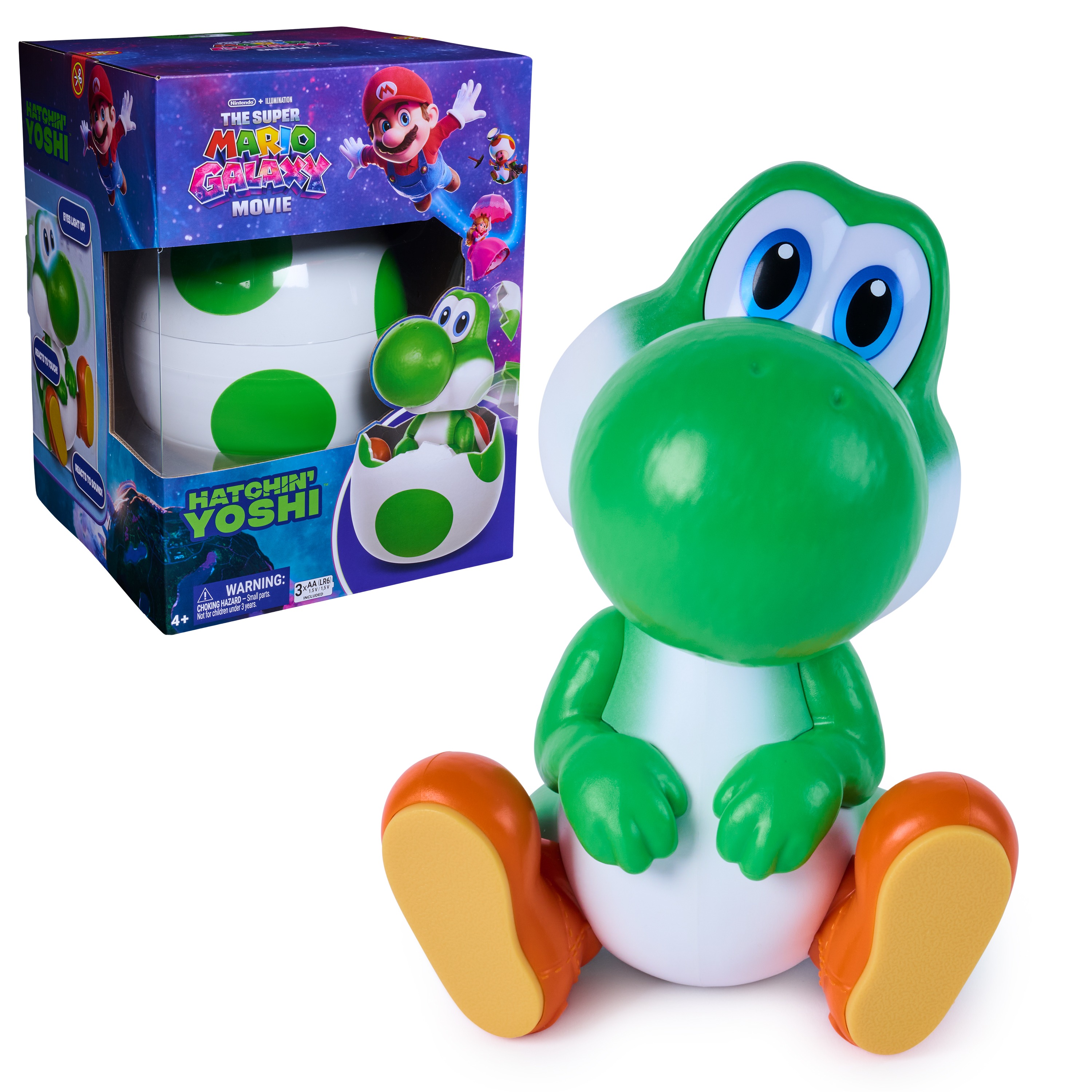
If Rosalina isn’t careful, Yoshi will become the biggest draw of the new Mario movie.
Spin Masters
Yoshi seems poised to steal the spotlight from Rosalina in the upcoming Super Mario Galaxy Movie and this release from Spin Masters is only reinforcing the lovable green dino’s aura. From inside his shell, Yoshi can burst out with his signature yell. After that, you can pat his nose to make his eyes light up or get him to rock when he’s really happy. But if you want one, you’re going to have to be vigilant. Pre-orders are already sold out, so you’ll need to keep a close eye on retailers like Walmart when he officially goes on sale on February 20.
Not only do the SolarFlowers look great, they’re educational too.
Thames & Kosmos
Technically, these went on sale last month, but Thames & Kosmos’ SolarFlowers caught my eye again at Toy Fair due to their combination of art and science. Available in four different styles, each kit features a model that you can build yourself or with your kids (recommended age 8+) that turns into a lasting showpiece. After putting the kinetic sculpture together, you can connect the included solar panel to bring the whole kit to life (no batteries required) and make the flowers spin for perpetual entertainment.
Honorable mentions
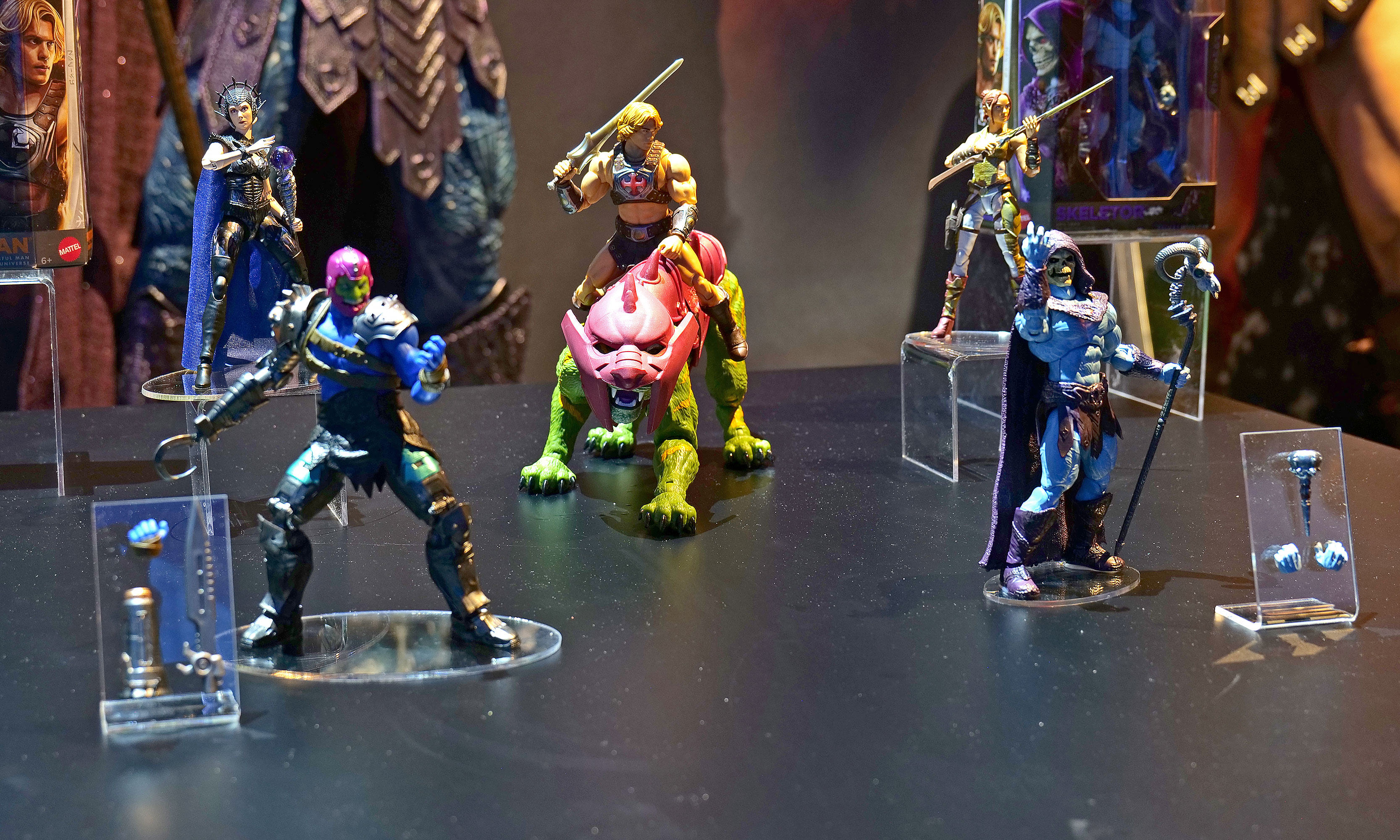
Upcoming Masters of the Universe figures
Some upcoming figures from Mattel’s line of Masters of the Universe figures.
Sam Rutherford for Engadget
As someone who grew up during the 80s and 90s, I’m trying to be optimistic about He-Man’s return to the big screen later this summer and Mattel’s new line of figures is certainly helping. To help prime people for the movie, there’s a big range of upcoming toys highlighting He-Man, Skeletor, Battle Cat and more, all of which I would have absolutely loved as a kid. Those will be available later this spring.
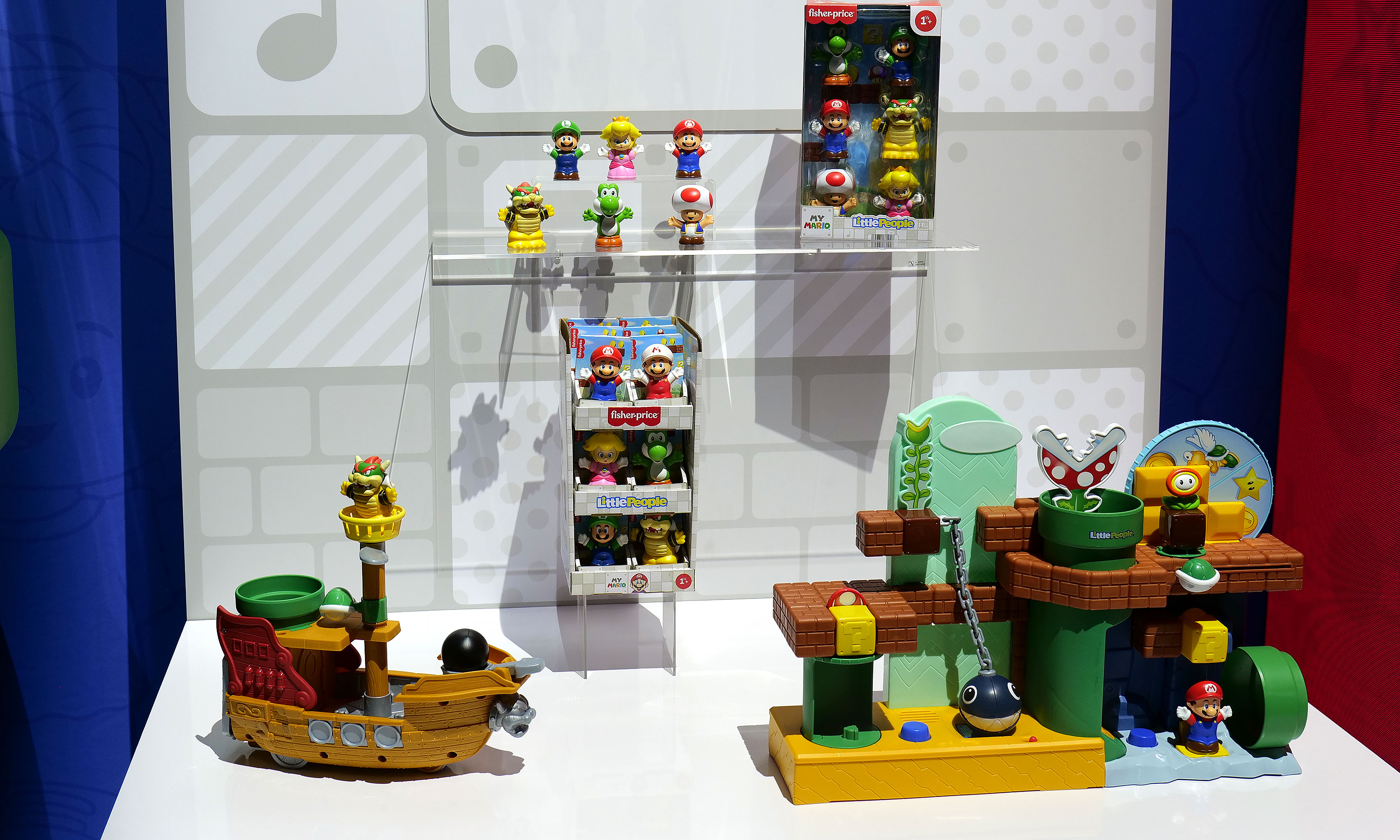
It’s hard to gauge the excitement of toys aimed at one-year-olds when they can’t read or get into Toy Fair. But as the parent of a toddler, I adore the partnership between Fisher-Price and Nintendo that has resulted in a line of Mario-themed Little People. All the big names are here, including Peach, Luigi and Bowser and there’s even a couple of super cute playsets to go with them. But perhaps the best part is that a six-pack of figures and Bower’s Airship costs under $25, which means your kid could be in for hours of fun without you spending a ton of money.
This article originally appeared on Engadget at https://www.engadget.com/entertainment/here-are-my-favorite-things-from-toy-fair-2026-183356720.html?src=rss
Despite the popular notion that the modern economy runs around the clock, a new NBER working paper analyzing fifty years of U.S. labor data from 1973 to 2023 finds that Americans have been steadily and consistently moving away from evening and night work toward traditional daytime hours [PDF].
The share of the workforce on the job at 11PM, for instance, fell by over 25% from its 1970s level. Economists Jeff Biddle and Daniel Hamermesh argue the primary driver is rising real incomes — night work is essentially an inferior good that workers avoid as they earn more. The wage premium employers must pay for undesirable hours has grown by about three percentage points over the period.
One sector bucked the trend: retail, where the rise of big-box chains, 24-hour Walmart supercenters and overnight distribution center restocking pushed more employees into late-night and early-morning shifts. The Covid-era surge in telework, rather than spreading work across the day, actually accelerated the concentration into prime hours — especially among college-educated workers. France showed a similar pattern of daytime compression over 1966-2010, but the U.K. did not, likely because rapid de-unionization there eliminated the union wage premiums that had made night work comparatively attractive.
Ring CEO Jamie Siminoff has indicated that the company’s controversial Search Party feature might not always be just for lost dogs, according to emails obtained by 404 Media. A creepy surveillance tool being used to surveil. Who could have predicted that?
“I believe that the foundation we created with Search Party, first for finding dogs, will end up becoming one of the most important pieces of tech and innovation to truly unlock the impact of our mission,” Siminoff wrote in an email to staffers. “You can now see a future where we are able to zero out crime in neighborhoods. So many things to do to get there but for the first time ever we have the chance to fully complete what we started.”
The Ring<->Flock partnership is even worse than imagined, it was setup to be a AI powered mass surveillance system from the start. See this email from the Ring Founder, Jamie Siminoff (https://t.co/kLbZdR6Is1) pic.twitter.com/W9TFQpriRh
The words “zero out crime in neighborhoods” are particularly troubling. It is, however, worth noting that this is just an email and doesn’t necessarily indicate a plan by the company. Siminoff wrote the email back in October when Search Party first launched, which was months before the public backlash started. He did end the thread by noting he couldn’t “wait to show everyone else all the exciting things we are building over the years to come.”
One of those things could be the recently-launched “Familiar Faces” tool, which uses facial recognition to identify people that wander into the frame of a Ring camera. It seems to me that a combination of the Search Party tech, which uses the combined might of connected Ring cameras, with the Familiar Faces tech could make for a very powerful surveillance tool that excels at finding specific individuals.
Siminoff also suggested in an earlier email to staffers that Ring technology could have been used to catch Charlie Kirk’s killer by leveraging the company’s Community Requests feature. This is a tool that allows cops to ask camera owners for footage, thanks to a partnership with the police tech company Axon.
Ring had planned an expansion of this program via a partnership with a surveillance company called Flock Safety. The companies canceled this partnership after a Super Bowl ad spotlighting the Search Party tool triggered public outcry. Ring didn’t cite public sentiment for this decision, rather saying the integration would require “significantly more time and resources than anticipated.”
Ring has responded to 404 Media’s reporting, saying in an email that Search Party “does not process human biometrics or track people” and that “sharing has always been the camera owner’s choice.” This response did not provide any information as to what the future will hold for the company’s toolset.
This article originally appeared on Engadget at https://www.engadget.com/big-tech/ring-could-be-planning-to-expand-search-party-feature-beyond-dogs-175805706.html?src=rss
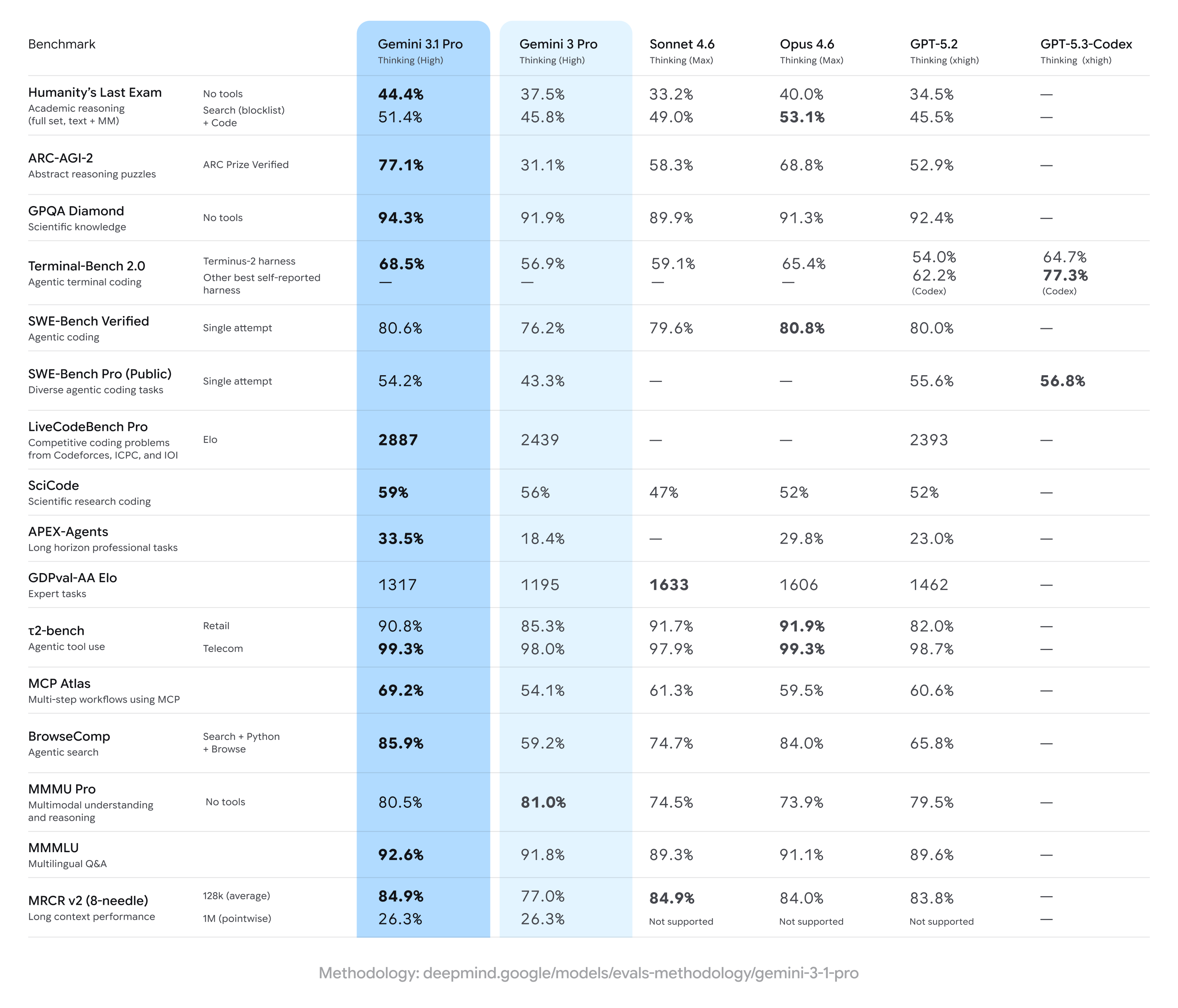
Another day, another Google AI model. Google has really been pumping out new AI tools lately, having just released Gemini 3 in November. Today, it’s bumping the flagship model to version 3.1. The new Gemini 3.1 Pro is rolling out (in preview) for developers and consumers today with the promise of better problem-solving and reasoning capabilities.
Google announced improvements to its Deep Think tool last week, and apparently, the “core intelligence” behind that update was Gemini 3.1 Pro. As usual, Google’s latest model announcement comes with a plethora of benchmarks that show mostly modest improvements. In the popular Humanity’s Last Exam, which tests advanced domain-specific knowledge, Gemini 3.1 Pro scored a record 44.4 percent. Gemini 3 Pro managed 37.5 percent, while OpenAI’s GPT 5.2 got 34.5 percent.
YouTube’s “Ask” button is making its way to the living room. The Gemini-powered feature is now rolling out as an experiment on smart TVs, gaming consoles and streaming devices. 9to5Google first spotted a Google support page announcing the change.
Like on mobile devices and desktop, the feature is essentially a Gemini chatbot trained on each video’s content. Selecting that “Ask” button will bring up a series of canned prompts related to the content. Alternatively, you can use your microphone to ask questions about it in your own words.
The “Ask about this video” feature on desktop
YouTube
Google says your TV remote’s microphone button (if it has one) will also activate the “Ask” feature. The company listed sample questions in its announcement, such as “what ingredients are they using for this recipe?” and “what’s the story behind this song’s lyrics?”
The conversational AI tool is only launching for “a small group of users” at first. Google promises that it will “keep everyone up to speed on any future expansions.”
This article originally appeared on Engadget at https://www.engadget.com/ai/youtube-is-bringing-the-gemini-powered-ask-button-to-tvs-173900295.html?src=rss
A new study [PDF] from Ramp’s economics lab has found that businesses are steadily replacing freelance workers hired through platforms like Upwork and Fiverr with AI tools from OpenAI and Anthropic, and the substitution is happening at a fraction of the cost.
The paper, authored by Ryan Stevens, Ramp’s Director of Applied Sciences, tracked firm-level spending data from Q3 2021 to Q3 2025 across thousands of companies on Ramp’s expense management platform. The share of total business spend going to online labor marketplaces fell from 0.66% in Q4 2021 to 0.14% in Q3 2025, while AI model provider spending rose from zero to 2.85% over the same period.
More than half the businesses that used freelance marketplaces in Q2 2022 had stopped entirely by Q2 2025. The cost dynamics are particularly notable. Firms most exposed to AI — those that historically spent the most on freelancers — substituted at a rate of roughly $1 in reduced freelance spend for every $0.03 in AI spend. A middle-exposure group showed a ratio of $1 to $0.30. The study uses a difference-in-differences design built around the launch of ChatGPT in October 2022 as a natural experiment. Stevens notes that micro-level substitution does not imply aggregate job loss, as demand for workers who build and maintain AI systems could grow faster than displacement.