
Oracle outlines a new community engagement strategy for MySQL, promising greater transparency, ecosystem growth, and renewed focus on the Community Edition.
Category Archives: Unfiltered RSS
Google Announces Gemini 3.1 Pro For ‘Complex Problem-Solving’
Google has introduced Gemini 3.1 Pro, a reasoning-focused upgrade aimed at more complex problem-solving. 9to5Google reports: This .1 increment is a first for Google, with the past two generations seeing .5 as the mid-year model update. (2.5 Pro was first announced in March and saw further updates in May for I/O.) Google says Gemini 3.1 Pro “represents a step forward in core reasoning.” The “upgraded core intelligence” that debuted last week with Gemini 3 Deep Think is now available in Gemini 3.1 Pro for more users. This model achieves an ARC-AGI-2 score of 77.1%, or “more than double the reasoning performance of 3 Pro.”
This “advanced reasoning” translates to practical applications like when “you’re looking for a clear, visual explanation of a complex topic, a way to synthesize data into a single view, or bringing a creative project to life.” 3.1 Pro is designed for tasks where a simple answer isn’t enough, taking advanced reasoning and making it useful for your hardest challenges.


Read more of this story at Slashdot.
Rumors Suggest Apple and Meta Are Betting Big on AI Wearables
We may earn a commission from links on this page.
The next generation of Meta’s Display smart glasses might come with a smart watch. According to a report from The Information, Meta’s watch, codenamed Malibu 2, could feature fitness tracking features and AI, but its real purpose is to replace the Display’s neural band and act as controller for the smart glasses. If the reports are accurate, Meta Display smart glasses with a smart watch could be available in 2026.
There aren’t any other details on the smart watch, so we don’t know the price or what features it may have—but I’d be surprised if this rumor doesn’t pan out eventually. Meta has discussed the idea of a smart watch before, and it makes sense: If you’re going to have a wrist-controller for your glasses, why not give it smart watch features as well? Especially if a glasses-and-watch combo potentially gives users a reason to switch away from their Apple Watches.
Apple is reportedly working on AI wearables too
Speaking of Apple, if the rumors about the company are true, Apple is pushing to release its own suite of AI-powered wearable devices. According to a report in Bloomberg, Apple could roll out smart glasses in early 2027. The company is also reportedly developing an AI-powered pendant that can “be pinned to a shirt or worn as a necklace,” as well as AirPods with expanded AI capabilities. The AirPods and pendant will be equipped with cameras designed to “help the AI work” as opposed to taking photos. Apple’s smart glasses will reportedly not feature a display, but will feature a higher end camera and superior build quality to Meta’s smart glasses. All of Apple’s devices are reportedly designed to work with iPhones.
Is the wearable war heating up?
None of this is confirmed, of course. The closest Apple has come to announcing these plans is CEO Tim Cook mentioning “categories of products” enabled by artificial intelligence at an all-hands meeting. However, everything points to Meta and Apple betting that consumers want a collection of connected AI-wearables. Each company is taking a different approach to hooking users into their ecosystem. Apple seems to be betting on devices integrated with iPhones and controlled with the kind of camera-based tech that powers the Apple Vision Pro headset. Meta seems to be aiming at replacing phones with an in-glasses display, and a biometric control scheme that works with muscle movements, like the existing neural band.
Both Meta and Apple seem to be competing to go beyond a screen or smart glasses to become the next interface for your life—but do people want that? Are consumers excited enough by the prospect of always-available AI and tied-together devices to buy them? That’s the big question, and the answer is anything but certain. Both Apple and Meta have made big bets on virtual reality, and, despite both companies’ VR devices being excellent, neither seems to have captured the market in way these firms would have liked. So, as they say, stay tuned.
Why I Contributed to FOSS Force’s ‘Independence 2026’ Fundraiser
Ken Starks once wrote here every week. Now he’s back to tell you why FOSS Force still matters, why independence isn’t free, and why he’s chosen to contribute to this year’s drive.
The post Why I Contributed to FOSS Force’s ‘Independence 2026’ Fundraiser appeared first on FOSS Force.
Apple inks deal for IMAX screenings of live Formula 1 races
Formula 1 has been receiving star treatment from Apple for awhile, and now the racing series will literally be getting even bigger. Apple is partnering with IMAX to show five races from the 2026 season. The Miami Grand Prix on May 3, the Monaco Grand Prix on June 7, the British Grand Prix on July 5, the Italian Grand Prix on September 6 and the United States Grand Prix on October 25 will be aired live at select IMAX theaters in the US.
Apple landed a five-year deal for the US broadcast rights to Formula 1 last fall and there’s already a dedicated channel for the car races on Apple TV ahead of the season’s start. It also got the rights for a splashy feature film about the racing league, which amassed more than $630 million at the global box office, including with some IMAX screenings. It’s unclear if IMAX will be paying to host more live F1 races at its theaters in future years, but it should be a fun way for fans to get the most immersive experience possible short of actually attending the racetrack.
This article originally appeared on Engadget at https://www.engadget.com/entertainment/apple-inks-deal-for-imax-screenings-of-live-formula-1-races-234003582.html?src=rss
Meta’s metaverse is going mobile-first
Meta is formally sectioning off Horizon Worlds, the closest thing it has to a metaverse, from its Quest VR platform, according to a new blog post from Samantha Ryan, Meta’s VP of Content, Reality Labs. While the decision runs counter to Meta’s original plan to own an immersive virtual world that could serve as the future home for all online interaction, it fits with the recent cuts it made to its costly Reality Labs division, and Mark Zuckerberg’s public commitment to focus the company on AI hardware like smart glasses going forward.
“We’re explicitly separating our Quest VR platform from our Worlds platform in order to create more space for both products to grow,” Ryan writes in the blog post. “We’re doubling down on the VR developer ecosystem while shifting the focus of Worlds to be almost exclusively mobile. By breaking things down into two distinct platforms, we’ll be better able to clearly focus on each.”
Meta has been developing mobile and web versions of Horizon Worlds in parallel with its VR app since at least 2023. Switching Worlds to being a mobile-first software platform isn’t good for VR diehards, but it does make it a more natural competitor to something like Roblox or Fortnite, which also offer user-created and monetizable worlds and games. It’s also a business Meta believes it can more easily scale because of its ability to connect games to “billions of people on the world’s biggest social networks.”
While Meta shuttered several of its own VR game studios earlier this year, it still wants to support third-party developers publishing games on its platform. The company says new monetization tools, better discoverability, a “Deals” tab and more ways for developers to talk to their customers should help make a difference. Maintaining the Quest’s library of games could also be critical going forward. Business Insider reported in December 2025 that Meta was working on a gaming-focused Quest headset, and Meta CTO Andrew Bosworth confirmed earlier this February that the company still had multiple Quest devices on its roadmap.
This article originally appeared on Engadget at https://www.engadget.com/ar-vr/metas-metaverse-is-going-mobile-first-233030532.html?src=rss
Linus T tells The Reg how Linux solo act became a global jam session
Ts’o, Hohndel and the man himself spill beans on how checks in the mail and GPL made it all possibleIf you know anything about Linux’s history, you’ll remember it all started with Linus Torvalds posting to the Minix Usenet group on August 25, 1991, that he was working on “a (free) operating system (just a hobby, won’t be big and professional like gnu) for 386(486) AT clones.” We know that the “hobby” operating system today is Linux, and except for PCs and Macs, it pretty much runs the world.…
Minecraft Java Is Switching From OpenGL To Vulkan
Minecraft: Java Edition is switching its rendering backend from OpenGL to Vulkan as part of the upcoming Vibrant Visuals update, aiming for both better performance and modern graphics features across platforms like Linux and macOS (via translation layers). GamingOnLinux reports: For modders, they’re suggesting they start making preparations to move away from OpenGL: “Switching from OpenGL to Vulkan will have an impact on the mods that currently use OpenGL for rendering, and we anticipate that updating from OpenGL to Vulkan will take modders more effort than the updates you undertake for each of our releases. To start with, we recommend our modding community look at moving away from OpenGL usage. We encourage authors to try to reuse as much of the internal rendering APIs as possible, to make this transition as easy as possible. If that is not sufficient for your needs, then come and talk to us!”
It does mean that players on really old devices that don’t support Vulkan will be left out, but Vulkan has been supported going back to some pretty old GPUs. You’ve got time though, as they’ll be rolling out Vulkan alongside OpenGL in snapshots (development releases) “sometime over the summer.” You’ll be able to toggle between them during the testing period until Mojang believe it’s ready. OpenGL will be entirely removed eventually once they’re happy with performance and stability.


Read more of this story at Slashdot.
I Was Skeptical of This Music App That Claims to Help With Focus, but It Actually Worked for Me
Sometimes a life hack works when I wish it didn’t. I, for example, am vulnerable to depression and anxiety. I also passionately hate running. I have, unfortunately, discovered that running regularly helps my mental health a great deal. I’m thankful (because I feel better) and resentful (because I have to run).
This is how I feel about Brain.fm, a music service I discovered a couple weeks ago when the company got in touch with me. I started using the service, mostly for the purposes of writing this article, and something unexpected happened: I noticed it’s a great deal easier to get started on my work in the morning. I like this (because I’m getting more done) but am also annoyed (because I’d rather be listening to the music I love).
Credit: Justin Pot
It’s a conundrum. Brain.fm is a subscription service that costs $14.99 per month, more than Spotify (which costs $12.99 per month). The product sells itself as having a collection of music backed by scientific research to increase your ability to focus, meditate, and sleep. There’s also a free trial, meaning you can get a feel for whether it works for you.
After a few weeks of testing, I feel it might be onto something. I don’t always trust my intuition, though, so I wanted to dig deeper. Is this for real? Or am I falling for snake oil? More importantly: can I go back to listening to KEXP in the morning?
Is the science behind Brain.fm legit?
After a few days of using the application, I couldn’t help but wonder. Is my increased focus real? Or is it a placebo?
So I wrote to Daniel J. Levitin, professor emeritus of neurology at McGill University, and author of This Is Your Brain on Music: The Science of a Human Obsession. He replied quickly, and concisely: “It’s all placebo,” he said.
It was a very concise email from an academic about a complex topic, which as a journalist is always nice. But Levitin didn’t stop there—he told me to get in touch with another neuroscientist, one who had published research on this type of modulated music. I’ll say more below about that research, but first, let’s take a look at what’s actually in those Brain.fm tracks.
What using Brain.fm is like
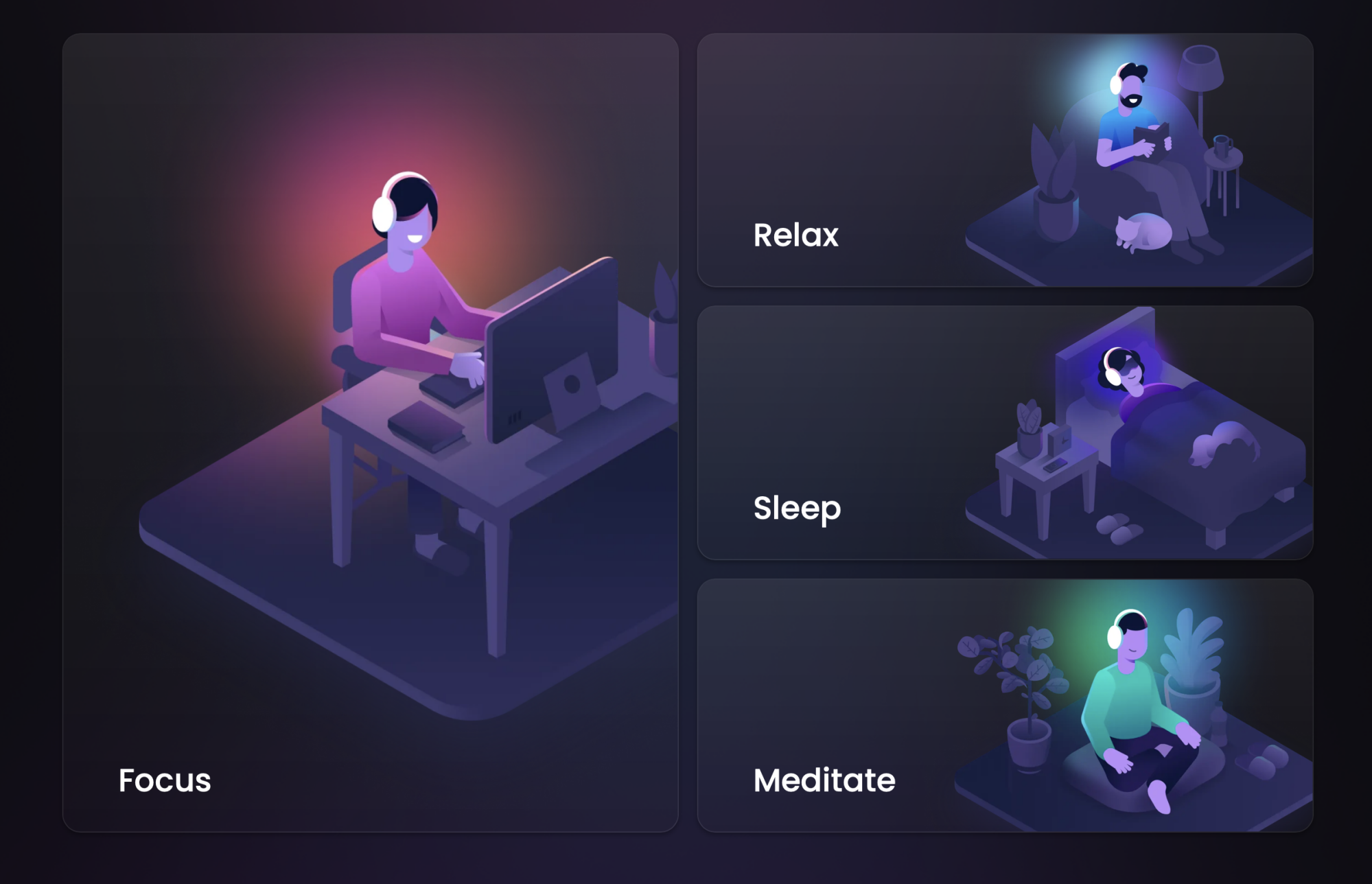
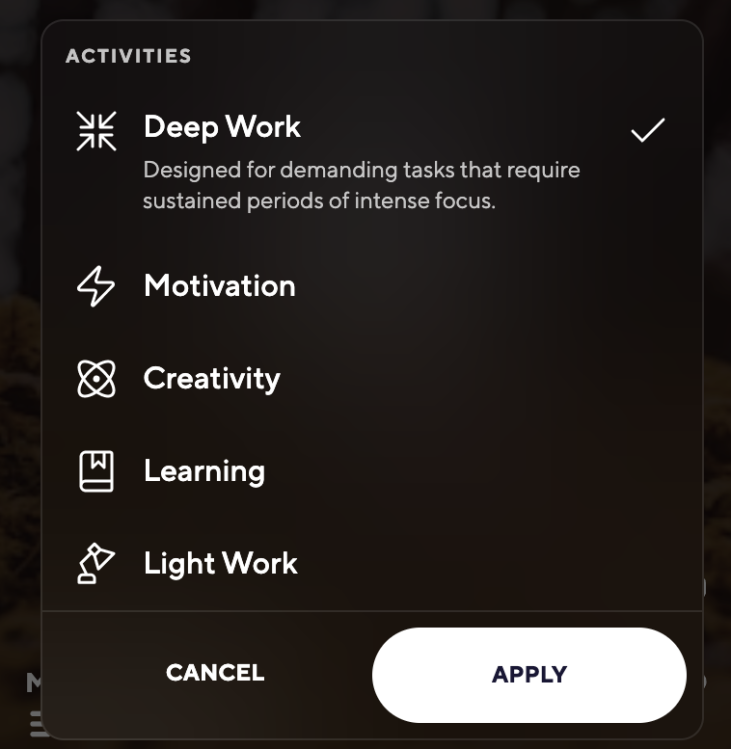
You can’t use this service to search for a specific artist—you instead let the application know what you’re trying to do (Focus, Relax, Meditate, or Sleep). In the Focus section, there are a few sub-options: Deep Work, Motivation, Creativity, Learning, and Light Work. Choose what you want to do and a track will start playing.
Credit: Justin Pot
The genres, such as they are, range from the kind of “chill beats” you can find on YouTube to post-rock and symphonic—though it’s all instrumental.
“The basic problem is that most music is made to grab your attention,” Kevin Woods, a neuroscience PhD who works for Brain.fm, told me. “If you talk to a music producer, they’ll tell you that their job is to make things punchy and bright, and to make somebody sit up and turn their head and favorite the song on Spotify.”
That attention seeking can make playing music during the work day distracting in a subtle way, according to Woods. “The problem is that a lot of the distraction is not overt in the sense of, ‘I can feel my attention breaking and I have to turn this off or turn down the volume’—it’s more like, ‘I’m working at 70, 80% capacity, and I’m not really sure why.'”
So the music at Brain.fm is written and performed by in-house composers who are intentionally trying not to keep your attention. But that alone doesn’t really set Brain.fm apart from using ambient music or video game soundtracks to focus, let alone the various “chill beats” playlists and live streams that are out there. And that’s where Brain.fm’s scientific claims come in.
Brain.fm says the key is “amplitude modulation”
Brain.fm points to several scientific studies on its homepage, also mentioning that its research was in part funded by that National Science Foundation. A lot of the claims are based on “amplitude modulation,” which Woods told me is what sets Brain.fm’s music apart.
But what is amplitude modulation? They’re “fast modulations added that do not usually occur in music,” according to Woods. If you listen to the music for a bit, you’ll hear an almost fluttering kind of sound. These sounds, which are added to compositions in post-production using AI, are available at three different levels for each track. The “ADHD Mode,” which is the highest of the three settings, is what I mostly used while testing.
I find this effect a little bit disorienting, so I sometimes needed to turn the setting down. It’s hard to deny the effect is a musical signature of Brain.fm. But does it work?
Research on amplitude modulation is limited, but promising
I became a bit less skeptical of the science after getting in touch with the expert that Levitin recommended: Psyche Loui, a neuroscientist, musician, and Associate Dean of Research at Northeastern University. Loui told me that “it’s not all placebo”, pointing to a paper she published alongside Woods and other neurologists in Communications Biology.
Now, to be clear, it’s not unusual for scientists to disagree about how things work—that’s part of the process. And the claims made by the paper are narrow—the conclusion is that music with amplitude modulation can help people focus on tasks when compared to both pink noise and music without amplitude modulation. The control music, according to Woods, were the same tracks—the only difference was whether amplitude modulation was added. The results of testing, and brain scans, suggest the effect is real.
“We did something which is rarely done in music research, which is a very well-controlled study that only changes one factor in the music,” Woods told me. As with all scientific research, there’s always more to learn. But to me, a study making these claims published in a Nature-affiliated publication suggests there might be something to this.
At the very least, Brain.fm helped me reflect on my relationship with music at work
Brain.fm, if nothing else, has been an opportunity to reflect on my relationship with music. I really enjoy discovering new music during the workday, but after using Brain.fm for a few weeks I wonder if that might have been the reason I have trouble focusing in the morning.
Maybe it’s best to listen to music that fades into the background when it’s time to focus, and save music discovery for when I only need part of my brain. And maybe I should save the music I really love for when I’m not working at all. Brain.fm, if nothing else, taught me that.
But I also find that the music really does work when I need to focus. I still am not fully sure if the effect is real, or if any music that blends into the background would do the job. I sometimes play the entire Boards of Canada discography when I need to focus, and find that works about as well.
All that having been said, I really think anyone who has read this much about Brain.fm should probably go ahead and see for themselves.
Lawsuit: ChatGPT told student he was “meant for greatness”—then came psychosis
A Georgia college student named Darian DeCruise has sued OpenAI, alleging that a recently deprecated version of ChatGPT “convinced him that he was an oracle” and “pushed him into psychosis.”
This case, which was first reported by ALM, marks the 11th such known lawsuit to be filed against OpenAI that involves mental health breakdowns allegedly caused by the chatbot. Other incidents have ranged from highly questionable medical and health advice to a man who took his own life, apparently after similarly sycophantic conversations with ChatGPT.
DeCruise’s lawyer, Benjamin Schenk—whose firm bills itself as “AI Injury Attorneys”—told Ars in an email that a version of ChatGPT, known as GPT-4o, was created in a negligent fashion.
IRS Loses 40% of IT Staff, 80% of Tech Leaders In ‘Efficiency’ Shakeup
The IRS’s IT division has reportedly lost 40% of its staff and nearly 80% of its tech leadership amid a federal “efficiency” overhaul, the agency’s CIO revealed yesterday. The Register reports: Kaschit Pandya detailed the extent of the tech reorganization during a panel at the Association of Government Accountants yesterday, describing it as the biggest in two decades. … The IRS lost a quarter of its workforce overall in 2025. But the tech team was clearly affected more deeply. At the start of the year, the team encompassed around 8,500 employees.
As reported by Federal News Network (FNN), Pandya said: “Last year, we lost approximately 40 percent of the IT staff and nearly 80 percent of the execs.” “So clearly there was an opportunity, and I thought the opportunity that we needed to really execute was reorganizing.” That included breaking up silos within the organization, he said. “Everyone was operating in their own department or area.”
It is not entirely clear where all those staff have gone. According to a report by the US Treasury Inspector General for Tax Administration, the IT department had 8,504 workers as of October 2024. As of October 2025, it had 7,135. However, reports say that as part of the reorganization, 1,000 techies were detailed to work on delivering frontline services during the US tax season. According to FNN, those employees have questioned the wisdom of this move and its implementation.


Read more of this story at Slashdot.
Google Maps Now Makes You Log In to See These Key Features
I use Google Maps to get from point A to point B, but I also use it for research. It’s an essential tool for finding new restaurants to try, or for identifying well-reviewed hotels in a new area. While many use it with their Google account, others might like to keep some of their data out of Google’s hands. Using Google Maps while signed out is a good way to do that: You can find new locations of interest without having Google know you’re interested in those spots. However, if you like using Google Maps without an account, be warned: The experience is now much more limited.
As reported by 9to5Google, Google is now limiting the amount of data visible when accessing Google Maps without an account. This change includes things like images, reviews, restaurants, businesses, hotels, parks—really, most labels on the map. From what I can tell, essential labels like city names and highway identifiers are left intact, but even some street names appear to be omitted when logged out.
If you can find restaurants in limited view, you’ll see some of the data points that you’d normally find, but you’ll also notice a number missing as well. That could include labels noting whether the restaurants supports takeout or delivery, user reviews, popular times, photos and videos submitted by users, menus, as well as related locations. I tested it myself in an incognito window, scrolled randomly over Richmond, VA, and clicked the first (of few) restaurants to appear: Laura Lee’s. While I could see the total star rating (4.6), I couldn’t actually click through to any reviews. I could also only see the primary image of the restaurant. There’s enough here to decide whether or not to call, but it’s missing a ton of the data points you’d usually rely on to consider a spot for lunch or dinner.

Credit: Jake Peterson
Google doesn’t necessarily pin the limited view on you being logged out, however. If you check the “Help” pop-up that appears here, titled “Seeing a limited view of Google Maps,” the company explains that there are a few reasons you might be seeing this view. That could include issues with Google Maps itself, unusual traffic from your computer or network, or browser extensions that might be interfering with Google Maps. Only after it lists these reasons does Google suggest that signing in to Google Maps “might help you avoid seeing this limited experience again.”
Of course, logging in brings all this data back as you’d expect, and if you always use Google Maps with your Google account, you’ll never notice the difference. But it’s an interesting line in the sand for Google to draw. How many people who use Google Maps without an account will know this is the reason why their experience just got worse? Perhaps they’ll flock to another option, though there aren’t many. Apple users have Apple Maps, and there’s always Waze—but, surprise, it’s owned by Google too.
Mark Zuckerberg Grilled On Usage Goals and Underage Users At California Trial
An anonymous reader quotes a report from the Wall Street Journal: Meta Chief Executive Mark Zuckerberg faced a barrage of questions about his social-media company’s efforts to secure ever more of its users’ time and attention at a landmark trial in Los Angeles on Wednesday. In sworn testimony, Zuckerberg said Meta’s growth targets reflect an aim to give users something useful, not addict them, and that the company doesn’t seek to attract children as users. […] Mark Lanier, a lawyer for the plaintiff, repeatedly asked Zuckerberg about internal company communications discussing targets for how much time users spend with Meta’s products. Lanier showed an email from 2015 in which the CEO stated his goal for 2016 was to increase users’ time spent by 12%. “We used to give teams goals on time spent and we don’t do that anymore because I don’t think that’s the best way to do it,” Zuckerberg said on the witness stand in sworn testimony.
Lanier also asked Zuckerberg about documents showing Meta employees were aware of children under 13 using Meta’s apps. Zuckerberg said the company’s policy was that children under 13 aren’t allowed on the platform and that they are removed when identified. Lanier showed an internal Meta email from 2015 that estimated 4 million children under 13 were using Instagram. He estimated that figure would represent approximately 30% of all kids aged 10 to 12 in the U.S. In response to a question about his ownership stake in Meta, which amounts to roughly more than $200 billion, Zuckerberg said he has pledged to donate most of his money to charity. “The better that Meta does, the more money I will be able to invest in science research,” he said.
[…] On the stand, Zuckerberg was also asked about his decision to continue to allow beauty filters on the apps after 18 experts said they were harmful to teenage girls. The company temporarily banned the filters on Instagram in 2019 and commissioned a panel of experts to review the feature. All 18 said they were damaging. Meta later lifted the ban but said it didn’t create any filters of its own or recommend the filters to users on Instagram after that. “We shouldn’t create that content ourselves and we shouldn’t recommend it to people,” Zuckerberg said. But at the same time, he continued, “I think oftentimes telling people that they can’t express themselves like that is overbearing.” He also argued that other experts had thought such bans were a suppression of free speech. By focusing on the design of Meta’s apps rather than the content posted in them, the case seeks to get around longstanding legal doctrine that largely shields social-media companies from litigation. At times, the case has veered into questions of content, prompting Meta’s lawyers to object.


Read more of this story at Slashdot.
You Can Finally Back Up Your Android’s Local Files
While Android has automated, built-in backups for plenty of data, including photos, apps, and settings, local files have been excluded. In order to ensure you don’t lose PDFs, documents, and other files stored on your device, you have to manually upload or copy them to the cloud or another location. But that’s changing, at least in part: the February Google Play Services update comes with a new feature that will copy and upload your Downloads folder to Google Drive.
This is a meaningful update to Android’s backup system, but it has some limitations. Here’s what to know before enabling it.
How Android will back up your files after the update
As Android Authority describes, the local file backup feature applies only to items in your Downloads folder. It will not cover your device’s entire internal storage. The backup will go to Google Drive as a static copy, meaning that files will not be continuously synced, and if you make changes in one location, they won’t be reflected in the other. Backups will likely take place occasionally, such as when your phone is idle, charging, and connected to wifi.
Android handles videos and photos similarly with backups to Google Photos. Other device data, like your call and text history and system settings, are backed up to Google Drive.
How to check your Android backup settings
While automatic backups of local files are useful for anyone who doesn’t already have a comprehensive backup plan (and if you don’t, you should), they could potentially take up a significant amount of space in your Google Drive storage. If you keep lots of invoices, tickets, documents, or installers in your Downloads folder, you may want to be more selective about what you back up and where—especially if you already pay for extra Drive capacity and need it for other purposes.
Thankfully, file backups are disabled by default. To turn them on, go to Settings > Google Backup and select Downloads. You can also change your backup preferences for photos and videos and “other device data” from this menu. Note that this feature is expected to be rolled out gradually and may not be available on your device immediately.
NASA chief classifies Starliner flight as “Type A” mishap, says agency made mistakes
NASA on Thursday announced it has formally classified the 2024 crewed flight of the Starliner spacecraft as a “Type A” mishap, an acknowledgement that the test flight was a serious failure.
As part of the announcement, NASA Administrator Jared Isaacman sent an agency-wide letter that recognized the shortcomings of both Starliner’s developer, Boeing, as well as the space agency itself. Starliner flew under the auspices of NASA’s Commercial Crew Program, in which the agency procures astronaut transportation services to the International Space Station.
“We are taking ownership of our shortcomings,” Isaacman said.
We Look at Debian 13.3 ‘Trixie,’ the Latest From the Crown Jewel of Linux Distros
‘Trixie’ doesn’t reinvent Debian so much as reaffirm it, with updated packages, subtle polish, and the same rock‑solid base that keeps it the go‑to choice for many serious Linux users.
The post We Look at Debian 13.3 ‘Trixie,’ the Latest From the Crown Jewel of Linux Distros appeared first on FOSS Force.
Rubik’s WOWCube adds complexity, possibility by reinventing the puzzle cube
There’s something special about the gadget that “just works.” Technology can open opportunities for those devices but also complicate and weigh down products that have done just fine without things like sensors and software.
So when a product like the beloved Rubik’s Cube gets stuffed with wires, processors, and rechargeable batteries, there’s demand for it to be not just on par with the original—but markedly better.
The Cubios Rubik’s WOWCube successfully breathes fresh life into the classic puzzle, but it’s also an example of when too much technology can cannibalize a gadget’s main appeal.
China’s Hottest App of 2026 Just Asks If You’re Still Alive
A bare-bones Chinese app called “Are You Dead?” — whose entire premise is that solo-living users tap daily to confirm they’re still alive, triggering an alert to an emergency contact after two missed check-ins — has rocketed to the top of China’s app store charts and gone viral globally without spending a dime on advertising.
The app wasn’t built for the elderly, as many assumed; its creators are Gen-Z developers who said they were inspired by the isolation of urban life in a country where one-person households are expected to hit 200 million by 2030. Its rise coincided with China’s birth rate plunging to a record low. Beijing quietly removed the app from Chinese stores last month, and the developers are now crowdsourcing a new name on social media after their first rebrand attempt, “Demumu,” failed to catch on.


Read more of this story at Slashdot.
Slay the Spire 2 will enter early access on March 5
Slay the Spire 2 will launch in early access next month. This sequel to the hugely popular 2019 roguelike deckbuilder hits early access on Steam beginning March 5, 2026. Along with releasing the teaser trailer above, developer Mega Crit shared some details about its goals for this phase ahead of the game’s official release.
“Slay the Spire requires a lot of player feedback so we can balance content, add quality of life features, and make sure the game runs without issues,” the developers explained. “Early Access is also a chance for us to test experimental features, try exotic designs, identify niche problems, and helps us make sure the game is headed in the right direction.” Slay the Spire 2 is expected to be in early access for a year or two, or more generally “until the game feels great.”
Mega Crit has also revealed that it will be introducing a new co-op mode where up to four people can team up. This gameplay option will feature some unique cards just for multiplayer as well as some team-wide synergies.
Some of the characters from Slay the Spire will be returning for the sequel alongside new ones. For anyone who hasn’t yet experienced the original game, Slay the Spire is available on iOS, including as part of Apple Arcade. It’s also on consoles and PC.
This article originally appeared on Engadget at https://www.engadget.com/gaming/slay-the-spire-2-will-enter-early-access-on-march-5-210338514.html?src=rss
Children And Robots Perform Choreographed Martial Arts Routine
This is a video from China of a group of young martial artists performing a choreographed routine with little humanoid robots. Admittedly, I did like the part where the robots were flipping off of the springboard. I did not like the part where they were waving swords, even if the swords were flimsy. We shouldn’t be giving them any ideas. And, if the questions my roommate asks ChatGPT are any indication, we’re giving them lots of bad ideas.