“In August 2025, TypeScript surpassed both Python and JavaScript to become the most-used language on GitHub for the first time ever…” writes GitHub’s senior developer advocate.
They point to this as proof that “AI isn’t just speeding up coding. It’s reshaping which languages, frameworks, and tools developers choose in the first place.”
Eighty percent of new developers on GitHub use Copilot within their first week. Those early exposures reset the baseline for what “easy” means. When AI handles boilerplate and error-prone syntax, the penalty for choosing powerful but complex languages disappears. Developers stop avoiding tools with high overhead and start picking based on utility instead.
The language adoption data shows this behavioral shift:
— TypeScript grew 66% year-over-year
— JavaScript grew 24%
— Shell scripting usage in AI-generated projects jumped 206%
That last one matters. We didn’t suddenly love Bash. AI absorbed the friction that made shell scripting painful. So now we use the right tool for the job without the usual cost.
“When a task or process goes smoothly, your brain remembers,” they point out. “Convenience captures attention. Reduced friction becomes a preference — and preferences at scale can shift ecosystems.”
“AI performs better with strongly typed languages. Strongly typed languages give AI much clearer constraints…”
“Standardize before you scale. Document patterns. Publish template repositories. Make your architectural decisions explicit. AI tools will mirror whatever structures they see.”
“Test AI-generated code harder, not less.”
No one knows exactly when the vehicles we drive will finally wrest the steering wheel from us. But the age of the autonomous automobile isn’t some sudden Big Bang. It’s more of a slow crawl, one that started during the Roosevelt administration. And that’s Theodore, not Franklin. And not in America, but in Spain, by someone you’ve probably never heard of.
His name was Leonardo Torres Quevedo, a Spanish engineer born in Santa Cruz, Spain, in 1852. Smart? In 1914, he developed a mechanical chess machine that autonomously played against humans. But more than a decade earlier, he pioneered the development of remote-control systems. What he wrought was brilliant, if crude—and certainly ahead of its time.
The first wireless control
It was called the Telekino, a name drawn from the Greek “tele,” meaning at a distance, and “kino,” meaning movement. Patented in Spain, France, and the United States, it was conceived as a way to prevent airship accidents. The Telekino transmitted wireless signals to a small receiver known as a coherer, which detected electromagnetic waves and transformed them into an electrical current. This current was amplified and sent on to electromagnets that slowly rotated a switch controlling the proper servomotor. Quevedo could issue 19 distinct commands to the systems of an airship without ever touching a control cable.
Fewer than 20 per cent of riders polled by the Cyclistes Professionnels Associés (CPA) were against the UCI’s proposed gearing restriction trial, claims the body’s president, Adam Hansen.
Writing for Domestique, Hansen explains that, while the proposal didn’t come from the CPA – the union that represents professional cyclists – it supports the move because it is “committed to following the collective voice of the peloton”.
Planned to take place at the Tour of Guangxi in October, the test would have seen riders restricted to gearing limited to 10.46 metres development – roughly equivalent to a 54x11t with a 28mm tyre.
SRAM was set to be keenly affected by the UCI’s proposal. Andy Lloyd / Our Media
At the time, the BCA said the trial didn’t “meet the required conditions of objectivity and transparency” and risked creating “serious and difficult to repair” harm for SRAM.
In a statement published following the original ruling, the UCI contested the BCA’s decision, questioning its authority to make a decision: “[the ruling] is issued by a Belgian authority responding to a complaint from a US company against a Swiss sports association regarding a test to be carried out on Chinese territory.”
SRAM to fund litigation against itself
Cyclingnews reports that UCI president David Lappartient – pictured right – proposed the UCI would take over management of SafeR due to a lack of unity. in Kigali, Rwanda. (Photo by Dario Belingheri/Getty Images
As reported by Cyclingnews, the UCI will contest the BCA’s ruling using funds from the SafeR budget, following a meeting of the SafeR supervisory board.
The CPA is one of four stakeholders that make up SafeR, along with the UCI, Association of Professional Cycling Teams (AIGCP), and the International Association of Race Organisers (AIOCC). Cyclingnews reports that all parties, except the AIGCP, voted for the proposal.
SafeR is part-funded by contributions from teams. This latest move means SRAM-sponsored teams will, in effect, be funding litigation against their sponsor.
Hansen notes that, along with the support of riders, the CPA’s decision to support the move is “based on a vote by the national associations”, and that if the test doesn’t go ahead, “then SafeR has no purpose”.
SRAM did not respond to requests for comment on Hansen’s claims or the latest developments in time for publication.
While these days nearly every major desktop Linux distribution is using Wayland or at least making it available, a decade ago before reaching that maturity one of the options for showing off the potential of Wayland was the oddly-named RebeccaBlack OS. With “RBOS” it shipped the very latest Wayland components and different desktop and toolkit options to easily try out Wayland-based environments from a live Linux environment. Released overnight was a surprise update to RBOS…
Red Hat engineers this weekend released Tuned 2.27, the newest version of their open-source project to provide a tuning profile delivery mechanism for Linux. Tuned makes it easier to adjust Linux power and performance characteristics depending upon the hardware and the different workload(s) for your Linux system deployment. Tuned is a replacement/alternative to Linux’s cpupower and power-profiles-daemon utilities…
FFmpeg developer Lynne is most known recently for all the Vulkan Video work to this open-source multimedia library while merged today to FFmpeg is another great contribution outside the scope of that: xHE-AAC MPS212 audio decoding support…
OnLogic has introduced the Factor 101, a compact fanless industrial system built around Qualcomm’s QCS6490 platform. The unit targets edge deployments that need wired networking, basic display output, and local inference acceleration in a small enclosure. The platform is based on an 8-core Qualcomm Kryo 670 CPU clocked at up to 2.1GHz, paired with 8GB […]
The bash (Bourne-Again SHell) is a sh-compatible command-line interpreter that reads from standard input or from a file and gives you the resulting output.
“A surprisingly ravenous black hole from the dawn of the universe is breaking two big rules,” reports Live Science. “It’s not only exceeding the ‘speed limit’ of black hole growth but also generating extreme X-ray and radio wave emissions — two features that are not predicted to coexist…”
“How is this rule-breaking behavior even possible? In a paper published Jan. 21 in The Astrophysical Journal, an international team of researchers observed ID830 in multiple wavelengths to find an answer….”
As they attract gas and dust, this material accumulates in a swirling accretion disk. Gravity pulls the material from the disk into the black hole, but the infalling material generates radiation pressure that pushes outward and prevents more stuff from falling in. As a result, black holes are muzzled by a self-regulating process called the Eddington limit… Its X-ray brightness suggests that ID830 is accreting mass at about 13 times the Eddington limit, due to a sudden burst of inflowing gas that may have occurred as ID830 shredded and engulfed a celestial body that wandered too close. “For a supermassive black hole (SMBH) as massive as ID830, this would require not a normal (main-sequence) star, but a more massive giant star or a huge gas cloud,” study co-author Sakiko Obuchi, an observational astronomer at Waseda University in Tokyo, told Live Science via email. Such super-Eddington phases may be incredibly brief, as “this transitional phase is expected to last for roughly 300 years,” Obuchi added.
ID830 also simultaneously displays radio and X-ray emissions. These two features are not expected to coexist, especially because super-Eddington accretion is thought to suppress such emissions. “This unexpected combination hints at physical mechanisms not yet fully captured by current models of extreme accretion and jet launching,” the researchers said in a statement. So while ID830 is launching massive radio jets, its X-ray emissions appear to originate from a structure called a corona, produced as intense magnetic fields from the accretion disk create a thin but turbulent billion-degree cloud of turbocharged particles. These particles orbit the black hole at nearly the speed of light, in what NASA calls “one of the most extreme physical environments in the universe.” Altogether, ID830’s rule-breaking behaviors suggest that it is in a rare transitional phase of excessive consumption — and excretion. This incredible feeding burst has energized both its jets and its corona, making ID830 shine brightly across multiple wavelengths as it spews out excess radiation.
Additionally, based on UV-brightness analysis, quasars like ID830 may be unexpectedly common, the researchers said. Models predict that only around 10% of quasars have spectacular radio jets, but these energetic objects could be significantly more abundant in the early universe than previously suggested. Most importantly, ID830 also shows how SMBHs can regulate galaxy growth in the early universe. As a black hole gobbles matter at the super-Eddington limit, the energy from its resultant emissions can heat and disperse matter throughout the interstellar medium — the gas between stars — to suppress star formation. As a result, ancient SMBHs like ID830 may have grown massive at the expense of their host galaxies.
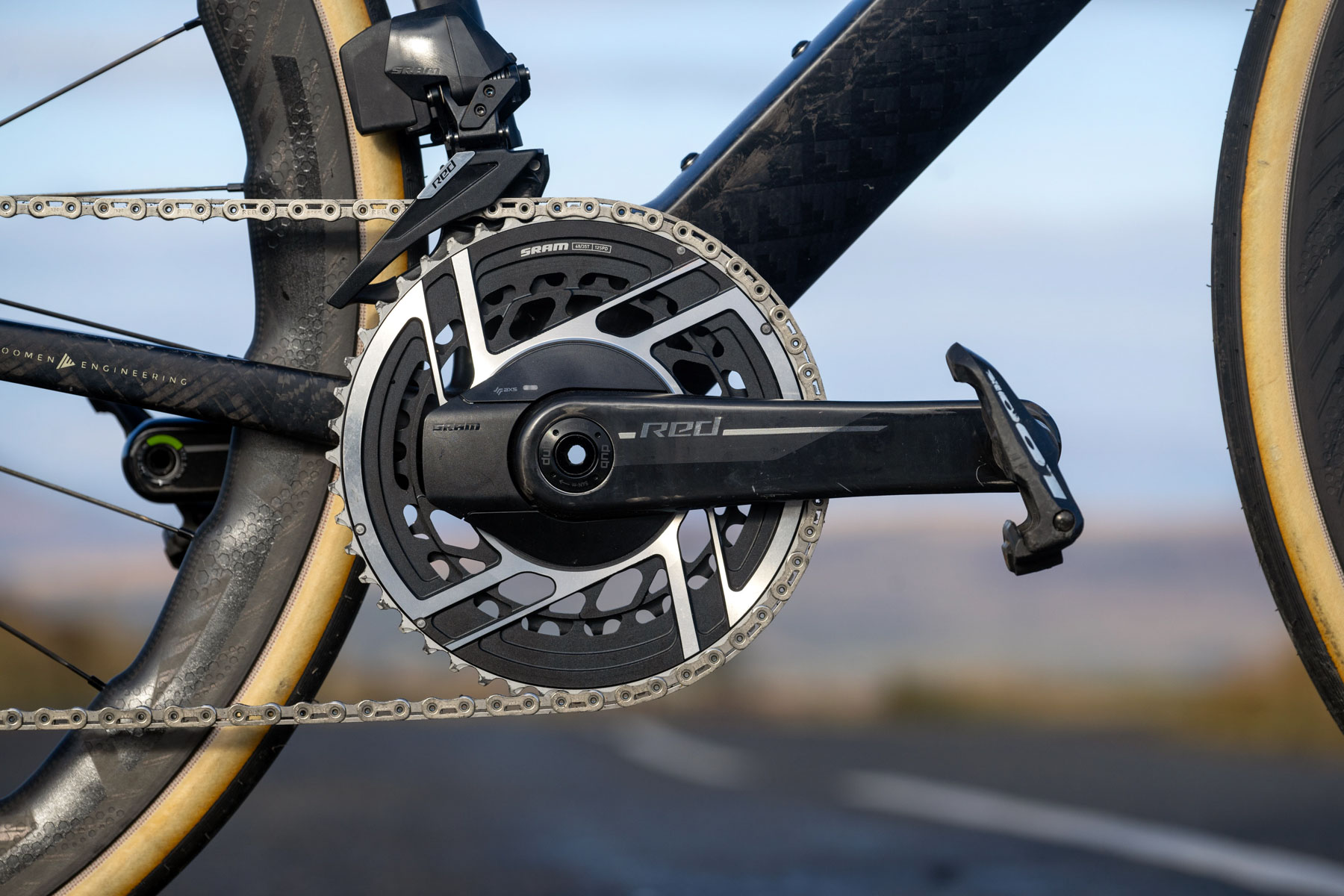
London-based bespoke bikemaker Quirk Cycles has announced two new limited-edition framesets, a Founder’s Batch of its latest Mamtor road bike, limited to 25 frames, and the Manchester to London Collector’s Edition of only five frames.
The new framesets are the first fruit of the investment made in Quirk in November 2025 by Simon Mottram, founder of Rapha. Mottram was a lead investor in Quirk’s latest £0.5m funding round, which it said was targeted at transforming the bikemaker into a global cycling brand.
Quirk claims the steel Mamtor is “a modern road bike developed with the restraint, precision, and depth of thinking that have defined Quirk for over a decade”.
The M2L Collector’s Edition is made of titanium, with design input from Mottram, and comes with a bespoke set of Tailfin bags to match.
Scalable batch manufacture
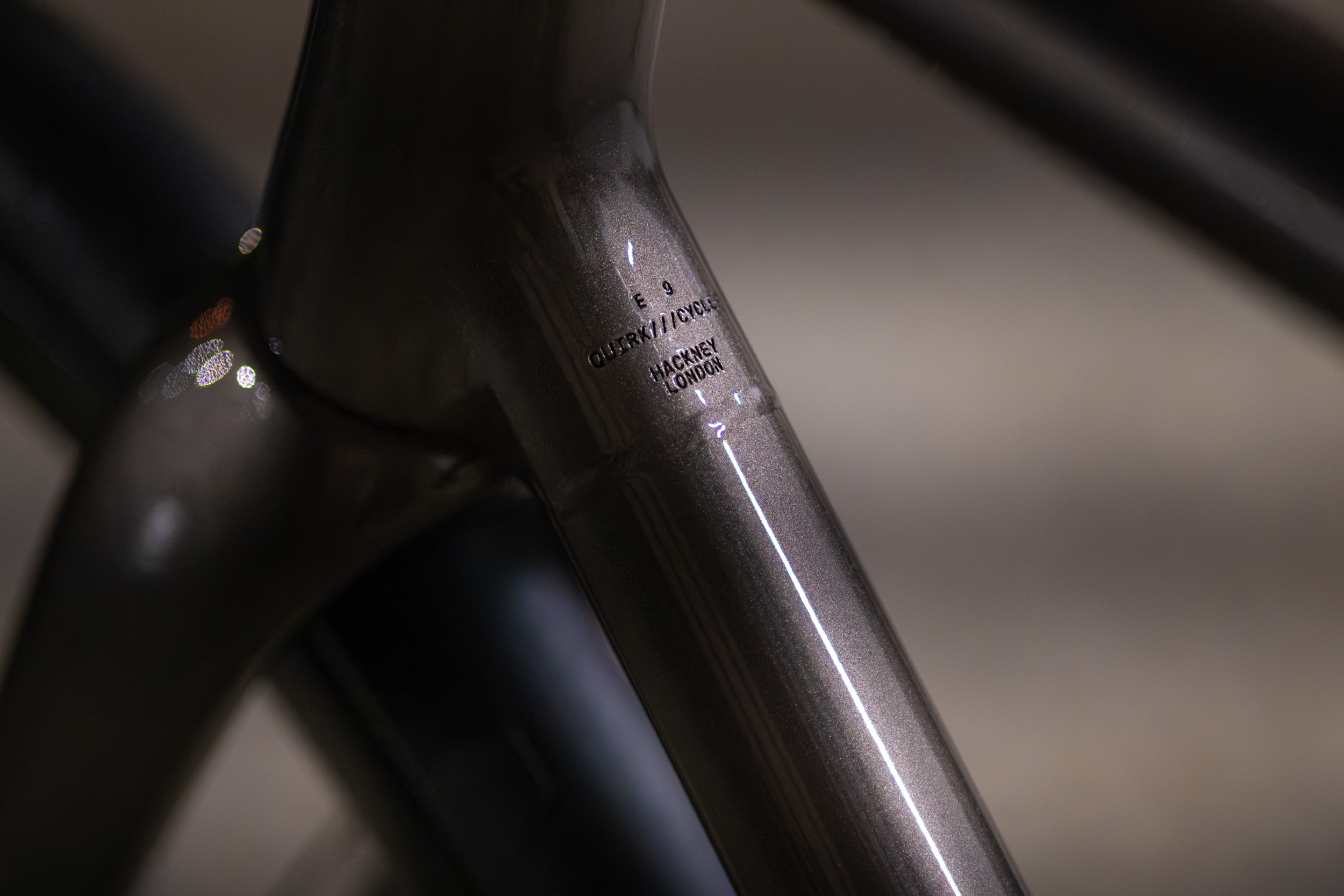
The Mamtor Founder’s Edition framesets will be made with stock geometry in small batches in Hackney, London.
While Quirk has previously specialised in bespoke builds, the Mamtor will be produced in small batches with stock geometry. The brand says full design and manufacturing oversight will be retained in London, with production in Hackney. It says the Founder’s Batch introduces scalable processes to its manufacturing.
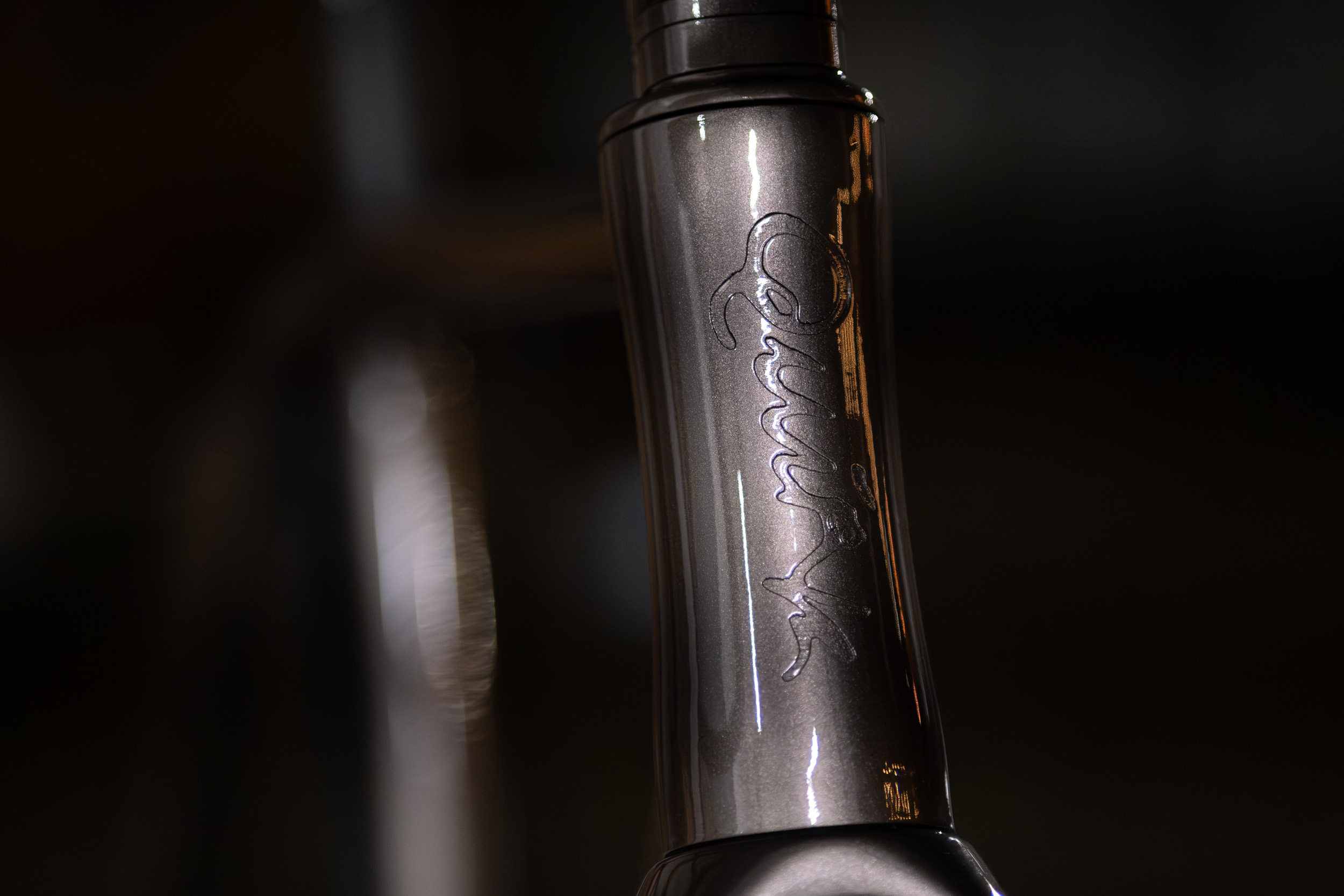
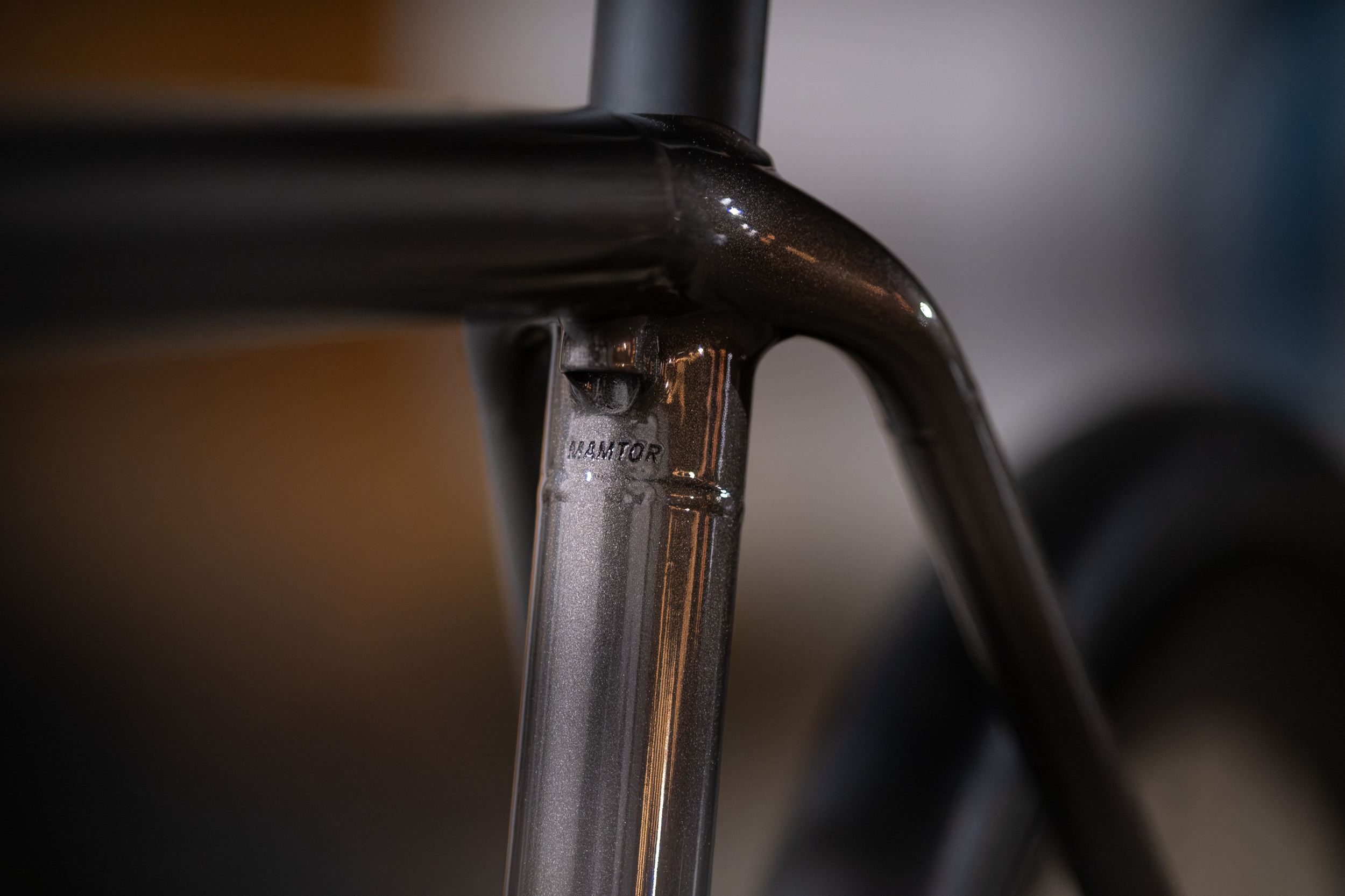
The Mamtor Founder’s Edition is made of Columbus Lite steel tubing and includes Quirk’s own 3D-printed stainless steel dropouts, head tube and seat cluster.
The Mamtor has clearance for 40mm tyres, making it capable on a range of surfaces.
It’s a bike that has the clearances for all-road duties and can fit 40mm tyres, or 30mm with mudguards. There’s a T47 bottom bracket shell and compatibility with electronic groupsets only.
The small-batch approach mirrors other bike makers, including Mason, whose frames are batch-made in Italy.
Argonaut, based in Oregon, mixes bespoke-geometry custom bike manufacture with stock-geometry builds of its carbon framesets, including the Supernaut RM3 and GR3, a similar approach to Quirk.
The frame is made from Columbus steel tubing, with 3D-printed parts including the dropouts and head tube.
Buyers of the Mamtor Founder’s Batch will get an individually numbered frameset with a polished stainless steel head badge, alongside what Quirk calls “build notes explaining the design thinking”.
They’ll also receive an invitation to a private workshop ride and evening in London.
The Founder’s Edition of the Mamtor will run to 25 individually numbered framesets.
Quirk says the Founder’s Edition spec will be a one-off, with orders closing on 31 March. Lead time from order is 16 weeks.
The Mamtor Founder’s Edition is priced at £4,999 for the frameset with fork, stem and spacers and painted in Quirk’s Creighton Brown. The bike can also be bought as a frame kit, priced at £5,699, and a rolling chassis. Complete builds are also available on request.
Manchester 2 London Collector’s Edition
Only five M2L Collector’s Edition frames are scheduled to be made and will come with custom Tailfin bags.
The M2L Collector’s Edition frameset will be even more rarified, with only five frames scheduled to be made in Quirk’s London atelier, with input from Mottram.
Quirk claims the frame prioritises long-distance comfort, while maintaining ride quality and low weight.
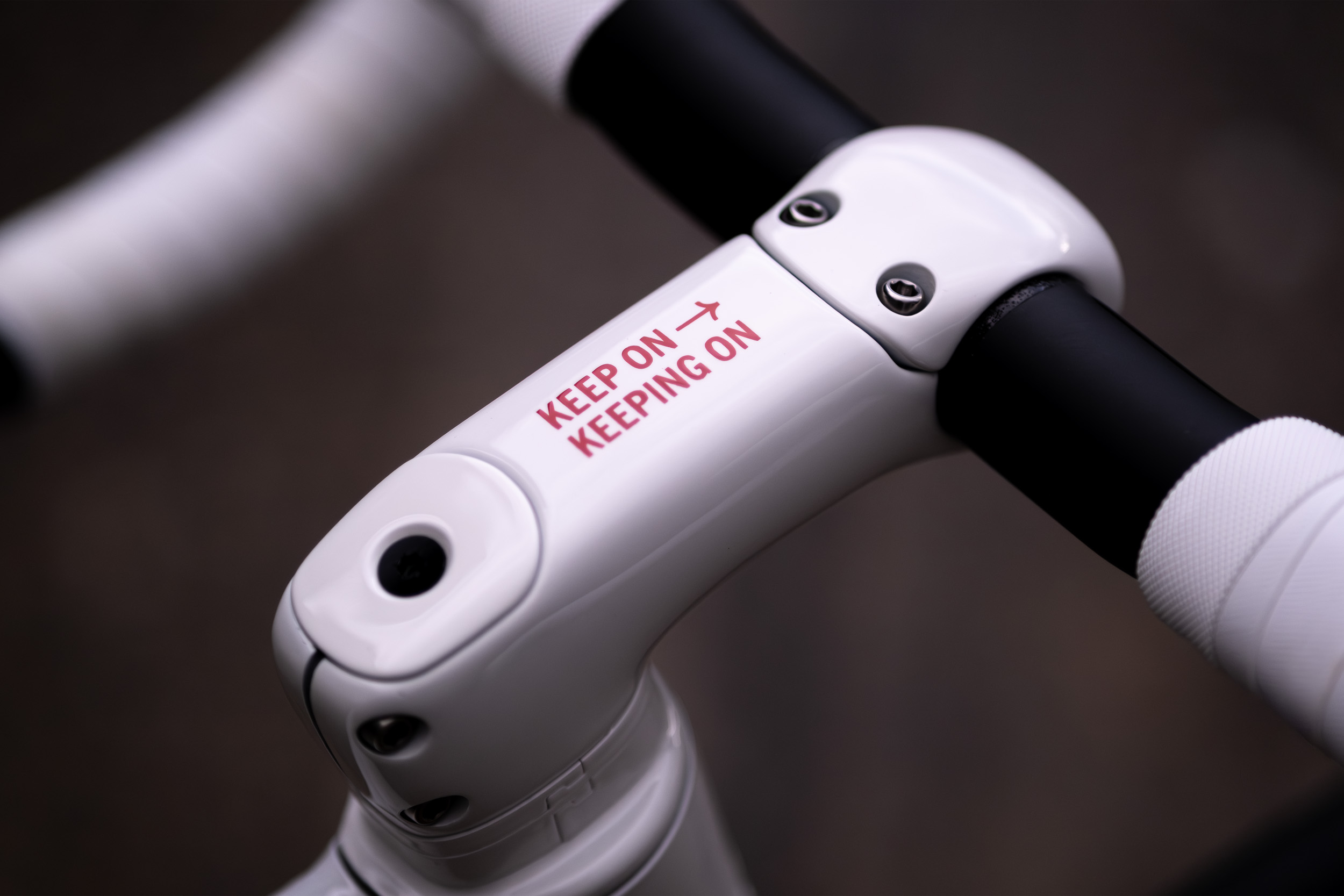
The ENVE InRoute stem is hand-painted and complete with encouraging messages.
Made of Columbus Hyperion titanium, with a 3D-printed titanium seatpost and ENVE carbon fork and hand-painted ENVE bar and stem, the bike is completed with a custom Tailfin top tube and half-frame bags.
According to Mottram: “Having ridden M2L ten times, I know what I’m looking for in a bike that will carry me 350km in a day. With custom Tailfin bags and a classic finish, this is the perfect bike for riding M2L and it should last me a lifetime.”
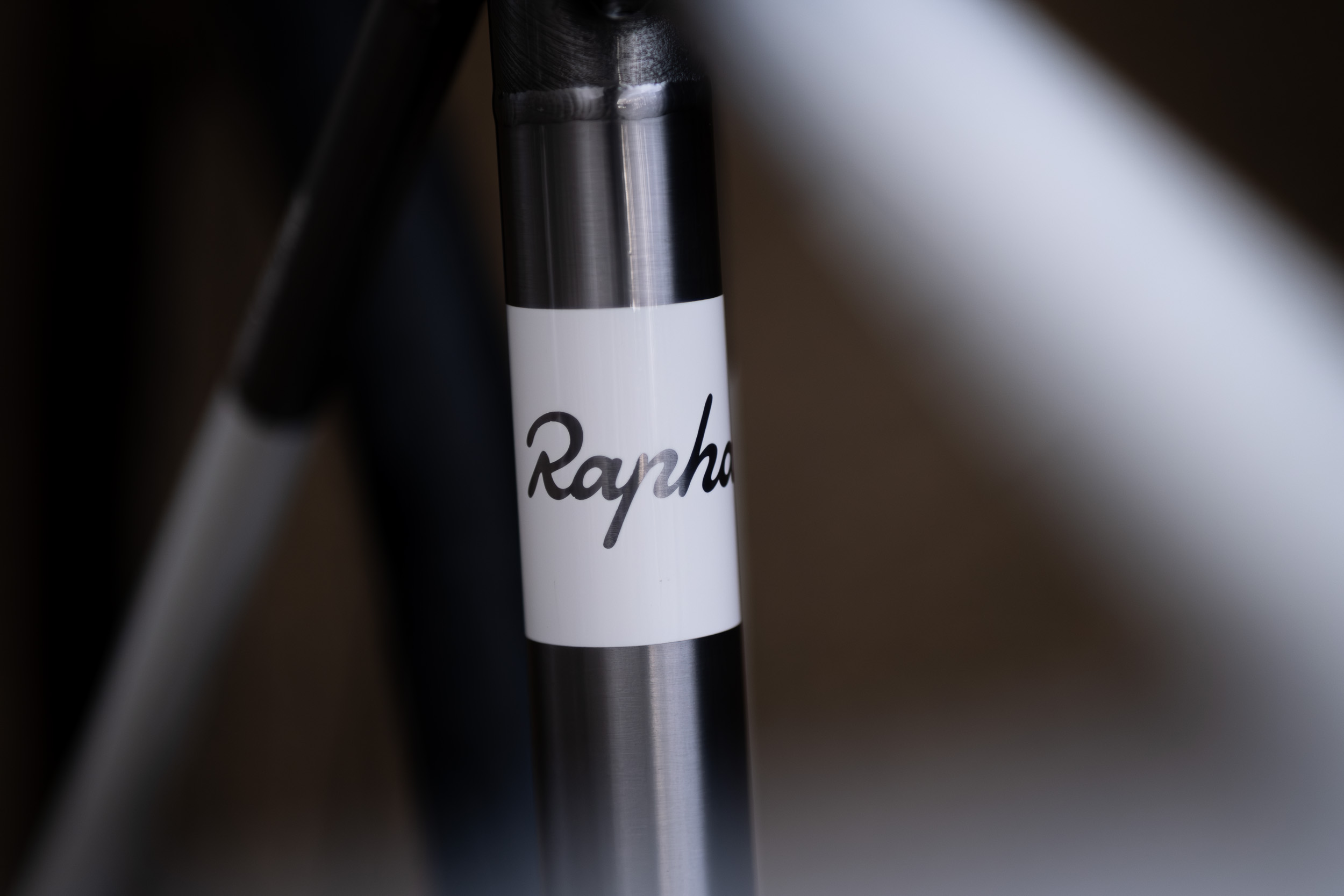
The Rapha logo on the seat tube highlights Mottram’s involvement.
Quirk quotes a lead time of 13 weeks for the M2L Collector’s Edition frame, so if ordered now it should be ready just in time for Rapha’s Manchester to London bike ride, which is scheduled for 28 June this year.
The M2L Collector’s Edition frameset is priced at £9,250, with £875 of the purchase price donated to the Ambitious About Autism charity.
When one company asked job applicants to submit a video where they answer a question, most of the 300 responses were “eerily similar,” reports the Washington Post (with a company executive saying it was “abundantly clear” they’d used AI.)
Job seekers are turning to AI to help them land jobs more quickly in a tough labor market…. Employers say that’s having an unintended consequence: Many applications are looking and sounding the same…
It’s easy to spot when candidates over-rely on AI, some employers said. Oftentimes, executive summaries will look eerily similar to each other, odd phrases that people wouldn’t normally use in conversation creep into descriptions, fancy vocabulary appears, and someone with entry-level experience uses language that indicates they are much more senior, they added. It’s worse when they use auto-apply AI tools, which will find jobs, fill out applications and submit résumés on the candidate’s behalf, some employers said. Those tend to misinterpret some of the application questions and fill in the wrong information in inappropriate spots. If these applications were evaluated alone, employers say they’d have a harder time identifying AI usage. But when hundreds of applications all have the same issue, they said, AI’s role in it becomes obvious.
The article acknowledges that some employers could be using AI tools to screen resumes too. One job-seeker in Texas even says he’ll stop submitting an AI-written résumé when the recruiter stops using AI to evaluate them. “You’re saying, ‘You shouldn’t be doing this’ when I know a good chunk of them do this!”
This week Raspberry Pi saw its stock price surge more than 60% above its early-February low (before giving up some gains at the end of the week). Reuters notes the rise started when CEO Eben Upton bought 13,224 pounds worth of shares — but there could be another reason. “The rally in the roughly $800 million company has materialised alongside social-media buzz that demand for its single-board computers could pick up as people buy them to run AI agents such as OpenClaw.”
The Register explains:
The catalyst appears to have been the sudden realization by one X user, “aleabitoreddit,” that the agentic AI hand grenade known as OpenClaw could drive demand for Raspberry Pis the way it had for Apple Mac Minis. The viral AI personal assistant, formerly known as Clawdbot and Moltbot, has dominated the feeds of AI boosters over the past few weeks for its ability to perform everyday tasks like sending emails, managing calendars, booking appointments, and complaining about their meatbag masters on the purportedly all-agent forum known as MoltBook… In case it needs to be said, no one should be running this thing on their personal devices lest the agent accidentally leak your most personal and sensitive secrets to the web… In this context, a cheap low-power device like a Raspberry Pi makes a certain kind of sense as a safer, saner way to poke the robo-lobster…
The Register argues Raspberry Pis aren’t as cheap as they used to be “thanks in part to the global memory crunch. Today, a top-specced Raspberry Pi 5 with 16GB of memory will set you back more than $200, up from $120 a year ago.”
“You know what’s cheaper, easier, and more secure than letting OpenClaw loose on your local area network? A virtual private cloud…”
Linus has released 7.0-rc1 and closed the
merge window for this development cycle. “You all know the drill by
now: two weeks have passed, and the kernel merge window is closed.“
Linus Torvalds announced today the general availability for public testing of the first Release Candidate (RC) development milestone of the upcoming Linux 7.0 kernel series.
Russia’s domestic intelligence agency claimed Saturday that Ukraine can obtain sensitive information from troops using the Telegram app on the front line, reports Bloomberg. The fact that the claims were made through Russia’s state-operated news outlet RIA Novosti signals “tightening scrutiny over a platform used by millions of Russians,” Bloomberg notes, as the Kremlin continues efforts to “push people to use a new state-backed alternative.”
Russia’s communications watchdog limited access to Telegram — a popular messaging app owned by Russian-born billionaire Pavel Durov — over a week ago for failing to comply with Russian laws requiring personal data to be stored locally. Voice and video calls were blocked via Telegram in August. The pressure is the latest move in a long-running campaign to promote what the Kremlin calls a sovereign internet that’s led to blocks on YouTube, Instagram and WhatsApp… Foreign intelligence services are able to see Russia’s military messages in Telegram too, Russia’s Minister for digital development, Maksut Shadaev, said on Wednesday, although he added that Russia will not block access to Telegram for troops for now.
Telegram responded at the time that no breaches of the app’s encryption have ever been found. “The Russian government’s allegation that our encryption has been compromised is a deliberate fabrication intended to justify outlawing Telegram and forcing citizens onto a state-controlled messaging platform engineered for mass surveillance and censorship,” it said in an emailed response.
Catch up on the latest Linux news: Sparky 8.2, KDE Plasma 6.6, COSMIC 1.0.7, Fish Shell 4.5, PipeWire 1.6, Bottles 62, open-source community launches MinIO fork, and more.
It looks like a March launch is no longer in the cards for Artemis II, NASA’s first crewed trip to the moon’s vicinity since the final Apollo mission over 50 years ago. While preparations were underway at the Kennedy Space Center for a launch as soon as March 6, the space agency says it ran into an issue with the flow of helium to its SLS rocket’s upper stage this weekend and it now has to roll the rocket from the launch pad back to the Vehicle Assembly Building (VAB) to figure out what’s wrong and fix it. A media briefing is planned for sometime this week to discuss the problem and what’s next.
But in a post on X, NASA Administrator Jared Isaacman confirmed the rollback will “take the March launch window out of consideration.” NASA noted on its blog that the current effort “potentially preserves the April launch window, pending the outcome of data findings, repair efforts, and how the schedule comes to fruition in the coming days and weeks.” It’s a four-mile trip back to the VAB that will take hours to carefully transport the massive rocket and the Orion spacecraft. NASA says it’s eyeing February 24 for this trek.
The issue occurred overnight in the early hours of February 21, when NASA says it observed “interrupted flow of helium to the SLS (Space Launch System) rocket’s interim cryogenic propulsion stage.” The space agency explained:
The upper stage uses helium to maintain the proper environmental conditions for the stage’s engine and to pressurize liquid hydrogen and liquid oxygen propellant tanks. The systems worked during NASA’s Artemis II wet dress rehearsals, but teams were not able to properly flow helium during normal operations and reconfigurations following the wet dress rehearsal that concluded Feb. 19. Operators are using a backup method to maintain the environmental conditions for the upper stage engines and the rocket, which remains in a safe configuration.
The Artemis II crew — Commander Reid Wiseman, Pilot Victor Glover, Mission Specialist Christina Koch and Canadian Space Agency astronaut Jeremy Hansen, Mission Specialist — had just entered quarantine a day before the issue arose. NASA says the astronauts have since come out of quarantine.
At the start of this year, NASA announced an accelerated timeline for Artemis II, which was previously set for April 2026 after experiencing delays in 2024. For this 10-day mission, which will be the first crewed flight of the SLS rocket, the Artemis II astronauts will take a trip around the moon in the Orion spacecraft. While it initially targeted early February, the launch was pushed to March due to issues that popped up during the wet dress rehearsal. Now, we’re back to the beginning with a possible April launch, but that’ll depend on the fix being a quick one.
This article originally appeared on Engadget at https://www.engadget.com/science/space/nasas-crewed-artemis-ii-launch-gets-pushed-back-again-this-time-due-to-a-helium-issue-231010042.html?src=rss