A sprawling Chinese influence operation — accidentally revealed by a Chinese law enforcement official’s use of ChatGPT — focused on intimidating Chinese dissidents abroad, including by impersonating US immigration officials, according to a new report from ChatGPT-maker OpenAI. From a report: The Chinese law enforcement official used ChatGPT like a diary to document the alleged covert campaign of suppression, OpenAI said. In one instance, Chinese operators allegedly disguised themselves as US immigration officials to warn a US-based Chinese dissident that their public statements had supposedly broken the law, according to the ChatGPT user. In another case, they describe an effort to use forged documents from a US county court to try to get a Chinese dissident’s social media account taken down.
The report offers one of the most vivid examples yet of how authoritarian regimes can use AI tools to document their censorship efforts. The influence operation appeared to involve hundreds of Chinese operators and thousands of fake online accounts on various social media platforms, according to OpenAI.
An anonymous reader shares a report: While some see AI as a tool to be used, its specific use and how it is deployed responsibly is being heavily debated online across a wide range of industries. In terms of journalistic content, and in this particular instance, reviews, review aggregator Metacritic has taken a firm stance on content published and submitted to their platform, that have been generated by artificial intelligence in some way.
In a statement by co-founder Marc Doyle, sent to Gamereactor, he says this: “Metacritic has been a reputable review source for a quarter century and has maintained a rigorous vetting process when adding new publications to our slate of critics. However, in certain instances such as a publication being sold or a writing staff having turned over, problems can arise such as plagiarism, theft, or other forms of fraud including AI-generated reviews. Metacritic’s policy is to never include an AI-generated critic review on Metacritic and if we discover that one has been posted, we’ll remove it immediately and sever ties with that publication indefinitely pending a thorough investigation.”
So, what is this about specifically? Well, it’s probably a sound guess, that this pertains to Videogamer’s review of Resident Evil 9: Requiem, which was removed from the platform after a barrage of comments accusing the review of being AI-written, and for the author of being made up.
With the likes of The Last of Usand Falloutout of the way for a bit, Amazon has seized its opportunity to put the spotlight on the next big video game adaptation, its currently-in-production God of War show. Today we got our first look at Ryan Hurst and Callum Vinson as Kratos and Atreus.
The image released by Amazon shows the eponymous God of War standing next to a tree as he watches his son — who notably looks a bit younger than the video game version of 11-year-old Atreus we first met in 2018’s God of War — take aim with his bow. Exactly what they’re hunting is unclear, but we know that the developing relationship between father and son that was such a big part of the PS4 game is also going to be at the heart of the show.
Whether Sony Pictures Television and Amazon MGM Studios have nailed the looks of its central characters is a matter of opinion. Personally I think Hurst’s Kratos in particular looks a little bit off here, but there’s every chance it all comes together later in production. Or when we first hear him angrily exclaim “boy!”
The Sons of Anarchy star was cast as Kratos back in January, and earlier this week we learned that Deadpool’s Ed Skrein will play Baldur in the Amazon show. The rest of the cast includes Mandy Patinkin as Odin, Max Parker and Heimfall, Ólafur Darri Ólafsson as Thor, Teresa Palmer as Sif, Alastair Duncan as Mimir, Jeff Gulka as Sindri and Danny Woodburn as Brok.
No release date has been announced yet, but a second season of God of War has already been confirmed.
This article originally appeared on Engadget at https://www.engadget.com/entertainment/streaming/heres-your-first-look-at-kratos-and-atreus-in-amazons-upcoming-god-of-war-tv-adaptation-172251366.html?src=rss
Lawyers who have looked into the particulars of the case tell Ars that the state faces an uphill battle in convincing courts that this portion of Valve’s business legally constitutes gambling. That said, there are a few elements of the case that might make Valve legally vulnerable to the state’s arguments.
What is gambling, anyway?
For a game to legally be counted as “gambling” in most jurisdictions, it has to pass a three-part test: a player has to pay money (1) for an outcome that’s materially determined by chance (2) in the hopes of receiving something of value (3). While buying a key to a loot box in a Valve game easily passes those first two tests, New York’s legal case will likely hinge on whether the random cosmetic items players get from those loot boxes constitute “something of value” for statutory purposes.
OpenAI just announced a massive funding round of $110 billion, which is one of the biggest investment rounds in Silicon Valley history. The investors feature many of the usual suspects, including Amazon with $50 billion, NVIDIA with $30 billion and SoftBank with $30 billion. This investment brings OpenAI to a $730 billion valuation
“We’re super excited about this deal,” OpenAI CEO Sam Altman told CNBC. “AI is going to happen everywhere.” That last statement seems more like a threat than a boast, but I digress.
Beyond the funding round, OpenAI has announced strategic partnerships with both NVIDIA and Amazon. This will involve Amazon Web Services (AWS) running OpenAI models for enterprise customers to “build generative AI applications and agents at production scale.” It also names AWS as the exclusive third-party cloud distribution provider for OpenAI Frontier, which is an agentic enterprise platform.
OpenAI has also committed to consuming 2 gigawatts of Amazon’s Trainium capacity, which is the company’s custom-designed AI training accelerator. In other words, Amazon is spending a lot of money on OpenAI and then OpenAI will turn around and spend a lot of money with Amazon. The AI funding ouroboros continues.
It’s also worth noting that Amazon’s investment in OpenAI will be staggered. The funding begins with $15 billion, but the remaining $35 billion will only be invested when certain conditions are met.
The new partnership with NVIDIA evolves the long-standing collaboration between the two companies. OpenAI has pledged to consume 2 gigawatts of training capacity on NVIDIA’s Vera Rubin systems and an additional 3 gigawatts of computing resources, likely in the form of GPUs, to run specific AI inference tasks. In other words, NVIDIA is spending a lot of money on OpenAI and then OpenAI will turn around and spend a lot of money with NVIDIA. The ouroboros must feed.
This article originally appeared on Engadget at https://www.engadget.com/ai/openai-secures-another-110-billion-in-funding-from-amazon-nvidia-and-softbank-171006356.html?src=rss
Today Zwift announced the third edition of their popular Big Spin, a prize-filled group ride series kicking off March 16!
This year’s theme is “Adventure is Calling”, with each week’s ride and prize spinner themed after a different Watopian biome. Read on for details…
Mystery Spinners
Zwift has rolled out a fun new Easter egg this year: Mystery Spinners placed at the end of some Watopia segments! These spinners just went live today and will be in Watopia until the end of Big Spin 2026.
Where are the Mystery Spinners?
We’ll be publishing a post on Monday with more info on Mystery Spinners, including (if possible) a Rebel Route that hits every spinner in one go. Until then, here’s a map of their locations:
What do they unlock?
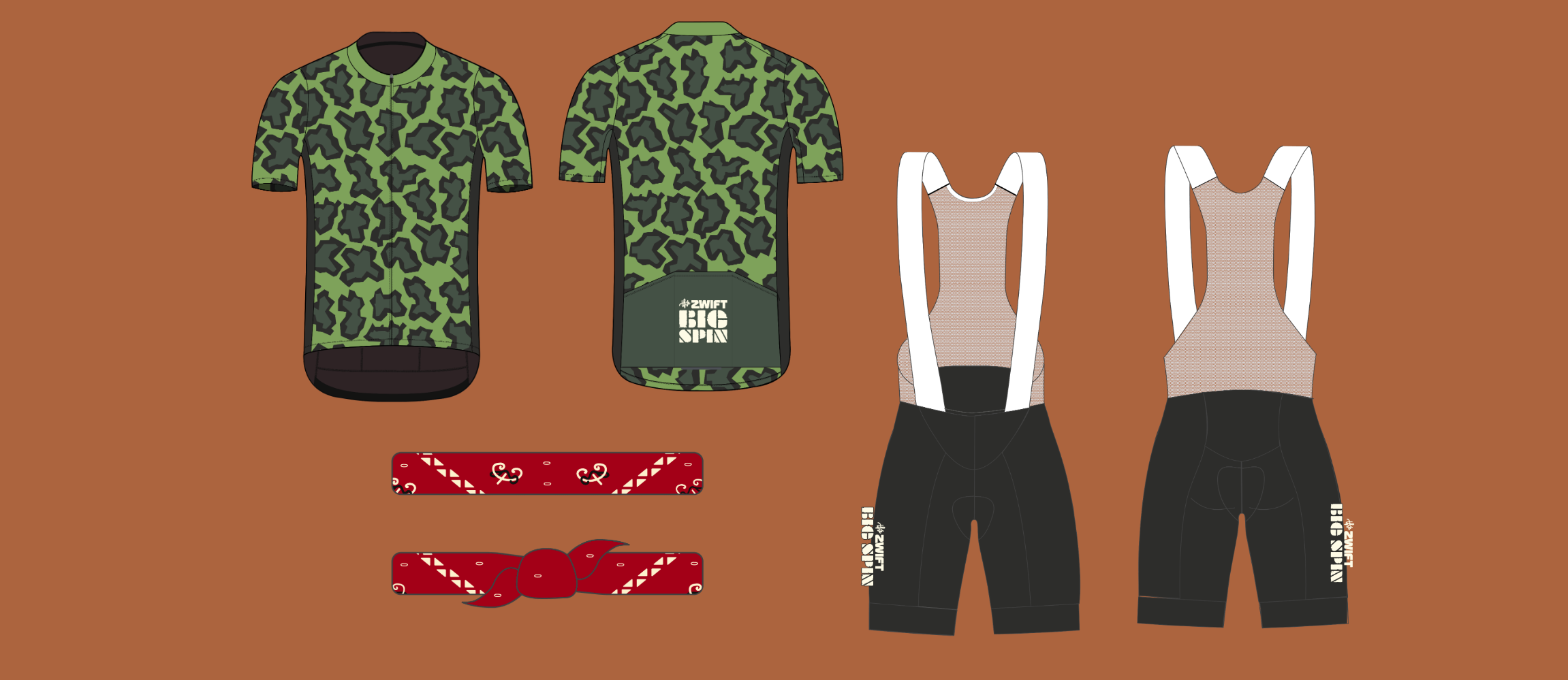
Mystery Spinners unlock Big Spin “vault” prizes – items from past Zwift Big Spins in 2024 and 2025. That’s a big list of prizes which includes the BMX Bandit from 2025, the Atomic Cruiser from 2024, various pieces of footwear and headwear, and eight different kits.
Schedule + Routes
Big Spin events are scheduled hourly at the half-hour mark.
Need more spins so you can unlock that sweet MX Rider, or perhaps you’re looking to ride a different Big Spin route than Zwift has scheduled for the week? You can complete Big Spin stages on-demand, meaning you ride the route on your own schedule, not in the official Zwift events.
(You can also organize Meetups, Club Rides, or do the route during a workout. Just make sure you finish the route in order to get credit and a spin.)
Completing a stage on demand will still get you a prize spin, and you can complete the same stage as many times as you’d like, whenever you’d like.
Prize Spinner
The Big Spin prize spinner we’ve come to love will make an appearance at the end of each Big Spin route (here’s a shot from last year’s Big Spin):
Each time you complete a Zwift Big Spin route (in an event or on demand), the spinner will pop up to give you a prize. If it lands on a prize you’ve already won, you’ll get a healthy Drops bonus (landing on the MX Rider twice gives you a 40,000 Drops bonus, for example)!
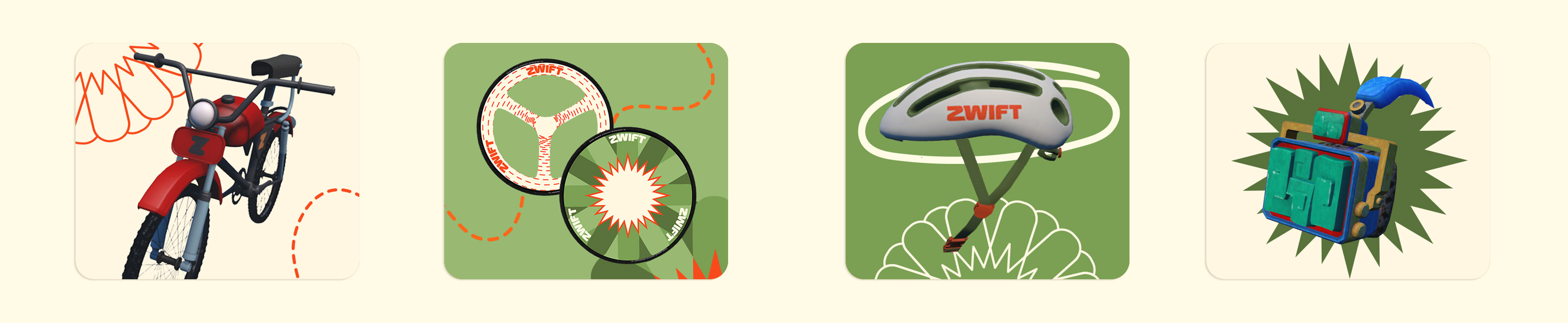
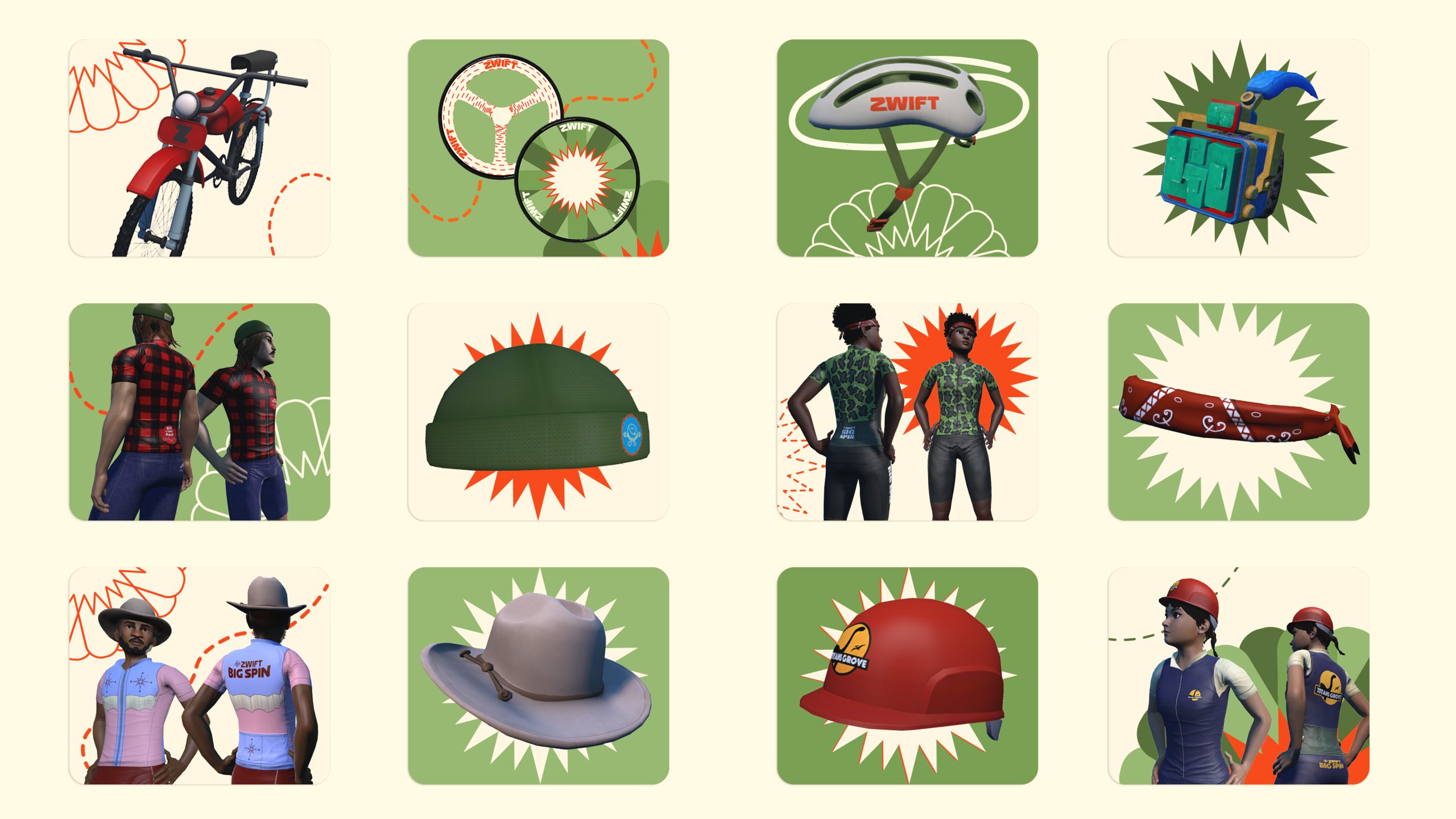
The prize spinner has 6 slots, each with a different probability. One slot, the lowest probability, is reserved for the coveted MX Rider. Three more slots are for the Big Spin Tri-Spoke, Big Spin Limeade Helmet, and Jungle Phones.
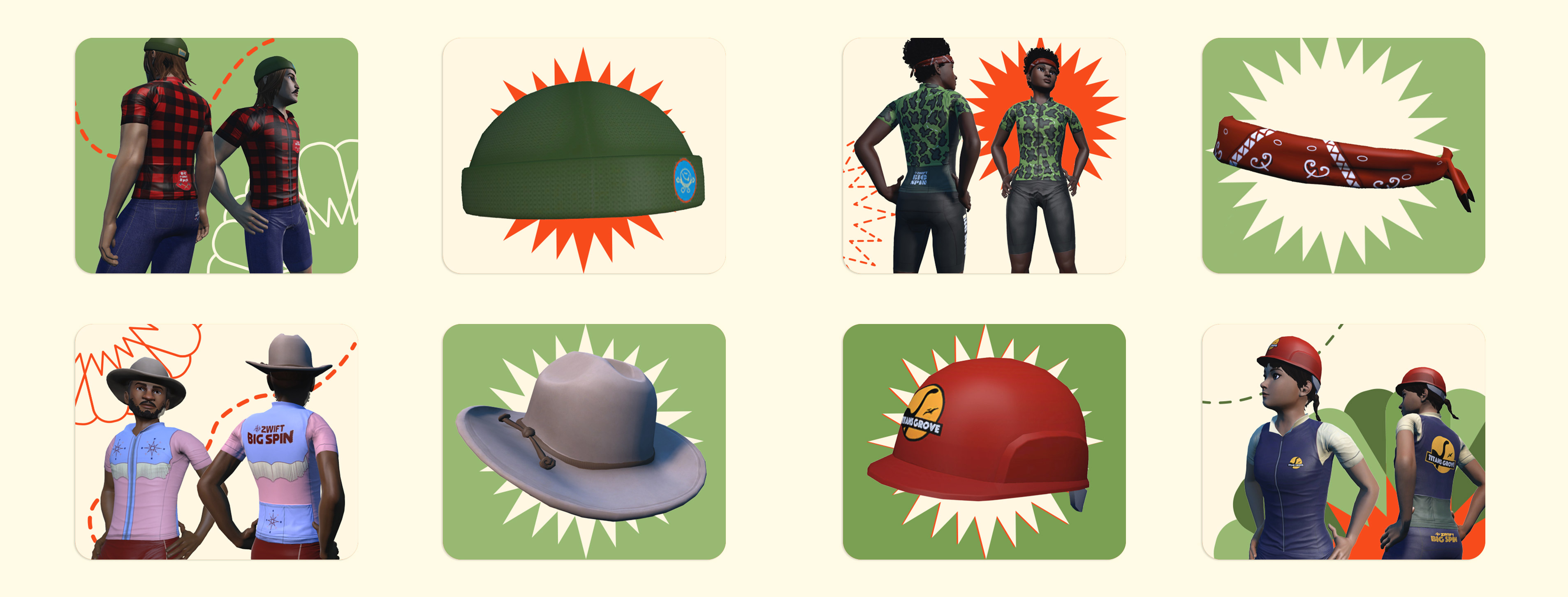
The other two slots’ prizes change on each stage (see images below), giving us a total of 12 possible prizes throughout the series. These prizes won’t be available in the Drop Shop any time soon (probably never), so this may be your only known chance to unlock them.
Stage-Specific Unlocks
Fuego Flats (Stage 1)
Mayan Jungle (Stage 2)
Southern Coast (Stage 3)
Titans Grove (Stage 4)
Full Spinner Prize List:
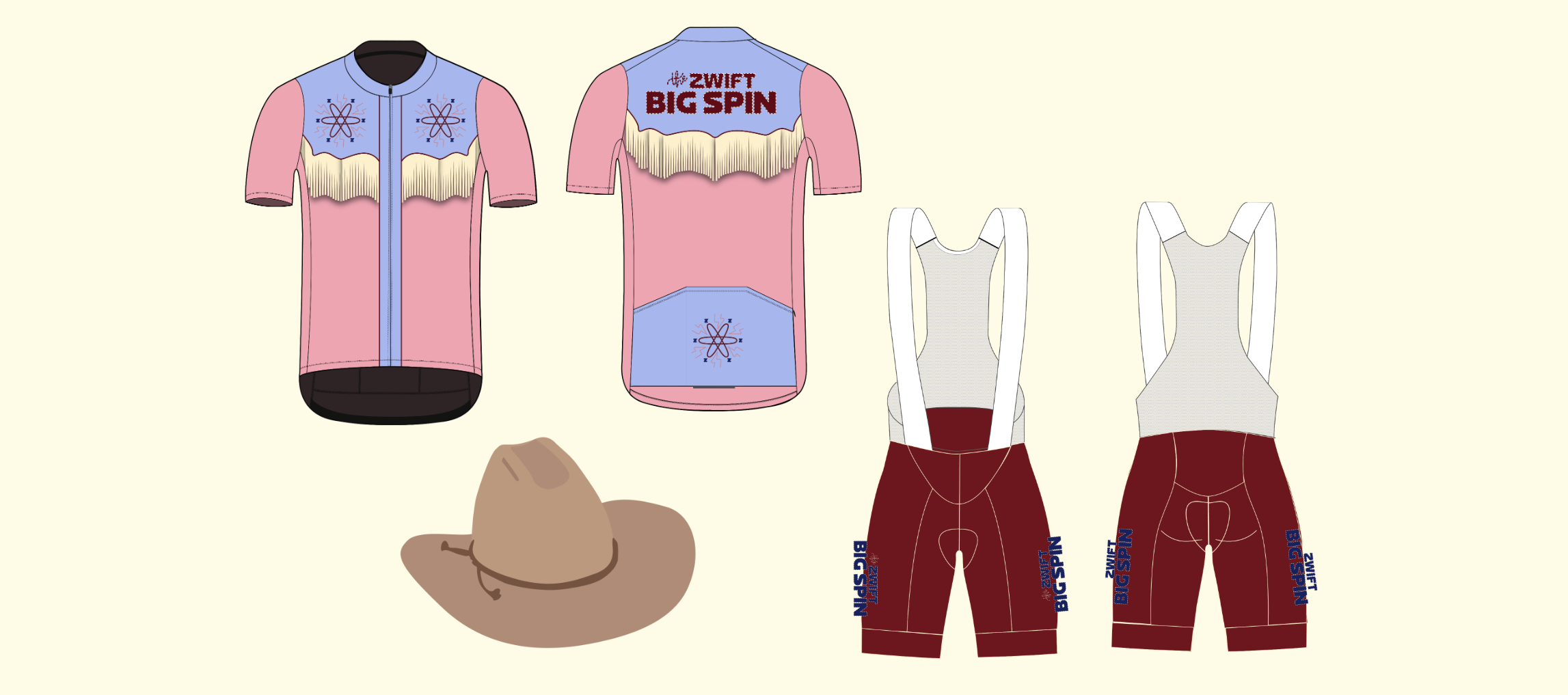
Stage 1
Rhinestone Rider Kit
Rhinestone Rider Hat
Stage 2
Mayan Camo Kit
Paisley Bandana
Stage 3
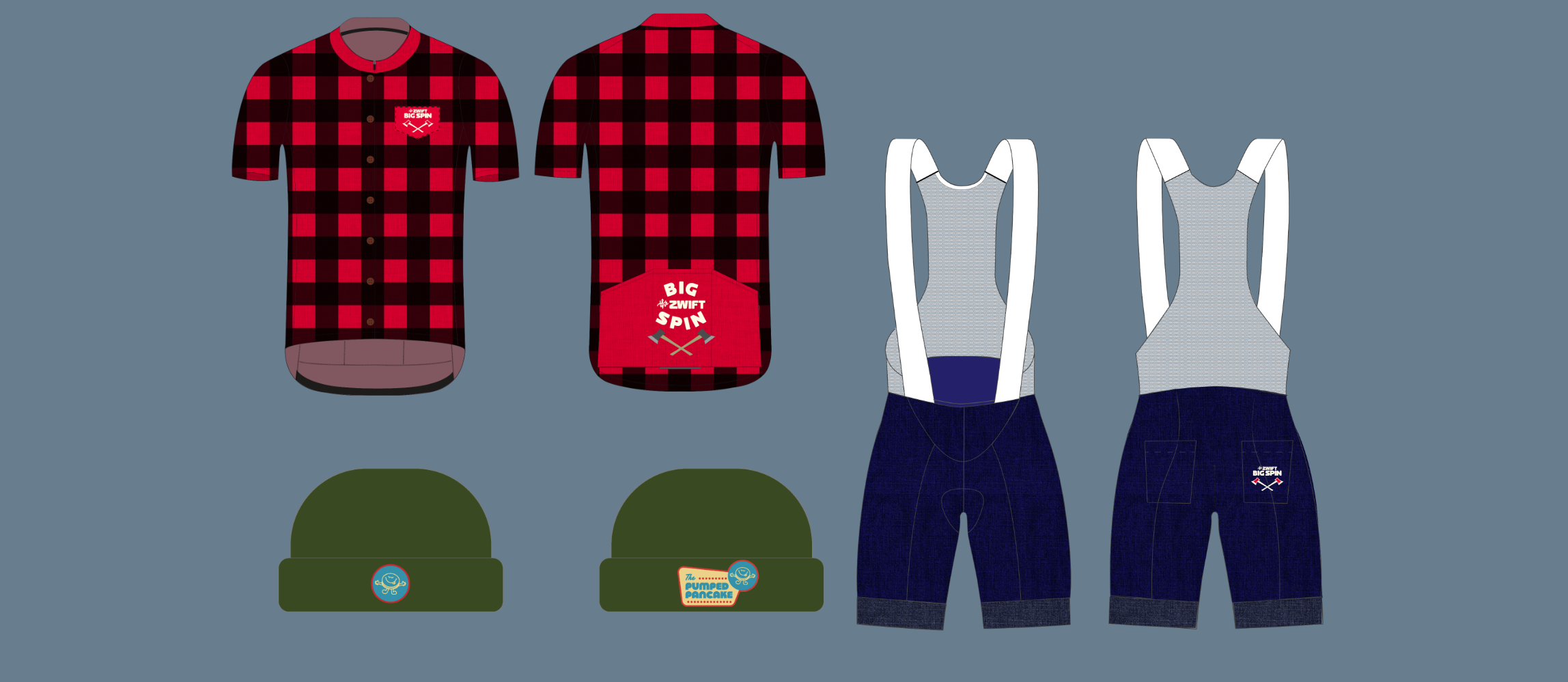
Lumberjack Chic Kit
Lumberjack Chic Beanie
Stage 4
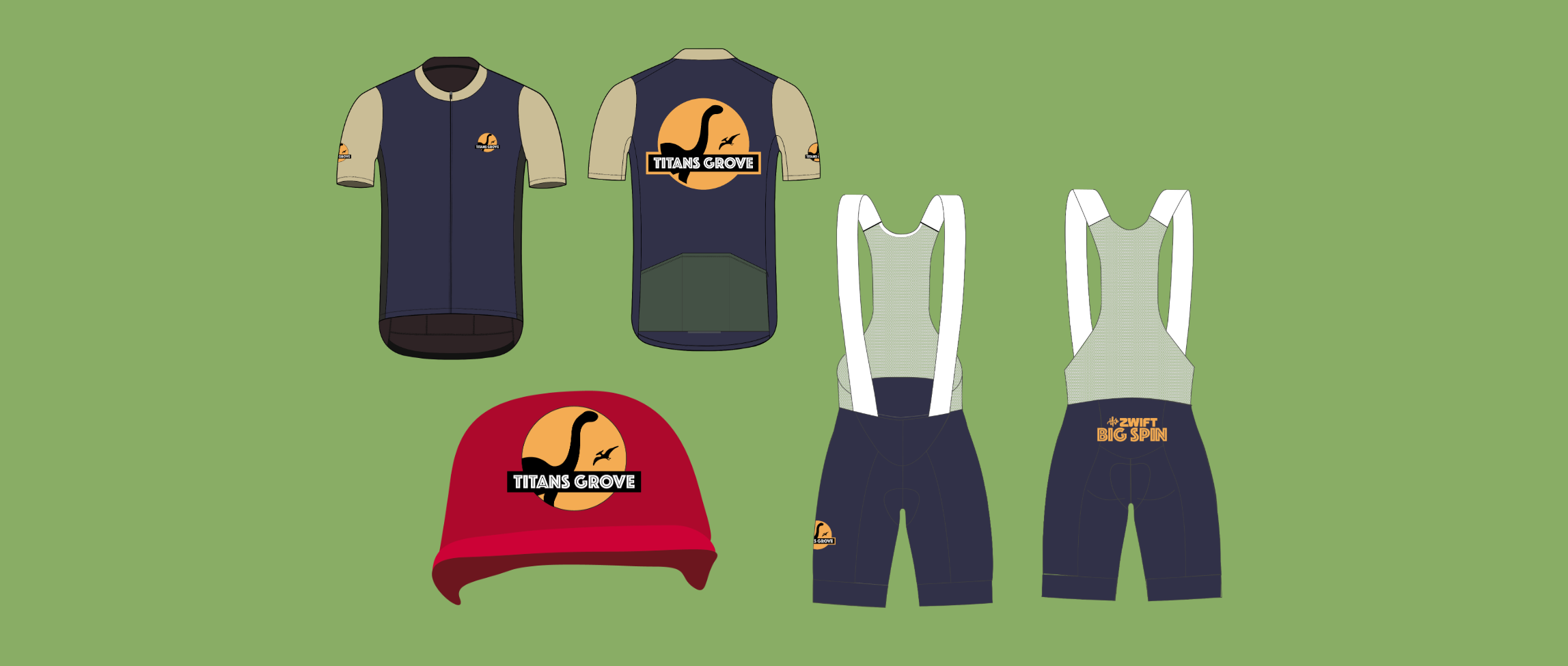
Dino-mite Kit
Dino-mite Hard Hat
Always On
MX Rider
Big Spin Tri-Spoke
Big Spin Limeade Helmet
Jungle Phones
Are these races?
Officially, no. Zwift Big Spin events are group rides without a stated pace. That means some riders will treat them as races, and the front of these rides will certainly be “spicy.”
Others will just spin their legs for a prize-laden recovery effort. You do you… just have fun!
The Zwift Big Spin is back for 2026, with the opportunity to spin on completion of a stage and virtual prizes on offer. You can ride each stage as often as you like, with Zwift suggesting you try to amass every available prize.
The Zwift Big Spin event runs from 16 March to 6 April and is spread across four stages in the Watopia virtual world:
Stage 1: Desert Discovery, 21.4km, 46m elevation gain
Stage 2: Hidden Temple, 21km, 219m elevation gain
Stage 3: Lost Coast Adventure, 26.3km, 147m elevation gain
Stage 4: Sand and Sequoias 20.1km, 175m elevation gain
When you complete any of the stages, you’re entitled to a spin to win a prize. In addition, there are eight new ‘Mystery Spinners’ hidden in Watopia and marked by treasure chests.
Zwift’s Big Spin competition has hats and a virtual bike as prizes.
You can choose to ride any of the stages at a time of your own choosing. Alternatively, you can join one of the hourly group rides if you want some company.
There’s a range of prizes on offer, including an array of hats, a bandana, ‘Jungle Headphones’, the Big Spin Tri-Spoke wheel and a new MX Rider bike.
Big Spin virtual prizes include a range of hats, as well as the MX Rider bike.
The Big Spin is one of a number of initiatives announced by Zwift to spice up riding on the platform this spring. Finishing on 29 March, the Zwift Games offer six stages of online racing, with virtual prizes. There’s a ‘make-up week’ that runs into April and gives you the opportunity to improve your times or complete any stages you’ve missed.
Meanwhile Zwift’s main challenger, Rouvy, has recently added routes in Sri Lanka and elsewhere as well as its own version of Strava segments. For the last year, you’ve also been able to use Zwift Cog and Click with Rouvy’s software.
Dark began as a mystery involving a missing child and evolved, over its three seasons, into a wildly complex narrative: a time travel-driven story that explores dark family secrets over the course of several generations. Youth may be a sort of protection in some horror stories, but not here, not even a little tiny bit. No one is safe from the show’s emotions threats, nor from literally being killed. Dark gets twistier and more compelling throughout its three seasons and, miracle of miracles, ends on its own terms and on a highly satisfying note. There’s nothing quite like it out there, which is a big part of the appeal, but it’s certainly not the only show with a smart, mature tone and compellingly twisty mysteries. Stream Dark on Netflix and then check out these other smart and spooky shows.
Wayward Pines (2015 – 2016)
Based on a trilogy of Blake Crouch novels, the show, initially, stars Matt Dillon as a Secret Service agent investigating the disappearances of two fellow agents in the Idaho town of Wayward Pines. Things go awry pretty much immediately, and he wakes up from a car accident to find one of the agents (Carla Gugino), who’s also his ex, having settled down in the seemingly idyllic community—and she’s 12 years older than when he last saw her a few weeks ago. Even more dramatically, the local sheriff (Terrence Howard) enforces a strict “no one ever leaves” policy, on pain of having one’s neck slit. The mysteries pile up from there. Stream Wayward Pines on Hulu.
Here we travel to The Town (we never get a name—definitely a red flag), from which no one can ever leave. The residents and visitors aren’t metaphorically trapped, but literally so, and are beset by creatures come from the woods and kill anyone found outside after dark. The Matthews family learn all about this firsthand when they roll into town in their RV and find themselves trapped alongside the local sheriff (Harold Perrineau)—just as the sun’s going down. The show’s monsters aren’t just mindlessly hungry, they’re cunning and sadistic, and more than capable of killing residents in impressively gory ways. It’s very much a supernatural spin on the “small towns ain’t what they seem” vibe. Stream From on MGM+ or buy it from Prime Video.
Though the series at first felt like a pointless retread of the Terry Gilliam film (and of La Jetée, on which that was based), the series eventually began to luxuriate in its extended timeline and use it to ruminate on ideas of free will versus predetermination, even while throwing in plenty of action and mystery. Well before the end of the first season, the show found its sometimes-confusing (but always heady) groove. It’s sort of a pre-apocalypse story, with time travelers from a pretty rotten future sent back into the past to seek out and stop the release of a virus that will ultimately kill seven billion humans, and that’s expected to continue to mutate and eventually wipe out everyone left. Stream 12 Monkeys on Prime Video.
The steamship Kerberos is headed to New York City from Southampton in the UK, full of immigrants ready to start a new life. Sounds inspirational, except for that portentously named ship—and the fact that the series comes from Jantje Friese and Baran bo Odar of Dark fame. The passengers soon discover that the boat isn’t just a boat, but includes portals to other locations and seemingly even other times. The unplanned ending (the show was cancelled) answers some questions while raising many others. Still: a bit of spooky fun on a boat. Stream 1899 on Netflix.
With all due respect to every other “small towns are weird” show, including Dark, I’m not sure that there’s any finer example of the form than than this addictive bit of weirdness from David Lynch and Mark Frost. Teens and adults in the deceptively quiet Twin Peaks face tragedy accompanied by supernatural threats from outside of our normal space and time. I think? The mysteries here aren’t really meant to be solved as much as pondered with an eye toward nebulous existential dread (and if that’s not your idea of fun, I’m not sure what you’re doing here). Kyle MacLachlan plays FBI Special Agent Dale Cooper, who arrives in the title town to investigate the murder of teenager homecoming queen Laura Palmer (Sheryl Lee), precipitating a (very) long night of the soul as Cooper uncovers secrets and mysteries among the town’s delightfully, and often disturbingly, weird residents. As good as the original is, the anti-nostalgic followup series is a triumph. Stream Twin Peaks on Paramount+.
Blending police procedural, mystery, and science fiction, this K-drama remains one of the most-watched dramas in South Korean TV history—enough that a second season is coming after a wait of nearly 10 years. Police profiler Park Hae-young (Lee Je-hoon) finds a discarded walkie-talkie that connects him with Detective Lee Jae-han (Cho Jin-woong), who disappeared in 2000 but who is able to communicate from an earlier time. The two detectives are able to work together, across time, to solve a very cold case—but soon discover that there are disturbing consequences in the present when they fiddle with time. Stream Signal on Netflix.
Set near the real-life Lago di Resia in northern Italy, the show was inspired by the lake’s singular view: the bell tower of a 14th century chapel rising above the water, the only visible remains of a village submerged by a dam in the 1950s. That eerie setting is home to Anna Raina (Valeria Bilello); it was, anyway, until she fled while pregnant with her twin daughters following her mother’s tragic and mysterious death. The twins are now teenagers, and the three of them have returned—except nobody seems to want them around. They come to learn that Anna’s been having dreams about her mother’s death in which she’s the killer, and then she herself disappears. It all ties back to that lake and the creepy bell tower. Stream Curon on Netflix.
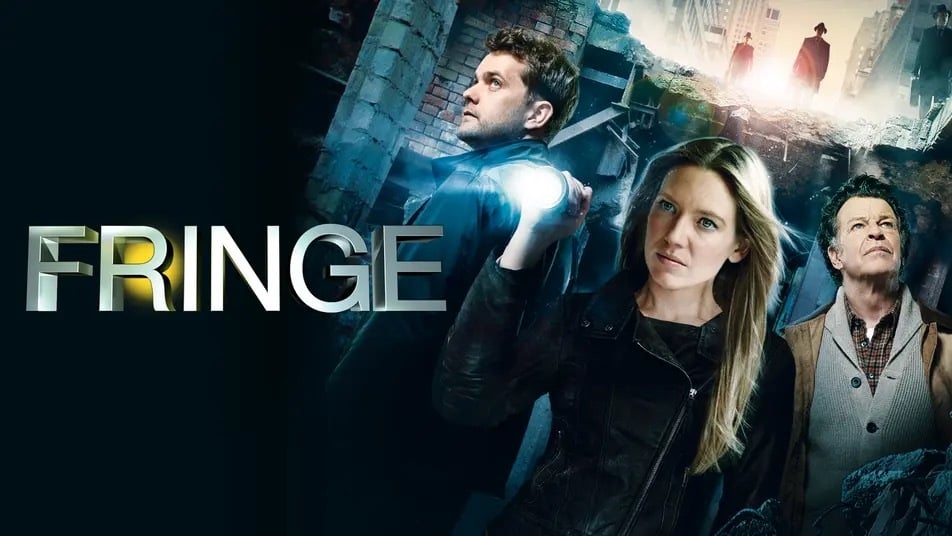
We don’t talk nearly enough about Fringe, a smart sci-fi/crime procedural that served as a true successor to the X-Files (and that wrapped more satisfyingly than that show ever did, even given multiple tries). Starting out as a kind of weird-mystery-of-the-week thing with Anna Torv as FBI Agent Olivia Dunham, Joshua Jackson as civilian consultant Peter and John Noble as his science-guy dad, Walter, straight out of a mental institution. It soon becomes clear that the odd occurrences they’ve been investigating are all linked to potentially universe-ending incursions across time and space, and that Walter has dark secrets that are both personal and existentially profound. Stream Fringe on Hulu.
A clever and spooky horror noir that gets a mixed recommendation only because of Netflix’s tendency to cancel shows after a single season. Archive 81 stars Mamoudou Athie as archivist Dan, hired to restore some old tapes from the 1990s. What follows involves a demonic cult, Lovecraftian horrors, and a jazz-age demon cult. It builds an impressive horror mythology that it only barely had a chance to develop. And yet! We love a spooky tape moment. Stream Archive 81 on Netflix.
A mind-bending and occasionally gruesome expansion of various online creepypastas, Nick Antosca’s series takes the form of four season-long storylines. While the tone is far from juvenile, the vibe here is childhood-nightmares-come-to-life: The show’s first season anticipates I Saw the TV Glow with a story about a half-remembered TV series linked to the disappearances of several children; another finds a couple of sisters dealing with cannibals and a mysterious staircase in the middle of the woods, while the last has a newlywed couple finding a mysterious door that unlocks childhood anxieties (and a freaky clown). The most Dark-like (perhaps) is the second season, which sees a group of friends trapped in a tourist-attraction haunted house that exits into a disturbing alternate reality. It’s all smart and genuinely freaky, existential dread blending with memorable visuals such as a child made entirely of human teeth. Stream Channel Zero on Shudder and AMC+ or buy it from Prime Video.
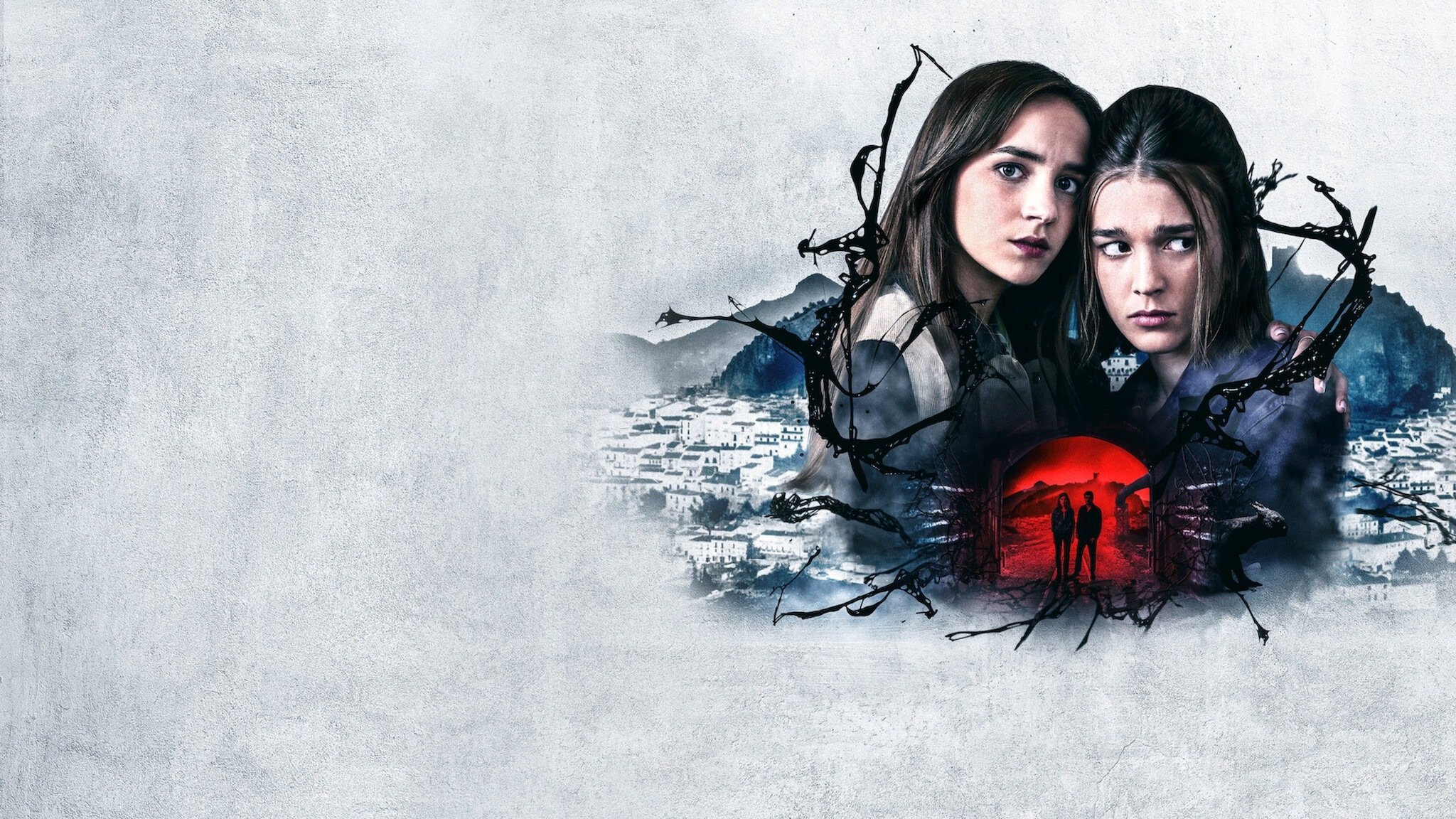
Dark deeds and supernatural forces from the past haunt multiple generations—this time, in 1995 Andalusia. This import finds teenage sisters Sofia and Eva caught in a nightmare when their parents go missing while being implicated in a cult ritual that’s left 23 people dead, including a woman who’d been missing for years. Tying back to 1975 and, implicitly, the fall of Francisco Franco, Feria shatters this small town’s sense of community and security while calling into question the value of the organizations—including government and church—that everyone holds dear. Kids getting caught up in generational cycles of violence and shame is an extremely recognizable vibe. Stream Feria on Netflix.
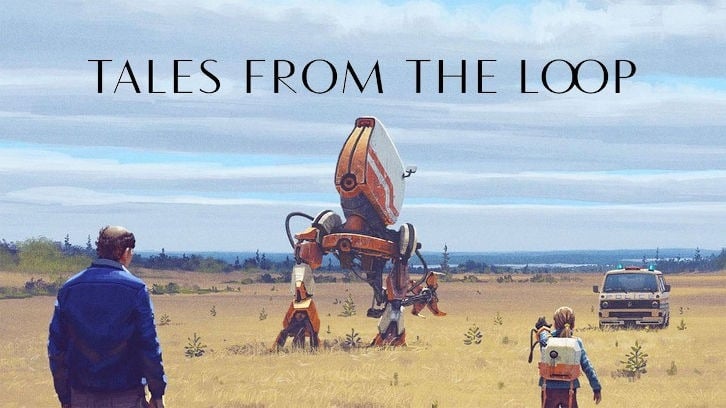
A gorgeous-looking anthology, Tales From the Loop takes place in the small town of Mercer, Ohio—a town that happens to sit upon the titular Loop, a physics lab exploring mysteries for which science has no answers. Each episode offers the story of a person or family in the town impacted by the work of the Loop, in slow-burning stories about the intersection of technology and human existence. It’s based on a conceptual art book by artist Simon Stålenhag, and successfully ports over that book’s striking look and feel. Stream Tales from the Loop on Prime Video.
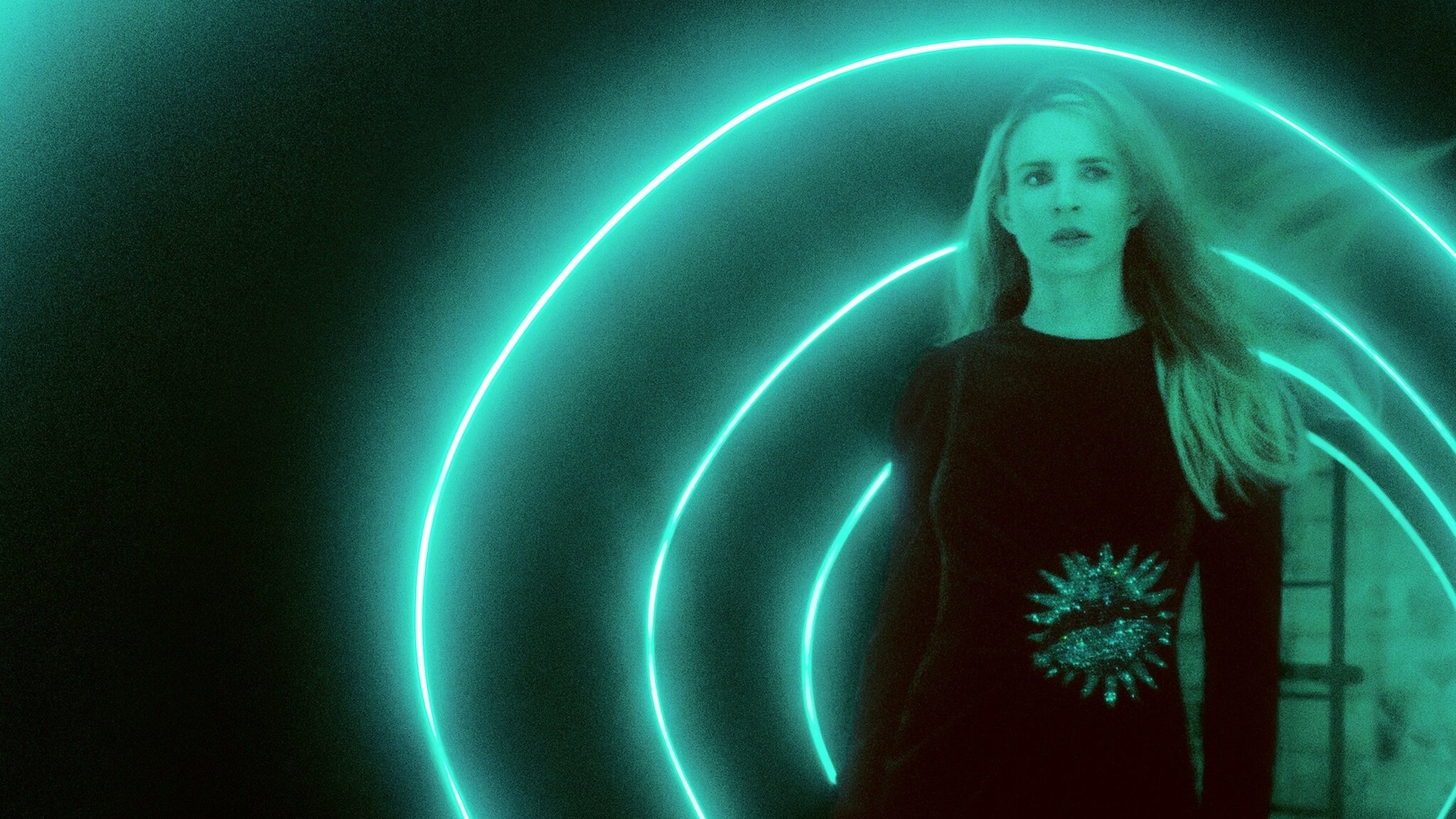
The unclassifiable sci-fi/mystery series stars Brit Marling as Prairie Johnson (Brit Marling), a woman who returns after a seven-year disappearance, proclaiming herself to be the “original angel”; aiding her case is the fact that she has the ability to see, though she was previously blind. She assembles a group of young people to help her in a mission to save others who’ve been lost, which she can only do by opening a portal to another dimension. The critically acclaimed show was unceremoniously cancelled after two seasons, which hasn’t stopped people talking about the show and its mysteries. Stream The OA on Netflix.
The premise of The Leftovers is brilliantly subdued: Around 2% of the world’s population disappears without explanation, and it’s enough to upend just about everything. Politics have adapted to the new normal, religions have collapsed and reformed, and families have had to make peace with the inexplicable loss of loved ones. The first season revolves around the Garvey family. led by Kevin (Justin Theroux), a sheriff whose wife (Amy Brenneman) left him to join a cult, while subsequent seasons broaden the scope to bring in other characters in other locations. Showrunner Damon Lindelof also co-created Lost, and the two series share some similarities (including a relatively grim tone), but where Lost spun out of control, The Leftovers recognizes that complex plotting and the search for answers is really the point. Stream The Leftovers on HBO Max.
Finally, a little something for the kids, who also deserve a spooky mystery or two. (I say “kids,” but this is genuinely pretty fun for all ages.) The much-loved, if relatively short-lived, animated series follows twin siblings Mabel and Dipper Pines (Kristen Schaal and Jason Ritter) sent to spend the summer with their great uncle (aka “Grunkle”) Stan (voiced by show creator Alex Hirsch). While helping Stan run his mystery-themed tourist shack, the kids run into a series of supernatural mysteries, many related to the show’s ultimate antagonist, dream demon Bill Cipher. The show’s finale was similarly a blockbuster—the highest rated telecast in the history of Disney XD, as a matter of fact. Not terrifying, perhaps, but genuinely clever. Stream Gravity Falls on Disney+.
As triple-A gaming trends more and more toward graphically-intensive titles with ray tracing enabled, vendors are in a continuous march to improve upscaling solutions to offset skyrocketing performance demands. PlayStation is no exception, as it has now finally shipped an updated PSSR upscaler with the release of Resident Evil: Requiem, aka
NASA is making major changes to its Artemis Moon program. On Friday, Administrator Jared Isaacman announced the space agency would carry out an additional flight in 2027 to test commercial lunar landers from SpaceX and/or Blue Origin. The new mission will take the place of Artemis 3, which previously would have seen NASA attempt to land on the Moon for the first time since 1972. The flight will also see the agency test a new spacesuit made by Axiom Space.
As part of the new plan, the redesigned Artemis 3 mission will give NASA the chance to test at least one lander in the relative safety of low Earth orbit. NASA will attempt to return humans to the Moon during Artemis 4 sometime in 2028, with the potential for another mission as early as later that same year. Per CBS News, the decision comes after NASA’s Aerospace Safety Advisory Plan said the agency’s existing mission plan was too risky.
“NASA must standardize its approach, increase flight rate safely, and execute on the President’s national space policy. With credible competition from our greatest geopolitical adversary increasing by the day, we need to move faster, eliminate delays, and achieve our objectives,” said Isaacman. “Standardizing vehicle configuration, increasing flight rate and progressing through objectives in a logical, phased approach, is how we achieved the near-impossible in 1969 and it is how we will do it again.”
The change of plan also comes as Artemis 2 has faced multiple delays in recent months. The Space Launch System (SLS) heavy-lift rocket has, once again, proven to be temperamental. NASA had planned to launch Artemis 2 in early February, but pushed the flight back after it caught a hydrogen leak during a fueling test. More recently, NASA delayed the mission to give its engineers time to fix a helium pressurization issue in the upper stage of the SLS. At the earliest, the mission can now get underway on April 1.
This article originally appeared on Engadget at https://www.engadget.com/science/nasa-overhauls-artemis-program-delaying-moon-landing-to-2028-164255318.html?src=rss
De Tomaso Automobili has revealed the powerplant specifications for the P900 track-only hypercar mated to a beautifully organic V12 developed in collaboration with engineering firm Italtecnica. With 900 horses on tap, a screaming redline, and wings galore, it looks like we have a strong candidate for the next Batmobile.
An anonymous reader shares a report: OpenAI CEO Sam Altman wrote in a memo to staff that he will draw the same red lines that sparked a high-stakes fight between rival Anthropic and the Pentagon: no AI for mass surveillance or autonomous lethal weapons. If other leading firms like Google follow suit, this could massively complicate the Pentagon’s efforts to replace Anthropic’s Claude, which was the first model integrated into the military’s most sensitive work. It would also be the first time the nation’s top AI leaders have taken a collective stand about how the U.S. government can and can’t use their technology.
Altman made clear he still wants to strike a deal with the Pentagon that would allow ChatGPT to be used for sensitive military contexts. Despite the show of solidarity, such a deal could see OpenAI replace Anthropic if the Pentagon follows through with its plan to declare the latter a “supply chain risk.”
Even though PC memory and storage prices have gotten out of control these days, there are still some deals to be had, especially if you venture into the realm of prebuilt system. Case in point, Dell is serving up discounts on a range of hardware, including its Alienware Aurora gaming PCs and some nice gaming monitors. Let’s get into it.
Dell’s
We may earn a commission from links on this page. Deal pricing and availability subject to change after time of publication.
Right now, those in the Samsung ecosystem can take advantage of a pre-order deal on a brand-new Samsung Galaxy S26 Ultra unlocked phone. $1,299 discount is the standard retail price, but Amazon is offering a free $200 gift card to sweeten the deal on the phone, which officially releases on March 11, 2026, and is available in four colors.
The Ultra is the largest and most feature-rich model in the S26 line, weighing close to half a pound. Its 5,000mAh battery is the largest of the lineup, and its 6.9-inch display is perfect for those who want more of an e-reader feel to their phone. This model comes with 512GB of storage, an S Pen, and the new Snapdragon 8 Elite Gen 5 chip, which enables more AI features, stronger gaming, better multitasking capabilities, and overall faster speeds than its predecessors.
The camera system is also the most advanced in the S26 series, with a 200-megapixel main sensor, a 50-megapixel ultrawide, and two dedicated telephoto lenses with 3x and 5x optical zoom that let you get closer without sacrificing image quality. The Ultra is also the only phone in the S26 lineup to feature the new privacy display, which is vetted by PCMag and limits the viewing angles so people can’t see the screen from off-angle, making it ideal for avoiding prying eyes. It can be used on the entire screen or just portions.
If you want the most powerful and largest Galaxy and don’t mind that it’s a little bulkier than the Plus and the S26, this unlocked Samsung Galaxy S26 Ultra is your best bet with top-of-the-line performance in every area and AI baked in everywhere.
Core bike is the annual kick-off for the UK bike-industry calendar, a chance for brands and distributors to show off their latest gear for the first time.
We were on hand at the show in Northamptonshire and have already shown you plenty of great new bikes and kit.
Here’s my round-up of five of the coolest things I saw at the show and should be on your radar.
The Tripster AT looks great in Cortado. Warren Rossiter / Ourmedia
First up, it’s a tweaked and refined version of an old favourite – Kinesis’ affordable, do-it-all Tripster AT gravel bike.
The 2026 Tripster AT aluminium frame and carbon fork have had a geometry update to bring it in line with the range-topping titanium ATR. Kinesis has also added more sizes, with the range expanded from 48cm up to 62cm.
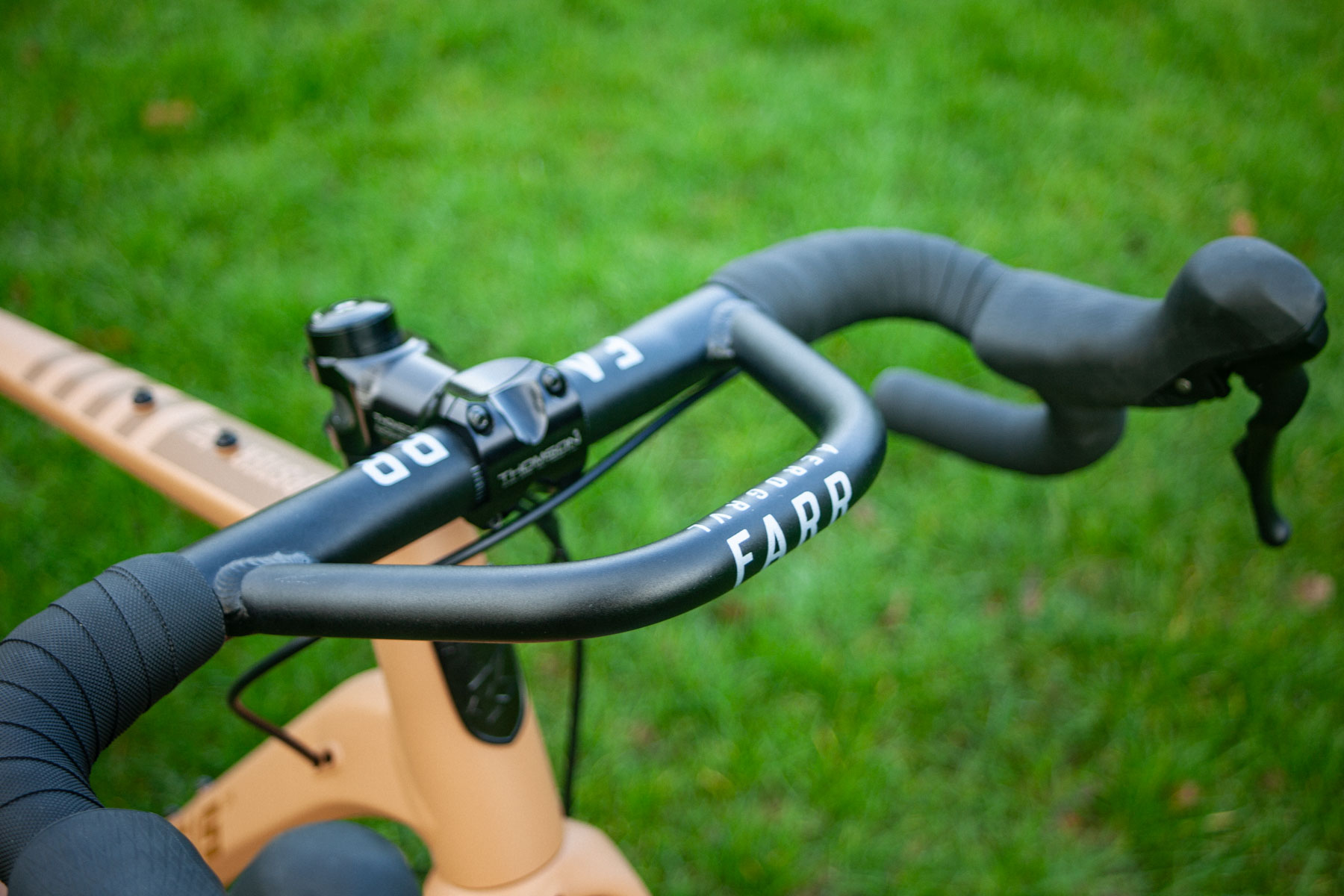
The wild-looking Farr Aero Gravel bar. Warren Rossiter / Ourmedia
Cable routing has also been improved, and Kinesis has added top tube pack mounts. What stood out for me, however, were the new colourways – subtle two-tone matt ‘Matcha Green’ and this stunning matt coffee colourway called ‘Cortado’.
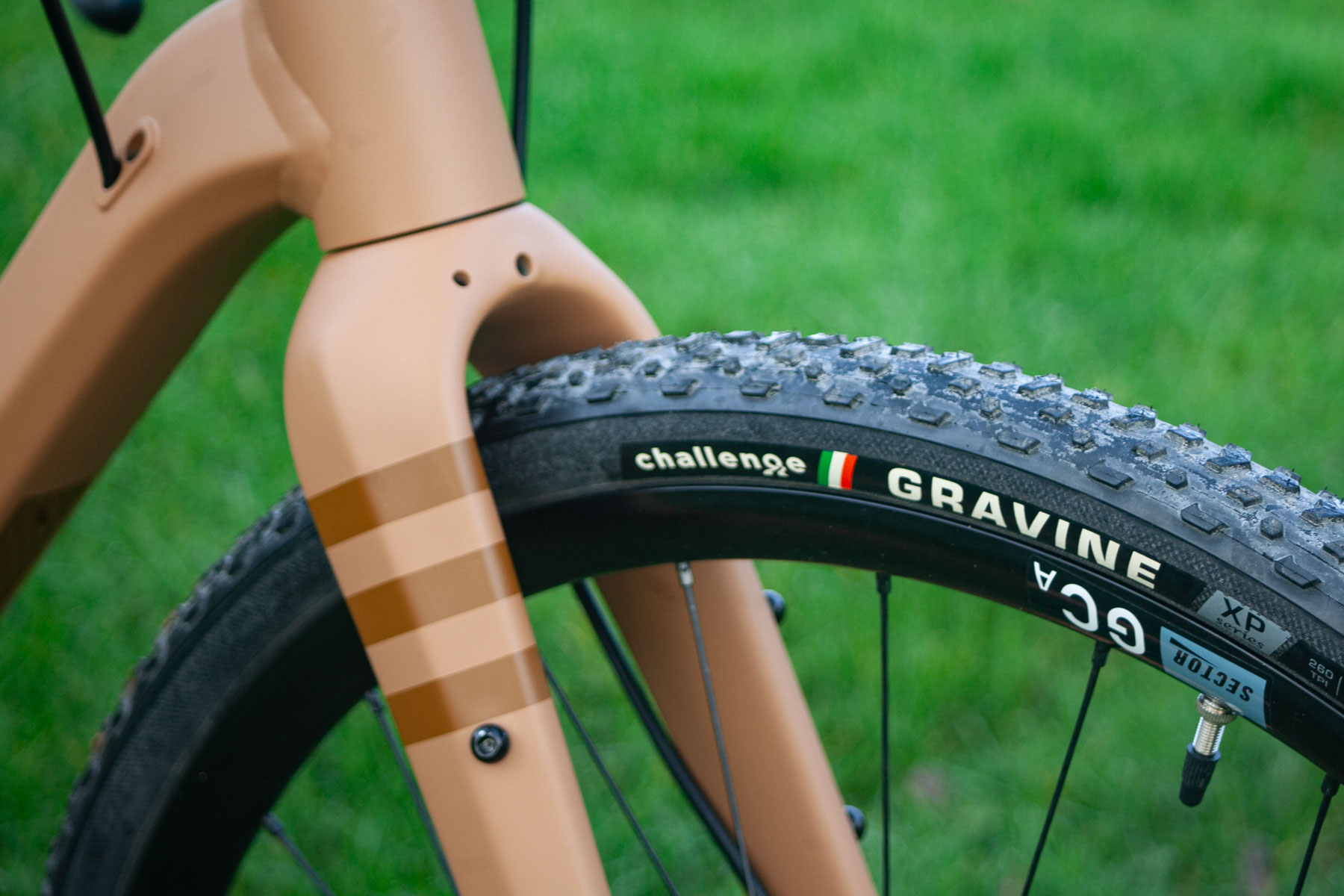
The all-carbon Columbus Futura Cross+ fork is colour-matched to the frame, making this £900 frameset look so much more premium.
The Columbus carbon fork is painted to match. Warren Rossiter / Ourmedia
Here, the AT is built up in a custom show build by Kinesis owner Upgrade.
It has Shimano GRX 1x mechanical and Sector GCa alloy gravel wheels wrapped in handmade Challenge Gravine tyres. It gets a Thomson Elite seatpost and stem, and the wild-looking Farr alloy Aero Gravel bar.
The price for a build such as this would be approximately £2,700.
Big-volume, user-friendly and super-secure bar bag
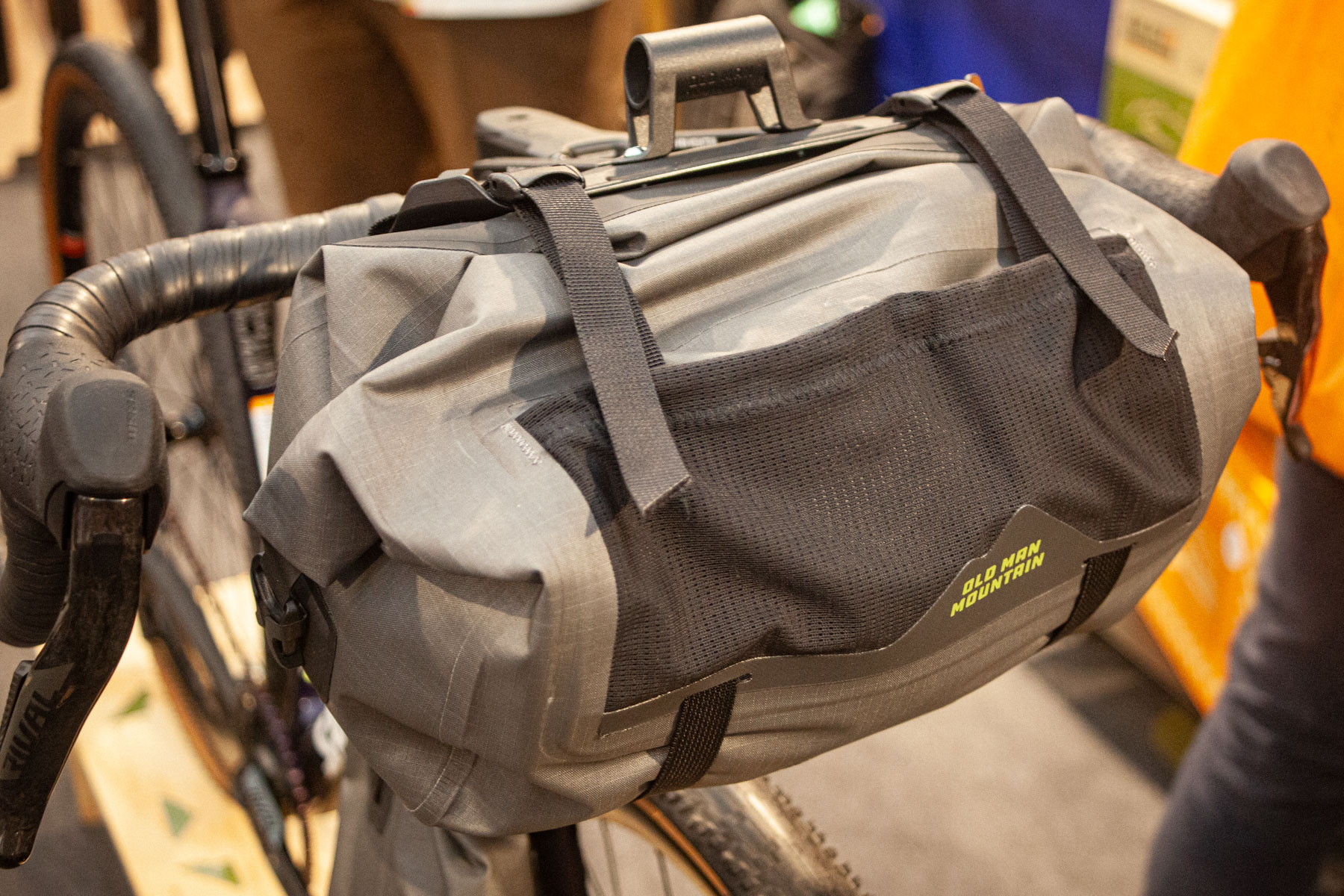
The heavy-duty waterproof bag is secured cleverly. Warren Rossiter / Ourmedia
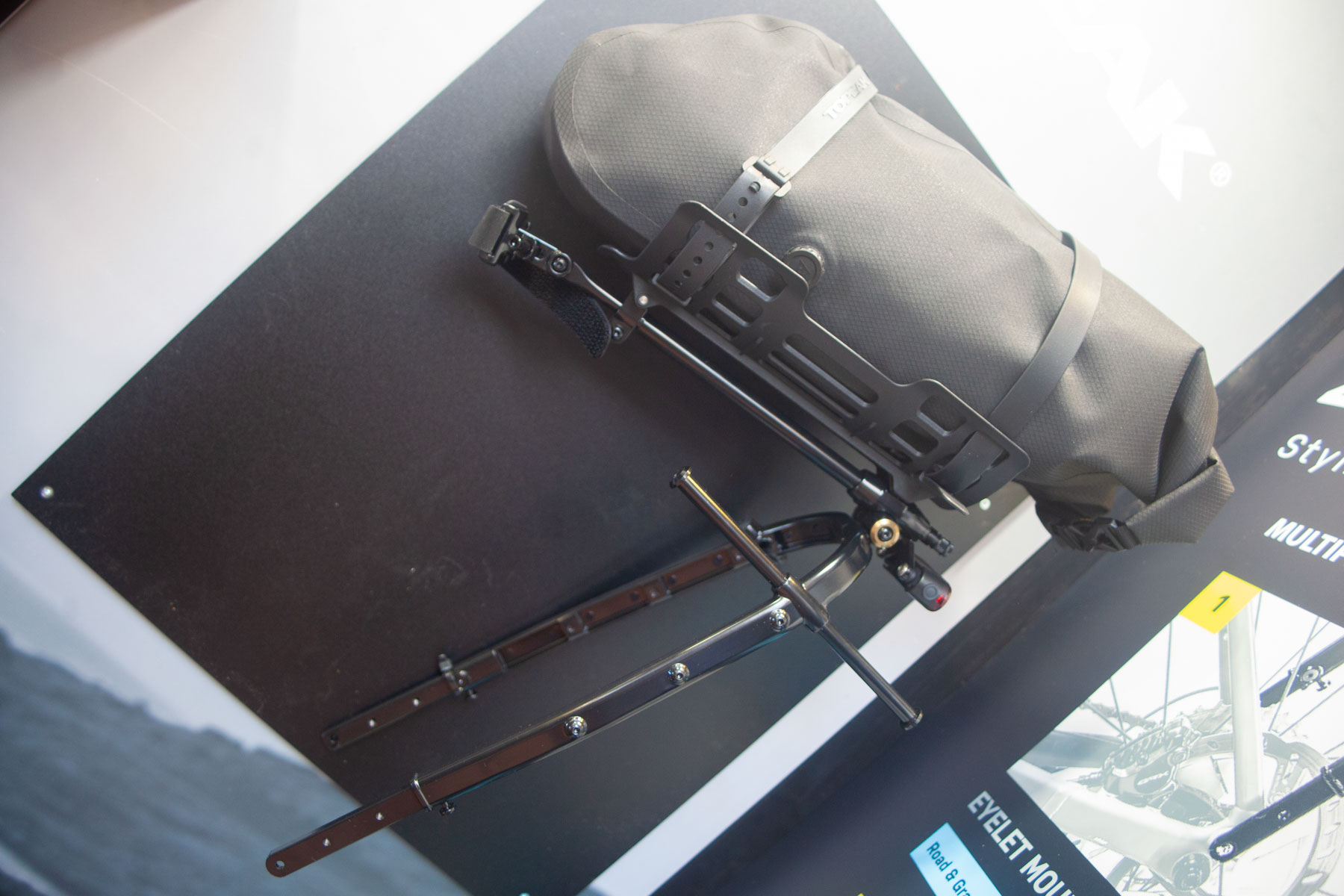
Next up is an unreleased new bar bag and mount system from Old Man Mountain. While not officially launching for another month or two, hence details are thin on the ground, the bag and mount look to be among the most secure and user-friendly I’ve seen.
The substantial twin-spar mount holds a supporting cradle that the bag hooks onto. This provides support and stability when bikepacking.
Cleverly, the compression straps loop through the bag and into the cradle. That means one-handed adjustment without having to fumble around holding the bag.
The fully waterproof bag has an air-release valve built in, so you can really pack down the volume, too.
The bag incorporates a T-bar on top to fit lights, a GPS or an action camera, with the twin spars offering multi-mount points, too. Old Man Mountain also told us it is looking at more accessories for the bag system, including bolt-on aero bars for marathon adventure racers.
New one-piece carbon aero cockpit
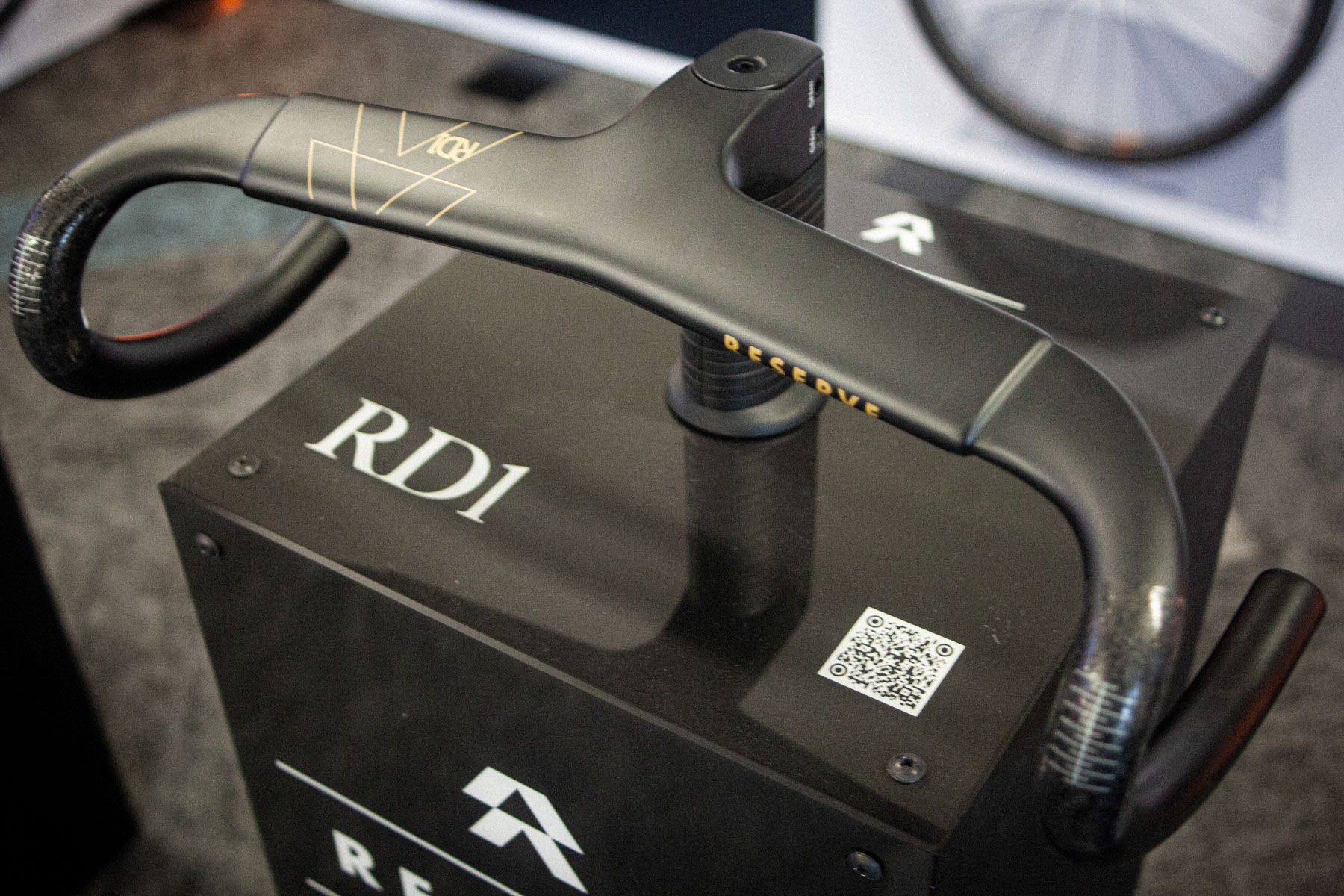
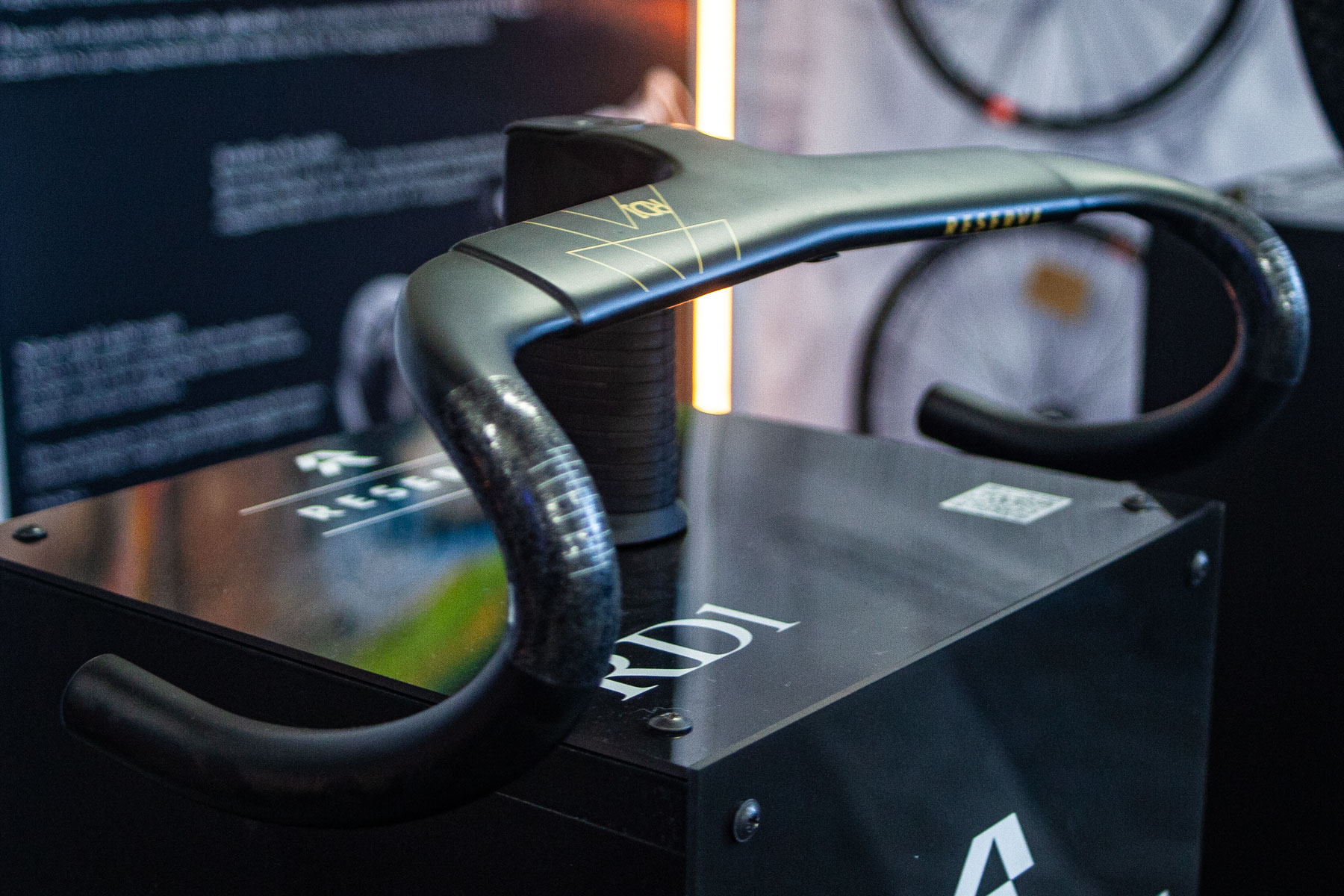
Reserve’s new RD1 aero cockpit. Warren Rossiter / Ourmedia
Reserve is known for aero road wheels and tough carbon mountain bike hoops, but now – much like rivals Zipp and ENVE – it has branched out into carbon cockpits.
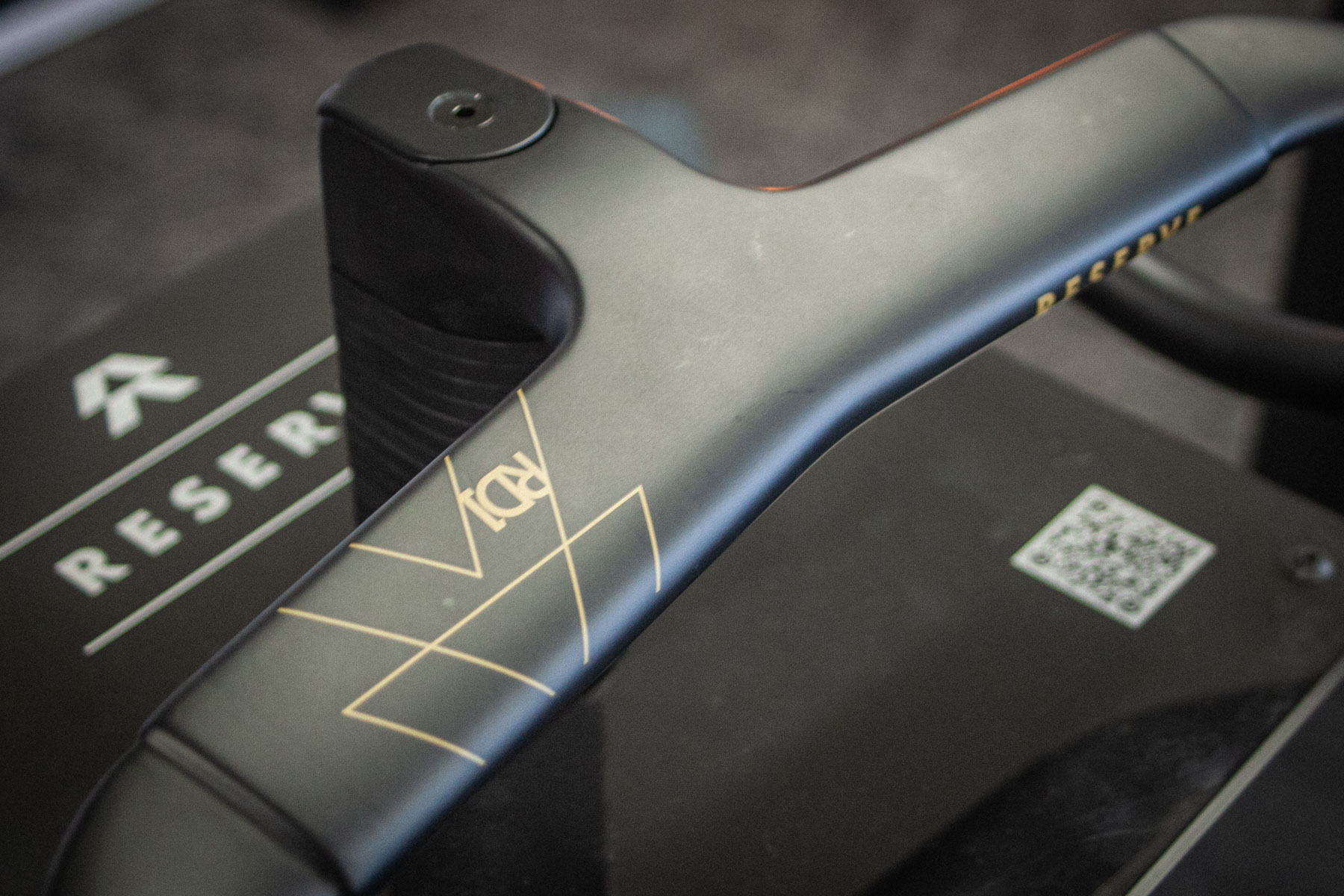
The new RD1 cockpit is wind-tunnel developed. Its one-piece design features a top section with an inset surface so that, once taped, the shape is more in unison and stops you from taping the key aero-advantage gaining mid-section.
The RD1 has a 75mm reach and 125mm drop, and is availble in 12 size and length options. Warren Rossiter / Ourmedia
The bars is available in 36, 38, 40 and 42cm widths and stem lengths from 80 to 120mm for a total of 12 configurations. Weights vary between 301g and 341g, making the RD1 impressively light.
The shape has a 75mm centre-to-centre reach and a 125mm drop with a subtle 6-degree flare. The stem has an effective -6-degree angle.
The top section has a recess for bar tape to keep the profile more uniform. Warren Rossiter / Ourmedia
The RD1 comes with no weight limit and a lifetime warranty. The bar is accompanied by a spacer kit and headset cover optimised for Acros ICR systems (52mm upper bearing). It also includes an integrated out-front computer mount. It’s priced at £499 / $549 / €549 / CA$769.
I’d expect to see the premium RD1 becoming original equipment on high-end offerings from affiliated brands under the Pon.Bike banner, such as Cervélo and Cannondale.
Topeak bikepacking solutions
Topeak’s new Zi:Rak offers lots of fitting options. Warren Rossiter / Ourmedia
Topeak has expanded its bikepacking offerings further with a new, very adaptable rear rack system and a mini-bar mounting rack.
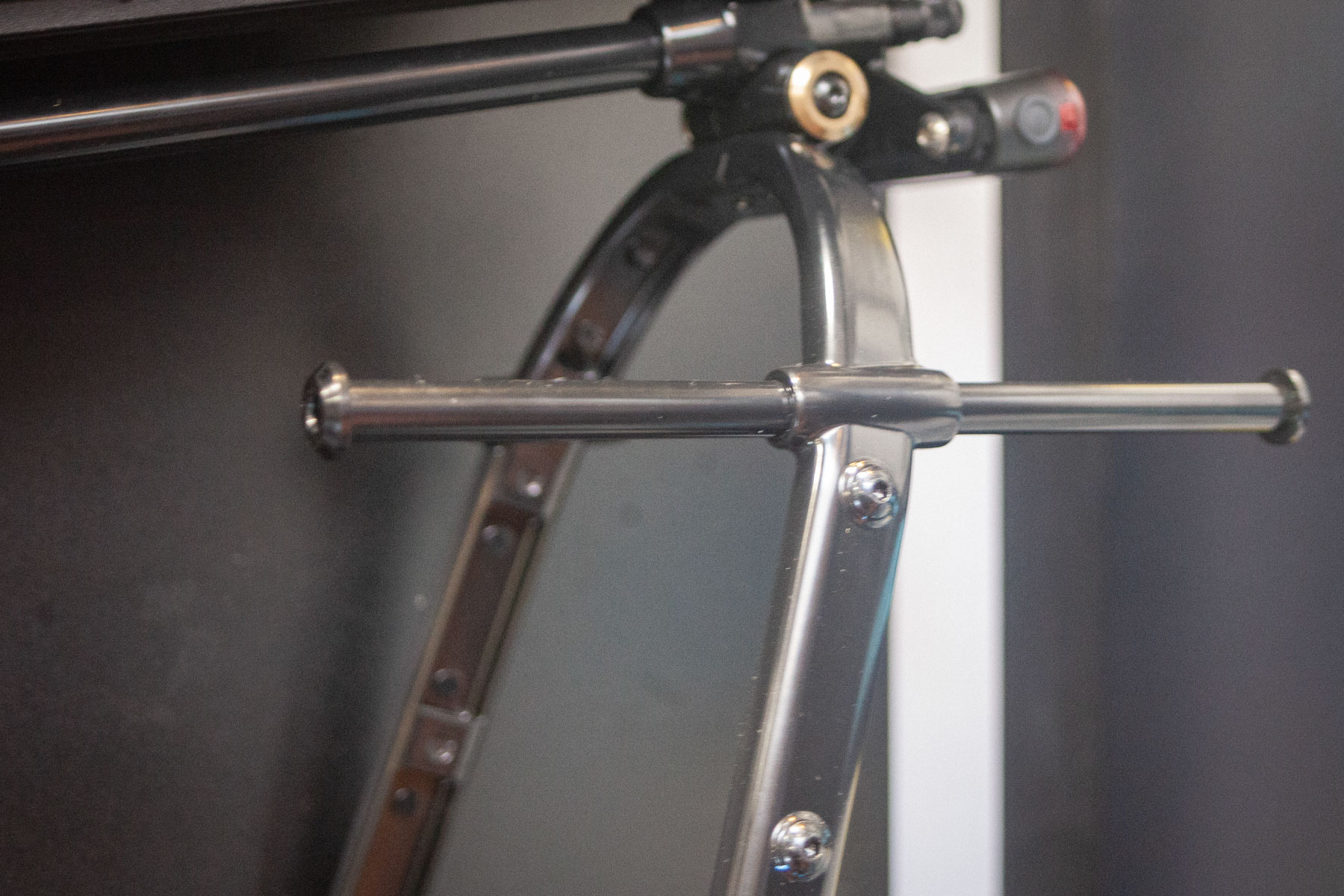
The new Zi:Rak looks similar to thru-axle systems from the likes of Tailfin and Restrap, but it comes in a multitude of options and is compatible with Topeak’s existing rack and bag ecosystem.
You can add these accessory bars to the Zi:Rak to make it compatible with standard panniers. Warren Rossiter / Ourmedia
You can choose between thru-axle, traditional rack mounts or quick-fix straps to attach the Zi:Rak.
It can be specified with a lightweight bar top and make use of Topeak’s new curved U-Shell accessory. This enables you to carry oversized wrap packs including Topeak’s new U-shell 10-litre dry bag.
Alternatively, you could opt for a Topeak MTX Quicktrack top, making it compatible with the wide range of top-mounting Topeak rack packs.
The Zi:Rak can use rack mounts, thru-axles or straps. Warren Rossiter / Ourmedia
The vertical supports have inserts to make them compatible with traditional panniers, too. It’s all very typically Topeak, with bundles of options and accessories so you can tune the rack to your needs.
Prices are keen, ranging between £89.99 and £109.99 (approximately $110–$140). The Zi:Rak has a 25kg capacity.
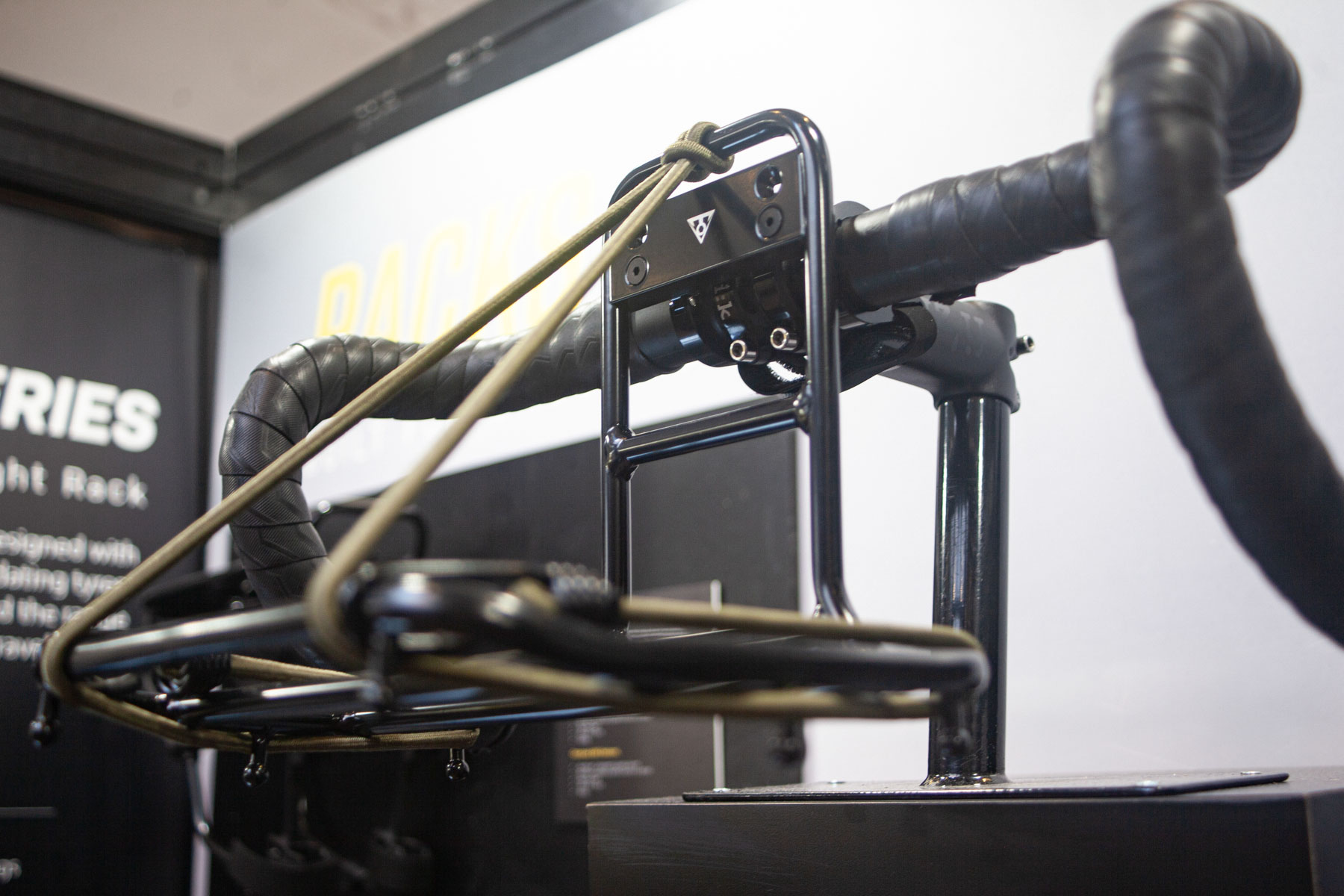
Next up is Topeak’s funky handlebar rack, made from slender aluminium tubing and coming with a clever anti-droop mounting-support system. It has clamps compatible with 25.4/28.6/31.8mm-diameter bars and is compatible with most stems up to 52mm wide. It has a 4.5kg payload.
The new handlebar rack is a cool accesory for bikepackers and commuters. Warren Rossiter / Ourmedia
The rack weighs 320g and the elasticated cord adds another 55g. It’s priced at £49.99 / $77.95.
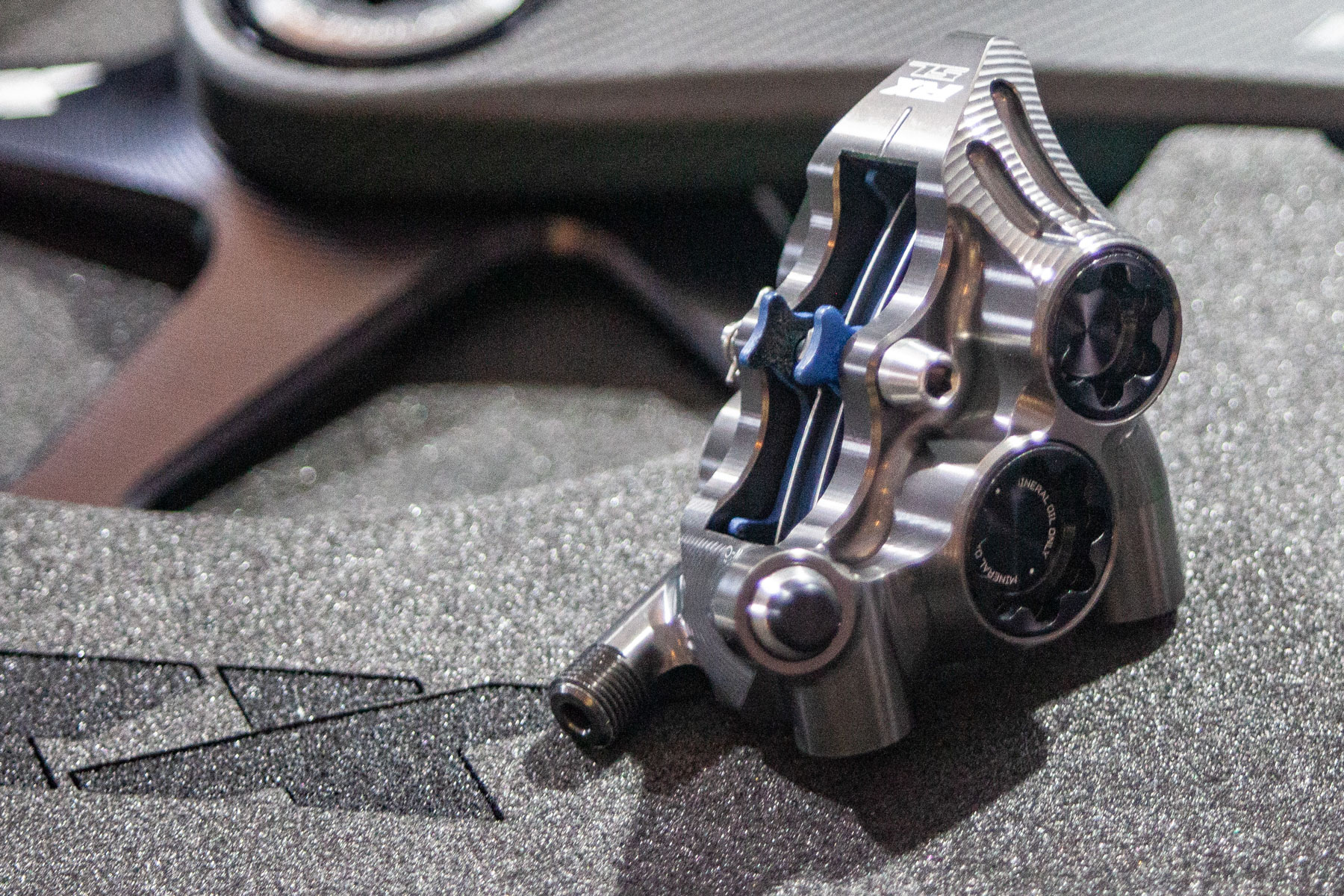
Hope’s new 4-pot caliper brings enduro power to road and gravel bikes
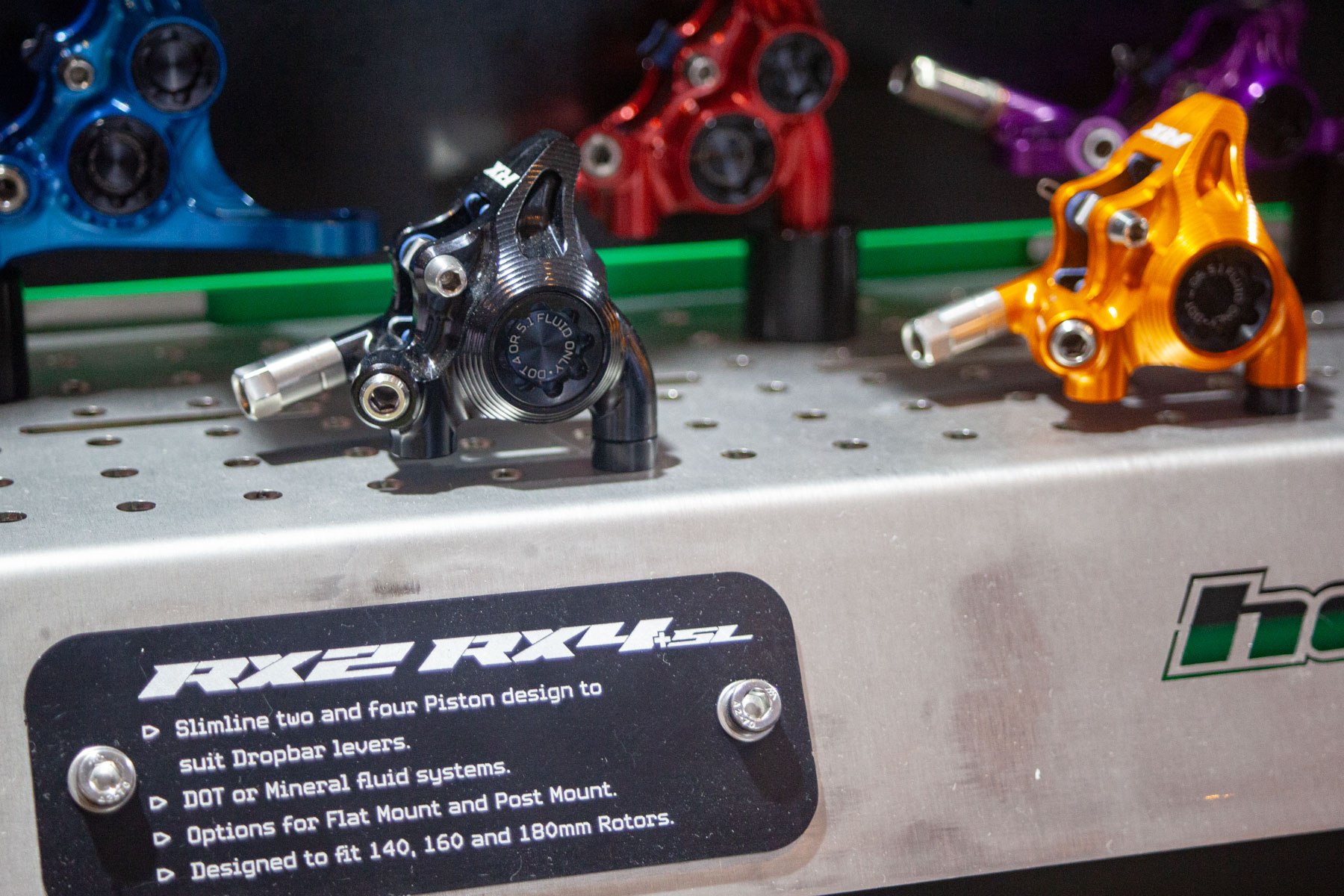
The RX4+ SL and RX2 are available in a wide range of colours. Warren Rossiter / Ourmedia
When it comes to upgrading brakes on gravel and road bikes, options have been thin on the ground. Stepping up the groupset hierarchy has usually been the only option.
While Hope has had a road-compatible option in its range for many years, the RX2’s minimal size and myriad colours are enough for me to want this upgrade.
When it comes to the more extreme end of gravel, I’ve often wondered about shifting to MTB-style 4-pot brakes (with four brake cylinders instead of two). The downside is the size of said brakes. Especially since the trend for road and gravel frame design has shifted away from the traditional double-diamond shape and moved to compact dropped-stay rear triangles.
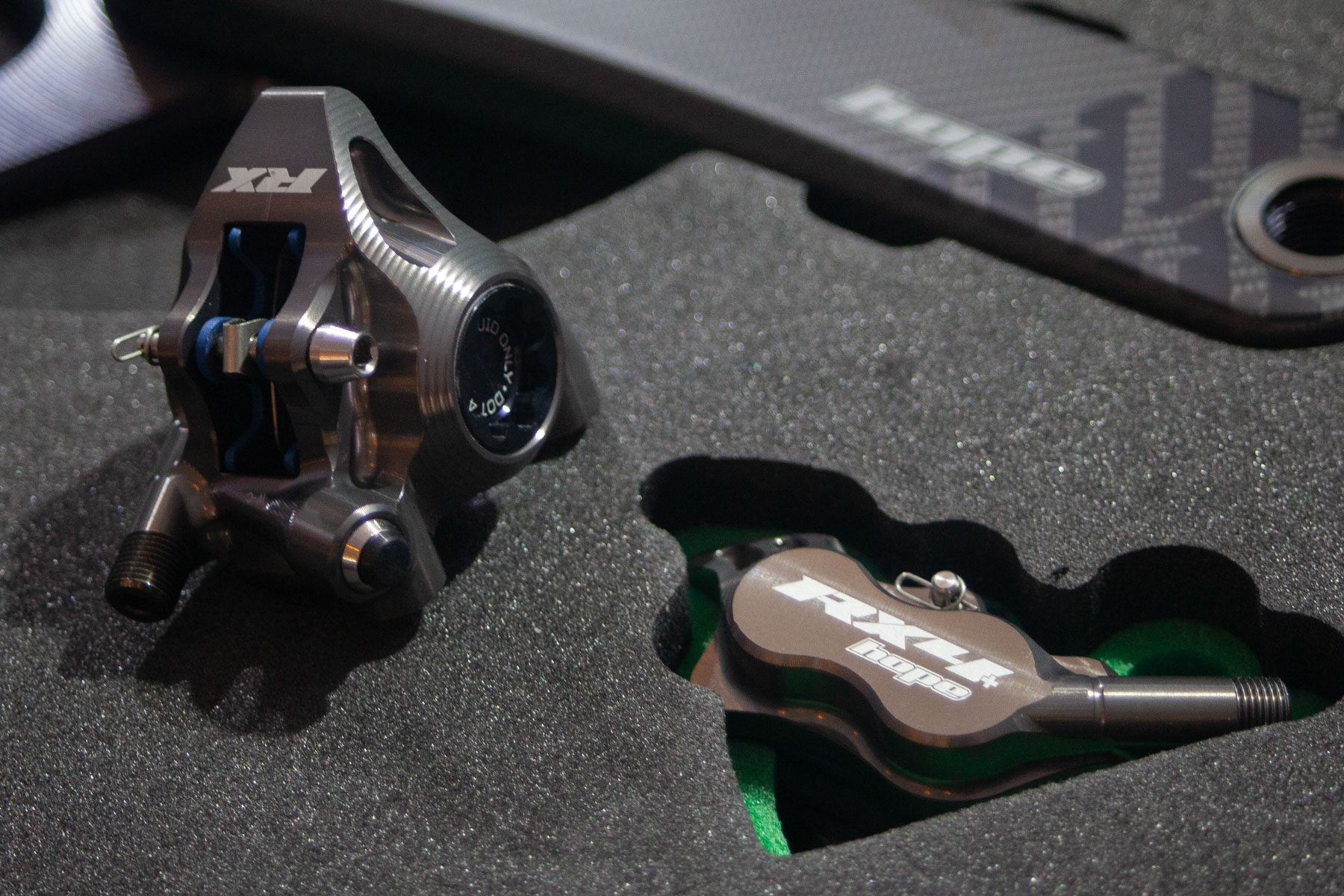
With the RX4+ SL, Hope has designed a new narrower bore cap, similar to that seen on the GR4 and TR4 brakes. That’s enabled it to reduce the overall caliper width, making for a much wider range of frame compatibility.
The latest bleed nipple design has been brought over from the RX2, making for a much simpler and cleaner bleed process. Plus it reduces the all-important bulk.
The RX2 is machined from a single aluminium billet. Warren Rossiter / Ourmedia
Why upgrade?
The RX4 SL brings four-cylinder brake power to road and gravel bikes. Warren Rossiter / Ourmedia
Hope’s RX4+ SL is the only four-pot brake caliper for road bikes. It offers more power, improved heat management and improved modulation. Hence, these brakes are usually found as offerings for downhill and enduro mountain bike use.
Both the RX4+ and RX2 are precision CNC-machined in a single piece from high-grade aluminium billet. This monobloc design is claimed to creates a stiffer caliper, improving lever feel and eliminating brake rub.
The new RX4+ SL and RX2 are available in both mineral oil and DOT fluid versions. This makes them compatible across the board with Shimano, SRAM and Campagnolo groupsets. They come in an array of colours, too: Black, Blue, Orange, Purple, Red, Silver and Smoke.
The RX4+ SL brakes will be available from March, priced at £115 / $160 / €144.50.
The Python bitwise-inversion (or complement) operator, “~“, behaves
pretty much as expected when it is applied to integers—it toggles every
bit, from one
to zero and vice versa. It might be expected that applying the
operator to a non-integer, a bool
for example, would raise a TypeError, but, because the bool type is really an int
in disguise, the complement operator is allowed, at least for now. For
nearly 15 years (and perhaps longer), there have been discussions about the
oddity of that behavior and whether it should be changed. Eventually,
that resulted in the “feature” being deprecated, producing a warning, with removal slated for
Python 3.16 (due October 2027). That has led to some reconsideration and the
deprecation may itself be deprecated.
The world’s largest automaker has had a somewhat difficult relationship with battery-electric vehicles. Toyota was an early pioneer of hybrid powertrains, and it remains a fan today, often saying that given limited battery supply, it makes sense to build more hybrids than fewer EVs. Its first full BEV had a rocky start, suffering a recall due to improperly attached wheels just as the cars were hitting showrooms. Reviews for the awkwardly named bZ4x were mixed; the car did little to stand out among the competition.
Toyota didn’t get to be the world’s largest automaker by being completely blind to feedback, and last year, it gave its EV platform (called -TNGA and shared with Lexus and Subaru) a bit of a spiff-up. To start, it simplified the name—the small electric SUV is now just called the bZ. It uses a new 74.7 kWh battery pack, available with either front- or all-wheel drive powertrains that now use silicon carbide power electronics. And for the North American market, instead of a CCS1 port just behind the front passenger wheel, you’ll now see a Tesla-style NACS socket.
Our test bZ was the $37,900 XLE FWD Plus, which has the most range of any bZ at 314 miles (505 km) according to the EPA test cycle. When you realize that the pre-facelift version managed just 252 miles (405 km) with 71.4 kWh onboard, the scale of the improvement becomes clear.
NASA’s James Webb Space Telescope (JWST) has unveiled a striking new photo of the “Exposed Cranium” Nebula, a celestial structure that, as the nickname implies, bears a strong resemblance to a human brain encased in a translucent skull.
Officially known as PMR 1, this nebula is a planetary shroud of gas and dust located roughly 5,000 light-years
Amidst drastic shifts from Xbox and the wider (PC) hardware market, Sony is reportedly considering a pivot away from its more recent strategy of eventually porting its single-player catalog to PC.
As-is, Sony first-party exclusives already trend toward a delay of at least a year before a PC port releases, making most titles merely timed
Netflix is walking away from a deal to buy Warner Bros. Discovery’s studio and streaming assets after the WBD board on Thursday deemed a revised bid by Paramount Skydance to be a superior offer. From a report: Earlier this week, Paramount raised its bid to buy the entirety of WBD to $31 per share, up from $30 per share, all cash. It was the latest amendment to Paramount’s multiple offers in recent months — and since moving forward with a hostile bid to buy the company — and it’s now unseated a deal between WBD and Netflix to sell the legacy media company’s studio and streaming businesses for $27.75 per share.
Last week, Netflix granted WBD a seven-day waiver to reengage with Paramount, resulting in the higher bid. Paramount’s offer is for the entirety of WBD, including its pay-TV networks, such as CNN, TBS and TNT. Netflix had four business days to make changes to its own proposal in light of Paramount’s superior bid, the WBD board said in a statement Thursday. Instead, the decision by the streaming giant to walk away puts a pin in a drawn-out saga that saw amended offers from both bidders.