Matthew Garrett examines
the factors that go into the decision about whether to install a
firmware update or not.
I trust my CPU vendor. I don’t trust my CPU vendor because I want
to, I trust my CPU vendor because I have no choice. I don’t think
it’s likely that my CPU vendor has designed a CPU that identifies
when I’m generating cryptographic keys and biases the RNG output so
my keys are significantly weaker than they look, but it’s not
literally impossible. I generate keys on it anyway, because what
choice do I have? At some point I will buy a new laptop because
Electron will no longer fit in 32GB of RAM and I will have to make
the same affirmation of trust, because the alternative is that I
just don’t have a computer.
Let’s deal with the bad news first: Apple is reverting a price cut from last year. It dropped the M4-powered MBA’s starting price down to $999, but for the M5-equipped model, you’ll need to shell out at least $1,099.
The company claimed the M5 MacBook Air will be able to deliver four times faster performance in AI tasks than the M4 MBA. Compared with the M1 MacBook Air, you’ll get up to 9.5 times faster performance, the company said.
Along with swapping in a more powerful chip, Apple has upgraded the starting storage by doubling it from 256GB to 512GB. The company says the SSD has “2x faster read/write performance compared to the previous generation.” You can kit out the MacBook Air with 4TB of internal storage if you have the will and the means.
You’ll also get 16GB of RAM for starters. The memory has 153GB/s of bandwidth, which Apple said is a 28 percent improvement over the M4 MBA. The latest MacBook Air can be equipped with up to 32GB of memory.
Just like it did with the latest iPad Air, Apple has upgraded the connectivity hardware. Thanks to the inclusion of the company’s N1 wireless chip, the M5 MacBook Air supports Wi-Fi 7 and Bluetooth 6.
As you’d imagine, the M5 MacBook Air runs on macOS Tahoe and it supports Apple Intelligence features. It has a Liquid Retina display, 12MP Center Stage camera, a sound system with Spatial Audio support and a pair of Thunderbolt 4 ports, which allows the laptop to support up to two external displays. Apple claims the M5 MacBook Air will run for up 18 hours on a single charge.
The M5 MacBook Air is available in 13-inch and 15-inch models, with the latter starting at $1,299. It’s available in sky blue, midnight, starlight and silver. Pre-orders start on March 4 at 9:15AM ET. The laptops will be available in stores in 33 countries and regions on March 11.
This article originally appeared on Engadget at https://www.engadget.com/computing/laptops/the-macbook-air-m5-starts-at-1099-up-100-from-the-m4-141612909.html?src=rss
NVIDIA made relatively quick work of stomping out a bug in its 595.59 WHQL driver following reports of fan issues. Just a few days after pulling that driver release, NVIDIA is pushing out its 595.71 WHQL driver package with the same Game Ready optimizations for Resident Evil Requiem, one of the most anticipated games of the year, but gamers
As part of its big week of announcements, Apple has unveiled a new pair of M5 chips alongside two new MacBooks. The new M5 Pro and M5 Max chips will power the new MacBook Pro that was just announced today, while the new MacBook Air comes with the base M5. According to the company’s press release, the M5 Pro and M5 Max come with an “advanced GPU with Neural Accelerators and higher unified memory bandwidth for a massive increase in AI compute.”
At the heart of the M5 Pro and M5 Max are what Apple is calling a new “Fusion Architecture” that “combines two dies into a single system on a chip (SoC).” The chips both feature a new 18-core CPU, six of which Apple is now calling “super cores, that are the word’s fastest CPU core.”
The other 12 are “all-new performance cores, optimized for power-efficient, multithreaded workloads.” Altogether, Apple says these CPU changes improve performance by “up to 30 percent for pro workloads.” Meanwhile, the GPU is a jump over the next-gen design we saw in the M5, as it goes to up to 40 cores. Each GPU core has a Neural Accelerator in it, and together with the higher unified memory bandwidth, the company says the M5 Pro and M5 Max offer “over 4x the peak GPU compute for AI compared to the previous generation.”
Apple added that graphics performance is also getting a substantial boost, by up to “35 percent for apps using ray tracing” compared to the M4 Pro and M4 Max.
To be clear, this isn’t the first time Apple has claimed it has the “world’s fastest” core. According to our resident Apple Silicon expert Devindra Hardawar, the benchmarks have proven the company’s claims true. It’s also worth noting that the two-die design isn’t novel or unique, as companies like Intel and AMD have been doing similar.
The M5 Pro and M5 Max will first show up in the new MacBook Pro, which is available for pre-order starting March 4, and will arrive on Wednesday, March 11.
This article originally appeared on Engadget at https://www.engadget.com/computing/apple-unveils-the-m5-pro-and-m5-max-chips-which-feature-new-faster-super-cores-141533420.html?src=rss
It happened much later than we expected, but Apple’s announcement of MacBook Pros with its M5 Pro and M5 Max chips has finally arrived. These more powerful variants on Apple’s silicon will be available in the 14-inch and 16-inch models of the laptops. Pre-orders will open on March 4 with an expected ship date of March 11. You’ll want to save some extra coin this time, though, as prices have gone up compared to the prior generation.
The new 14-inch MacBook Pro can be kitted out with either an M5 Pro or M5 Max. The Pro option for the chip boasts a CPU with 15 or 18 CPU cores and 16 or 20 GPU cores. For the M5 Max, users will have 18 CPU cores along with 32 or 40 GPU cores. The base model with an M5 Pro has either 24 or 48GB of RAM and now starts with 1TB of storage, up from 512GB as was standard before.
If you’re eyeing the 16-inch MacBook Pro, it starts with the M5 Pro with 18 CPU cores and 20 GPU cores. You can also get the same two M5 Max configurations as you can on the 14-inch model.
Perhaps most significantly, Apple has raised prices on its entire MacBook Pro lineup. The 14-inch M5 model previously started at $1,599; it’s now priced at $1,699. At least you’re getting something for that cash, as Apple has doubled its base storage to 1TB.
The same goes for the new M5 Pro and Max options. The 14-inch with the M5 Pro now starts at $2,199 instead of $1,999, while the 16-inch starts at a whopping $2,699 instead of $2,499. That 16-inch model comes with 24GB of RAM and 1TB of storage now as standard; that’s again double the storage space from the prior model. The M5 Max model starts with 2TB of storage and 36GB of RAM for $3,599 (14-inch) or $3,899 (16-inch).
Running down the rest of the specs: Apple says the storage in the new MacBook Pro is twice as fast as the prior generation — so you’re getting more, faster storage than before for the extra cash. The laptops also include the Apple-designed N1 chip for Wi-Fi 7 and Bluetooth 6 connectivity, and Apple says the MacBook Pro is rated for up to 24 hours of battery life. It has the same excellent Liquid Retina XDR display as we’ve seen for multiple years now, as well as a 12-megapixel “Center Stage” front-facing camera.
It’s a little unusual for these heavy-duty upgrades to Apple’s MacBook Pros to be announced so much later from the news of its latest silicon updates. The company debuted the M5 chip last fall as usual, but spent several months before it revealed these major hardware additions for housing it. And the M5 MacBook Pro that was announced in October shortly after the M5 chip news came with zero fanfare.
This article originally appeared on Engadget at https://www.engadget.com/computing/laptops/apple-brings-its-m5-pro-and-max-silicon-to-the-next-macbook-pro-generation-141553279.html?src=rss
Colnago has revealed two limited-edition bikes that put their carbon frames on full display, without any paint and only minimal graphics.
The Y1Rs and V5Rs Dark Series bikes are said to take Colnago’s philosophy of creating bikes for riders who want more from the machine beneath them “to its logical extreme”.
“The finish reflects the ideal color scheme for dedicated racers: full carbon with visible carbon-fiber layup, complemented by chrome-plated details. A minimum layer of transparent coating is sprayed to assure the quality of the finishing,” says Colnago.
Colnago says the bikes have been made the same way as Tadej Pogačar’s raw-carbon Y1Rs that he used at last year’s Tour de France.
Having stuck with his standard Colnago Y1Rs for the opening weeks of the Grand Boucle, Pogačar switched to a raw-carbon version of the aero bike for the stage 15 uphill time trial and then used it again for stage 16, which finished on Mont Ventoux.
The Dark Series frames show off the carbon layup. Colnago Tadej Pogačar used a raw-carbon Colnago Y1Rs at the 2025 Tour de France. Colnago
Colnago said at the time that a typical Y1Rs build weighs between 7.2 and 7.5kg, while Pogačar’s raw-carbon version was just over 7kg. The Italian brand also said the aerodynamic gains of the Y1Rs outweighed the small weight savings of switching to the V5Rs.
Whether the radical looks of the Y1Rs or the more classic appearance of the V5Rs appeal to you, Colnago says there will be 300 of each Dark Series bike, and production has already started in a range of sizes.
The bikes will arrive in shops from early March, starting with Colnago Elite Dealers. Prices are to be confirmed.
Apple continues its gradual unveiling of new products this week with the launch of the Studio Display and an all-new 27-inch Studio Display XDR. The latter is a higher-end model aimed at content creators with a 27-inch 5K Retina XDR display that features a mini-LED display with 2,000-plus dimming zones, up to 2,000 nits of peak HDR brightness and a wider color gamut for improved accuracy. It appears to be a replacement for the expensive, nearly seven-year-old 32-inch 6K Pro XDR Display, which is no longer for sale on Apple’s website.
The Studio Display XDR also has a 120Hz refresh rate, addressing complaints about the relatively anemic 60Hz refresh rate of previous models. At the same time, it addresses a longstanding user ergonomic complaint with a new tilt- and height-adjustable stand, with a height range of 105mm.
Apple
Apple calls the Studio Display XDR the “world’s best pro display” for things like HDR video editing and medical displays. Brightness levels are certainly outstanding at 1,000 nits of SDR and 2,000 nits HDR, and the 1,000,000:1 contrast ratio and 80 percent Rec.2020 coverage are also outstanding. The new model should also be fine for some light gaming thanks to the 120Hz refresh rate and Adaptive Sync support, though many buyers may want a 32-inch or larger display like the previous model.
Other features include a 12MP Center Stage camera with Desk View support and Thunderbolt 5 connectivity with a second port for downstream high-speed accessories or additional daisy-chained displays. It can also act as a Thunderbolt hub, while offering up to 140W of charging power through the included Thunderbolt 5 Pro cable, enough to fast-charge a 16-inch MacBook Pro.
Apple
Along with the Display XDR, Apple also announced a new version of the basic Studio Display. As before, it comes with a 27-inch 5K Retina display with up to 600 nits of brightness and P3 wide color, either with standard of optional nano-texture glass (a $300 option). However, it now includes an improved 12MP Center Stage camera along with Desk View to show your face and an overhead view of your desk at the same. You also get a studio-quality three-microphone array and six speaker sound system with Spatial Audio
That display now supports Thunderbolt 5 connectivity as well, providing higher-speed connections for accessories and the ability to daisy-chain displays. However, max charging power on this model is limited to 96W, enough to fast-charge a 14-inch MacBook Pro. The Studio Display comes standard with a tilt-adjustable stand, but you can get it with a tilt- and height-adjustable standard or a VESA mount adapter for custom desk setups.
The Studio Display XDR will be available tomorrow for pre-order starting at $3,299, while the new Studio Display also goes on pre-order on March 4 for $1,599.
This article originally appeared on Engadget at https://www.engadget.com/computing/accessories/apple-reveals-its-new-5k-mini-led-studio-display-xdr-141515587.html?src=rss
XLR microphone owners, rejoice: Shure’s successor to the MVX2U Digital Audio Interface (DAI) brings the adapter into the mobile era. The compact MVX2U Gen 2 adds more advanced onboard audio processing. But its most notable upgrade is mobile device compatibility, so you’re no longer limited to desktop use.
The single-channel MVX2U Gen 2 provides up to +60dB of gain and 48V phantom power. On the processing front, the adapter includes an auto-level mode. There’s also a real-time denoiser to minimize background noise and a pop filter (“Popper Stopper” in Shure marketing-speak) to soften those harsh plosive sounds. Shure says the new model improves the noise floor, headphone amp and DAC.
The adapter stores your last-used audio processing settings. That way, you don’t have to worry about your settings getting wiped out when switching between devices or software.
The Shure MVX2U Gen 2 includes a 1m (3.3 ft) USB-C to USB-C cable, so you can get it up and running quickly on your phone, tablet or PC. The adapter is now available for $139 from the company website.
This article originally appeared on Engadget at https://www.engadget.com/audio/shures-next-gen-dai-adds-mobile-support-140000205.html?src=rss
An anonymous reader shares a CTech article with the caption: “A brilliantly executed operation.” From the report: Years before the air strike that killed Ayatollah Ali Khamenei, Israeli intelligence had been quietly mapping the daily rhythms of Tehran. According to reporting by the Financial Times (paywalled), nearly all of the Iranian capital’s traffic cameras had been hacked years earlier, their footage encrypted and transmitted to Israeli servers. One camera angle near Pasteur Street, close to Khamenei’s compound, allowed analysts to observe the routines of bodyguards and drivers: where they parked, when they arrived and whom they escorted. That data was fed into complex algorithms that built what intelligence officials call a “pattern of life,” detailed profiles including addresses, work schedules and, crucially, which senior officials were being protected and transported. The surveillance stream was one of hundreds feeding Israel’s intelligence system, which combines signals interception from Unit 8200, human assets recruited by the Mossad and large-scale data analysis by military intelligence.
When US and Israeli intelligence determined that Khamenei would attend a Saturday morning meeting at his compound, the opportunity was judged unusually favorable. Two people familiar with the operation told the FT that US intelligence provided confirmation from a human source that the meeting was proceeding as planned, a level of certainty required for a target of such magnitude. Israeli aircraft, reportedly airborne for hours, fired as many as 30 precision munitions. The strike was carried out in daylight, which the Israeli military said created tactical surprise despite heightened Iranian alertness. The Financial Times reports that the assassination was a political decision as much as a technological feat. Even during last year’s 12-day war, when Israeli strikes killed more than a dozen Iranian nuclear scientists and senior military officials and disabled air defences through cyber operations and drones, Israel did not attempt to kill Khamenei.
The capability to do so, however, had been built over decades. Former Mossad official Sima Shine told the FT that Israel’s strategic focus on Iran dates back to a 2001 directive from then-prime minister Ariel Sharon instructing intelligence chief Meir Dagan to make the Islamic Republic the priority target. What distinguishes the latest operation, according to the FT, is the scale of automation. Target tracking that once required painstaking visual confirmation has increasingly been handled by algorithm-driven systems parsing billions of data points. One person familiar with the process described it as an “assembly line with a single product: targets.” Further reading: America Used Anthropic’s AI for Its Attack On Iran, One Day After Banning It
Last year AMD and Intel as part of the x86 Ecosystem Advisory Group announced ChkTag for x86 memory tagging across processors to better fight buffer overflows and use-after-free errors. In preparing for ChkTag with future processors, Intel has begun adapting their Linear Address Masking (LAM) support to more nicely jive with it…
The KDE project released KDE Plasma 6.6.2 today as the second maintenance update to the latest KDE Plasma 6.6 desktop environment series to address more bugs, crashes, and other issues.
Intel yesterday sent out their first “drm-xe-next” pull request to DRM-Next of new Xe kernel graphics driver improvements they have readied for their eventual upstreaming into the Linux 7.1 kernel…
Zwift launched a set of Mystery Spinners in Watopia as a fun lead-in to the Big Spin 2026 series, so I thought it would be a fun challenge to create the shortest possible route that hits all 8 spinners.
The route, it turns out, is rather similar to the Four Horsemen in terms of the big climbs it hits, and the overall length and elevation gain. Strong riders will be able to finish the route in under 2.5 hours, while most riders can expect it to take 3+ hours to complete.
About Rebel Routes
“Rebel Routes” are Zwift rides not available on Zwift’s routes list, thus requiring manual navigation.
The reward for your rebel ride? Exploring a new route, knowing you’ve gone where few Zwifters have gone before. And a Strava segment rank in the tens or hundreds instead of the thousands! Rebel Routes are also included as a separate category on our Veloviewer Route Hunter leaderboard.
Route Description
Our basic ride plan is to knock out all the Mystery Spinners in and around downtown Watopia before heading up the Epic KOM, then finishing on Alpe du Zwift. Begin by choosing the Hilly Route, which will start you in downtown Watopia, and heading in the right direction up the Hilly KOM.
After finishing the KOM (spinner #1), take the KOM bypass to head back into downtown Watopia, then out to the Volcano for a lap of the circuit in a CW direction (spinner #2). Then it’s up the Volcano KOM for spinner #3, and out to Jarvis for the KOM and spinner #4.
That’s half the spinners done. Those are the easy ones. Now we need to do some climbing!
Head into Ocean Boulevard and take a right at Sequoia Circle to head up the Epic KOM forward. You’ll get spinner #5 at this KOM arch, then turn right to head up the Radio Tower KOM “bonus climb” for spinner #6.
Descend from the Radio Tower (it’s fast) and head down the Epic KOM the way you came up, except hang a right onto The Grade descent. Drop all the way down into Ciudad La Cumbre, then turn right toward the Jungle. Two spinners left!
A bit of flat road gets you to spinner #7, Stoneway Sprint Reverse. Now you have just one spinner left… but it’s going to take some work to get there! Get onto the Jungle Circuit, then turn left to head up Alpe do Zwift. Spinner #8 is at the top. Hup hup!
Turn By Turn Directions
Begin by choosing the Hilly Route, which will start you in the right place and heading in the right direction up the Hilly KOM.
Burner accounts on social media sites can increasingly be analyzed to identify the pseudonymous users who post to them using AI in research that has far-reaching consequences for privacy on the Internet, researchers said.
The finding, from a recently published research paper, is based on results of experiments correlating specific individuals with accounts or posts across more than one social media platform. The success rate was far greater than existing classical deanonymization work that relied on humans assembling structured data sets suitable for algorithmic matching or manual work by skilled investigators. Recall—that is, how many users were successfully deanonymized—was as high as 68 percent. Precision—meaning the rate of guesses that correctly identify the user—was up to 90 percent.
I know what you posted last year
The findings have the potential to upend pseudonymity, an imperfect but often sufficient privacy measure used by many people to post queries and participate in sometimes sensitive public discussions while making it hard for others to positively identify the speakers. The ability to cheaply and quickly identify the people behind such obscured accounts opens them up to doxxing, stalking, and the assembly of detailed marketing profiles that track where speakers live, what they do for a living, and other personal information. This pseudonymity measure no longer holds.
We’re at the start of another one of those weeks where Apple announces one or two of its lesser products each day. The first pair to break cover is the iPhone 17e and iPad Air M4, with more due to drop as the calendar rolls forward. The iPhone 17e is by far the more interesting gadget, especially as the price remained the same as for the iPhone 16e. Apple is charging $599 for the 17e, even though the base model storage has doubled to a very welcome 256GB.
The 17e also gains several features that were held back from the equivalent budget handset last year. The most notable is perhaps the addition of MagSafe at Qi2 speeds, enabling users to wirelessly charge their device at 15W. Keen-eyed spec-list nerds will also spot Apple’s C1X proprietary wireless chip, which offers comparable speed to the Qualcomm models it will eventually replace, but with far better power efficiency.
The iPad Air, by comparison, is the very model of a modern major iterative spec revision to keep it up to date. The M3 has been upgraded to an M4, and it’ll get the same home grown wireless chips (N1 and C1X), blessing it with Wi-Fi 7 compatibility. Apple is also adding some more RAM to the iPad Air, boosting it from 8GB to 12GB, but without adding any more digits to the price.
As someone who’s still clinging on to an iPhone 14, the generous storage and low cost of the iPhone 17e is intriguing. And it’s a far more attractive package than whatever Apple was trying to offer with the iPhone Air.
Lenovo rocked up to MWC to show off a concept laptop with hot-swappable components, letting users push around their keyboard and displays at will. The company says you can set up the hardware on your desk to suit your needs at any given time. So, if you need a standard laptop, you can do that, or you can put a second display where your keyboard should go and use your keyboard wirelessly. Sadly, it’s a concept, so while you can purr at Lenovo’s engineering prowess you can’t hand it any of your cash to properly own this thing.
Honor made its usual full-court press at MWC, but the star of its own show was the Robot Phone, due to launch later this year. It’s a smartphone with its own articulating camera gimbal which can move around in response to its user’s commands. The Morning After’s own Mat Smith says it’s able to shake and nod its, uh, “head,” and can even dance along to music. And that’s before you get to its real function to, you know, take photos and stuff.
The combined ParaSkyWarDisco would serve 200 million subscribers.
Paramount Sky CEO David Ellison has outlined his vision for his latest toy, Warner Brothers Discovery. He told investors both companies would merge their streaming services, giving it a global audience of around 200 million subscribers. Ellison also pledged to give HBO operational independence, hopefully meaning it won’t be staffed entirely by patronage appointees.
MWC is such a big show it would be impossible to cover everything we’ve reported on in a single newsletter. But, thankfully, we’ve built a roundup of the most important things for you to peruse, especially all of the biggest phones that you aren’t as likely to see on store shelves in the US.
Meta has started rolling out an experimental AI shopping tool to some users in the US, according to Bloomberg. At the moment, it’s reportedly only showing up on desktop browsers when select users visit Meta AI on the web. They’ll know if they have access to the feature if they see the “Shopping research” button inside the query text box. The company has confirmed that it was testing the feature, Bloomberg said, but it didn’t say when a wider release will happen.
When users ask for product suggestions, the chatbot will show them a carousel with product images and their pricing, along with a link to the e-commerce website and information about the brand. Meta AI will also include a short explanation why it recommended the item. If Meta AI can see a user’s information, such as their gender and location data, it can tailor responses for them. Bloomberg said it replied with a selection of women’s puffer jackets from shops that ship to New York, based on the tester’s profile. Users cannot check out from within the Meta AI interface, but they can click on the links it provides to shop online.
Mark Zuckerberg previously told investors that Meta is launching agentic shopping tools during an earnings call earlier this year. It doesn’t come as a surprise that the company is working on them, when rival AI companies already offer the same tools. OpenAI rolled out a dedicated shopping assistant for ChatGPT just before Black Friday last year, shortly after Google launched its own shopping tools for Gemini. Perplexity also released an AI shopping assistant at the same time.
This article originally appeared on Engadget at https://www.engadget.com/ai/meta-starts-testing-its-ai-shopping-assistant-120148124.html?src=rss
It’s been nearly 20 years since Google revealed Android, which the company described as the first “truly open” mobile operating system, setting Google-powered phones apart from the iPhone’s aggressively managed experience. Over time, though, Android has become more aligned with Apple’s approach. For the moment, users still have the final say in what software runs on their increasingly locked-down smartphones. Later this year, though, Google plans to seriously curtail that freedom in the name of security.
In the coming weeks, Google will officially debut Android developer verification, which will require app makers outside the Play Store to register with their real names and pay a fee to Google. Failure to do so will block their apps from installation (sometimes called sideloading) on virtually all Android devices. Google says this is a necessary evolution of the platform’s security model, but upending the status quo could push developers away from Android and risk the privacy of those that remain.
This might make your phone a little safer, sure, but it won’t stop people from getting scammed. At the same time, it could rob the Android ecosystem of what made it special in the first place.
Google Home has some significant new quality-of-life updates and a new AI-powered feature, the division’s head honcho Anish Katturkan announced on X. Many of them, including a function called “Live Search,” are powered by the company’s Gemini for Home service launched in October 2025 as the official replacement for Google Assistant on smart devices.
“We launched Gemini for Home in Early Access specifically to learn from real-world usage,” Katturkaran said. “With millions of you now testing and shaping this experience every day, we’re pushing regular voice improvements to address your feedback.”
The Live Search feature does just what it says, letting you query Gemini about the current state of your home based on what the cameras see. For instance, you can ask things like “Hey Google, is there a car in the driveway?” However, the feature is only available for Google Home Premium advanced subscribers who pay a $20 per month ($200 per year) fee.
Gemini for Home now uses updated models to improve the quality and accuracy of answers too and will more reliably play newly-released songs. Other key updates include better targeting for smart home devices by room, house and device, reduced instances of cutting off a speaker prematurely, better reliability for user-created automations by voice and more. Too see all those changes, check out Google Home’s latest changelog,
Finally, Google Home announced “enhanced support” for the Nest x Yale lock, including comprehensive passcode management (including for guests), a more robust activity history, real-time notifications for lock events and enhanced lock settings like single touch locking.
This article originally appeared on Engadget at https://www.engadget.com/home/smart-home/googles-homes-latest-feature-is-gemini-powered-live-search-for-cameras-112216551.html?src=rss
Teaching about AI concepts in schools is a tricky business as there are complicated ideas to be taught.
To teach complex concepts, in computer science, we often use an instructional approach called ‘unplugged’. We use the unplugged approach to teach computing concepts without a computer. Often unplugged activities include using an everyday analogy or a physical fun activity. For example, to teach about algorithms, students might learn how to make a jam sandwich where the recipe and following instructions accurately are similar to an algorithm and the steps within it used to write a program. The jam sandwich activity has now become a popular and key teaching experience for young students across the world, as it teaches a complex but fundamental idea in a simple and fun way.
At the January 2026 Raspberry Pi Foundation Research Seminar, Salomey Afua Addo, a researcher at the University of Cambridge, presented her work about how to teach about AI. She has specifically looked at this in the context of high school students in Ghana, where AI is now part of the mandatory curriculum. In Ghana, most schools do not have access to computers, therefore an unplugged approach to teach about AI is a good idea. Therefore, Salomey developed a set of unplugged activities to teach about a range of AI concepts.
Here, I focus on one of the activities that she presented — one that I think will become another ‘jam sandwich’ experience for students. So if you might teach about AI at some point, then read on.
Neural networks and rope: An unplugged activity
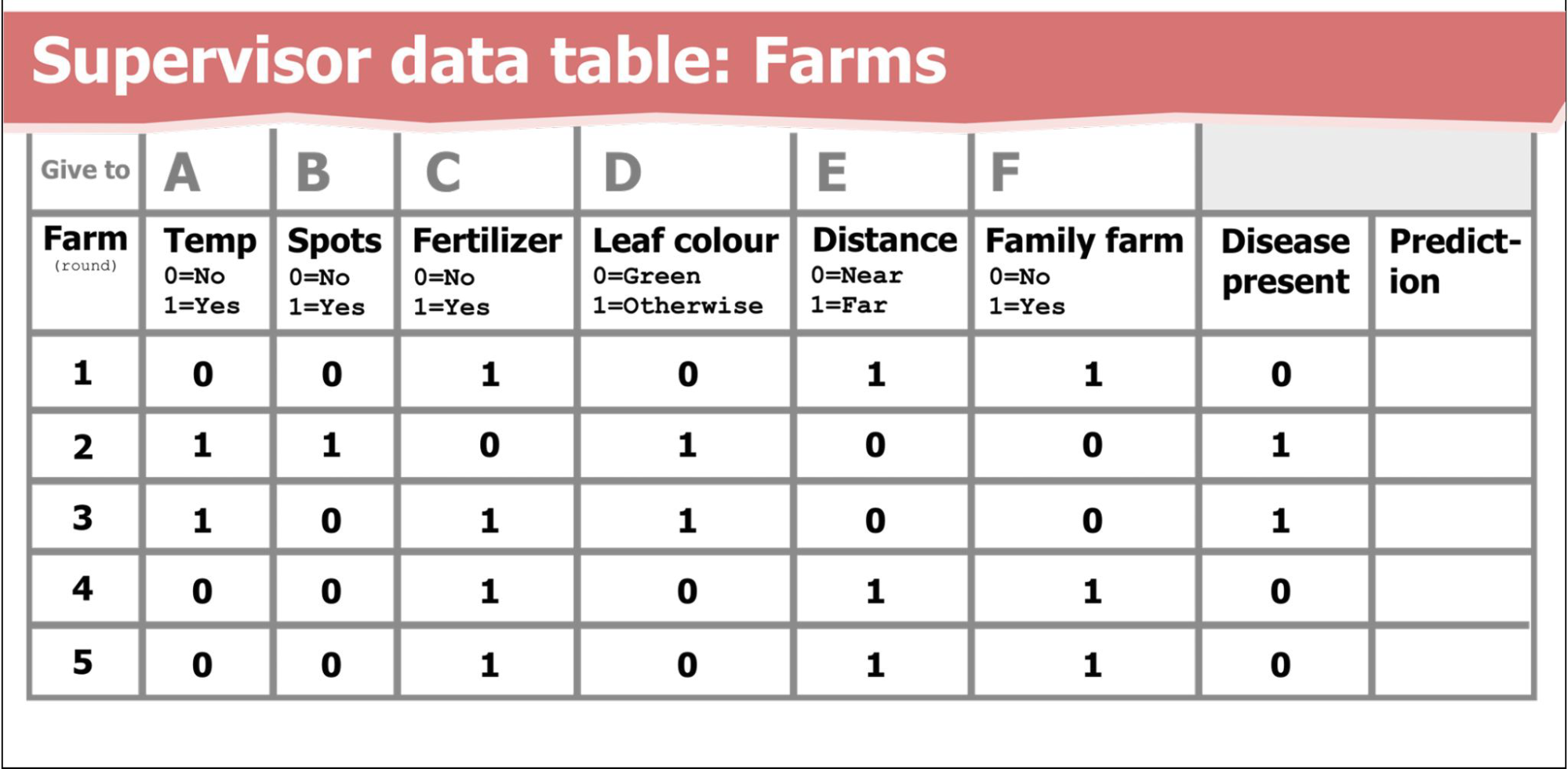
Salomey has designed an unplugged role-play activity to teach about neural networks and how they are trained to solve a problem. She focused on finding a familiar problem context for Ghanaian teachers and their students, and selected farming and crop disease. Students are asked to figure out what features about a farm are relevant for detecting diseases on cocoa trees. To solve the problem, students are given data about the farms (see Table 1). Giving students data, rather than preconceived rules about the context is key to the learning activity. Neural networks are data-driven — they provide a way to model given data so that we can make predictions. Here the features of farms, and importantly whether disease is or is not found in their cocoa trees, is the data that is used to train a model. The model is used to make predictions, which can then be used to improve farming by reducing crop disease.
Students using ropes to signify the strength of connections between nodes.
Using farm data, students can learn how neural networks work, and they can do this through an unplugged role play — using ropes!
Here’s how Salomey’s classroom activity works. Sets of students act out the processes of training a neural network, including forward propagation, evaluation, and backpropagation. They take on the “roles’’ of some of the concepts of a neural network. One student acts as the supervisor, six students act as the input layer, two as the hidden layer, and one as the output layer.
Keeping it simple: Concepts and data
Key concepts are simplified for students:
Forward propagation: The hidden layer players randomly select a set of farms (three of the six sets of input values), which reflects how weights are often set to random values at the start.
Evaluation: The student acting as the output layer compares the prediction (whether crop disease is present or not) to the actual value for the farm to assess the error, similar to a loss function.
Backpropagation: Inspired by MIT’s RAISE curriculum, this stage is modelled on establishing trust. Players in the hidden and output layers modify their trust in the previous layers (by adding or removing ropes) based on the accuracy of the prediction (if the farm has disease).
Simple numerical data about the features of the problem are given to the students, such as whether the “Temperature” is suitable (0=No, 1=Yes), if there are “Spots” on the plant (0=No, 1=Yes), if “Fertilizer’’ has been used, whether the “Leaf colour’’ is green or not (see Table 1). Importantly, each of the six features given are represented by the six “input layer” students. So each student can ‘process’ each feature as the data for a given farm is used to train the model. Cards are used to represent the data values passed between layers. And this is where the ropes come into play, as they are used to represent the connections between the nodes in the layers.
Table 1: This data table was given to the student assigned the “Supervisor” role in each group and contains both relevant and irrelevant data to “train” their neural network.
Instructions for each role
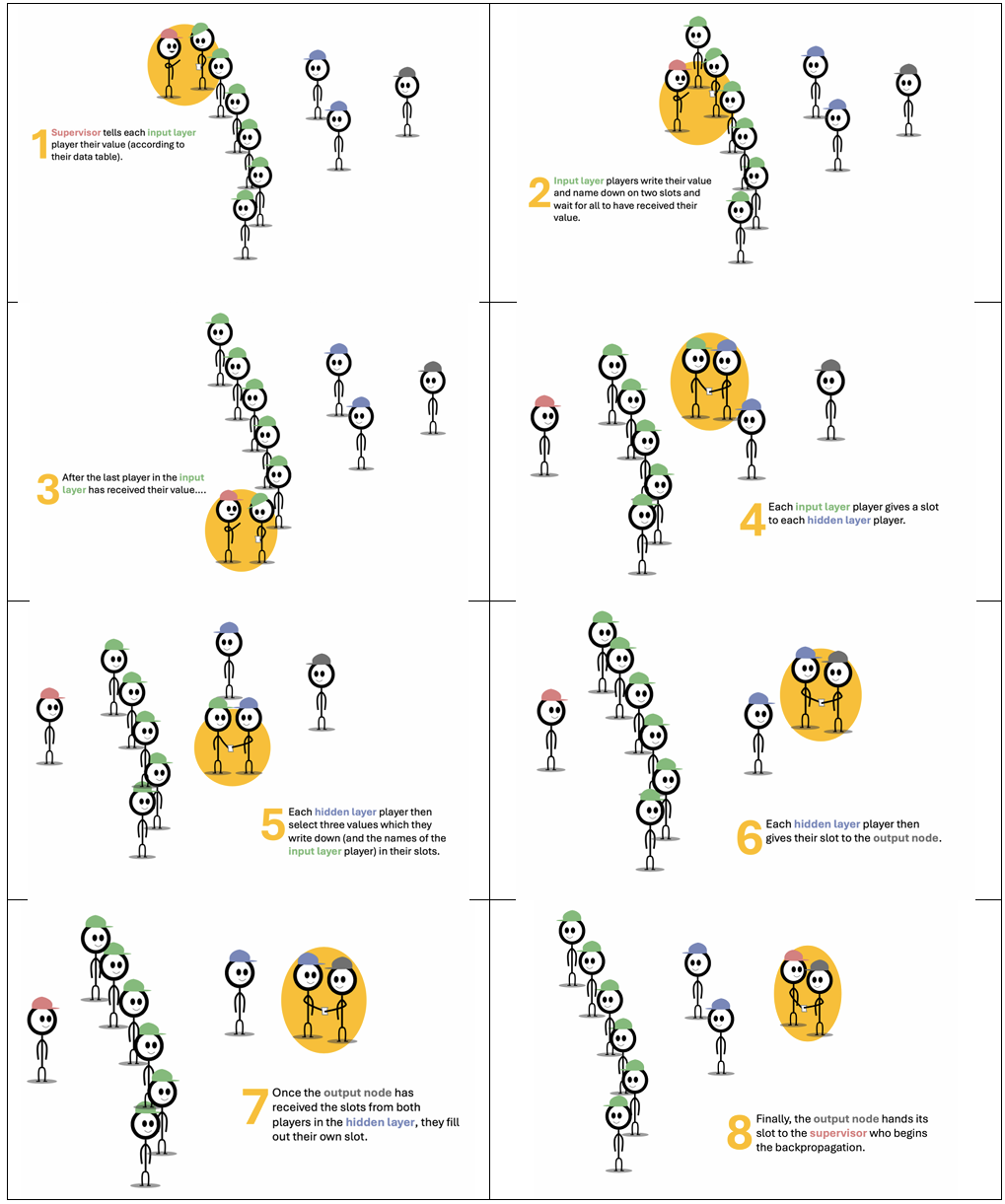
Written role-specific instructions are provided for the students to follow, for example, the Supervisor is given three steps to follow for the forward propagation stage, and the Input Layer students receive a different set of instructions and so on. The detail of the role play is shown in the instruction sheets (see Figure 1).
Figure 1: Detailed explanation of the eight steps of the role-play activity that Salomey developed. Click to enlarge.
Why the ropes are important
Using ropes to connect the nodes becomes most important at the reverse propagation stage. The clever part of this is that we can show an increase or decrease in the strength of connection by adding or removing ropes. For me, this is the ‘jam sandwich’ effect. This, I think, is probably the most significant learning point. Here, the number of ropes that connect the nodes in the layers are changed based on the strength of evidence that a particular feature is indicated, by the data, to be relevant to the output. In this case, whether “Temperature”, for example, has an implied effect on cocoa disease or not — based on the data, not on any preconceived rule. Simply put, if a farm did have disease then a rope is added, if a farm did not then a rope is removed. Or at a more abstracted level, if a particular neuron contributes towards the correct prediction, a rope is added, otherwise a rope is removed. In a real neural network, backpropagation involves complex maths, such as calculus that would not be accessible to students of this age. Therefore, the rope is an analogy that replaces something that would be impossible for these students to grasp if it was taught using the real-world implementation.
Problem to be solved in the unplugged activity: Identify features that are relevant for detecting diseases
At the end of the activity, features (temperature, leaf color, family farm, etc.) with many rope connections are considered to be relevant for crop disease detection on the farm, whereas features with fewer rope connections are considered to be irrelevant for crop disease detection. The more ropes attached to a particular feature, e.g., temperature, represent its higher relevance in identifying crop disease on the farm.
Activity design, follow-on and evaluation
As part of the design of this activity, Salomey has simplified technical language so that throughout the role play students use everyday terms and she has chosen a context that is relatable for the students. For example, she uses the language of trust, and the new thickness of a rope connection, rather than using technical terms such as weight, loss function, and the error of the network.
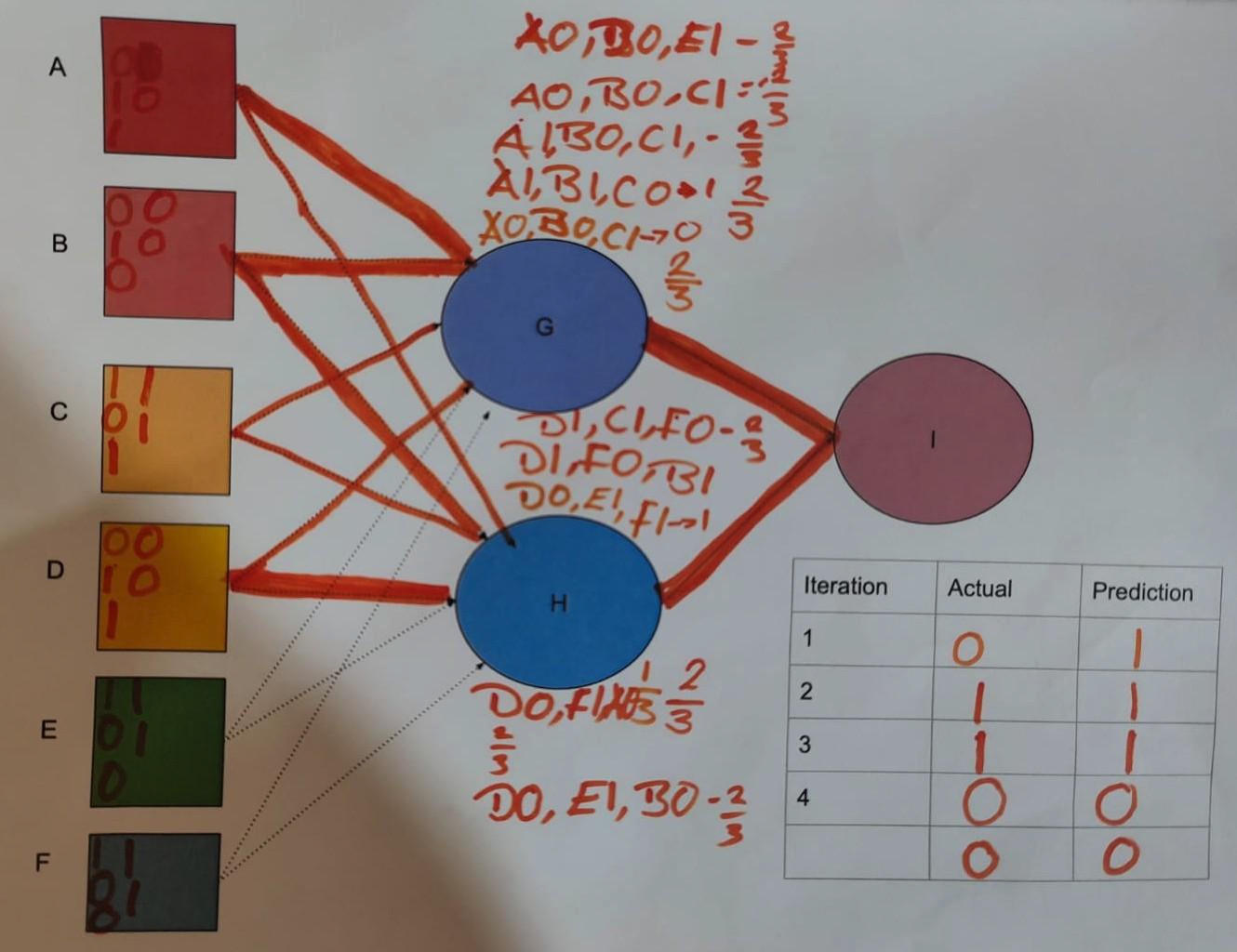
Salomey also designed a follow-on activity that uses pen and paper. In this version of the activity, which she calls a board game, the students draw lines to connect the nodes in the layers. The thickness of the lines connecting the nodes represent the strength of the trust (see Figure 2).
Figure 2: An example of how students use the board game that Salomey designed to teach about neural networks, where the thickness of the lines between nodes represents the strength of trust.
Salomey also shared her evaluation of the resources. She conducted pre‑ and post‑intervention surveys with 39 teachers as part of the professional development on the AI teaching materials, and ten of those teachers implemented the unplugged activities in their classrooms. She reported that the teachers found the role-play activity was effective to demonstrate neural networks, that children worked independently to learn, and that some students who did not take part usually in class were engaged.
As well as sharing about her unplugged neural network activity, Salomey also talked about a set of AI stories that she has developed to teach about other aspects of AI applications. For example, the importance of fact-checking is demonstrated through a story about a young girl who fact-checked information she received from her friends about life in a city. If you would like to find out more about Salomey’s work, you can find related materials on our seminar website.
Join our next seminar
Join us at our next seminar on Tuesday 17 March from 17:00 to 18:30 GMT to hear Rebecca Fiebrink (University of the Arts London) speak about teaching AI for creative practitioners. This will be the second seminar in our new series on how to teach about AI across disciplines. We hope to see you there!
To sign up and take part in our research seminars, click below: