What’s New on Paramount+ With Showtime in March 2025

Paramount+’s March slate is anchored by a new original crime series Happy Face (March 20), which tells the true story of Keith Jesperson, a serial killer known as Happy Face. The drama stars Dennis Quaid as Jesperson and Annaleigh Ashford as his daughter, who discovered his identity at age 15 and must decide if she wants a relationship with him after decades of no contact.

Also in true crime is a three-part docuseries Sin City Gigolo: A Murder in Las Vegas (March 4) about the criminal investigation into a former reality TV star arrested in 2020 for murder.

March brings a handful of music features to Paramount+, including a remastered version of the 80s film Tom Petty: Heartbreakers Beach Party Extended (March 11), which originally debuted on MTV, as well as the two-hour taped special Ringo & Friends at the Ryman (March 10) featuring performances from Ringo Starr and guests ranging from Sheryl Crow to Emmylou Harris.

Here’s everything else coming to the service in February. Note that titles with an asterisk are exclusive to Paramount+ With Showtime; everything else is also available to subscribers on the ad-supported plan. Those with two asterisks are available to Paramount+ With Showtime users streaming live on CBS and to all subscribers the following day.

Paramount+ Originals and premieres coming in March 2025

Available March 1

  • Strange Darling*

Available March 3

  • Rumours*

Available March 4

  • Sin City Gigolo: A Murder in Las Vegas, premiere

Available March 10

  • Ringo & Friends at the Ryman,** special

Available March 11

  • Tom Petty: Heartbreakers Beach Party Extended, premiere

Available March 20

  • Happy Face, series premiere

TV shows coming to Paramount+ in March 2025

Available March 5

  • The Amazing Race (season 37 premiere)**

  • The Fairly OddParents: Abra-Catastrophe Special

  • The Surreal Life (season 2)

Available March 12

  • Air Disasters (season 20)

  • The Fairly OddParents: A New Wish (season 1)

Available March 19

  • Teen Mom: The Next Chapter (season 2)

Available March 26

  • Basketball Wives (season 11)

Movies coming to Paramount+ in March 2025

Available March 1

  • A League of Their Own

  • Annihilation

  • Becoming Jane

  • Blue Crush

  • Boys on the Side

  • Cloud Atlas

  • Continue

  • Crawl

  • Dune (1984)

  • Edge of Tomorrow

  • Elizabethtown

  • Ex Machina

  • Face/Off

  • Failure to Launch

  • Foxcatcher

  • Foxfire

  • Frozen River

  • Good Will Hunting

  • Harlem Nights

  • Inglourious Basterds*

  • Julie & Julia

  • Jungleland

  • Lara Croft Tomb Raider: The Cradle of Life

  • Lara Croft: Tomb Raider

  • Love, Rosie

  • Marie Antoinette

  • Middle School: The Worst Years of My Life*

  • Million Dollar Baby

  • Motherhood*

  • Mulholland Drive

  • Only the Brave

  • Pan’s Labyrinth

  • Practical Magic

  • Pulp Fiction

  • Rat Race

  • Room

  • Run All Night

  • Searching For Bobby Fischer

  • Serpico

  • Shutter Island

  • Sicario: Day of the Soldado

  • Sleepy Hollow

  • Snake Eyes

  • Son of a Gun

  • Staying Alive

  • Sugar & Spice

  • The Abandon

  • The Fifth Estate*

  • The Glorias

  • The Heartbreak Kid (2007)

  • The Hurt Locker

  • The Ides of March

  • The Kite Runner

  • The Lodge*

  • The Machinist

  • The Manchurian Candidate

  • The Other Boleyn Girl

  • The Queens of Comedy

  • The Sum of All Fears

  • The Terminal

  • The Virgin Suicides

  • The Warriors

  • The Way Of The Dragon

  • The Weekend

  • The Women

  • There Will Be Blood

  • Trail of Justice

  • Up In The Air

  • Wayne’s World

  • Wayne’s World 2

  • Witness

Available March 3

  • The House with a Clock in Its Walls*

Available March 8

  • Babylon

  • India Sweets and Spices*

Available March 16

  • Bridge of Spies*

Available March 18

  • The Last Manhunt*

Available March 21

  • The Hunting Party*

Available March 23

  • The Free World*

Available March 26

  • Mass*

Available March 31

  • American Psycho*

  • American Psycho II: All American Girl*

The Milky Way’s Central Black Hole Just Put On A Cosmic Disco Party For NASA


The James Webb Space Telescope (JWST), a product of over two decades of collaboration between NASA, CSA, and ESA, has made a remarkable discovery. From its home in a stable orbit in Lagrange point 2, the JWST captured a dazzling display of flaring activity from the supermassive black hole at the center of our Milky Way. These findings have

Cozy Lord of the Rings game Tales of the Shire is delayed to July

Samwise Gamgee said, “It’s the job that’s never started as takes longest to finish.” But then, he hadn’t been exposed to the world of video game development. Tales of the Shire: A The Lord of the Rings Game, a cozy take on the most idyllic pocket of Middle Earth, has been delayed. The new launch date is July 29. According to a post from the devs at Wētā Workshop Game Studio, this delay is about ensuring that all the project’s supported platforms “can enjoy the same cozy experience.” It is currently slated to launch on Nintendo Switch, PlayStation 5, Steam and Xbox Series X.

This project has taken a couple tough hits over the past several months. The release date had already been pushed back in September, and it was axed from Netflix’s planned game lineup earlier this month. Will there be more hurdles before we can finally enjoy our happy hobbit alternate lives? As a wise wizard once said: “Who knows? Have patience.”

This article originally appeared on Engadget at https://www.engadget.com/gaming/cozy-lord-of-the-rings-game-tales-of-the-shire-is-delayed-to-july-213500109.html?src=rss

Why the iPhone 16e Uses a ‘Binned’ A18 Chip (and What That Means)

When Apple announced the iPhone 16e on Wednesday, there was a lot of focus on the price tag ($599 is cheap for a new iPhone, but not that cheap), the lack of MagSafe support, and Apple’s decision to finally kill off the Home button.

But there’s an interesting discussion surrounding the 16e’s processor: the A18. At first glance, it seems like the same chip as the iPhone 16 and iPhone 16 Plus. The phones also have the A18, which makes it sound like the iPhone 16e offers the same performance as its more expensive sibling devices, for at least $200 less. The thing is, these aren’t the same chips: The A18 in the iPhone 16e is “binned.”

What is a “binned” chip?

“Binned” chips don’t just apply to Apple products. All computer chip makers can bin their chips. It has to do with the manufacturing process: Chips are extremely complicated products, and they don’t all come out exactly the same. Samples are tested for quality assurance purposes, and the chips that aren’t quite up to snuff are separated from the ones that perform to standard. The former are then “binned,” and won’t be used as high-end chips, since they aren’t able to hit the performance levels manufacturers are looking for.

That doesn’t mean binned chips won’t be used at all, however. On the contrary, binned chips are often used, especially as mid- and lower-tier options. Manufacturers will often disable different “cores” of these chips to keep their performance in check. They’re still perfectly capable chips, especially when they have this ceiling in place. Intel does this with its line of chips, for example, which is why you have different performance variants, like i5, i7, and i9. Apple does this, too: For the iPad mini 7, the company used binned A17 Pro chips. Now, Apple is using binned A18s for the iPhone 16e.

How the iPhone 16e uses binned A18s

So, Apple makes a batch of A18 chips, originally intended to ship with the iPhone 16 series. During testing, some of these A18 chips aren’t totally up to snuff, so they’re set aside and not used for iPhone 16 and iPhone 16 Plus devices.

However, Apple has a new iPhone they want to sell for less than its flagship line—one that strips out “premium” features to keep costs down, but also offers incentives for users to actually buy their new iPhone over other options. It does have some binned A18 chips lying around: Why not use those instead?

The iPhone 16e, then, uses the “same” chip as you’d find in the iPhone 16 and 16 Plus—but we know it doesn’t perform as well, and thus can’t be pushed as far. Apple, then, disables one of the GPU cores to keep performance in check. The 16e’s CPU has the same six cores as the 16 and 16 Plus’ (two performance and four efficiency), and the NPU has the same 16 cores across all devices. But where the GPU in the 16 and 16 Plus has five cores, the GPU in the 16e only has four cores. That’s because these chips are binned.

We won’t know exactly how the binned A18 compares to the A18 found in the iPhone 16 and 16 Plus until reviewers get their hands on the iPhone 16e. However, my guess is the differences will be minimal. The CPUs and NPUs are the same, and the 16e’s GPU still has four cores, which means performance for most tasks on the iPhone is going to be high. However, where the difference might show is in graphically demanding apps, such as AAA games. Developers could push the iPhone 16 a bit further than the iPhone 16e, because it has that extra GPU core. That will likely extend to the longevity of these devices, too: As software advances and becomes more demanding, the extra GPU core on the iPhone 16 could help keep it running smoother for longer.

That said, it’s just one extra core. In all likelihood, it’s not going to amount to that great a difference. We’ll see the numbers once reviewers run their benchmarks, but I think Apple’s choice here was more about saving the company money than offering users a noticeably worse experience.

Elon Musk wants to ‘fix’ Community Notes on X

Elon Musk has a problem with Community Notes, the crowdsourced fact-checking feature that started as Birdwatch, and launched at scale after he purchased Twitter.

“Unfortunately @CommunityNotes is increasingly being gamed by governments & legacy media,” Musk posted. “Working to fix this…” Based on the rant his tweet descends in to afterwards, his issue appears to be with how X’s Community Notes contributors have been treating misinformation about President Volodymyr Zelenskyy and the war in Ukraine. Musk quotes a post from an X account that claims polls showing Zelenskyy has a 57 percent approval rating in Ukraine are “not credible.” Information like that being challenged on X doesn’t jive with President Trump’s description of Zelenskyy as a “dictator” or Musk’s desire to use the platform as an unofficial arm of the current administration.

What “fixing” Community Notes will look like remains to be seen, but Musk uncritically quoting a post that cites no sources beyond an image with small text that says “Accuracy Confidence: Normal” is hopefully evidence enough that Community Notes are the bare minimum needed. Ragging on the feature of course fits the larger pattern of Musk’s tenure at X, which has been characterized by him manipulating the platform’s algorithm and eliminating features that helped determine credibility, like verification. If he thinks you can’t even trust crowdsourced fact-checks, there’s really no source of truth left on the platform.

The concept of Community Notes is no longer unique to X — Meta recently opened up the waitlist to use the feature on its platforms — but how long Community Notes exists its current form is apparently now an open question.

This article originally appeared on Engadget at https://www.engadget.com/social-media/elon-musk-wants-to-fix-community-notes-on-x-212310412.html?src=rss

Dark Mode Might Be Burning More Juice Than You Think

Using apps and websites in dark mode can actually use more energy than standard mode, according to researchers, as it causes people to crank up the brightness. From a report: This counterintuitive finding is claimed by BBC Research & Development (R&D), which says that despite the popular energy saving recommendation to cut electricity consumption by switching to dark mode, doing so might actually make things worse. “Dark mode is a popular dark-theme colour content scheme and research has found that, for some devices, switching to dark mode can reduce device power consumption. Energy conscious internet users are therefore encouraged to browse in dark mode,” say the authors of a BBC R&D blog post.

“The catch is that the advertised energy savings haven’t been tested in the wild, where user behavior can cause unexpected consequences.” So the BBC’s R&D engineers put participants in front of the BBC Sounds home page and asked them to adjust the device brightness until they were comfortable with it, repeating this for both light and dark mode versions of the page.

Read more of this story at Slashdot.

FTC investigates “tech censorship,” says it’s un-American and may be illegal

The Federal Trade Commission today announced a public inquiry into alleged censorship online, saying it wants “to better understand how technology platforms deny or degrade users’ access to services based on the content of their speech or affiliations, and how this conduct may have violated the law.”

“Tech firms should not be bullying their users,” said FTC Chairman Andrew Ferguson, who was chosen by President Trump to lead the commission. “This inquiry will help the FTC better understand how these firms may have violated the law by silencing and intimidating Americans for speaking their minds.”

The FTC announcement said that “censorship by technology platforms is not just un-American, it is potentially illegal.” Tech platforms’ actions “may harm consumers, affect competition, may have resulted from a lack of competition, or may have been the product of anti-competitive conduct,” the FTC said.

Read full article

Comments

David Attenborough Imagines What The Extinct Dodo Bird Actually Looked Like

Because humanity is, by nature, complete garbage, the flightless dodo bird has the distinction of being the first known species to be completely extinguishing by human activity (hunting, habitat destruction, introduction of predators). The species was discovered and extinct in less than 80 years. Go us! In this clip from Museum Alive with David Attenborough from PBS Nature, everyone’s favorite soothing naturalist Sir David Attenborough imagines what the birds might have looked like with the help of modern computer graphics. In that shot above? There was no bird there, David was just staring at the floor. My grandpa does that a lot too.

Meta Announces $50M ‘Horizon Worlds’ Content Fund as Some VR Studios Struggle to Make Ends Meet

Meta today announced a $50 million fund to incentivize the creation of new and improved content in Horizon Worlds, the company’s first-party social gaming platform. The move comes as many seasoned studios that build self-contained VR apps for the Quest platform are struggling to sustain themselves due to what Meta says is a shifting demographic of headset users.

Since the launch of Oculus Rift CV1 in 2016, self-contained VR apps have been the lifeblood of Meta’s VR platforms, and the primary driver of a growing audience of users over the years. And while these self-contained games and apps still largely define Meta’s XR platform, the company has come to believe that an all-encompassing ‘metaverse’ of connected experiences is the key to its success.

Horizon Worlds is Meta’s attempt at building the ‘metaverse’, where the platform serves as both a destination for playing and for building. Creators can build content inside of Horizon Worlds itself, then publish that content to the rest of the Horizon Worlds community. It’s all social by default, a critical element for one of the world’s largest social media companies.

But with Horizon Worlds available in VR for several years but not achieving a critical mass of users that could satisfy Meta’s desire for scale, the company eventually opened up Horizon Worlds to flatscreen devices like phones and computers with the goal of bringing more people onto the platform. While this invites a larger audience, it also makes the job of creators harder, given the challenge of satisfying the unique affordances of VR vs. those of flatscreen platforms.

Image courtesy Meta

And of course, one of the big hurdles to getting people using and returning to Horizon Worlds is straightforward: content. If there isn’t fun things to do with strong replayability, why would anyone keep coming back, let alone check out Horizon Worlds in the first place?

Meta has made some strides on content by attracting more and more creators to build for the platform and creating some of its own first-party games inside of Horizon Worlds.

Now the company is making another big bet to incentivize creators to build on Horizon Worlds; today it announced a $50 million ‘Creator Fund’ that will pay out to creators of worlds that drive high visits and retention.

“Each month, we’ll pay out bonuses from the Creator Fund to the makers of fun and engaging mobile and MR worlds. Bonuses will be tied to worlds’ contributions to the overall ecosystem across time spent, retention, and in-world purchases, so there are a variety of different ways for creators to maximize their earnings,” the company said in its announcement.

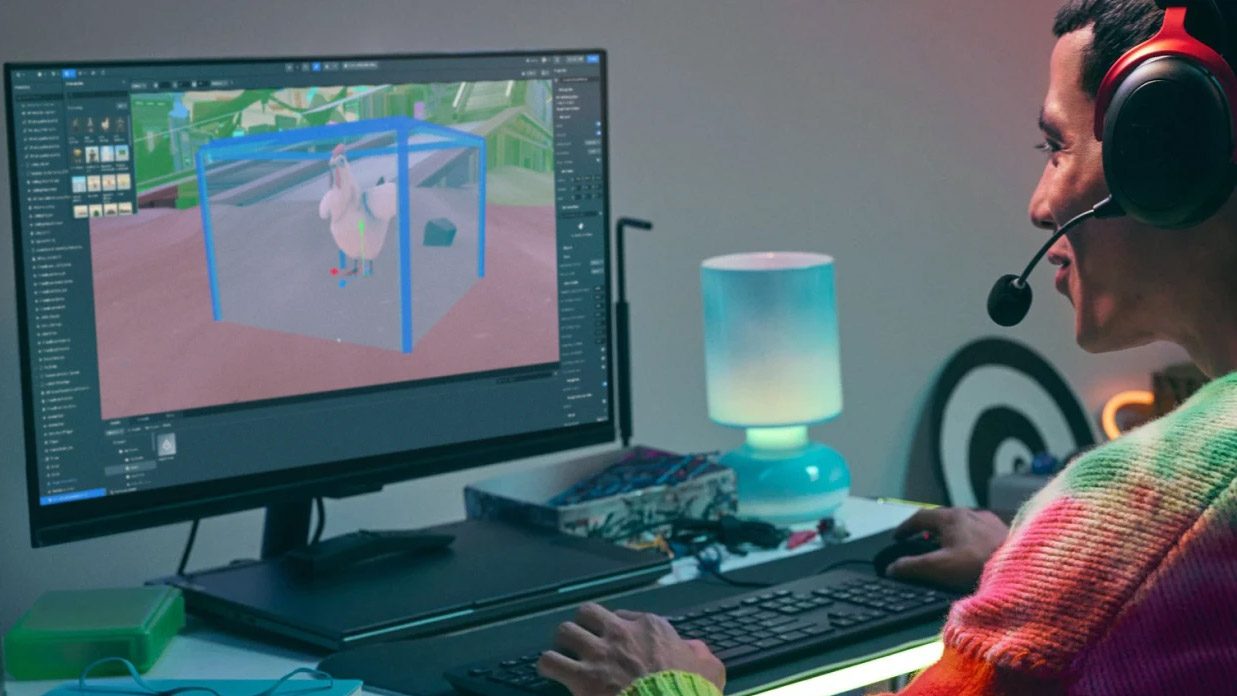
The fund comes alongside a new development tool, the Horizon Worlds desktop editor, which allows creators to build more extensive projects with the speed and power of their computer, rather than being inside a headset. It’s closer to the workflow of existing self-contained VR app developers, who generally build their apps using a game engine like Unity.

Image courtesy Meta

The move is in line with Meta’s growing conviction that Horizon Worlds is essential to its success in this space. Whether VR or not, Meta wants to build its own version of Fortnite—a social gaming platform with massive reach and retention.

Meta’s CTO recently told the teams working on XR and Horizon that the mobile version of Horizon Worlds “absolutely has to break out for our long term plans to have a chance.”

While the new $50 million creator fund is certainly a boon for creators who believe in Meta’s vision for Horizon Worlds, it comes at a tough time for developers of the self-contained VR and MR apps that have kept Meta’s headsets relevant.

The fund is the exclamation mark on the last two years which saw Meta pivot its VR platform to focus much more on Horizon Worlds. The company drastically reorganized its headset interface and mobile companion app—and even renamed them to reflect their new focus—to put Horizon Worlds content in front of more users. In some cases this meant pushing high-quality self-contained apps further from view, sometimes in favor of amatuer content of little value, or ‘cloned’ content that aims to recreate the gameplay of a successful self-contained VR app inside of Horizon Worlds.

A widespread feeling among those third-party developers at the moment is that these changes have significantly harmed their businesses, which rely on sales of their apps to continue supporting existing content and to create new content. The feeling is that Meta is funneling customers away from their apps and onto its own sub-platform (where Meta takes an even more aggressive cut of creator revenue).

A growing list of longstanding studios that have built well received self-contained VR apps have been made significant cuts to staff and footprint, citing the dual challenges of sluggish performance on Meta’s Quest platform and broader distress in the overall gaming industry. Meta even closed one of its own studios that was focused on high-production self-contained VR games.

That’s not to say that Meta hasn’t invested in developers of self-contained VR games & apps over the years.

The company has disbursed hundreds of millions of dollars for the purpose of building alluring VR content, and has aimed to accelerate small indie developers with programs like Oculus Start.

Last year the company created a “multi-million dollar” fund to incentivize new studios to try their hand at creating MR content for Quest, and a similar fund aimed at developers building ‘lifestyle’ apps for Quest headsets.

However, many developers are left with a feeling that even if they have found a sustainable audience for now, Meta’s shifting focus—whether from VR to MR, or MR to Horizon Worlds—makes the Quest platform a volatile and risky place to do business.

For its part, Meta counters that the fading fortunes of some self-contained VR app developers is due not to frequent pivots, but to a demographic shift of Quest users which has seen growing demand for free-to-play apps over paid apps

And indeed, there’s probably some truth to that. Despite being ‘free to play’, Gorilla Tag has become one of VR’s most successful titles ever, reeling in more than $100 million in revenue through in-app purchases. The studio credits its free-to-play model as a major factor in that success, with the low barrier to entry helping to achieve a critical mass of player population.

Other VR apps building on the free-to-play model are also seeing positive signs of momentum, like Digigods, which recently raised $2.6 million in funding to expand thanks for strong growth from players responding to social, free-to-play, and user-generated content.

Meta maintains that paid VR apps will continue to be important to its Horizon platform. The company says it’s continuing existing its usual funding activities for self-contained VR content (though recent reports contest that notion).

The post Meta Announces $50M ‘Horizon Worlds’ Content Fund as Some VR Studios Struggle to Make Ends Meet appeared first on Road to VR.

The Latest M4 Apple iMac Is Already $150 Off

We may earn a commission from links on this page. Deal pricing and availability subject to change after time of publication.

Apple released the latest iMac in late 2024, using their all-powerful M4 chip with their all-in-one desktop. If you’ve been keeping tabs on the iMac, this is a good opportunity to pull the trigger. You can get the M4 iMac for $1,149 (originally $1,299) after a $150 discount, the lowest price since its recent release according to price tracking tools.

The latest iMac comes with the M4 chip, which is about 1.5 times faster than the M2, and of course, comes better prepared to handle AI than previous models. You’ll get 16GB of RAM, 256GB SSD of storage, an 8-core CPU, and an 8-core GPU. If you want to double your Thunderbolt 4 ports to four and get a 10-core CPU and GPU, you can upgrade to this even more powerful M4 iMac, which is also at its lowest price of $1,374 (originally $1,499).

Some other improvements include the 12MP Center Stage webcam and USB-C charging ports for the Magic Mouse, Magic Keyboard, and Magic Trackpad. The “nano-texture display” option makes the 4.5K Retina display a bit less prone to glare or reflections.

The design is essentially the same since 2021, according to PCMag’s “excellent” review. One cool new feature that might be useful to you is the ability to mirror your iPhone and your MacBook’s display to the monitor. While it’s not a true external monitor, it sure beats spending more money for the 2022 Studio Display.

The M4 iMac can handle heavy workloads, making it a capable workhorse computer for those looking to work on demanding software for media editing or similar work. Like older iMacs, you can expect the M4 to last many years and get support for Apple well into the future (M1’s still get major updates).

Microsoft Majorana 1 Reaches Past Electrons For Quantum Computing Breakthrough


For years, predicting when quantum computing would become practical has been difficult, largely because of fundamental challenges that had no clear solutions. Those timelines may need to be advanced considerably, though; Microsoft has announced Majorana 1 (pronounced “Ma-ya-ra-nah”, because it’s Italian), the world’s first processor powered

Nvidia GeForce RTX 5070 Ti review: An RTX 4080 for $749, at least in theory

Nvidia’s RTX 50-series makes its first foray below the $1,000 mark starting this week, with the $749 RTX 5070 Ti—at least in theory.

The third-fastest card in the Blackwell GPU lineup, the 5070 Ti is still far from “reasonably priced” by historical standards (the 3070 Ti was $599 at launch). But it’s also $50 cheaper and a fair bit faster than the outgoing 4070 Ti Super and the older 4070 Ti. These are steps in the right direction, if small ones.

We’ll talk more about its performance shortly, but at a high level, the 5070 Ti’s performance falls in the same general range as the 4080 Super and the original RTX 4080, a card that launched for $1,199 just over two years ago. And it’s probably your floor for consistently playable native 4K gaming for those of you out there who don’t want to rely on DLSS or 4K upscaling to hit that resolution (it’s also probably all the GPU that most people will need for high-FPS 1440p, if that’s more your speed).

Read full article

Comments

An iOS update will give iPhone 15 Pro owners Visual Intelligence

iPhone 15 Pro owners will soon have one less reason to consider upgrading to an iPhone 16 series handset. Visual Intelligence, Apple’s equivalent to Google Lens, is coming to the 2023 Pro-series flagships, according to Daring Fireball.

Owners of the iPhone 16 and 16 Pro can trigger Visual Intelligence with a long press of their dedicated camera button. But like the recently announced iPhone 16e (which also supports the feature), the iPhone 15 Pro and Pro Max don’t have a physical camera button. So, all three phones will have to assign it to the Action button or use a Control Center shortcut, which will arrive in an upcoming software update.

Apple hasn’t said which iOS version will bring the Apple Intelligence visual search feature to the iPhone 15 Pro series. However, Daring Fireball‘s John Gruber suspects it will be in iOS 18.4, which could arrive “any day now” for beta testers.

Cherlynn Low for Engadget

Part of the Apple Intelligence suite of AI features, Visual Intelligence lets you point your camera at something and use AI to analyze it in real time. It does a few things on its own, but it gets more useful with info from its persistent onscreen shortcuts to ChatGPT or Google Image Search.

So, say you find a set of towels in your closet with a unique pattern. You really like those dang towels and want to buy more, but you can’t remember where you got them. Activate Visual Intelligence, choose the Google search shortcut and see if your beloved rags are among the web results that pop up. Alternatively, you could use ChatGPT to ask it about the product and where to order it.

Visual Intelligence can also do a few things without the help of Google or OpenAI. You can interact with text: translate, read aloud and summarize. Or learn about a business you point your phone toward: view its hours, menu and services or buy something from it.

So, iPhone 15 Pro and Pro Max owners should get a taste of that before long. And perhaps even sooner for those willing to brave the (sometimes rough) waters of beta software.

This article originally appeared on Engadget at https://www.engadget.com/mobile/smartphones/an-ios-update-will-give-iphone-15-pro-owners-visual-intelligence-205030298.html?src=rss