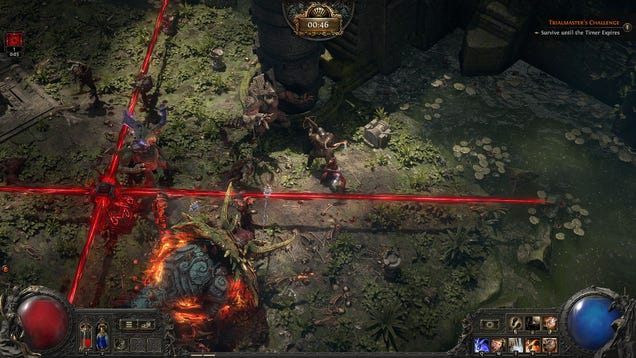
Whether you followed an intricate online build guide, or decided to wing the entire experience and choose fabulous skills and passives, Path of Exile 2 offers a metric ton of variety regarding how you grow in power. But one of the most essential aspects isn’t your class or abilities; it’s the gear you wield. If you’re…
Peak Design may have recently begun dabbling in tripods and dedicated smartphone accessories, but it started as a bag maker. It’s continuing that tradition by announcing its first-ever roller luggage, the Roller Pro Carry-On. This bag is appropriate to stow away overhead during flights, thus the name, but also comes with some tech-friendly features.
First of all, there’s a hidden compartment specifically for an AirTag tracker. That would come in mighty handy in the case of a mistaken identity/swapped luggage type of deal like in the movies. It also boasts external gear loops for hooking stuff like tripods. There’s a protected pocket for chargers, headphones, tablets and laptops.
The Roller Pro has been designed to accommodate the company’s newly-announced XL-sized Camera Cube. This container fills the entire volume of the Roller Pro and holds a 400mm prime lens, along with other camera accessories. The company says it turns the bag into a “mobile creative workstation for photographers on location or in the studio.” It also eliminates the need for a dedicated camera roller.
Tech aside, this is a piece of luggage. To that end, the carbon fiber handle has been designed for “maximal strength in a minimal volume.” Peak Design says it’s “significantly stiffer” than rival handles, but takes up “just a third of the volume.” This allows for more packing space, which is always good. The 60mm wheels also nestle into the corners, further maximizing space. The capacity is expandable from 34L to 39L, which is great for piling on last minute gifts while traveling.
Peak Design
It’s covered in a lightweight polycarbonate shell and Peak Design’s proprietary VersaShell fabric. The Roller Pro is available in a few colors and preorders start today via Kickstarter. This is a Peak Design product, however, so get ready to empty that bank account. The price ranges from $140 to $600, depending on add-ons.
This article originally appeared on Engadget at https://www.engadget.com/cameras/peak-design-made-a-roller-suitcase-thats-perfect-for-techies-and-content-creators-140035490.html?src=rss
I’ll cut right to the chase: If you’re an RTX 4070 owner looking to upgrade to NVIDIA’s latest video cards, the $549 RTX 5070 won’t be much different than what you’re used to. Aside from DLSS 4’s ability to generate multiple extra frames, the 5070 is practically the same as the 4070 Ti in our testing (and in some cases it’s worse). So if you’re already committed to spending more than $500 for a new GPU, you’re likely better off saving up a bit more for the $749 5070 Ti, which has more VRAM (16GB instead of the 5070’s 12GB) and more capable hardware for gaming in 4K.
Given the current state of the video card market, though, those prices are basically just theoretical. NVIDIA’s previous RTX 50-series cards are already selling well above their retail prices at most stores, if you can find them in stock at all. So I wouldn’t be surprised to see the RTX 5070 suffering the same fate. For now, though, Best Buy has NVIDIA’s Founder’s Edition card and an ASUS model listed for $549.
The RTX 5070 comes in $50 cheaper than the RTX 4070’s original launch price, so at least we’re edging closer to the days of the $500 RTX 3070 (again, if you were lucky enough to snag it for that MSRP). The 5070’s price alone made it the new NVIDIA GPU I was most looking forward to test. But after spending some time with it, I can see why NVIDIA was able to keep it relatively affordable: It’s simply not a huge jump from the 4070.
Devindra Hardawar for Engadget
Hardware
As the runt of the litter (so far), the RTX 5070 is clearly behind its siblings on paper. It sports 6,144 CUDA cores, compared to the 5070 Ti’s 8,960, and the aforementioned 12GB of GDDR7 memory. Notably, the RTX 4070 also shipped with 12GB of memory, though that was slightly slower GDDR6X RAM. The new card has a 33 percent memory bandwidth advantage — 672 GB/s vs 504 GB/s — but it would have been nice to see more RAM, especially since AMD managed to deliver 16GB in the upcoming $549 Radeon 9070.
The NVIDIA Founder’s Edition RTX 5070 we reviewed looks similar to the 5090, with a gorgeous metal case and dual fans to cool down the PCB sandwiched in the middle. A dongle with two 8-pin PSU connections is included in the box, and the 5070 requires a 650W power supply at a minimum. (Though I’d recommend going for at least an 800W PSU if you want to future-proof a bit.) Around the back, the 5070 features three DisplayPort 2.1 connections and an HDMI 2.1 port.
RTX 5090
RTX 5080
RTX 5070 Ti
RTX 5070
RTX 4090
Architecture
Blackwell
Blackwell
Blackwell
Blackwell
Lovelace
CUDA cores
21,760
10,752
8,960
6,144
16,384
AI TOPS
3,352
1,801
1,406
988
1,321
Tensor cores
5th Gen
5th Gen
5th Gen
5th Gen
4th Gen
RT cores
4th Gen
4th Gen
4th Gen
4th Gen
3rd Gen
VRAM
32 GB GDDR7
16 GB GDDR7
16 GB GDDR7
12 GB GDDR7
24 GB GDDR6X
Memory bandwidth
1,792 GB/sec
960 GB/sec
896 GB/sec
672 GB/sec
1,008 GB/sec
TGP
575W
360W
300W
250W
450W
In use: Solid 1440p and 4K, especially with multi-frame generation
I was a bit worried that testing the RTX 5070 would meaning scaling down my Avowed settings from maxed out 4K to 1440p. First-world problems, I know. But the 5070 managed to stay above 60 fps in 4K with ray tracing and graphics settings cranked up — so long as I was using DLSS upscaling. I typically saw between 65 fps and 75 fps in a variety of areas, which played smoothly on my 32-inch Alienware QD-OLED monitor.
I saw a smoother 120 fps while playing Avowed in 1440p, but I preferred sticking with 4K since it’s not a very fast-paced game. Instead, it’s a title where you’re often moving slowly through the world and absorbing breathtaking vistas and gorgeously constructed environments. Without DLSS, the 5070 crawled along at just 15 fps in 4K. In comparison, the 5070 Ti reached 90 fps in 4K with DLSS, and 32 fps in 4K without any upscaling.
Devindra Hardawar for Engadget
Clearly, the RTX 5070 is best-suited to 1440p gaming, just like the 4070. But it’s more capable if you don’t mind the interpolated frames from DLSS 4’s multi-frame generation. It can generate up to three frames from every one that’s natively rendered. That led to me seeing 168 fps in Dragon Age: The Veilguard while playing in 4K with graphics settings cranked up. The 5070 Ti, meanwhile, hit over 200 fps while playing Veilguard in 4K, while the 5090 reached 250 fps.
Your experience with the RTX 5070 will mostly come down to the amount of games you play with DLSS 3 and 4 support. Halo Infinite, which doesn’t work with any upscaling technology yet, hit an acceptable 97 fps in 4K. Still, I think most players would prefer the smoother 138 fps performance in 1440p, or even the 178 fps I saw in 1080p. Cyberpunk 2077, meanwhile, flew in 4K with multi-frame gen in ray tracing overdrive mode, reaching 115 fps.
None
3DMark TimeSpy Extreme
Geekbench 6 GPU
Cyberpunk (4K RT Overdrive DLSS)
Blender
NVIDIA RTX 5070
10,343
178,795
115 fps (4x frame gen)
6,015
NVIDIA RTX 5070 Ti
12,675
238,417
153 fps (4X frame gen)
7,365
NVIDIA RTX 4070 Ti Super
11,366
220,722
75 fps (1x frame gen)
7,342
NVIDIA RTX 4070
8,610
N/A
55 fps (1x frame gen)
6,020
Benchmarks paint a far starker picture for the RTX 5070. It was practically identical to the RTX 4070 Ti in 3DMark’s TimeSpy Extreme and Speedway tests. And it lagged behind that card in the Port Royal and DirectX ray tracing tests, as well as in Blender’s benchmark, where it was a full 1,200 points behind the 4070 Ti! NVIDIA clearly leaned more on tensor core performance for DLSS for the 5070, rather than raw rasterized or ray tracing speeds.
Unsurprisingly, NVIDIA’s Founder’s Edition cooling setup shined on the RTX 5070, where it kept temperatures between 35C and 40C while idling, and under 75C while I was gaming and running benchmarks. The fans were audible but not annoying when I was really stressing the card, thoughI didn’t notice much since I also had audio blasting on my speakers.
Devindra Hardawar for Engadget
Should you buy the RTX 5070?
As I mentioned up top, I don’t think the RTX 5070 is a compelling upgrade if you’re already satisfied with an RTX 4070. But if you’re coming from an older GPU, and you’re not ready to shell out $750 (or likely more) for the 4070 Ti, it’s currently the best value NVIDIA is offering. The 5070 will handle 1440p gaming well, and it’ll be acceptable for basic 4K gaming for non-DLSS titles. Throw multi-frame generation in the mix, and things look even better.
Still, for the price, I really wish the 5070 was more of a step up from the 4070. If the 5070 Ti ever comes back down to its $750 retail price, it’s likely a better longterm purchase since it has 16GB of RAM. That’ll make it better equipped for handling massive 4K textures, and it’s also more powerful in general to deal with more demanding gaming engines and ray tracing. The 5070 is a GPU that might satisfy you for a few years, whereas I think the 5070 Ti could handle most of what you throw at it for the next four years.
For now, though, my advice is the same as it was in my 5070 Ti review: Don’t rush out to buy a new video card right away. NVIDIA’s pricing and stock availability is incredibly volatile, and it’s not worth paying over $900 for something like the 5070 Ti. In a few months, prices may fall back down to Earth, especially with AMD’s more reasonable $549 and $599 Radeon RX 9070 and 9070 XT in the mix. In fact, it’s worth waiting a bit just to see how well those two cards compare to the 5070.
Devindra Hardawar for Engadget
Wrap-up
While NVIDIA mostly succeeded with delivering a semi-affordable midrange GPU with the RTX 5070, it’s competing against itself when compared to the excellent RTX 4070. It’s limited by having only 12GB of VRAM, and without the magic of DLSS AI upscaling, its performance isn’t that much different than the 4070 Ti. In the end, the 5070 feels a bit like a missed opportunity to deliver a truly performant card for close to $500. Instead, it’s more of the same, with a healthy dose of AI.
This article originally appeared on Engadget at https://www.engadget.com/gaming/pc/nvidia-geforce-rtx-5070-review-basically-a-4070-ti-thats-better-at-4k-140016718.html?src=rss
Alienware unveiled a widescreen 34-inch QD-OLED monitor a few years ago and it was hit from the get-go thanks to the HDR brightness, OLED color accuracy and smooth 175Hz refresh rate. Now, the company has launched an updated version that boosts the refresh rate to 240Hz — making it a tempting option for gamers who prize visuals and speed. Dell’s gaming brand also revealed several inexpensive LCD gaming models, including a 25-inch, 320Hz model for just $250.
On top of the boosted refresh rate, the new Alienware 34 Ultra-Wide QD-OLED Monitor (AW3425DW) offers improved connectivity with HDMI 2.1 FRL, while adding G-SYNC, AMD FreeSync Premium Pro and VESA AdaptiveSync certification. As before, it comes with WQHD 3,440 x 1,440 resolution and 1800R curve, providing a 21:9 gaming experience that while not as sharp as 4K, is still a huge leap ahead of 1080p. It goes on sale today for $800.
Along with that model, Alienware’s 27-inch 280Hz QD-OLED Monitor (AW2725D) is also available at a reasonable $550 price point (arriving summer 2025). It combines QHD resolution with a high-speed 280Hz refresh rate, allowing sharp high-quality visuals along with a smooth gaming experience. Rounding out the QD-OLED models is the 27-inch 4K QD-OLED Monitor (AW2725Q) previously announced at CES, with a 240Hz refresh rate and highest pixel density of any OLED or QD-OLED monitor, the company claims. It’s available starting today for $900.
Finally, Alienware unveiled four new LCD monitors, including 34- and 32-inch curved VA monitors with 180Hz refresh rates priced at $400 and $320, with both available starting March 6th. The most interesting, however, is a 25-inch 320Hz monitor available for just $250 (coming summer 2025), giving pro gamers on a budget a very high-speed option, if they don’t mind a smallish screen.
This article originally appeared on Engadget at https://www.engadget.com/computing/accessories/alienware-boosts-its-34-inch-qd-oled-gaming-monitor-to-240hz-140015276.html?src=rss
That’s what Nvidia CEO Jensen Huang said of the GeForce RTX 5070 when he announced the card at CES in January. Thanks to AI, this new midrange GPU would be able to match the frame rates of what had been the fastest consumer GPU that had previously existed for around one-third the price.
Let’s dispel that notion up front. No, the GeForce RTX 5070 is not as fast as an RTX 4090, not without some very creative comparing of non-comparable numbers. Per usual for the 50-series, Nvidia is leaning on its AI-generated interpolated frames for the bulk of its claimed performance improvements. In terms of actual rendering speed, the 5070 isn’t even as fast as a 4080 or a 4070 Ti. It’s barely faster than last year’s 4070 Super, and it has disproportionately higher power usage.
Ahead of NVIDIA GeForce RTX 5070 graphics cards seeing retail availability tomorrow, today the review embargo expires on the GeForce RTX 5070 Founders Edition graphics cards. I’ve been testing out the GeForce RTX 5070 under Linux and today have a number of GPU compute benchmarks to share.
Realme plans to double smartphone battery capacity to 10,000mAh within its three-year strategic roadmap, the company said at tradeshow MWC on Tuesday. Current flagship devices typically offer 5,000mAh, while Realme’s latest models already ship with 6,000mAh cells. The company expects to implement 7,500mAh batteries next year before reaching the 10,000mAh target, PCMag reported, citing the firm.
iOS users will find a handful of new emojis with an update to the 18.4 beta, including a “Face with Bags Under Eyes,” which represents us all right now.
The new characters were recommended for release in September 2024 with Unicode Emoji 16.0, though it typically takes designers for Apple (as well as Google, Samsung, and others) to interpret and create their versions of the new emojis and push them to users. The last round of characters rolled out with the iOS 17.4 update in March 2024 and included “Head Shaking Horizontally” and “Head Shaking Vertically,” as well as a phoenix, lime, brown mushroom, and broken chain.
What new emojis are coming to iPhone?
These are the new emojis launching with iOS 18.4:
Bags under eyes
Fingerprint
Leafless tree
Root vegetable
Harp
Shovel
Splatter
On top of the standard emojis, some users can create any emoji they want using Apple Intelligence’s Genmoji feature, which launched in beta with iOS 18.2 for iPhone 15 Pro, iPhone 15 Pro Max, and iPhone 16 series. To make an AI-generated emoji, switch to the emoji keyboard from any text field, tap the emoji, and enter the prompt for what you want to create.
The next round of new emojis will come with Unicode 17, which is expected sometime in the fall and will make its way to Apple OS around this time in 2026. The proposed characters include hairy creature, distorted face, fight cloud, apple core, orca, trombone, landslide, and treasure chest as well as skin tone variations for several existing emoji.
NVIDIA GeForce RTX 5070 Founders Edition: MSRP $549 The final member of the initial GeForce RTX 50 series launches today, the mid-range GeForce RTX 5070, and we’ve got the full scoop with copius benchmarks and overclocking data. Latest Architecture And Features Relatively Low Power Small Form Factor Modest Temps And Noise Good Overclocker…
VR Games Showcase is returning next week, promising to feature 20+ VR games from over a dozen developers and publishers. The livestream, kicking off on March 11th at 12 PM ET, is slated to not only include updates to upcoming releases, but also new game announcements as well as exclusive peeks at gameplay.
Event organizers have already teased a few of the 15+ publishers taking part in the VR Games Showcase next week, which thus far is set to include Flat2VR Studios, Triangle Factory, Fireproof Games, tinyBuild, Trebuchet, IO Interactive, PolarityOne, Patient 8 Games, Blue Isle Studios and Perp Games.
Here’s a breakdown of what’s been confirmed so far:
Flat2VR Studios is announcing a list of upcoming flatscreen-to-VR ports in addition to info on the VR version of RyseUp Studios’ roguelike shooter Roboquest (2023).
Triangle Factory, the studio behind Rainbow Six-inspired VR shooter Breachers (2023), will debut its next major VR project.
Fireproof Games, the studio behind The Room VR: A Dark Matter (2020), is sharing more info on Ghost Town, its upcoming VR puzzle-adventure for Quest, PSVR 2 and PC VR headsets
Trebuchet is tossing out more info on Prison Boss: Prohibition, its sequel to the 2017 prison-based VR crafting and trading game.
IO Interactive is showing off PSVR 2 gameplay of Hitman: World of Assassination, which was previously slated to launch on PSVR 2 in December 2024, but is now releasing March 27th.
PolarityOne is showing off Exoshock gameplay, its upcoming co-op shooter for Quest slated to release in Q2 2025.
Patient 8 Games is releasing info on its previously delayed sci-fi survival-horror game Memoreum.
Blue Isle Studios and Perp Games are showing off gameplay of the VR port of Slender: The Arrival (2013), which was initially supposed to launch last year.
We’ll of course be following along, but you can catch this year’s VR Games Showcase livestream on March 11th at 9 AM PT / 12 PM ET (local time here) across YouTube and TikTok Live.
TSMC announced plans to invest an additional $100 billion on advanced chip manufacturing in the United States, bringing its total US investment to $165 million. As part of the bolstered spending, TSMC will build five new factories, including three fabrication plants and two advanced packaging facilities. It’s also planning to erect a “major
Open-sourced back in January was the Yandex Perforator as a new software project for uncovering code inefficiencies and potentially “save billions of dollars” in expenses. Perforator has continued evolving since its open-source announcement and out today is Perforator 0.0.5 as the latest milestone…
We may earn a commission from links on this page. Deal pricing and availability subject to change after time of publication.
If you’ve been looking for a solid pair of workout earbuds that won’t slip out mid-burpee, the JBL Endurance Peak 3 is down to $39.95 on Woot (originally $99.99) this month (or until they sell out). That’s a steal for earbuds that scored an Editor’s Choice from PCMag for their workout-friendly design and secure fit. This deal includes a one-year JBL manufacturer warranty, and if you’re an Amazon Prime member, you get free standard shipping (otherwise, it’ll cost you $6).
These wireless earbuds come with ear hooks that wrap snugly around your ears, ensuring they stay put even during the most intense sessions. And unlike some other hook-style earbuds, these reportedly don’t clash with glasses frames (an underrated feature for anyone who wears specs). That said, the ear hooks double as a power switch, turning off when the tips magnetically touch the body of the earpiece—that’s useful in theory, but it can be frustrating if you’re just taking them out for a quick break. Also, the touch controls take some getting used to since the panels have a larger surface area than most earbuds.
Sound-wise, JBL packs a punch with 10mm dynamic drivers that cover the full frequency range from 20Hz to 20KHz (with fully customizable EQ settings in the companion app), delivering a sound profile with strong bass that stays clear of distortion, even at top volume. If you’re an Android user, you’ll appreciate Google Fast Pair for easy setup, though the earbuds stick to basic AAC and SBC codecs—no AptX support here, notes this PCMag review. They do, however, boast an impressive IP68 rating, meaning they’re fully dust-proof and can survive full submersion in water for over 30 minutes. Rain, sweat, or a quick rinse under the tap? No problem. Battery life is another win, with JBL estimating 10 hours per charge, plus an additional 40 hours from the charging case (your mileage may vary depending on usage). So unless you’re planning to run an ultramarathon, you should be covered.
Note: Woot does not ship these earbuds to Alaska, Hawaii, or PO box addresses.
We’re just a month out from the big Nintendo Direct giving us the full rundown on the Switch 2. Fans have been patiently waiting for the new hardware for years, excited to see what the future holds for the successor to one of the best video game consoles ever made. I’m excited too, but I also know that no matter what…