Get four months of the Disney+ Hulu Duo Basic streaming bundle for only $12 right now

You have to be patient if you want to take advantage of the best streaming deals because they don’t come around as often as discounts on laptops and smartphones. One of the best deals as of late is a new one from Disney: new and returning subscribers can get four months of the Disney+ Hulu Duo Basic bundle for only $12.

You’ll pay $3 per month for four months, and that represents a 72-percent discount off the standard $11-per-month price. For the whole period, you’ll save a total of $32. The deal is available through March 30, but just keep in mind that the Duo Basic plan includes advertisements on both Disney+ and Hulu content.

At a time when it feels like every streaming service, audio and video, is pushing their subscription costs ever-higher, it’s a treat to get any amount of entertainment access for a discount. That’s why we’re big fans of the Disney+ Hulu Duo plans; even at the normal rate, it unites two of our favorite standalone content libraries in a single package that’s a solid deal at its normal rates. 

Snagging the basic tier for an even lower cost feels like a no-brainer, especially if you’re invested in any facet of the Marvel Cinematic Universe, if you’re counting the days until the second season of The Secret Lives of Mormon Wives or if you just like to hum along with Encanto in the background while you work. 

Keep in mind that the ad-free Duo Premium plan isn’t covered in this promotion, nor is the option that also bundles ESPN into the package. Access to Duo Premium will still run you $20 a month, while the Trio bundles begin at $17 a month.

Check out our coverage of the best streaming deals for more discounts, and follow @EngadgetDeals on X for the latest tech deals and buying advice.

This article originally appeared on Engadget at https://www.engadget.com/deals/get-four-months-of-the-disney-hulu-duo-basic-streaming-bundle-for-only-12-right-now-123511048.html?src=rss

The Out-of-Touch Adults’ Guide to Kid Culture: International Women’s Month

Saturday, March 8, was International Women’s Day. March is a whole women’s month, even if Google erased it from its calendar. So I’m taking a look at young women—and not in a creepy way. I want to know: what’s up with young women? What are they about? What are their dreams? How are they feeling deep in their hearts? So I’m checking out Reddit’s woman-centric corners, listening to Doechii and “Call her Daddy,” and consulting some “coochie doctors.”

The state of young women in two subreddits

To try to get some insight on young women between the ages of 18 and 25 or so, I took a look at some Reddit communities ostensibly made for, by, and about women.

I started at Reddit’s TwoXChromosomes. at over 13 million subscribers: This is by far Reddit’s largest woman-centric community, and it’s bleak. The top posts of the week are dominated by tales of creepy dudes, sexual violence, violence–violence, and more creepy dudes. There’s an occasional “here’s something funny/cute that happened” to lighten the mood a little, but overall, it’s bad out there: “Growing up is realising how much the world hates you” is how redditor gaycat21 puts it.

For a way less depressing and way more interesting women’s subreddit, check out NSFW meme subreddit R/LetGirlsHaveFun. At only around 100,000 subs, it’s much smaller than TwoX, but it’s proof that crudeness and no-censorship vibe of online culture doesn’t have to be misogynistic, and it’s much funnier that way. According to its creator, Let Girls Have Fun is a place for “girls to post their deranged thoughts, from a girl perspective,” because “Girls can also like edgy and crude humor.” Posts like this, this, or this seem like open rebellion against society’s endless set of rules and expectations for women, expressed in the most explicit way possible.

Alex Cooper’s Call Her Daddy is the biggest podcast among young women

Almost everyone who listens to the Call Her Daddy podcast is a young woman. According to research firm Edison Research, 70% of CHD’s audience are women, and 70% of them are under 35. A full 93% of its listeners are under 45. The podcast made news when it scored an interview with Vice President Kamala Harris in October, but politics isn’t the show’s usual subject matter. Host Alex Cooper has been described as “Gen Z’s podcast queen” and “the female Howard Stern” by The Hollywood Reporter, tends to focus on sex and relationships when she’s not interviewing celebrities like Miley Cyrus and John Mayer. Like Stern, Cooper is frank, open, and raunchy. In the early days of her show, she focused more on sex, but the subject matter has expanded into topics like female empowerment, self-love, and pop culture. Unlike boy’s top podcaster Joe Rogan, Call Her Daddy‘s host doesn’t regularly fall victim to believing in crap that isn’t true.

AI-generated “coochie doctors” invade TikTok

When someone describes themselves as a “coochie doctor,” it’s probably safe to ignore any medical advice they offer, especially when they’re online and they’re not actually human. For the last few months, weirdos and/or algorithms have been using an app called “Caption” to spam TikTok with hundreds of videos featuring lifelike, AI-generated avatars who call themselves “coochie doctors,” “booty doctors,” “tata surgeons,” “booby doctors,” and “Korean butt doctors” followed by terrible medical advice. These videos generally start with a variation of the phrase, “13 years a coochie doctor and no one believes me when I say this,” followed by some questionable health tips geared toward women like “rubbing fig seeds on your breasts will make them go from saggy to perky” and “sea moss is a great way to cleanse your gut.”

It’s worth noting that these tips are about neither coochies nor butts, so these medical professionals are working outside their area of expertise. These videos generally end with exhorting viewers to search out a specific “wellness” product on Amazon. It’s like all these medical professionals are only offering advice to get money out of the gullible!

“Dating a GM,” and the mystery of what “GM” means

A few weeks ago, TikToker @myak.tt posted the video you see above, a short, random clip with the caption “Dating a GM.” It’s been viewed over 11 million times since then, and sparked an online debate over what a GM is.

My first thought is “game master,” the more inclusive form of “dungeon master,” but I’m a damn nerd, and that’s almost definitely not what Myak.tt meant. Others have suggested “gang member,” “gun man,” or “grand master.” It’s frustrating because the video gives no information, and as of yet, the young woman who posted the video has offered no explanation.

The video has inspired “99% accurate” reenactments like this one:

and this one:

But these give no indication of what a GM is either. Maybe as big a mystery is: Why did this video get popular? Why did the TikTok algorithm choose to share this over the millions of other short, meaningless clips posted all day on the site? I have no answers.

(For a glossary of slang words I’m pretty sure I do know the definition of, check out ‘Mewing,’ ‘Sigma,’ and Other Gen Z and Gen Alpha Slang You Might Need Help Decoding‘)

Viral video of the week: Doechii’s  “Anxiety”

Rapper/singer/songwriter Doechii, born Jaylah Ji’mya Hickmon, has been blowing up over the past couple months. Aided by a legion of fans using her song “Denial Is a River” on their TikTok videos and a stand-out performance at the Grammy Awards, Doechii has become so popular that her older songs are being dug out of mothballs and getting huge. This week’s viral video, Anxiety (Visualizer), was posted on Doechii’s YouTube with no fanfare, and almost three million people watched it in its first two days online alone. The original video for the song was posted back in 2020, and features COVID-era Doechii rapping in her bedroom over Gotye’s “Somebody That I Used to Know.” But part of Doechii’s “Anxiety” was also sampled on a track from rapper Sleepy Hallow, for his song called “Anxiety.” You know what: Here’s Doechii explaining the deep lore around this song:

Apple Reportedly to Reveal “feature-packed” visionOS 3.0 Update at WWDC in June

Apple is planning a “feature-packed release” for visionOS 3.0, reports Bloomberg’s Mark Gurman, who says that Vision Pro’s operating system—and not new XR hardware—is going to be a focus at this year’s World Wide Developer Conference (WWDC).

Despite its high price and premium appeal, Apple hasn’t slowed down software updates for Vision Pro, which launched in February 2024 for $3,500.

Recently, the Cupertino tech giant has released a host of productivity features, including the long-promised ultra-wide Mac Virtual Display and the full suite of Apple Intelligence features in developer preview.

Now, Gurman reports Apple is gearing up to showcase visionOS 3.0 at WWDC, which typically takes place in June.

“All signs are pointing to the company’s Vision Products Group shifting its resources to other form factors,” Gurman maintains. “But Apple can’t just let the Vision Pro die out. It has invested too much and needs to keep churning out the device’s visionOS updates (the third edition will be a pretty feature-packed release, I’m told).”

There’s no indication yet what visionOS 3.0 could contain, although if it’s anything like visionOS 2.0, which was announced at WWDC 2024 last June, developers will likely be able to go hands-on as soon as it’s announced.

That said, information is still thin. One possible candidate for visionOS 3.0 could address the headset’s lack of motion controllers; Gurman reported last month Apple is currently working with Sony to adopt PSVR 2’s Sense Controllers as Vision Pro’s officially supported motion controller.

As for hardware reveals (or the lack thereof) at WWDC 2025, Gurman echoes previous claims made by Apple supply chain analyst Ming-Chi Kuo late last year, who reported that multiple Vision Pro follow-up are currently planned.

Gurman notes that Apple is planning a headset containing a new M-series chip (possibly M5), as well as cheaper versions of the headset. Contrary to Kuo’s report, which maintains an upgraded M5 version of Vision Pro is coming this year, Gurman claims we won’t see a follow-up headset from Apple in 2025.

The post Apple Reportedly to Reveal “feature-packed” visionOS 3.0 Update at WWDC in June appeared first on Road to VR.

The best robot vacuums on a budget for 2025

Robot vacuums have become ubiquitous over the past few years, in the sense that there are more options to choose from now than ever before. In their early years, you’d have to dish out $500 or more to get a decent robot vacuum, but that’s not the case anymore. Sure, you could pick up a $1,000 cleaning behemoth with mopping features, but it would be incorrect to assume that you need to spend that much money to get a good machine.

Now, you can get an autonomous dirt-sucker to do one of your least favorite chores (and do it pretty well) by spending $300, or less in some instances. But you get what you pay for in this space; don’t expect affordable robot vacuum cleaners to have all of the bells and whistles that premium machines do, like self-emptying capabilities or advanced dirt detection. Engadget has tested dozens of robot vacuums at various price points over the years and we’ve narrowed down the best budget robot vacuums you can get right now.

Since I’ve tested dozens of robot vacuums, I’m often asked if these gadgets are “worth it” and I’d say the answer is yes. The biggest thing they offer is convenience: just turn on a robot vacuum and walk away. The machine will take care of the rest. If vacuuming is one of your least favorite chores, or you just want to spend less time keeping your home tidy, semi-autonomous robotic vacuum is a great investment. Many models, albeit more expensive ones, even come with features like self-emptying bases to further reduce maintenance.

There are plenty of other good things about them, but before we dive in let’s consider the biggest trade-offs: less power, less capacity and less flexibility. Those first two go hand in hand; robot vacuum cleaners are much smaller than upright vacuums, which leads to less powerful suction. They also hold less dirt because their built-in bins are a fraction of the size of a standard vacuum canister or bag. Fortunately, some models include features like an empty station, which helps with dirt capacity, especially in homes with pet hair.

When it comes to flexibility, robot vacuums do things differently than standard ones. You can control some with your smartphone, set cleaning schedules and more, but robo-vacs are primarily tasked with cleaning floors. On the flip side, their upright counterparts can come with various attachments that let you clean couches, stairs, light fixtures and other hard-to-reach places.

When looking for the best cheap robot vacuum, one of the first things you should consider is the types of floors you have in your home. Do you have mostly carpet, tile, laminate, hardwood? Carpets demand vacuums with more suction power that can pick up debris pushed down into nooks and crannies. Unfortunately, there isn’t a universal metric by which suction is measured. Some companies provide Pascal (Pa) levels and generally the higher the Pa, the stronger. But other companies don’t rely on Pa levels and simply say their bots have X-times more suction power than other robot vacuums.

So how can you ensure you’re getting the best cheap robot vacuum to clean your floor type? Read the product description. Look for details about its ability to clean hard floors and carpets, and see if it has a “max” mode you can use to increase suction. If you are given a Pa measurement, look for around 2000Pa if you have mostly carpeted floors. Pay attention to the brush roll mechanism as well, especially if you’re dealing with dog hair or other stubborn debris that can cause tangles. Many of these machines also feature side brushes to help clean edges and corners.

You may find some budget robot vacuums also offer vacuum/mop combo capabilities. These bots feature a water tank, which means they can offer mopping functionality, enhancing debris pickup, and resulting in shiny floors. However, these are less common when you’re shopping in the lower price range.

Size is also important for two reasons: clearance and dirt storage. Check the specs for the robot’s height to see if it can get underneath the furniture you have in your home. Most robo-vacs won’t be able to clean under a couch (unless it’s a very tall, very strange couch), but some can get under entryway tables, nightstands and the like. As for dirt storage, look out for the milliliter capacity of the robot’s dustbin — the bigger the capacity, the more dirt the vacuum cleaner can collect before you have to empty it.

You should also double check the Wi-Fi capabilities of the robo-vac you’re eyeing. While you may think that’s a given on all smart home devices, it’s not. Some of the most affordable models don’t have the option to connect to your home Wi-Fi network. If you choose a robot vac like this, you won’t be able to direct it with a smartphone app or with voice controls. Another feature that’s typically reserved for Wi-Fi-connected robots is scheduling because most of them use a mobile app to set cleaning schedules.

But Wi-Fi-incapable vacuums usually come with remote controls that have all the basic functions that companion mobile apps do, including start, stop and return to dock. And if you’re concerned about the possibility of hacking, a robot vac with no access to your Wi-Fi network is the best option.

Obstacle detection and cliff sensors are other key features to look out for. The former helps the robot vacuum navigate around furniture while it cleans, rather than mindlessly pushing its way into it. Many also offer no-go zones, letting you block off areas you don’t want the robot to enter. Meanwhile, cliff sensors prevent robot vacuums from tumbling down the stairs, making them the best vacuum for multi-level homes.

When we consider which robot vacuums to test, we look at each machine’s specs and feature list, as well as online reviews to get a general idea of its capabilities. With each robot vacuum we review, we set it up as per the instructions and use it for as long as possible — at minimum, we’ll use each for one week, running cleaning cycles daily. We make sure to try out any physical buttons the machine has on it, and any app-power features like scheduling, robot mapping and more.

Since we test robot vacuums in our own homes, there are obstacles already in the machine’s way like tables, chairs and other furniture — this helps us understand how capable the machine is at avoiding obstacles, and we’ll intentionally throw smaller items in their way like shoes, pet toys and more. With robot vacuums that include self-emptying bases, we assess how loud the machine is while emptying contents into the base and roughly how long it takes for us to fill up the bag (or bagless) base with debris.

First and foremost, always empty your robot vacuum’s dustbin after every cleaning job, or use a self-emptying base if the model supports it. Simply detach and empty the dustbin as soon as the robot is done cleaning, and then reattach it so it’s ready to go for the next time. It’s also a good idea to take a dry cloth to the inside of the dustbin every once in a while to remove any small dust and dirt particles clinging to its insides.

In addition, you’ll want to regularly examine the machine’s brushes to see if any human or pet hair has wrapped around them, or if any large debris is preventing them from working properly. Some brushes are better than others at not succumbing to tangled hair, but it’s a good idea to check your robot’s brushes regardless — both their main brush and any smaller, side brushes or corner brushes they have. These parts are often easy to pop off of the machine (because they do require replacements eventually) so we recommend removing each brush entirely, getting rid of any tangles or other debris attached to them and reinstalling them afterwards. If you have a robot vacuum with mopping capabilities, you’ll need to wash the bots’ mop pads too, to avoid any unpleasant smells or tracking mess around your home. Similarly, if your robot vacuum has a water tank, it’s worth washing this out regularly to keep it clean.

Robot vacuums also have filters that need replacing every couple of months. Check your machine’s user manual or the manufacturer’s website to see how long they recommend going in between filter replacements. Most of the time, these filters cannot be washed, so you will need to buy new ones either directly from the manufacturer or from other retailers like Amazon or Walmart.

This article originally appeared on Engadget at https://www.engadget.com/home/smart-home/best-budget-robot-vacuums-133030847.html?src=rss

JBL just announced two new portable speakers that support AI Sound Boost technology

JBL just announced a pair of portable speakers that take advantage of the company’s AI Sound Boost technology. This software analyzes the signal and maxes out the driver while minimizing distortion. The company says this creates a boost in sound quality.

The Flip 7 features an interchangeable strap and carabiner and an updated control placement when compared to the previous generation. The Flip 6 easily made our list of the best portable Bluetooth speakers, so any improvement is just icing on the cake. It also includes an upgraded woofer with more output power, which should further improve the sound.

The battery life is solid, at 14 hours of use per charge. There’s a Playtime Boost feature that dials back the bass to add another two hours of use. The Flip 7 offers the ability for multi-speaker output that’s powered by Auracast and it can play lossless audio over USB-C, just like the Beats Pill. Preorders are open right now, with shipments going out on April 6. This speaker costs $150.

A speaker.
JBL

The Charge 6 also includes a new design with an updated button layout and a detachable and reconfigurable strap. Just like the Flip 7, it includes a redesigned woofer for an audio upgrade. The battery life here is astounding, at 24 hours of use per charge. This is several hours more than the Charge 5. It also includes Playtime Boost, for even more juice, and a quick-charge feature.

This speaker can be used as part of a larger system via Auracast. Preorders are available right now and shipments go out on April 6. That extra battery life does tick the price up a bit, as the Charge 6 costs $200.

This article originally appeared on Engadget at https://www.engadget.com/audio/speakers/jbl-just-announced-two-new-portable-speakers-that-support-ai-sound-boost-technology-120052295.html?src=rss

My Favorite Unexpected Cleaning Tools for the Kitchen and Bathroom

We may earn a commission from links on this page.

This is a website about hacks, so you know I’m not going to advocate for a cleaning product unless it really gets the job done. Lifehacker has years’ worth of archives explaining how, for the most part, common things like hydrogen peroxide, baking soda, and vinegar get the major cleaning jobs taken care of, and all you need is a rag or a sponge to go with them. Still, there are some more specialized products that are worth having on hand. These are what I use to make cleaning easier and faster.

Useful cleaning tools you might not have

First up, you need a little squeegee. In fact, I think you should have a few. The first one should be stored in your shower and, after you finish washing up, you should use it to get the fog, scum, and water off your shower doors and walls. Doing this every time you bathe takes just a few seconds, but drastically reduces how much and how often you need to clean the tile and glass in the shower. Get one with an adhesive holder so it dries straight up and down, then stick it to the shower wall. This one is $9.59.

Second, you should keep one in the kitchen. Use it to scrape wet messes off your countertops or to gather spills on your floor. Why waste a bunch of paper towels or dirty up a rag when you could just push the wet mess off the counter and into a container, then put it in the trash? Pick up a two-pack for $13.99.

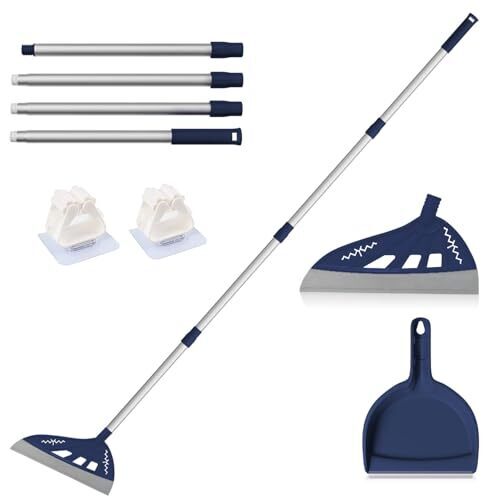
We aren’t finished with squeegees, actually. You also need a gigantic one for your floor. This will replace your broom and I’m serious. It’s $29.99 (though you can apply a 30% coupon on Amazon right now) and it solves all the annoying little problems you face with a regular broom. There are no bristles, so hair and dust don’t get caught in anything and there are no gaps for dirt and debris to slip through. To wash it, you just wipe down the silicone. What’s even better is that, unlike a standard broom, you can tackle wet messes with this, dragging all the droplets and rivulets into a more concise puddle that is a lot easier to wipe up.

Next, consider some soap-dispensing brushes. You may have seen these for dishwashing, which is great, but they’re also perfect for scrubbing floors, tile, and hard-to-reach spots, all without having to fill up a whole container of soapy water and drag it around. Obviously, keep the one you use for household cleaning away from the one you use for the dishes, so get at least two. Better yet, this one for $9.89 comes with detachable heads, so you only need one handle.

Speaking of brushes, it’s time to upgrade to an electric one. Stop getting on your hands and knees, putting too much elbow grease in, or over-exerting yourself when you could outsource the strenuous part of your labor to technology. You can get an electric spin scrubber with a telescopic handle and eight different brush heads for $49.99, then use it as a handheld or long-reach solution when you just don’t want to scrub.

My favorite cleaning solutions and products

The wide array of tools and gadgets available to address needs you didn’t realize you had is great and all, but what about cleaning solutions and products? It might seem like, hey, an all-purpose cleaner is an all-purpose cleaner, but that’s not true. For instance, I recently tested out “double concentrated” solutions from Pine Sol and Fabuloso and found both of them to be way more effective than their standard-concentration predecessors. Did you know floor-cleaning solutions were innovating? Well, now you do.

Another innovation I really like counts as both a tool and a product. Yes, you probably have a melamine sponge, like a Mr. Clean Magic Eraser, on hand and yes, you probably also have some kind of foaming soap you use around the house. But now they’ve been combined into one product: It’s called the Mr. Clean Ultra Foamy Magic Eraser and I can no longer live without it. You get five for $8.94 and with them, you can clean a lot faster and easier. It takes me far fewer passes of the eraser over any kind of grime to remove it than it does when I use the original version.

And the last unexpected product that has really changed how I clean is this set of coatings from spotLESS. Three bottles of coating cost $24.99 and you get one for glass and mirrors, one for toilets, and one for sinks and fixtures. I spray these on their respective surfaces after cleaning and have definitely noticed I need to clean those areas again more infrequently. The coating works to keep grime from accumulating and makes it easier to wipe off when it eventually does appear. The glass spritz has proven especially helpful for the glass table I got a few months ago. Again, I didn’t realize I had these problems until I found a product that fixed them. We’re truly living in the future.

Thousands of Freed Scam Center Workers Now Trapped in Overcrowded Detention Centers

August, 2023: Thousands of Crypto Scammers are Enslaved by Human-Trafficking Gangsters, Says Bloomberg Reporter. (“They’d lure young people from across Southeast Asia…with the promise of well-paying jobs in customer service or online gambling.”)
February, 2025: A coordinated response begins by Thai, Chinese and Myanmar authorities, which includes cutting power, internet, and fuel supplies to the scam centers.

Today: The Associated Press reports that thousands of the people liberated from locked compounds in Myanmar now “have found themselves trapped once again, this time in overcrowded facilities with no medical care, limited food and no idea when they’ll be sent home.”

Thousands of sick, exhausted and terrified young men and women, from countries all over the world squat in rows, packed shoulder to shoulder, surgical masks covering their mouths and eyes. Their nightmare was supposed to be over… The armed groups who are holding the survivors, as well as Thai officials across the border, say they are awaiting action from the detainees’ home governments. It’s one of the largest potential rescues of forced laborers in modern history, but advocates say the first major effort to crack down on the cyber scam industry has turned into a growing humanitarian crisis…

An unconfirmed list provided by authorities in Myanmar says they’re holding citizens from 29 countries including Philippines, Kenya and the Czech Republic. Authorities in Thailand say they cannot allow foreigners to cross the border from Myanmar unless they can be sent home immediately, leaving many to wait for help from embassies that has been long in coming. China sent a chartered flight Thursday to the tiny Mae Sot airport to pick up a group of its citizens, but few other governments have matched that. There are roughly 130 Ethiopians waiting in a Thai military base, stuck for want of a $600 plane ticket. Dozens of Indonesians were bused out one morning last week, pushing suitcases and carrying plastic bags with their meager possessions as they headed to Bangkok for a flight home… The recent abrupt halt to U.S. foreign aid funding has made it even harder to get help to released scam center workers…

It’s not clear how much of an effect these releases will have on the criminal groups that run the scam centers. February marked the third time the Thais have cut internet or electricity to towns across the river. Each time, the compounds have managed to work around the cuts. Large compounds have access to diesel-powered generators, as well as access to internet provider Starlink, experts working with law enforcement say.

The article also points out that “The people released are just a small fraction of what could be 300,000 people working in similar scam operations across the region, according to an estimate from the United States Institute of Peace. Human rights groups and analysts add that the networks that run these illegal scams will continue to operate unless much broader action is taken against them…”

“The United Nations Office on Drugs and Crimes estimates that between $18 billion and $37 billion was lost in Asia alone in 2023, with minimal government action against the criminal industry’s spread.”

Read more of this story at Slashdot.

Intel Preps Xe3’s “Dirty Rect” Feature For Linux 6.15

Along with other exciting Intel kernel graphics driver updates submitted for the upcoming Linux 6.15 merge window, another batch of drm-intel-next code was sent out today to DRM-Next. This pull request is mostly around bug fixing and other low-level work but it does provide a new “dirty rect” feature being introduced with next-gen Intel Xe3 graphics…

Spark 2 adds AI, doubles its DSP power to help your guitar rock out

The Spark 2 from Positive Grid looks like a miniature old-school amp, but it is, essentially, a computer with some knobs and a speaker. It has Bluetooth, USB-C, and an associated smartphone app. It needs firmware updates, which can brick the device—ask me how I found this out—and it runs code on DSP chips. New guitar tones can be downloaded into the device, where they run as software rather than as analog electrical circuits in an amp or foot pedal.

In other words, the Spark 2 is the latest example of the “software-ization” of music.

Forget the old image of a studio filled with a million-dollar, 48-track mixing board from SSL or API and bursting with analog amps, vintage mics, and ginormous plate reverbs. Studios today are far more likely to be digital, where people record “in the box” (i.e., they track and mix on a computer running software like Pro Tools or Logic Pro) using digital models of classic (and expensive) amplifiers, coded by companies like NeuralDSP and IK Multimedia. These modeled amp sounds are then run through convolution software that relies on digital impulse responses captured from different speakers and speaker cabinets. They are modified with effects like chorus and distortion, which are all modeled, too. The results can be world-class, and they’re increasingly showing up on records.

Read full article

Comments