Live Nation settlement avoids breakup with Ticketmaster

To keep Ticketmaster, Live Nation is going to have to make some major changes. As first reported by Politico, Live Nation reached a settlement with the Department of Justice in its antitrust case that accused the live entertainment giant of monopolistic practices. Live Nation will reportedly pay at least $200 million in damages to states that were part of the lawsuit filed in May 2024, but avoid selling off Ticketmaster.

Live Nation will also be required to make a few changes to its business practices. According to NBC News, Ticketmaster, a subsidiary of Live Nation, will be required to create a “standalone ticketing system” that allows third-party competitors like SeatGeek and Eventbrite to sell tickets on.

The settlement aims to loosen some of Live Nation’s control over venues as well. According to NBC News, the company will have to divest up to 13 amphitheaters and be prohibited from retaliating against venues that choose another ticket seller over Ticketmaster.

The settlement comes less than a week after the case went to trial. While the matter may be concluded with the Justice Department, many of the states’ attorneys general who were part of the lawsuit will be continuing their legal action separately.

“The settlement recently announced with the U.S. Department of Justice fails to address the monopoly at the center of this case and would benefit Live Nation at the expense of consumers,” New York State Attorney General Letitia James wrote in a press release. “We will continue our lawsuit to protect consumers and restore fair competition to the live entertainment industry.” 26 other attorneys general signed onto continuing the lawsuit with James.

This article originally appeared on Engadget at https://www.engadget.com/entertainment/music/live-nation-settlement-avoids-breakup-with-ticketmaster-155031214.html?src=rss

2026 Australian Grand Prix: Formula 1 debuts a new style of racing

Formula 1’s 2026 season got underway this past weekend in Melbourne, Australia. Formula 1 has undergone a radical transformation during the short off-season, with new technical rules that have created cars that are smaller and lighter than before, with new hybrid systems that are more powerful than anything since the turbo era of the 1980s—but only if the battery is fully charged.

The changes promised to upend the established pecking order of teams, with the introduction of several new engine manufacturers and a move away from the ground-effect method of generating downforce, which was in use from 2022. For at least a year, paddock rumors have suggested that Mercedes might pull off a repeat of 2014, when it started the first hybrid era with a power unit far ahead of anyone else.

That wasn’t entirely clear after six days of preseason testing in Bahrain, nor really after Friday’s two practice sessions in Melbourne, topped by Charles Leclerc’s Ferrari and Oscar Piastri’s McLaren, respectively. The Mercedes team didn’t look particularly worried, and on Saturday we found out why when George Russell finally left off the sandbags and showed some true pace, lapping more than six-tenths faster by the end of free practice than the next-quickest car, the Ferrari of Lewis Hamilton.

Read full article

Comments

Anthropic sues US government over supply chain risk designation

According to Reuters, Anthropic has filed a lawsuit to prevent the Pentagon from adding the company it a national security blocklist. This comes days after the Department of Defense sent a letter to Anthropic confirming the company was labeled a supply chain risk; at the time CEO Dario Amodei had all but guaranteed Anthropic would fight back with legal action.

The lawsuit claims the designation is unlawful and violated free speech and due process rights. “These actions are unprecedented and unlawful. The Constitution does not allow ​the government to wield its enormous power to punish a company for its protected speech,” Anthropic said in a statement published by Reuters.

Engadget received the following statement from an Anthropic spokesperson:

 “Seeking judicial review does not change our longstanding commitment to harnessing AI to protect our national security, but this is a necessary step to protect our business, our customers, and our partners. We will continue to pursue every path toward resolution, including dialogue with the government.” 

The lawsuit states that the government’s actions “are unprecedented and unlawful.” It goes on to say that “the Constitution does not allow the government to wield its enormous power to punish a company for its protected speech. No federal statute authorizes the actions taken here. Anthropic turns to the judiciary as a last resort to vindicate its rights and halt the Executive’s unlawful campaign of retaliation.”

Today’s legal action comes after several weeks of back-and-forth between the AI company and the government. In late February, news broke that the Department of Defense and Defense Secretary Pete Hesgeth were pressuring Anthropic to remove certain safeguards from its AI systems, but Amodei made it clear the company would refuse to allow its model to be used for mass surveillance or development of autonomous weapons.

On the February 27 deadline, Amodei refused to budge, leading Hesgeth to threaten the company with the supply chain risk designation; he also said the US government would cancel its $200 million contract with the company. The same day, President Trump ordered all federal agencies to cease using Anthropic as well.

Despite the fact that, according to the lawsuit, Anthropic had agreed to “collaborate with the Department on an orderly transition to another AI provider willing to meet its demands,” the government followed up with “public castigation.”

Amidst all this, it was reported late last week that Anthropic was once again meeting with the Department of Defense to try and reach a solution — but it seems those talks were unsuccessful.

This story is developing, please refresh for further updates.

This article originally appeared on Engadget at https://www.engadget.com/ai/anthropic-sues-us-government-over-supply-chain-risk-designation-152838128.html?src=rss

Samsung Q990F 11.1.4 Dolby Atmos Soundbar Deal Cuts Price By 50%

Samsung Q990F 11.1.4 Dolby Atmos Soundbar Deal Cuts Price By 50%
Several years ago, I replaced my home theater’s bulky surround sound setup for a sleek soundbar, opting for what at the time was Samsung’s flagship 11.1.4-channel model, and never looked back. You can too if you’re looking to de-clutter, or simply want to level up from your TV’s built-in speakers, and it won’t cost you nearly as much as it

Swiss Vote Places Right To Use Cash In Country’s Constitution

Swiss voters overwhelmingly approved a constitutional amendment guaranteeing the right to use physical cash. “The vote means Switzerland will join the likes of Hungary, Slovakia and Slovenia, which have already written the right to cold, hard cash in their constitutions,” reports Politico. From the report: Official results revealed that 73.4 percent of voters backed the legal amendment, which the government proposed as a counter to a similar initiative by a group called the Swiss Freedom Movement. The Swiss Freedom Movement triggered the national referendum after its initiative to protect cash collected more than 100,000 signatures, triggering a national referendum. Its initiative secured only 46 percent of the final vote after the government said some of the group’s proposed amendments went too far.


Read more of this story at Slashdot.

This Three-in-One Belkin Charging Pad Is Nearly 75% Off Right Now

We may earn a commission from links on this page. Deal pricing and availability subject to change after time of publication.

Charging multiple Apple devices often turns into a mess of cables. An iPhone charger here, an Apple Watch puck there, and another cable for AirPods. A single charging station like the Belkin MagSafe 3-in-1 Fast Wireless Charging Pad helps simplify things. It’s currently $39.99 at Woot, down from its original $149.99 price. The same charger is selling for about $100.58 on Amazon, and price trackers show it rarely dipping below $75.99. Shipping is free for Amazon Prime members—everyone else pays a $6 fee. Woot says the deal will stay live for 23 days or until it sells out, whichever happens first.

The appeal here is convenience: Instead of plugging in three separate chargers every night, this pad lets you place all your devices in one spot. It can charge an iPhone, Apple Watch, and AirPods at the same time, which is helpful if you use Apple gear daily and want a simple bedside setup. The phone section uses MagSafe magnets, so compatible iPhones snap into place without much effort. Charging speeds reach up to 15W for iPhone 12 models and newer, which is Apple’s standard for fast wireless charging. The Apple Watch section also supports fast charging for newer models like the Series 9, so a quick top-up in the morning can add a useful amount of battery. AirPods with a wireless charging case sit on the third section of the pad.

This charger is clearly built with Apple devices in mind, so it doesn’t make much sense if you use Android phones or non-MagSafe accessories. You also need an iPhone 12 or newer to get the magnetic alignment and full 15W charging speeds. Older iPhones will still charge, but without the magnetic guidance. At $39.99, it costs less than many single-device MagSafe chargers.


Our Best Editor-Vetted Tech Deals Right Now

Deals are selected by our commerce team

Oppo Find N6 Teased With Zero-Feel Crease And 200MP Hasselblad Camera

Oppo Find N6 Teased With Zero-Feel Crease And 200MP Hasselblad Camera
Not wanting to be outdone, Oppo is preparing to stay at the top of the foldable smartphone heap with the Find N6, dropping globally on March 17. This time, Oppo promises to bring an end to the visible screen crease, thanks to a new titanium alloy hinge with a specialized memory glass layer combo. We’ve heard it all before, but based on what

Amazon’s Zoox will test its robotaxis in Dallas and Phoenix

Amazon’s self-driving subsidiary Zoox announced on Monday that it will begin testing its autonomous vehicles in Dallas and Phoenix. The company will initially deploy retrofitted Toyota Highlander SUVs with human safety drivers to map the new cities before eventually rolling out its purpose-built robotaxis.

Zoox says these two cities will offer a chance to test its sensors and battery performance in unique conditions its cars haven’t yet encountered in existing markets. Phoenix experiences extreme heat, dust and high-speed roads, while Dallas has more sprawling roads and varied weather compared to other cities where Zoox operates. The company is also opening new depots in both cities and a command hub in Scottsdale, Arizona which will handle fleet operations, remote guidance and rider support.

The move brings Zoox’s footprint (between actual launches and test markets) to 10 US cities. It’s other areas of operation are Las Vegas, San Francisco, Seattle, Austin, Miami, Los Angeles, Atlanta and Washington, DC. Amazon acquired the self-driving startup for $1.3 billion in 2020 and has been steadily expanding its reach, with the company saying its fleet has driven over one million autonomous miles and served more than 300,000 riders to date.

Zoox’s expansion comes as competition in the robotaxi market intensifies. Alphabet-owned Waymo has continued its rapid spread across the US, while Tesla’s Robotaxis launched last year, though those are currently limited to parts of Austin, Texas. US regulators are set to hold a self-driving safety forum on Tuesday, with the CEOs of Waymo, Zoox and Aurora all expected to attend.

The regulatory framework has dragged behind the rapid rollout of these vehicles as companies test and iterate the technology on public streets. Just in the last year, autonomous vehicles have struck a child near a school, blocked emergency services responding to a mass shooting and, at least in the case of Teslas, appear to be crashing at higher rates than human drivers.

This article originally appeared on Engadget at https://www.engadget.com/big-tech/amazons-zoox-will-test-its-robotaxis-in-dallas-and-phoenix-143828899.html?src=rss

NVIDIA 595 Linux Driver Running Well In Early Benchmarks

Last week NVIDIA released the 595.45.04 beta Linux driver as their first public build in the R595 release branch. The NVIDIA R595 Linux driver is bringing a number of Vulkan driver improvements, HDR enhancements, DRI3 v1.2 support, and a variety of other improvements. Benchmarking the NVIDIA 595.45.04 Linux driver the past few days on GeForce RTX 50 “Blackwell” have been showing some nice incremental performance improvements over the current NVIDIA 590 driver stable series.

Dual-Brain Arduino Ventuno Q Debuts With Qualcomm Dragonwing For AI Robotics

Dual-Brain Arduino Ventuno Q Debuts With Qualcomm Dragonwing For AI Robotics
Five months after acquiring Arduino, the open-source hardware and software company best known for its UNO and Nano microcontroller board for hobbyists, Qualcomm is looking to make another big splash with its new Arduino Ventuno Q, a single-board, dual-brain computer built specifically for AI, robotics, and actuation.

The Ventuno Q is built

Gorewear is closing down and some great kit is in the sale

While Gorewear won’t be around much longer, there are still some bargains to be picked up before the brand disappears for good.

Last year, it was confirmed that Gore would shut the door on its Gorewear cycling clothing brand after more than 40 years. 

At the time, the company said it would accept and fulfil orders until 31 March, with the Gorewear website remaining online to sell its remaining inventory.

We’ve had a look through the brand’s website and highlighted some of the pieces we believe are worth a look at.

You can see the whole sale here:

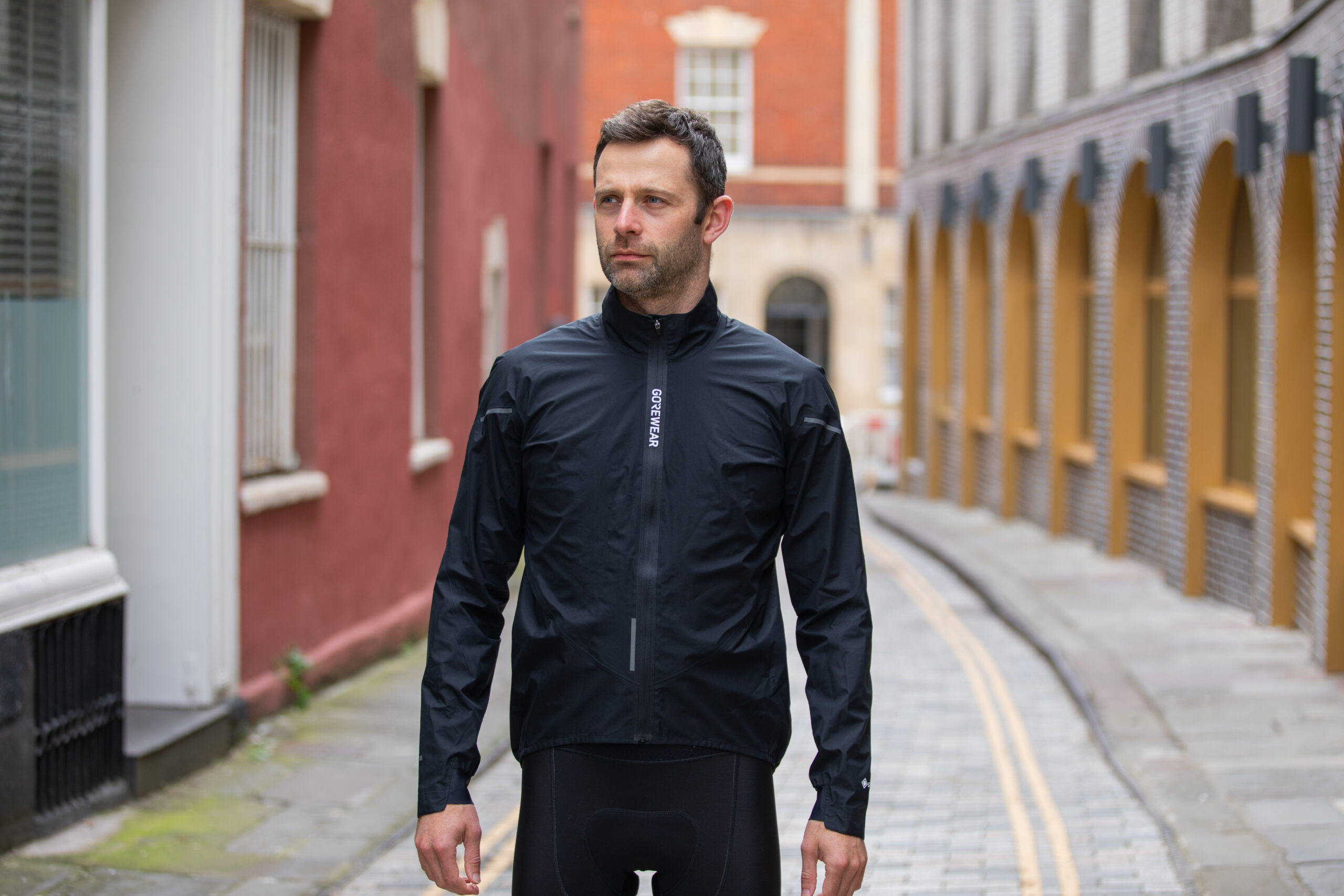
Spinshift Gore-Tex jacket – £244.99 £183.74 $270 $189

Gore Spinshift Gore-Tex Jacket
Gore has gone PFC-free with the Spinshift jacket. Scott Windsor / Our Media

The Spinshift Gore-Tex jacket features the latest Gore-Tex ePE Membrane, with the brand promising it is “guaranteed to keep you dry”.

We tested the jacket and rated it at 4 stars, with Ash Quinlan praising its well-considered cut, ease of packing down, and its waterproofing and breathability.

There is plenty of reflective detailing on the jacket that should help enusre you’re seen when out on the road, plus there’s good pocket storage for keeping your things close to hand.

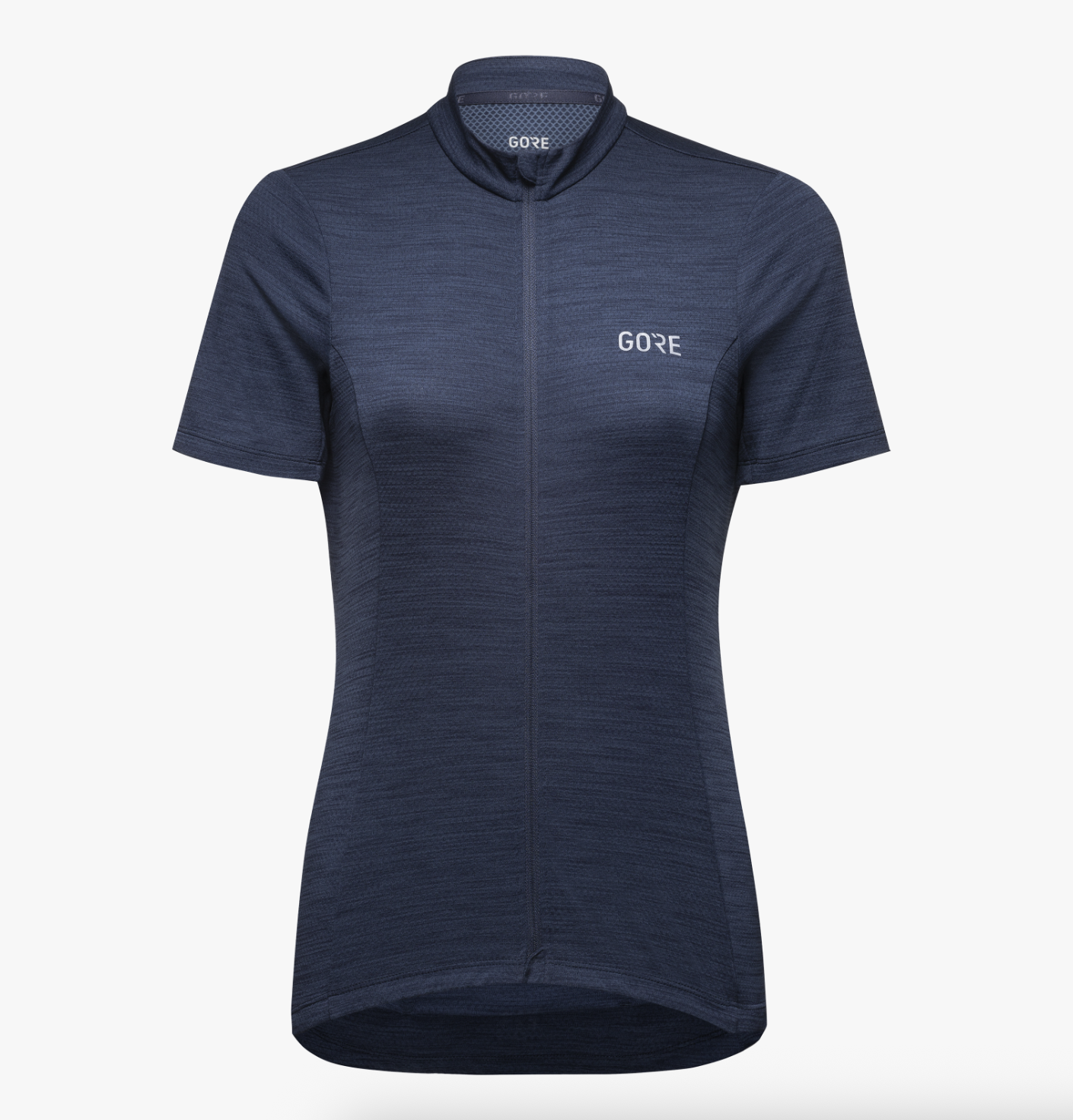
C3 Women Jersey – £69.99 £31.50 $90 $27

Gorewear C3 Women Jersey
This C3 Jersey has over 50 per cent off. Gorewear

Gorewear says the C3 jersey has a modern, relaxed fit for comfortable riding in warm weather, with the jersey featuring lightweight polyester material.

There are three gusseted back pockets for keeping your essentials close, with one featuring a zipped pocket for valuables.

The front zip has a semi-lock slider that should keep it in place wherever you leave it on the zipper.

There is also an elastic grip on the bottom hem for added security.

Lupra 2.0 Gore-Tex jacket – £269.99 £175.49 $280 $196

Gorewear Lupra 2.0
The Lupra 2.0 is iconic out on the trails. Gorewear

Gorewear says the Lupra 2.0 is the upgrade to its best-selling Endure jacket, with the new jacket featuring the GORE-TEX ePE membrane.

The brand says the jacket is lightweight and packable, yet ruggedly durable to tackle any adventure.

You get a hood, it looks large enough to fit over most helmets and there’s a dual zipper on the front to help control your temperature.

It’s made with mountain biking in mind, but it could be used for commuting, gravel and even bike touring thanks to its design.

At £175.49 / $196, it’s still not cheap, but this looks like a quality buy for someone in the market for a new waterproof jacket.

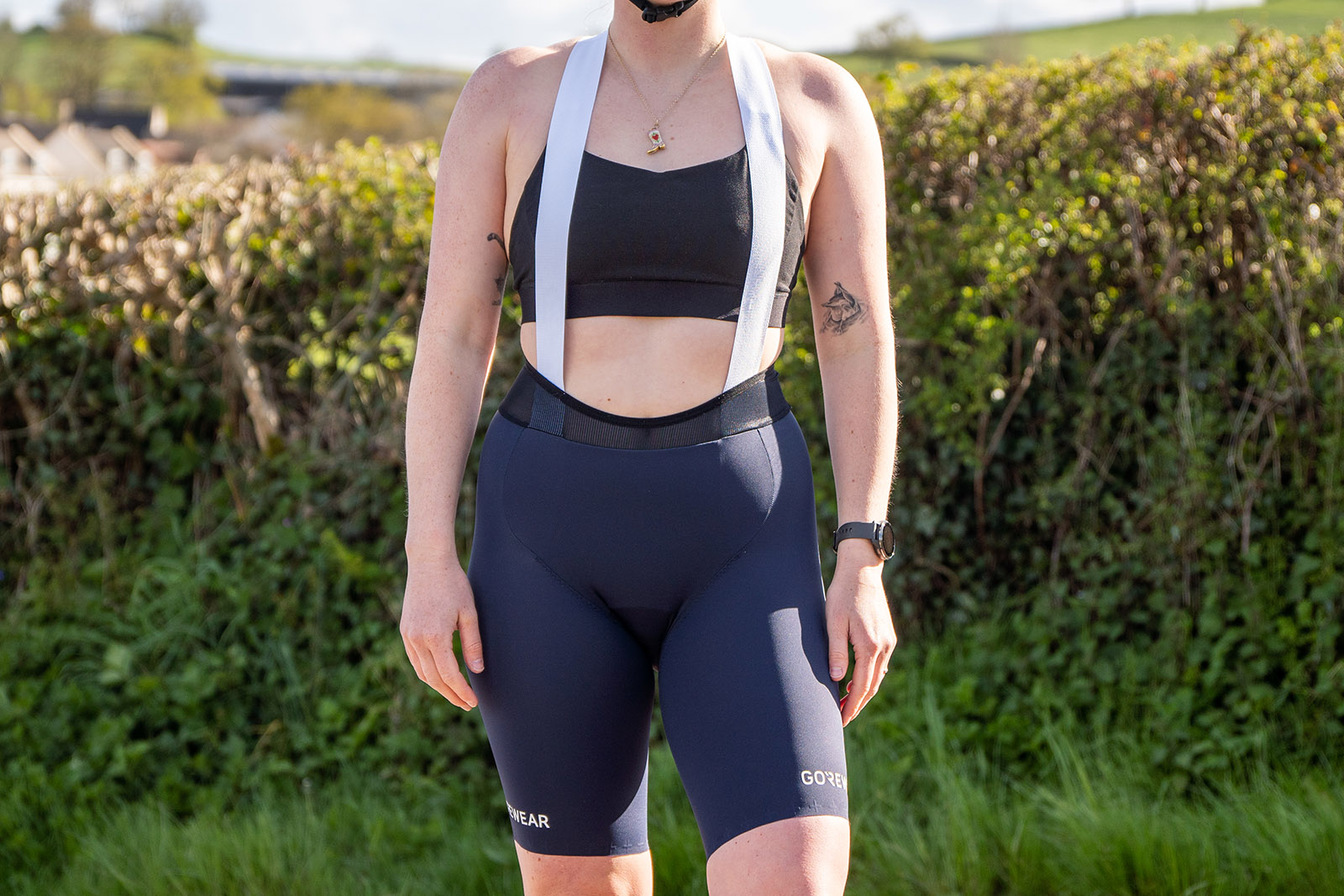
Spinshift Bib Shorts Women’s – £134.99 £87.74 $150 $105

Gore Spinshift Bib Shorts for female road cyclists
The Spinshift Bib Shorts are also available in a men’s version. Sam Voaden / Our Media

The Spinshift Bib Shorts are focused on comfort, with the brand saying they are durable and thoughtfully engineered for everyday rides.

We tested the women’s shorts and gave them a solid 3.5-star rating, with Katherine saying she liked the easy-pee mechanism, luxurious fabric and seamless leg hems.

She highlighted that they weren’t the easiest to size, though, so make sure you’re confident before clicking the buy button.

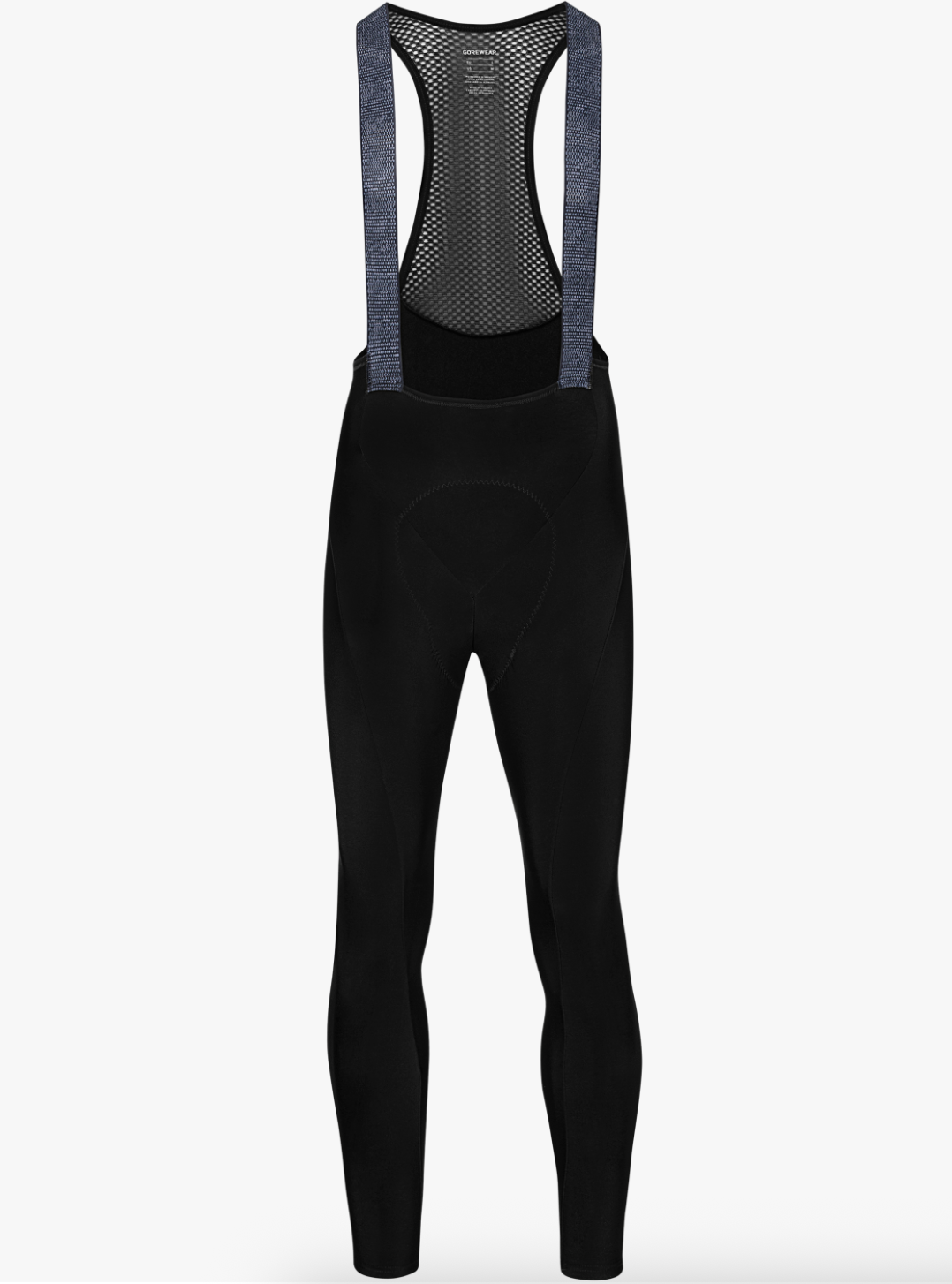
Glidewheel Thermo Bib Tights – $130 $65

Gorewear Glidewheel Thermo Bib Tights
These would be great to stave off the last bite of winter. Gorewear

These bib tights feature a thermo-stretch functional fabric that should keep you warm on cold days.

Inside, there is Gorewear’s Active Comfort seat pad, and full-mesh bibs are used for fit and breathability.

  • Buy now from Gorewear US for $65

Qualcomm Launches Dragonwing Robotics Hub, Announces NEURA AI Robotics Collaboration

Qualcomm Launches Dragonwing Robotics Hub, Announces NEURA AI Robotics Collaboration
Qualcomm and NEURA Robotics have announced a collaboration to integrate edge computing with embodied AI, aiming to move cognitive humanoid robots from research labs into large-scale industrial and domestic environments. By combining Qualcomm’s new DragonWing robotics processors with NEURA’s full-stack hardware and software systems, this partnership

10 Hacks Every Dark Web User Should Know

The dark web has a sinister and foreboding name for a reason. This is a place where all manner of illegal and underhand activity takes place, as well as somewhere internet users can free themselves from government censorship and draconian surveillance. Getting on the dark web isn’t particularly difficult, but it’s not somewhere you should head without doing your research first. If you visit an unfamiliar location in real life, you’ll want to make sure you know how to stay safe and make the most of your trip, and it’s the same with the dark web. As such, follow these hacks and tips to maximize your chances of staying safe and getting the most out of what the dark web has to offer.

Use IP Leak to make sure your IP address stays hidden

As with the general web, using a VPN with the dark web isn’t essential, but is recommended. However, you should also check for IP leaks before you start doing any dark web browsing, even with a VPN up and running.

In simple terms, an IP leak is where your actual internet location is revealed to the sites you’re connecting to—something you want to avoid on the dark web. This might be caused by a rogue website script or browser extension, for example. It’s easy to do: Just head to IP Leak and check the IP address that’s being reported isn’t actually where you are. As an added bonus, the site checks for leaks through the WebRTC and DNS protocols, which can also reveal your location in a more roundabout way.

Avoid leaving fingerprints by resizing your browser window

Tor and a VPN of your choice can hide a lot about your identity, but you’re still vulnerable to fingerprinting when you’re on the dark web. That’s where information being reported by your computer—such as the operating system, the system time, and even the fonts you have installed—is used to recognize you as an individual.

Another key piece of information used in fingerprinting is the size of your monitor display: If your browser window fills your screen, a bad actor can infer what monitor or device you may be using. Tor does use some tricks to try and obfuscate this, but you can help by not maximizing your browser window (and perhaps randomly resizing it from time to time).

Tor browser
An identity reset in Tor.
Credit: Lifehacker

Use “New Identity” to hide who you are online

Tor includes a feature that isn’t immediately obvious, but which can help you switch identities in a couple of clicks. It’s like disappearing into a rest room and then remerging with a different disguise—disconnecting you from whatever you were doing through the browser before.

Click the menu button (three horizontal lines, top right), then pick New identity. All currently open tabs will be closed, and the browser restarts. You’ll be rerouted through different Tor circuits to get back online, and all previous browsing data and cookies will be wiped away.

Use Dangerzone to securely open files on the dark web

Generally speaking, you don’t really want to be downloading anything from the dark web, if you can help it: The dark web waters are swimming with malware, scams, and otherwise unwholesome material. However, there may be times when you need to open a document given to you by a trusted contact.

Anything you do need to open should be opened through Dangerzone. It basically puts a security sandbox around PDFs, images, and office documents, and strips out any kind of malicious or tracking data embedded in the file. You’re then left with a sanitized file that’s passed security clearance and can be opened as normal.

Add a bridge for extra security

For ease of use, you can have Tor connect to the web through a path of its choice, concealing your identity and location through a series of recognized nodes. If you want to take this a step further, you can add a bridge into the connection chain as well.

Standard Tor nodes (or relays) still report an IP address, though it won’t be your actual one. Bridges don’t share IP addresses at all, which makes it even harder for someone else to track who you are and what you’re doing. They’re particularly useful in countries where known Tor relays might be blocked by the authorities.

In the Tor browser, click the menu button (three horizontal lines, top right), then Settings > Connection to configure a bridge. Use Request bridges to ask for a bridge link from the official Tor bot, or use the web or Telegram links to find one.

Tor browser
Setting a pluggable transport.
Credit: Lifehacker

Use pluggable transports to hide from your internet provider

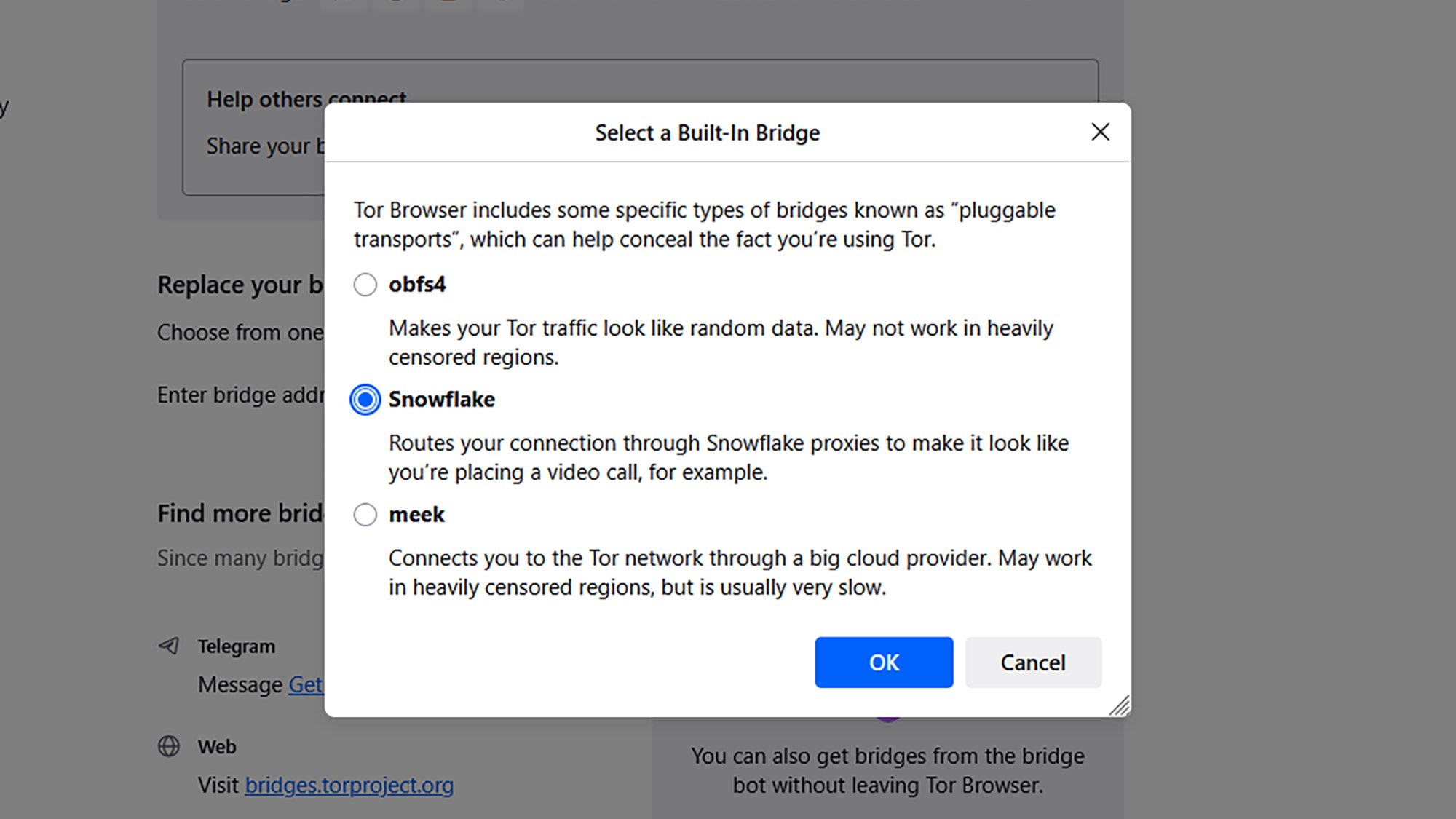
Pluggable transports are a specific type of Tor bridge: As well as additional IP address cloaking and anti-censorship measures, pluggable transports hide the fact that you’re actually using Tor from your internet provider as well. They’re often used as a next-level step wherever the Tor network has been banned.

To configure a pluggable transport bridge inside Tor, click the menu button (three horizontal lines, top right), then pick Settings > Connection. Click Select a built-in bridge to choose from one of the available pluggable transports, which each come with a description of how they work.

Kill your other tasks and apps before surfing the dark web

If you’re accessing the dark web through Tor, shut down everything else on your system: Clear out all the apps that are in memory, even if they’re only running in the background (Task Manager on Windows and Activity Monitor on macOS can help with this).

Not only can running apps help to identify your system for fingerprinting (see the window resizing tip above), they can also make you more vulnerable to malicious websites and malware you might come across on the dark web. The more programs you’ve got running besides Tor, the bigger the target area for bad actors.

Use tools to create a “dark web persona”

All of the security and anonymity measures that go into Tor and VPNs are compromised to an extent if you then log into your regular accounts (like Amazon and Instagram) while you’re also browsing the dark web. It makes it more likely that your credentials will be stolen, and that you can be identified as an individual user.

Some dark web users set down rules for a whole new internet persona to make it harder to reveal their real identities. This might involve going online at different times, using different devices, and maybe even different wifi networks. Any overlap with your “regular” internet use puts you at more risk.

This extends to email addresses and login names too: Use different ones on the dark web to the ones that you normally use. You can get burner email addresses from plenty of providers, including DuckDuckGo and Apple.

Tor browser
Ramping up browser security.
Credit: Lifehacker

Use Tor’s “Safest” mode to restrict what websites can do

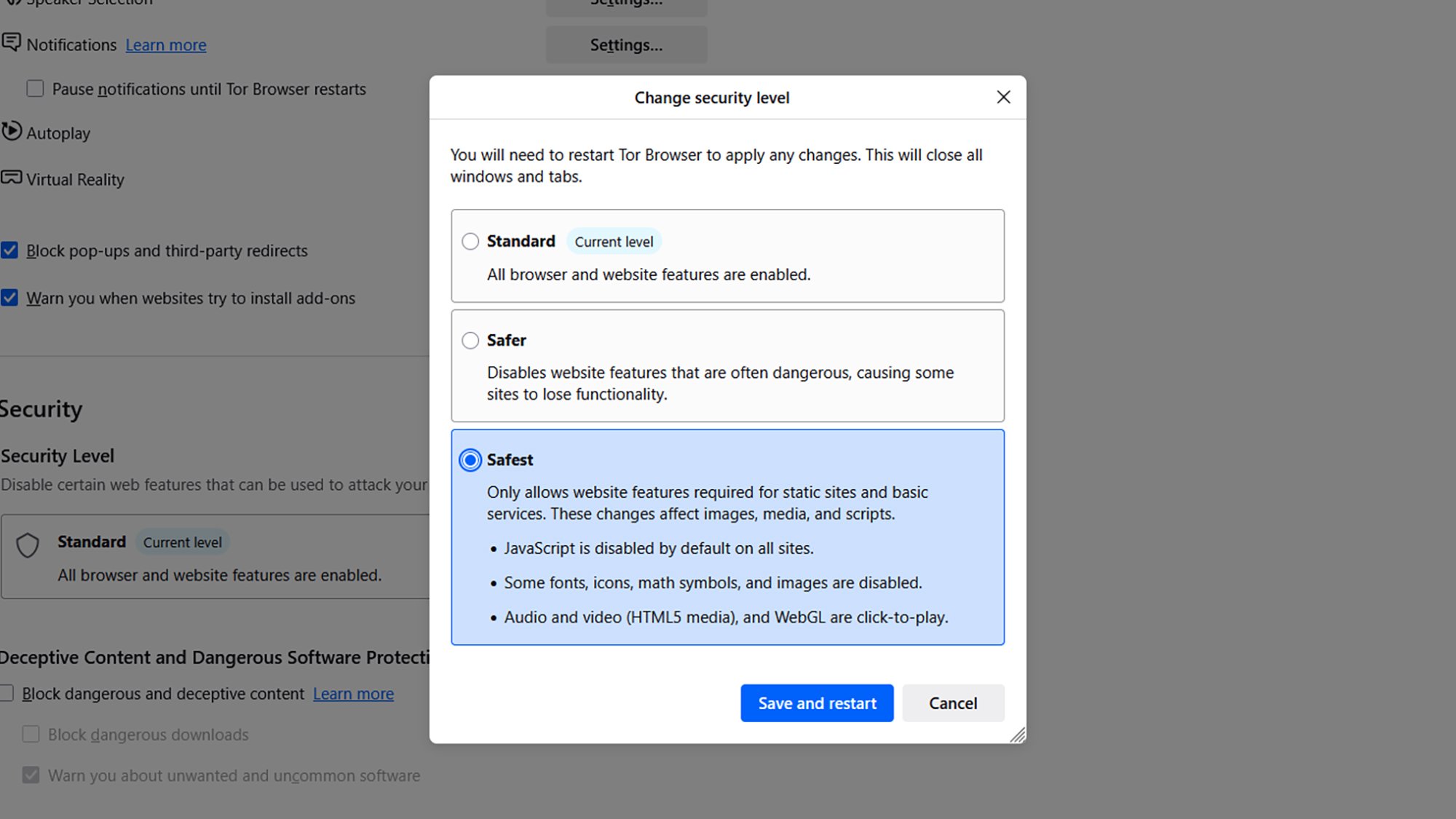
The Tor browser includes a “maximum security” level that shuts down a lot of website activity like scripts and media playback. It’s not on by default, and it can affect the functionality of sites (they’ll typically look a lot more barebones), but if you want to stay as safe as possible then it’s available as an option.

Click the menu button (three horizontal lines), then Settings > Privacy & Security and Change under Security. Select Safest to put Tor into maximum security mode, then click Save and restart.

Connect through Tails OS for an extra security layer

Access the dark web through Tor on Windows or macOS, and you’re well protected from harm. Access it through the portable, Linux-based operating system Tails, and that protection goes up another level.

Tails runs from either a USB stick or through a virtual machine, which means any malware that does sneak through your defenses can’t reach your main operating system and everything on it. (Everything on the OS runs through the Tor platform, not just the browser.) You will need to set aside some time for this, but it’s worth the additional effort if you want to stay as safe as possible. Tails offers a full guide explaining how to get started.


US Military Tested Device That May Be Tied To Havana Syndrome On Rats, Sheep

An anonymous reader quotes a report from CBS News: Tonight, we have details of a classified U.S. intelligence mission that has obtained a previously unknown weapon that may finally unlock a mystery. Since at least 2016, U.S. diplomats, spies and military officers have suffered crippling brain injuries. They’ve told of being hit by an overwhelming force, damaging their vision, hearing, sense of balance and cognition. but the government has doubted their stories. They’ve been called delusional. Well now, 60 Minutes has learned that a weapon that can inflict these injuries was obtained overseas and secretly tested on animals on a U.S. military base. We’ve investigated this mystery for nine years. This is our fourth story called, “Targeting Americans.” Despite official government doubt, we never stopped reporting because of the haunting stories we heard […]. 60 Minutes interviewed Dr. David Relman, a scientific expert and professor from Stanford University who was tasked by the government to lead two investigations into the Havana Syndrome cases. What he and his panel of doctors, physicists, engineers and others found was that “the most plausible explanation for a subset of these cases was a form of radiofrequency or microwave energy,” the report says.

According to confidential sources cited in the report, undercover Homeland Security agents bought a miniaturized microwave weapon from a Russian criminal network in 2024 and tested it on animals at a U.S. military lab. The injuries reportedly matched those seen in the human cases. “Our confidential sources tell us the still classified weapon has been tested in a U.S. military lab for more than a year,” says Dr. Relman. “Tests on rats and sheep show injuries consistent with those seen in humans.”

He continues: “Also, as a separate part of the investigation, security camera videos have been collected that show Americans being hit. The videos are classified but they were described to us. In one, a camera in a restaurant in Istanbul captured two FBI agents on vacation sitting at a table with their families. A man with a backpack walks in and suddenly everyone at the table grabs their head as if in pain. Our sources say another video comes from a stairwell in the U.S. embassy in Vienna. The stairs lead to a secure facility. In the video, two people on the stairs suddenly collapse. Those videos and the weapon were among the reasons the Biden administration summoned about half a dozen victims to the White House with about two months left in the president’s term.”

Former intelligence officials and researchers claim elements of the U.S. government downplayed or dismissed the theory for years, possibly to avoid political consequences of accusing a foreign state like Russia of conducting attacks on American personnel.


Read more of this story at Slashdot.