
Even if it’s just pretending, the novel simplicity of a watch with a few buttons and a small screen is a welcome respite from the complicated hell we live in.

Even if it’s just pretending, the novel simplicity of a watch with a few buttons and a small screen is a welcome respite from the complicated hell we live in.
I’ve tried all kinds of time-tracking apps over the years and they can be helpful, but it’s easy to get bogged down in the numbers. Sometimes all you need is a little self-awareness about how long you’ve been on the computer, either all day or during the current session, without the burden of long-term metrics.
Pandan is a totally free Mac app from indie app developer Sindre Sorhus that that does exactly that. The application mostly lives in the menu bar, telling you how long your current computing session has been. You can click the menu bar icon to see how long the previous session was and how long you’ve been on your computer today.
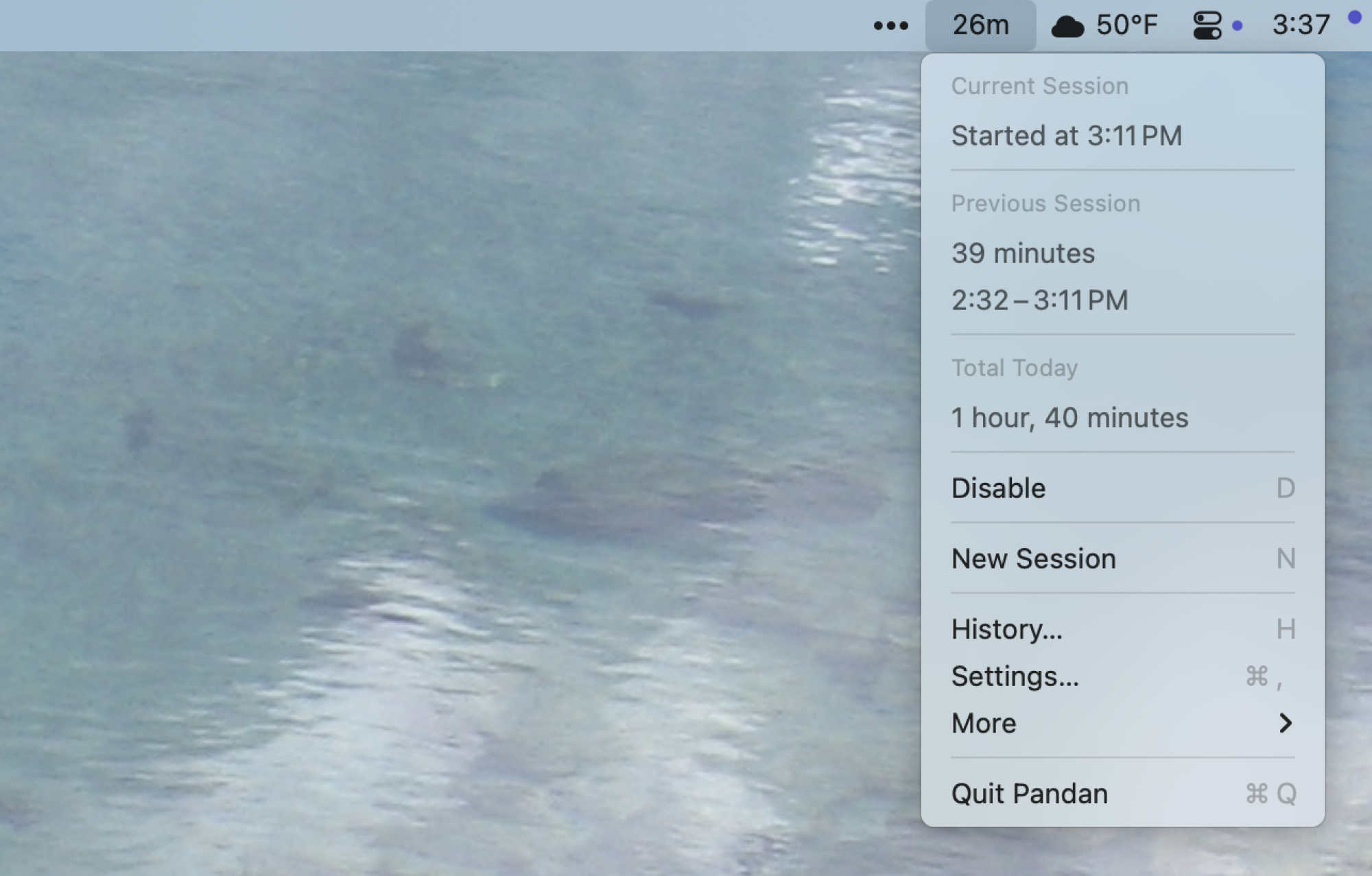
You can also dig into the history, if you want—the applications goes back 180 days. But history isn’t the point of this application, which is very much not a time-tracking app—Sorhus recommends looking into Screen Time if you want to track longterm trends. Pandan is instead about gently reminding you how long you’ve been on the computer so you can be aware of that.
The settings let you set up an optional reminder when you’ve been on your computer for a particular amount of time. These can take the form of a macOS notification, a pop-up near the menu bar icon, or a HUD in the middle of the screen as seen at the top of this article. The idea is to remind yourself to get up or do some stretches.
You can even trigger an Apple Shortcut if you want, which means you can set up your computer to do all sorts of things when it’s time for a break. I can’t exactly explain everything Apple Shortcuts can do—it’s a powerful tool—but know that this means you could do things like load particular applications or play a custom sound when you’ve been on your computer for a certain amount of time. And Pandan can also be triggered using Apple Shortcuts, meaning you could use it as part of productivity automations you’ve already set up.
That’s all power user stuff, though. For most people this application doesn’t need to do anything other than the basics, and that’s telling you—at a glance—how long you’ve been at your computer. It’s very good at that, and completely free, all from a developer with a great reputation. Check it out if you’re interested.
Following Hector Martin stepping down from the Asahi Linux project that he founded for bringing Linux to Apple Silicon hardware, Asahi Lina announced today that she is pausing work on all of the Apple GPU driver development she had been pursuing for Asahi Linux with the open-source DRM kernel driver as well as Mesa contributions…

The Chris Pratt and Milly Bobby Brown film had a lot of views, but pales in comparison to similar Netflix films.
General Motors is partnering with Nvidia to enhance its self-driving and manufacturing capabilities by leveraging Nvidia’s AI chips, software, and simulation tools. “GM says it will apply several of Nvidia’s products to its business, such as the Omniverse 3D graphics platform which will run simulations on virtual assembly lines with an eye on reducing downtime and improving efficiency,” reports The Verge. “The automaker also plans to equip its next-generation vehicles with Nvidia’s ‘AI brain’ for advanced driver assistance and autonomous driving. And it will employ the chipmaker’s AI training software to make its vehicle assembly line robots better at certain tasks, like precision welding and material handling.” From the report: GM already uses Nvidia’s GPUs to train its AI software for simulation and validation. Today’s announcement was about expanding those use cases into improving its manufacturing operations and autonomous vehicles, GM CEO Mary Barra said in a statement. (Dave Richardson, GM’s senior VP of Software and Services Engineering will be joining NVIDIA’s Norm Marks for a fireside chat at the conference.) “AI not only optimizes manufacturing processes and accelerates virtual testing but also helps us build smarter vehicles while empowering our workforce to focus on craftsmanship,” Barra said. “By merging technology with human ingenuity, we unlock new levels of innovation in vehicle manufacturing and beyond.”
GM will adopt Nvidia’s in-car software products to build next-gen vehicles with autonomous driving capabilities. That includes the company’s Drive AGX system-on-a-chip (SoC), similar to Tesla’s Full Self-Driving chip or Intel’s Mobileye EyeQ. The SoC runs the “safety-certified” DriveOS operating system, built on the Blackwell GPU architecture, which is capable of delivering 1,000 trillion operations per second (TOPS) of high-performance compute, the company says. […] In a briefing with reporters, Ali Kani, Nvidia’s vice president and general manager of automotive, described the chipmaking company’s automotive business as still in its “infancy,” with the expectation that it will only bring in $5 billion this year. (Nvidia reported over $130 billion in revenue in 2024 for all its divisions.)
Nvidia’s chips are in less than 1 percent of the billions of cars on the road today, he added. But the future looks promising. The company is also announcing deals with Tier 1 auto supplier Magna, which helped build Sony’s Afeela concept, to use Drive AGX in the company’s next-generation advanced driver assist software. “We believe automotive is a trillion dollar opportunity for Nvidia,” Kani said.


Read more of this story at Slashdot.
Starting Tuesday, Disney+ has a 24/7 streaming channel for The Simpsons that broadcasts seasons one through 35 (all but the currently airing one) chronologically.
To be clear, this announcement isn’t about any new content, as you can already watch each of those 767 episodes on-demand on Disney+. All that’s different here is a single stream that runs through each of them in order around the clock. If episodes average 22 minutes long, that would have the stream taking nearly 12 days to refresh.
The advantage for those who like this format (I can only guess) is you don’t have to think about where to pick up; just turn on the stream and imagine you’re popping in on The Cartoon Network’s longest marathon ever.
“The Simpsons Stream will deliver a Simpsons marathon all day, every day — no matter when you tune in, this ultimate Simpsons binge will be there,” current show-runner Matt Selman wrote in a press release.
This article originally appeared on Engadget at https://www.engadget.com/entertainment/streaming/disney-adds-a-247-stream-of-the-simpsons-203929882.html?src=rss
If you wanted to play some tunes on your iPhone this afternoon, but found nothing would play, it’s not just you: As of Tuesday afternoon ET, Apple Music is down.
Apple’s System Status website currently confirms Apple Music’s downtime. As of this piece, the site shows the following status for Apple Music:
Apple Music – Outage
Today, 2:26 PM – ongoing
Some users are affected
Users may be experiencing intermittent issues with this service.
All other Apple services, including the App Store, FaceTime, iMessage, and all iCloud services, are currently online.
I first saw the news thanks to 9to5Mac’s Chance Miller. Both Miller and I are personally not experiencing any issues with Apple Music. In fact, as I write this piece, I’m streaming the same Lo-Fi Breeze playlist I’ve been playing all afternoon. I’ve tested it on both my iPhone and my Mac, making sure to stream music and not to play downloaded tracks, and I’ve encountered zero issues.
The service has definitely worked for me since 2:26 p.m., so it’s not clear how widespread this Apple Music outage actually is. But if you are having trouble getting Apple Music to work this afternoon, know you aren’t alone, and that it likely isn’t something on your end. Apple will likely have a fix out as soon as possible for whatever is causing the outage; so, in the meantime, sit tight, and play some music on YouTube.
Ubuntu developers decided a few months back to switch from IRC to Matrix for real-time communication needs. The newest fundamental shift being discussed by Ubuntu developers is shifting from mailing list discussions to Ubuntu Discourse for mailing list like written communications…
One PUT request, one poisoned session file, and the server’s yours. A trivial flaw in Apache Tomcat that allows remote code execution and access to sensitive files is said to be under attack in the wild within a week of its disclosure.

The California governor has been sending prepaid cell phones to executives throughout his state.
Sheriff John Montgomery of Baxter County, Arkansas, isn’t going to take it anymore—if by “it” you mean “having to offer lower phone call rates to incarcerated inmates.” Noting that such phone calls are “not required to be provided by law,” Montgomery is ending all inmate phone calls on March 30, 2025.
The cause of Montgomery’s wrath, and of his March 30 date, is the Federal Communications Commission, which set an April 1, 2025, deadline for smaller jails to lower the obscene rates of inmate phone calls. (Larger jails had to comply in January.) According to the FCC, 15-minute phone calls to inmates could run as much as $12.10 in these smaller jails. The Commission now demands that such calls cost no more than $1.35. (You can read the new rate schedule here.)
The rates are high in part because extra security is required for inmate communications services, but the system had also become a way for local agencies to make money by charging vendors a “site commission payment.” In this model, vendors might be selected based less on what was good for security and for inmate families and more on how much cash the vendor could funnel to the jail. FCC Commissioner Geoffrey Starks even referred to these payments as “kickbacks.”
NVIDIA is building a desktop supercomputer. At the company’s GTC conference today, CEO Jensen Huang announced DGX Spark and DGX Station. We got a first look at the former during CES earlier this year when Huang and company revealed Project Digits. Now known as DGX Spark, NVIDIA is billing the $3,000 device as the world’s smallest AI supercomputer.
It features a GB10 Grace Blackwell Superchip NVIDIA has shrunk down to fit inside an enclosure about the size of the previous generation Mac mini. NVIDIA says the GB10 can run up to 1,000 trillion operations per second of AI compute, making it ideal for fine-tuning the latest AI reasoning models, including the GR00T N1 robot system Huang announced at the end of his GTC keynote. The DGX Spark is available to preorder today.
For researchers and data scientists who need even more AI processing power, the DGX Station features a GB300 Grace Blackwell Ultra Desktop Superchip. The GB300 offers 20 petaflops of performance and 784GB of unified system memory. NVIDIA has yet to announce a price for the DGX Station, though the company says the computer will arrive later this year, with ASUS, BOXX, Dell, HP, Lambda and Supermicro all making their own versions of the system.
This article originally appeared on Engadget at https://www.engadget.com/ai/nvidias-spark-desktop-ai-supercomputer-arrives-this-summer-200351998.html?src=rss
Nvidia unveiled its next wave of AI processors at GTC on Tuesday, announcing Blackwell Ultra chips that will ship in the second half of 2025, followed by the Vera Rubin architecture in 2026. CEO Jensen Huang also revealed that its 2028 chips will be named after physicist Richard Feynman.
The Blackwell Ultra maintains the same 20 petaflops of AI performance as standard Blackwell chips but increases memory from 192GB to 288GB of HBM3e. Nvidia claims these chips can process 1,000 tokens per second — ten times faster than its 2022 hardware — enabling AI reasoning tasks like running DeepSeek-R1 models with 10-second response times versus 1.5 minutes on H100 chips.
Vera Rubin will deliver a substantial leap to 50 petaflops in 2026, featuring Nvidia’s first custom Arm-based CPU design called Olympus. Nvidia is also changing how it counts GPUs — Rubin itself contains two dies working as one chip. The annual release cadence represents a strategic shift for Nvidia, which previously introduced new architectures every two years before the AI boom transformed its business.


Read more of this story at Slashdot.

We may earn a commission from links on this page. Deal pricing and availability subject to change after time of publication.
Online security and an ad-free browsing can be expensive, but right now, StackSocial is offering the AdGuard Family Security Suite for just $49.99, bundling two services that would normally run you a lot more. You can also add the promo code GUARD5 to take off an additional $5, bringing the final cost of this sale down to $44.99. This bundle includes a five-year AdGuard VPN subscription (for up to 10 devices) and a lifetime Family Plan subscription to AdGuard Ad Blocker (covering up to 9 devices) across iOS, Android, macOS, Windows, and common browsers like Chrome. Just note that this plan is only for new users, and you need to redeem your code within 30 days of buying.
Unlike free VPNs that might log and sell user data, AdGuard operates with a strict no-logs policy, meaning that with AdGuard VPN, your browsing history will stay private. It also lets you connect to over 60 server locations worldwide, so you can bypass geo-restrictions, access region-locked content, and keep your online activity hidden from prying eyes. Whether you’re working remotely, streaming content from another country, or just trying to protect your information on public wifi, this VPN encrypts your data with industry-standard AES-256 encryption, preventing ISPs, hackers, and advertisers from tracking you. And with support for up to 10 devices, you can secure your phone, laptop, tablet, and your family’s gadgets under one plan.
The AdGuard Ad Blocker Family Plan takes care of the other internet headaches too, blocking pop-ups, banners, and video ads across browsers and apps, meaning you get faster page loads and a cleaner experience without autoplay videos or sketchy pop-ups trying to trick you into clicking. Unlike most ad blockers that only work in browsers, AdGuard’s system-level filtering works on apps too, giving you cleaner feeds on social media and ad-free experiences on mobile games. It also includes advanced parental controls, letting you filter out inappropriate content to create a safer browsing environment for kids. The $45 deal with the promo code GUARD5 runs through March 30.

The popular Apple TV+ series has just one episode left to go in season two.
On the heels of its release of new Gemini models last week, Google has announced a pair of new features for its flagship AI product. Starting today, Gemini has a new Canvas feature that lets you draft, edit, and refine documents or code. Gemini is also getting Audio Overviews, a neat capability that first appeared in the company’s NotebookLM product, but it’s getting even more useful as part of Gemini.
Canvas is similar (confusingly) to the OpenAI product of the same name. Canvas is available in the Gemini prompt bar on the web and mobile app. Simply upload a document and tell Gemini what you need to do with it. In Google’s example, the user asks for a speech based on a PDF containing class notes. And just like that, Gemini spits out a document.
Canvas lets you refine the AI-generated documents right inside Gemini. The writing tools available across the Google ecosystem, with options like suggested edits and different tones, are available inside the Gemini-based editor. If you want to do more edits or collaborate with others, you can export the document to Google Docs with a single click.
I’ve been writing books for over 30 years now. I began publishing them in 2011. So far, I unleashed 21 books unto the wild. By and large, fiction is super easy to write. You just use your own head. Even my technical works on kernel crash analysis, problem solving, ethics, or career help were relatively simple to jot down.
Because if you yell ‘Free Bird’ at enough concerts somebody is bound to oblige, this is a video of musician Mo Yun performing Lynyrd Skynyrd’s guitar solo from the song on a traditional Chinese guzheng (a form of plucked zither). Like my girlfriend whenever she senses I’m about to start talking about my pen1s at a dinner party, it slaps.
Commissioner Geoffrey Starks will resign from the Federal Communications Commission this spring, he announced today. Starks’ exit will give Chairman Brendan Carr a Republican majority, as the FCC has had two Democrats and two Republicans since the January resignation of former Chairwoman Jessica Rosenworcel.
“Today I sent a letter to the President and Leader Schumer indicating that I intend to resign my seat as a Commissioner this spring,” said Starks, a Democrat who has been an FCC commissioner for over six years. “Serving the American people as a Commissioner on the Federal Communications Commission has been the honor of my life… Over the next few weeks, I look forward to working with the chairman and my fellow Commissioners, and all FCC staff, to further the mission of the agency.”
Even with a 2-2 deadlock, Carr has gotten to work on some of his priorities, such as investigating news stations accused of bias against President Donald Trump and dropping a Biden-era proposal to increase regulation of broadband providers.