Meta is buying Moltbook, the ridiculous social network populated by AI bots

Meta is snapping up Moltbook, a Reddit-like social network for AI agents that has been around since January and remains completely ridiculous. The company hasn’t disclosed the terms of the deal.

Moltbook and its creators Matt Schlicht and Ben Parr will be joining Meta Superintelligence Labs (MSL) when the deal closes. That’s expected to happen in the coming days, according to Axios.

“The Moltbook team joining MSL opens up new ways for AI agents to work for people and businesses,” a Meta spokesperson told TechCrunch. “Their approach to connecting agents through an always-on directory is a novel step in a rapidly developing space, and we look forward to working together to bring innovative, secure agentic experiences to everyone.”

It seems current Moltbook users will be able to continue interacting with the platform for the time being. Moltbook was built on the back of OpenClaw, a tool that enables people to whip up AI agents that can interact with dozens of different apps. (OpenAI hired the creator of OpenClaw last month.)

Schlicht used OpenClaw to create a bot named “Clawd Clawderberg” and asked it to create a social network for AI agents. And that’s how Moltbook came to be.

For what it’s worth, Clawd Clawderberg is a play on “Mark Zuckerberg” and Moltbook is a clear riff on “Facebook,” so it’s somewhat fitting that Schlicht vibe-coded his way to a job at Meta. It also emerged that it was relatively easy for humans to pose as AI agents and post on Moltbook. Again, all of this is deeply, deeply absurd.

This article originally appeared on Engadget at https://www.engadget.com/ai/meta-is-buying-moltbook-the-ridiculous-social-network-populated-by-ai-bots-152732453.html?src=rss

German Publishers Push Regulators To Fine Apple Over App Tracking Transparency

German publishers and advertising groups are urging regulators to fine Apple over its App Tracking Transparency (ATT) system, arguing it unfairly restricts access to advertising data while allowing Apple to remain the central gatekeeper — without subjecting its own apps to the same restrictions. If Germany’s antitrust authority does rule against Apple, the company could face fines of up to 10% of its global revenue. 9to5Mac reports: One of the countries investigating whether ATT is anticompetitive is Germany. Last year, in an attempt to appease the country’s antitrust watchdog, the company proposed several changes to the framework’s rules. From Reuters’ original coverage of Apple’s changes proposals: “Apple had agreed to introduce neutral consent prompts for both its own services and third-party apps, and to largely align the wording, content and visual design of these messages, said Andreas Mundt, head of Germany’s Bundeskartellamt. The company also proposed simplifying the consent process so developers can obtain user permission for advertising-related data processing in a way that complies with data protection law.” […] At the time, German regulators launched a consultation with industry publications to determine whether the proposals addressed their concerns. As it turns out, the answer was a hard no.

As Reuters reported today: “Apple’s proposed changes to its app tracking rules do not resolve antitrust issues in the mobile advertising market, associations representing German publishers and advertisers said on Tuesday as they urged the country’s antitrust authority to slap a fine on the U.S. tech giant. […] ‘The proposed commitments would not change the negative effects of the App Tracking Transparency Framework,’ Bernd Nauen, chief executive of the German Advertising Federation, said in a joint letter signed by the trade bodies. ‘Apple would remain the data gatekeeper and would continue to decide who gets access to advertising-relevant data and how companies can communicate with their end customers,’ he said.”


Read more of this story at Slashdot.

Google brings Gemini-powered content creation tools to Docs, Sheets, Slides and Drive

Google is rolling out a batch of Gemini updates across its Workspace apps that give the AI assistant the ability to generate first drafts in Docs, build entire spreadsheets in Sheets, design presentations in Slides and answer questions about files stored in Drive. The features started rolling out on March 10 in beta for Google AI Ultra and Pro subscribers and Gemini Alpha business customers, in English only.

In Docs, a new “Help me create” tool produces a formatted first draft by pulling context from Drive, Gmail, Chat and the web based on a user’s prompt. Gemini can also match the writing style or formatting of a reference document. Google says more than a third of new Docs are created from copies of existing files, so the formatting tool is meant to cut down on that manual work. In Sheets, Gemini can now construct an entire spreadsheet from a natural language prompt, drawing data from a user’s files and emails, as well as Google Chat and the web.

A “Fill with Gemini” feature auto-populates table cells, which Google says is nine times faster than manual entry based on a 95-person study (this sounds profoundly unscientific, so take these claims with a grain of salt). Sheets also gained optimization tools powered by Google DeepMind and Google Research that can solve problems like employee scheduling through written prompts. In Slides, Gemini can generate individual slides that match an existing deck’s theme, with full presentation generation from a single prompt coming later.

Google Drive is getting AI Overviews in search results, similar to a feature the company recently added to Gmail, along with a new “Ask Gemini” tool that lets users query their files, emails and calendar. The Drive features will be released first only for customers in the US, unlike the rest of these updates.

This article originally appeared on Engadget at https://www.engadget.com/ai/google-brings-gemini-powered-content-creation-tools-to-docs-sheets-slides-and-drive-144705622.html?src=rss

A Resident Evil Requiem story expansion is in the works

It takes around 30 hours to experience everything Resident Evil Requiem has to offer. If you’ve already enjoyed all the thrills and spills and you’re itching for more, there’s some positive news. Capcom has some updates on the way. The biggest of those is a story expansion, which is now in development. Just don’t expect it to arrive imminently.

“In this story, we will delve deeper into the world of Requiem,” game director Koshi Nakanishi said in a short video message. “We’re hard at work on it now. It will take some time, so we ask for your patience and hope you’ll look forward to it.”

A message from Koshi Nakanishi, director of Resident Evil Requiem. pic.twitter.com/54aKw80h8K

— Resident Evil (@RE_Games) March 10, 2026

Nakanishi noted that on top of the story expansion and fixing bugs and performance issues, the development team is cooking up some other features. A photo mode is on the way to help you capture all the horrors that Grace and Leon encounter. There’s also a “surprise coming around May,” Nakanishi said. “We’re planning to add a mini-game.”

Resident Evil Requiem sold more than 5 million copies within its first week of release. Reviews have been generally positive, though we can safely discount the one that was likely AI generated and briefly featured on Metacritic.

This article originally appeared on Engadget at https://www.engadget.com/gaming/a-resident-evil-requiem-story-expansion-is-in-the-works-140512827.html?src=rss

EQT Eyes $6 Billion Sale of SUSE

Private equity firm EQT AB is reportedly exploring a sale of SUSE that could value the open-source Linux pioneer at up to $6 billion, roughly doubling the valuation since EQT took the company private in 2023. Reuters reports: EQT “has hired investment bank Arma Partners to sound out a group of private equity investors for a possible sale of the company, said the sources, who requested anonymity to discuss confidential matters. The deliberations are at “an early stage and there is no certainty that EQT will proceed with “a transaction, the sources said. […] The potential deal comes amid a broader selloff in software stocks, which has disrupted mergers and acquisitions activity. Investors are “concerned that new artificial intelligence tools could displace many existing software products, weighing on technology “valuations and making deals harder to price.

Some investors, however, see Luxembourg-headquartered SUSE as a potential beneficiary of AI adoption, arguing that demand for enterprise-grade infrastructure software is likely to grow as companies build and deploy more AI applications. The company generates about $800 million in revenue and more than $250 million in earnings before interest, taxes, depreciation, and amortization (EBITDA) and could fetch between $4 billion and $6 billion in a sale, the sources said.


Read more of this story at Slashdot.

The Sonos Play puts the best parts of the Era 100 in a portable speaker

Sonos has just announced its first new products since 2024, when the company’s plans went sideways after a disastrous update to its app. First up is the Sonos Play, the company’s latest portable speaker. Long-time Sonos watchers will recognize the name from the old Play:1, Play:3 and Play:5 speakers, but this new model has little to do with those products of the past. The $299 Play is a Wi-Fi and Bluetooth speaker that sits between the $179 Roam 2 and $499 Move 2 and could be the “goldilocks” speaker in the company’s portable lineup, at least based on what I know so far.

The closest comparison for the Play is the excellent Era 100, which Sonos released back in 2023. At 7.6” tall, 4.4” wide and 3” deep, it’s much thinner than the Era 100 which is over 5 inches deep. And compared to the Move 2 (9.5” x 6.3 x 5”) it’s much more portable. That goes for weight, too — the Play is less than 3 pounds, compared to over 6.5 pounds for the Move 2. It’s not the kind of speaker you’ll throw in your bag and forget about, like the tiny Roam 2, but it’s far more portable than the Move 2. Finally, the Play is IP67 rated, just like the Roam 2. That means it can be submerged in up to a meter of water for up to 30 minutes; it’s also dustproof.

The grab handle on the back of the Sonos Play.
Sonos

From a speaker component perspective, it’s again quite similar to the Era 100. It has two tweeters positioned at a 90-degree angle for stereo separation paired with one midwoofer; it also has two additional passive radiators to increase the bass response in its relatively small case. The Era 100 lacks those passive radiators but is otherwise identical. Obviously, we’ll have to listen to the Play before saying how closely it compares to the Era 100, but this speaker should significantly outperform the Roam 2 simply due to the increased size of its components. The Move 2, on the other hand, is extremely loud and will likely still be the best choice for people who want a speaker to cover a large outdoor space.

You’ll find familiar controls on the Sonos Play, which comes in black or white. (Fingers crossed for future color options like the lovely trio that Sonos offers on the Roam.) On the top surface are buttons for play/pause, volume up and down and a microphone toggle. On the back is a power button, a Bluetooth button and a physical switch that disconnects the microphone for increased security. Finally, there’s a new feature here: a removable plastic grab loop. 

Sonos was keen to note that the Play is a full-featured member of the Sonos ecosystem. Like all of its other speakers, that means you’ll see all Sonos speakers in the app and can group them as you see fit, or have different music playing on different speakers throughout the house. You can also pair two of these in stereo. If you remove one from your network (say you’re outside and away from Wi-Fi), you’ll need to re-pair them though. In addition to controlling playback via the Sonos app (which, in my testing, is functioning fine and recovered from the 2024 debacle), you can stream music via AirPlay 2 or Spotify Connect. The Sonos Voice Assistant as well as Amazon Alexa are also on board here for anyone who likes to shout at their speakers.

The Sonos Play on its wireless charging base.
Sonos

There’s a new trick here for both the Play and Move 2, as well. For the first time, you can group Sonos speakers together through Bluetooth. After pairing a Play to your phone via Bluetooth, you can press and hold the play/pause button on three more Play or Move 2 speakers to add them to the group. If you want to cover a larger outdoor space with multiple speakers, this sounds like a pretty handy way to do so.

The Play also has line-in via its USB-C port, and you can use it for Ethernet as well; both features require a separate adapter. You can even use the USB-C port to top up your phone if you’re so inclined. And while you can also charge via the USB-C port, the Play comes with a wireless charging dock which makes for a nice home base for the speaker’s primary location. Annoyingly, Sonos did not include a charger, so you’ll need to provide your own USB-C brick. 

A pair of Sonos Era 100 SL speakers with a turntable.
Sonos

Sonos is also adding a second, much simpler speaker to its lineup today: the Era 100 SL. Like the One SL before it, the Era 100 SL is identical to the Era 100 with one key difference. There are no microphones on it at all. As such, the Era 100 SL is also a bit cheaper, coming in at $189 compared to $219 for the standard model. 

Otherwise, there are no differences in acoustic architecture or feature set here. As its most affordable speaker besides the portable Roam 2, Sonos is positioning the Era 100 SL as the ideal entry point into its products. I can’t really argue with that, as the Era 100 still sounds outstanding and is also quite flexible with features like line-in and Bluetooth as well as all the standard streaming options. Both versions of the Era 100 are compatible with each other, too — so if you get an SL and then decide you want a stereo pair, a standard Era 100 with a mic will work there and bring voice control to your system as well. 

Both the $299 Play and $189 Era 100 SL are up for pre-order now, and Sonos says they’ll be shipping on March 31.

This article originally appeared on Engadget at https://www.engadget.com/audio/speakers/the-sonos-play-puts-the-best-parts-of-the-era-100-in-a-portable-speaker-133000129.html?src=rss

After Outages, Amazon To Make Senior Engineers Sign Off On AI-Assisted Changes

An anonymous reader quotes a report from the Financial Times: Amazon’s ecommerce business has summoned a large group of engineers to a meeting on Tuesday for a “deep dive” into a spate of outages, including incidents tied to the use of AI coding tools. The online retail giant said there had been a “trend of incidents” in recent months, characterized by a “high blast radius” and “Gen-AI assisted changes” among other factors, according to a briefing note for the meeting seen by the FT. Under “contributing factors” the note included “novel GenAI usage for which best practices and safeguards are not yet fully established.”

“Folks, as you likely know, the availability of the site and related infrastructure has not been good recently,” Dave Treadwell, a senior vice-president at the group, told employees in an email, also seen by the FT. The note ahead of Tuesday’s meeting did not specify which particular incidents the group planned to discuss. […] Treadwell, a former Microsoft engineering executive, told employees that Amazon would focus its weekly “This Week in Stores Tech” (TWiST) meeting on a “deep dive into some of the issues that got us here as well as some short immediate term initiatives” the group hopes will limit future outages.

He asked staff to attend the meeting, which is normally optional. Junior and mid-level engineers will now require more senior engineers to sign off any AI-assisted changes, Treadwell added. Amazon said the review of website availability was “part of normal business” and it aims for continual improvement. “TWiST is our regular weekly operations meeting with a specific group of retail technology leaders and teams where we review operational performance across our store,” the company said.


Read more of this story at Slashdot.

Google starts rolling out Gemini in Chrome to users in Canada, India and New Zealand

At the start of the year, Google brought a host of new Gemini-powered features, including built-in Nano Banana image generation, to Chrome. After debuting in the United States, those features are now making their way to Chrome users in Canada, India and New Zealand, with support for 50 additional in tow. Among the new languages Gemini in Chrome can now converse in are French, Gujarati, Hindi and Spanish.   

To try out Gemini in Chrome, tap the sparkle icon at the top right of the interface. This will open the sidebar interface Google introduced in January. From there, you can chat with the company’s Gemini chatbot without the need to switch tabs. From the sidebar, you can also access Google’s in-house image generator. Additionally, Gemini in Chrome offers integrations with Gmail, Maps, Calendar, YouTube and other Google apps. If you live outside Canada, India or New Zealand, Google says it will make Gemini in Chrome available in more countries and languages throughout the rest of 2026. Oh, and if don’t want to use Gemini in Chrome, you can right click on the sparkle icon and select unpin to never see it again.

This article originally appeared on Engadget at https://www.engadget.com/ai/google-starts-rolling-out-gemini-in-chrome-to-users-in-canada-india-and-new-zealand-023000528.html?src=rss

Tony Hoare, Turing Award-Winning Computer Scientist Behind QuickSort, Dies At 92

Tony Hoare, the Turing Award-winning pioneer who created the Quicksort algorithm, developed Hoare logic, and advanced theories of concurrency and structured programming, has died at age 92.

News of his passing was shared today in a blog post. The site I Programmer also commemorated Hoare in a post highlighting his contributions to computer science and the lasting impact of his work. Personal accounts have been shared on Hacker News and Reddit.

Many Slashdotters may know Hoare for his aphorism regarding software design: “There are two ways of constructing a software design: One way is to make it so simple that there are obviously no deficiencies, and the other way is to make it so complicated that there are no obvious deficiencies. The first method is far more difficult.”


Read more of this story at Slashdot.

You Can Get ClearVPN, an Easy, Beginner-Friendly VPN Setup, on Sale for Just $20 Right Now

We may earn a commission from links on this page. Deal pricing and availability subject to change after time of publication.

VPNs tend to fall into two camps: Some are packed with settings and server lists that assume you know what you’re doing, while others aim to disappear and run silently in the background. The ClearVPN Premium Plan sits firmly in the latter category, and right now, a one-year subscription is on sale for $19.99 on StackSocial, down from $119.88. The price alone makes it worth a look, but it’s especially worth trying if a simplified VPN fits your internet use. ClearVPN isn’t a power user’s playground. It’s built for people who want protection without fiddling with settings every time they connect.

Using ClearVPN feels closer to flipping a switch than configuring a tool. You simply open the app and tap once, and the connection is live. Under the hood, it uses AES-256 encryption, the same standard used by banks and security-focused services, along with OpenVPN and IKEv2 protocols to keep connections stable. In real terms, that means your traffic is scrambled and harder to intercept when you’re on public wifi at airports, cafés, or hotels. The service offers access to more than 55 servers worldwide, which is enough for general browsing and basic location switching, though it’s not as extensive as larger VPN networks. You can run it on up to six devices at the same time, covering a phone, a laptop, and a few shared devices at home. It works across Windows, macOS, iOS, iPadOS, and Android, and updates are included during the subscription.

ClearVPN follows a strict no-logs policy, meaning it doesn’t collect or store your browsing activity, IP address, or personal data. At the same time, this isn’t a VPN aimed at advanced users who want deep server control, niche locations, or constant manual tweaking. The smaller server count may matter if you rely on very specific regions or heavy streaming access. You also need to redeem the deal within 30 days of purchase, and access lasts exactly one year.

For everyday browsing, basic privacy, and simple protection that runs quietly in the background, ClearVPN does its job well. If you want endless customization or the largest network possible, it may feel limited, but for people who value ease, clarity, and a low yearly cost, this deal makes online security feel far less complicated: ClearVPN Premium is on sale for $19.99 for a full year on StackSocial, down from $119.88.

Our Best Editor-Vetted Tech Deals Right Now

Deals are selected by our commerce team

Reentry of NASA satellite will exceed the agency’s own risk guidelines

A NASA satellite that spent more than a decade coursing through the Van Allen radiation belts encircling Earth is about to fall back into the atmosphere.

Most of the spacecraft will burn up during reentry, but a fraction of the material making up the 1,323-pound (600-kilogram) satellite will likely reach Earth’s surface without vaporizing in the atmosphere. Uncontrolled reentries of satellites with comparable mass happen quite regularly—multiple times per month, according to one recent study—but most of them are older spacecraft or spent rocket bodies.

This reentry is notable because it poses a higher risk to the public than the US government typically allows. The risk of harm coming to anyone on Earth is still low, approximately 1 in 4,200, but it exceeds the government standard of a 1 in 10,000 chance of an uncontrolled reentry causing a casualty.

Read full article

Comments

Royal Caribbean Cruises Builds World’s Largest Swim-Up Bar

Because overindulgence is the name of the cruise game, Royal Caribbean has built the world’s largest swim-up bar. Part of the company’s Royal Beach Club on its private Paradise Island, the bar features over 100 seats in the pool. Damn, that’s a lot of seats! That is also a lot of pee in the pool.You think sunburnt Joe with the Tasmanian devil tattoo and six empty Bahama Mamas in front of him is going to get out to go to the bathroom? He’s too afraid somebody will steal his seat!

H&R Block Deluxe + State 2025 Is 50% Off Before the Tax Deadline

We may earn a commission from links on this page. Deal pricing and availability subject to change after time of publication.

Handing your taxes off to an accountant isn’t always necessary, but doing everything blind isn’t ideal either. H&R Block Deluxe + State 2025 fills the space in between: It’s built for people whose returns go beyond a single W-2, without turning the process into a spreadsheet nightmare. Right now, it’s on sale for 50% off at $29.97 on StackSocial, down from $59.99, which puts it firmly in “worth considering” territory if you want structure for filing your taxes without outsourcing the whole job. This version is limited to U.S. filers and a single state, and the license needs to be redeemed within 30 days of purchase to use it for the 2025 tax year.

The experience is less about filling out tax forms and more about responding to clear, step-by-step prompts. The software runs locally on both Windows and Mac, so you’re not locked into a browser session, and you can pause and pick things back up without losing progress. Built-in import tools pull information from W-2s, 1099s, and even prior-year TurboTax or Quicken returns, reducing the need to re-enter the same data year after year. And this Deluxe tier is geared toward situations that usually cause stress—mortgage interest, property taxes, investment income, stock sales, and retirement distributions—so the guidance is more detailed where mistakes are most common.

You can e-file up to five federal returns at no additional cost, which is handy if you’re filing for family members. One state return is included, though electronic state filing costs extra ($19.95) and isn’t available everywhere, something to factor into the total price. There’s also a searchable help library with thousands of articles, plus audit support that includes in-person representation if the IRS ever comes knocking. A newer AI Tax Assist tool offers real-time explanations during filing, which can be useful for quick clarity, though it’s not a substitute for professional advice in complex cases.

The H&R Block Deluxe + State 2025 tax software is on sale for $29.97 on StackSocial, down from $59.99. It helps homeowners, investors, and retirees file federal and state taxes with guided questions, import tools, and audit support, and is a practical middle ground between DIY software and hiring an accountant.

Our Best Editor-Vetted Tech Deals Right Now

Deals are selected by our commerce team

You Can Get Microsoft Visual Studio Pro 2026 on Sale for Just $50 Right Now

We may earn a commission from links on this page. Deal pricing and availability subject to change after time of publication.

Microsoft’s flagship development tool, Visual Studio Professional 2026, reduces much of the friction that used to come with large projects, and it’s on sale for $49.99 on StackSocial right now, which is far less than what most developers expect to pay for a professional-grade IDE.

Microsoft Visual Studio Professional 2026 is a desktop-only Windows product built as a 64-bit application, clearly aimed at people working on real-world codebases. Think multi-project solutions, long build times, and code that’s touched by more than one person. In day-to-day use, the biggest benefit is the context the software provides while you work. Visual Studio 2026 supports C#, C++, .NET, ASP.NET, Blazor, and .NET MAUI, so you can move between desktop, web, and cross-platform projects without switching tools. You also get Hot Reload, which helps reduce rebuild time by letting you edit code in .NET and C++ apps and see changes immediately. And CodeLens adds useful context right inside the editor—who last edited a method, which tests cover it, and whether recent changes broke anything—without forcing you to dig through menus or version history. The software’s AI-powered IntelliCode suggestions also feel more restrained than flashy. They tend to fill in logical patterns based on your existing code. It saves time on repetitive work, but you’ll still want to read what it writes.

Collaboration is another area where this version earns its keep. Live Share allows teammates to jump into a debugging or editing session without cloning the repo or matching environments. That’s useful for code reviews or troubleshooting, but it depends heavily on a stable internet connection. System requirements are also worth noting: While it can technically run on 4GB of RAM, 8GB or more is far more realistic, especially for larger solutions, and storage needs can balloon depending on workloads, reaching well over 100GB in some setups. Also, it doesn’t support 32-bit systems and won’t run on mobile devices or Chromebooks. For developers already working in the Windows ecosystem, this is a solid long-term license. For everyone else, those limitations can be deal breakers.

Microsoft Visual Studio Professional 2026 is a full-featured, 64-bit IDE for Windows designed for developers working on complex, multi-project codebases, and it’s on sale right now for a one-time price of $49.99 on StackSocial.

Our Best Editor-Vetted Tech Deals Right Now

Deals are selected by our commerce team

Intel Demos Chip To Compute With Encrypted Data

An anonymous reader quotes a report from IEEE Spectrum: Worried that your latest ask to a cloud-based AI reveals a bit too much about you? Want to know your genetic risk of disease without revealing it to the services that compute the answer? There is a way to do computing on encrypted data without ever having it decrypted. It’s called fully homomorphic encryption, or FHE. But there’s a rather large catch. It can take thousands — even tens of thousands — of times longer to compute on today’s CPUs and GPUs than simply working with the decrypted data. So universities, startups, and at least one processor giant have been working on specialized chips that could close that gap. Last month at the IEEE International Solid-State Circuits Conference (ISSCC) in San Francisco, Intel demonstrated its answer, Heracles, which sped up FHE computing tasks as much as 5,000-fold compared to a top-of the-line Intel server CPU.

Startups are racing to beat Intel and each other to commercialization. But Sanu Mathew, who leads security circuits research at Intel, believes the CPU giant has a big lead, because its chip can do more computing than any other FHE accelerator yet built. “Heracles is the first hardware that works at scale,” he says. The scale is measurable both physically and in compute performance. While other FHE research chips have been in the range of 10 square millimeters or less, Heracles is about 20 times that size and is built using Intel’s most advanced, 3-nanometer FinFET technology. And it’s flanked inside a liquid-cooled package by two 24-gigabyte high-bandwidth memory chips—a configuration usually seen only in GPUs for training AI.

In terms of scaling compute performance, Heracles showed muscle in live demonstrations at ISSCC. At its heart the demo was a simple private query to a secure server. It simulated a request by a voter to make sure that her ballot had been registered correctly. The state, in this case, has an encrypted database of voters and their votes. To maintain her privacy, the voter would not want to have her ballot information decrypted at any point; so using FHE, she encrypts her ID and vote and sends it to the government database. There, without decrypting it, the system determines if it is a match and returns an encrypted answer, which she then decrypts on her side. On an Intel Xeon server CPU, the process took 15 milliseconds. Heracles did it in 14 microseconds. While that difference isn’t something a single human would notice, verifying 100 million voter ballots adds up to more than 17 days of CPU work versus a mere 23 minutes on Heracles.


Read more of this story at Slashdot.

10 Hacks Every NotebookLM User Should Know

Google may spend more time promoting its Gemini AI chatbot, but NotebookLM (the LM stands for Language Model) is built on the same underlying AI, and it takes the analysis and deep dive features up a notch.

NotebookLM is built around the idea of a digital notebook, where various different sources are gathered together and scrutinized. Using data you import, NotebookLM can produce everything from video explainers, to podcasts, to presentation slides, to flashcard study aids from your selected sources.

It’s an app packed with features, available on the web, on Android, and on iOS. If you’ve tried it out and you’re ready to level up your NotebookLM experience beyond the basics, these 10 tips will take you there.

You can make NotebookLM to find its own sources

The traditional way to get started with NotebookLM is to feed it one or more sources—PDFs, web links, or YouTube videos for example—but the app can actually head out on the web and find its own relevant sources too.

If you want to research and explore a topic but are starting from scratch, this can be really useful. The Search the web box is in the Sources panel, and you can choose between Fast research and Deep research, depending on how quickly you want your results back.

When the results appear, select the ones you’d like to use and click Import. You can continue to look for new sources as needed, tweaking the information you’re searching for each time.

You can be a “guest” on your Audio Overview podcasts

NotebookLM Audio Overview
Become part of your AI podcasts with the Join button.
Credit: Lifehacker

You may have played around with the Audio Overview feature in NotebookLM already, which lets you create realistic-sounding podcasts from your material, but there’s a way to add your own interjections to these podcasts—like a caller ringing into a radio station.

Click the waving hand icon next to any Audio Overview to go into interactive mode, and when you’ve got something to say, click Join. The AI hosts will break to let you have your say, and then respond to your comment or question before resuming the podcast.

You can make NotebookLM show you overviews of individual sources without typing any prompts

Once you’ve uploaded all your materials into NotebookLM, you’re probably going to want to busy yourself with asking questions about them, but you can make NotebookLM provide brief overviews of your sources without typing any prompts.

Select an individual source from the Sources pane and you’ll see a Source guide up at the top: This is a handy AI-generated overview of the source and the content it contains. It will give you a good understanding of the material, and help you decide if it is a source you want to include in future queries. There are also tags down at the bottom of the guide that cover the key subjects in the source—click on any of these to get NotebookLM to tell you more about that subject in particular.

You can give each chat with NotebookLM its own personality

NotebookLM custom chat
You can heavily customize how NotebookLM responds.
Credit: Lifehacker

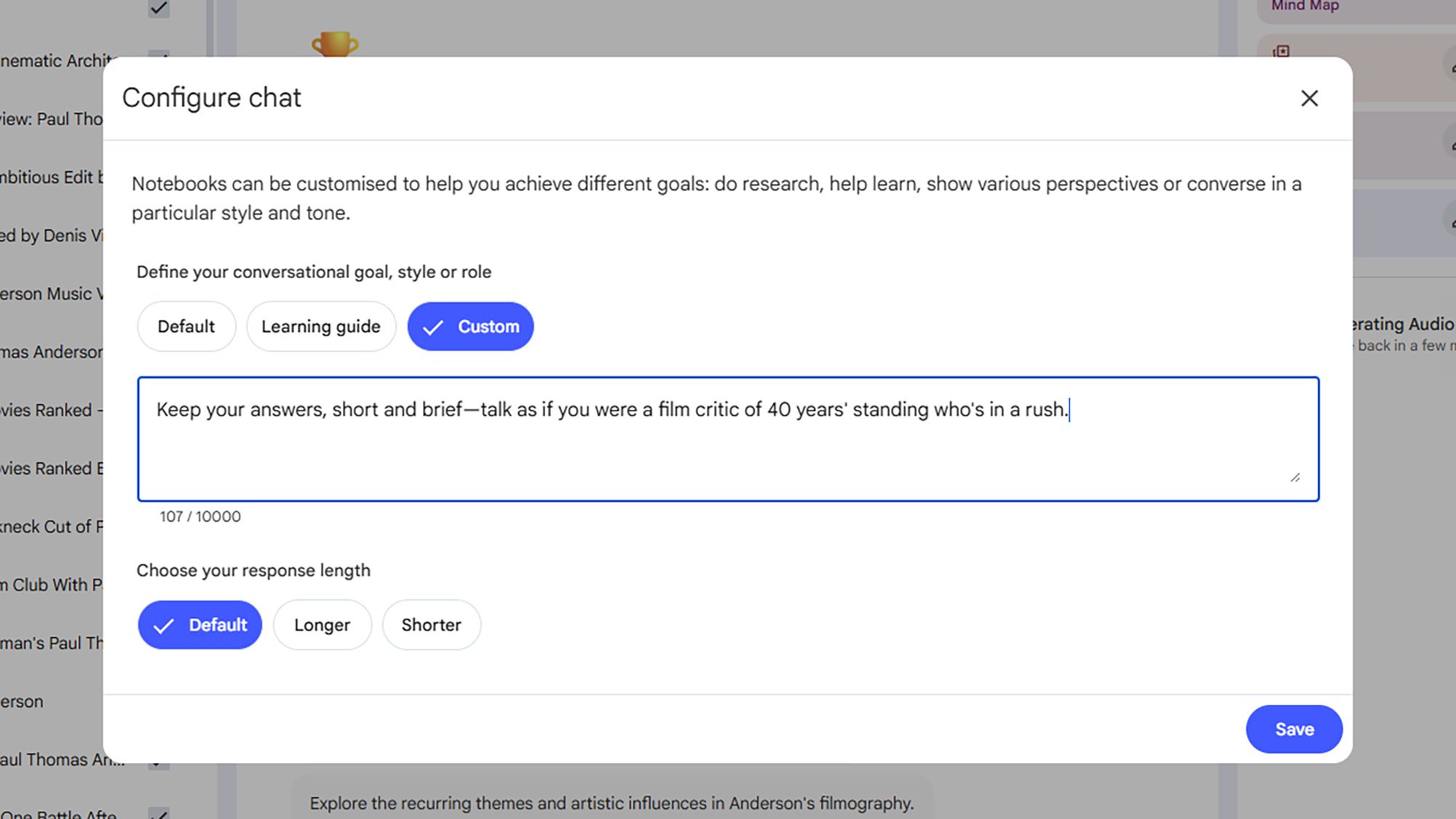
Up at the top of each Chat pane there’s a configuration button (it looks like three sliders). Click this, then select Custom to get specific about how you want NotebookLM to respond in this conversation: You can ask it to play a certain role, tailor its output to a particular audience, or work towards a set goal.

For example, you can ask for replies to be aimed at a high school level of understanding, indicate that you’re writing up a report for a board meeting, or get the AI to break down its responses into short, separated bullet points. The instructions you give it here get applied for the rest of the chat, until you change them again.

You can upload existing slideshows for NotebookLM to use as an example when making yours

NotebookLM is able to produce presentations based on your sources—either with a prompt or via the Slide deck option in the Studio panel—but it can sometimes be tricky to get these presentations looking exactly the way you want.

You can fix this by uploading an existing slideshow and using it as a reference point. Add it as a source, and then refer to the name of the file in your request for a new presentation: Just tell NotebookLM to use the existing slideshow as a style template, and it will.

NotebookLM’s sharing options can your notebooks with the world

NotebookLM public notebooks
NotebookLM notebooks can be made public.
Credit: Lifehacker

You don’t have to keep your notebooks to yourself: While clicking the Share button on a notebook page will allow you to collaborate with other people on projects (and you get controls over how much they can edit and view), you have more options than that. If you select Anyone with a link under Notebook access, then click Copy link, you’ll get a URL you can share with anyone, or post publicly on the web. (Here’s one on the Made by Google 2025 event.)

This link will lead anyone who finds it directly to your notebook. They will get their own private chat history, but they won’t be able to make any changes to sources or Studio materials.

You can use NotebookLM to sort your Google Drive

As you might expect, NotebookLM works well with other Google apps, and if you’re comfortable giving it access to your files then the AI tool can work really well as a way of searching through your Google Drive and pulling out information from it.

When you click Add sources, you then need to click the Web drop-down menu and pick Drive instead. Enter something you’re looking for, and you’ll get a list of matches from your Drive storage: You can then use the checkboxes to decide which files to import.

Whether you’re working on your next novel or trying to wrangle data from multiple spreadsheets for a business report, it makes it easy to mine the data inside whatever you’ve got stored in Google Drive.

You can tailor the sources for each prompt

NotebookLM sources
Select different sources for different prompts.
Credit: Lifehacker

You don’t have to use every source for every prompt: Use the checkboxes next to each entry in the Sources panel to tell NotebookLM where to pull its information from (the sources overview mentioned above can be helpful here). There might well be times when you want to analyze every source except one, or you just want to focus on one specific source—maybe you have a bunch of reports you’re analyzing and there’s one in particular you want to interrogate, for example.

Use Google Docs to deliver more complex prompts

If you’re working on really complex prompts—full of instructions, references, and multi-level queries—then these can work best as separate documents within your notebook. It means you’ve got more flexibility when composing and editing them, and once they have been made, you can refer to them again and again.

Make a new Google Docs document and then compose your prompt instructions as required—you can even split it up with headings and bullet points if needed. Then, add it as a source in NotebookLM.

For your next prompt, reference the name of the document and ask NotebookLM to use its contents as a framework for what it should do next. The AI will confirm that it’s read and understood the document, and then proceeds as instructed.

Pull information from all of your notebooks at once by uploading them to Gemini

NotebookLM Gemini integration
Your notebooks are available through Gemini too.
Credit: Lifehacker

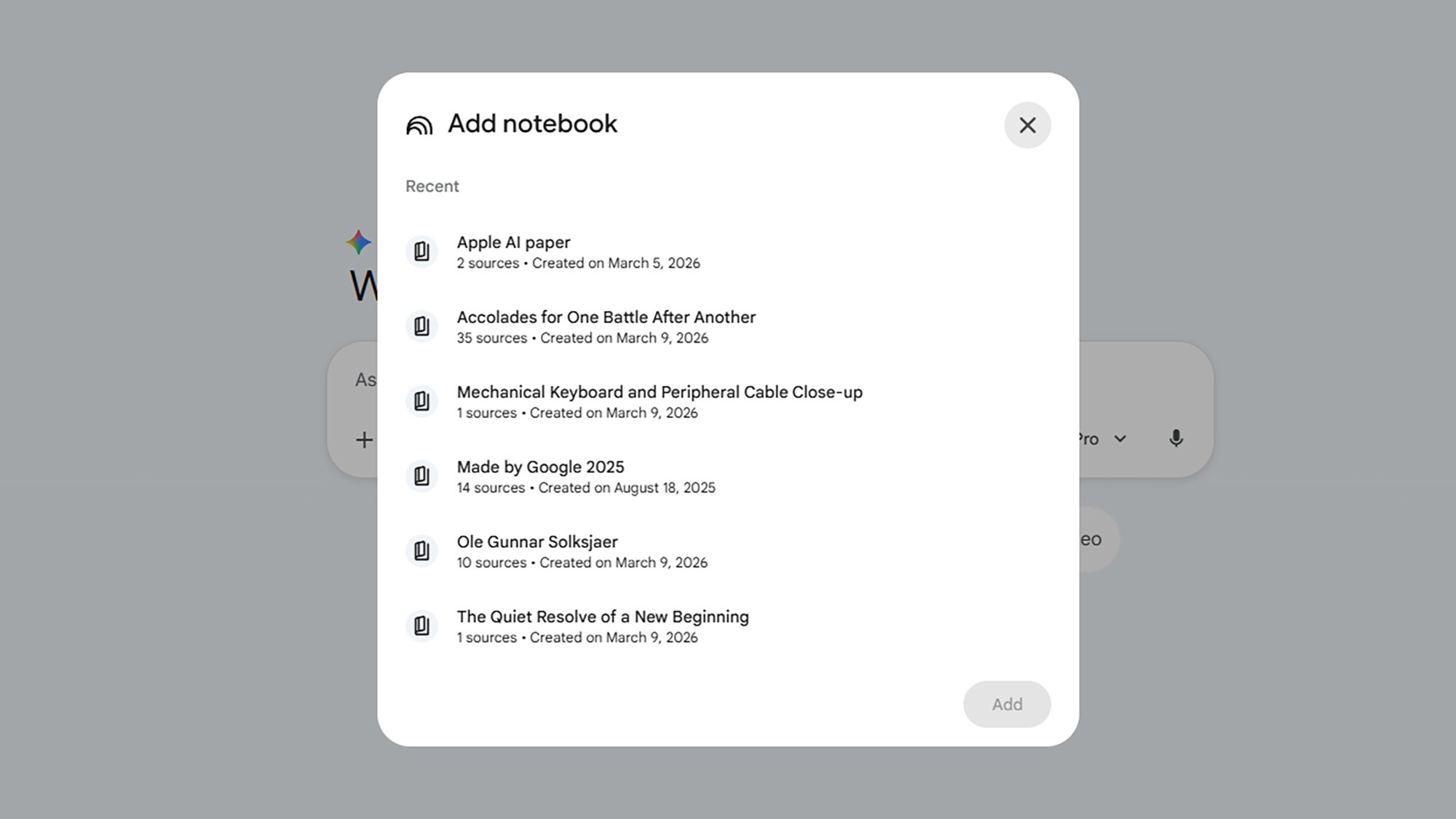
Your NotebookLM notebooks will also be available in the Google Gemini app. Select the + (plus) button next to the Gemini prompt box, and NotebookLM comes up as an option. You can then pick one or more notebooks to import. There are lots of ways that this can be useful, from using Gemini to create videos and images based on your collected material, to running prompts that analyze multiple notebooks at once (saving you having to switch between them in NotebookLM).

[$] Disabling Python’s lazy imports from the command line

The advent of lazy imports in the Python language is upon us, now that PEP 810 (“Explicit lazy
imports”) was accepted by the steering
council
and the feature will appear in the upcoming Python 3.15 release
in October. There are a number of good reasons,
performance foremost, for wanting to defer spending—perhaps wasting—the
time to do an import before a needed symbol is used. However, there are
also good reasons not to want that behavior, at least in some cases. The
tension between those two positions is what led to an earlier PEP rejection,
but it is also playing into a recent discussion of the API used to control
lazy imports.

FDA contradicts Trump admin, declines to approve generic drug for autism

In September, the Trump administration took what it called “bold actions” on autism that included touting the generic drug leucovorin as a promising treatment. In a news release, Marty Makary, commissioner of the Food and Drug Administration, claimed a “growing body of evidence suggests” the drug could be helpful. And at a White House press event, Makary suggested it might help “20, 40, 50 percent of kids with autism.”

“Hundreds of thousands of kids, in my opinion, will benefit,” he said at another point in the event.

The bold claims were apparently persuasive. A study published in The Lancet last week found that new outpatient prescriptions of leucovorin for children ages 5 to 17 shot up 71 percent in the three months after the Trump administration’s actions.

Read full article

Comments

10 Hacks Every Laptop Gamer Should Know

A good gaming laptop can be worth its (surprisingly heavy) weight in gold for gamers on the go. However, unlike traditional consoles or handhelds, it can take a lot of fiddling to get the best performance out of yours. If you haven’t dug into all the arcane settings and features of your gaming laptop, I’ve rounded up some of my favorite hacks and tips for boosting your performance.

Always use your included charger for the best performance

If you’re used to using a laptop mainly for work, you probably haven’t thought too much about the specifics of your power supply. For a gaming laptop, though, it can matter a lot. Running high-end, graphics-intensive games requires a lot of power, and most laptops will try to limit power consumption when they’re not connected to a power source.

While most gaming laptops can charge the battery from a generic USB-C charger, if yours comes with a proprietary charger, use that instead. These are usually designed to support the load needed to run your GPU at full strength. If you rely on a weak USB-C charger, it’s possible to continue to drain the battery even while it’s plugged in.

Use a clean and stable surface to maintain proper airflow

Gaming laptops get hot, hotter than your average laptop usually will, and that means ventilation matters a lot more. Most gaming laptops have plenty of fans and vents along the bottom and sides, and it’s important to keep these clear, especially while actively playing games. Be sure to blow out the dust every once in a while to keep the air flowing.

It’s also important to use your gaming laptop on a flat, hard surface. If you put your laptop on a pillow, bed, or blanket, the soft surface can block your vents, trapping heat and making your system run worse. A good lap desk or laptop stand can help prop up your device, with plenty of airflow underneath and around it to help keep it cool.

Use an SSD for everything you can

There’s a decent chance that your gaming laptop already has an SSD installed, or at least has the option to upgrade to one (more on that below). If it’s not already the default, though, you can get a substantial performance boost by installing your games on an SSD, if not the entire OS itself. SSDs offer much faster loading speeds than platter-style drives, meaning you spend less time stuck on loading screens in your games.

If you don’t have an SSD installed in your gaming laptop—or you just need extra space—you can use an external drive to install games. Just make sure that the external drive uses a fast connection like Thunderbolt 4 (or 5, on newer devices) so you don’t give yourself an unnecessary bottleneck. 

Limit your display’s refresh rate to boost battery life

Battery life comes at a premium on gaming laptops, so it’s important to make sure your power saver settings are optimized. You can use the built-in Windows settings to limit your screen’s refresh rate or turn off the screen sooner when you’re on battery power, as opposed to plugged into a charger.

Many companies like Razer, MSI, and Asus also have their own software that can be used to further customize power settings. These will vary by manufacturer, so poke around in the software that comes bundled with your gaming laptop to see what options are available to you. In most cases, you’ll have tools to balance performance against battery drain, so if you’d rather game for longer–albeit at lower performance–you should find some features to help you.

Lower your games’ frame rates for additional battery life

Part of what makes gaming laptops draw so much power is the intense graphical calculations that modern games require. However, that means you can also save power by fiddling with the graphics settings in your games, and turning off some of the more demanding features.

One of the biggest power drains is super high frame rates. For most single-player games, 60 frames per second is probably enough to get by, so if you’re running games at 120 fps or higher, try setting a limit when you’re on battery power. Ray-tracing features can also be a significant power suck, so unless you need really high-detail graphics, you can try disabling these. The options available will differ in specific games, so check the settings for each game to see what options are available to you.

Use a docking station for a full PC experience

A powerful gaming laptop can be a great alternative to a full-size desktop, but with a docking station, you can get the best of both worlds. A decent docking station allows you to plug in a gaming monitor, keyboard, and a proper mouse, all from a single cable running to your laptop.

Some of the higher end docking stations can also provide enough power to your gaming laptop to keep it charged, even while you’re playing. Once again, it’s a good idea to check the power demands of your laptop, and how much power your docking station can supply before setting this up, though. If all else fails, just plug in the proprietary charger that came with your laptop in addition to the cable running to your dock.

Delete bloatware and end background processes

Manufacturers like to bundle software you don’t particularly need with their devices. Most of the time, it doesn’t impact performance too much, but it can be worth spending a bit of time to either delete or disable all the junk that might be running in the background on your machine.

Much of the bloat that comes with Windows can be deleted with a simple command. If you’d rather be more precise, you can press Ctrl-Shift-Esc on Windows to pull up the Task Manager to see what processes are running. Here, you can also check out the Startup tab to see what apps are running when you start your machine. While it’s not a great idea to just start slashing anything you don’t recognize, this can be a good way to find apps that are hogging resources that you don’t actually need.

Upgrade your new laptop with hardware from your old machine

Most of the time, laptops aren’t too upgradeable, but some gaming laptops will have options to add extra RAM or even upgrade the internal storage options. Depending on your model, it’s worth checking to see if you can pick up some physical upgrades to your device.

Of course, at the time of writing, RAM prices are insanely overpriced, and SSDs aren’t doing too hot, either. You can save a bit of money by buying used components or even swapping out parts from older devices. If you recently upgraded from one laptop with removable RAM to another, make sure to swap your older parts into the new one. Even if you’re adding slower RAM to a faster machine, having a higher total amount of RAM can help your games run better.

Use “Game Mode” to block updates and alerts

Windows now comes with a dedicated Game Mode that gives priority to the game you’re playing. While this mode is active, Windows will block things like driver updates and restart notifications from interrupting you. 

To enable it, open the Start menu, head to Settings > Gaming > Game Mode, and toggle the setting to On. In most cases, this should offer a small improvement to your gaming experience, but it’s worth paying attention to any conflicts with the games you’re running. If turning this setting on causes your games to glitch out, come back here to turn it off.

Customize those RGB lights to be useful in-game

There’s a vanishingly small chance that your gaming laptop isn’t stuffed with more RGB lights than your average Christmas display. But you can make these a bit more useful than your typical Rainbow Road rave.

RGB controller software like Razer’s often has profiles that can change the color layout on your keyboard to help highlight important keys in specific games, or even react to in-game events. It’s a small change, and it probably won’t magically make you make a better gamer, but it’s a cool way to customize your device to make it your own.