
New Rapha Pro Team Powerweave Road and Gravel shoes made with input from 130-athlete programme

Rapha has released two new shoes, the Rapha Pro Team Powerweave Road and Gravel, which are said to benefit from its Wear Test programme.

The programme asks 130 amateur and professional athletes worldwide to give feedback on new products, from initial development to validation. 

Finn Abbot-White, Rapha’s Wear Test lead, says: “We handpick testers, people I would call experts and seasoned riders. People who are critical, but who want to help us push boundaries.” 

Three Rapha shoe prototypes.
Prototypes from the Rapha Wear Test programme. Rapha

The new Road and Gravel shoes feature Rapha’s woven Powerweave uppers, which debuted on the Pro Team shoes in 2020.  

The uppers have a new knitted sock collar, similar to what you find on some football boots. Rapha says this “ensures a stable, locked-in fit eliminating tongue movement and hotspots”. 

The new £350 shoes also share Boa Li2 dials for “comfort and total control” over fit adjustments. 

Rapha Pro Team Powerweave Road 
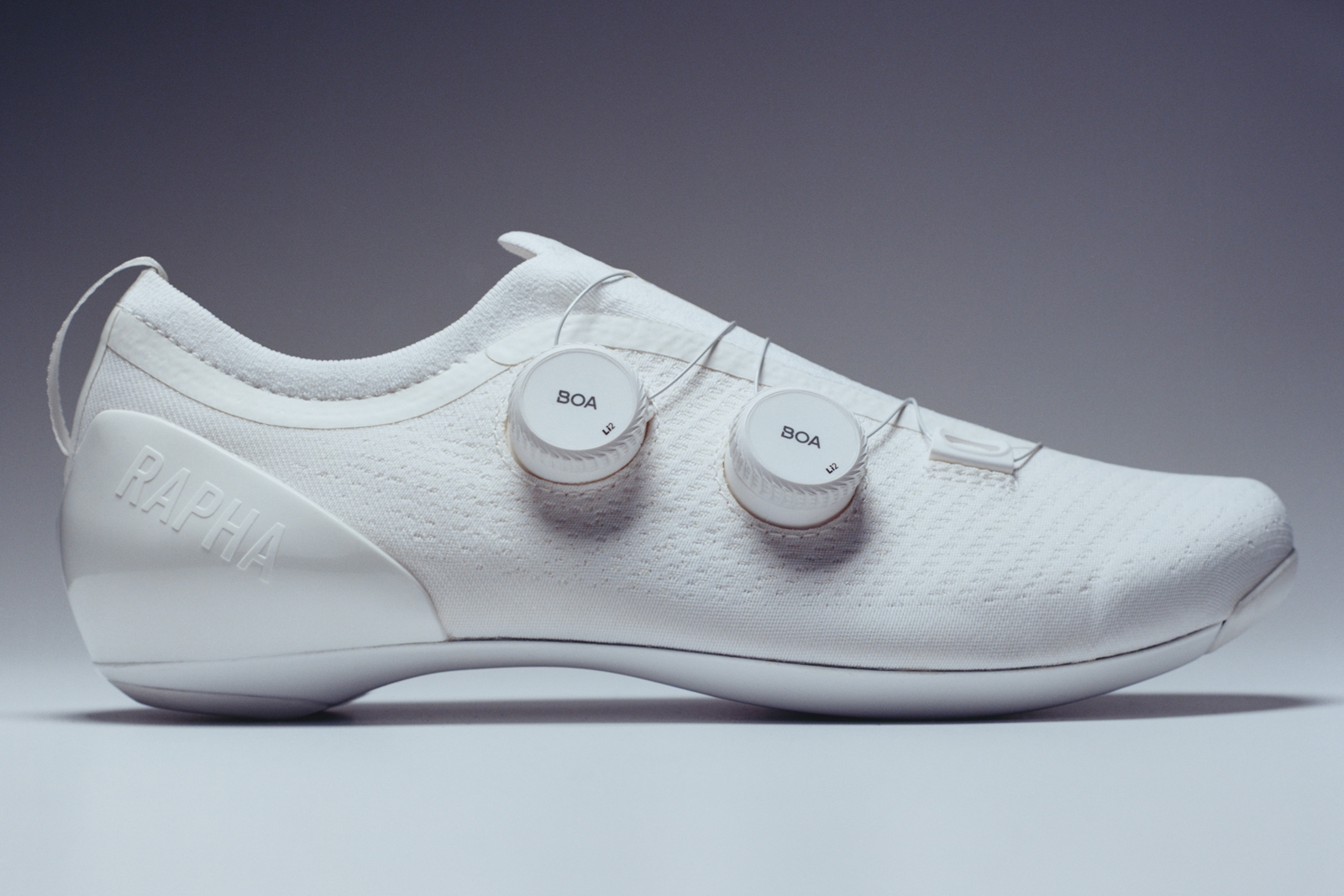
Rapha Pro Team Powerweave Road cycling shoe.
Rapha has used woven uppers on its shoes for five years. Rapha

The Pro Team Powerweave Road shoes target greater comfort and a “superior connection”.

Alongside the woven upper and Li2 dials, the road cycling shoes have a 100 per cent carbon sole for stiffness and power delivery. 

There is also a heel counter made from Pebax, a thermoplastic polymer with a low material density and an efficient energy return, according to its producer Arkema. 
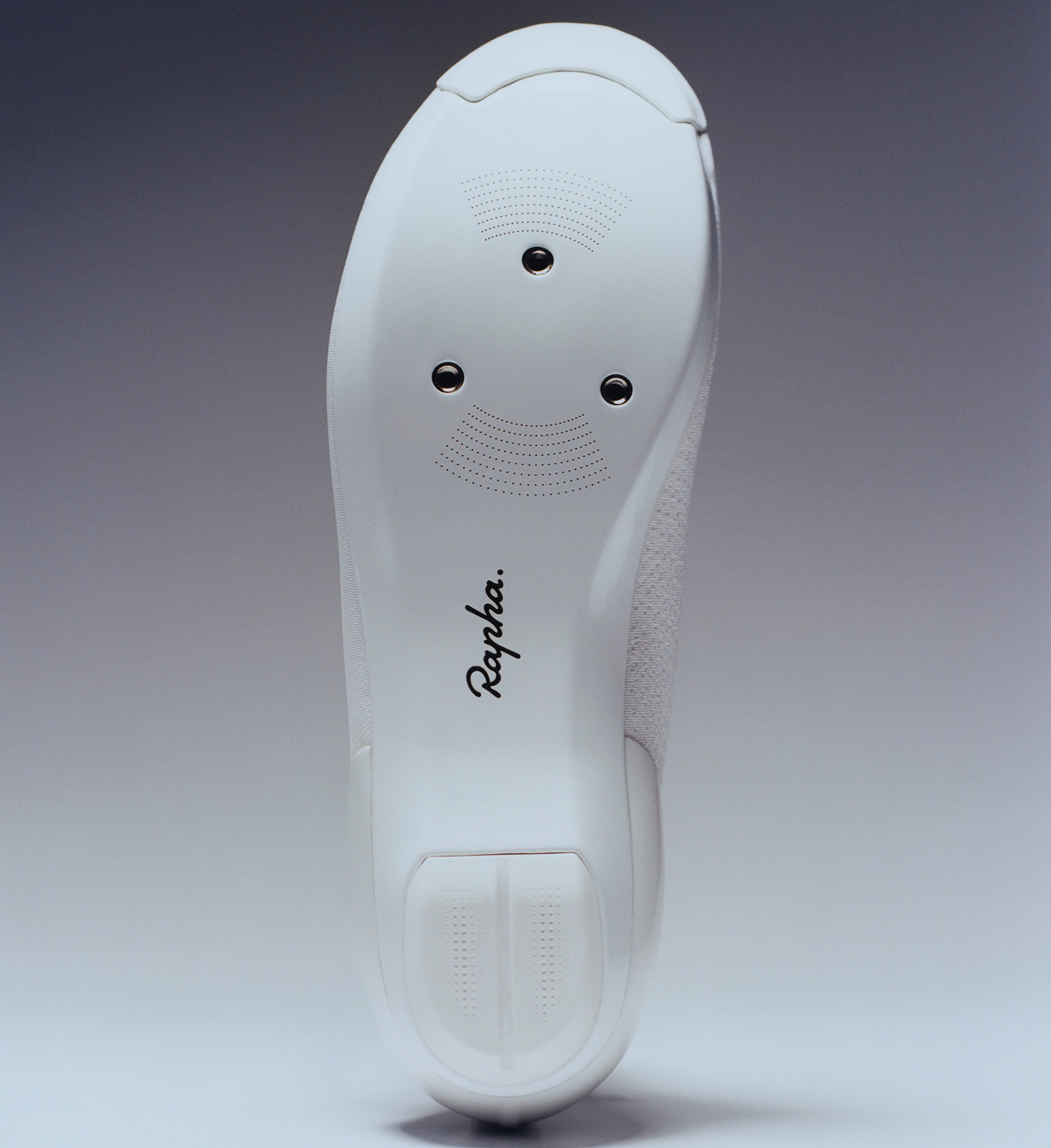
Rapha Pro Team Powerweave Road cycling shoe sole.
The shoe has a 100 per cent carbon sole, which fits three-bolt cleats. Rapha

You can adjust the fit of the new road shoes thanks to interchangeable insole arches. 

The shoes take inspiration from the Rapha Climber’s Shoes with reflective detailing. 

Rapha says they weigh 227g per shoe (size 42) and recommends you go up half a size. 

Rapha Pro Team Powerweave Gravel 

Rapha Pro Team Powerweave Gravel cycling shoe upper.
The Rapha Pro Team Powerweave Gravel upper combines recycled polyester with TPU to improve abrasion resistance. Rapha

Rapha’s new road shoe features a carbon sole, but the Pro Team Powerweave Gravel pairs an EVA midsole and Vibram Megagrip outsole. 

Rapha says this combination “enhances off-bike agility and grip”, while a carbon plate and reinforced toe aid power transfer, durability and support. 
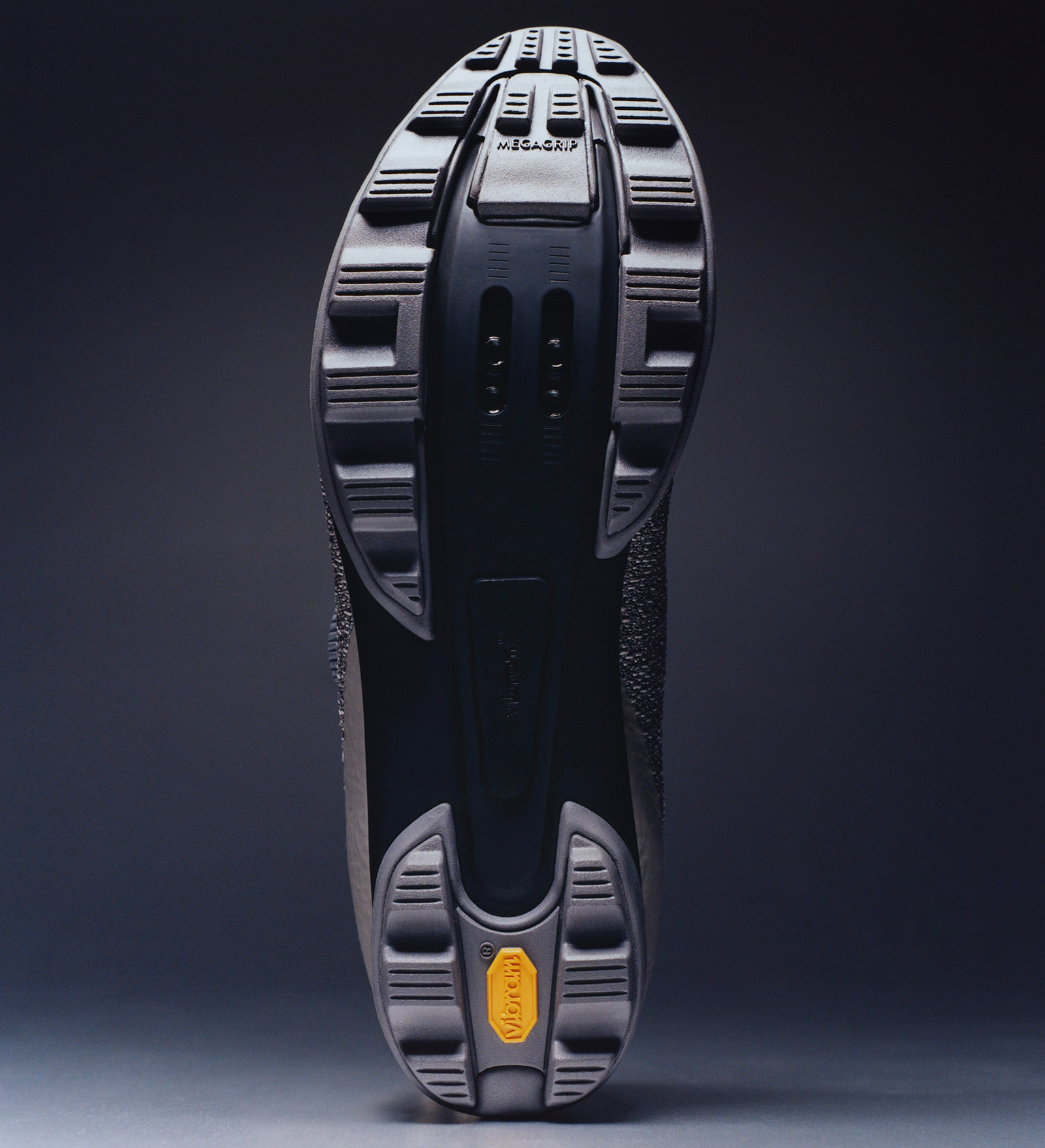
Rapha Pro Team Powerweave Gravel cycling shoe sole.
It has a Vibram outsole for grip. Rapha

“For the Gravel version we didn’t want a completely stripped back sole, we wanted to keep that off-bike comfort, and at different levels of contact, allowing your foot to adjust to different shapes in the terrain,” says Rapha’s senior footwear designer Tom Matic.  

Another difference between the shoes is the upper material. The road shoe uses a 100 per cent recycled polyester, but the gravel shoe combines this with a TPU yarn for better abrasion resistance. 

The Pro Team Powerweave Gravel shoes weigh a claimed 282g per shoe (size 42) and come with interchangeable insole arches. 

Final Fantasy IX Remake Teased As Classic Game Celebrates 25th Anniversary

Final Fantasy IX Remake Teased As Classic Game Celebrates 25th Anniversary
As the years have passed, video games are no longer become a mere novelty for the masses. With serious time behind them, they’re now becoming iconic in many respects, with some celebrating hefty anniversaries. Such is the case with Square Enix’s Final Fantasy IX, which is seeing its 25th anniversary coming up. 

Originally released on Sony’s

ASUS ROG Crosshair X870E Extreme Motherboard Pictured And It Looks Slick

ASUS ROG Crosshair X870E Extreme Motherboard Pictured And It Looks Slick
It looks as though ASUS is readying a new flagship socket AM5 (LGA 1718) motherboard for AMD’s Ryzen 9000 series processors based on Zen 5 (as well as previous gen Zen 4 chips based on the same socket). Either that or somebody meticulously crafted convincing-looking renders showcasing the front and pack, as well as the retail packaging.

Occam’s

Apple’s M4 MacBook Air is $50 off in the Amazon Spring Sale

We’ve reached the final day of Amazon’s Spring Sale, but there are still plenty of great deals to shop. That list includes a $50 price cut on our pick for best MacBook overall this year, Apple’s 2025 MacBook Air M4. The 13-inch, 16GB model is available for $949, down from $999. 

Apple only released the new MacBook Air M4 in mid-March. It scored a 92 in our review, thanks to features like its M4 chip. The 13-inch base model boasts a 10-core CPU, 8-core GPU and 16-core Neural Engine. It also has an excellent battery life, lasting more than 18 hours while playing HD video. 

The 2025 MacBook Air M4 is also well done from an exterior standpoint. It has a 13.6-inch liquid retina display and it’s very lightweight. The smaller model (it’s also available, and on sale, in a 15-inch option) is 0.44 inches thick and weighs 2.7 pounds. 

This article originally appeared on Engadget at https://www.engadget.com/deals/apples-m4-macbook-air-is-50-off-in-the-amazon-spring-sale-132413964.html?src=rss

Big brands are spending small sums on X to stay out of Musk’s crosshairs

Big brands are allocating small amounts of their advertising budget to Elon Musk’s X, seeking to avoid being seen as boycotting the social media platform and triggering a public fallout with its billionaire owner.

Multiple marketing executives told the Financial Times that companies have felt pressure to spend a nominal sum on X following Musk’s high-profile role in US President Donald Trump’s administration.

They said Musk’s pursuit of legal action against groups that have stopped advertising since his $44 billion acquisition in late 2022 had also sparked alarm. X last month added about half a dozen more companies to its case including Shell, Nestlé, Pinterest, and Lego.

Read full article

Comments

Trump on car tariffs: “I couldn’t care less if they raise prices”

Late last week, President Donald Trump decided to upend the automotive industry by levying a new 25 percent import tariff on all imported cars, which goes into effect on April 2. An additional 25 percent tariff on car parts is set to go into effect within the next month, which promises to make US-made cars more expensive as well, as many parts and subassemblies used in domestic manufacturing come from suppliers in Canada or Mexico.

During the election campaign (and in the years preceding it), Trump repeatedly claimed that the cost of tariffs would be borne by the exporters. But tariffs don’t work that way—they’re paid by the importer, at the time of import.

The White House does not appear to have any concerns about this, despite a report in The Wall Street Journal last week claiming that Trump had warned automakers not to pass the costs on to their customers.

Read full article

Comments

You Can Now Make WhatsApp the Default Calling and Messaging App on Your iPhone

In the iOS 18.2 update, Apple gave users a dedicated Default Apps tab, finally letting us pick our own default apps for messages and calls. Unfortunately, not many apps have been updated to take advantage of this yet. I previously talked about DefaultSMS, which takes over the default messaging app and redirects it to WhatsApp, Signal, or Telegram, but at least one of those now has an official option that you can use instead.

Yes, WhatsApp has finally been updated the to support the Default Apps feature. This means you can now make WhatsApp the default Calling and Messaging app on iPhone. But does this mean you can stop using the Phone app and Messaging app altogether? Not exactly.

Think of it more like a shortcut. When applicable, you can use this feature to quickly call someone using WhatsApp Audio, or open up a text conversation in WhatsApp, directly from the Phone app or anywhere you see a phone number.

How to make WhatsApp the default app for calls and messages

First, let’s talk about how to make this happen. On your iPhone running the latest iOS 18 build, go to Settings > Apps > Default Apps.

Default Apps hub in Settings for iPhone.

Credit: Khamosh Pathak

Scroll to the Messaging and Calling sections. Here, choose WhatsApp as the default.

How the iPhone’s default calling and messaging app features work

The default feature doesn’t mean that you can simply replace the Phone app and Messages app. When you get an incoming SMS or Apple iMessage, it will still show up in the Messages app. And when you get a phone call, you’ll still see it in the Phone app.

WhatsApp as default phone app.

Credit: Khamosh Pathak

In this context, “default app” means that when you tap the Message button or the Call button for a contact in your Phone app or Contacts app, it will now open a call or message with them via WhatsApp app directly. This essentially serves as a shortcut, rather than a full replacement for the apps that come with your phone.

After you change your default calling or messaging app, when you open a contact card and tap the Call button or Message button for the first time, you’ll get an overflow menu where WhatsApp will be the first and default option. You can pick another option to change your default if you like. From then on, tapping the Call button will directly call the contact using WhatsApp Audio (or whatever you changed your default to), unless you change your default again in your iPhone settings.

From there, you’re all set… mostly. If your contact doesn’t have WhatsApp, WhatsApp will simply tell that they’re not on WhatsApp, at which point you’ll have to manually open the Phone or Messages app to reach out instead.

California Has 48% More EV Chargers Than Gas Nozzles

California has 11.3% of America’s population — but bought 30% of America’s new zero-emission vehicles. That’s according to figures from the California Air Resources Board, which also reports 1 in 4 Californians have chosen a zero-emission car over a gas-powered one… for the last two years in a row.

But what about chargers? It turns out that California now has 48% more public and “shared” private EV chargers than the number of gasoline nozzles. (California has 178,000 public and “shared” private EV chargers, versus about 120,000 gas nozzles.) And beyond that public network, there’s more than 700,000 Level 2 chargers installed in single-family California homes, according to the California Energy Commission.

Of the 178,000 public/”shared” private chargers, “Over 162,000 are Level 2 chargers,” according to an announcement from the governor’s office, while nearly 17,000 are fast chargers. (A chart shows a 41% jump in 2024 — though the EV news site Electrek notes that of the 73,537 chargers added in 2024, nearly 38,000 are newly installed, while the other 35,554 were already plugged in before 2024 but just recently identified.)

California approved a $1.4 billion investment plan in December to expand zero-emission transportation infrastructure. The plan funds projects like the Fast Charge California Project, which has earmarked $55 million of funding to install DC fast chargers at businesses and publicly accessible locations.


Read more of this story at Slashdot.

Overblown quantum dot conspiracy theories make important points about QLED TVs

QLED TV manufacturers have dug themselves into a hole.

After years of companies promising that their quantum dot light-emitting diode TVs use quantum dots (QDs) to boost color, some industry watchers and consumers have recently started questioning whether QLED TVs use QDs at all. Lawsuits have been filed, accusing companies like TCL of using misleading language about whether their QLED TVs actually use QDs.

In this article, we’ll break down why new conspiracy theories about QLED TVs are probably overblown. We’ll also explore why misleading marketing from TV brands is responsible for customer doubt and how it all sets a bad precedent for the future of high-end displays, including OLED TVs and monitors.

Read full article

Comments

Intel-Started Cloud Hypervisor Project Adds Experimental RISC-V Support

Cloud Hypervisor began as an open-source Intel software project more than a half-decade ago with an emphasis on security and cloud deployments while leveraging the Rust programming language. With time its scope has broadened a lot as has its industry adoption. With time it added ARM64 support and recruited AMD, Ampere Computing, Microsoft, and others as its supporters while being folded into the Linux Foundation. The latest expansion for the project is introducing experimental RISC-V 64-bit support…

HTTPS Certificate Industry Adopts New Security Requirements

The Certification Authority/Browser Forum “is a cross-industry group that works together to develop minimum requirements for TLS certificates,” writes Google’s Security blog. And earlier this month two proposals from Google’s forward-looking roadmap “became required practices in the CA/Browser Forum Baseline Requirements,” improving the security and agility of TLS connections…

Multi-Perspective Issuance Corroboration
Before issuing a certificate to a website, a Certification Authority (CA) must verify the requestor legitimately controls the domain whose name will be represented in the certificate. This process is referred to as “domain control validation” and there are several well-defined methods that can be used. For example, a CA can specify a random value to be placed on a website, and then perform a check to verify the value’s presence has been published by the certificate requestor.

Despite the existing domain control validation requirements defined by the CA/Browser Forum, peer-reviewed research authored by the Center for Information Technology Policy of Princeton University and others highlighted the risk of Border Gateway Protocol (BGP) attacks and prefix-hijacking resulting in fraudulently issued certificates. This risk was not merely theoretical, as it was demonstrated that attackers successfully exploited this vulnerability on numerous occasions, with just one of these attacks resulting in approximately $2 million dollars of direct losses.

The Chrome Root Program led a work team of ecosystem participants, which culminated in a CA/Browser Forum Ballot to require adoption of MPIC via Ballot SC-067. The ballot received unanimous support from organizations who participated in voting. Beginning March 15, 2025, CAs issuing publicly-trusted certificates must now rely on MPIC as part of their certificate issuance process. Some of these CAs are relying on the Open MPIC Project to ensure their implementations are robust and consistent with ecosystem expectations…

Linting

Linting refers to the automated process of analyzing X.509 certificates to detect and prevent errors, inconsistencies, and non-compliance with requirements and industry standards. Linting ensures certificates are well-formatted and include the necessary data for their intended use, such as website authentication. Linting can expose the use of weak or obsolete cryptographic algorithms and other known insecure practices, improving overall security… The ballot received unanimous support from organizations who participated in voting. Beginning March 15, 2025, CAs issuing publicly-trusted certificates must now rely on linting as part of their certificate issuance process.

Linting also improves interoperability, according to the blog post, and helps reduce the risk of non-compliance with standards that can result in certificates being “mis-issued”.

And coming up, weak domain control validation methods (currently permitted by the CA/Browser Forum TLS Baseline Requirements) will be prohibited beginning July 15, 2025.

“Looking forward, we’re excited to explore a reimagined Web PKI and Chrome Root Program with even stronger security assurances for the web as we navigate the transition to post-quantum cryptography.”


Read more of this story at Slashdot.

Linus Torvalds Gently Criticizes Build-Slowing Testing Code Left in Linux 6.15-rc1

“The big set of open-source graphics driver updates for Linux 6.15 have been merged,” writes Phoronix, “but Linux creator Linus Torvalds isn’t particularly happy with the pull request.”

The new “hdrtest” code is for the Intel Xe kernel driver and is around trying to help ensure the Direct Rendering Manager header files are self-contained and pass kernel-doc tests — basic maintenance checks on the included DRM header files to ensure they are all in good shape.

But Torvalds accused the code of not only slowing down the full-kernel builds, but also leaving behind “random” files for dependencies “that then make the source tree nasty,” reports Tom’s Hardware:

While Torvalds was disturbed by the code that was impacting the latest Linux kernel, beginning his post with a “Grr,” he remained precise in his objections to it. “I did the pull, resolved the (trivial) conflicts, but I notice that this ended up containing the disgusting ‘hdrtest’ crap that (a) slows down the build because it’s done for a regular allmodconfig build rather than be some simple thing that you guys can run as needed (b) also leaves random ‘hdrtest’ turds around in the include directories,” he wrote.

Torvalds went on to state that he had previously complained about this issue, and inquired why the hdr testing is being done as a regular part of the build. Moreover, he highlighted that the resulting ‘turds’ were breaking filename completion. Torvalds underlined this point — and his disgust — by stating, “this thing needs to *die*.” In a shot of advice to fellow Linux developers, Torvalds said, “If you want to do that hdrtest thing, do it as part of your *own* checks. Don’t make everybody else see that disgusting thing….”
He then noted that he had decided to mark hdrtest as broken for now, to prevent its inclusion in regular builds.

As of Saturday, all of the DRM-Next code had made it into Linux 6.15 Git, notes Phoronix. “But Linus Torvalds is expecting all this ‘hdrtest’ mess to be cleaned up.”


Read more of this story at Slashdot.