
Saying that calibre is
ebook-management software undersells the application by a fair
margin. Calibre is an open-source Swiss Army knife for ebooks that can
be used for everything from creating ebooks, converting ebooks from
obscure formats to modern formats like EPUB, to serving up an ebook
library over the web. The most recent major release, calibre 8.0,
brings a better text-to-speech engine, a tool for creating audio
overlays when authoring ebooks, support for profiles in the ebook
viewer, and more.
Category Archives: Unfiltered RSS
Amazon Said To Make a Bid To Buy TikTok in the US
An anonymous reader shares a report: Amazon has put in a last-minute bid to acquire all of TikTok, the popular video app, as it approaches an April deadline to be separated from its Chinese owner or face a ban in the United States, according to three people familiar with the bid.
Various parties who have been involved in the talks do not appear to be taking Amazon’s bid seriously, the people said. The bid came via an offer letter addressed to Vice President JD Vance and Howard Lutnick, the commerce secretary, according to a person briefed on the matter. Amazon’s bid highlights the 11th-hour maneuvering in Washington over TikTok’s ownership. Policymakers in both parties have expressed deep national security concerns over the app’s Chinese ownership, and passed a law last year to force a sale of TikTok that was set to take effect in January.


Read more of this story at Slashdot.
The Star Trek: Strange New Worlds season 3 trailer has some serious retro vibes
There’s a trailer for the upcoming third season of Star Trek: Strange New Worlds and it’s absolutely filled with goodies. It looks like there will be an episode soaked in the 1960s retro vibes of the original show, complete with period-accurate costumes and sets.
This is an episodic show, meaning that each episode is (more or less) standalone. The trailer shows off a few of the sci-fi concepts that will populate this third season. There’s a clip of the crew trying to connect dial-up phones to the ship (?!) and one that involves a murder mystery.
There are also two puzzling TNG-era additions. The famous Holodeck will be incorporated this season, or something that looks a whole lot like it. For the uninitiated, this is like VR but way, way better. Also, the trailer strongly indicates that Rhys Darby (Our Flag Means Death) will be playing a version of the prankster alien Q. It’s the finger snap that gives it away. We knew he was going to be in the show, but didn’t know who he’d be playing.
Now for some bad news. There’s no release date, other than summer. That could mean June. It could mean August. We’ll keep you updated when Paramount+ drops some new info.
Star Trek: Strange New Worlds is a prequel series that follows Christopher Pike, the captain of the Enterprise prior to Kirk. However, the show has begun working in elements of the original iteration. Spock and Uhura have always been in it, but now Kirk, Bones and Scotty are starting to show up.
This article originally appeared on Engadget at https://www.engadget.com/entertainment/tv-movies/the-star-trek-strange-new-worlds-season-3-trailer-has-some-serious-retro-vibes-164425733.html?src=rss
The Premier League will speed up offside calls with optical tracking tech starting next week
England’s top-tier soccer league will soon use optical tracking to automate portions of offside calls. The Premier League said on Tuesday it will adopt semi-automated offside technology (SAOT) in live matches beginning on April 12. The league said the new tech won’t change the accuracy of offside calls, but it will make them 30 seconds faster on average.
SAOT uses sensors from up to 30 cameras mounted high above the field in each Premier League stadium. They track the ball’s precise location and up to 10,000 surface data points for each player. The sports tech company Genius Sports explains that the tech “provides more efficient placement of the virtual offside line, using optical player tracking, and generates virtual graphics to ensure an enhanced in-stadium and broadcast experience for fans.”
Premier League
For the uninitiated, offsides is called in soccer when the attacking team’s lead player is closer to the opponent’s goal line than both the ball and the second-last defender. (The last defender is usually the goalie.) In recent years, the Premier League defaulted to the offsite Video Assistant Referee (VAR) team, which would determine the kick-point (the moment the lead attacker’s teammate passes it) and add calibrated lines with a crosshair for the attacker and defender’s locations at that time.
SAOT cuts a big chunk out of this (often lengthy) process by suggesting the kick-point and automatically creating offside lines based on the relevant defender and attacker’s positions. The VAR team still has a chance to review the algorithm’s suggestion before approving it.
At that point, a “decision visual” like the one below will roll for the fans in the stadium and those watching the broadcast at home to help clarify the call. The animation shows a white vertical wall representing the offside line, with a red (offside) or green (onside) line indicating whether the player crossed it.
Premier League
VAR will still be available as a backup for offside calls. “Most offside decisions will be quicker, but VAR will still have the option to draw crosshairs as a backup to the SAOT system if required,” the Premier League explained. “This process may be necessary in ‘edge cases’ where several players block the view of the ball or other players for the system’s cameras.”
This isn’t the first use of the tech. The Premier League has tested it in non-live matches and in live FA Cup games. The BBC notes that SAOT was also used in the 2022 World Cup, Serie A, La Liga and the Champions League. The Premier League’s version is a custom offshoot that Genius Sports developed with PGMOL (the referees’ organization) and the league itself. Unlike previous adaptations, the Premier League’s version doesn’t put a chip inside the ball.
This article originally appeared on Engadget at https://www.engadget.com/entertainment/the-premier-league-will-speed-up-offside-calls-with-optical-tracking-tech-starting-next-week-163327195.html?src=rss
Some original Switch games will run better on Switch 2; some won’t run at all
We’ve known for a few months now that the Nintendo Switch 2 will support backward compatibility for older Nintendo Switch games, and as of today’s presentation, we also know that some Switch games will get special Switch 2 Editions that add new features and support higher resolutions and other features.
Nintendo’s product pages for the Switch add more details, including the status of backward-compatibility testing for original Switch games and a small handful of first-party Switch games that will get “free updates” to enhance them for Switch 2.
First, some good news. There will be a second tier of updates for original Switch games that Nintendo says “may improve performance or add support for features such as GameShare in select games.” These won’t include the extra features or higher resolutions of Switch 2 Edition games, but they’ll be available for free, and they ought to improve playability. Nintendo lists a dozen first-party Switch games that will benefit from free Switch 2 updates:
‘Text Lens’ Can Copy Any Text From Your Mac’s Screen
There are many ways to copy text that can’t be easily selected, but few that are as simple and fast as Text Lens ($6)—a new Mac app by prolific developer Sindre Sorhus. Text Lens lets you select any part of your Mac’s screen and automatically copy all of the text from that part. This makes it easy to copy text from images, videos, scanned pages, settings menus, and other types of text that are otherwise impossible to grab.
Text Lens vs. Apple’s Live Text
Live Text, which is built into macOS, allows you to capture text from screenshots. While it’s good enough to get you started, it works only with Safari, Preview, and the built-in screenshot tool. You can’t select text from other apps without taking a screenshot first, which adds an extra step to the process. With tools such as Text Lens, you can instantly go into selection mode to capture and copy text. There’s no need to take a screenshot and then extract text.
Using Text Lens on your Mac
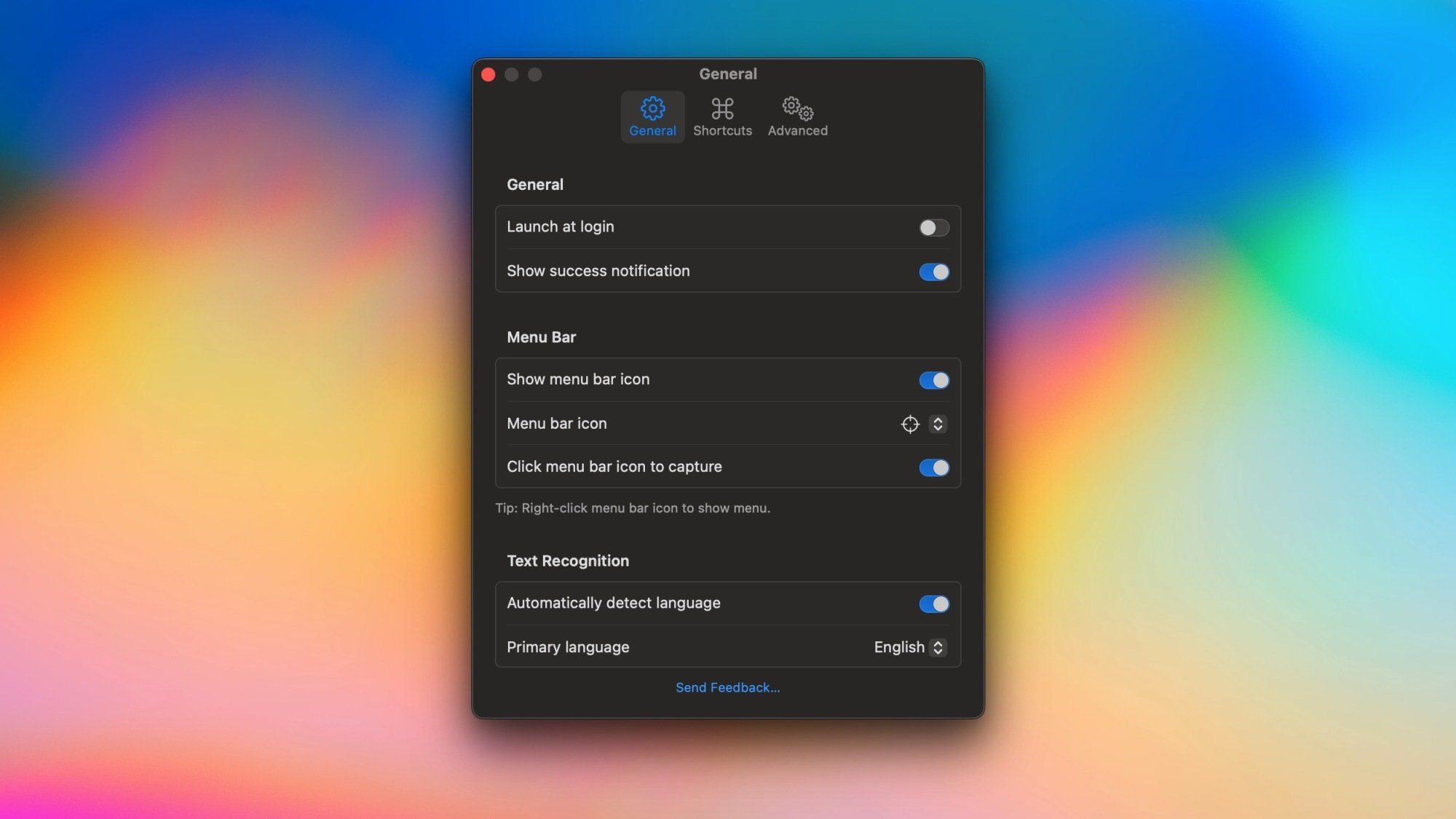
Credit: Pranay Parab
Text Lens is simple and fast, but you should take a moment to configure it to make the most of the app. Once you’ve installed the app, click its menu bar icon and go to Settings. In the General tab, enable the following options:
-
Launch at login
-
Click menu bar icon to capture [you can right-click it to open the menu]
Next, go to the Shortcuts tab and record keyboard shortcuts for this app. You can even use Raycast’s Hyper Key to quickly create unique shortcuts. Once this is done, you’re ready to use the app. Try either its keyboard shortcut or click the menu bar icon to fire up the selector. Click and drag to cover the area you want to copy text from, and release the mouse when you’re done.
Text Lens will show a popover to confirm if the text has been copied to your clipboard. (In case it fails to copy, the same popover will tell you that no text was detected.) Once it’s successful, you can now paste the text in any app and carry on with your day. This app supports 18 languages including English, French, and Spanish.
Text Lens will also allow you to copy text from saved files on your Mac: You can import images, PDFs, or other files, and Text Lens will copy everything on the page. The app can also copy text from images in your clipboard.
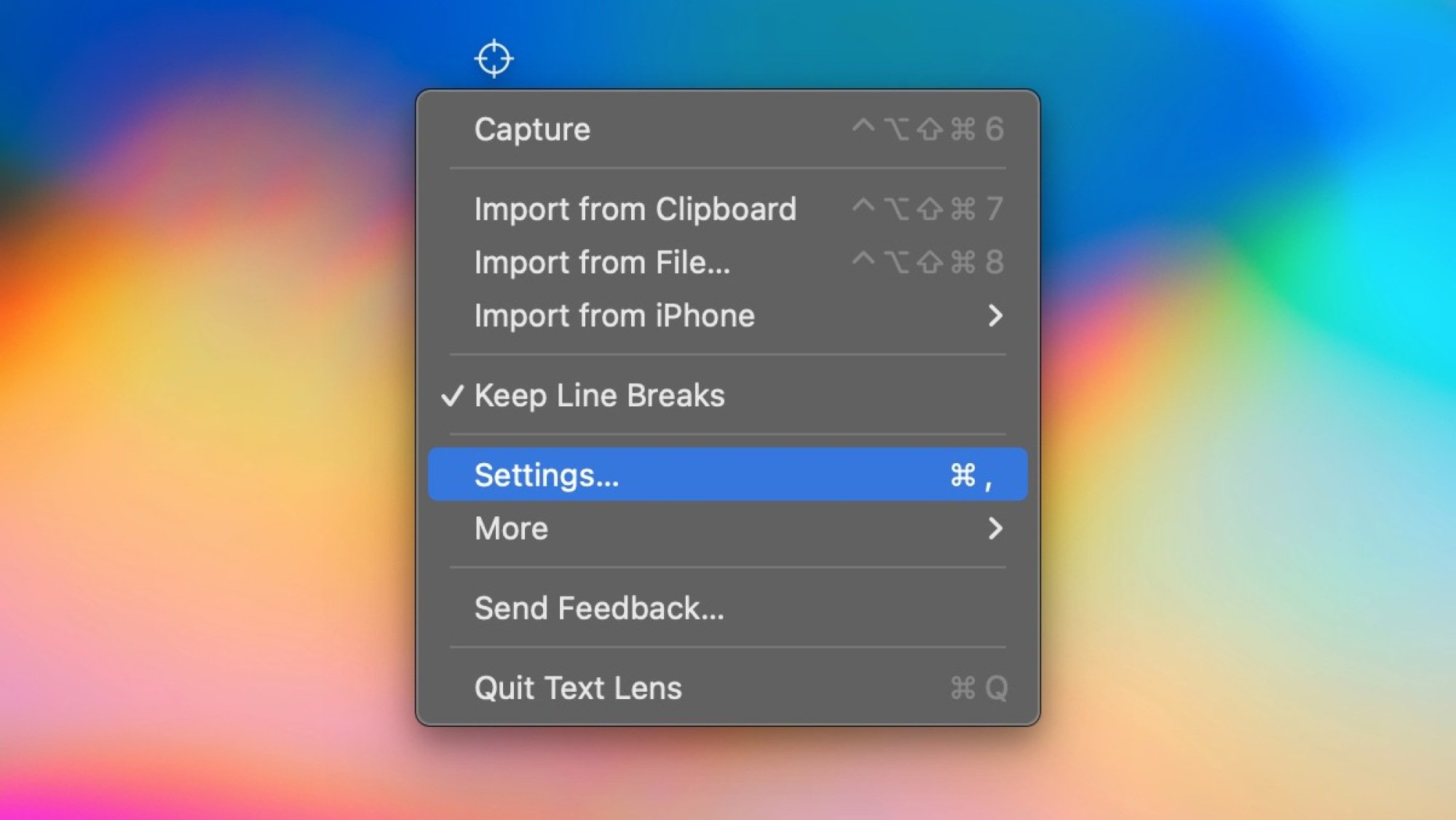
Credit: Pranay Parab
While I was quite impressed with Text Lens’ accuracy with smaller bits of text, I imported a few larger batches of text to see how it works. For this, I compared it with the results from TextSniper ($11.99 for unlimited license) and Cleanshot X($29), two other Mac apps that let you copy text from images. I used one of my invoices to see how all three apps handle formatting challenges, and at the end of the quick test, TextSniper did the best job with the file.
Text Lens and Cleanshot X were able to capture text from the invoice fairly well, but they both included a few typos and messed up the formatting. Both these apps listed all the items and dates first, and lumped together the prices at the end. Meanwhile, TextSniper listed each item, its date, and the price together. It also had the fewest typos.
Still, for basic text copying, Text Lens does a fairly good job and is priced quite well. I hope that it gets better at copying large amounts of text in the future, but for copying a few lines here and there, it will do what you need it to do without much of a fuss.
RIP Val Kilmer: Celebrating cult classic Real Genius is now a moral imperative
Actor Val Kilmer—star of Top Gun, The Doors, and Batman Forever, among other roles—has died at the age of 65 of pneumonia, Deadline Hollywood reports.
Kilmer was diagnosed with throat cancer in 2015 and while chemotherapy and two tracheotomies helped him defeat it, the procedures destroyed his voice. He spoke in a rasp or used an electric voice box for the remainder of his life and largely left acting. (He made a brief cameo in 2022’s Top Gun: Maverick, for which his voice was digitally altered.) The 2021 documentary Val, narrated by his son Jack Kilmer, followed his life and health struggles.
Kilmer had a reputation for being eccentric and difficult to work with, but he also had his champions, and his talent was undeniable. “While working with Val on Heat, I always marveled at the range, the brilliant variability within the powerful current of Val’s possessing and expressing character,” Michael Mann, who directed the actor in 1995’s Heat, told Deadline. “After so many years of Val battling disease and maintaining his spirit, this is tremendously sad news.”
All the Games Coming to the Nintendo Switch 2
The Nintendo Switch 2 is quite a bit different than the OG Switch: The Joy-Cons are beefier and connect via magnets; when docked, the console supports 4K 60fps output; and you can finally charge the console when playing in tabletop mode. But at the end of the day, what matters most about a new console like the Switch 2 is the games: If there’s nothing new to play, what’s the point?
Of course, Nintendo shared a number of Switch 2 exclusives during its big Direct on Wednesday. This isn’t a repeat of the Nintendo 3DS launch: There are games to play if you buy a Switch 2 on day one. But there are also a number of interesting titles coming soon and later this year. (There’s even a new From Soft title coming in 2026!)
Games launching the same day as Nintendo Switch 2
Whoa.
Credit: Nintendo of America/YouTube
Credit: Nintendo of America/YouTube
Nintendo Switch 2 launches on June 5. While many of the games announced today do not launch alongside the console, there are also many that do—including Mario Kart World.
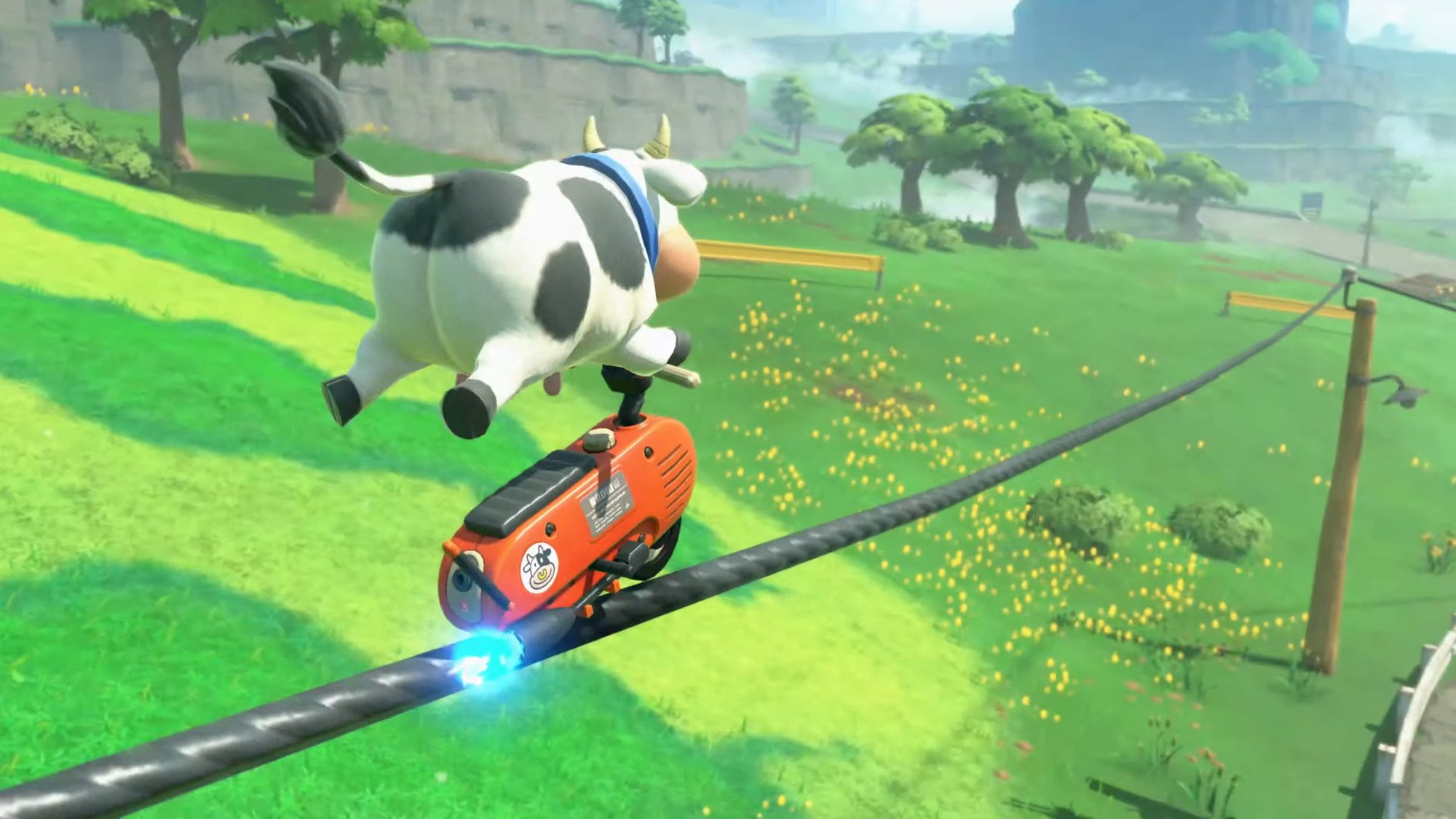
True to its name, this game offers an open-world Mario Kart experience. You can drive around the world, with friends, as you travel to different races. Not that every game needs to be open-world, but this one’s kind of a no brainer. It just seems like fun to drive around a giant Mario Kart map. You don’t even need to drive anywhere in particular: Nintendo encourages you to drive around leisurely, taking selfies as you do.
Of course, the core gameplay is still the same: Race other drivers around a track. But now, you can compete in races with up to 24 people at a time, and part of the competition is driving to the next race. There’s even a new “Knockout Tour,” where you race non-stop from one side of the map to the other. If you pass through a checkpoint in too low a position, you’re eliminated. Plus, you can bounce off walls like Mario in a platformer, grind on rails, and play as a cow, for some reason.
Here are the rest of the games that you can play on launch day:
-
Nintendo Switch 2 Welcome Tour
-
Street Fighter 6
-
Split Fiction
-
Hogwarts Legacy
-
Hitman World of Assassination
-
Brave & Default Flying Fair (HD Remaster)
-
Yakuza 0 Director’s Cut
-
The Legend of Zelda: The Wind Waker (Nintendo Switch Online)
-
Soulcalibur II (Nintendo Switch Online)
-
F-Zero GX (Nintendo Switch Online)
-
Deltarune 1 + 2 + 3 + 4
-
Civilizations VII
-
Survival Kids
-
Cyberpunk 2077 Ultimate Edition
-
Fortnite
-
Arcade Archives 2 RIDGE RACER
-
Rune Factory: Guardians of Azuma
-
Puyo Puyo Tetris 2S
-
Nobunaga’s Ambition: Awakening Complete Edition
-
Fast Fusion
Upcoming Nintendo titles
There are a number of first-party games and upgrades Nintendo announced during its presentation that won’t be ready for launch on June 5.
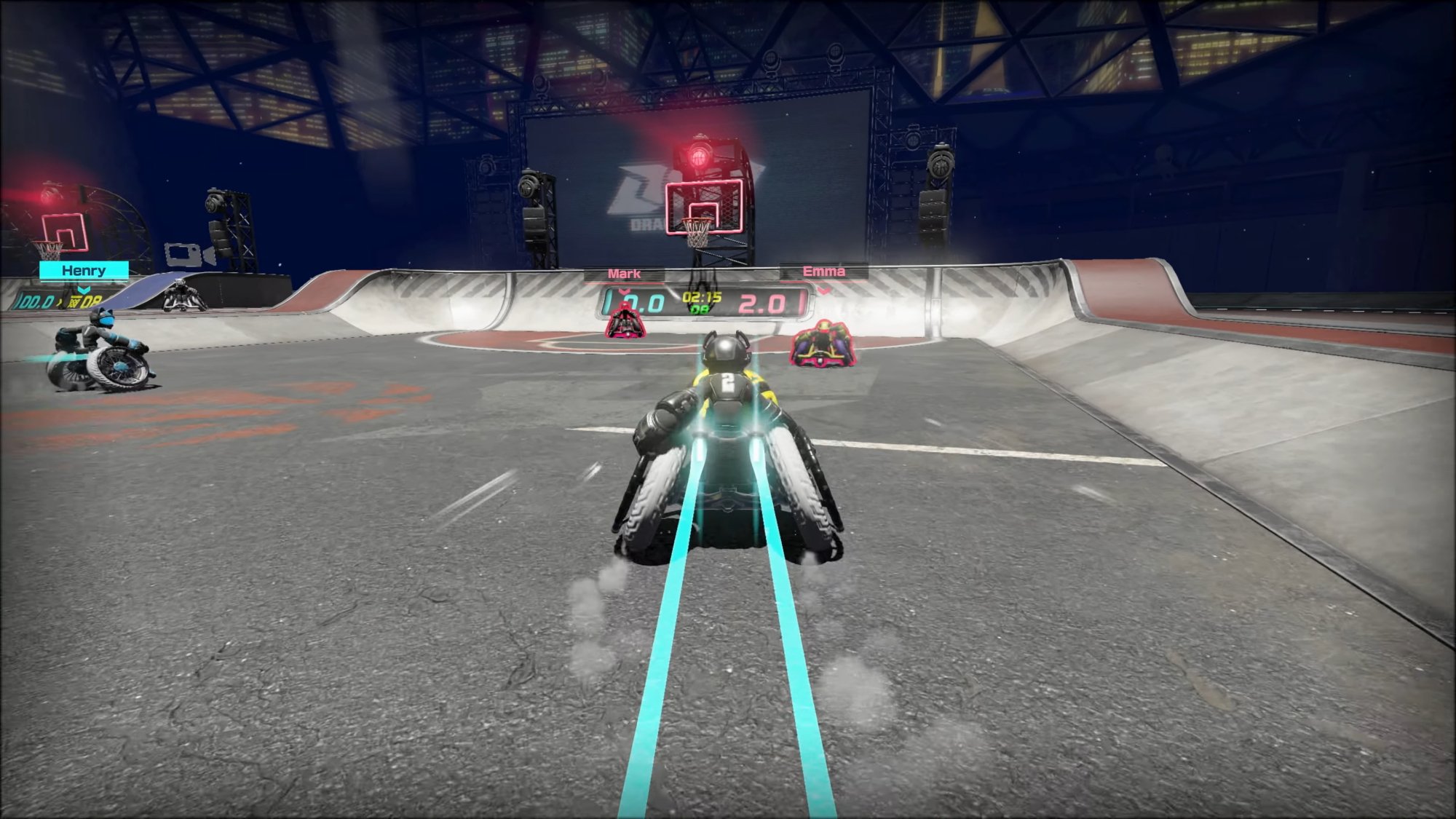
Drag X Drive (Summer 2025)
Credit: Nintendo of America/YouTube
This is an entirely new game for Nintendo. Drag X Drive is wheelchair basketball that uses the new mouse controls on the Switch 2 Joy-Cons. You can push both controllers forward, as your character pushes both wheels forward on their wheelchair. You can also swing the Joy-Con to throw a basket, similar to the experience with Wii Sports.
Donkey Kong Bananza (TBA)

Credit: Nintendo of America/YouTube
After a number of remasters, Donkey Kong is finally getting a new game. This was the last announcement of the Direct, and was worth the wait: Bananza looks like Donkey Kong‘s version of Super Mario Odyssey—3D platforming in an open environment (though I’m not sure if it’s “open world.”) The biggest difference? You smash your way through just about anything you can see in the world.
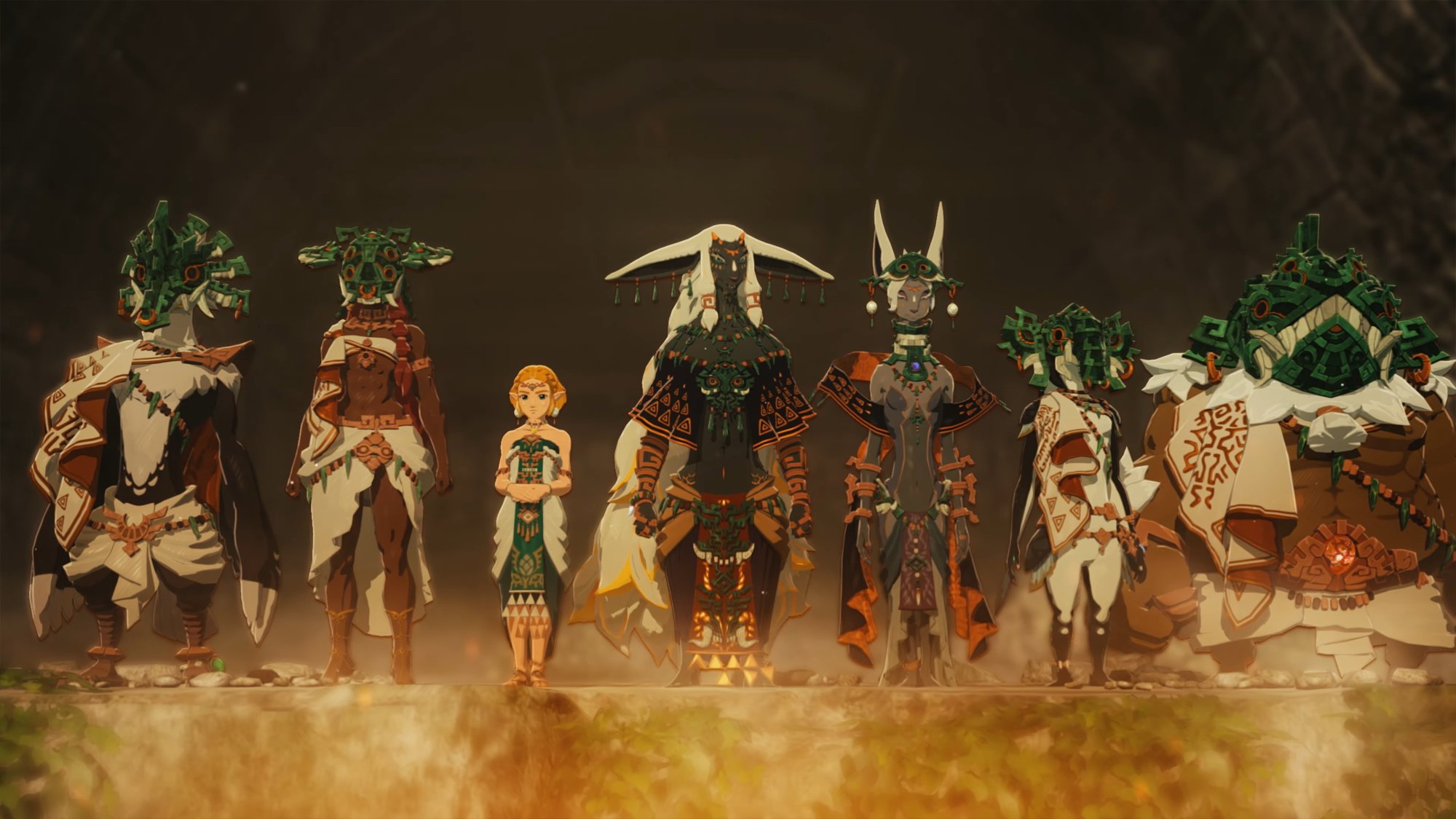
Hyrule Warriors Age of Imprisonment (Winter 2025)
Credit: Nintendo of America/YouTube
This is the third entry in the Hyrule Warriors series, and takes place prior to the events of Tears of the Kingdom. I won’t go into spoiler territory here, but you will get to play out the events of the Imprisoning War, and even get to play as Zelda.
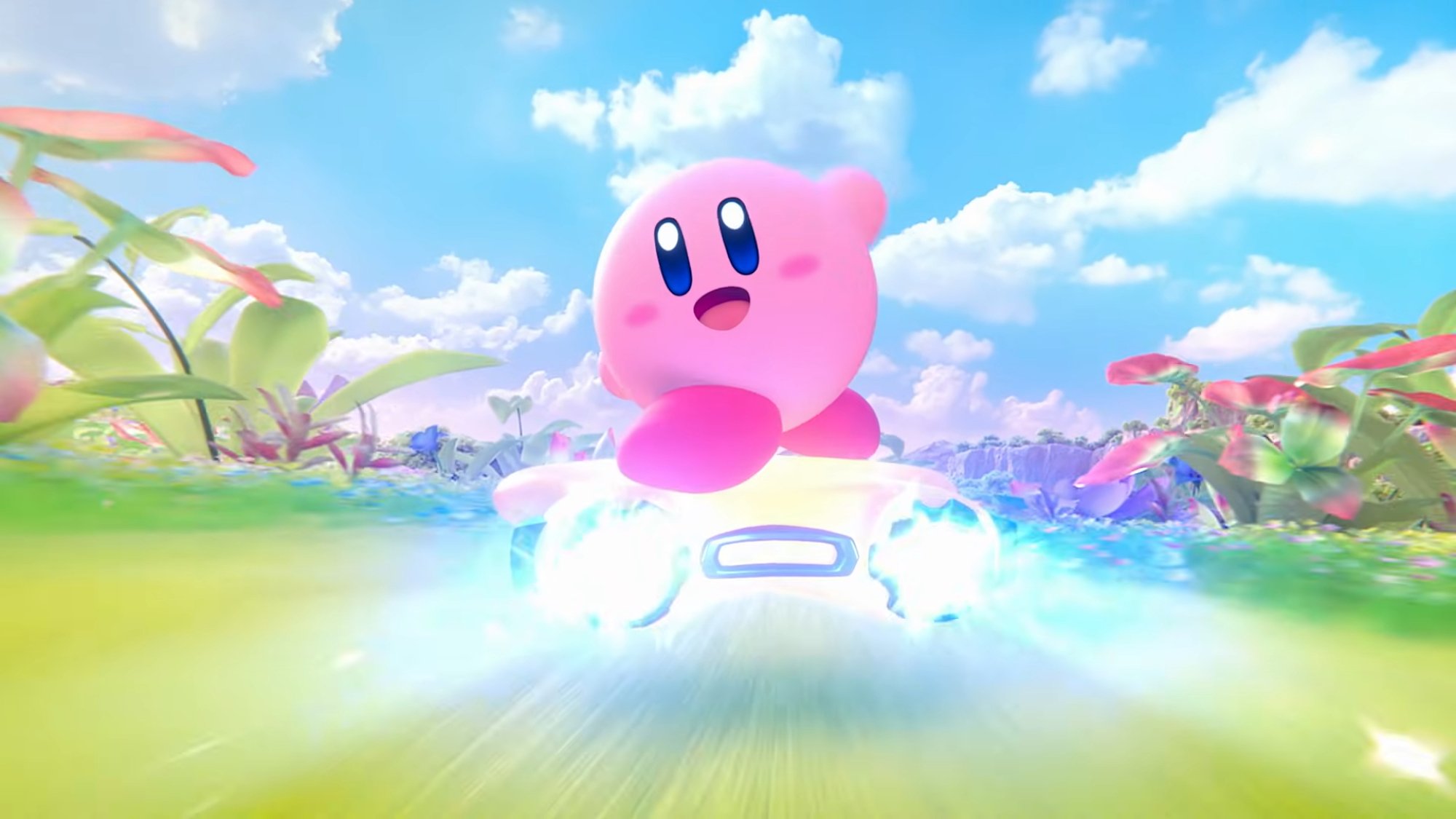
Kirby Air Riders (2025)
Credit: Nintendo of America/YouTube
It looks like we’re finally getting a sequel to 2003’s Kirby Air Ride. We don’t have a lot of details yet, other than seeing stars, bikes, and space ships as rideable vehicles. But Kirby Air Riders is directed by Masahiro Sakurai, the creator of both Kirby and Super Smash Bros., which bodes well.
Nintendo Switch 2 Editions
Like other consoles, Nintendo is now offering Switch 2 users upgraded versions of certain Switch 1 titles. These can include better visuals, faster performance, or new features that take advantage of the Switch 2’s controllers. These upgrades include:
-
Super Mario Part Jamboree + Jamboree TV (July 24, 2025)
-
The Legend of Zelda: Breath of the Wild (TBA)
-
The Legend of Zelda: Tears of the Kingdom (TBA)
-
Kirby and the Forgotten Land + Star Crossed World (TBA)
-
Metroid Prime 4 Beyond (TBA)
-
Pokémon Legends ZA (TBA)
GameCube games
Nintendo Switch Online is finally adding support for GameCube games—but only for Nintendo Switch 2. (Why my 2017 Nintendo Switch is incompatible with games that ran on a system from 2001 is beyond me, but I digress.) In addition to the three aforementioned GameCube titles that will be available at launch, here’s what’s coming down the line, none of which have release dates yet:
-
Super Mario Sunshine
-
Fire Emblem: Path of Radiance
-
Pokémon XD: Gale of Darkness
-
Super Mario Strikes
-
Chibi-Robo
-
Luigi’s Mansion
-
Pokémon Colosseum
Third-party titles
Credit: Nintendo of America/YouTube
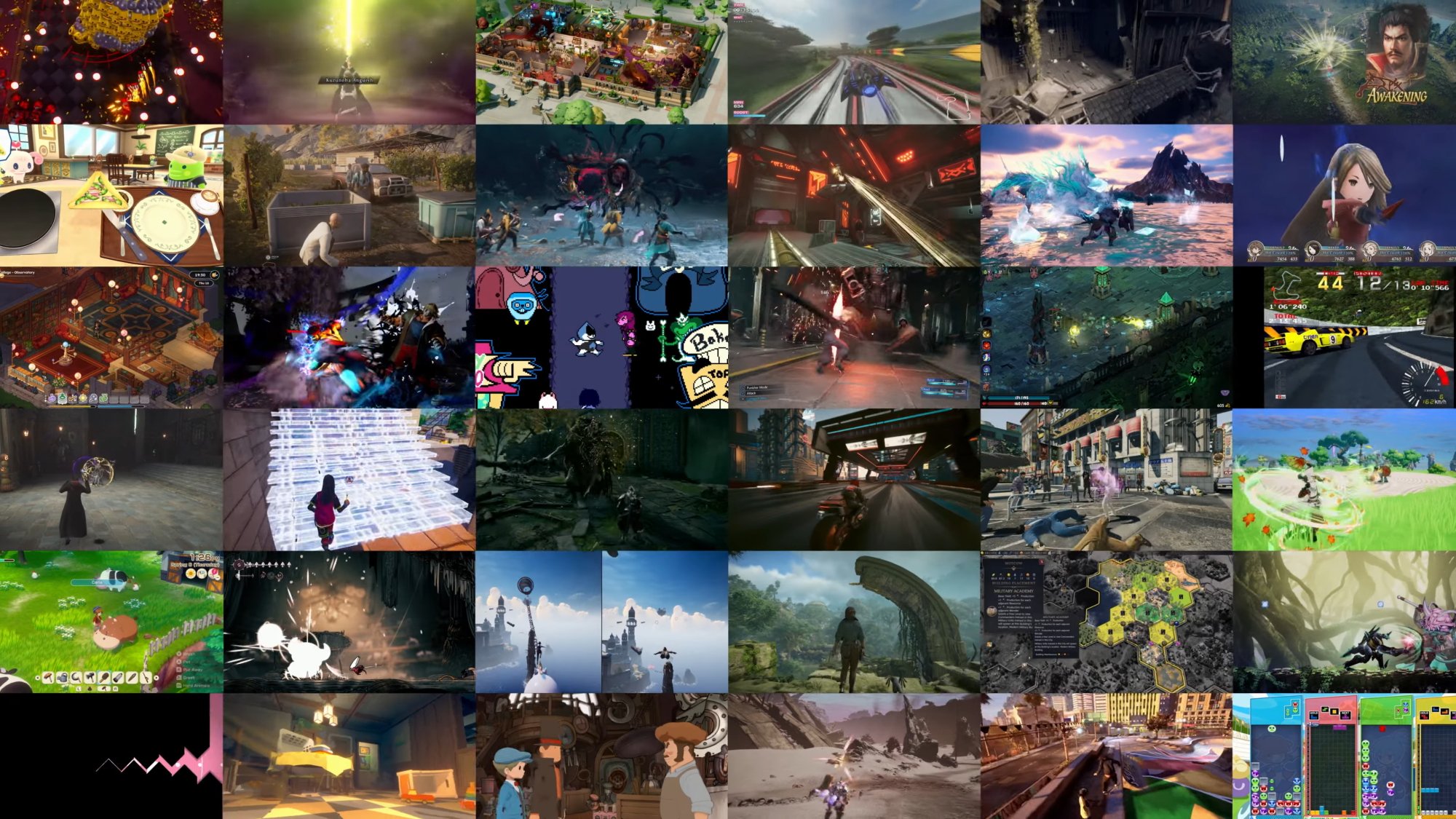
Nintendo ran through a number of third-party titles that are making their way to Switch 2. They include:
-
Elden Ring Tarnished Edition (2025)
-
Hades II (TBA)
-
Daemon X Machina Titanic Scion (Sept. 5, 2025)
-
Tony Hawk’s Pro Skater 3 + 4 (Summer 2025)
-
Project 007 (TBA)
-
Borderlands 4 (2025)
-
WWE 2K (TBA)
-
NBA 2K (TBA)
-
Enter the Gungeon 2 (TBA)
-
Starseeker Astoneer Expeditions (2026)
-
Final Fantasy VII Remake Intergrade (TBA)
-
Kunitsu-Gami: Path of the Goddess
-
Hollow Knight: Silkson (2025)
-
Story of Seasons: Grand Bazaar (Aug. 27, 2025)
-
Goodnight Universe (2025)
-
Silksong (2025)
-
Two Point Museum (2025)
-
Wild Hearts S (July 25, 2025)
-
Witchbrook (Holiday 2025)
-
Marvel Comic Invasion (Holiday 2025)
-
Star Wars Outlaws (2025)
-
Shadow Labyrinth (July 18, 2025)
-
RAIDOU Remastered: The Mystery of the Soulless Army (June 19, 2025)
-
No Sleep For Kaname Date – From AI: THE SOMNIUM FILES (July 25, 2025)
-
REANIMAL (2025)
-
Professor Layton and The New World of Steam (2025)
-
Tamagotchi Plaza (June 27, 2025)
-
Human Fall Flat 2 (TBA)
-
The Duskbloods (2026)
95% of Code Will Be AI-Generated Within Five Years, Microsoft CTO Says
Microsoft Chief Technology Officer Kevin Scott has predicted that AI will generate 95% of code within five years. Speaking on the 20VC podcast, Scott said AI would not replace software engineers but transform their role. “It doesn’t mean that the AI is doing the software engineering job…. authorship is still going to be human,” Scott said.
According to Scott, developers will shift from writing code directly to guiding AI through prompts and instructions. “We go from being an input master (programming languages) to a prompt master (AI orchestrator),” he said. Scott said the current AI systems have significant memory limitations, making them “awfully transactional,” but predicted improvements within the next year.


Read more of this story at Slashdot.
Brain Interface Speaks Your Thoughts In Near Real-time
Longtime Slashdot reader backslashdot writes: Commentary, video, and a publication in this week’s Nature Neuroscience herald a significant advance in brain-computer interface (BCI) technology, enabling speech by decoding electrical activity in the brain’s sensorimotor cortex in real-time. Researchers from UC Berkeley and UCSF employed deep learning recurrent neural network transducer models to decode neural signals in 80-millisecond intervals, generating fluent, intelligible speech tailored to each participant’s pre-injury voice. Unlike earlier methods that synthesized speech only after a full sentence was completed, this system can detect and vocalize words within just three seconds. It is accomplished via a 253-electrode array chip implant on the brain. Code and the dataset to replicate the main findings of this study are available in the Chang Lab’s public GitHub repository.


Read more of this story at Slashdot.
James Webb Space Telescope Reveals That Most Galaxies Rotate Clockwise
The James Webb Space Telescope has revealed that a surprising majority of galaxies rotate clockwise, challenging the long-held belief in a directionally uniform universe; this anomaly could suggest either our universe originated inside a rotating black hole or that astronomers have been misinterpreting the universe’s expansion due to observational biases. Smithsonian Magazine reports: The problem is that astronomers have long posited that galaxies should be evenly split between rotating in one direction or the other, astronomer Dan Weisz from the University of California, Berkeley, who was not involved with the study, wrote for Astronomy back in 2017. “This stems from the idea that we live in an ‘isotropic’ universe, which means that the universe looks roughly the same in every direction. By extension, galaxies shouldn’t have a preferred direction of spin from our perspective,” he added. According to Shamir, there are two strong potential explanations for this discrepancy. One explanation is that the universe came into existence while in rotation. This theory would support what’s known as black hole cosmology: the hypothesis that our universe exists within a black hole that exists within another parent universe. In other words, black holes create universes within themselves, meaning that the black holes in our own universe also lead to other baby universes.
“A preferred axis in our universe, inherited by the axis of rotation of its parent black hole, might have influenced the rotation dynamics of galaxies, creating the observed clockwise-counterclockwise asymmetry,” Nikodem Poplawski, a theoretical physicist at the University of New Haven who was not involved in the study, tells Space.com’s Robert Lea. “The discovery by the JWST that galaxies rotate in a preferred direction would support the theory of black holes creating new universes, and I would be extremely excited if these findings are confirmed.”
Another possible explanation involves the Milky Way’s rotation. Due to an effect called the Doppler shift, astronomers expect galaxies rotating opposite to the Milky Way’s motion to appear brighter, which could explain their overrepresentation in telescopic surveys. “If that is indeed the case, we will need to re-calibrate our distance measurements for the deep universe,” Shamir explains in the statement. “The re-calibration of distance measurements can also explain several other unsolved questions in cosmology such as the differences in the expansion rates of the universe and the large galaxies that according to the existing distance measurements are expected to be older than the universe itself.”
The findings have been published in the journal Monthly Notices of the Royal Astronomical Society.


Read more of this story at Slashdot.
Mozilla is rolling Thundermail, a Gmail, Office 365 rival
Thunderbirds are Pro: Open-source email client to get message hosting, appointment scheduling, moreThunderbird, Firefox maker Mozilla’s open-source email client, is aiming to reinvent itself as a more comprehensive communications platform.…
Sony’s 2025 Bravia TV lineup includes a new flagship QD-OLED model
Samsung and LG got a headstart on Sony when they announced their new 2025 TVs a few months ago at CES. But now, the latter is catching up with the pending arrival of three new Bravia sets, including a refreshed flagship QD-OLED, a midrange mini LED option and an updated budget alternative.
Before we get into the specific models, it’s important to note that after revamping the naming scheme for all of its home theater gear last year, Sony isn’t doing a full top-to-bottom overhaul of its entire lineup for 2025. Instead, it’s introducing a handful of new TVs that will replace old models or slot into some existing gaps in its current portfolio. That means the Bravia 9 will continue to be the company’s top-tier TV, with everything else falling in line under that.
Sam Rutherford for Engadget
This brings us to the Bravia 8 II, which as you may have guessed, is the replacement to the Bravia 8 and will be Sony’s most premium QD-OLED TV. Like the Bravia 9, it features the company’s XR processor which supports AI scene recognition tech to help preserve details in tricky scenes. The way it works is that by analyzing your content, the TV can compare what’s being displayed with a reference library of known backgrounds and patterns to help fill in any gaps the source material may not have fully captured.
I had a chance to see this AI trick in person and while the effect is subtle, it definitely makes a difference during shots with lots of foliage, rocks or other challenging textures. I also noticed that the Bravia 8 II demonstrated improved tone mapping and much more accurate color gradients, which resulted in more detailed and realistic images, especially in very bright or dark shots. And of course, you get those lovely deep blacks and the excellent contrast that modern QD-OLED panels are known for.
Sam Rutherford for Engadget
Moving down the line, there’s the Bravia 5, which neatly fills the void between Sony’s existing 7 and 3 series TVs. It features a mini LED panel powered by the company’s Backlight Master Drive tech, which delivers reduced digital noise and improved contrast. The most noticeable example I saw of this was the almost complete lack of halos or light bleed when viewing bright objects on a dark background. Another important spec is that the Bravia 5 is available in sizes of up to 98 inches, which makes it one of Sony’s largest TVs (including the 83-inch flagship Bravia 9).
Sam Rutherford for Engadget
Finally we come to the Bravia 2 II, where the biggest change is the shift to full direct lit LED instead of an edge lit panel like the previous model. This delivers much more vibrant colors in addition to significantly wider viewing angles on sizes ranging from 43 to 75 inches. Like Sony’s other TVs, its OS is powered by Google TV and it includes an upscaler to bring old content up to 4K. The one major limitation on the Bravia 2 II is that it features a refresh rate of just 60Hz.
Unfortunately, official pricing and availability for all of Sony’s new TV’s won’t be available until sometime later this spring. So if you’re currently shopping for a new set, you may want to hold off for another couple of months.
This article originally appeared on Engadget at https://www.engadget.com/home/home-theater/sonys-2025-bravia-tv-lineup-includes-a-new-flagship-qd-oled-model-160019669.html?src=rss
Sony adds the Bravia Theater Bar 6 to its Dolby Atmos soundbar lineup
Last spring, Sony debuted its Bravia Theater line of soundbars and speakers, ditching its confusing product names in the process. The initial group consisted of the flagship Bar 9, Bar 8, Bravia Quad speaker set and a Theater U neck speaker. Now the company is looking to offer a more compact midrange option that’s still capable of Dolby Atmos and DTS:X audio. With the new Bravia Theater Bar 6, Sony gives users a 3.1.2-channel option, and this time, it comes with a wireless subwoofer in the box.
The Bar 6 will be the entry-level option in Sony’s Bravia Theater soundbar lineup when compared to the more robust Bar 8 and Bar 9. The company says the goal here is to provide both immersive sound and clear dialogue. The soundbar’s two up-firing drivers are paired with three more across the front for Dolby Atmos and DTS/X dimensional audio. Sony provides up-mixing tech to transform stereo content to 3D sound when those immersive formats aren’t available. For dialogue, Sony utilizes both a dedicated center speaker and so-called Voice Zoom 3. That latter item is an AI-powered tool that recognizes human voices and adjusts their volume as needed to keep speech clear.
Sony is offering two packages for the Bar 6. First, you can opt for all-in-one setup that comes with rear satellite speakers and a subwoofer for a 5.1.2 surround sound setup. The company calls this the Bravia Theater System 6. If you don’t need the rears, you can get the Bar 6 and a sub. Just note that the two subwoofers in those two configurations are different, and the back speakers with the System 6 don’t have up-firing drivers.
Sony
One item that’s notable about the System 6 is Sony’s new Multi Stereo Mode. With living room setups that have rear speakers, those satellites sometimes provide awkward audio performance for music. This feature on Sony’s new all-inclusive package replicates stereo left/right channels to the center and rear speakers for a more enjoyable audio experience.
Lastly, Sony has a new set of rear speakers, dubbed the Bravia Theater Rear 8. These are compatible with the company’s soundbars and work with its 360 Spatial Sound Mapping tech to calibrate your system to your living room’s acoustics. The Rear 8 are different from the speakers that come with the System 6, so you’ll want to consider that when making your buying decision.
When paired with a Bravia TV, Sony’s soundbars can be controlled with the Bravia Connect app on a phone. Here, you can adjust volume and other settings without a remote or on-screen menu. Both the Bravia TV and Bravia Theater lineups can be controlled via on-screen prompts without having to change remotes. More specifically, a Bravia TV controller can be used to adjust volume, sound field and more on the Bravia Theater soundbars and speakers.
There’s no word on pricing or availability yet for the Bravia Theater Bar 6, Bravia Theater System 6 or the Bravia Theater Rear 8. All Sony has divulged thus far is that the trio of new products is set to arrive sometime this spring.
This article originally appeared on Engadget at https://www.engadget.com/home/home-theater/sony-adds-the-bravia-theater-bar-6-to-its-dolby-atmos-soundbar-lineup-160012544.html?src=rss
Zwift Update Version 1.87 (143212) Released
Zwift version 1.87 begins its phased rollout today. This release includes a new “Streak Flair” feature to reward consistent work, upgrades to the Ven-Top climb, and more…
Note: I’m at Simon Schofield’s home in Spain as a stopover on my way to Mallorca for Zwift Community Live, so this post may be a bit light on details. If you see additional changes beyond what I’ve noted below, please comment!
Streak Flair with Scotty

Ride Streaks were added to the game in December 2023 as a way to motivate Zwifters to train regularly on the platform. Today’s update adds what Zwift is calling “Streak Flair”: a visual upgrade to our avatars that changes based on the length of your ride streak.
What is the visual upgrade, exactly? Well, it turns out that yesterday’s April Fools Scotty was actually a sneak peek at a new game feature. Our jersey pocket can now be filled with a bit of Scotty flare:
- Level 1 (4 weeks): the first bit of flair is a pocket Scotty medal when your streak hits 4 weeks. (You’ll keep this flair until you reach 12 weeks.)
- Level 2 (12 weeks): the medal is upgraded to a keychain Scotty peeking out of your pocket.
- Level 3 (24 weeks): animated Scotty! Now your pocket companion moves with a fun animation. This Scotty will stay with you as long as you hold onto your streak from here on out.
Important note: at launch, everyone’s Streak Flair will default to being turned OFF. You’ll need to select FUN from the Settings screen to show your flair.
Ventoux Upgrades: Sections and Spinner

Zwift’s release notes say, “… the Ven-Top route now includes a HUD display mirroring the Grade’s climb experience with 10 equidistant sections highlighted on screen. Additionally, when you summit this epic climb, you’ll now receive the Alpe du Zwift spinner!”
This is a welcome upgrade. Ventoux is the longest climb in game (apart from a handful of climb portals), yet it has always lacked the segments and spinner that help make Alpe du Zwift a more attractive climb. I predict we’ll see increased traffic on Zwift’s Ventoux KOM in the coming days.
Release Notes
Zwift provided notes on additional tweaks and bug fixes in this update:
- Standardized the look and feel of scrollbars throughout the game.
- Fixed an issue that could cause an incorrect value to be shown in the Weekly Goal Met in-game banner.
- Improved the reliability of The Zwift Big Spin reward spinner.
- Fixed an issue that could cause a Zwifter’s kit to revert to the default Zwift kit after leaving a group ride or event.
- Enabled more detailed 3D lighting on newer Apple devices and Windows machines with dedicated GPUs.
- Improved an issue that could cause intermittent shadows to flicker on Zwifter avatars in some conditions.
- Android: Improved readability and usability of form input fields (login, profile settings, custom workout editor on tablets, etc.).
Discuss this update in Zwift’s forum > (link coming soon)
Questions or Comments?
If you spotted any other changes or bugs in the update, please comment below!
Runway Says That Its Gen-4 AI Videos Are Now More Consistent
Producing video content is a particular challenge for generative AI models, which have no real concept of space or physics, and are essentially dreaming up clips frame by frame. It can lead to obvious errors and inconsistencies, as we wrote about in December with OpenAI’s Sora, after it served up a video with a disappearing taxi.
It’s these specific problems that AI video company Runway says it’s made some progress in fixing with its new Gen-4 models. The new models offer “a new generation of consistent and controllable media” according to Runway, with characters, objects, and scenes now much more likely to look the same over an entire project.
If you’ve experimented with AI video, you’ll know that many clips are brief and show slow movement, and don’t feature elements that go out of the frame and come back in—usually because the AI will render them in a different way. People merge into buildings, limbs transform into animals, and entire scenes mutate as the seconds pass.
This is because, as you might have gathered by now, these AIs are essentially probability machines. They know, more or less, what a futuristic cityscape should look like, based on scraping lots of futuristic cityscapes—but they don’t understand the building blocks of the real world, and can’t keep a fixed idea of a world in their memories. Instead, they keep reimagining it.
Runway is aiming to fix this with reference images that it can keep going back to while it invents everything else in the frame: People should look the same from frame to frame, and there should be fewer issues with principal characters walking through furniture and transforming into walls.
The new Gen-4 models can also “understand the world” and “simulate real-world physics” better than ever before, Runway says. The benefit of going out into the world with an actual video camera is that you can shoot a bridge from one side, then cross over and shoot the same bridge from the other side. With AI, you tend to get a different approximation of a bridge each time—something Runway wants to tackle.
Have a look at the demo videos put together by Runway and you’ll see they do a pretty good job in terms of consistency (though, of course, these are hand-picked from a wide pool). The characters in this clip look more or less the same from shot to shot, albeit with some variations in facial hair, clothing, and apparent age.
There’s also The Lonely Little Flame (above), which—like all Runway videos—has reportedly been synthesized from the hard work of actual animators and filmmakers. It looks impressively professional, but you’ll see the shape and the markings on the skunk change from scene to scene, as does the shape of the rock character in the second half of the story. Even with these latest models, there’s still some way to go.
While Gen-4 models are now available for image-to-video generations for paying Runway users, the scene-to-scene consistency features haven’t rolled out yet, so I can’t test them personally. I have experimented with creating some short clips on Sora, and consistency and real-world physics remains an issue there, with objects appearing out of (and disappearing into) thin air, and characters moving through walls and furniture. See below for one of my creations:
It is possible to create some polished-looking clips, as you can see from the official Sora showcase page, and the technology is now of a high-enough standard that it is starting to be used in a limited way in professional productions. However, the problems with vanishing and morphing taxis that we wrote about last year haven’t gone away.
Of course, you only have to look at where AI video technology was a year ago to know that these models are going to get better and better, but generating video is not the same as generating text, or a static image: It requires a lot more computing power and a lot more “thought,” as well as a grasp of real-world physics that will be difficult for AI to learn.
Everything you need to know about bird flu
In early 2024, the bird influenza that had been spreading across the globe for nearly three decades did something wholly unexpected: It showed up in dairy cows in the Texas Panhandle.
A dangerous bird flu, in other words, was suddenly circulating in mammals—mammals with which people have ongoing, extensive contact. “Holy cow,” says Thomas Friedrich, a virologist at the University of Wisconsin–Madison. “This is how pandemics start.”
This bird flu, which scientists call highly pathogenic avian influenza, or H5N1, is already at panzootic—animal pandemic—status, killing birds in every continent except for Australia. Around the world, it has also affected diverse mammals including cats, goats, mink, tigers, seals, and dolphins. Thus far, the United States is the only nation with H5N1 in cows; it’s shown up in dairies in at least 17 states.
[$] An update on GCC BPF support
José Marchesi and David Faust kicked off the BPF track at the 2025 Linux Storage,
Filesystem, Memory-Management, and BPF Summit with an extra-long session on what
they have been doing to support compiling to BPF in GCC. Overall, the project is slowly working
toward full support for BPF, with most of the self-tests now passing using
Faust’s in-progress patches. However, the progress toward that goal has turned up
a number of problems with how Clang supports BPF that needed to be discussed at
length to find a path forward for both projects.
How to pre-order the Nintendo Switch 2
During today’s Nintendo Direct all about the Switch 2, the company shared how and when fans can finally get the handheld into their hands. After a long, long wait, pre-orders for the Switch 2 will begin on April 9. Its starting price tag is $450, and the console will be widely available on June 5. The console will be available from the usual lineup of retailers, which we expect to include Amazon, Best Buy, GameStop, Walmart and others.
The $450 price tag is for the Switch 2 console alone, but Nintendo said it will also offer a bundle with the Switch 2 and a copy of the new Mario Kart World game, a Switch 2 exclusive, for $500.
There’s some fine-print attached to pre-ordering directly from Nintendo. According to the pre-order page on Nintendo’s site, you must be 18 years or older, sign in with your Nintendo account and register your interest in pre-ordering. Then, you’ll be sent an invitation email when it’s time to play your pre-order, and the invitation will be valid for 72 hours. And then there’s this bit of info: “Invitation emails will be prioritized on a first-come, first-served basis to registrants who have purchased a Nintendo Switch Online membership with a minimum of 12 months of paid membership and a minimum of 50 total gameplay hours, as of April 2, 2025.”
That seems to mean those who have paid for Switch Online in the recent past and those who have spent a good amount of time playing Switch games as of late will get first pick at buying a Switch 2. There’s no telling if these same restrictions will apply if you want to pre-order from third-party retailers.
We knew from the teaser trailer for the Switch 2 that Nintendo’s new hardware would be bigger and would have a new approach to the detachable Joy-Cons. The new Joy-Con 2 have a new C button, mouse controls and a built in gyroscope for tilt control. The console has a built-in mic to support a new feature called Game Chat that will let you communicate with friends in-game. The device is indeed a bit larger, with a 7.9-inch LCD screen that supports a 120Hz refresh rate, HDR and a 1080p resolution.
When docked, you’ll be able to play at up to 4K on your TV, and Nintendo says it improved the consoles internal speakers as well. The new dock also has a built-in fan to keep the console cool and help maintain performance during long play sessions. The Switch 2 has dual USB-C ports for charging, and the base storage amount has increased to 256GB. The Switch 2’s storage can be expanded like the previous model, but it will only work with newer microSD Express cards.
The Switch 2 has a number of accessories that you’ll be able to purchase separately as well, including the new Switch 2 camera for $50, a new Switch 2 Pro controller for $80, an extra pair of Joy-Con 2 controllers for $90, a Joy-Con 2 charging grip for $35 and more.
Pre-order the Nintendo Switch 2 starting April 9 from:
This article originally appeared on Engadget at https://www.engadget.com/gaming/nintendo/how-to-pre-order-the-nintendo-switch-2-140931639.html?src=rss
Thunderbird plans “Thundermail” email and other services
Ryan Sipes has announced
efforts to expand Thunderbird’s offerings with web services to
“enhance the experience of using Thunderbird
“.
The Why for offering these services is simple. Thunderbird loses users
each day to rich ecosystems that are both clients and services, such
as Gmail and Office365. These ecosystems have both hard vendor
lock-ins (through interoperability issues with 3rd-pary clients) and
soft lock-ins (through convenience and integration between their
clients and services). It is our goal to eventually have a similar
offering so that a 100% open source, freedom-respecting alternative
ecosystem is available for those who want it.
The planned services include hosted email, appointment scheduling,
a revival of Firefox Send,
and (of course) an AI assistant based on a partnership with Flower AI. The AI features will
“always be optional for use by people who want them
“. Sipes is
managing director of product for Thunderbird’s parent organization, MZLA
Technologies Corporation. LWN covered his
GUADEC 2024 keynote last July.