
Red Hat might be the company making money off of Enterprise Linux, but the now discontinued Linux distribution CentOS Linux has many times more installs.
Category Archives: Unfiltered RSS
AMD Quietly Refreshes Ryzen 8000HX Dragon Range Laptop CPUs With These Specs
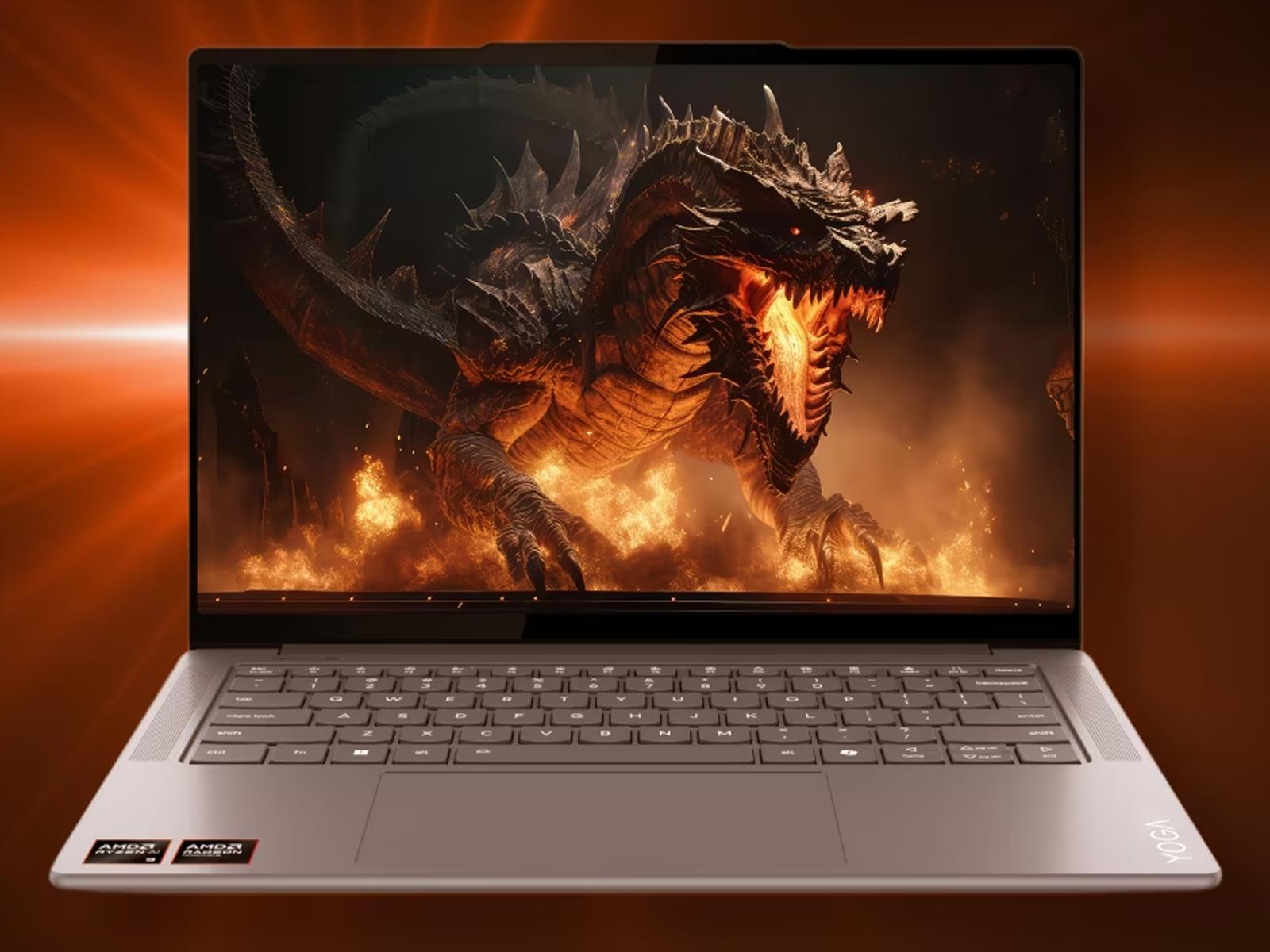
AMD is rolling out a new round of mobile processors to fuel presumably cheaper gaming laptops, and the timing couldn’t be better with so much uncertainty surrounding the tariffs situation. Unofficially, the new Ryzen 8000HX series processors are being called Dragon Range Refresh. That’s because they are an iterative upgrade (or rebadge, really)
Gas Boiler Fittings Outnumbered Heat Pumps By 15 To One in UK Last Year – Report
An anonymous reader shares a report: Gas boiler fittings outnumbered new heat pump installations by more than 15 to one last year, and only one in eight new homes were equipped with the low-carbon alternative despite the government’s clean energy targets.
Poorer households are also being shut out of the heat pump market as the grants available are inadequate and should be increased, according to a report by the Resolution Foundation thinktank. The UK has the slowest introduction of heat pumps in Europe: fewer than 100,000 were fitted last year, compared with 1.5m gas boilers. Most of the boilers were replacements for existing units, but new houses are still being built with gas as standard — only 13% of new homes came with heat pumps last year.
If the government is to meet its net zero targets, switching people to heat pumps will be essential: about 450,000 households will need to install them each year by 2030. But the grant available through the boiler upgrade scheme — $9,700 in England and Wales — still leaves homeowners paying about $7000 on average.


Read more of this story at Slashdot.
April’s Full Pink Moon Is Coming And Here’s How To Catch It

Attention all stargazers, dust off your DLSR camera and adjust your weekend plans accordingly, because you’re about to be treated to the first full moon of spring. Otherwise known as the Pink Moon, Paschal Moon, and Passover Moon, there’s some interesting trivia afoot to be the life of the moon watch party, should you bring along less celestial-savvy
France to ban students from keeping smartphones in schools
The last decade or so has seen schools and governments alike working on a substantial question: To what degree should students be allowed access to their phones? France has been among those leading the charge, requiring smartphones to be turned off during school hours since 2018. Now, the country is taking things a step further, insisting that students leave their phone in lockers or pouches, The Guardian reports.
France’s education minister and former prime minister Élisabeth Borne announced the new regulation, which will go into effect in middle schools come September. “At a time when the use of screens is being widely questioned because of its many harmful effects, this measure is essential for our children’s wellbeing and success at school.”
The decision follows two key events, a pilot program reported on by multiple sources and published expert recommendations. The former involved 180 middle schools comprised of over 50,000 students. Over the last six months, participants have done a “digital pause,” putting their phones in a locker or pouch that is unlocked when they finish the day. Borne announced that the trial was successful in improving school’s atmospheres. She added that schools will choose whether to use lockers or pouches, costing them up to a few thousand euros (€3,000 equals $3,331, for example).
The 2024 report, commissioned by President Emmanuel Macron, issued recommendations including no smartphone use for children under 13 years of age and no “conventional” social media access until they reach 18. The recommendations, led by a neurologist and an addictions psychiatrist, additionally pushed for limited to no screen-time for children, depending on their age.
The UK and the US are among the other countries exploring similar school-based measures to France. In 2024, the UK government released guidance for schools on banning phones in educational spaces. Both New York and California’s governors have also supported measures to limit smartphone use in schools.
This article originally appeared on Engadget at https://www.engadget.com/mobile/smartphones/france-to-ban-students-from-keeping-smartphones-in-schools-140053272.html?src=rss
How to Try Copilot’s New ‘Vision’ and File Search Updates
Microsoft announced a plethora of Copilot upgrades at the start of the week, and we’re now starting to see some of them roll out—to Windows Insiders, at least. The Copilot app for Windows has now been updated to support Copilot Vision and file search, so the AI bot is better able to interact with whatever’s on your PC.
Copilot Vision first appeared on the web last year, but it’s new to the Windows app: It essentially lets the AI “see” what’s happening on your computer, so you can ask it about websites you’re viewing, or documents you’re editing, or songs you’re listening to, without having to take a screenshot or do any copying or pasting.
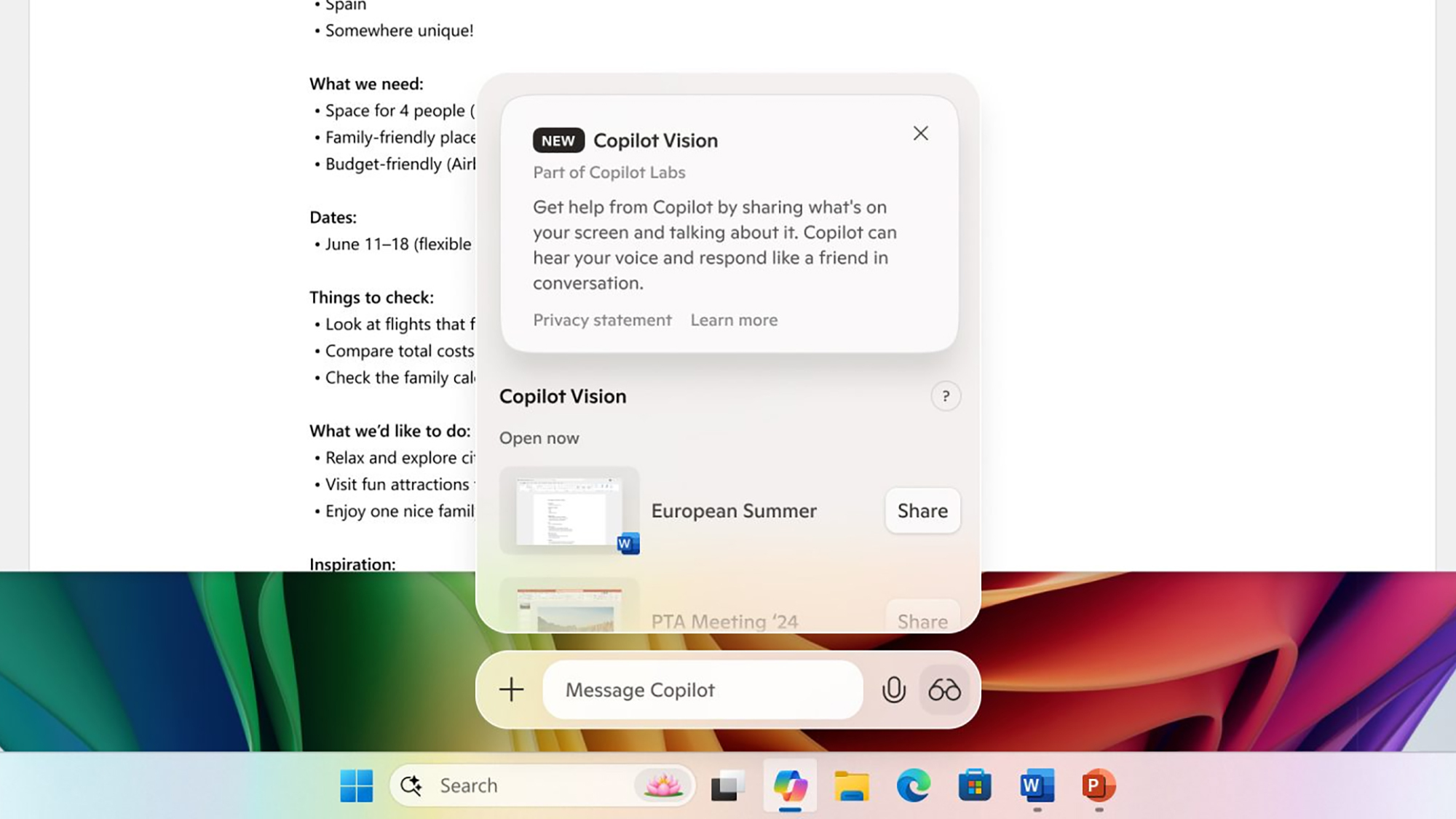
Copilot Vision can see what’s on your screen.
Credit: Microsoft
Credit: Microsoft
It’s somewhat similar to the Windows Recall feature that remains in limited testing, and which also gives the operating system more access to what’s on your screen. This does of course raise a few worries around privacy, but Microsoft promises users stay in full control of what’s accessible, and that all data is deleted after every Copilot Vision session.
Microsoft imagines users taking advantage of Copilot Vision to chat through plans for a trip, or for help when shopping online. As the AI can see what you’re seeing, it’s able to pick out ideas and give feedback on what you’re talking about, with interactions primarily handled via voice.
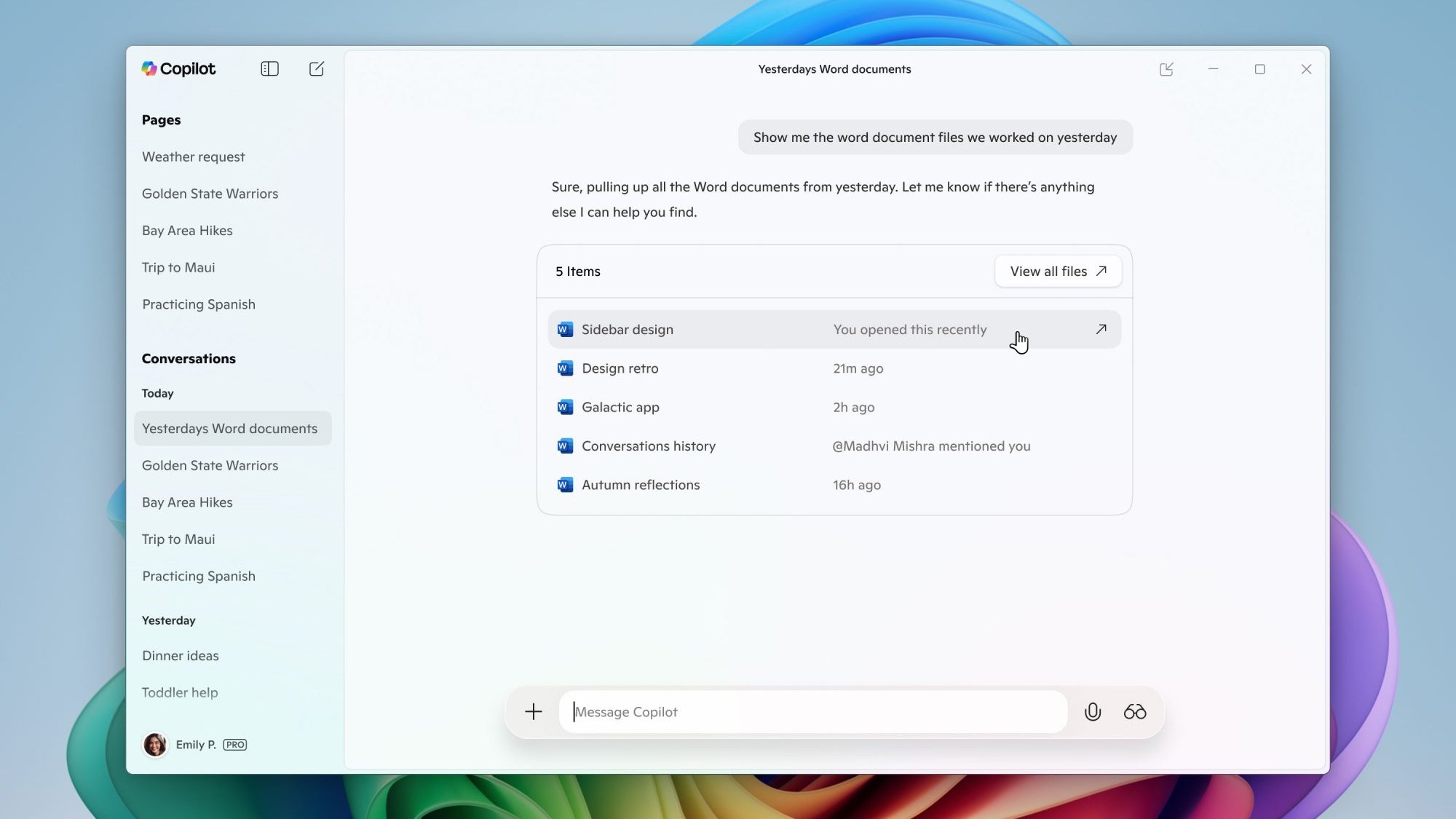
Copilot file search in action.
Credit: Microsoft
Credit: Microsoft
Then there’s file search, which means Copilot can find, open, and chat about files stored locally on your system. You might want to look for your résumé, for example, or bring up a slideshow you were working on last month—all these requests can be handled using natural language queries.
You can even ask about the contents of your files—so you could, for example, get Copilot to pull out spending figures from a spreadsheet. Again, Microsoft says you’ll be in full control over what Copilot can and can’t access in terms of your files: Everything is going to be handled through the permissions configured in Copilot’s settings.
How to start testing
Eventually, these features will appear in the stable version of Windows for all users, though that may take a while (Microsoft hasn’t announced an exact timetable). In the meantime, you can test these new Copilot features early, if you’re prepared to sign up for the Windows Insider Program. You can do that for free here.
The Windows Insider Program is like any other beta testing program: You get access to new features earlier than everyone else, but there are likely to be a few more bugs that you come across. It’s generally not recommended to run Insider versions of Windows on a laptop or desktop that’s critical to your day-to-day computing.
Once you’re up and running as a Windows Insider, you’ll find you can sign up for the beta channel of Windows 11 through the Windows Update part of Settings in Windows. Shortly after, you’ll get a new download, which will install the beta version on your computer (you can switch back to the stable version any time you like).
With all that taken care of, you need the latest version of Copilot on your computer: Look for version 1.25034.133.0 or later on the Microsoft Store. Microsoft says these features will come to Insiders in the U.S. first, then be available to everyone else after that—with the features “gradually rolling out” over time.
Copilot Vision can be launched by clicking the glasses icon to the right of the main input box inside Copilot for Windows. You’re then prompted to indicate which app or browser window you want to share with Copilot, and you can then chat with the bot using your voice. Click the Stop or X buttons to end a session.
File search is built right into the Copilot app for Windows, so you can simply type out or speak out a query as you would in any other chat — something like “what were the places I shortlisted in my vacation plan document last week?” for example. As always with AI, I’d recommend double-checking the answers you get for anything important.
Graphics/Display Driver Changes Begin Queuing For Linux 6.16 This Summer
While the Linux 6.15 merge window only ended last weekend, new feature material is beginning to queue for DRM-Next ahead of the Linux 6.16 kernel cycle kicking off in late May or early June. A few notable patches so far have been submitted by way of DRM-Misc-Next…
Car safety experts at NHTSA, which regulates Tesla, axed by DOGE
Job cuts at the US traffic safety regulator instigated by Elon Musk’s so-called Department of Government Efficiency disproportionately hit staff assessing self-driving risks, hampering oversight of technology on which the world’s richest man has staked the future of Tesla.
Of roughly 30 National Highway Traffic Safety Administration workers dismissed in February as part of Musk’s campaign to shrink the federal workforce, many were in the “office of vehicle automation safety,” people familiar with the situation told the Financial Times.
The cuts are part of mass firings by Doge that have affected at least 20,000 federal employees and raised widespread concern over potential conflicts of interest for Musk given many of the targeted agencies regulate or have contracts with his businesses.
Finally, The Monopoly High Heels You’ve Been Waiting For
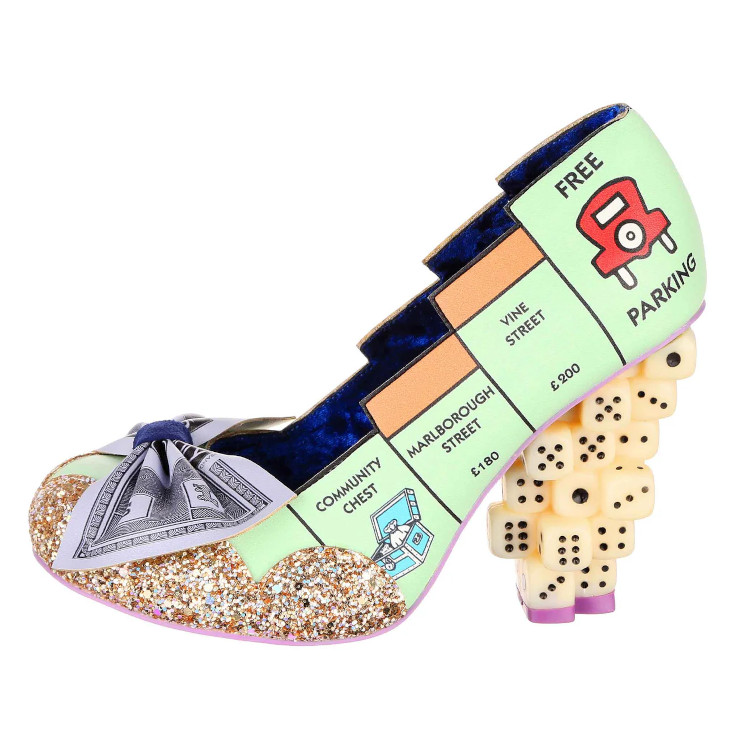
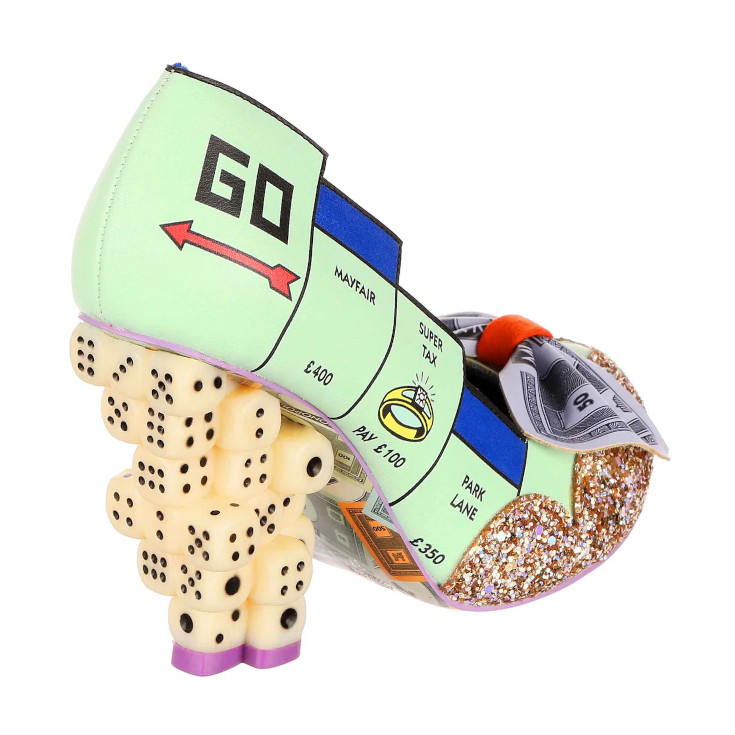
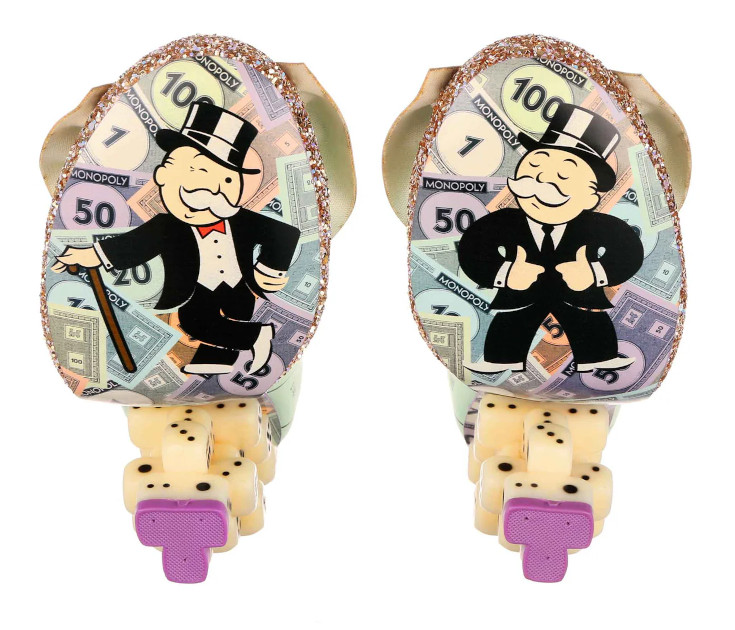
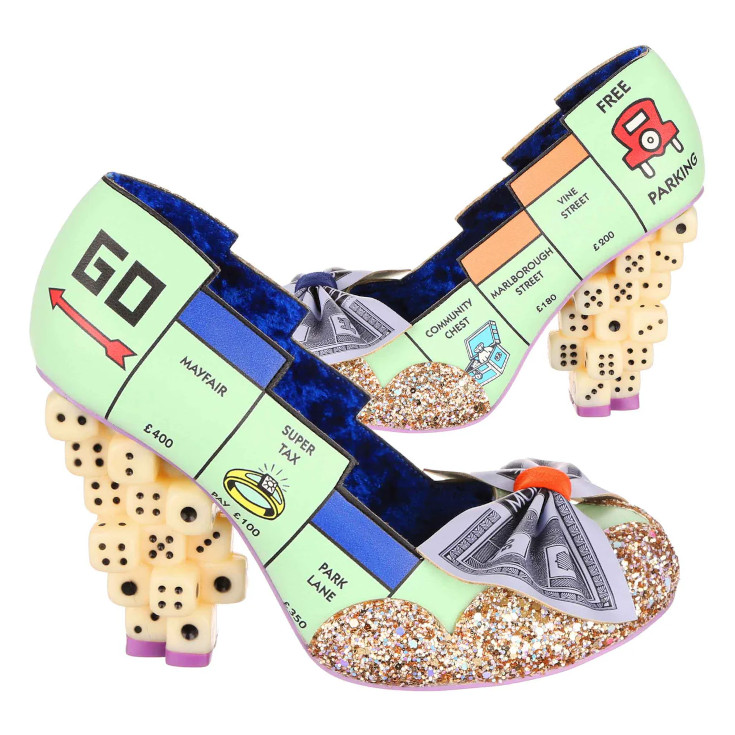
Designed and sold by UK-based novelty footwear maker Irregular Choice, these are the $239 Roll The Dice high heels. In case you couldn’t tell, they’re Monopoly themed. I’m kidding, even people who have never heard of the game could tell you they’re Monopoly themed. It’s…hard to miss. Does anybody really love Monopoly this much? I always felt like everyone who liked playing Monopoly were either sadists who liked bankrupting their friends or people who wanted to practice cheating. Still, there’s no question these heels make a statement. What that statement is, I’m not sure, but I do hope it’s not directed at me on game night.


Dinosaur Doomsday Crater Became an Ocean Oasis for 700,000 Years

Cores extracted from the impact crater revealed evidence of an ancient, life-nurturing hydrothermal system in the wake of the catastrophe.
The Samsung Galaxy Watch Ultra Is at Its Lowest Price Ever Right Now
We may earn a commission from links on this page. Deal pricing and availability subject to change after time of publication.
When Samsung dropped the Galaxy Watch Ultra last summer, it was clearly swinging at the Apple Watch Ultra crowd—people who run marathons for fun, hike trails that end in the clouds, or just want a tank of a smartwatch on their wrist. Now that the hype’s settled and the price has dropped to $378 (down from $649.99), its lowest yet according to price trackers, it’s a more interesting pick, especially if you’re big on the outdoors.

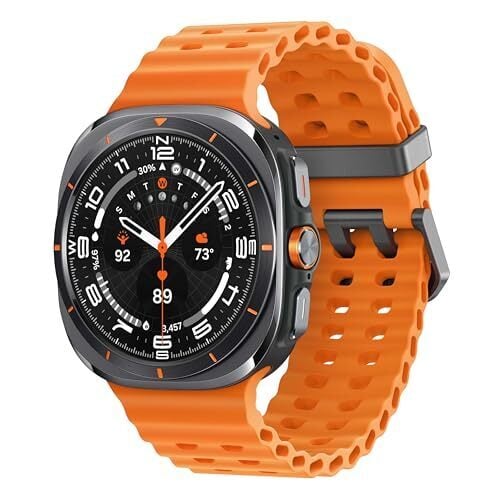
That said, the Galaxy Watch Ultra only comes in a 47mm size, which might feel chunky for some, but the build is solid. You get a 1.47-inch Super AMOLED display that’s bright even in direct sunlight, wrapped in Grade 4 titanium, with IP68 dust/water resistance. This thing isn’t just “rugged”—it’s designed for extremes, like high-altitude treks (up to 9,000 meters) and diving up to 330 feet underwater.
Where the Galaxy Watch Ultra shines is in how it handles long adventures without needing a pit stop. The LTE version means you can take calls, track GPS, and get alerts even if your phone’s back in the car. Battery life is impressive, too. With normal use, you’ll get about 60 hours, and pushing it with power-saving can stretch that to 100. That’s a big deal for multi-day hikers or anyone who forgets to charge stuff regularly. The built-in emergency siren is another thoughtful touch, especially if you’re out solo. And if you’re deep into wellness tracking, it’s got all the usual suspects—heart rate, blood oxygen, body temp—but adds AI-powered metrics and advanced sleep tracking that reviewers seem pretty impressed by (as evidenced in this “excellent” review by PCMag).
Still, there are a few things to keep in mind. Wear OS is smooth, but you’re getting Samsung’s flavor of it, so compatibility is better with Galaxy phones. There’s also no smaller size, so if you’ve got a smaller wrist or want something lighter, it could feel like overkill. If you’re just looking for a good smartwatch for casual workouts and everyday use, the Galaxy Watch 7 at $219.16 (down from $299.99) might suit you better.
Google Pixel 9a Review: Harder, Better, Faster, Stronger
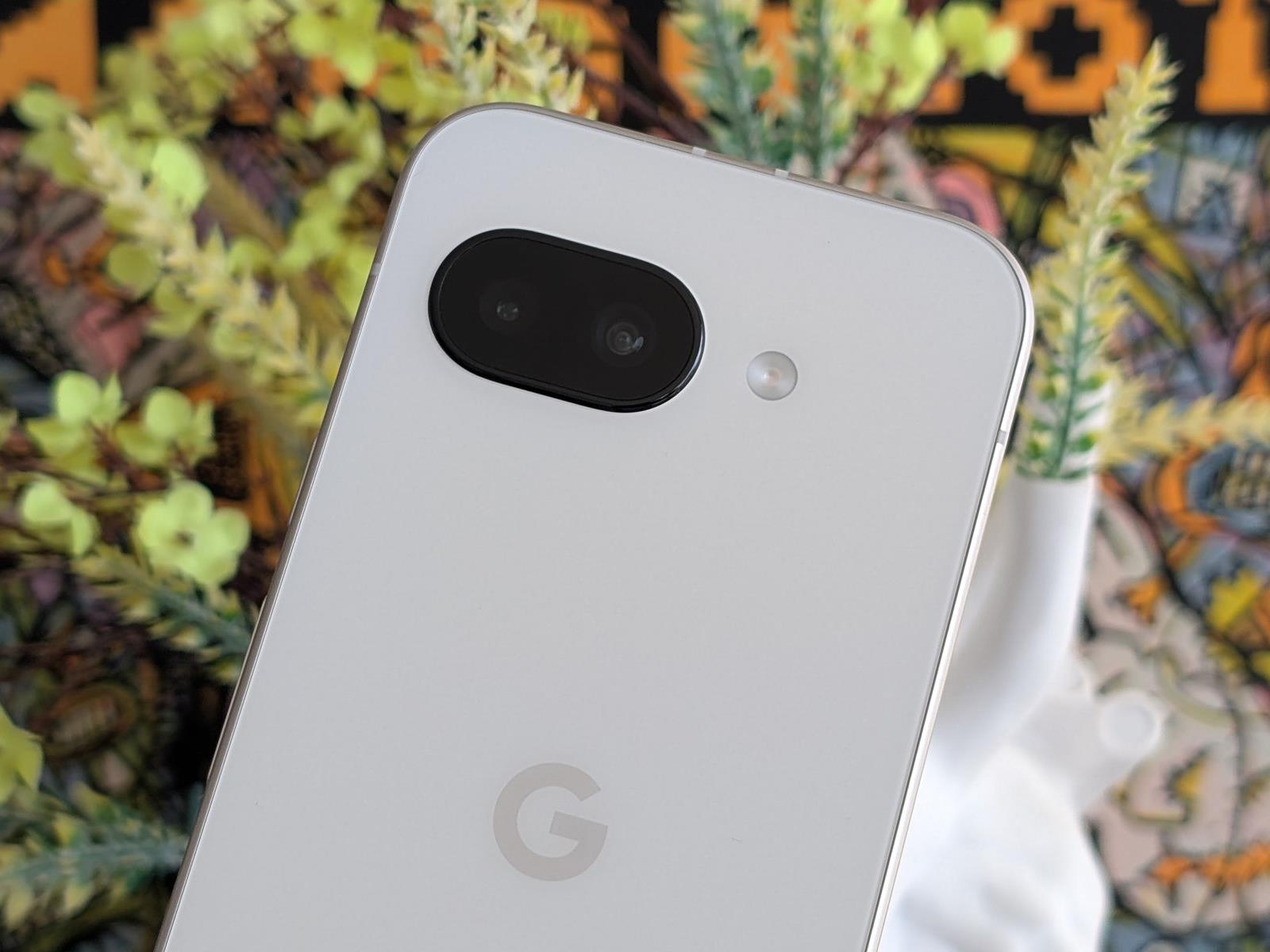
Google Pixel 9a – MSRP Starting A $499 Google’s Pixel 9a is its latest mid-range phone that updates last year’s Pixel 8a with a larger screen, a better Tensor processor, a bigger battery and faster charging. Fantastic value Lovely display Excellent cameras Impressive battery life Outstanding software Sharp, bright display…
Sticking Simpsons Character Stickers In Appropriate Locations
This is a video of Seattle based artist Rudy Willingham placing stickers of Simpsons characters around his neighborhood (Burger King appears to have been a goldmine of content) in places that are contextually appropriate for the characters’ faces or whatever they’re doing. That’s clever. I especially liked the one of Bart dropping the water balloon on Principal Skinner, but they’re all really great. Like dogs.
The Black Mirror game Thronglets is real and available for iOS and Android
Netflix has released a game called Thronglets based on episode seven of the latest season of Black Mirror. It’s like a game of Tamagotchi and Pokémon, with dark, existential themes like what you’d expect from a tie up for the series would be. Thronglets was developed by Night School, the same studio behind Oxenfree that Netflix had acquired in 2021. “Our explorations in narrative gameplay and Netflix’s track record of supporting diverse storytellers was such a natural pairing,” said Sean Krankel, the founder of Night School Studio, at the time.
In the series, Thronglets is at the center of episode seven’s story, which is set in the same universe as Netflix’s interactive movie Bandersnatch. It’s a long-lost game by Tuckersoft, the same gaming studio in the movie, that hasn’t been seen since it was cancelled in 1994. In the game, you’ll have to hatch, evolve and raise creatures called Thronglets, bathing them, feeding them and entertaining them as they multiply more quickly than gremlins. Netflix says the game is not really only about raising virtual creations, though, but about “exploring the depths of human nature and the consequences of our digital obsessions.”
When you build groups of Thonglets known as a Throng, you can unlock video fragments of a documentary titled Ritman Retrospective. The videos are from a series of interviews with Tuckersoft chief Mohan Thakur (Asim Chaudhry) and the game’s creator Colin Ritman (Will Poulter). At the end of the game, you’ll get a personality test result that you can share on your socials. Thronglets, like Netflix’s other games, are free to play on its iOS and Android app for anybody who has an account. It comes after the company’s first gaming boss Mike Verdu left the company and after it announced that it will put a focus on party and narrative games. The new season of Black Mirror arrives on the streaming service today.
This article originally appeared on Engadget at https://www.engadget.com/gaming/the-black-mirror-game-thronglets-is-real-and-available-for-ios-and-android-070128362.html?src=rss
Bank of England Says AI Software Could Create Market Crisis For Profit
Increasingly autonomous AI programs could end up manipulating markets and intentionally creating crises in order to boost profits for banks and traders, the Bank of England has warned. From a report: Artificial intelligence’s ability to “exploit profit-making opportunities” was among a wide range of risks cited in a report by the Bank of England’s financial policy committee (FPC), which has been monitoring the City’s growing use of the technology.
The FPC said it was concerned about the potential for advanced AI models — which are deployed to act with more autonomy — to learn that periods of extreme volatility were beneficial for the firms they were trained to serve. Those AI programs may “identify and exploit weaknesses” of other trading firms in a way that triggers or amplifies big moves in bond prices or stock markets.


Read more of this story at Slashdot.
Jimmi Simpson worried Black Mirror’s return to the USS Callister wouldn’t be ‘essential’
After dozens of mind-bending, thought-provoking escapades across time and space, Black Mirror’s seventh season is tackling something new: its first-ever sequel episode.
The Emmy-winning Netflix series dropped its entire six-episode seventh season on Thursday, April 10, closing with the finale “USS Callister: Into Infinity.” The sprawling 90-minute episode rounds up many of the actors from Black Mirror’s season 4 episode “USS Callister” — including Cristin Milioti, Jimmi Simpson, Billy Magnussen, Osy Ikhile, Milanka Brooks and Paul G. Raymond — for another adrenaline-pumping adventure.
The USS Callister’s crew, still trapped in the Infinity company’s space-faring virtual reality MMORPG, are barely scraping by, robbing other players of their credits to simply survive. In the real world, the crew’s in-game robberies become problematic for Infinity’s greedy CEO James Walton (Jimmi Simpson) when a tenacious investigative reporter starts to ask questions, threatening to implicate the company and its former founder Robert Daly.
Sequels are generally difficult to pull off well, but “USS Callister: Into Infinity” is a rare exception, thanks to years of development by Black Mirror creator Charlie Brooker, who worked on the script on-and-off for years after “USS Callister” aired in December 2017 and became one of the show’s most popular episodes.
Simpson told Engadget he first learned he would revisit the Black Mirror universe in 2021. The 49-year-old actor holds credits in shows like Westworld, Dark Matter and Pachinko — and yet, Simpson is still “surprised” when projects come together.
“When people say it’s happening, I don’t believe them, ever, until it’s definitely happening,” he said. Beyond his hesitation about gigs panning out in general, Simpson also had reservations that the original episode could successfully be iterated on. “It’s a one-piece film. I was a little bit cynical,” he said, “How are you going to top [the first episode].”
“They found not just the reason to spend more time with these characters, but the reason why the story wasn’t done yet,” he continued. “That was my favorite part, that they made this sequel kind of essential.”
Nick Wall/Netflix
Revisiting Walton after seven years wasn’t as difficult as he thought it might be. “It was pretty natural. It was kind of like putting on an old suit that had ketchup stains all over it. So it’s familiar, but smells weird,” Simpson mused. “And so I just dropped into that guy.”
It also helped that many of Simpson’s scenes this time were with Milioti, who reprises her role as an Infinity programmer, now turned captain of the USS Callister. For Simpson, she was the ideal acting partner.
“[Milioti] takes pauses like a jazz musician,” he explained, adding, “She’s always making something alive, and so I think our work together was some of my favorite stuff.”
Brooker previously described season 7 as a “little bit OG Black Mirror” and “back to basics in many ways,” which bodes well for the beloved show. It left an indelible impression on viewers since premiering in 2011 by weaving heady speculative fiction premises with a deep sense of humanity.
Simpson hopes that longtime Black Mirror viewers — and fans of “USS Callister” in particular — find the show’s first “expansion” episode worth the long wait, and that they’re “beyond entertained” by what the cast and crew took time to painstakingly and lovingly create.
“Entertainment, you know, what we do, it’s about giving you a nice time, because the world sucks sometimes,” he admits. “So let’s spend some time together. We’ve got that in spades. I think we also have a little commentary on the power of loneliness and the power of togetherness, and it shows you both of those things perfectly.”
This article originally appeared on Engadget at https://www.engadget.com/entertainment/tv-movies/jimmi-simpson-worried-black-mirrors-return-to-the-uss-callister-wouldnt-be-essential-070050250.html?src=rss
Black Mirror is now a delightful escape from reality
The latest season of Black Mirror feels almost therapeutic as we peer over the cliff of civilizational collapse. Everything is awful, but at least we don’t have to worry about renting out access to our brains from skeevy startups, or dealing with the consequences of a PC game’s super-intelligent AI. Not yet, anyway. While Black Mirror felt like a horrifying harbinger of an over-teched future when it debuted in 2011, now it’s practically an escape from the fresh hell of real world headlines.
That’s not to say that the show has lost any of the acerbic bite from creator Charlie Brooker. Season 7 of Black Mirror, which debuts on Netflix on today, still occasionally veers into nihilistic territory, and at times it will emotionally devastate you. But now Brooker and his writers — Ms. Marvel showrunner Bisha K. Ali, William Bridges, Ella Road and Bekka Bowling — more deftly wield their talent for cultural analysis.
Minor spoilers for Black Mirror season 7 ahead.
Not all of the new episodes revolve around nefarious new tech, sometimes the tools themselves are genuinely helpful — it’s humans who are often the real problem. And I suppose that was always the end-goal for Black Mirror. When our screens are turned off, we see ourselves. And most of the time, we’re probably holding a smartphone.
The season’s first episode, “Common People,” is the most stereotypical Black Mirror tale. A loving husband (IT Crowd’s Chris O’Dowd) discovers that his wife (Parks and Recs’ Rashida Jones) has a terminal brain disease. Her only hope for survival comes from Rivermind, a startup that can digitally encode the damaged part of her brain and stream it to her head via the cloud. For a fee, of course.
Robert Falconer/Netflix
You can pretty much guess where things go from there. I won’t spoil the specifics, but the episode taps into the universal experience of paying ever more for subscription services that get inexplicably shittier. Cellphone and cable plans are the most obvious parallels, but ironically it also maps onto Netflix’s own troubled evolution, which has led to significantly higher prices, confusing new tiers and more limitations around account sharing.
“Bête Noire” starts out like a psychological thriller: A successful confections designer (Siena Kelly) starts working alongside a former schoolmate (Rosy McEwen) who had been bullied for being a nerdy outcast. Inexplicably, McEwen’s character becomes the office darling, while the star snack artist appears to lose her grip on reality. While there is ultimately a tech-related explanation for what’s going on, the episode works best as an unhinged revenge story.
I’d also classify the season’s two sequel episodes as campy fun, but for different reasons. “Plaything” re-introduces Colin Ritman (Will Poulter), the genius video game designer from the interactive Black Mirror episode “Bandersnatch,” who developed a Sims-like computer game with adorable AI creatures. But this being Black Mirror, they’re obviously more than meets the eye.
Netflix
The episode kicks off as an older disheveled man (Peter Capaldi) gets arrested, and reveals that he was a former game critic who became obsessed with the game and learned to understand the AI’s song-like language. “Plaything” is far from the first episode of the series to delve into the possibilities of AI consciousness, but it’s the most explosive spin Black Mirror has taken so far.
“USS Callister: Into Infinity” is a feature-length follow-up to the season 4 opening episode, and it’s yet another sign that Brooker and his team simply want to lighten things up a bit. We follow the digital clones from the first episode as they try to survive in a popular online game by robbing other players. Meanwhile, their real-world counterparts discover their existence as they follow player complaints about these robberies.
“Into Infinity” delivers everything I loved about the original “USS Callister” — it’s simultaneously akin to an episode of classic Star Trek and a modern cyberpunk thriller, while also being funnier and sharper. It’s also a bit strange to see Cristin Milioti and Billy Magnussen paired up once again in a sci-fi show after starring together in Max’s Made for Love. (And if you’re looking for a bit more Black Mirror-esque dystopia in your life, that show is worth a watch.)
Netflix
“Hotel Reverie” and “Eulogy,” both feature neural connection gadgets that can instantly transport people into immersive digital worlds. (According to a viral marketing site, it’s called the Nubbin.) It’s sort of like putting on a VR headset and haptics suit, except you only need to place a small puck by your temple. Once again, though, the technology is far from the most interesting aspect of the episodes.
In “Hotel Reverie,” an actress (Issa Rae) who is bored with the limited roles Hollywood is giving her gets a chance to do something completely new: Inject herself into a classic film. She’s not just remaking the original film, she’s replacing the lead male actor and working alongside digitized versions of the rest of the cast. The film, also called Hotel Reverie, was already a tale of forbidden love, but it becomes even more transgressive as a love story between two women. It’s not quite as transcendent as “San Junipero,” but the episode will definitely make your heart ache a bit.
And speaking of heartache, I’d recommend bracing yourself for “Eulogy,” a monumental episode featuring some of Paul Giamatti’s finest work. We’re introduced to him as an older man who gets a strange call: Someone he used to know has died, and their family would like him to contribute some virtual memories via a company called Eulogy. The startup sends him a neural puck, which is powered by a plucky virtual assistant. The puck can record his memories, but even more intriguing, it lets him step directly into virtual memories via old photos.
Nick Wall/Netflix
Giamatti recounts a tale of lost love, and by the end of the episode you’re reminded that few actors can embody soul-crushing regret as well as him. All of the whiz-bang technology in the episode is just a vehicle to see Giamatti’s heart fully exposed. (Get you a man who can do that and also give his all as Rhino in the forgettable Amazing Spider-Man 2.)
It took about five seconds of scrolling through Bluesky to snap me back to the hellscape of reality after binging this season of Black Mirror. I was riding high on a wave of emotion and energy, the sort of feeling you get when experiencing the work of talented artists at their peak. One news headline washed that all away. I used to need a breather between earlier Black Mirror episodes to escape Brooker’s bleak sensibility. Now, the dystopian show is my balm.
This article originally appeared on Engadget at https://www.engadget.com/entertainment/tv-movies/black-mirror-is-now-a-delightful-escape-from-reality-070019017.html?src=rss
Goodbye Mezcal! Vittoria wants choosing a gravel tyre to get a whole lot easier with new naming conventions
Vittoria will rename its gravel tyres from July to make choosing the ideal tyre easier. The company has also announced its mixed-terrain T50 tyre is now available in more sizes.
Previously, Vittoria’s gravel bike tyres were called the Terreno Zero, Terreno Dry, Mezcal and Terreno Wet.
But its tyres will be named based on the brand’s new Gravel Terrain Score, or T-Score. Vittoria says the T-Score ranks surfaces on a scale from 0 (smooth like tarmac) to 100 (almost impossible to ride on a gravel bike).
The T-Score breaks gravel riding into five main terrains: hardpack; fine loose; mixed; coarse loose; and mud.
How does the T-Score work?
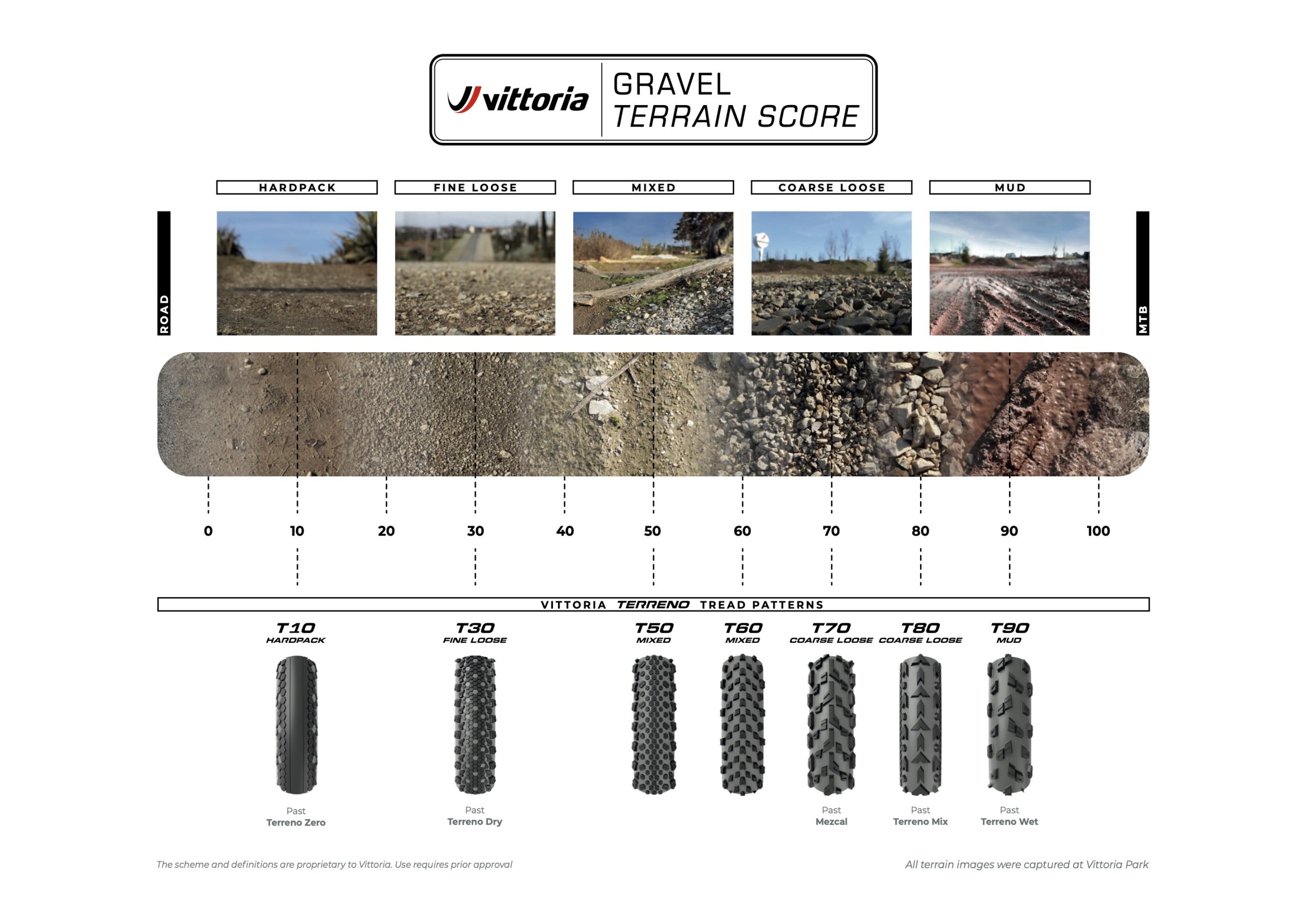
With the new T-Score system, all you’ll need to do to find the right gravel tyre is assess which surface you’re riding on and choose a tyre accordingly.
Stijn Vriends, chairman and CEO of Vittoria, says: “When riders follow the chart and start by identifying the type or types of terrain they intend to ride, and by simply tracing their way down, a rider can quickly identify the perfect tyre for their situation.”
The tyres in Vittoria’s endurance gravel tyre range will feature new labelling, which will correspond to the Terrain Score scale. It will adopt the new naming convention across its sport and performance gravel tyre ranges later in the year.
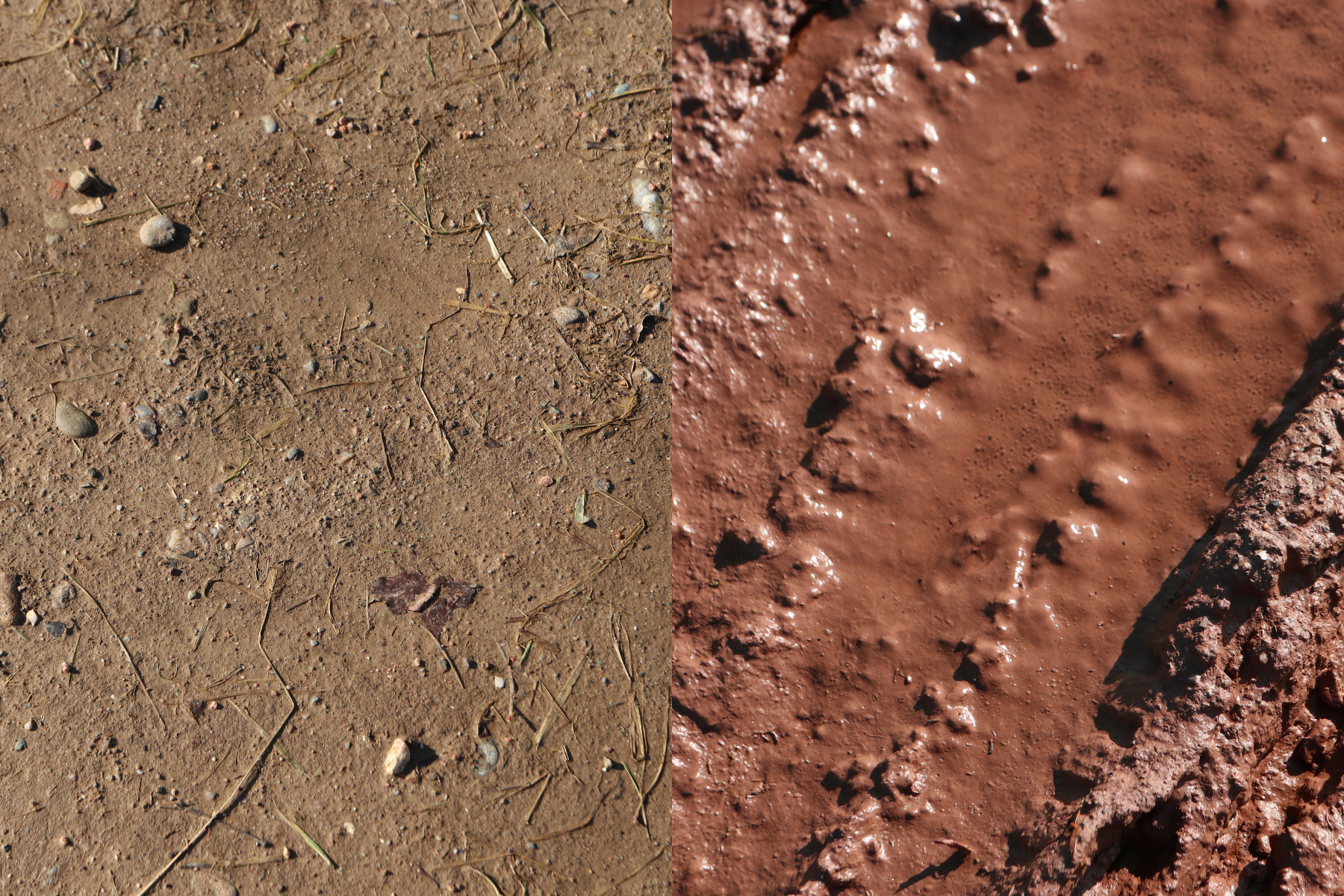
For example, this means the Terreno Zero, suitable for riding on hardpack, will now be called the T10.
At the opposite end of the spectrum, the Terreno Wet, suitable for riding in mud, will be called the T90.
“In all the choices we make, we always strive to put ourselves in the cyclist’s perspective, and this Gravel Terrain Score is precisely an effort to simplify every rider’s decision, as each of them knows what bike they own and what type of terrain they will ride on the most,” says Vanessa ten Hoff, Vittoria’s chief marketing and innovation officer.
Some of Vittoria’s previous gravel tyre names highlighted whether they were suitable for dry or wet riding. But ten Hoff says this was “sort of misleading” because the dry tyres also work well in the wet. “It’s more important to focus on the terrain,” she says.
Vittoria’s new gravel tyre names at a glance
| New tyre name | Ideal surface | Previous name |
| T10 | Hardpack | Terreno Zero |
| T30 | Fine loose | Terreno Dry |
| T50 | Mixed | N/A |
| T70 | Coarse loose | Mezcal |
| T80 | Coarse loose | Terreno Mix |
| T90 | Mud | Terreno Wet |
A confusing golden age?
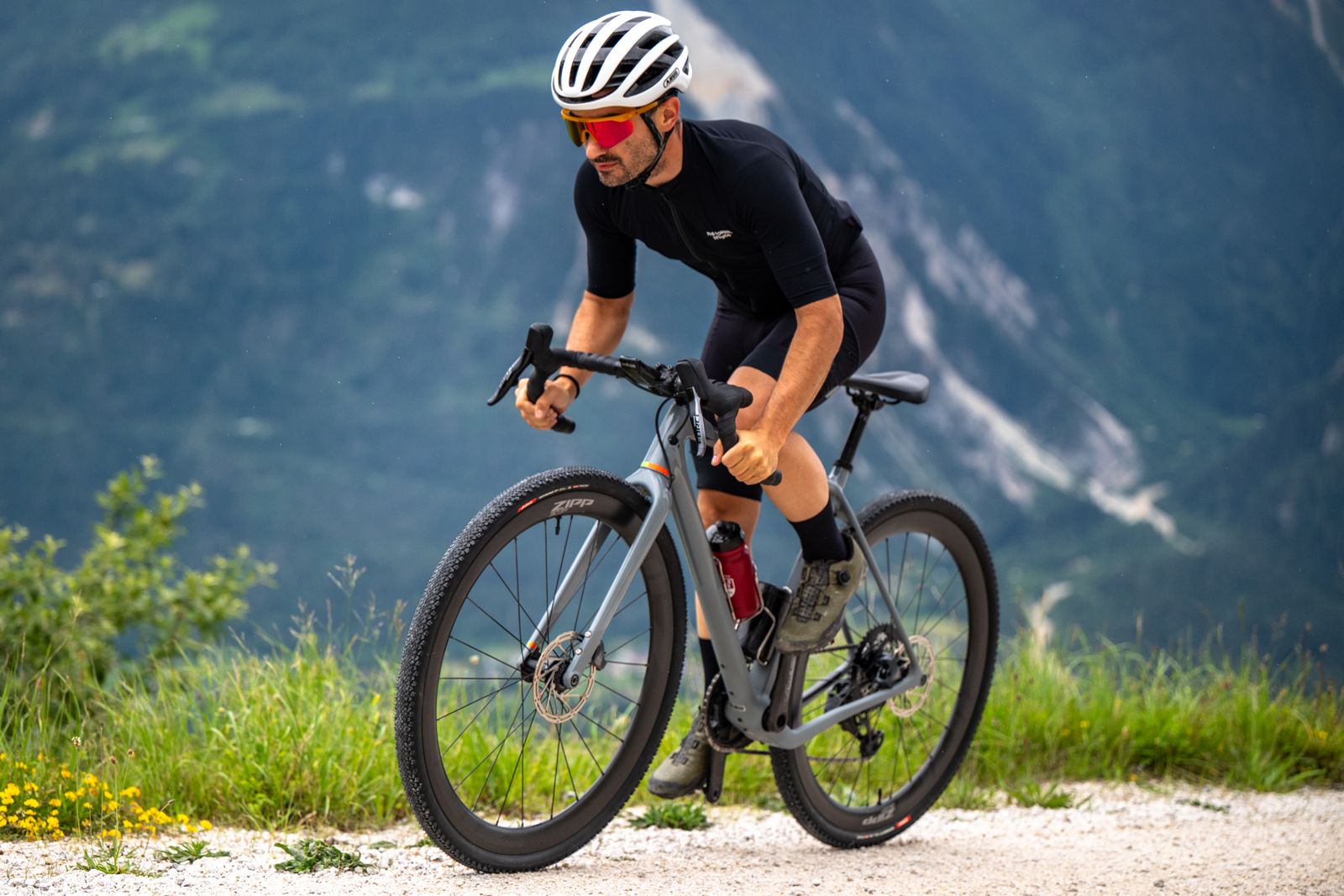
In a white paper, Vittoria explains that we are in a “golden age” of gravel riding. There is an evolution in the bikes and equipment people use as well as riders “enjoying a fresh perspective”.
But the momentum in innovation has led to confusion over equipment and application. This is an issue BikeRadar’s senior technical editor Warren Rossiter addressed, arguing that we need to change the way we categorise gravel bikes.
Vittoria says this issue is particularly true with tyres, and that it should be simpler to pick the right ones.
Instead, consumers are faced with complex naming conventions and product categories.
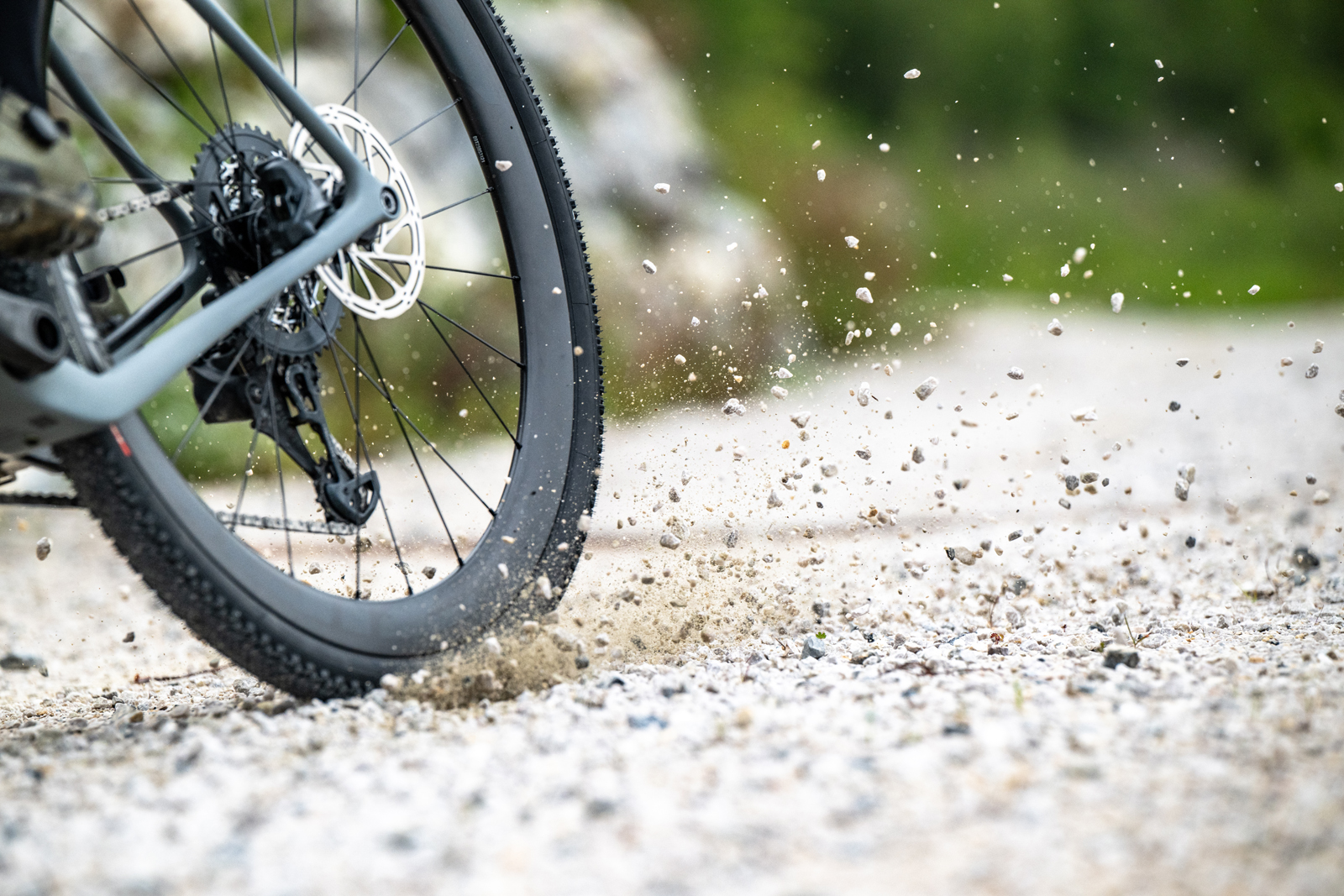
In the white paper, Vittoria says the category of ‘gravel tyres’ does little to guide a consumer towards the correct product for their riding, be it gravel racing or bikepacking, for example.
It says a consumer stating they are interested in gravel riding to a shop assistant is the ‘beginning of a battle’.
“[T]hey must pour [sic] through seemingly endless tread designs, widths, casing and worst of all model names are devoid of any clear contextual application,” it says.
Vittoria says the T-Score will bring some clarity to these interactions: “When that same gravel consumer enters the shop, the dealer can ask, ‘what percentage of the time do you ride off-road?’, and the consumer answer will automatically link their needs to the correct product.”
Vittoria adds that if a consumer has tried one of the products before but wants more off-road capability, knowing which tyre to choose becomes easier. Likewise, if they want a faster tread, they can choose a tyre with a lower T-Score.
Vittoria T50 gravel tyre
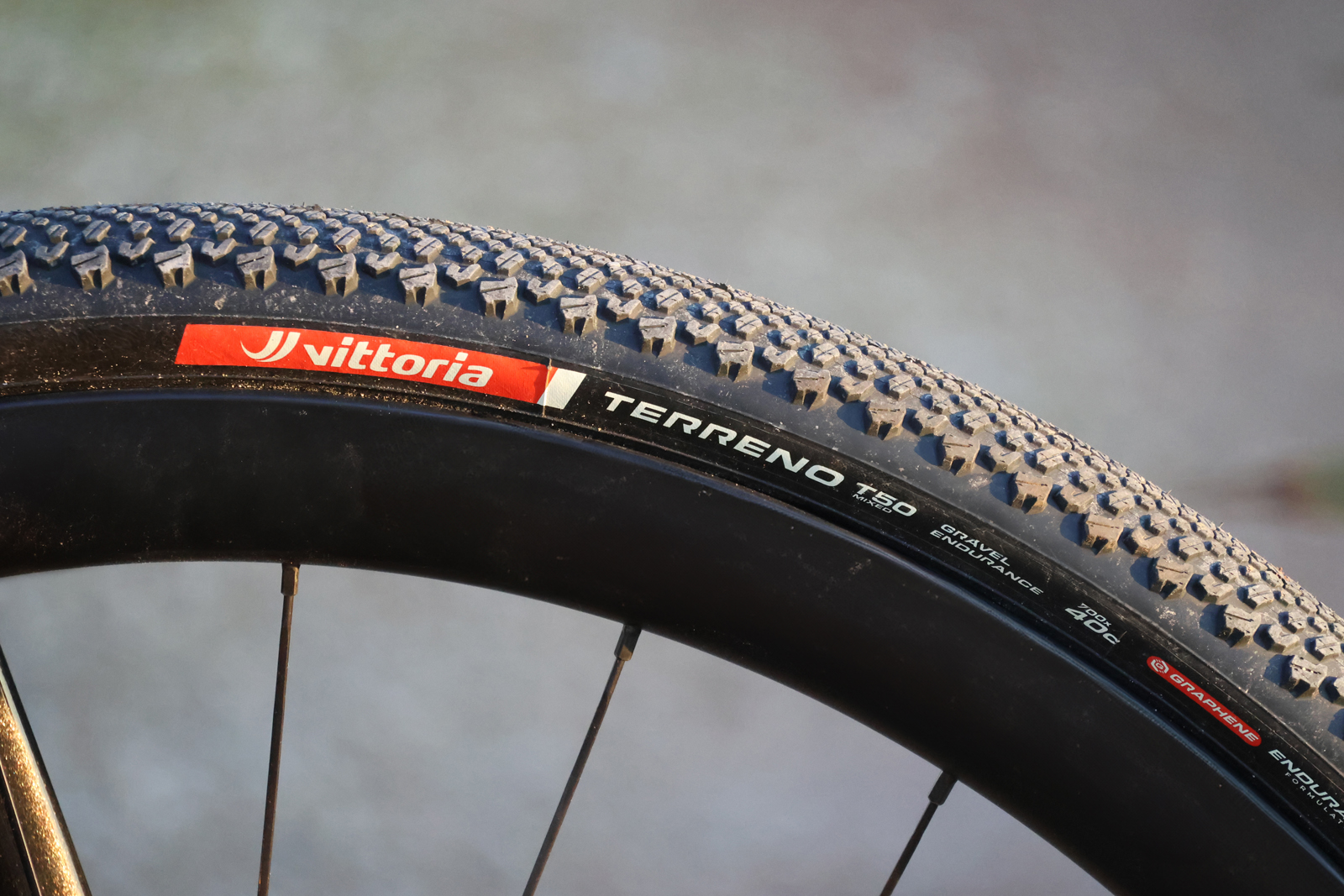
The T50 gravel tyre has no previous equivalent in Vittoria’s range. The tyre is the first from Vittoria to follow the new T-Score naming convention and it’s now available in three sizes.
Designed for mixed terrains, Vittoria says the T50 ensures you can find the “perfect” tyre for your riding in its new categorisation.
Vittoria says the tyre provides “unparalleled speed and capability across various terrains, from hardpack to mixed conditions”.
Ten Hoff explains that the new V-shaped tread plays an integral role in this performance.
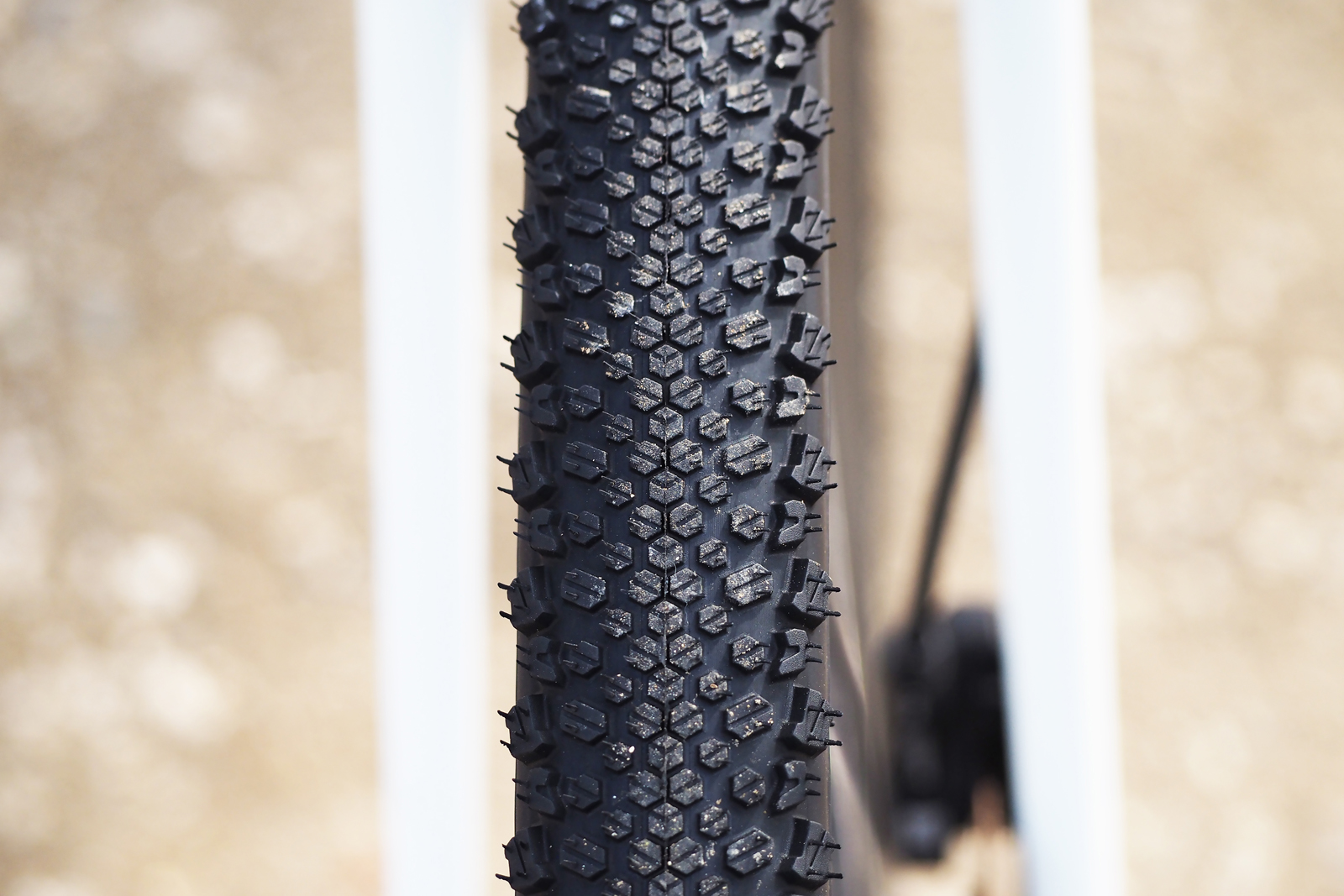
“If you’re going in the riding direction, when the V shape comes down it has the smallest area that grips. But if you’re breaking or cornering, this is where the bigger part of the area is gripping,” she says.
The new directional siping texture on the tyre aids the T50’s performance across the surface.
Sitting wide of the V, there are two lines of lugs on the tread. Ten Hoff says these lugs provide “progressive feedback” when you are leaning and that the lugs on the edge of the tyre are different sizes to help free debris.
“This is what makes the T50 a really, really fast tyre,” she says, adding that the T50 doesn’t feel like a mixed-terrain tyre.
Elsewhere, the tyre uses Vittoria’s endurance casing for adaptability and strength. It features reinforced nylon sidewalls for puncture resistance and stability. The tyre also features an anti-puncture belt.
The T50 uses Vittoria’s Endurance Formulation tyre compound with graphene, making it suitable for long-distance gravel riding.
The tyre will be available in three sizes, from 40m to 50mm, costing €58.95.
It will also be available with black or brown sidewalls, which will soon be available for all Vittoria’s gravel tyres.
FSA’s Gradient components put compliance first – and you should too
FSA’s all-new Gradient components range is designed to boost rider performance by targeting compliance and durability.
From the new i30 carbon wheels to both the carbon and aluminium handlebars, all of Gradient’s premium-level components have been developed in conjunction with the Atherton Continental race team to be as compliant and strong as possible.
The new range encompasses mountain bike wheels, handlebars, stems, and cranks and chainrings, with prices ranging from £99.99 / $99 / €119.99 for the direct-mount stem up to £1,499 / $1,420 / €1,498 for the wheelset.
While the new i30 wheelset – with its striking-looking variable-depth rim – is probably the biggest news here, it’s the carbon and alloy handlebars that piqued my interest the most.
Bars aren’t boring
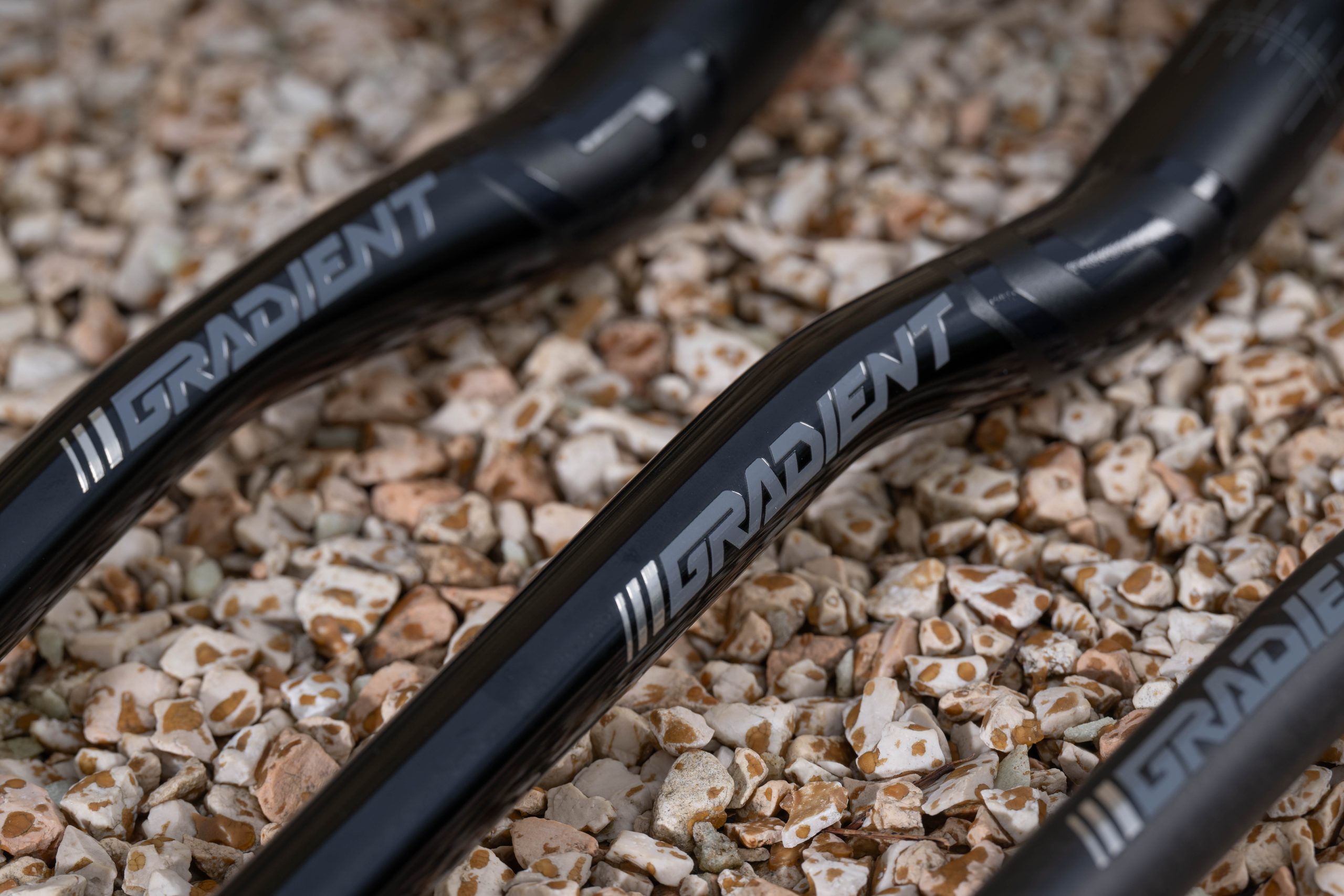
Handlebars are the most important contact point between you and your bike.
While your pedals, saddle and sometimes frame act as two-way translators between you and the bike, it’s the handlebar you have the most visceral, raw connection with.
Your hands are filled with nerve endings, sending millions of sensory inputs to your brain every millisecond.
Harshness, steering vagueness, feel and comfort are derived – in large part – from the bar.
Getting it right is, therefore, important and FSA thinks it has done just that with the newest Gradient kit.
Offered in two material types – carbon and alloy – and two stem-clamp diameters for each material – 31.8mm and 35mm – the brand has gone to great lengths to emphasise the importance of their feel.
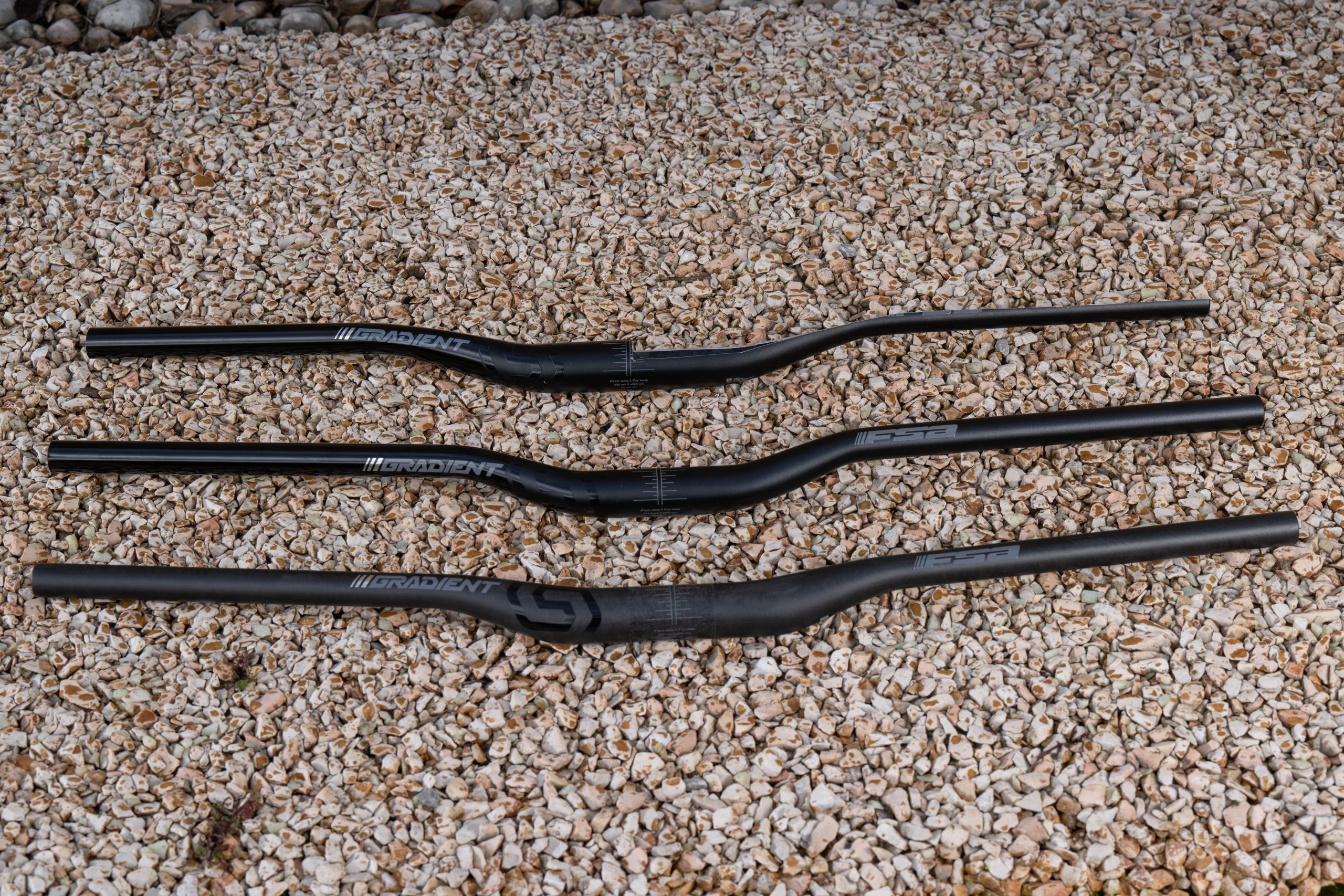
All variants share an 800mm width, eight-degree backsweep and five-degree upsweep. The carbon versions come in 20mm and 30mm rises, and the alloy ones 25mm and 40mm.
Now the important bit; the carbon bar’s layup has been specially formulated to “increase compliance”, and is said to offer “superior vibration-damping qualities” helping “reduce arm fatigue”.
While that may sound like word soup to the less tech-savvy, it basically means the new bar should – although it’s not guaranteed – filter out some of the trail’s buzzy, harsh vibrations that can cause your hands to cramp and seize up.
The alloy bar is claimed to do a similar thing, but FSA acknowledges the two materials are not equal.
Increased compliance is the main focus, however.
Here, the brand says aluminium – at least with how it has been manufactured – is going to “absorb large impacts” and help reduce rider fatigue when the terrain goes from extreme to crazy.
To improve the bar’s resonance-damping abilities beyond the alloy’s own properties, FSA has ‘squashed’ or flattened its bends (where it rises) to reduce stiffness.
FSA says the proof is in the pudding, with its sponsored riders choosing the alloy version over the carbon one, because of the smoother feel.
Not missing a trick, though, the brand’s latest, or should I say resurgent, smaller bar-clamp diameter standard is claimed to increase the damping further without feeling – in my words – ‘noodly’.
Cashing in on compliance
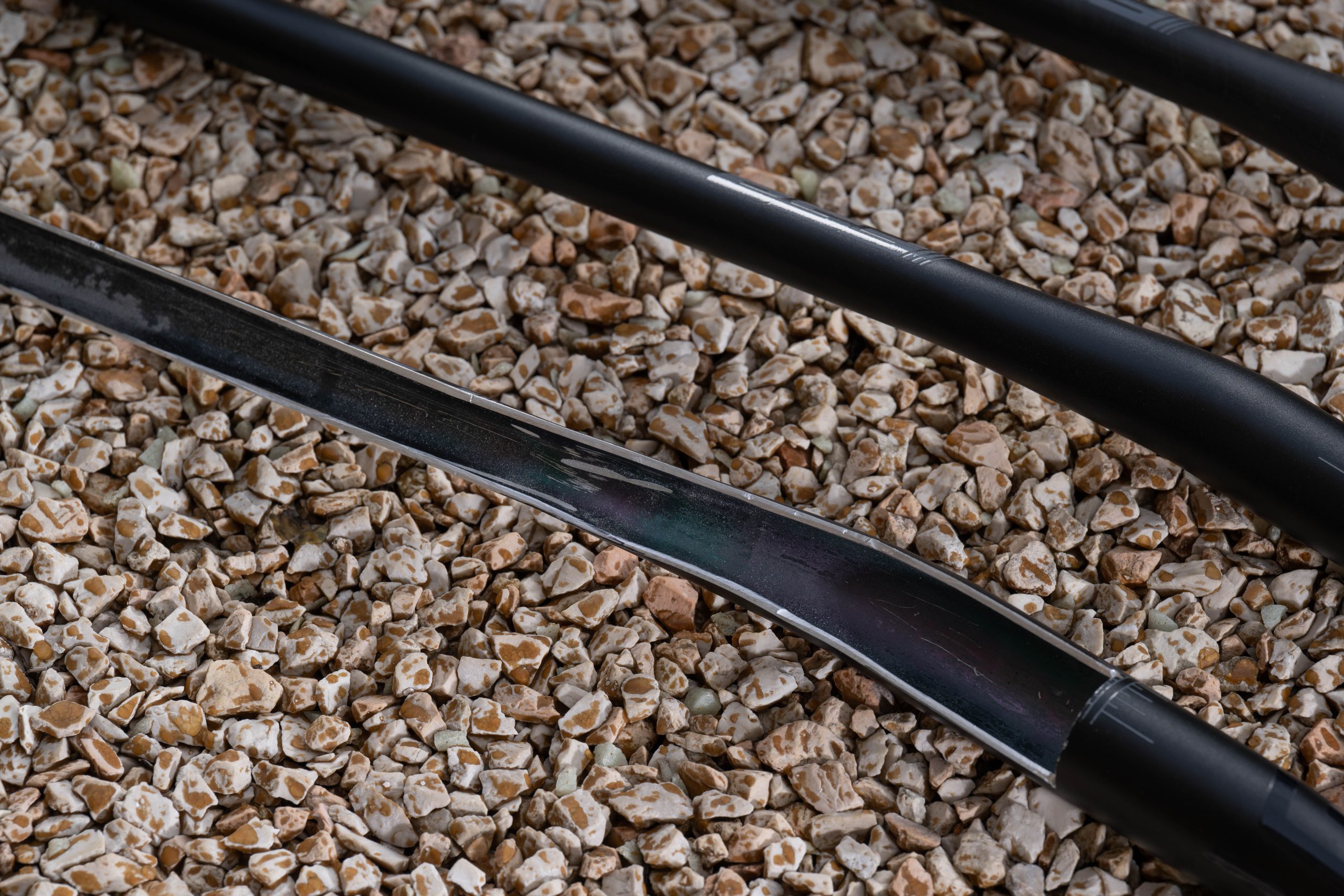
FSA isn’t the only brand cashing in on this latest compliance craze, however.
As manufacturing and technology, and therefore bikes, improved quickly throughout the late 2000s and early 2010s, every component and frame became stiffer.
As a sum of their parts, we reached a tipping point where bikes were too rigid.
They rode like bucking broncos, with each part transferring every one of the trail’s undulations directly into your hands, wrists and arms.
This resulted in a tiring and uncontrollable ride.
Brands such as OneUp launched the compliance-tuned Carbon Handlebar, and later the alloy alternative, pioneering the ovalised or flattened profile where the bar raises.
We’ve also seen this expertise with compliance used in wheel building – the Crankbrothers Synthesis being a prime example – where the front is tuned for compliance and the rear for stiffness.
Most recently, it has been used in stems. Employing the molecular structure of cast magnesium, Leatt hopes its stems will dampen vibrations.
FSA hopes it’s onto something by tapping into this performance-enhancing trend.
FSA’s i30 wheels
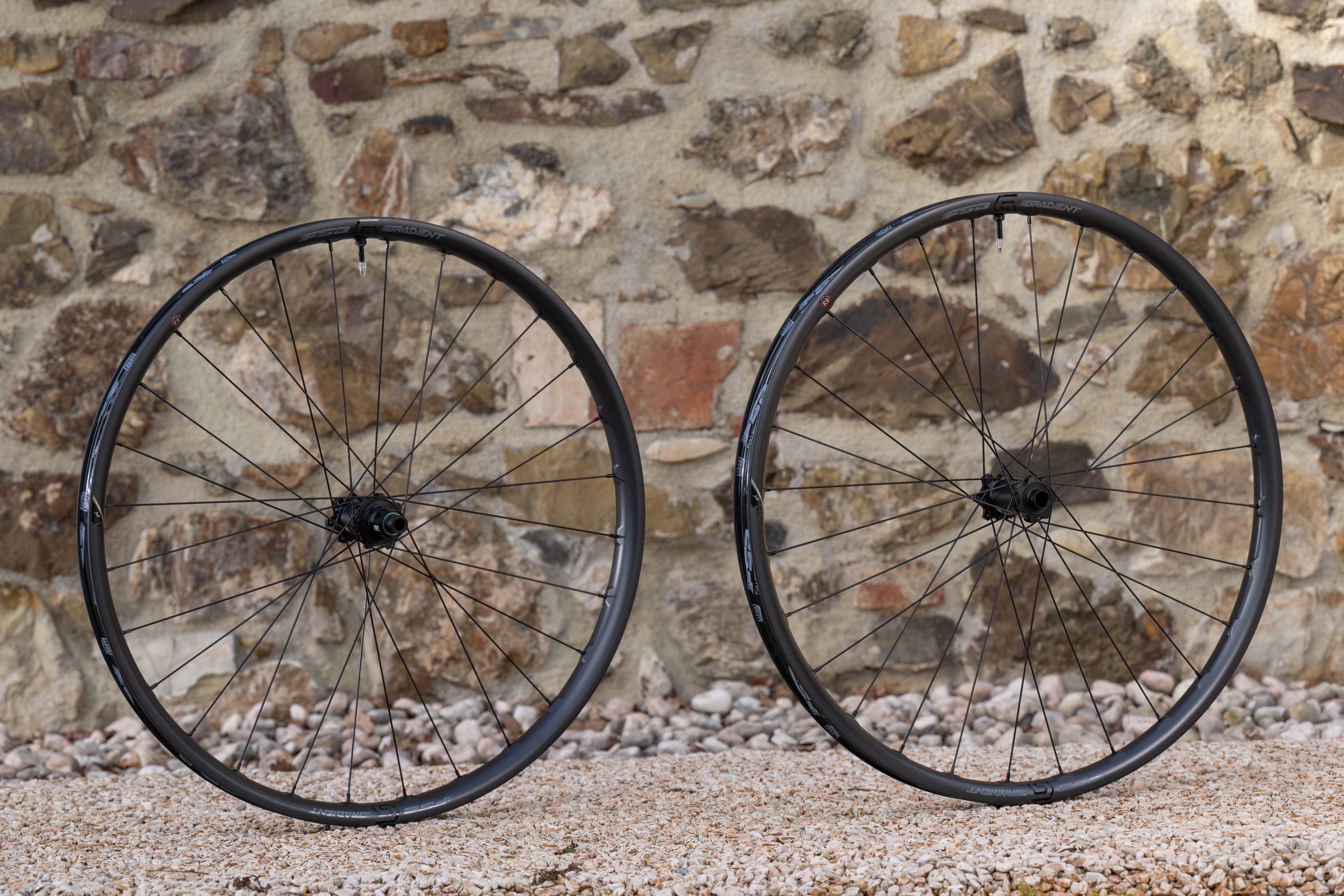
The new i30 wheels are also claimed to offer compliance and a smooth ride quality.
That’s thanks, firstly, to a “special carbon layup”, where material is presumably added in some places and removed from others to tune stiffness.
Secondly, and just as importantly, it’s because of the striking variable-height rim. Here, the spokes anchor onto a thicker, taller section. There is then a lower, thinner section between each spoke.
Mimicking FSA road-wheel tech – called ‘interspoke milling technology’ – the wheels are said to be light and strong.
This 22mm to 24mm height variation is behind a good chunk of the compliance ‘magic’.
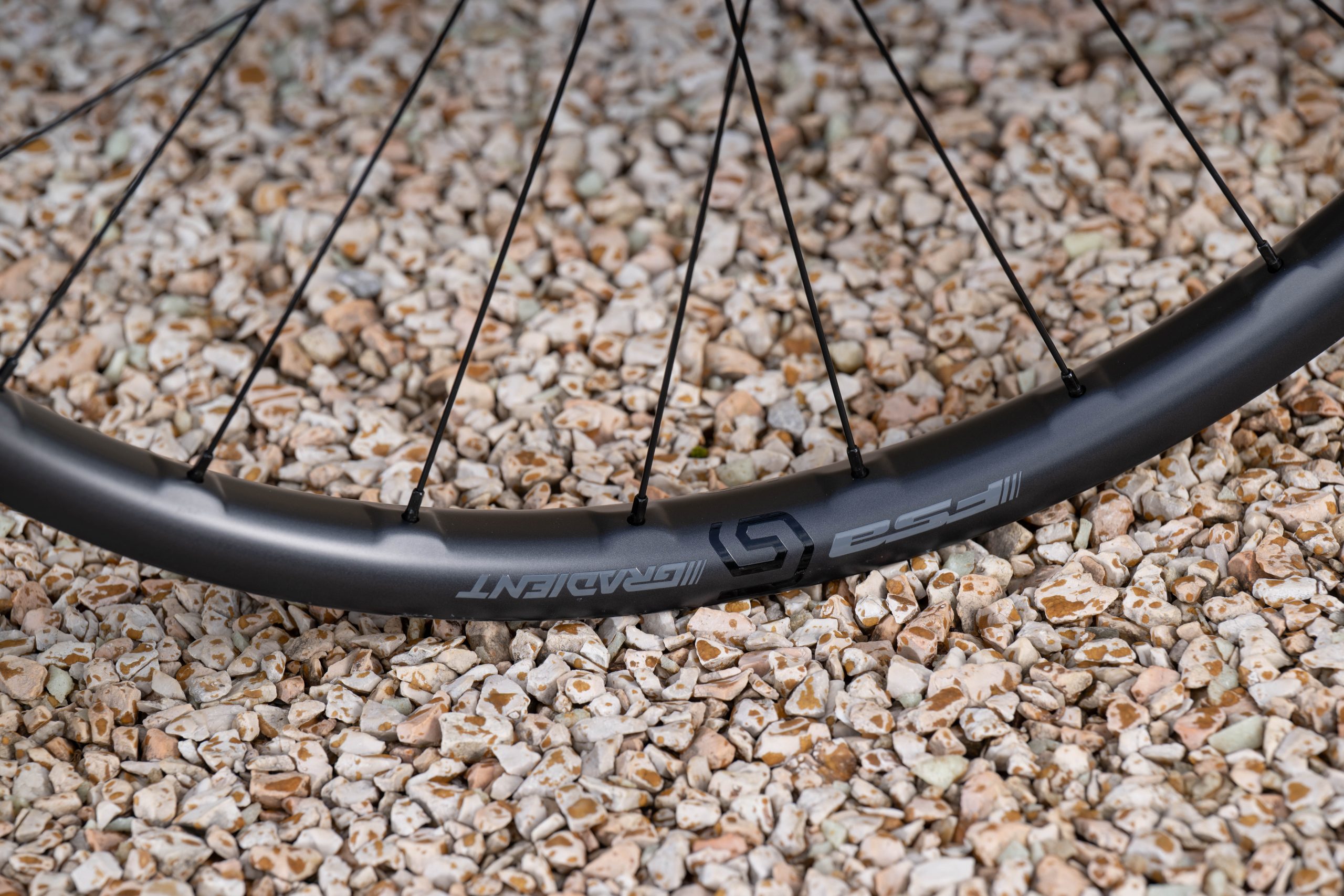
FSA claims the lower height “provides increased flexibility”. By implication, a more flexible rim means vibrations and big hits are better absorbed by the wheels.
With a 30mm internal width – hence the name i30 – FSA is saying this metric also plays its part in tuning strength or stiffness and “handling”, which reading between the lines means the wheels’ ability to absorb vibrations.
Details make the difference
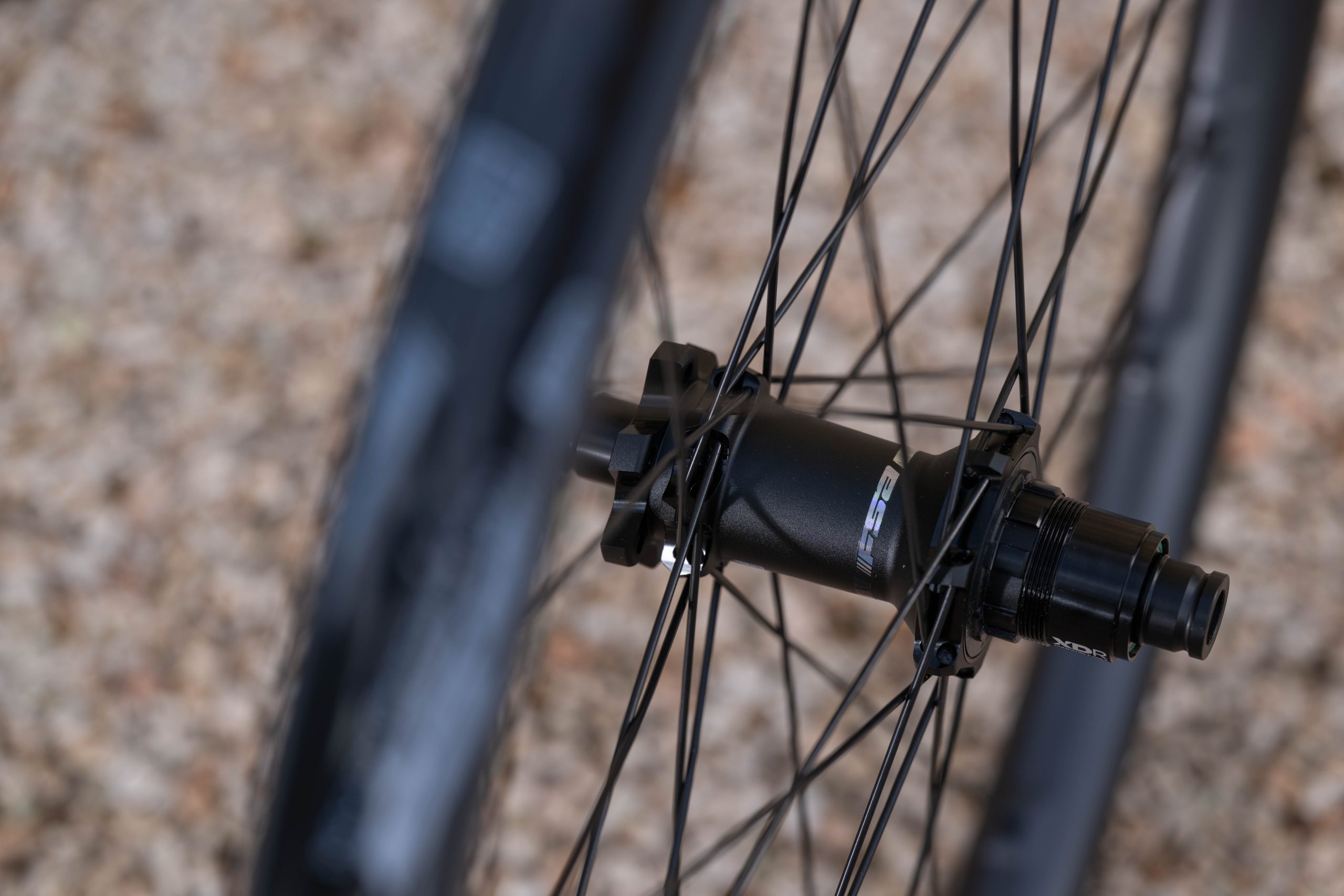
In terms of other details, the rims have a 4mm asymmetrical design, where the spokes sit off to one side, helping create an evenly tensioned build.
The rims have a 37mm external width – which is par for the course these days – and a 3.5mm sidewall width, which is claimed to reduce pinch flats.
The hubs have Microspline and SRAM XD freehubs, running on a 72-point ratchet-style engagement system.
According to FSA, the hubs have a tool-free design to speed up and simplify maintenance.
Extensive testing has put each part of the wheels through stringent ride-simulating torture.
Torsional, ISO, impact, fatigue, mud and spoke testing have all been carried out.
Emerging with the highest ASTM5 rating, the i30 wheels look impressive.
In fact, FSA’s so confident in the wheels’ durability, it’s offering a lifetime warranty on them.
A pair of 29in wheels are claimed to weigh 1,869g, which is marginally heavier than DT’s EXC 1200, but slightly lighter than the EXC 1501 wheels, both of which set the benchmark in carbon wheel performance.
Hold on, what about the wheel build?
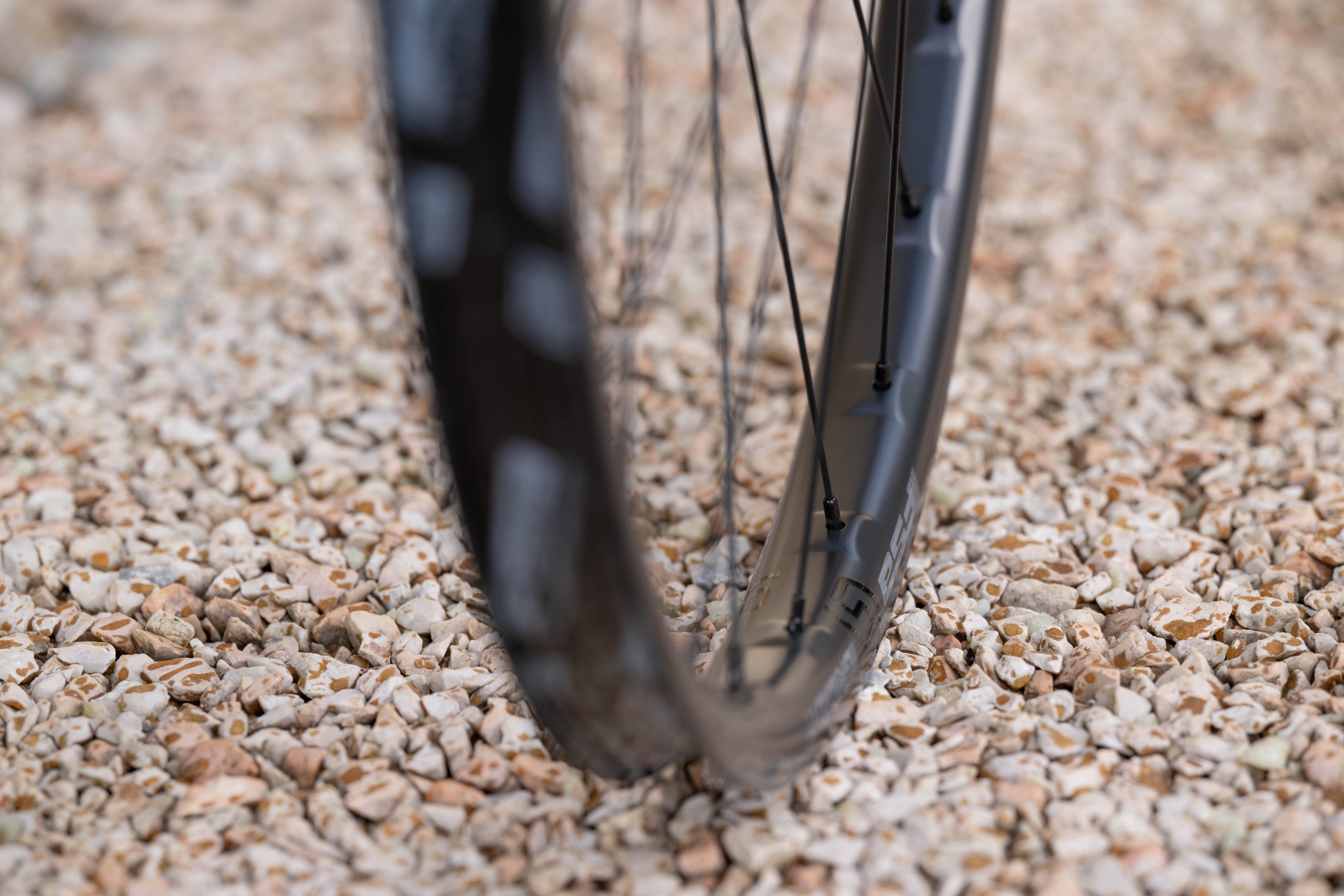
The most important part of a wheel is arguably its build.
No amount of individual component tuning can compensate for a badly built wheel, whether that’s because it’s weak and wobbly, or ultra-stiff and harsh.
And we all know the painstaking approach pro racers and their mechanics take to wheel builds, finely tuning spoke tension to adjust the feel.
It’s a bit of an art; and while FSA may have done all this, it’s a surprise to see it’s not shouting about it.
Not mentioning how its wheels are built beyond stating the spokes are evenly tensioned thanks to the rim’s asymmetrical design seems like a bit of an omission.
The only other tidbit of information I could glean is about the spokes and their mounting points.
The brand says it has “[applied] a force of 150kg to the spokes and rim spoke holes” to check durability and strength, but there’s no mention of spoke tension.
Of course, the brand’s engineers aren’t stupid and neither are the pro riders who have used and tested the wheels, so until I try a pair, I’m going to take FSA’s word about these claims.
Rounding out the Gradient range
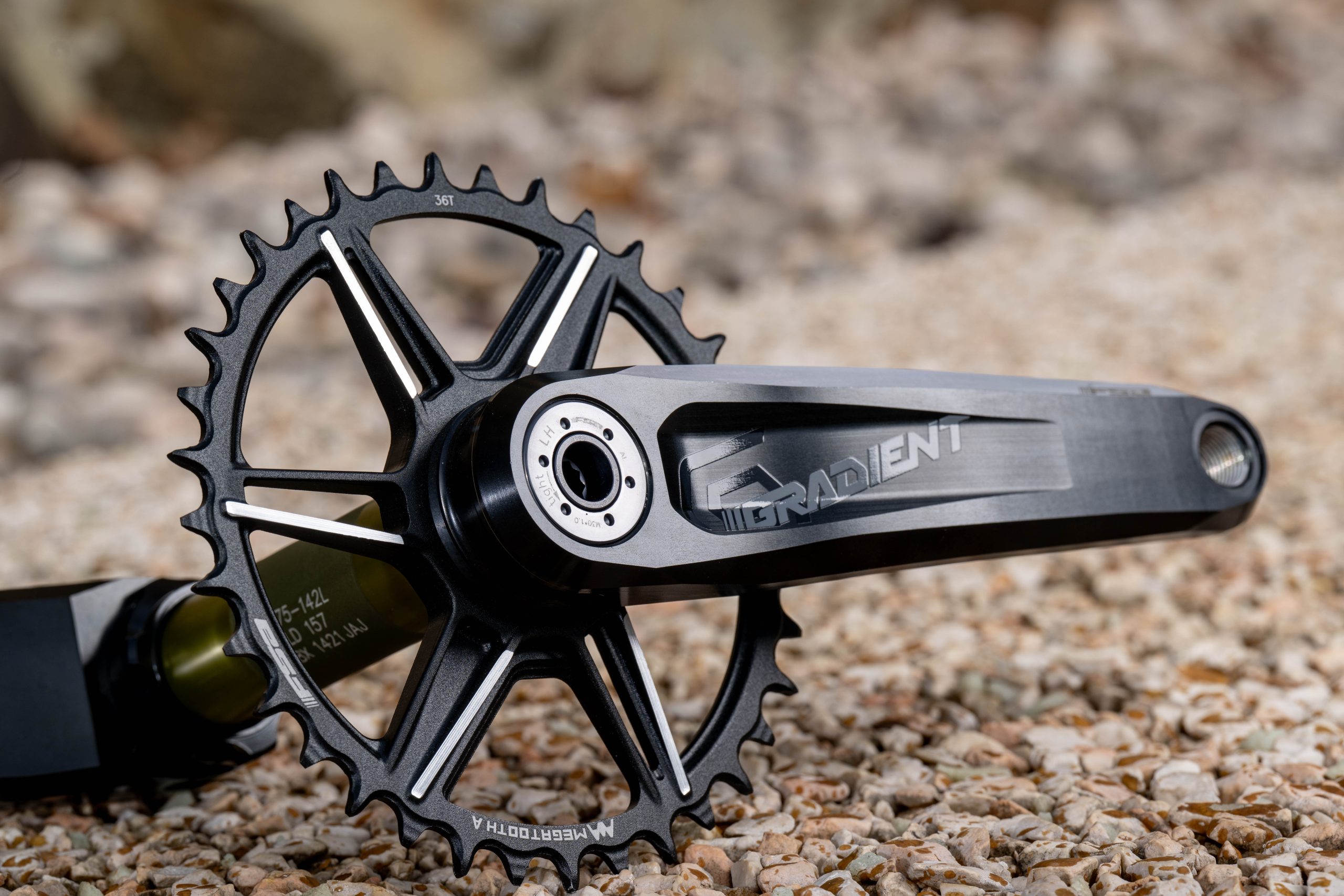
Although not focused on compliance like the bars and wheels, the new Gradient range also includes stems – both fork crown direct-mount and steerer-bolted – and a 1x aluminium crankset.
The Gradient cranks are made from forged aluminium with CNC machine finishing, where two halves of each crank arm are made from a single block of material and then seamlessly bonded together.
They’re available in 165mm, 170mm and 175mm lengths and have 30t to 36t (in 2t increments) chainring options.
Both the direct-mount and steerer-bolted stems are available to match the 31.8mm and 35mm clamp-diameter Gradient handlebars.
The direct-mount stem comes in 45mm and 50mm lengths, while the steerer-bolted stem has 33mm, 45mm and 50mm lengths.
FSA Gradient range prices
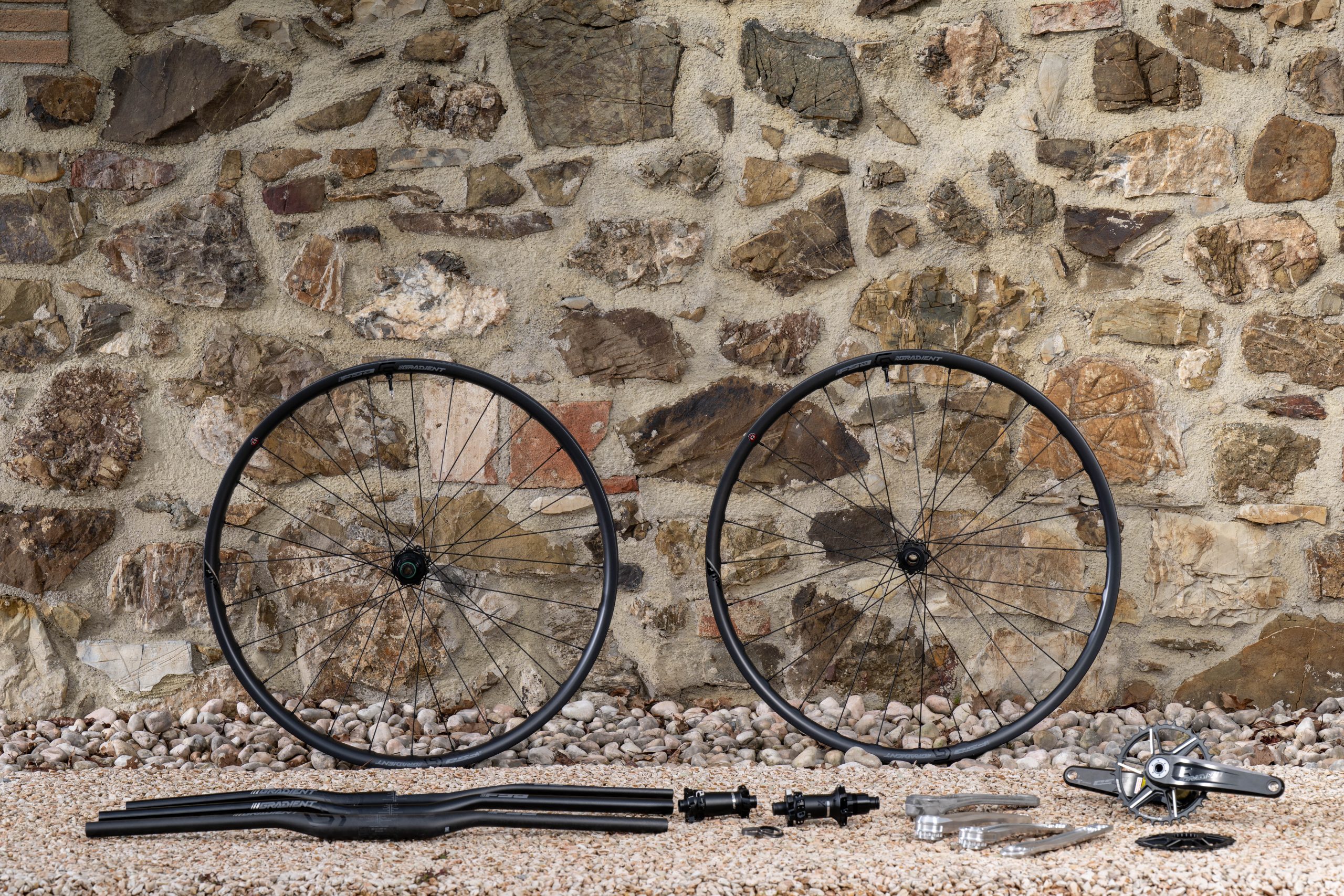
- FSA Gradient i30 wheels: £1,499 / $1,420 / €1,489
- FSA Gradient Alloy Riser handlebar, 31.8mm: £99.99 / $85 / €99.90
- FSA Gradient Alloy Riser handlebar, 35mm: £99.99 / $89 / €105
- FSA Gradient Carbon Riser handlebar, 31.8mm: £184.99 / $149 / €179
- FSA Gradient Alloy Riser handlebar, 35mm: £184.99 / $159 / €199.90
- FSA Gradient stem: £99.99 / $99 / €119
- FSA Gradient Alloy crank (without chainring): £399 / $330 / €379
- FSA Gradient chainring: £134.99 / $114 / €198
Google Pixel 9a review: All the phone you need
It took a few years, but Google’s Pixel phones have risen to the top of the Android ranks, and its new Pixel 9a keeps most of what has made flagship Pixel phones so good, including the slick software and versatile cameras. Despite a revamped design and larger battery, Google has maintained the $499 price point of last year’s phone, undercutting other “budget” devices like the iPhone 16e.
However, hitting this price point involves trade-offs in materials, charging, and—significantly—the on-device AI capabilities compared to its pricier siblings. None of those are deal-breakers, though. In fact, the Pixel 9a may be coming along at just the right time. As we enter a period of uncertainty for imported gadgets, a modestly priced phone with lengthy support could be the perfect purchase.
A simpler silhouette
The Pixel 9a sports the same rounded corners and flat edges we’ve seen on other recent smartphones. The aluminum frame has a smooth, almost silky texture, with rolled edges that flow into the front and back covers.