ChatGPT Now Has a ‘Library’ of Your AI-Generated Images

Like many AI chatbots, ChatGPT has offered image generation for some time now. You might be well acquainted with it, seeing as its latest image generation tools have recently gone viral.

Putting both the ethics of AI art as well as its errors, quirks, and inconsistencies aside for a moment, you may have noticed some issues with ChatGPT’s image generation, especially if you’ve been using a lot. Since each image is contained to the ChatGPT conversation in which it was generated, it’s quite difficult to keep tabs on all your images, unless you’re exporting and cataloging them somewhere else manually. OpenAI might not be able to solve the other issues with AI art yet, but it can offer a solution to the last point.

Introducing ChatGPT’s Image Library

On Tuesday, OpenAI announced Image Library, a new section of ChatGPT. The Image Library automatically stores all images you generate with ChatGPT’s 4o model across your various discussions. That way, you don’t have to scroll through past threads in search of a particular image you made. It sort of acts like the default image library on your smartphone: Any photos you take or save throughout the day end up in one centralized database.


This Tweet is currently unavailable. It might be loading or has been removed.

All ChatGPT account types now have access to Image Library—including Free, Plus, and Pro—and you can access it from both the app as well as the web app. You’ll find the option, “Library,” in the side panel on the left, under “Explore GPTs.” (While the web app should update on its own, you may need to update your ChatGPT app before the option appears, however.)

The Library itself is relatively straightforward. When you open it, you’ll see your previous image generations. It might not be all of your images, however: I was a bit confused to see two of my most recent generations, knowing I had definitely generated far more with ChatGPT in the past. However, OpenAI says legacy DALL-E images will not appear here. Only images generated with 4o are added to the library, so don’t expect your entire generation history to pop up. That said, OpenAI says it is currently backfilling all images for the new Library feature, so more of your older images may appear in your Library over the next couple days.

When you select one of your images in your Library, ChatGPT presents you with a series of options: Edit, Select, Save, and Share. You can choose “Edit” to launch a new chat along with the image, so you can prompt ChatGPT with the edits you want it to make. Similarly, “Select” lets you highlight a portion of the image you want to edit, so ChatGPT will only change that selection. You can choose “Save” to add the image to your device’s personal library, while “Share” lets you export the image to any destination you want.

I don’t use ChatGPT for much, especially image generation, so I can only imagine this feature will be a convenience for those that do. However, one pain point I see is the lack of a “delete” option. If you want to remove an image from your ChatGPT Library, you have to find the thread you generated it in and delete it from there. While Library lets you open the thread where that image was generated, you won’t be able to delete the image or the thread from here. Instead, you need to locate the thread from the conversation title in your sidebar, then delete the entire conversation to delete the image or images within. It’s pretty complicated, and I’m not sure why OpenAI does it this way, so here’s hoping it adds a simple “delete” button to each image in the Library sooner or later.

[$] What’s new in APT 3.0

Debian’s Advanced Package Tool (APT) is the suite of utilities that handle package
management on Debian and Debian-derived operating systems. APT recently received a
major upgrade to 3.0 just in time for inclusion in Debian 13
(“trixie”), which is planned for release sometime in 2025. The version bump is
warranted; the latest APT has user-interface improvements, switches to Sequoia to verify package
signatures, and includes solver3—a new solver that is designed to improve
how it evaluates and resolves package dependencies.

RoboBee sticks the landing

The RoboBee lands on a leaf. Credit: Harvard Microrobotics Laboratory

Several years ago, Harvard University roboticist Robert Wood made headlines when his lab constructed RoboBee, a tiny robot capable of partially untethered flight. Over the years, RoboBee has learned to fly, dive, and hover. The latest improvement: RoboBee has learned how to stick the landing, thanks to biomechanical improvements to its landing gear modeled on the crane fly, which has a similar wingspan and body size to the RoboBee platform. The details of this achievement appear in a new paper published in the journal Science Robotics.

As previously reported, the ultimate goal of the RoboBee initiative is to build a swarm of tiny interconnected robots capable of sustained untethered flight—a significant technological challenge, given the insect-sized scale, which changes the various forces at play. In 2019, Wood’s group announced its achievement of the lightest insect-scale robot so far to have achieved sustained, untethered flight—an improved version called the RoboBee X-Wing. In 2021, Wood’s group turned its attention to the biomechanics of the mantis shrimp’s knock-out punch and built a tiny robot to mimic that movement

But RoboBee was not forgotten, with the team focusing this time around on achieving more robust landings. “Previously, if we were to go in for a landing, we’d turn off the vehicle a little bit above the ground and just drop it, and pray that it will land upright and safely,” said co-author Christian Chan, one of Wood’s graduate students. The trick is to minimize velocity when approaching a surface and then quickly dissipating impact energy. Even something as small and light as RoboBee can generate significant impact energy. The crane fly has long, jointed appendages that enable them to dampen their landings, so the insect served as a useful model for RoboBee’s new landing gear.

Read full article

Comments

Catanzaro: Dangerous arbitrary file read vulnerability in Yelp

GNOME contributor Michael Catanzaro has written a blog
post
about a noteworthy vulnerability in GNOME’s help browser, Yelp.

I don’t normally blog about particular CVEs, but Yelp CVE-2025-3155 is
noteworthy because it is quite severe, public for several weeks now,
and not yet fixed upstream. In short, help files can read your
filesystem and execute arbitrary JavaScript code, allowing an attacker
to exfiltrate any files your Unix user has access to.

The vulnerability was first reported on December 25, and it
was made public on March 26 after the 90-day-disclosure deadline
was reached. Patches
have been proposed to fix the issue. The bug reporter has published a writeup
demonstrating the attack
. Catanzaro asks that Linux vendors
“please consider applying the provided patches even though they
have not yet been accepted upstream
“.

Xbox users can now stream games they own on their consoles

Microsoft just announced that Xbox Series X/S and Xbox One owners can now stream select games they own directly from the console. This feature is exclusive to Game Pass Ultimate members.

What’s the point of this? It’s intended to save both time and hard drive space. Gamers can jump right in immediately, without having to download and install a giant file. It doesn’t work with every game. As of this writing, there are over 100 titles that enable this feature. They include standouts like Assassin’s Creed Shadows, Animal Well, Baldur’s Gate 3 and Hogwarts Legacy, among others.

An ad for the feature showing Assassin's Creed.
Xbox

All you have to do is peruse your library and look for the cloud icon accompanying a game. Playable titles can also be filtered in search. The Store app even displays this icon, allowing you to start playing as soon as you hand over some digital cash.

Xbox players could already do this on devices outside of an official console. Throughout the past few months, the feature has been popping up on select smart TVs, Amazon Fire TVs and Meta Quest VR headsets. It also works on browser-supported devices like PCs, tablets and smartphones. A beta test for Xbox consoles started in December.

Microsoft also just announced that backward compatible games from the Xbox and Xbox 360 will now be streamable via remote play across all supported devices. That significantly increases the library of available titles. It’s worth noting that the company has removed remote play from the official Xbox app on mobile, but it still works via browsers.

This article originally appeared on Engadget at https://www.engadget.com/gaming/xbox/xbox-users-can-now-stream-games-they-own-on-their-consoles-173739687.html?src=rss

What happened when Formula E visited an American oval track?

MIAMI—A decade after its first visit to the state, Formula E returned to Florida this past weekend. The even has come a long way since that first chaotic Miami ePrix: The cars are properly fast now, the racing is both entertaining and quite technical, and at least the trackside advertising banners were in place before the start of the event this time.

It’s not the same track, of course. Nor is it anywhere near the Hard Rock Stadium that Formula 1 now fills with ersatz marinas and high-priced hospitality packages during its visit to the area. Despite what the b-roll helicopter shots might have led viewers to believe, we were actually an hour south of the city at a mid-sized oval track next to a landfill in Homestead. Usually, a place that hosts NASCAR races, for Formula E, there was a 2.2-mile (3.5 km) layout that used the straights and infield but not the banked corners.

Formula E has begun to branch out from its original diet of racing exclusively on temporary city center street tracks, having visited Portland International Raceway in Oregon in 2023 and 2024. Despite the bucolic charm of PIR, with its easy bicycle and light rail access, enthusiastic crowd of attendees, and exciting racing, it was only a temporary patch for Formula E. The vast majority of Formula E’s fans live outside the US, and Portland means nothing to them, but they’ve heard of Miami, I was told last year.

Read full article

Comments

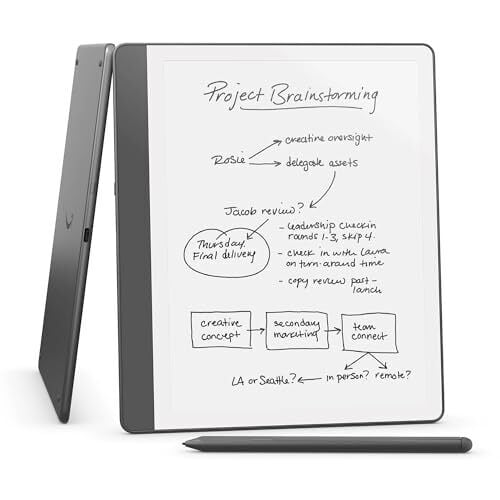
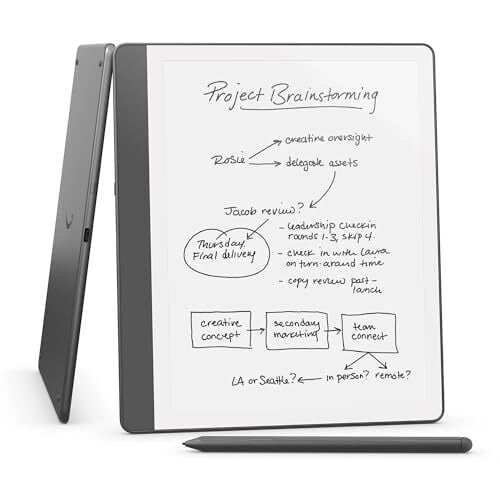
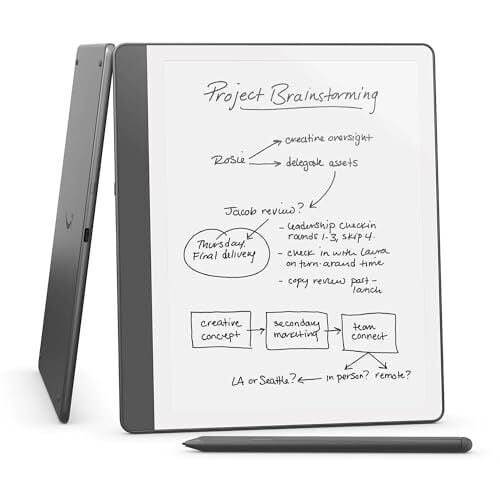
My Favorite Amazon Deal of the Day: The New Amazon Kindle Scribe

We may earn a commission from links on this page. Deal pricing and availability subject to change after time of publication.

A new version of the Kindle Scribe, an upgraded version of the classic e-reader designed for note-taking, came out this past December, with some nice upgrades that make the device more pleasant to use. Those upgrades don’t come cheap, with prices on the new Kindle Scribe starting at $399.99. Right now, though, the 16GB version is discounted to $324.99, the 32GB version is going for $339.99 (originally $419.99), and the 64GB version is $364.99 (originally $449.99).

The original Kindle Scribe first came out in 2022; that first version is currently $339.99 for the 16GB model, which puts how good of a deal this is in perspective.

If you already have the 2022 version, there really is no reason to upgrade. The main difference is the 2024 version comes with the Premium Pen instead of the Basic Pen stylus. The tablet itself is shorter, narrower, and slimmer, but not by much (you can even still use the same case). The new screen also has texture, which will add more resistance when you’re writing on it for a more natural feel, and the gap between the screen and the outer casing is smaller. But that’s where the differences end, at least according to PCMag’s 3.5-star review.

Otherwise, you’ll get the same book format compatibility, the same 15.3 oz weight, the same glare-free 300 ppi front-lit display screen, and the same 12-week battery life. Both tablets run the same software. Still, if you don’t own a Scribe at all and are considering getting one, the newer version is the better option, especially since it is currently cheaper than the older version.

Cronos: The New Dawn seems to smush Dead Space and Control together (in a good way)

Bloober Team has provided a first proper look at gameplay for its latest project, Cronos: The New Dawn, after a brief tease at the end of the initial reveal in October. The trailer has a very Dead Space-like feel, which shouldn’t be too surprising given that this is a third-person survival horror game, but that’s hardly a bad thing. There appear to be some other influences at play here, and there’s one particular feature that seems quite terrifying.

The game takes place across two time periods, a decayed post-apocalyptic future and 1980s-era Poland. As a Traveller, you’re sent back in time to rescue certain people before they die in an apocalypse. To do that, you’ll need to battle creatures known as Orphans, which Bloober describes as “twisted, body-horror monstrosities born from humanity’s darkest nightmares.” But you’ll need to be sure to burn the bodies of fallen monsters. If you don’t, that can spell a whole heap of trouble.

Living Orphans can absorb the bodies of their fallen ilk. This so-called Merging evolves the creatures. They become fast, stronger and tougher to take down, and they gain new abilities to boot. So yeah, you’ll want to torch any Orphans that you take out.

There’s a lot going on elsewhere in the trailer. Along with Dead Space, the action and visuals evoke games like The Last of Us Part 2 (if you know, you know), Returnal, Bioshock and Control — not least because of the shifting, fractured Brutalist architecture. The creature designs are reminiscent of those in last year’s Silent Hill 2 remake, a game that Bloober Team just happens to be behind.

Those aren’t criticisms in any way. There’s nothing wrong with drawing inspiration from others and fashioning them into something new. Cronos: The New Dawn is looking pretty compelling, and it’s already got a spot on my wishlist.

Cronos: The New Dawn is slated to arrive later this year. It’s coming to Steam, PS5 and Xbox Series X/S.

This article originally appeared on Engadget at https://www.engadget.com/gaming/cronos-the-new-dawn-seems-to-smush-dead-space-and-control-together-in-a-good-way-172611962.html?src=rss

The Best Cheeses for Homemade Pizza

When preparing for homemade pizza, it’s easy to hit the grocery store with mozzarella on your list. But what kind of mozzarella is best? Fresh, shredded, string? And is that really the best cheese for the pizza you’re craving? I sit here typing away when I should be nursing the burnt roof of my mouth because great pizza discoveries have been made in my kitchen today—my cheese-scorched mouth can wait. 

Similar to why there are good and bad cheese options for the best grilled cheese sandwich, pizza requires one with good melting properties (a fatty cheese), with a good balance of water, and not an overload of protein (which can resist melting). There are some surprises here, including cheeses you’d normally find at the sandwich counter and cheeses you’ve probably seen on pizza before. Here are the best cheeses to try on your next pizza, and unexpected ones to avoid.

Muenster cheese (and fatty cheeses)

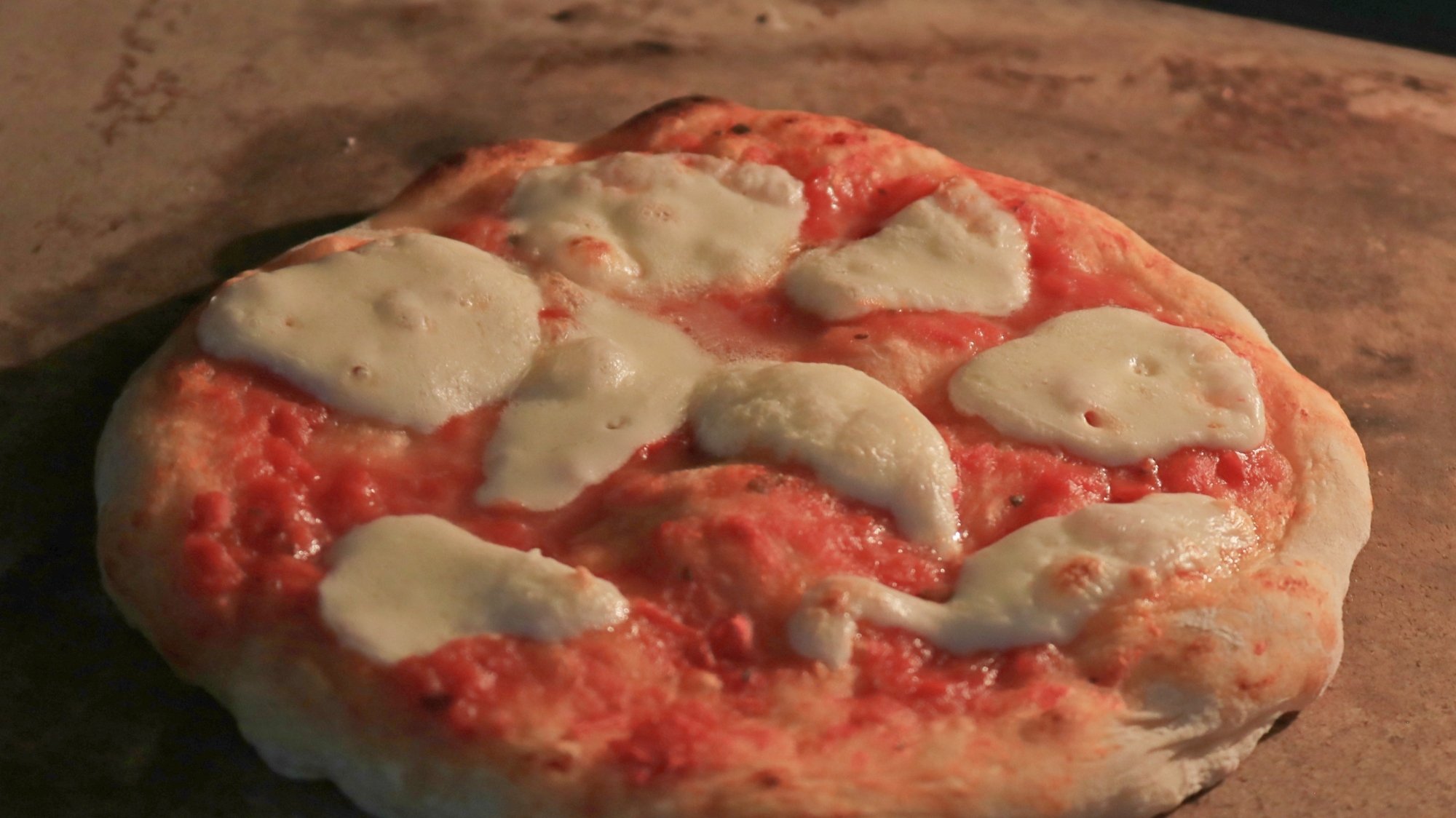
For the longest time, I thought shredded cheese was the only cheese for my homemade slice, but I auditioned sandwich slices of Muenster cheese and was blown away. Muenster is a semi-soft cheese that doesn’t break into oily pockets after cooking. I tore up a slice of muenster and scattered the irregular flats around my sauced pie. After 15 minutes or so in the oven, I removed a pizza that could stand up to even the most bougie Brooklyn pizzeria. 

Fatty sandwich slices of cheese—the same ones you use for grilled cheese—make great melting cheeses for high oven temperatures. They don’t become greasy after they melt, and they reward you with a lovely gooey cheese pull after slicing. Since they really melt out far and wide, don’t load up the pie too much. You can leave some space between each island and still have a nice balance of cheese to sauce. 

Other fatty cheeses like muenster: havarti, gouda, taleggio, and fontina.

Some mozzarella 

Mozzarella is the pizza cheese. There’s no question that the flavor and stretchy consistency make for both the perfect centerpiece and a great canvas for toppings. However, there are a couple mozzarellas out there, and not all of them can stand up to the heat. 

Pizza with melted mozzarella.
The fresh mozzarella starts to squeeze out water which is puddling in the middle of the pie.
Credit: Allie Chanthorn Reinmann

Fresh mozzarella and the like. Fresh mozzarella, burrata, and buffalo mozzarella are these gorgeous, moist orbs of creamy white cheese. They’re usually wrapped with some moisture in the packaging or submerged and floating in liquid. While you might think these cheeses would be insanely creamy and wonderful on pizza, stay your eager cheese hand. 

When fresh mozzarella cooks, especially at high temperatures like 350°F to 450°F, the protein network in the cheese begins to denature and tighten up, squeezing out the moisture that used to live in the network. Fresh mozzarella has a lot of moisture to give and it’ll end up on the surface of your pizza as a watery puddle. Besides the sadness of a floppy, wet pizza crust, you also have globs of rubbery cheese that pull off in one bite. 

There is a way to avoid this unfortunate result: During my tests, after about five minutes, the fresh mozzarella was lovely and melted. But after 10 minutes in my 450°F oven, the water started to puddle up as the cheese began to take on some color. Pizza takes at least 15 minutes to cook in a screaming hot oven. If you must use fresh mozzarella, my advice is to add it to the pizza during the last five minutes of the cooking time. 

Low-moisture mozzarella. Fresh mozzarella, burrata, and buffalo mozzarella are expensive and decadent. I’d hate for you to ruin them by cooking them for too long on your pizza. Instead, rely on trusty low-moisture mozzarella. This cheese is produced with way less moisture captured and you won’t risk it ending up on your pizza. You can buy it shredded, in slices, or in big bricks. You can enjoy all the flavor and meltability of fresh mozzarella in a more pizza-friendly.  

Parmesan (and hard cheeses)

Parmesan cheese on a pizza.

Credit: Allie Chanthorn Reinmann

Parmesan and other aged, hard cheeses exhibit strong, bold flavors that are lovely on pizza. However, when cheeses age, they lose moisture, and that’s when they can become broken and greasy on a pizza. Cheeses melt best when they have a balance of fat, water, and protein, so when you have a hard cheese under a high temperature, it doesn’t do much except squeeze out fats and become even harder. 

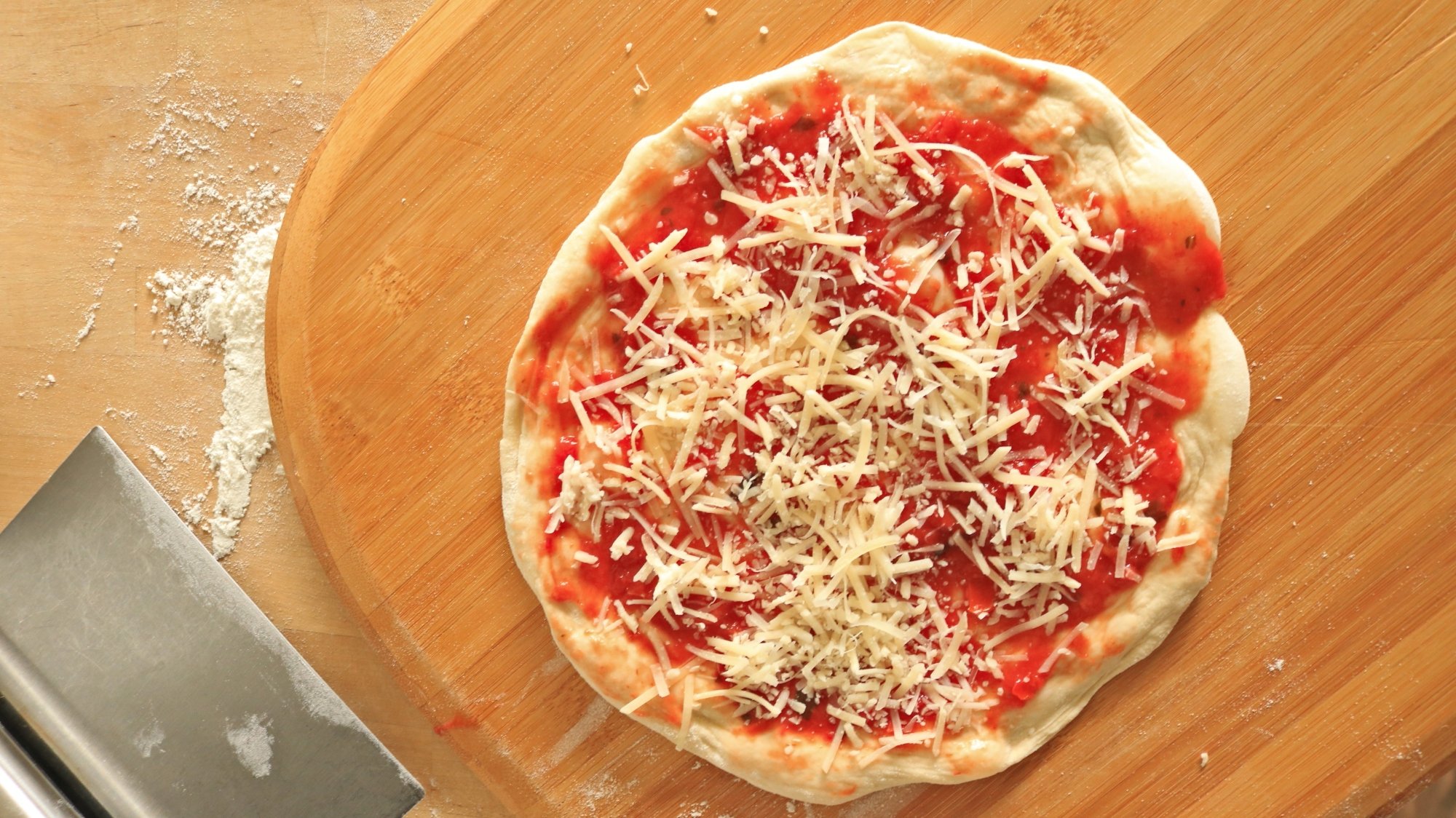
I added shredded parmesan to cover one of my pizzas, and when I took the pie out of the oven, the cheese stayed put in its shredded form, not really melting out but instead becoming rather translucent. It almost looked like I barely added cheese at all. That said, the flavor was bangin’. Parmesan has a presence; it’s not a mild cheese like mozzarella. I would recommend shredded parmesan if you prefer flavor over cheese pull. It’s important to note that parmesan actually might be better on the bottom of your pizza. It makes a crispy, cheesy frico crust if you make a cast iron skillet pizza. Check out the recipe here.

Flavor-packed hard cheeses like parmesan: Asiago, manchego, aged swiss, aged cheddars. 

The winner is a mixture

It may not come as a surprise, but the best homemade pizza cheese will always be a mixture of cheeses. Each cheese has its strong suit, so don’t deprive yourself. Low-moisture mozzarella is stretchy but mild, so add some shredded asiago for a sharp touch of flavor. Love a good melty cheese pie? Skip the asiago and opt for something like fontina to mix in with your mozzarella. My favorite mixture so far has been mozzarella with pepper jack and a bit of muenster. The opportunities are only limited by your grocery store’s cheese section, so grab some sandwich slices and get experimenting. Once you’ve selected your cheese combo, you’re ready for more of my tips for making the best homemade pizza every time; to start with, you should ferment your dough.

Each measles case in raging outbreak costs up to $50,000, CDC official says

In now-rarified comments from experts at the Centers for Disease Control and Prevention, an agency official on Tuesday evening said the explosive measles outbreak mushrooming out of West Texas will require “significant financial resources” to control and that the agency is already struggling to keep up.

“We are scrapping to find the resources and personnel needed to provide support to Texas and other jurisdictions,” said David Sugerman, the CDC’s lead on its measles team. The agency has been devastated by brutal cuts to CDC staff and funding, including a clawback of more than $11 billion in public health funds that largely went to state health departments.

Sugerman noted that the response to measles outbreaks is generally expensive. “The estimates are that each measles cases can be $30,000 to $50,000 for public health response work—and that adds up quite quickly.” The costs go to various responses, including on-the-ground response teams, vaccine doses and vaccination clinics, case reporting, contact tracing, mitigation plans, infection prevention, data systems, and other technical assistance to state health departments.

Read full article

Comments

X may soon replace DMs with its upcoming chat platform

X DMs may soon be kaput. On Tuesday, a company software engineer posted on the platform that “the whole entire DM’s will be gone soon.” But the former Twitter isn’t getting rid of messaging; the company is said to be replacing it with a full-fledged chatting system called XChat.

X Software Engineer Zach Warunek replied to another user who asked whether XChat would replace message requests. “No, not like request messages but like the whole entire DM’s will be gone soon,” the engineer replied. Engadget contacted Warunek to ask about a timeframe for the feature, and we’ll update this article if we hear back.

No, not like request messages but like the whole entire DM’s will be gone soon

— Zach Warunek (@ZachWarunek) April 16, 2025

These aren’t the first rumors we’ve seen about XChat. Early this year, the X account @xDaily posted a screenshot showing an XChat icon instead of Messages in the platform’s sidebar. In February, owner Elon Musk wrote that, within a few months, he would discontinue his phone number and only use X for texts and calls. Then, @swak_12 (via Android Headlines) posted screenshots this month showing a PIN verification screen (similar to secure messaging apps like Signal) for XChat.

Yet another alleged leak posted on Wednesday by @P4mui includes more screenshots and a list of XChat features, including fully encrypted end-to-end messaging, file transfers and the ability to unread messages and delete individual ones for all users.

This article originally appeared on Engadget at https://www.engadget.com/social-media/x-may-soon-replace-dms-with-its-upcoming-chat-platform-171006540.html?src=rss

[$] Parallel directory operations

Allowing directories to be modified in parallel was the topic of Jeff
Layton’s filesystem-track session at the 2025 Linux Storage, Filesystem,
Memory Management, and BPF Summit (LSFMM+BPF). There are certain use
cases, including for the NFS and Lustre filesystems, as mentioned in a patch set
referenced in the topic
proposal
, where contention in creating multiple files in a directory is
causing noticeable performance problems. In some testing, Layton has found
that the inode read-write semaphore (i_rwsem) for the directory is
serializing operations; he wanted to discuss alternatives.

OpenAI’s new o3 and o4-mini models are all about ‘thinking with images’

A mere two days after announcing GPT-4.1, OpenAI is releasing not one but two new models. The company today announced the public availability of o3 and o4-mini. Of the former, OpenAI says o3 is its most advanced reasoning model yet, with it showing “strong performance” in coding, math and science tasks. As for o4-mini, OpenAI is billing it as a lower cost alternative that still delivers “impressive results” across those same fields.

More notably, both models offer novel capabilities not found in OpenAI’s past systems. For first time, the company’s reasoning models can use and combine all of the tools available in ChatGPT, including web browsing and image generation. The company says this capability allows o3 and o4-mini solve challenging, multi-step problems more effectively, and “take real steps toward acting independently.” 

At the same time, o3 and o4-mini can not just see images, but also interpret and “think” about them in a way that significantly extends their visual processing capabilities. For instance, you can upload images of whiteboards, diagrams or sketches — even poor quality ones — and the new models will understand them. They can also adjust the images as part of how they reason.  

“The combined power of state-of-the-art reasoning with full tool access translates into significantly stronger performance across academic benchmarks and real-world tasks, setting a new standard in both intelligence and usefulness,” says OpenAI. 

Separately, OpenAI is releasing a new coding agent (à la Claude Code) named Codex CLI. It’s designed to give developers a minimal interface they can use to link OpenAI’s models with their local code. Out of the box, it works with o3 and o4-mini, with support for GPT-4.1 on the way. 

Today’s announcement comes after OpenAI CEO Sam Altman said the company was changing course on the roadmap he detailed in February. At the time, Altman indicated OpenAI would not release o3, which the company first previewed late last year, as a standalone product. However, at the start of April, he announced a “change of plans,” noting OpenAI was moving forward with the release of o3 and o4-mini.  

“There are a bunch of reasons for this, but the most exciting one is that we are going to be able to make GPT-5 much better than we originally though,” he wrote on X. “We also found it harder than we thought it was going to be to smoothly integrate everything. and we want to make sure we have enough capacity to support what we expect to be unprecedented demand.”

That means the streamlining Altman promised in February will likely need to wait until at least the release of GPT-5, which he said would arrive sometime in the next “few months.” 

In the meantime, ChatGPT Plus, Pro and Team users can begin using o3 and o4-mini starting today. Sometime in the next few weeks, OpenAI will bring online o3-pro, an even more powerful version of its flagship reasoning model, and make it available to Pro subscribers. For the time being, those users can continue to use o1-pro. 

This article originally appeared on Engadget at https://www.engadget.com/ai/openais-new-o3-and-o4-mini-models-are-all-about-thinking-with-images-170043465.html?src=rss

Google suspended 39.2 million malicious advertisers in 2024 thanks to AI

Google may have finally found an application of large language models (LLMs) that even AI skeptics can get behind. The company just released its 2024 Ads Safety report, confirming that it used a collection of newly upgraded AI models to scan for bad ads. The result is a huge increase in suspended spammer and scammer accounts, with fewer malicious ads in front of your eyeballs.

While stressing that it was not asleep at the switch in past years, Google reports that it deployed more than 50 enhanced LLMs to help enforce its ad policy in 2024. Some 97 percent of Google’s advertising enforcement involved these AI models, which reportedly require even less data to make a determination. Therefore, it’s feasible to tackle rapidly evolving scam tactics.

Google says that its efforts in 2024 resulted in 39.2 million US ad accounts being suspended for fraudulent activities. That’s over three times more than the number of suspended accounts in 2023 (12.7 million). The factors that trigger a suspension usually include ad network abuse, improper use of personalization data, false medical claims, trademark infringement, or a mix of violations.

Read full article

Comments

Trump threatens to spike chipmakers’ costs by billions as China mulls exemptions

The semiconductor industry is bracing to potentially lose more than $1 billion once Donald Trump announces chip tariffs.

Two sources familiar with discussions between chipmakers and lawmakers last week told Reuters that Applied Materials, Lam Research, and KLA—three of the largest US chip equipment makers—could each lose about “$350 million over a year related to the tariffs.” That adds up to likely more than $1 billion in losses between the three, and smaller firms will likely face similarly spiked costs, estimating losses in the tens of millions.

Some chipmakers are already feeling the pain of Trump’s trade war, despite a 90-day pause on reciprocal tariffs and a tenuous exception for semiconductors and other electronics.

Read full article

Comments