
The latest Tor Browser adds Connection Assist to Android, making it easier for users in censored regions to connect securely with one tap.
Category Archives: Unfiltered RSS
Disgruntled users roast X for killing Support account
After X (formerly Twitter) announced it would be killing its “Support” account, disgruntled users quickly roasted the social media platform for providing “essentially non-existent” support.
“We’ll soon be closing this account to streamline how users can contact us for help,” X’s Support account posted, explaining that now, paid “subscribers can get support via @Premium, and everyone can get help through our Help Center.”
On X, the Support account was one of the few paths that users had to publicly seek support for help requests the platform seemed to be ignoring. For suspended users, it was viewed as a lifeline. Replies to the account were commonly flooded with users trying to get X to fix reported issues, and several seemingly paying users cracked jokes in response to the news that the account would soon be removed.
OpenAI Debuts Codex CLI, an Open Source Coding Tool For Terminals
OpenAI has released Codex CLI, an open-source coding agent that runs locally in users’ terminal software. Announced alongside the company’s new o3 and o4-mini models, Codex CLI directly connects OpenAI’s AI systems with local code and computing tasks, enabling them to write and manipulate code on users’ machines.
The lightweight tool allows developers to leverage multimodal reasoning capabilities by passing screenshots or sketches to the model while providing access to local code repositories. Unlike more ambitious future plans for an “agentic software engineer” that could potentially build entire applications from descriptions, Codex CLI focuses specifically on integrating AI models with command-line interfaces.
To accelerate adoption, OpenAI is distributing $1 million in API credits through a grant program, offering $25,000 blocks to selected projects. While the tool expands AI’s role in programming workflows, it comes with inherent risks — studies show AI coding models frequently fail to fix security vulnerabilities and sometimes introduce new bugs, particularly concerning when given system-level access.


Read more of this story at Slashdot.
Database for cybersecurity vulnerabilities secures last-minute government funding
The US government has continued to make drastic cuts to budgets and personnel, but one cybersecurity service has at least temporarily avoided the chop. The Common Vulnerabilities and Exposures database operated by nonprofit MITRE Corp will receive 11 months of federal support. A representative from the Cybersecurity and Infrastructure Security Agency, whose parent agency funds the MITRE database, told Reuters that the department exercised an “option period on the contract to ensure there will be no lapse in critical CVE services.” The news was an eleventh-hour announcement, as federal funding for the project was slated to expire today.
This CVE database identifies and tracks cybersecurity vulnerabilities, and it is regularly used by IT professionals. It offers a standardized approach that allows complex and technical information about potential problems to be quickly shared across companies and organizations worldwide.
“We appreciate the overwhelming support for these programs that have been expressed by the global cyber community, industry, and government over the last 24 hours,” said Yosry Barsoum, vice president and director for MITRE’s Center for Securing the Homeland.
This article originally appeared on Engadget at https://www.engadget.com/cybersecurity/database-for-cybersecurity-vulnerabilities-secures-last-minute-government-funding-202703659.html?src=rss
LG TVs’ integrated ads get more personal with tech that analyzes viewer emotions
LG TVs will soon leverage an AI model built for showing advertisements that more closely align with viewers’ personal beliefs and emotions. The company plans to incorporate a partner company’s AI tech into its TV software in order to interpret psychological factors impacting a viewer, such as personal interests, personality traits, and lifestyle choices. The aim is to show LG webOS users ads that will emotionally impact them.
The upcoming advertising approach comes via a multi-year licensing deal with Zenapse, a company describing itself as a software-as-a-service marketing platform that can drive advertiser sales “with AI-powered emotional intelligence.” LG will use Zenapse’s technology to divide webOS users into hyper-specific market segments that are supposed to be more informative to advertisers. LG Ad Solutions, LG’s advertising business, announced the partnership on Tuesday.
The technology will be used to inform ads shown on LG smart TVs’ homescreens, free ad-supported TV (FAST) channels, and elsewhere throughout webOS, per StreamTV Insider. LG will also use Zenapse’s tech to “expand new software development and go-to-market products,” it said. LG didn’t specify the duration of its licensing deal with Zenapse.
TikTok Is Getting Community Notes Now Too
TikTok is joining the ranks of social networks with Community Notes programs, which allow users to add context, corrections, and additional information to posts on the platform. The new feature is called Footnotes, and it will be rolled out first on short-form videos in the U.S.
TikTok is just the latest app to add user-generated notes for existing content, though it has yet to drop formal fact-checking and other content moderation entirely. In February, Meta announced plans for a Community Notes beta to replace fact-checking on Facebook, Instagram, and Threads and is now admitting contributors from the program’s waitlist. YouTube and X both have active Community Notes programs as well (X’s Community Notes, formerly known as Birdwatch, replaced the option to report misleading content).
According to TikTok’s page explaining the program, Footnotes can only be added to public posts but will remain visible if those posts are made private. Creators can add footnotes to and rate footnotes on their own content if they are enrolled contributors. Footnotes must meet a threshold for “helpful” as rated by contributors before they become visible to all users (who can then vote on them as well).
TikTok will still partner with IFCN-accredited fact-checking organizations to assess the accuracy of content on the platform.
How to sign up to write TikTok Footnotes
Users in the U.S. can apply to write Footnotes starting today if they are at least 18 years old, have been on TikTok for six months or more, have a valid email address or U.S. phone number, and have no history of violating the platform’s community guidelines within the last six months. TikTok may also notify users who meet these eligibility requirements, and those approved for the program can begin contributing “over the coming months.”
14 reasons why Trump’s tariffs won’t bring manufacturing back
On April 2, 2025, our president announced major new taxes on imports from foreign countries (“tariffs”), ranging from 10 percent to 49 percent. The stated goal is to bring manufacturing back to the United States and to “make America wealthy again.”
These tariffs will not work. In fact, they may even do the opposite, fail to bring manufacturing back, and make America poorer in the process.
This article gives the 14 reasons why this is the case, how the United States could bring manufacturing back if it were serious about doing so, and what will ultimately happen with this wrongheaded policy.
OpenAI Unveils o3 and o4-mini Models
OpenAI has released two new AI models that can “think with images” during their reasoning process. The o3 and o4-mini models represent a significant advancement in visual perception, enabling them to manipulate images — cropping, zooming, and rotating — as part of their analytical process.
Unlike previous models, o3 and o4-mini can agentically use all of ChatGPT’s tools, including web search, Python code execution, and image generation. This allows them to tackle multi-faceted problems by selecting appropriate tools based on the task at hand.
The models have set new state-of-the-art performance benchmarks across multiple domains. On visual tasks, o3 achieved 86.8% accuracy on MathVista and 78.6% on CharXiv-Reasoning, while o4-mini scored 91.6% on AIME 2024 competitions. In expert evaluations, o3 made 20% fewer major errors than its predecessor on complex real-world tasks. ChatGPT Plus, Pro, and Team users will see o3, o4-mini, and o4-mini-high in the model selector starting today, replacing o1, o3â’mini, and o3â’miniâ’high.


Read more of this story at Slashdot.
iOS 18.4.1 patches two iPhone security flaws used in ‘extremely sophisticated’ attacks
On Wednesday, Apple pushed updates to most of its platforms: iOS 18.4.1, iPadOS 18.4.1, macOS 15.4.1, tvOS 18.4.1 and visionOS 2.4.1. They contain two security fixes for flaws that may have been used in real-world attacks, so it’s wise to update your devices without too much delay.
Apple is aware of a report that both security issues “may have been exploited in an extremely sophisticated attack against specific targeted individuals on iOS.”
One patched bug is in Apple’s audio framework, CoreAudio. This memory corruption issue allowed malicious media files to execute code when processed as audio streams. The other relates to the Remote Participant Audio Control (RPAC) framework, which lets communications apps manage audio streams. That flaw allowed an attacker with arbitrary read / write capabilities to bypass Pointer Authentication (a security feature in Apple’s processors).
Apple “strongly advises” all users to update their devices.
This article originally appeared on Engadget at https://www.engadget.com/mobile/smartphones/ios-1841-patches-two-iphone-security-flaws-used-in-extremely-sophisticated-attacks-194922877.html?src=rss
Fedora 43 Looking To Make It Easier To Deploy Intel TDX Confidential VMs
While Fedora 42 was just released yesterday, already Red Hat developers and the Fedora development community have been busy thinking about Fedora 43 that will debut this autumn. Among the early change proposals this week is one for better supporting Intel Trust Domain Extensions (TDX) with this next Fedora Linux release…
Hertz So Bad: Alarming Data Breach Exposes Customer Data To Hackers

Hertz Corporation has warned about an alarming data breach that might have exposed sensitive customer data to hackers. The rental car company has provided details of the breach, the measures it has taken, and what potentially affected individuals can do to safeguard their personal information, if needed.
In a notice, Hertz revealed that
Deezer reports 18 percent of the music uploaded to its service every day is AI-generated
Deezer, a Spotify alternative that launched in the US in 2016, shared on Wednesday that 20,000 completely AI-generated tracks are added to its music service on a daily basis, making up “over 18% of all uploaded content” the platform receives every day.
Like other streaming services, Deezer offers methods for independent artists to upload their own music without having to be part of a larger licensing deal with a record label. While that lowers some barriers, it also leaves the door open for music that isn’t made by people at all. Clearly, people are taking advantage of the option.
Deezer introduced a tool for detecting and tagging AI-generated content in January 2025, when at the time, AI-generated music only made up 10 percent of uploads. The tool is helpful, but it feels like a stopgap until there’s consensus on whether AI-generated tracks should be allowed to exist in the first place. AI companies contend that training on existing books, movies, music, and internet ephemera is “fair use,” but many of the people who made that material feel differently. In terms of pushback, AI music startups Suno and Udio were sued by record labels for copyright infringement in 2024 and artists have spoken out about “unlicensed AI training” but there’s yet to be ruling that sets the new legal standard.
Deezer also isn’t alone in dealing with an infestation of AI-generated content. It’s well-documented at this point that Spotify has the same issue. Subscribers have highlighted dozens of instances of AI-generated tracks that were clearly uploaded to try and game Spotify’s popular weekly playlists, and while Spotify has removed some copycat tracks when artists have complained, the company has no qualms with hosting AI music.
“If creators are using these technologies — where they are creating music in a legal way that we reimburse and people listen to them — and are successful, we should let people listen to them,” Spotify co-president Gustav Söderström shared on a Big Technology podcast episode from November 2024.
This article originally appeared on Engadget at https://www.engadget.com/ai/deezer-reports-18-percent-of-the-music-uploaded-to-its-service-every-day-is-ai-generated-193652533.html?src=rss
Trump Administration Plans To End the IRS Direct File Program for Free Tax Filing
The Trump administration plans to eliminate the IRS’ Direct File program, an electronic system for filing tax returns directly to the agency for free, AP reported Wednesday, citing two people familiar with the decision. From the report: The program developed during Joe Biden’s presidency was credited by users with making tax filing easy, fast and economical. But Republican lawmakers and commercial tax preparation companies complained it was a waste of taxpayer money because free filing programs already exist, although they are hard to use.


Read more of this story at Slashdot.
Government IT whistleblower calls out DOGE, says he was threatened at home
A government whistleblower told lawmakers that DOGE’s access to National Labor Relations Board (NLRB) systems went far beyond what was needed to analyze agency operations and apparently led to a data breach. NLRB employee Daniel Berulis, a DevSecOps architect, also says he received a threat when he was preparing his whistleblower disclosure.
“Mr. Berulis is coming forward today because of his concern that recent activity by members of the Department of Government Efficiency (‘DOGE’) have resulted in a significant cybersecurity breach that likely has and continues to expose our government to foreign intelligence and our nation’s adversaries,” said a letter from the group Whistleblower Aid to the Senate Select Committee on Intelligence leaders and the US Office of Special Counsel.
The letter, Berulis’ sworn declaration, and an exhibit with screenshots of technical data are available here. “This declaration details DOGE activity within NLRB, the exfiltration of data from NLRB systems, and—concerningly—near real-time access by users in Russia,” Whistleblower Aid Chief Legal Counsel Andrew Bakaj wrote. “Notably, within minutes of DOGE personnel creating user accounts in NLRB systems, on multiple occasions someone or something within Russia attempted to login using all of the valid credentials (e.g. Usernames/Passwords). This, combined with verifiable data being systematically exfiltrated to unknown servers within the continental United States—and perhaps abroad—merits investigation.”
Samsung Odyssey 3D monitor hands-on: This should be the new baseline for glasses-free 3D
It seems like every few years, gadget makers try to come up with something that will make us care about seeing things in 3D again. Without going all the way back to the 1800s, the first Avatar movie brought millions to theaters to watch blue cat people dance around in stereoscopic vision. Then came the flop that was 3D TVs in the early 2010s before things heated up again with the arrival of VR headsets like the HTC Vive and Oculus Rift. Soon, Samsung will release a new take on the tech with its glasses-free Odyssey 3D Gaming Monitor (model G90XF) and after trying it out, I feel like if 3D has been this good all along, people wouldn’t roll their eyes every time the idea gets brought up.
If this monitor looks somewhat familiar, that’s because Samsung actually demoed very early pre-production models at CES in both 2024 and 2025. In fact, I tried the first version in Las Vegas almost a year and a half ago, playing Lies of P back when it was a slightly larger 37-inch display. Regardless, the Odyssey 3D is finally going on sale later this month on April 28 for $2,000 and while I don’t think it’s an essential piece of tech, it’s definitely a fun way to experience both games and videos in a new dimension.
Sam Rutherford for Engadget
The G90XF features a 27-inch 4K LCD panel with a 165Hz refresh rate, which isn’t all that impressive considering its price. And in some respects, it gets even worse when the 3D effect is active. In addition to having two eye and face tracking sensors hidden beneath its bezels, the Odyssey 3D also uses a lenticular filter to create two slightly different versions of the same scene (one for each eye), which gets interpreted by your brain as a 3D image.
This lowers the perceived resolution of the screen, which results in a very faint screen door effect like you might get on a VR headset. For me, this meant I saw a little chromatic fringing around certain objects while individual pixels became more noticeable. Unfortunately, because the monitor is designed to be viewed with two eyes, the effect doesn’t come across in photos or videos as cameras typically only record with a single lens/sensor at a time. (Womp womp.)
Sam Rutherford for Engadget
That said, even with all of those limitations, I was still impressed by the Odyssey 3D. In games, the monitor can handle two different levels of integration. There is one for titles specifically co-developed with input from Samsung (denoted with a yellow badge) that take full advantage of the tech and another more general setting for games with basic 3D support.
The first game I played — Khazan: The First Berserker — is a fully certified title and it demonstrated a surprising level of immersion. Even without pushing the sliders for 3D effects like focal distance and depth factor all the way up, trees and foliage around the edge of the screen looked like they were popping out the display right at me, while little gameplay elements like floating orbs of blood just hovered in the space between my face and the monitor. There were also details like snowflakes that looked like they were flying past my head, which was a nice touch.
Importantly, the tech never felt oppressive and thanks to the built-in head tracking, I had the freedom to move around in my seat (just a little bit) without ruining the effect. So instead of being a distraction, it simply added a bit of atmosphere to the game. And it still looked quite sharp and ran as smooth as you’d expect. Sadly, I couldn’t play Octopath Traveler, which is another one of Samsung’s supported titles, as I think the combination of the 3D effect with the game’s retro HD-2D art style would be a great showcase of the tech.
As for other titles, the monitor can convert standard 2D graphics into 3D on the fly. Though, as you might imagine, the effect isn’t nearly as pronounced, particularly in more modern titles with fancier graphics. However, when I played Grand Theft Auto: Vice City, characters and vehicles still popped out in a very pleasing way that made a more than 20-year-old game feel brand new. Once again, it wasn’t a groundbreaking change, but added an extra level of fun and immersion to an already very nostalgic game.
Sam Rutherford for Engadget
But the Odyssey 3D’s abilities don’t stop at gaming because the monitor can also convert non-DRM-protected videos (like clips from YouTube) into 3D on the fly. Similar to games, more recent trailers like Avengers: Endgame had an obvious depth effect that made certain scenes shine, though I still wouldn’t call it a revolutionary experience. However, for other genres like anime, the display did an even better job of separating stuff in the background from characters up front. On top of all that, the monitor can also convert side-by-side stereoscopic footage into standard 3D videos as well, which is a nice, though rather niche, inclusion. I just wish I didn’t have to click on the notification to activate the 3D effect every time I pulled up a new video.
Of course, the big question is if the Odyssey 3D’s added dimensionality is worth an extra $1,000 or more compared to a more traditional monitor with similar specs. And to that I’d probably say no. But I don’t think that means this display is a failure, because I found that being able to turn this effect on and off at will without needing extra equipment like glasses made the whole experience rather enjoyable, instead of completely off-putting like so many devices in the past. And if Samsung can make this tech a bit more affordable, it would feel more like a nice bonus that has definite value when viewing certain games or movies. When you consider all the false starts and flops 3D gadgets have had throughout the years, that feels like a small but important win in my book.
Sam Rutherford for Engadget
Finally, while there are currently 12 games that are fully certified to work with the Odyssey 3D, Samsung says it hopes to bring that number closer to 50 by the end of the year. Currently support titles are listed below.
-
KHAZAN: The First Berserker
-
Dragon Ball Z: Kakarot
-
Lies of P
-
Psychonauts 2
-
Little Nightmares II
-
Palworld
-
F.I.S.T.: Forged In Shadow Torch
-
SpongeBob SquarePants: The Cosmic Shake
-
Like a Dragon: Ishin
-
Only UP
-
Darksiders Genesis
-
Octopath Traveler
The Samsung Odyssey 3D Gaming Monitor will be available for $2,000 starting on April 28, with pre-orders eligible for a $200 credit from select retailers like Samsung.com.
This article originally appeared on Engadget at https://www.engadget.com/computing/samsung-odyssey-3d-monitor-hands-on-this-should-be-the-new-baseline-for-glasses-free-3d-190015689.html?src=rss
arbee Is the Bartender Replacement I’ve Been Looking For
As someone whose job involves testing and writing about Mac apps, a crowded menu bar is an occupational hazard. Until its ownership change last year, my go-to recommendation for tidying up your menu bar was Bartender. But once it became clear that we don’t really know who owns Bartender now, I tried a few alternatives, and none of them had all the features I was looking for. So, I abandoned menu bar managers until recently, when the apps in my menu bar began extending more than halfway into my screen and I was finding it hard to even locate which app I was looking for.
That’s when I discovered Barbee, a powerful menu bar manager for Mac. It can do everything from hiding unnecessary menu bar icons to customizing the shape of your menu bar and even the look of the Apple logo in the top-left corner of your screen.
The app is a free download and comes with a three-day free trial for you to try all its features. Note that you won’t even get charged automatically at the end of the trial. You’ll simply lose access to the app’s features, and you can then either pay $7 for a one-time unlock or choose the annual subscription fee of $3. This allows you to try Barbee with no pressure to see if it works for you.
Barbee requires accessibility and screen recording permissions to allow you to use all its features. These permissions allow the app to show different menu bar layouts and let you set up and run automations, which is an invaluable feature for me. However, if you’re worried, know that the app is sandboxed, so it is limited in how much of its data it can access through those permissions.
Changing menu bar layouts in Barbee
Credit: Pranay Parab
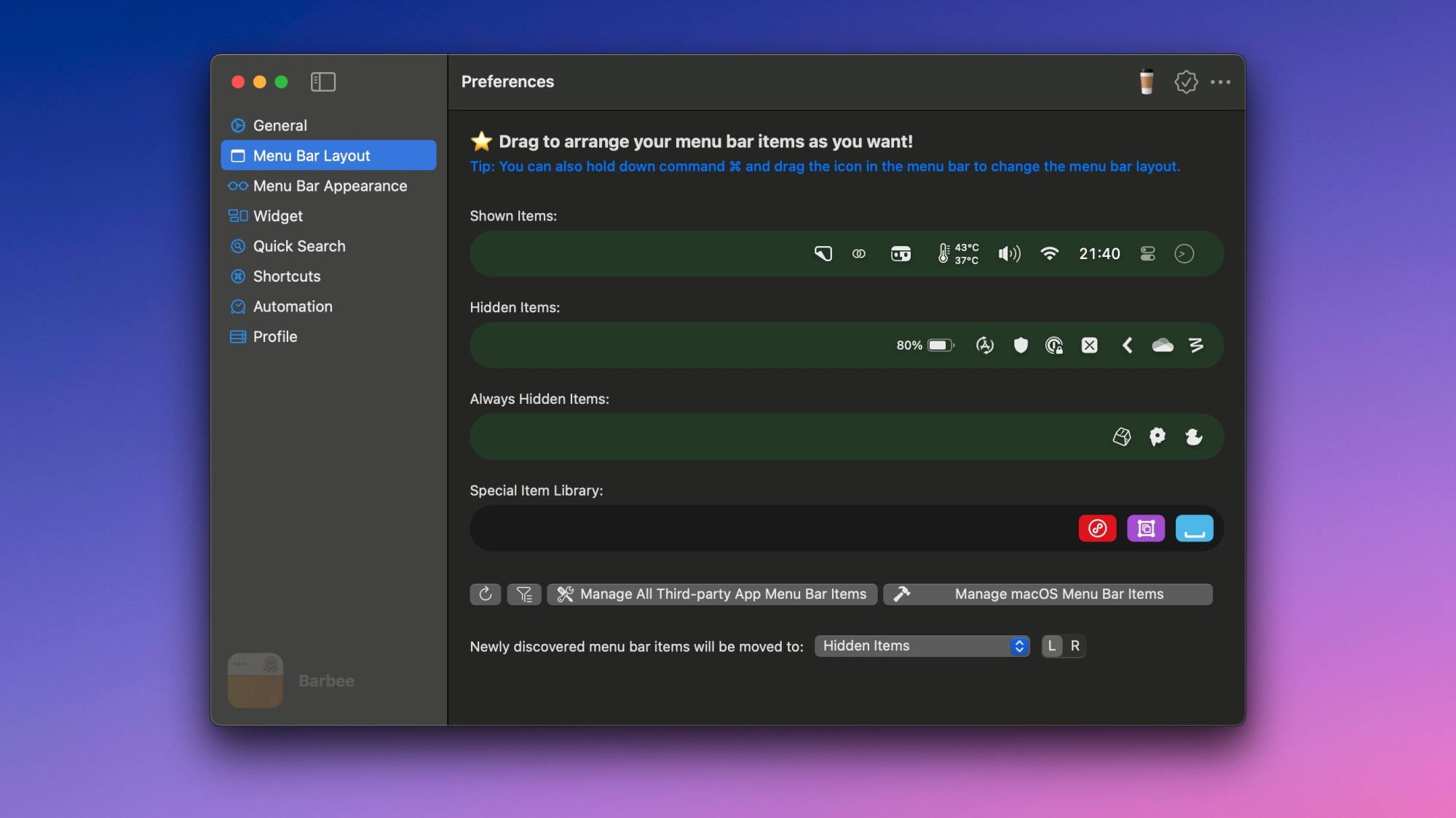
The Menu Bar Layout settings page is your best to place to get started in Barbee, since that’s where you’ll actually arrange which of your menu bar icons are hidden. Here, you can pick which apps you’d like to always see, such as calendar or performance monitoring apps, while moving the rest to the hidden section. There’s also an “Always Hidden” section, which is great for apps that can’t run if they’re not in the menu bar. In my case, one of these is Unclack, which mutes the Mac’s mic when I’m typing. I need to run this app all the time but I never actually want to see its menu bar icon. The difference? You can temporarily reveal hidden icons when needed, but not Always Hidden ones.
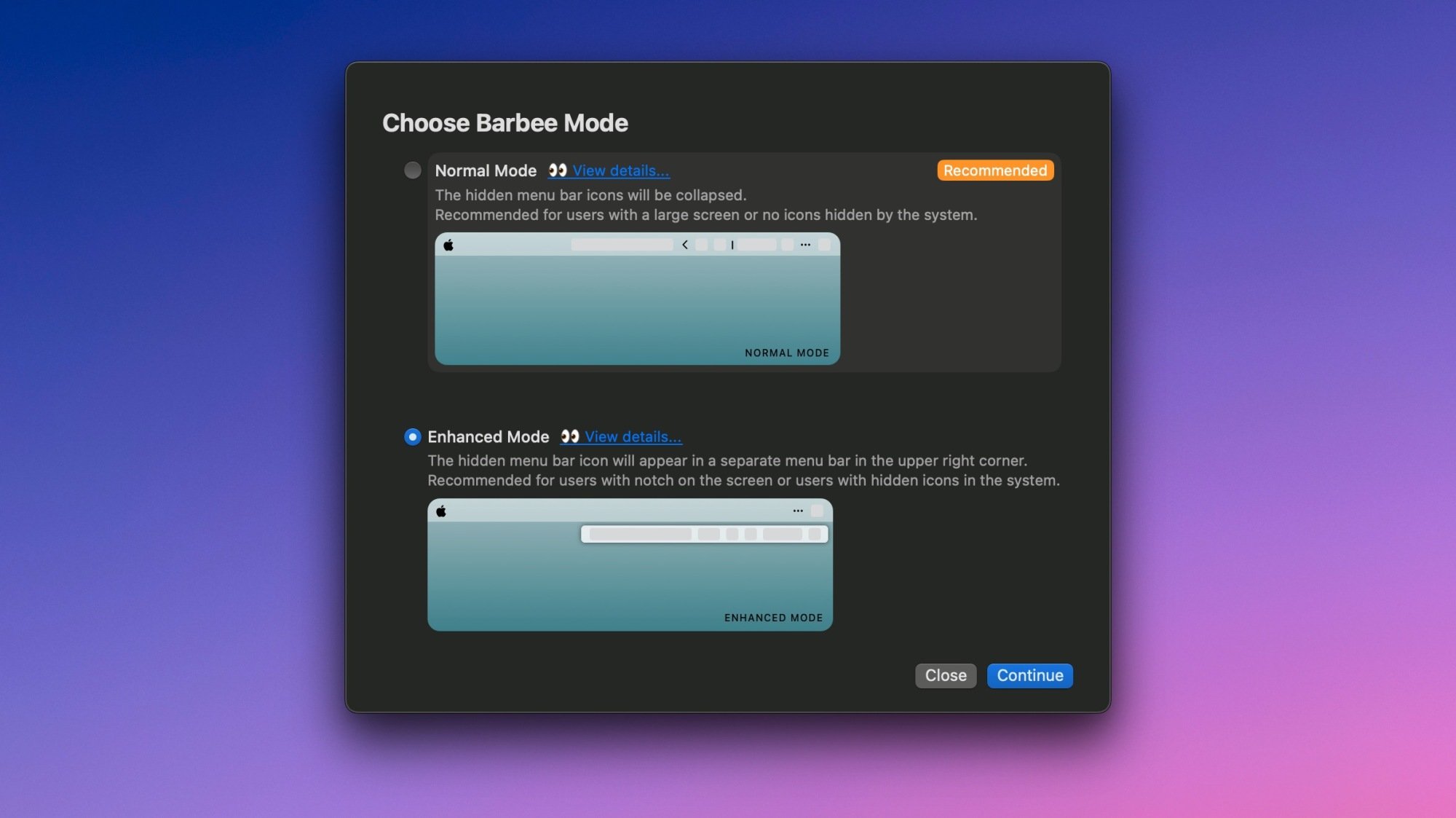
This app also has a lot of tweaks available in its settings menu, and I highly recommend going through them all to make the most of it. Under Barbee Settings > General > Mode, for instance, you can choose between Normal Mode and Enhanced Mode. In normal mode, when you reveal hidden icons, the app displays them within the menu bar, right next to the visible icons. But enhanced mode displays them in a small floating menu instead. For those who have a lot of menu bar icons (pretty much the entire target audience for this kind of an app), that is a great feature.
You can also customize the menu bar’s look and feel in the Menu Bar Appearance section. This lets you change the shape of the menu bar, and you can choose if you want it to have rounded corners, a different tint, and even if you want to use a separated layout where app menus appear in a separate menu bar on the left. I prefer a more unified look, so that’s not for me, but I couldn’t resist changing the Apple logo to the classic rainbow variant, which is maybe one of my favorite Barbee features.
Automation and other options
Credit: Pranay Parab
Barbee also has an automation section that allows you to show or hide certain menu bar icons based on triggers. The simplest example is the battery widget, which I only really want to see when the battery is low. So, I went to Barbee Settings > Automation and quickly added a new automation to make that happen. You can set up similar triggers with pretty much every menu bar icon, so feel free to set it up according to your needs.
I also added a custom keyboard shortcut to see hidden menu items, which speeds up my workflow quite a bit. You can do this by going to the Shortcuts section in the app’s settings. The General settings page has many other useful options, too. Be sure to enable Launch at login to make the app fire up each time you use your Mac, and also the Extend battery life option to ensure that Barbee doesn’t consume an inordinate amount of power. There are also niche, but useful features on this page, such as the ability to show all menu bar icons when you’re using an external display. This is nice to have, because my MacBook Air’s screen has limited real estate, but when I plug it in to my ultrawide monitor, I don’t need to hide any menu bar icons.
Armbian Introduces Optimized Cloud Images for x86 and aarch64 Deployments
Armbian has expanded its support for cloud infrastructure with a new line of dedicated cloud images designed for generic x86 and aarch64 platforms. These images are tailored for performance, efficiency, and streamlined deployment in virtualized and cloud-native environments. The new Armbian cloud image set aims to meet the growing demand for lightweight and reliable Linux […]
Intel Bartlett Lake-S Gaming CPU May Pack More Performance Cores

Bartlett Lake is a real, confirmed CPU family for Intel’s LGA 1700 platform. The company confirmed its existence back at CES 2025. However, it’s designed by the company’s NEX group and aimed at edge compute and networking use, not high-end gaming. That may change according to the latest leaks and rumors, though, which suggest we could see
Elder Scrolls IV Oblivion Remaster Is Really Happening And These Screenshots Prove It

Gamers are living in an era of remasters and remakes as studios and publishers look for consisten return on their investments, with projects people are familiar with. The next modern glow up of a gaming classic has long been rumored to be Elder Scrolls IV: Oblivion. Although, the rumor appears to be confirmed, since screenshots leaked from
Here’s how to watch the Mario Kart-focused Nintendo Direct
There’s yet another Nintendo Direct coming our way, which is the third in less than a month. This one is entirely focused on the upcoming Switch 2 launch title Mario Kart World. It starts at 9AM ET and should last around 15 minutes.
It’s livestreaming on Nintendo’s YouTube page, but mega-fans can also open up that recently-launched Nintendo Today! app to follow along. We are embedding the YouTube link, so feel free to keep this tab open.
We have no idea what information Nintendo is going to spring on us as part of this Direct presentation. The company has already released a ton of info about Mario Kart World. It’s an open-world racer that can accommodate 24 plays at the same time.
However, there are still a couple of unknowns. Most of these involve the open-world aspect. Are there any rewards for exploration? Are there secret tracks that can only be unlocked by finding them? Can the same be said for unlockable characters? Again, we don’t know, but hope springs eternal.
There’s also the $80 elephant in the room. The exorbitant retail price of Mario Kart World has sent many fans into a tailspin. That’s a whole lot of money, and Nintendo only recently-released its first-ever $70 game. There’s a minuscule chance that the company will throw us a bone and knock $10 off the asking price, but this is highly unlikely given current economic uncertainty. At the very least, we could get some new data regarding the preorder date for US customers.
This article originally appeared on Engadget at https://www.engadget.com/gaming/nintendo/heres-how-to-watch-the-mario-kart-focused-nintendo-direct-184825796.html?src=rss