What’s New on Hulu in May 2025

Hulu’s May lineup brings viewers back into the world of Mormon “MomTok” with the second season of cult reality show The Secret Lives of Mormon Wives (May 15). The series centers on eight Utah-based, Mormon TikTok influencers navigating ongoing relationship drama. Also back for a second season is reality series Vanderpump Villa (May 8), which follows the staff at Real Housewives and Vanderpump Rules star Lisa Vanderpump’s French estate.

Nine Perfect Strangers (May 21), originally produced as a miniseries, is returning with another installment as an anthology series starring Nicole Kidman and ensemble cast that includes Annie Murphy, Christine Baransky, and Murray Bartlett, among others. The second season brings nine strangers together at a wellness retreat in the Austrian Alps, with Kidman reprising her role as the Russian founder and guru.

At the end of the month, Hulu will get the first season of FX’s Adults (May 29), an ensemble comedy series from The Tonight Show‘s Ben Kronengold and Rebecca Shaw about a group of 20-somethings in New York City.

Finally, there’s a new standup hour from Matteo Lane—The Al Dente Special, a Hulu original, will drop on May 16.

Here’s everything else coming to (and leaving) Hulu in May.

What’s coming to Hulu in May 2025

Arriving May 1

  • Alone Australia: Complete Season 1

  • The Chicano Squad: Complete Season 1

  • History’s Greatest Escapes with Morgan Freeman: Complete Season 2

  • Inmate to Roommate: Complete Season 2

  • James Brown: Say it Loud: Complete Season 1

  • Jeopardy! Masters: Season 3 Premiere

  • Mormon Mom Gone Wrong: The Ruby Franke Story

  • Naruto Shippuden: Complete Season 9 (Dubbed)

  • Pawn Stars: Complete Season 22

  • Alienoid (2022)

  • Alienoid 2 (2024)

  • Anaconda (1997)

  • Anaconda En Espanol (1997)

  • Attack The Block (2011)

  • Attack the Block En Espanol (2011)

  • Austenland (2013)

  • Austenland En Espanol (2013)

  • Babylon A.D. (2008)

  • Bad Teacher (2011)

  • Bad Teacher En Espanol (2011)

  • Basic (2003)

  • Basic En Espanol (2003)

  • Battle of the Year (2013)

  • Battle Of The Year En Espanol (2013)

  • The Childe (2023)

  • Con Air (1997)

  • Courage Under Fire (1996)

  • Deliver Us From Evil (2020)

  • Enemy Of The State (1998)

  • Far From the Madding Crowd (2015)

  • The 5th Wave (2016)

  • The 5th Wave En Espanol (2016)

  • The Guardian (2006)

  • Georgia Rule (2007)

  • The Gangster, The Cop, The Devil (2019)

  • Hacksaw Ridge (2016)

  • Horrible Bosses (2011)

  • Horrible Bosses 2 (2014)

  • The Infiltrator (2016)

  • The Insider (1999)

  • Jackass Presents: Bad Grandpa (2013)

  • Jackass Presents: Bad Grandpa En Espanol (2013)

  • Joy (2015)

  • The King’s Man (2021)

  • Kingsman: The Golden Circle (2017)

  • Kingsman: The Secret Service (2014)

  • Kung Fu Panda (2008)

  • Kung Fu Panda 2 (2011)

  • Little Fockers (2010)

  • The Negotiator (1998)

  • The Power Of One (1992)

  • Maid in Manhattan (2002)

  • Maid in Manhattan En Espanol (2002)

  • Man on Fire (2004)

  • The Marine (2006)

  • Meet the Fockers (2004)

  • Meet the Parents (2000)

  • Meet the Spartans (2008)

  • Mission: Impossible (1996)

  • Mission: Impossible – Ghost Protocol (2011)

  • Mission: Impossible – Ghost Protocol En Espanol (2011)

  • Mission: Impossible II (2000)

  • Mission: Impossible II En Espanol (2000)

  • Mission: Impossible III (2006)

  • Mission: Impossible III En Espanol (2006)

  • Once (2007)

  • Once Upon a Time in America (1984)

  • Prospect (2018)

  • Rogue One: A Star Wars Story (2016)

  • The Secret Life Of Walter Mitty (2013)

  • Sex Tape (2014)

  • Sex Tape En Espanol (2014)

  • Shadow (2018)

  • Spy (2015)

  • Star Wars: Episode IV – A New Hope (1977)

  • Star Wars: Episode V – The Empire Strikes Back (1980)

  • Star Wars: Episode VI – Return of the Jedi (1983)

  • Street Kings (2008)

  • Stuber (2019)

  • Super Troopers 2 (2018)

  • Take Me Home Tonight (2011)

  • Tears of the Sun (2003)

  • That’s My Boy (2012)

  • The Villainess (2017)

  • The Wailing (2016)

  • The Witch: Subversion (2018)

  • The Witch 2: The Other One (2022)

  • Tropic Thunder (2008)

  • Waitress (2007)

  • Wedding Crashers (2005)

Arriving May 2

  • Pita Hall: Film Premiere

  • Decision to Leave (2022)

  • Harbin (2024)

  • The Last Word (2017)

  • 72 Hours (2024)

Arriving May 3

  • Evil Lives Here: Complete Season 13

  • Naked and Afraid: Complete Season 10

  • Naked and Afraid XL: Complete Season 3

  • Unsellable Houses: Complete Season 2

  • Escape (2024)

  • Jimmy O. Yang: Guess How Much (2023)

Arriving May 4

  • Insidious: The Red Door (2023)

  • Insidious: The Red Door En Espanol (2023)

Arriving May 7

  • Kun by Agüero: Complete Limited Series (Subbed)

Arriving May 8

  • Vanderpump Villa: Complete Season 2

  • Alone Australia: Complete Season 2

  • Find My Country House: Australia: Complete Season 1

  • New House No Debt: Complete Season 1

  • 60 Days In: Complete Season 9

  • Pil’s Adventures (2021)

Arriving May 9

  • The UnXplained: Complete Season 7

  • Summer of 69: Film Premiere

  • Behind Enemy Lines (2001)

  • Commando (1985)

  • The Damned (2024)

  • Hitman (2007)

  • Hitman: Agent 47 (2015)

  • Men Of Honor (2000)

  • The Thin Red Line (1998)

  • The Transporter (2002)

  • Transporter 2 (2005)

Arriving May 10

  • Expedition Unknown: Complete Season 6

  • How It’s Made: Complete Season 21

  • My 600-lb Life: Complete Season 2

  • My 600-lb Life: Where Are They Now?: Complete Season 1

  • Robert Durst: An ID Murder Mystery: Complete Season 1

  • Scorned: Love Kills: Complete Season 2

  • Blonde and Blonder (2008)

  • Strangerland (2015)

  • Trust (2010)

  • Vengeance: A Love Story (2017)

  • War Inc. (2008)

Arriving May 12

  • I’m the Villainess, So I’m Taming the Final Boss: Complete Season 1 (Subbed & Dubbed)

  • My Next Life as a Villainess: All Routes Lead to Doom!: Complete Season 1 (Subbed & Dubbed)

  • Hells Paradise: Complete Season 1 (Subbed & Dubbed)

  • SHANGRILA FRONTIER: Complete Season 1 (Subbed & Dubbed)

Arriving May 13

  • Not Others: Complete Season 1 (Subbed)

  • Good Bad Things (2023)

  • Mission: Impossible – Rogue Nation (2015)

  • Mission: Impossible – Rogue Nation En Espanol (2015)

  • Not Others (2023)

Arriving May 15

  • The Secret Lives of Mormon Wives: Season 2 Premiere

  • Beach Hunters: Complete Season 7

  • Cake Boss: Complete Season 15

  • Container Homes: Complete Season 1

  • Curb Appeal: Complete Season 25

  • Cutthroat Kitchen: Complete Season 4-5

  • Dr. Pimple Popper: Complete Season 5

  • Extreme Homes: Complete Season 5

  • Flea Market Flip: Complete Seasons 10 and 14

  • Island Life: Complete Seasons 19 and 20

  • My 600-lb Life: Complete Season 3

  • My Strange Addiction: Complte Season 5 and 6

  • Naked and Afraid: Complete Season 9

  • Say Yes to the Dress: Atlanta Complete Season 7

  • Tanked: Complete Seasons 13-15

  • The Last Alaskans: Complete Season 4

  • Undercover Billionaire: Complete Season 2

  • Unusual Suspects: Complete Season 7

  • Worst Cooks in America: Complete Season 24

Arriving May 16

  • Matteo Lane: The Al Dente Special (2025)

  • Welcome to Wrexham: Season 4 Premiere

  • Crossroads (2002)

  • The Last Breath (2025)

Arriving May 17

  • Death by Fame: Complete Season 1

  • Destinations of the Damned With Zak Bagans: Complete Season 1

  • Expedition X: Complete Season 6-7

  • Spring Baking Championship: Complete Season 1-3

  • Jim Gaffigan: Noble Ape (2018)

  • Jim Gaffigan: Quality Time (2019)

  • Jimmy O. Yang: Good Deal (2020)

  • Zarna Garg: One in a Billion (2023)

Arriving May 20

  • American Underdog: The Kurt Warner Story (2021)

  • Night Call (2024)

Arriving May 21

  • Nine Perfect Strangers: Season 2 Premiere

  • Nine Puzzles: Series Premiere

Arriving May 22

  • Ancient Aliens: Complete Season 20

  • Intervention: Complete Season 25

  • Jump!: Complete Season 1

  • Outrageous Love with Nene Leakes: Complete Season 1

  • Taken in Plain Sight (2024)

Arriving May 23

  • The Last Showgirl (2024)

Arriving May 24

  • BBQ Brawl: Flay V. Anderson V. Burrell: Complete Season 4

  • Bizarre Foods with Andrew Zimmern: Complete Season 3

  • Fixer Upper: Welcome Home: Complete Season 1

  • Gold Rush: Complete Season 1

  • Homestead Rescue: Complete Season 12

Arriving May 25

  • How to Please a Woman (2022)

Arriving May 27

  • Tsukimichi: Moonlit Fantasy: Complete Season 1

  • Re: Zero: Complete Season 1

  • Tower of God: Complete Season 1

  • The Seed of the Sacred Fig (2024)

Arriving May 29

  • Adults: Complete Season 1

  • The Silencing (2020)

Arriving May 30

  • Into the Deep (2024)

  • Rickey Smiley: Untitled (2025)

Arriving May 31

  • House Hunters: Complete Season 253

  • House Hunters International: Complete Season 18

  • Mysteries at the Museum: Complete Season 24

  • Tournament of Champions: Complete Season 1

  • Vanished in New Canaan: An ID Mystery: Complete Season 1

  • Leanne Morgan: So Yummy (2018)

What’s leaving Hulu in May 2025

Leaving May 3

  • Both Sides of the Blade (2022)

Leaving May 4

  • Last Survivors (2022)

Leaving May 8

  • The Last Warrior (2022)

Leaving May 10

  • Bar Fight! (2022)

  • Murder at Yellowstone City (2022)

Leaving May 11

  • A Cops and Robbers Story (2020)

  • Italian Studies (2021)

Leaving May 12

  • Not Going Quietly (2021)

Leaving May 13

  • The Capote Tapes (2019)

Leaving May 14

  • All the Streets Are Silent: The Convergence of Hip Hop and Skateboarding (1987-1997) (2021)

Leaving May 16

  • Kandahar (2023)

  • Sundown (2021)

  • The Immaculate Room (2022)

Leaving May 17

  • Slash/Back (2022)

Leaving May 19

  • President (2021)

Leaving May 25

  • A Taste of Hunger (2021)

Leaving May 27

  • The Requin (2022)

Leaving May 28

  • Intrigo: Death Of An Author (2018)

Leaving May 31

  • Gamestop: Rise of the Players (2022)

  • Mob Land (2023)

  • The Last Tourist (2021)

  • Try Harder! (2021)

Archer outlines its plan to use air taxis between New York’s major airports

One of the more serious players in the air taxi game, Archer, has just unveiled routes for a potential service in New York City. Its Midnight aircraft would shuttle passengers from Manhattan to JFK, LaGuardia and Newark airpots in five to 15 minutes, potentially shaving an hour or more from typical driving times. However, Archer didn’t provide any dates for the start of the service and all of this could be derailed by regulatory bodies, particularly the Federal Aviation Administration (FAA).

Any news about air taxis should come with the caveat that no such services are operating yet, even though startups have been trying for a decade or more. With that said, Archer has partnered with a number of established aviation and other companies including Fiat Chrysler and United Airlines, along with fixed base operators (FBOs) like Signature Aviation and Atlantic Aviation. Archer also previously announced proposed air taxi networks in San Francisco, Los Angeles and Chicago. 

Archer’s plan is to have you book air taxi rides as an “add-on” to traditional flights. You’d launch from existing Manhattan facilities, namely the East 34th Street Heliport, Downtown Skyport and West 30th Street Heliport. From there, you’d be able to fly to “vertiports” at JFK, LaGuardia and Newark airpots, along with locations at other regional airports. Flights would be aboard the company’s human-piloted, four-passenger Midnight aircraft with 12 rotors, six batteries and a range of 20-50 miles. 

Archer planned New York Air Taxi Network
Archer

Archer does have United Airlines, New York’s Port Authority and the New York City Economic Development Corportation (NYCEDC) all on board. However, it hasn’t provided important details like the number of potential flights per day, operating hours and more. That information would be vital to the FAA, which must decide if the service is safe for passengers, other aircraft and people on the ground.

That’s an undertaking that could require a lot of time and cost, and Archer’s VTOL aircraft still hasn’t received its FAA type certification required for any operations. The company did receive the FAA’s final airworthiness criteria, though, making it one of only two air taxi companies with that certification along with rival Joby Aviation. The only air taxi company to obtain type certification from an aviation regulator is EHang from China’s Civil Aviation Administration (CAAC). 

The air taxi game is risky for startups, too. Late last year one of Archer’s VTOL rivals, Lilium ceased operations, laying off 1,000 people, despite successful flight tests. 

This article originally appeared on Engadget at https://www.engadget.com/transportation/archer-outlines-its-plan-to-use-air-taxis-between-new-yorks-major-airports-123024903.html?src=rss

These Samsung Galaxy Earbuds Are at Their Lowest Price Ever Right Now

We may earn a commission from links on this page. Deal pricing and availability subject to change after time of publication.

The Samsung Galaxy Buds FE are down to $47.99 on Woot right now—their lowest price to date, according to price trackers. That’s a solid $22 cheaper than Amazon’s current listing at $69.99. This deal is live for two weeks or until it sells out, and it comes with a 90-day Woot limited warranty. If you’re a Prime member, you’ll get free shipping—otherwise, there’s a $6 shipping charge.

At this price, these are a decent entry point into Samsung’s audio ecosystem, especially if you’re already using Galaxy devices. You’ll get decent active noise cancellation that holds up surprisingly well in everyday environments like cafes or public transit, enough to cut out most low-level hums and chatter. That said, it doesn’t completely block the outside world, but it muffles it enough to focus on music or a call.

The touch controls are responsive—maybe too responsive at times; accidental skips and pauses are common until you get used to the layout. As for battery life, Samsung claims up to six hours of playback with ANC on, and the case adds another 21 hours. That’s more than enough to get through a day or two of regular use. There’s no wireless charging here, though—just USB-C. These days, that feels like a cut corner. And while the EQ presets are decent, there’s no manual tuning option, so if you’re picky about your sound profile, that might feel limiting, notes this PCMag review.

There’s also the Galaxy-only interpreter feature that sounds cool on paper but won’t work if you’re using anything other than a Samsung phone. Cross-device sync works great within the ecosystem, though, and the Find My Earbuds tool is genuinely helpful for the forgetful. Still, these aren’t ideal for everything. If you’re planning to use them at the gym or on runs, the IPX2 rating won’t cut it—it barely holds up against sweat. And if you’re not a Samsung user, the app experience feels half-baked. For something more flexible and water-resistant, the Soundcore Liberty 4 NC at $69.99 (down from $99.99) might offer better value.

IBM Granite: Not Your Grandpa’s AI (Unless He Was a Super-Genius)

Alright, let’s talk AI. The field’s buzzing like a server room full of caffeinated bees, and standing tall amidst it all is IBM with Granite. Now, IBM isn’t some fresh-faced startup that just discovered algorithms. It has been wrestling with AI concepts for decades. Seriously. Since before AI was the cool kid at the tech party, IBM was building “expert systems” back when the rest of us were mastering floppy disks. Granite is IBM’s latest heavyweight champ, built on being Open, Performant and Trusted. Think of it as the friendly giant of the AI world.

Why Open Source Is IBM’s Jam

IBM is really into open source, and frankly, it makes sense. Why keep your cool tech locked in a black box when you can share it (under licenses like the friendly Apache 2.0, not the scary kind)? Granite models often strut their stuff out in the open, meaning they’re usually free-ish to use and way easier to tinker with than those mysterious proprietary AIs.

This openness is IBM’s superpower. It’s a wizard at taking a solid open-source foundation (like Granite) and helping businesses sprinkle their own secret sauce (aka client data) on top. The result? Custom AI that actually works for specific needs, built faster than you can say “synergistic optimization.”

Need proof? One poor company was drowning in 300,000 customer calls, trying to get answers to 81 questions using some fancy proprietary AI that was… well, not helping. It was like using a fork to eat soup. IBM swooped in, Granite model in hand (figuratively speaking), and bam – success! Open source for the win.

From Texting to Talking: Granite’s Glow-Up

Granite didn’t just appear fully formed. It’s had quite the evolution. It started with text, like most AIs learning their ABCs. Then it got good with time-based stuff for forecasting (predicting the future, basically). Granite 3.2 learned to see, adding image support. And now, with 3.3, it’s got the gift of gab – full voice support! We’re talking speech recognition, translation and transcribing even those super long, rambling meeting notes. Its ability to handle context has also ballooned from 12K to a whopping 128K tokens – that’s like going from reading a pamphlet to understanding an epic novel.

Imagine this in insurance: Granite looks at your dented car pics, chats with you about what happened (“Did a rogue shopping cart attack?”), and gets the claim rolling, mostly on its own. Less paperwork for you, faster processing – it’s almost enough to make insurance feel… pleasant? Maybe? It’s also a whiz at pulling key info from dense technical manuals and answering questions about it, especially with some RAG (Retrieval-Augmented Generation) magic involved.

Lean, Mean, AI Machine

Don’t let the “open” part fool you into thinking Granite isn’t powerful. IBM claims it’s the speediest open-source model out there, giving even the big-name proprietary AIs a serious run for their money. On tasks like speech recognition, benchmarks show it matching or beating the competition.

And here’s the kicker: it’s efficient. Granite models can often do their magic on a single, affordable GPU – no need for a server farm cooled by arctic winds. This efficiency is huge for businesses wanting to actually use AI without breaking the bank. IBM’s own research suggests smaller Granite models can be more cost-effective for certain tasks than gigantic ones like GPT-4 (nerd out on the details here). Remember the US Open? When faced with a tsunami of tennis matches, IBM’s AI (powered by tech like Granite) managed to report on everything in real-time – a first! That’s handling scale.

Thinking Deep, Playing Safe

Granite is also getting smarter with enhanced reasoning, like “chain-of-thought” (basically, showing its work). This can create a lot of digital chatter (tokens), but Granite’s efficiency handles it gracefully. Importantly, IBM baked in safety and quality from day one. So, while some other models apparently lost their minds a bit when trying to get smarter (looking at you, DeepSeek comparison!), Granite kept its cool, focusing on reliable, trustworthy results. Less chance of your AI suddenly deciding the sky is plaid.

This “Trusted” label isn’t just marketing fluff. It’s backed by that clear Apache 2.0 license, transparent data practices, IP indemnification (lawyer-speak for “we got your back”), and strong digital guardrails to keep things secure.

Wrapping Up

So, IBM Granite? It’s Big Blue’s experienced, open and surprisingly efficient answer to the AI call. It’s already making waves within IBM itself and helping clients tackle real problems. By mixing performance with openness and a solid dose of trust (plus maybe saving you from rogue shopping carts), Granite is definitely an AI suite worth watching in the business world. It’s AI that’s ready to work, not just hog the headlines.

The 1873 Colt Single-Action Army Revolver Toy: A Timeless Tribute to Wild West Heritage

The 1873 Colt Single-Action Army Revolver Toy stands as a masterpiece of craftsmanship, blending historical authenticity with modern safety standards. Designed for enthusiasts of all ages, this 1:1 scale replica captures the essence of the American West through its realistic metal construction, rotating wheel action, and immersive play experience. Weighing 755 grams and measuring 28 x 14 cm, the revolver offers a tactile connection to the past while prioritizing safety with non-toxic materials and EVA foam darts. Ideal for educational role-playing or collectors seeking a functional art piece, this toy bridges generations by combining nostalgia with innovative design.

Historical Significance of the Colt Single-Action Army Revolver

The Icon of the American Frontier

The Colt Single-Action Army Revolver, colloquially known as the “Peacemaker,” revolutionized firearm technology in 1873 and became synonymous with the expansion of the American West. Its rugged reliability made it the sidearm of choice for cowboys, lawmen, and outlaws alike, cementing its place in cultural lore. This toy replica pays homage to that legacy, replicating every contour and mechanism with precision to evoke the spirit of frontier life.

Colt 1873 Toy Revolver with Shell Ejection

Engineering a Legend

Original Colt revolvers were celebrated for their simplicity and durability—qualities mirrored in this replica’s design. The 1:1 scale reproduction ensures historical accuracy, allowing users to handle a piece of engineering history without the risks associated with antique firearms. The rotating cylinder, a hallmark of the Single-Action Army’s functionality, has been faithfully recreated to mimic the loading and firing process, providing an authentic tactile experience.

Design and Build Quality: Where Realism Meets Safety

Metal Construction for Authentic Aesthetics

Crafted primarily from metal, this replica achieves a level of realism rarely seen in toy firearms. The heft (755 grams) and textured grip replicate the feel of handling an original Colt, while the polished finish and engraved details mirror the artistry of 19th-century gunsmithing. Unlike plastic alternatives, the metal build ensures longevity, making it a durable addition to collections or outdoor play.

Ergonomic and Functional Design

Measuring 28 cm in length, the revolver gun fits comfortably in both adult and adolescent hands. The 14 cm barrel length maintains proportionality, ensuring the toy remains manageable while preserving its iconic silhouette. Each component, from the trigger to the hammer, operates smoothly, reinforcing the illusion of a functional firearm while adhering to toy safety standards.

1873 colt single-action army revolver toy

Immersive Play Experience: Mechanics and Performance

Rotating Cylinder Action

The revolver’s standout feature is its rotating cylinder, which turns with each simulated shot. This mechanism, powered by a spring-loaded system, replicates the sequential firing process of the original Colt. Users load the six included shells into the cylinder, pull back the hammer, and squeeze the trigger to “fire” a dart, creating a cycle of action that mirrors historical reloading techniques.

Precision Targeting with EVA Foam Darts

Included with the revolver are 20 EVA foam darts, designed for safe yet engaging target practice. With an effective range of 15–25 feet, these darts allow users to hone their aim in backyards or designated play areas. The soft-tip design eliminates injury risks, making the toy suitable for children aged 8 and above.

Safety and Environmental Considerations

Non-Toxic Materials for Family-Friendly Use

Prioritizing child safety, the revolver is constructed from materials free of lead, phthalates, and BPA. The EVA darts are similarly compliant with international toy safety regulations, ensuring peace of mind for parents. Even the metal components have rounded edges to prevent accidental cuts or scratches.

Eco-Conscious Manufacturing

M416GelBlasters.com collaborates with suppliers who adhere to sustainable production practices. The revolver’s packaging excludes non-recyclable plastics, and the absence of a retail box reduces shipping weight, lowering its carbon footprint.

Educational Value: Teaching History Through Play

Role-Playing as a Learning Tool

This revolver serves as an interactive educational aid, helping children visualize historical scenarios like cattle drives or sheriff’s posse formations. By simulating frontier life, it encourages interest in American history and the technological advancements of the 19th century.

Developing Responsibility and Coordination

Operating the revolver teaches fine motor skills, as users must sequentially load shells, rotate the cylinder, and aim carefully. Parents can use play sessions to discuss firearm safety, fostering respect for real weapons while differentiating them from toys.

Why Choose M416GelBlasters.com for Historical Replicas?

M416GelBlasters.com specializes in curating historically accurate toys that balance authenticity with modern safety standards. Their 1873 Colt replica exemplifies this commitment, offering unparalleled attention to detail compared to mass-market alternatives. By sourcing directly from manufacturers, they ensure competitive pricing without compromising quality—a rare find in niche toy markets.

Conclusion: Bridging Generations Through Play

The 1873 Colt Single-Action Army Revolver Toy transcends typical plaything status, serving as a bridge between past and present. Its combination of historical fidelity, robust construction, and child-safe design makes it a versatile tool for education, collection, or imaginative play. As families seek toys that encourage offline interaction and learning, this revolver stands out as a testament to thoughtful engineering and cultural preservation.

How Nintendo’s Legal Team Destroyed Atari Games Through Courtroom Strategy

Nintendo’s lawyers systematically dismantled Atari Games in a landmark 1989 legal battle that reshaped the gaming industry, killing off the Tengen brand until its surprise resurrection recently.

When Atari Games (operating as Tengen) attempted to circumvent Nintendo’s control by reverse-engineering the NES security system, Nintendo’s legal team discovered a fatal flaw in their rival’s approach: Atari had fraudulently obtained Nintendo’s proprietary code from the Copyright Office by falsely claiming they were defendants in a nonexistent lawsuit.

Though courts ultimately established that reverse engineering was legal under fair use principles, Atari’s deception proved catastrophic. The judge invoked the centuries-old “unclean hands” doctrine, ruling that Atari could not claim fair use protection after approaching the court in bad faith.

“As a result of its lawyers’ filthy hands, Atari was barred from manufacturing games for the NES. Nintendo, with its stronger legal team, subsequently ‘bled Atari to death,'” writes tech industry attorney Julien Mailland. The court ordered the recall of Tengen’s “Tetris” version, now a rare collector’s item.

After a 30-year absence, Tengen Games returned in July 2024 with “Zed and Zee” for the NES, finally achieving what its predecessor was legally prohibited from doing.


Read more of this story at Slashdot.

Research insights to help learners develop data awareness

An increasing number of frameworks describe the possible contents of a K–12 artificial intelligence (AI) curriculum and suggest possible learning activities (for example, see the UNESCO competency framework for students, 2024). In our March seminar, Lukas Höper and Carsten Schulte from the Department of Computing Education at Paderborn University in Germany shared with us a unit of work they’ve developed that could inform such a curriculum. At its core, the unit enhances young people’s awareness of how their personal data is used in the data-driven technologies that form part of their everyday lives.

Headshot of Lukas Höper
Lukas Höper
Headshot of Dr Carsten Schulte
Carsten Schulte

Lukas Höper and Carsten Schulte are part of a larger team who are investigating how to teach school students about data science and Big Data.

Carsten explained that Germany’s informatics (computing) curriculum includes a competency area known as Informatics, People and Society (IPS), which explores the interrelationships between technology, individuals, and society, and how computation influences and is influenced by social, ethical, and cultural factors. However, research has suggested that teachers face several problems in delivering this topic, including:

  • Lack of subject knowledge 
  • Lack of teaching material
  • Lack of integration with other topics in informatics lessons
  • A perception that IPS is the responsibility of other subjects

Some of the findings of that 2007 research were mirrored in a more recent local study in 2025, which found that although there have been some gains in subject knowledge in the interval period, the problems of a lack of teaching material and integration with other computer science (CS) topics persist, with IPS increasingly perceived as the responsibility of the informatics subject area alone. Despite this, within the informatics curriculum, IPS is often the first topic to be dropped when educators face time constraints — and concerns with what and how to assess the topic remain. 

Photo focused on a young person working on a computer in a classroom.

In this context, and as part of a larger, longitudinal project to promote data science teaching in schools called ProDaBi, Carsten and Lukas have been developing, implementing, and evaluating concepts and materials on the topics of data science and AI. Lukas explained the importance of students developing data awareness in the context of the digital systems they use in their everyday lives, such as search engines, streaming services, social media apps, digital assistants, and chatbots, and emphasised the difference between being a user of these systems and a data-aware user. Using the example of image recognition and ‘I am not a robot’ Captcha services, Lukas explained how young people need to develop a data-aware perspective of the secondary purposes of the data collected by these (and other) systems, as well as the more obvious, primary purposes. 

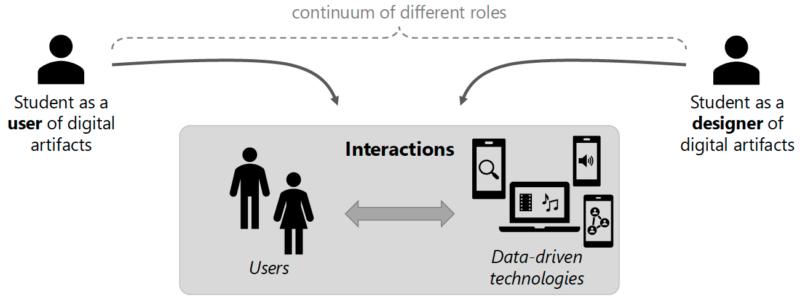
Lukas went on to illustrate the human interaction system model, which presents a continuum of possible different roles, from the student as the user of digital artefacts to the student as the designer of digital artefacts. 

 Figure 1. Different roles in interactions with data-driven technologies
 Figure 1. Different roles in interactions with data-driven technologies

To become data-aware users of digital artefacts, students need to be able to understand and reflect on those digital artefacts. Only then can they proceed to become responsible designers of digital artefacts. However, when surveyed, some students were only moderately interested in engaging with the inner workings of the digital technologies they use in their everyday lives. Many students prefer to use the systems and are less interested in how they process data. 

The explanatory model approach in computing education

Lukas explained how students often become more interested in data-driven technologies when learning about them with explanatory models. Such models can foster data awareness, giving students a different perspective of data-driven technologies and helping them become more empowered users of them. 

To illustrate, Lukas gave the example of an explanatory model about the role of data in digital systems. Such a model can be used to introduce the idea that data is explicitly and implicitly collected in the interaction between the user and the technology, and used for primary and secondary purposes. 

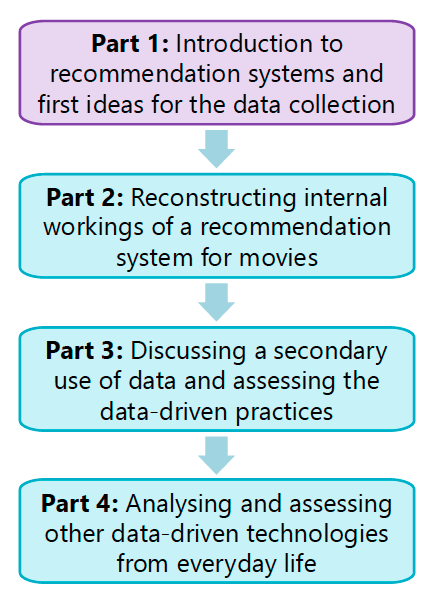
The four parts of the explanatory model.
Figure 2. The four parts of the explanatory model

Lukas then introduced two teaching units that were developed for use with middle school children to evaluate the success of the explanatory model approach in computing education. The first unit explores location data collected by mobile phone networks and the second features recommendation systems used by movie streaming services such as Netflix and Amazon Prime.

Taking the second unit as their focus, Lukas and Carsten outlined the four parts of the explanatory model approach: 

Part 1

The teaching unit begins by introducing recommendation systems and asking students to think about what a streaming service is, how a personalised start page is constructed, and how personal recommendations might be generated. Students then complete an unplugged activity to simulate the process of making movie recommendations for a peer:

Task 1: Students write down movie recommendations for another student. 

Task 2: They then ask each other questions (they collect data). 

Task 3: They write down revised movie recommendations.

Task 4: They share and evaluate their recommendations.  

Task 5: Together they reflect on which collected data was helpful in this exercise and what kind of data a recommendation system might collect. This reflection introduces the concepts of explicit and implicit data collection. 

Part 2

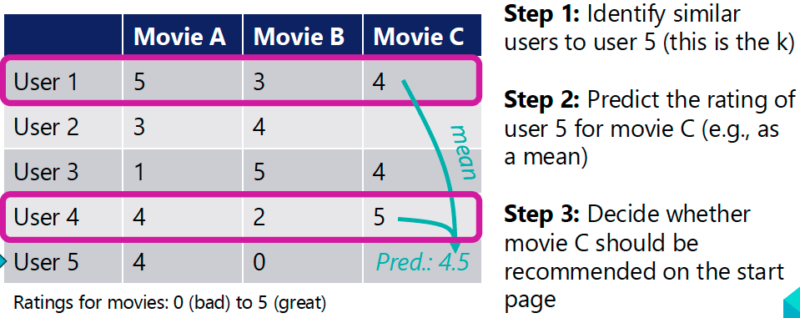
In part 2, students are given a prepared Jupyter Notebook, which allows them to explore a simulation of a recommendation system. Students rate movies and receive personal recommendations. They reconstruct a data model about users, using the idea of collaborative filtering with the k-nearest neighbours algorithm (see Figure 3). 

Figure 3. Data model of movie ratings

Part 3

In part 3, the concepts of primary and secondary purposes for data collection are introduced. Students discuss examples of secondary purposes such as personalised paywalls for movies that can be purchased, and subscriptions based on the predictions of future behaviour. The discussion includes various topics about individual and societal issues (e.g. filter bubbles, behaviour engineering, information asymmetry, and responsible development of data-driven technologies). 

Part 4

Finally, students use the explanatory model as an ‘analytical lens’. They choose other examples from their everyday lives of technologies that implement recommendation systems and analyse these examples, assessing the data practices involved. Students present their results in class and discuss their role in these situations and possible actions they can take to become more empowered, data-aware users.

Uses of explanatory models

Using the explanatory model is one approach to make the Informatics, People and Society strand of the German informatics curriculum more engaging for students, and addresses some of the problems teachers identify with delivering this competency area. 

In presenting the idea of the explanatory model, Carsten and Lukas emphasised that the model in use delivers content as well as functioning as a tool to design teaching content. In the example above, we see how the explanatory model introduces the concepts of:

  1. Explicit and implicit data collection
  2. Primary and secondary purposes of that data 
  3. Data models 

The explanatory model framework can also be used as a focus for academic research in computing education. For example, further research is needed to evaluate if explanatory models are appropriate or ‘correct’ models and to determine the extent to which they are useful in computing education. 

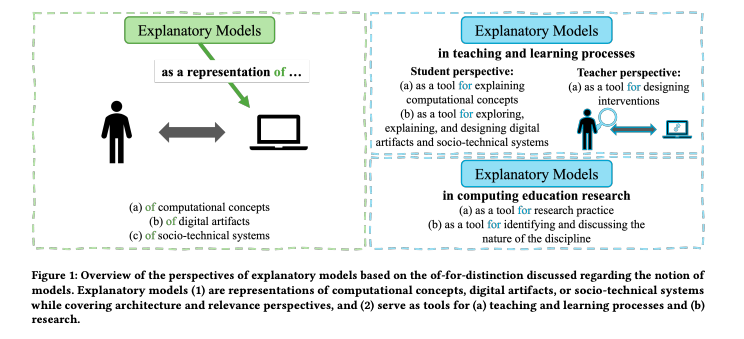
In summary, an explanatory model provides a specific perspective on and explanation of particular computing concepts and digital artefacts. In the example given here, the model focuses on the role of data in a recommender system. Explanatory models are representations of concepts, artefacts, and socio-technical systems, but can also serve as tools to support teaching and learning processes and research in computing education. 

Figure 4. Overview of the perspectives of explanatory models
Figure 4. Overview of the perspectives of explanatory models. Click to enlarge.

The teaching units referred to above are published on www.prodabi.de (in German and English). 

See the background paper to the seminar, called ‘Learning an explanatory model of data-driven technologies can lead to empowered behaviour: A mixed-methods study in K-12 Computing education’.

You can also view the paper describing the development of the explanatory model approach, called ‘New perspectives on the future of Computing education: Teaching and learning explanatory models’.

Join our next seminar

In our current seminar series, we’re exploring teaching about AI and data science. Join us at our next seminar on Tuesday 13 May at 17:00–18:30 BST to hear Henriikka Vartiainen and Matti Tedre (University of Eastern Finland) discuss how to empower students by teaching them how to develop AI and machine learning (ML) apps without code in the classroom.

To sign up and take part in our research seminars, click below:

You can also view the schedule of our upcoming seminars, and catch up on past seminars on our previous seminars and recordings page.

The post Research insights to help learners develop data awareness appeared first on Raspberry Pi Foundation.

Astronomers Detect a Possible Signature of Life on a Distant Planet

Astronomers have detected what may be the strongest evidence yet of extraterrestrial life on K2-18b, a massive exoplanet orbiting a star 120 light-years from Earth. The research team, led by Cambridge astronomer Nikku Madhusudhan, published their findings today in the Astrophysical Journal Letters.

Using the James Webb Space Telescope, researchers found significant concentrations of dimethyl sulfide and dimethyl disulfide in K2-18b’s atmosphere. On Earth, these sulfur compounds are exclusively produced by living organisms, particularly marine algae. “It is in no one’s interest to claim prematurely that we have detected life,” said Madhusudhan, though he described the findings as “a revolutionary moment” and “the first time humanity has seen potential biosignatures on a habitable planet.”

The team detected the signals during two separate observations, with the second showing an even stronger signature. Their analysis suggests K2-18b may be a “Hycean” planet — covered with warm oceans and wrapped in a hydrogen-rich atmosphere — with concentrations of dimethyl sulfide thousands of times higher than Earth levels.

Other scientists remain cautious. Christopher Glein of the Southwest Research Institute suggested K2-18b could instead be “a massive hunk of rock with a magma ocean and a thick, scorching hydrogen atmosphere.” Further observations with Webb and future NASA telescopes will be necessary to confirm whether K2-18b is truly habitable or inhabited, though planned budget cuts may impact follow-up research.

Further reading: Water Found On a Potentially Life-Friendly Alien Planet (2019).


Read more of this story at Slashdot.

‘We Are Not Programmed to Die,’ Says Nobel Laureate Venki Ramakrishnan

In a recent interview with Wired, Nobel laureate Venkatraman Ramakrishnan discusses his book Why We Die, in which he argues that death is not genetically programmed but rather a consequence of evolution favoring reproduction over longevity. Here are some of the most thought-provoking excerpts:
WIRED: Professor Ramakrishnan, the crucial question in your book is why we die. But exactly what is death?
Venki Ramakrishnan: By death, we mean the irreversible loss of the ability to function as a coherent individual. It is the result of the failure of a critical system or apparatus, for example, heart, brain, lung, or kidney failure. In this sense there is an apparent paradox: When our organism, as a whole, is alive, millions of cells within us are constantly dying, and we do not even realize it. On the other hand, at the time of death, most of the cells in our bodies are still alive, and entire organs are still functioning and can be donated to people in need of transplantation. But at that point the body has lost the ability to function as a whole. In this sense, it is therefore important to distinguish between cell death and death of the individual.

Speaking of death and aging, you say in your most recent book that you “wanted to offer an objective look at our current understanding of the two phenomena.” What was the biggest surprise or most deeply held belief that you had to reconsider while writing and researching this work?

There have been several surprises, actually. One is that death, contrary to what one might think, is not programmed by our genes. Evolution does not care how long we live, but merely selects the ability to pass on our genes, a process known as “fitness” in evolutionary biology. Thus, the traits that are selected are those that help us survive childhood and reproduce. And it is these traits, later in life, that cause aging and decline. Another curious finding was the fact that aging is not simply due to wear and tear on cells. Wear and tear happens constantly in all living things, yet different species have very different lifespans. Instead, lifespan is the result of a balance between the expenditure of resources needed to keep the organism functioning and repairing it and those needed to make it grow, mature, and keep it healthy until it reproduces and nurtures offspring.

Do you think there is an aspect of the biology of aging that is still deeply misunderstood by the general public?
Certainly the indefinite extension of life. Although in principle there are no laws or constraints that prevent us from living much longer than we do currently, great longevity or “eternal youth” are still far off, and very significant obstacles to increasing our maximum life expectancy remain. We must also beware of the pseudoscience — and business — around the concepts of “anti-aging” or the “reversal of aging.” These are often baseless concepts, unsupported by hard evidence, even though they may use language that sounds scientific. Unfortunately, we are all afraid of growing old and dying, so we are very sensitive to any claim that promises to help us avoid it. […]

What do you think are the social and ethical implications of our desire to live longer?
Ever since we became aware of our mortality, we have desired to defeat aging and death. However, our individual desires may conflict with what is best for society. A society in which fertility rates are very low and lifespans are very high will be a stagnant society, with very slow generational turnover, and probably much less dynamic and creative. The Nobel Prize-winning South American novelist Mario Vargas Llosa, who recently passed away, expressed it best: “Old age on the one hand terrifies us, but when we feel anxious, it is important to remember how terrible it would be to live forever. If eternity were guaranteed, all the incentives and illusions of life would vanish. This thought can help us live old age in a better way.”


Read more of this story at Slashdot.

Microsoft Confirms Classic Outlook CPU Usage Spikes, Offers No Fix

Microsoft has acknowledged that Classic Outlook can mysteriously transform into a system resource hog, causing CPU usage spikes between 30-50% and significantly increasing power consumption on both Windows 10 and 11 systems.

Users first reported the issue in November 2024, but Microsoft only confirmed the problem this week, offering little resolution beyond stating that “the Outlook Team is investigating this issue.” The company’s sole workaround involves forcing a switch to the Semi-Annual Channel update through registry edits — an approach many enterprise environments will likely avoid. Microsoft hasn’t announced a definitive end date for Classic Outlook, but the company continues pushing users toward its New Outlook client despite its incomplete feature set.


Read more of this story at Slashdot.

Harvard’s RoboBee Masters Landing, Paving Way For Agricultural Pollination

After more than a decade of development, Harvard’s insect-sized flying robot, RoboBee, has successfully learned to land using dragonfly-inspired legs and improved flight controls. The researchers see RoboBee as a potential substitute for endangered bees, assisting in the pollination of plants. From a report: RoboBee is a micro flying robot that Harvard has been developing since 2013. As the name suggests, it is the size of a bee, capable of flying like a bee and hovering in mid-air. Its wings are 3 cm long and it weighs only 0.08 g. The weight was reduced by using light piezoelectric elements instead of motors. Piezoelectric elements change shape when an electric current flows through them. The researchers were able to make RoboBee flap its wings 120 times per second by turning the current on and off, which is similar to actual insects.

While RoboBee exhibited flight capabilities comparable to those of a bee, the real problem was landing. Being too light and having short wings, it could not withstand the air turbulence generated during landing. It is easy to understand if you think about the strong winds generated when a helicopter approaches the ground. Christian Chan, a graduate student at Harvard who participated in the research, said, “Until now, it was a matter of shutting off the robot while it attempted to land and praying for a proper touchdown.”

To ensure RoboBee’s safe landing, it was important to dissipate energy just before touchdown. Hyun Nak-Seung, a professor at Purdue University who participated in the development of RoboBee, explained, “For any flying object, the success of landing depends on minimizing speed just before impact and rapidly dissipating energy afterward. Even for tiny flapping like RoboBee’s, the ground effect cannot be ignored, and after landing, the risk of bouncing or rolling makes the situation more complex.” The findings have been published in the journal Science Robotics.


Read more of this story at Slashdot.