Government Hackers Are Leading the Use of Attributed Zero-Days, Google Says

Hackers working for governments were responsible for the majority of attributed zero-day exploits used in real-world cyberattacks last year, per new research from Google. From a report: Google’s report said that the number of zero-day exploits — referring to security flaws that were unknown to the software makers at the time hackers abused them — had dropped from 98 exploits in 2023 to 75 exploits in 2024.

But the report noted that of the proportion of zero-days that Google could attribute — meaning identifying the hackers who were responsible for exploiting them — at least 23 zero-day exploits were linked to government-backed hackers. Among those 23 exploits, 10 zero-days were attributed to hackers working directly for governments, including five exploits linked to China and another five to North Korea.


Read more of this story at Slashdot.

Samsung’s 512GB Pro Plus microSD card hits an all-time low of $30

The Samsung 512GB Pro Plus microSD card has hit an all-time low price. You can pick one up for just $30 via Amazon, which is a massive discount of 40 percent. The 256GB model is also on sale, but it’s actually slightly more expensive than the 512GB card.

This model came in second on our list of the best microSD cards, and with good reason. It’s fast, with up to 180 MB/s transfer speeds. It also comes with a USB reader, which is a must for integrating with certain PCs. The card performed admirably in our long-term testing, so it should last for a good while without any issues.

The zippy read and write speeds make it particularly suited for portable game consoles, so it’s worth considering as an accessory for the Steam Deck and the original Nintendo Switch. As a heads up, it will not work with the Nintendo Switch 2, as the upcoming console requires a MicroSD Express card.

Beyond being locked out of the Switch 2 party, this is a great all-around microSD card at an unbeatable price. The only real downside is that Samsung caps the warranty at ten years, and some companies go longer than that.

Follow @EngadgetDeals on X for the latest tech deals and buying advice.

This article originally appeared on Engadget at https://www.engadget.com/deals/samsungs-512gb-pro-plus-microsd-card-hits-an-all-time-low-of-30-152245638.html?src=rss

Meson 1.8.0 released

Version 1.8.0
of the Meson build system has
been released. Notable changes in this release include the ability to
run rustdoc for Rust projects, support for the c2y and gnu2y
compiler options, and a new argument (android_exe_type) that
makes it possible to use the same meson.build file for
Android and non-Android systems.

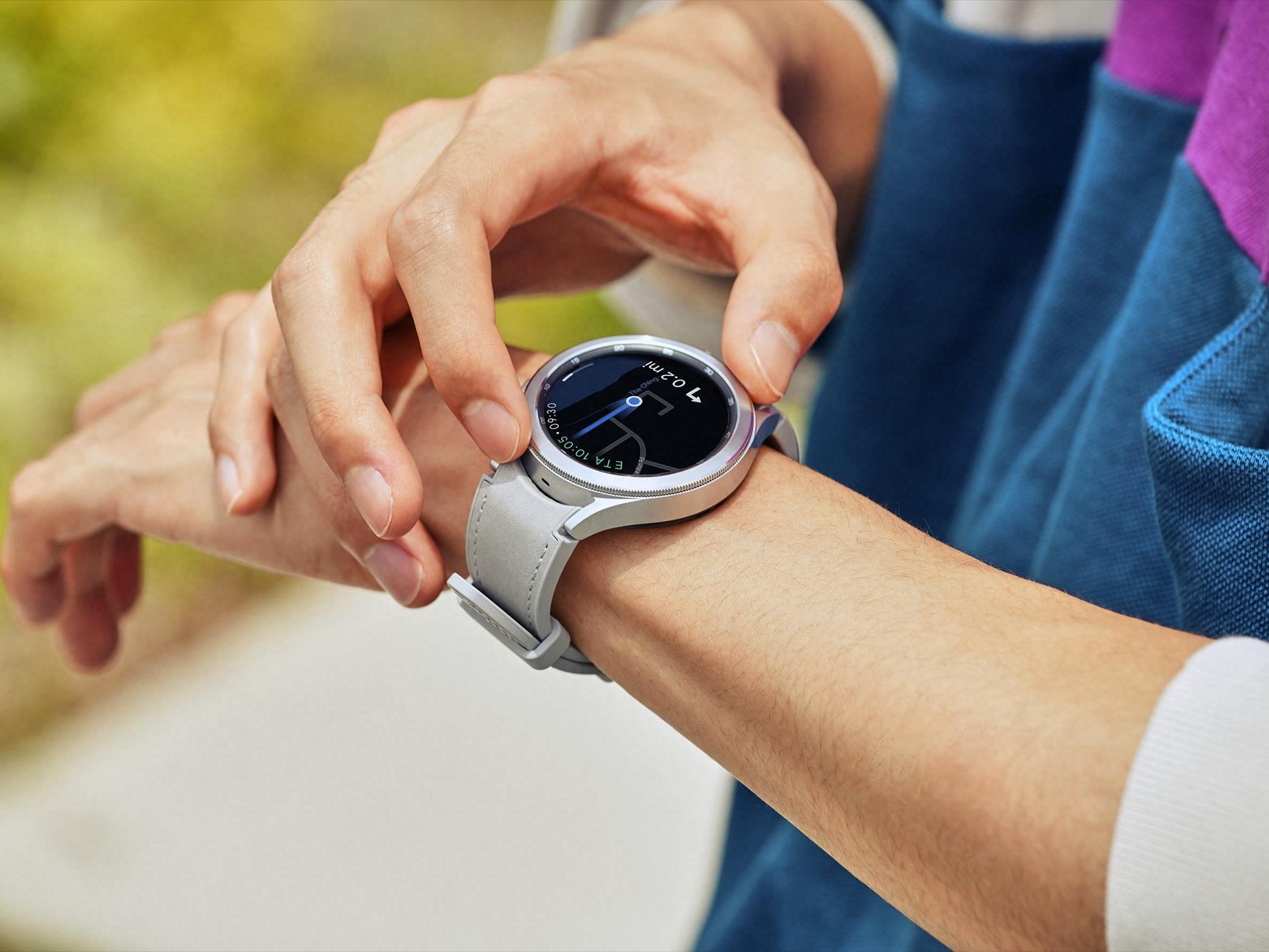
Samsung Galaxy Watch 8 Classic Listing Hints Return Of A Beloved Feature

Samsung Galaxy Watch 8 Classic Listing Hints Return Of A Beloved Feature
Oh, hello! Samsung might be going for a special two-fer with the next Galaxy Watch 8 series. According to a recent Bluetooth SIG (Special Interest Group) listing, fans of the smartwatch will be seeing the return of the Classic model and with that, hopes of the return of the much-loved rotating bezel. Regardless, Galaxy Watch 8 buyers will

Fired Disney Employee Gets 3 Years in Prison For Hacking and Changing Menus

A former Disney employee who hacked into the company’s servers to alter its restaurant menus, including falsifying allergen information and printing profane language, has been sentenced to three years in prison. From a report: Michael Scheuer, a Florida resident, was sentenced last week in federal court and ordered to pay nearly $690,000 in restitution, with most of that going to Disney. He pled guilty in January to one count of computer fraud and one count of aggravated identity theft.

“Scheuer remains remorseful and apologetic to his former co-workers. We are grateful that the judge heard all of our arguments and mitigation when fashioning a sentence that was half of what the government was seeking,” said David Haas, Scheuer’s lawyer, in a statement to CNN.

Scheuer worked as a menu production manager for Disney and was fired last June for misconduct, according to the original complaint. He had access to, and also used, secure internal servers for creating and publishing menus for all of Disney’s restaurants as part of his job at the company.


Read more of this story at Slashdot.

Amazon denies report that it plans to show tariff impacts on its prices

Amazon has refuted a report which said it was planning to tell consumers how much of a product’s price was due to the impact of tariffs that the Trump administration has imposed on imports, particularly those from China. According to Punchbowl News, Amazon was going to display this right next to an item’s total price. However, that’s not the case, Amazon said in a statement.

“The team that runs our ultra low cost Amazon Haul store has considered listing import charges on certain products,” an Amazon spokesperson told The Washington Post (which is owned by Amazon founder Jeff Bezos). “This was never a consideration for the main Amazon site and nothing has been implemented on any Amazon properties.”

During Tuesday’s White House press briefing, Press Secretary Karoline Leavitt responded to a question regarding the Punchbowl report and called the purported plan “a hostile and political act by Amazon.” Citing a Reuters report from 2021, Leavitt claimed that Amazon had partnered with “a Chinese propaganda arm.”

Amazon Haul is a discount storefront that the company debuted to compete with low-cost Chinese retailers Temu and Shein. In recent days, Temu started including “import charges” of around 145 percent on various products, matching tariffs that the Trump administration imposed on many imports from China. Shein also increased prices, though it hasn’t explicitly pinned the blame on “import charges,” per CNBC. “Tariffs are included in the price you pay,” a banner displayed at checkout reads. “You’ll never have to pay extra at delivery.”

Meanwhile, Amazon said on Tuesday it plans to hold its annual blockbuster Prime Day sale this July. According to Reuters, however, some third-party Amazon sellers plan to opt out of this year’s event amid uncertainty over tariffs.

This article originally appeared on Engadget at https://www.engadget.com/big-tech/amazon-denies-report-that-it-plans-to-show-tariff-impacts-on-its-prices-144320278.html?src=rss

ASUS ROG Astral RTX 50 Cards Have A Built-In Gyroscope And It’s Genius

ASUS ROG Astral RTX 50 Cards Have A Built-In Gyroscope And It's Genius
NVIDIA’s latest generation GeForce RTX 50 series GPUs have been around for a few months now, and there is a recently discovered feature from one of the company’s hardware partners that is quite unique amongst GPUs. ASUS ROG’s Astral GeForce RTX 50 models have a built-in gyroscope and accelerometer that can detect the movement of the GPU itself.

Yelp will use AI to help restaurants answer calls and make phone reservations

Yelp has announced new AI-powered call answering features for restaurants and services as part of its Spring Product Release. With the service, currently under development, the company hopes that “businesses never have to miss a call again.” 

“In this next step of our product transformation, we’re continuing to harness AI to unlock the potential of Yelp’s rich data in ways that build trust and simplify decision-making — whether users are hiring a pro or booking a reservation,” Yelp’s chief product officer, Craig Saldanha, said in a statement. “By grounding our AI in real consumer behavior and business data, we’re creating intuitive, transparent features that improve the experience for everyone on Yelp.”

The AI-powered system “will be fully integrated into Yelp’s platform with customizable features and the ability to answer general questions, filter spam, transfer calls when needed, and capture messages.” For restaurants, it will make reservations, put guests on a waitlist and highlight deals like happy hours. It will be part of Yelp Guest Manager, which is also getting a few updates to streamline operations — plus, a new Guest Experience Survey. 

Users calling services will be able to provide project details, get answers to follow-up questions and receive a call back from the company. For example, if a person has an issue with their car, they can give information to the AI system and receive potential solutions. Every business will be able to customize the AI service’s greetings, choose when a call should be forwarded and determine follow-up questions.

This article originally appeared on Engadget at https://www.engadget.com/ai/yelp-will-use-ai-to-help-restaurants-answer-calls-and-make-phone-reservations-143320476.html?src=rss

WhatsApp is reportedly bringing voice and video calls to browsers

Microsoft will shut Skype down on Monday, May 5, in less than a week’s time. While it’s long fallen by the wayside in favor of Zoom, Teams and Google Meet, more users might be turning to WhatsApp. The Meta-owned messaging platform is reportedly working on a feature that would bring voice and video calling to its web browser, WABetaInfo reports. 

WhatsApp already allows voice and video calls on its Mac and Windows apps, but this update would allow users to access these functions without downloading an app. While I’m happy to have the app on my personal computer, this could benefit anyone who doesn’t want to download WhatsApp on a work computer. Right now, the feature is only under development, but there’s a preview of it below. 

WhatsApp calls on browser.
WABetaInfo

WhatsApp has taken additional measures recently to make calling easier. In March, the platform launched a call menu feature for one-on-one and group chats. It allows users to quickly choose a type of call from within the chat or to send a call link. 

This article originally appeared on Engadget at https://www.engadget.com/big-tech/whatsapp-is-reportedly-bringing-voice-and-video-calls-to-browsers-130026611.html?src=rss

Nine Changes You Need to Make to Your Google Security and Privacy Settings

There’s no doubt Google is keen to track just about everything you do online and inside its apps, but it’s also fair to say the company puts a comprehensive set of security and privacy tools at its users’ disposal. You can use these tools to manage data in everything from Google Maps to YouTube.

And there is a lot of data to manage: With Gmail, Gemini, Android, Chrome, and all the other apps and services it runs, Google can suck up a vast amount of information about you and what you’re up to. It’s important to make sure this data is being managed in a way you’re comfortable with, and kept safe from unauthorized access.

All of these security and privacy settings can be found by heading to your Google account page on the web, in a desktop browser.

Automatically wipe the data Google is storing

If you click Data and security and then Web & App Activity, you can see the bulk of the data Google is holding on you. There’s a lot of it, in a lot of categories—from searches you’ve run on the web, to movies you’ve watched on Google TV—and you can delete any of these bits of information, either individually or in batches based on date or app.

Even better, you can have Google wipe this data automatically after a set period of time. Click Choose an auto-delete option, and you can have some or all of your data wiped after 3, 18, or 36 months. There’s also the option to turn off data collection in these categories completely, or to only have certain types of information wiped automatically.

Set up recovery information

Recovery details
Make sure your account recovery details are up to date.
Credit: Lifehacker

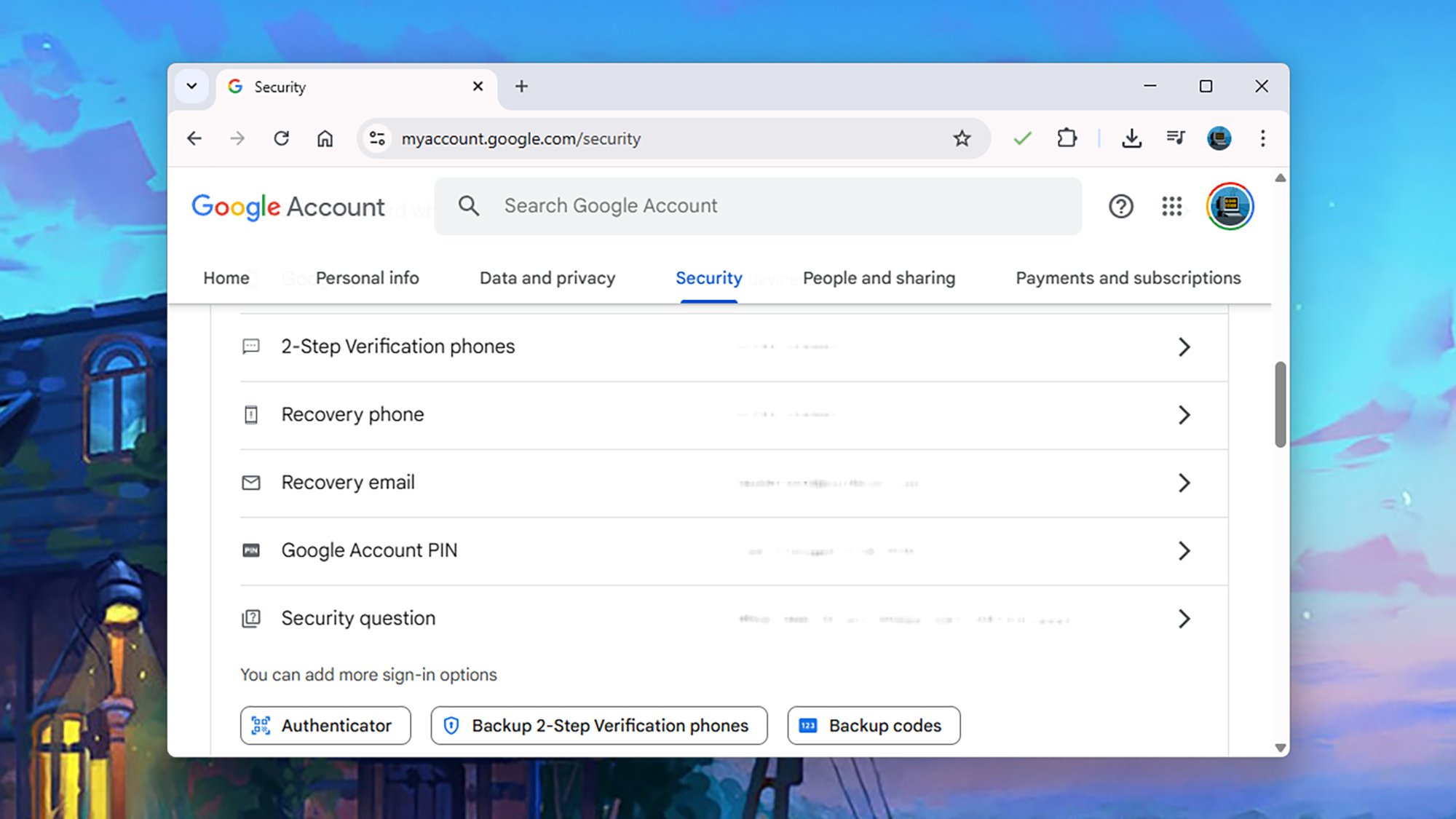
Let’s hope you never get locked out of your account, but if you do, Google will try and use your registered recovery phone number and email address to verify your identity and restore your access—so you need to make sure this information is up to date. To do this, click Security and then Recovery phone or Recovery email to enter or edit the details.

Customize the ads you see

It’s difficult to get away from Google ads, but you can at least tweak the ads you see. From Data and privacy, select My Ad Center to start making changes. The first setting you can change is to turn off personalized ads entirely, which won’t reduce the number of ads you see, but will mean they’re not specifically targeted at your demographic.

To make more granular tweaks, click any of the categories listed (like Education or Industry) to disable personalized ads or correct assumptions Google has made about you (such as your relationship status). You’re also able to click Customize Ads to change the ad topics you get shown, and to disable ads for sensitive topics like weight loss or gambling.

Enable dark web reports

Dark web reports
Google can keep tabs on the dark web for you.
Credit: Lifehacker

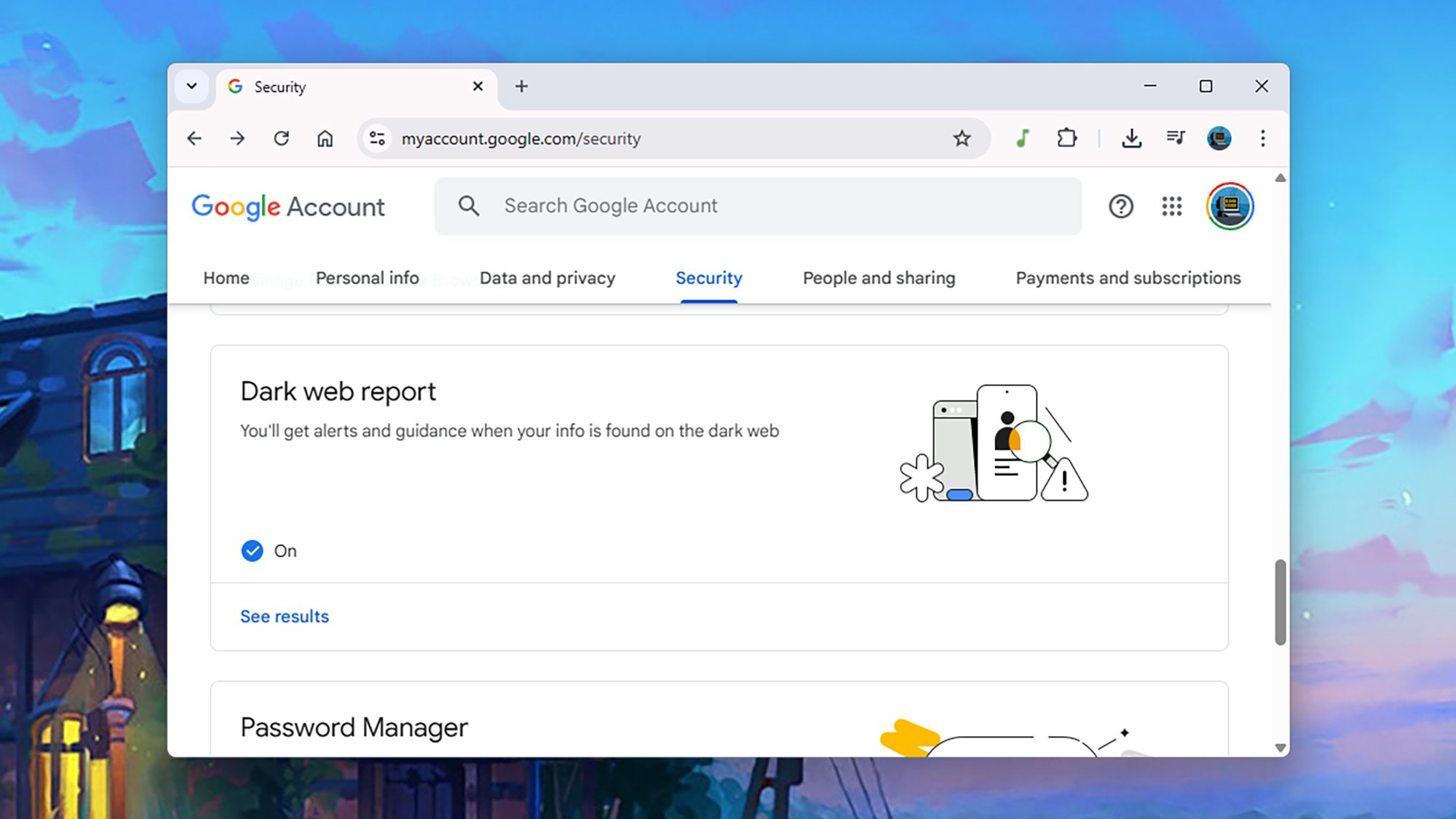
Did you know Google can warn you if your information leaks out on the dark web? Which gives you a heads up that you need to change your passwords or take additional precautions. From the Security tab inside your Google account, click Start monitoring under Dark web report. You can then specify the info you want Google to look out for.

Manage location sharing

From the Data and privacy screen, you can manage how Google tracks your location over time, and also manage which other people can see your location. Click Timeline to configure how your location history is saved on specific devices: You can turn off this history completely, or have it automatically wiped after a certain amount of time.

Select Location sharing under Data and privacy to see which contacts are sharing their location with you, and vice versa (if this is something you’ve set up). You’re able to stop sharing your location with any of these people at any time, as well as set up email reminders that periodically remind you that you’ve got this feature turned on.

Check connected devices

Connected devices
Disconnect devices you’re no longer using.
Credit: Lifehacker

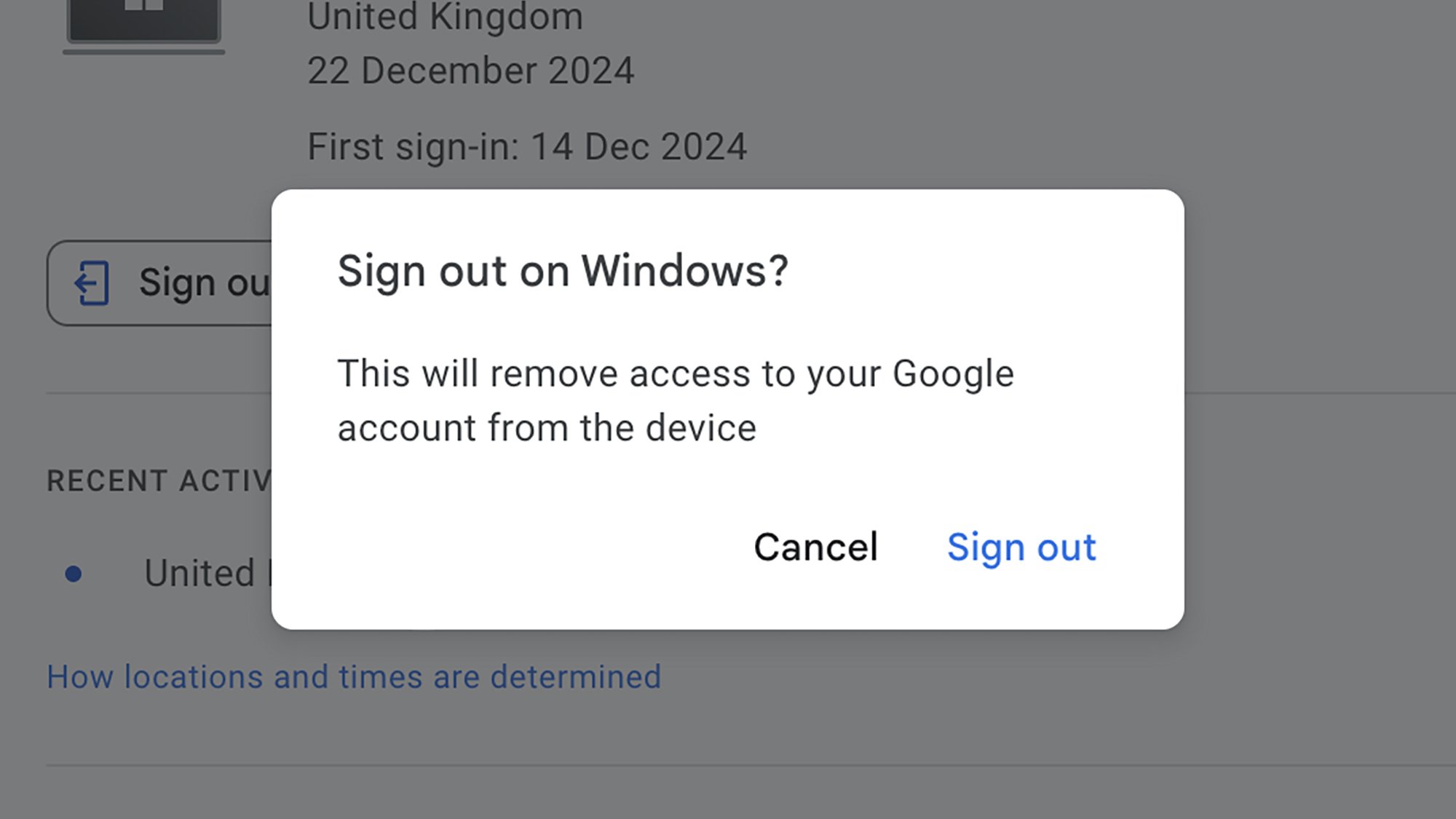
This is a good check to run regularly: From Security, click Manage all devices to see everywhere you’re signed into your Google account. If there are old devices you’ve forgotten about, or other people are using your account when they shouldn’t be, you can revoke permissions. You can also get help if you see a device you don’t recognize.

Set up a digital legacy plan

It’s important to make some plans for when the inevitable happens—if only to make life easier for the family and friends you leave behind. Google lets you choose what happens to your data after you’re gone through what’s known as a digital legacy plan for your account.

If you click Data and privacy and then Make a plan for your digital legacy, you can set this up. It’s not a particularly complicated or time-consuming process: You just choose which contacts you want to have access to your data after a certain period of time (from three to 18 months), and which categories of data you want to leave available to them.

Revoke access for third-party apps

Connected apps
You might be surprised at how many apps are connected to your Google account
Credit: Lifehacker

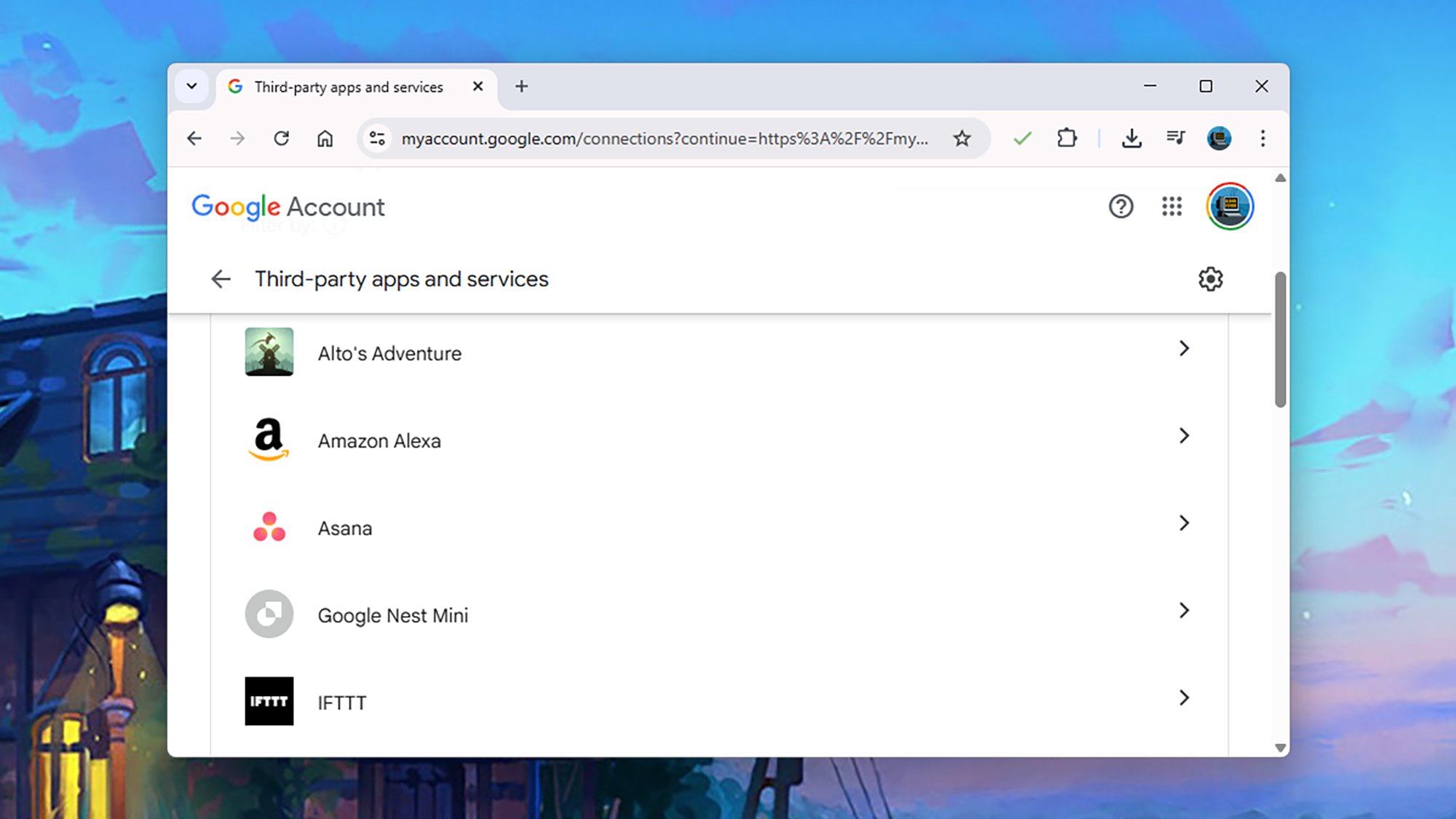
Connecting to apps and services with your Google account is quick and convenient, but the more of these connections you have, the more exposed your account is. Remove outdated and unnecessary links to third-party apps by clicking Security and then See all connections.

Turn on two-factor authentication

We’ve said it plenty of times in the past, and we’ll keep saying it: Two-factor authentication (2FA) is one of the best ways to protect your accounts, because it means hackers need more than a username and password to get at your data. Typically, a code from an authenticator app is also needed when you’re logging in on a new device.

To get 2FA set up on your Google account, if it isn’t already, click Security then 2-Step Verification and follow the instructions on screen. You get a choice of 2FA methods you can use, besides an authenticator app, which include having confirmation prompts sent to authorized devices (such as your phone) and using a physical security key to log in.

A rocket launch Monday night may finally jump-start Amazon’s answer to Starlink

The first 27 operational satellites for Amazon’s Kuiper broadband network lifted off from Florida’s Space Coast on Monday evening, the opening salvo in a challenge to SpaceX’s dominant Starlink global Internet service.

Amazon’s Project Kuiper, costing up to $20 billion, will beam high-speed, low-latency broadband signals to consumers around the world. Monday’s milestone launch kicks off a test campaign in low-Earth orbit to verify the functionality and performance of Amazon’s satellites. In a statement earlier this month, Amazon said it planned to begin providing service to customers later this year.

These initial services are likely to have limited reach. Amazon needs more than 80 launches to complete the first-generation Kuiper network, and this will probably take several years.

Read full article

Comments

Arm Flexes An Incredible 250 Billion Chip Cores Shipped In 40 Years

Arm Flexes An Incredible 250 Billion Chip Cores Shipped In 40 Years
You may not realize it, but chances are high that one of your devices is rocking an Arm-based chip of some kind. And probably multiple devices. Arm’s IP has been used to design an enormous range of system-on-chips (SoCs) that power many Android smartphones, tablets, routers, smart TVs, and so much more. Given that’s the case, it’s not surprising

The BYD Dolphin review: Here’s what we’re missing out on in America

China’s BYD doesn’t mess around. It began life as a battery company that eventually realized it could branch out into electrified cars. And so it did. Today, BYD is outselling rival giants and has cars on the road almost everywhere, except the US. Its eyes are firmly set on conquering the electric vehicle sector, but it will sell you a hybrid if you’re not quite ready to take on life with a battery EV full-time.

Being a thoroughly modern car company, BYD will sell you cars in various shapes and sizes and across a wide price range, though the bigger you go, the higher the price tag becomes. With popular sentiment starting to turn against this second gilded age, the super-lux stuff won’t suit everyone. That’s where BYD’s smallest car, the Dolphin, comes into play.

Small is, of course, a relative term. An original Issigonis Mini it is not, but it makes a Range Rover Evoque look big. It’s tall, but it’s narrow enough that it will fit in a European parking space with room to open the doors. You won’t miss it in a parking lot, either.

Read full article

Comments

Amazon deploys the first Project Kuiper internet satellites

Amazon has finally launched its first batch of Project Kuiper internet satellites on top of a United Launch Alliance Atlas V rocket. The company was supposed to send the first 27 satellites in the constellation, which will eventually be comprised of more than 3,200 satellites, on April 8. However, the event got pushed back. A previous Bloomberg investigation claimed that Kuiper was way behind schedule, because the company was struggling to ramp up the production of its satellites. If true, the company will have to ask for an extension from the FCC to fulfill its commitment to the government, requiring it to put 1,600 satellites in orbit next summer. 

An Amazon spokesperson denied that the company was having manufacturing issues, however. They said that Amazon was on track to support its target and that it will continue increasing its production and launch rates. Around seven hours after launch, Amazon CEO Andy Jassy announced that the company has confirmed that its “first 27 production satellites are operating as expected in low Earth orbit.” Amazon now has over 80 launches scheduled with ULA on top of the Atlas V and the aerospace corporation’s newer Vulcan Centaur heavy lift vehicles. The company’s goal is to provide internet access to far-flung regions not typically reached by conventional internet connections. Its staunchest rival, SpaceX’s Starlink, already has over 7,000 functioning satellites in orbit. 

Important moment for @ProjectKuiper as we just confirmed our first 27 production satellites are operating as expected in low Earth orbit. While this is the first step in a much longer journey to launch the rest of our low Earth orbit constellation, it represents an incredible… pic.twitter.com/sb2eO6n6Im

— Andy Jassy (@ajassy) April 29, 2025

This article originally appeared on Engadget at https://www.engadget.com/science/space/amazon-deploys-the-first-project-kuiper-internet-satellites-140006298.html?src=rss

This Razer Mobile Gaming Controller Is at Its Lowest Price Ever Right Now

We may earn a commission from links on this page. Deal pricing and availability subject to change after time of publication.

The Razer Kishi Ultra is finally seeing a real price break, now down to $99.99 from its usual $149.99—the lowest it’s been, according to price trackers.

Designed mainly for Android phones and newer iPhones with USB-C, the Kishi Ultra snaps onto your device with a springy bridge that can handle anything between 4.7 and 8.3 inches long. In hand, it feels closer to a full-size Xbox controller split in half, complete with offset analog sticks, large tactile buttons, clicky bumpers, and analog triggers. That said, its wide build does make it less travel-friendly compared to the Kishi V2 Pro, but the trade-off is comfort, especially for bigger hands or longer gaming sessions.

The physical controls of the Kishi Ultra are reportedly snappy and responsive. You get a familiar Xbox-style setup with a big D-pad, customizable L4 and R4 triggers, and optional RGB lighting for a bit of flair. Plus, the addition of haptic feedback brings an extra punch to every shot or impact in games like Ultrakill. Beyond that, the Kishi Ultra includes practical touches like a USB-C port that supports pass-through charging and a 3.5mm headphone jack for wired audio. On Android, you get bonus features like virtual controller support for games without native control mapping (think Genshin Impact). However, if you’re an iPhone user, you’ll miss out on that feature. Also, cloud gaming on iOS through Xbox Game Pass isn’t quite as smooth, needing a web-based workaround instead of a clean app experience.

Still, the core experience holds strong across both platforms. Some quirks remain, like a bit of twitchiness in the analog triggers (especially when you’re trying to finely control acceleration in driving games—something to keep in mind if you’re picky about racing or precision-heavy titles, notes this PCMag review) and the overall size, making it a pain to stuff into smaller bags. But if you can work around that, this is about as close as mobile gaming gets to feeling console-grade. Plus, with the ability to plug it into a PC via USB-C and use it as a wired controller, it quietly doubles its value.

Is Nothing Phone 3 Coming To The US? Founder Carl Pei Shares Update

Is Nothing Phone 3 Coming To The US? Founder Carl Pei Shares Update
Nothing’s upcoming Phone (3) could well be getting some love in the United States, assuming Nothing CEO Carl Pei is to be believed. When someone on X asked Pei if the new phone will be sold in the U.S. outside of the Nothing Beta program, the Chinese-Swedish entrepreneur simply said: “100%!” The new device is expected to drop sometime late

Barnes: Parallel ./configure

Tavian Barnes takes on
the tedious process
of waiting for configure scripts to run.

I paid good money for my 24 CPU cores, but ./configure can only
manage to use 69% of one of them. As a result, this random project
takes about 13.5× longer to configure the build than it does to
actually do the build.

The purpose of a ./configure script is basically to run the
compiler a bunch of times and check which runs succeeded. In this
way it can test whether particular headers, functions, struct
fields, etc. exist, which lets people write portable software. This
is an embarrassingly parallel problem, but Autoconf can’t
parallelize it, and neither can CMake, neither can Meson, etc.,
etc.

(Thanks to Paul Wise).