
Clonezilla Live’s May update includes an Ubuntu 25.04 base, Linux kernel 6.14, improved USB support, and key bug fixes.
Category Archives: Unfiltered RSS
The state of SSL stacks
Willy Tarreau and William Lallemand have posted an extensive white
paper examining the landscape of the available SSL implementations.
OpenSSL 3.0 performs significantly worse than alternative SSL
libraries, forcing organizations to provision more hardware just to
maintain existing throughput. This raises important questions about
performance, energy efficiency, and operational costs.Examining alternatives—BoringSSL, LibreSSL, WolfSSL, and
AWS-LC—reveals a landscape of trade-offs. Each offers different
approaches to API compatibility, performance optimization, and QUIC
support. For developers navigating the modern SSL ecosystem,
understanding these trade-offs is crucial for optimizing
performance, maintaining compatibility, and future-proofing their
infrastructure.
The end of the USENIX Annual Technical Conference
On the 50th anniversary of the USENIX organization, its flagship Annual
Technical Conference (ATC) is coming
to an end.
For the past two decades, as more USENIX conferences have joined
the USENIX calendar by focusing on specific topics that grew out of
ATC itself, attendance at ATC has steadily decreased to the point
where there is no longer a critical mass of researchers and
practitioners joining us. Thus, after many years of experiments to
adapt this conference to the ever-changing tech landscape and
community, the USENIX Board of Directors has made the difficult
decision to sunset USENIX ATC.
Many important technologies first saw the light of day at this event.
30 years of MySQL, the database that changed the world
From ubiquitous go-to system for early Noughties startups to a legacy like no otherBefore Donald Trump became US president and the UK left the EU – both arguably the result of a new kind of online politics – a rather nervous-looking Mark Zuckerberg shuffled out onto a Harvard University lecture hall floor to offer some insight into the inner workings of a website he had created less than two years earlier.…
Stratolaunch’s Talon-A2 Prototype Goes Hypersonic After Dropping From World’s Largest Airplane
Stratolaunch successfully flew its uncrewed Talon-A2 prototype to hypersonic speeds twice — once in December and again in March. “We’ve now demonstrated hypersonic speed, added the complexity of a full runway landing with prompt payload recovery and proven reusability,” Stratolaunch President and CEO Zachary Krevor said in a statement on Monday. “Both flights were great achievements for our country, our company and our partners.” Space.com reports: Microsoft co-founder Paul Allen established Stratolaunch in 2011, with the goal of air-launching satellites from a giant carrier plane called Roc, which has a wingspan of 385 feet (117 meters). That vision changed after Allen’s 2018 death, however; the company is now using Roc as a platform to test hypersonic technology.
Hypersonic vehicles are highly maneuverable craft capable of flying at least five times the speed of sound. Their combination of speed and agility make them much more difficult to track and intercept than traditional ballistic missiles. The United States, China and other countries view hypersonic tech as vital for national security, and are therefore developing and testing such gear at an ever-increasing pace. Stratolaunch, Roc and the winged, rocket-powered Talon-2A are part of this evolving picture, as the two newly announced test flights show. They were both conducted for the U.S. military’s Test Resource Management Center Multi-Service Advanced Capability Hypersonic Test Bed (MACH-TB) program, under a partnership with the Virginia-based company Leidos.
On both occasions, Roc lifted off from California and dropped Talon-2A over the Pacific Ocean. The hypersonic vehicle then powered its way to a landing at Vandenberg Space Force Base, on California’s Central Coast. “These flights were a huge success for our program and for the nation,” Scott Wilson, MACH-TB program manager, said in the same statement. “The data collected from the experiments flown on the initial Talon-A flight has now been analyzed and the results are extremely positive,” he added. “The opportunity for technology testing at a high rate is highly valuable as we push the pace of hypersonic testing. The MACH-TB program is pleased with the multiple flight successes while looking forward to future flight tests with Stratolaunch.”


Read more of this story at Slashdot.
Jury orders NSO to pay $167 million for hacking WhatsApp users
A jury has awarded WhatsApp $167 million in punitive damages in a case the company brought against Israel-based NSO Group for exploiting a software vulnerability that hijacked the phones of thousands of users.
The verdict, reached Tuesday, comes as a major victory not just for Meta-owned WhatsApp but also for privacy- and security-rights advocates who have long criticized the practices of NSO and other exploit sellers. The jury also awarded WhatsApp $444 million in compensatory damages.
Clickless exploit
WhatsApp sued NSO in 2019 for an attack that targeted roughly 1,400 mobile phones belonging to attorneys, journalists, human-rights activists, political dissidents, diplomats, and senior foreign government officials. NSO, which works on behalf of governments and law enforcement authorities in various countries, exploited a critical WhatsApp vulnerability that allowed it to install NSO’s proprietary spyware Pegasus on iOS and Android devices. The clickless exploit worked by placing a call to a target’s app. A target did not have to answer the call to be infected.
Amazon’s Zoox Robotaxi Unit Issues Software Recall After Recent Las Vegas Crash
Amazon’s Zoox said it has issued a software recall for 270 of its robotaxis after a crash in Las Vegas last month. CNBC reports: The recall surrounds a defect with the vehicle’s automated driving system that could cause it to inaccurately predict the movement of another car, increasing “the risk of a crash,” according to a report submitted to the National Highway Traffic Safety Administration on May 1. Zoox submitted the recall after an April 8 incident in Las Vegas in which an unoccupied Zoox robotaxi collided with a passenger vehicle, the NHTSA report states. There were no injuries in the crash and only minor damage occurred to both vehicles.
“After analysis and rigorous testing, Zoox identified the root cause,” the company said in a blog post. “We issued a software update that was implemented across all Zoox vehicles. All Zoox vehicles on the road today, including our purpose-built robotaxi and test fleet, have the updated software.” Zoox paused all driverless vehicle operations while it reviewed the incident. It has since resumed operations after rolling out the software update.


Read more of this story at Slashdot.
Trump Admin Plans To Shut Down the Energy Star Program
According to the Washington Post (paywalled), the Trump administration plans to eliminate the Energy Star program — a long-standing EPA initiative that has saved Americans over $500 billion in energy costs since 1992. “The organization states that the average American saves about $450 per year on energy bills by choosing appliances that have been Energy Star-certified,” adds Engadget. From the report: The EPA hasn’t said when this would go into effect and when consumers would stop seeing Energy Star certifications on home appliances. It’s technically illegal for a presidential administration to end this program without Congress, but the same goes for many of Trump’s pronouncements and executive orders. “Eliminating the Energy Star program would directly contradict this administration’s promise to reduce household energy costs,” Paula Glover, president of the nonprofit coalition Alliance to Save Energy, told CNN. “For just $32 million a year, Energy Star helps American families save over $40 billion in annual energy costs. That’s a return of $350 for every federal dollar invested.”


Read more of this story at Slashdot.
Google Accidentally Reveals Android’s Material 3 Expressive Interface
An anonymous reader quotes a report from Ars Technica: Google’s accelerated Android release cycle will soon deliver a new version of the software, and it might look quite different from what you’d expect. Amid rumors of a major UI overhaul, Google seems to have accidentally published a blog post detailing “Material 3 Expressive,” which we expect to see revealed at I/O later this month. Google quickly removed the post from its design site, but not before the Internet Archive saved it.
It has been a few years since Google introduced any major changes to its Material theming, but the design team wasn’t just sitting idly this whole time. According to the leaked blog post, Google has spent the past three years working on a more emotionally engaging vision for Android design. While the original Material Design did an admirable job of leveraging colors and consistent theming, it could make apps look too similar. The answer to that, apparently, is Material 3 Expressive.
Google says this is “the most-researched update to Google’s design system, ever.” The effort reportedly included 46 separate studies with hundreds of sample designs. The team showed these designs to more than 18,000 study participants to understand how the user experience would work. In these studies, the design team used a variety of metrics, including the following: – Eye tracking: Analyzing where users focus their attention – Surveys and focus groups: Gauging emotional responses to different designs – Experiments: Gathering sentiment and preferences – Usability: Seeing how quickly participants could understand and use an interface
“The result of all this is an interface that appears much more varied than the previous Material Design,” writes Ars.
You can check out 9to5Google’s article, which preserved many of the blog post’s visuals before they were removed.


Read more of this story at Slashdot.
Linux Boot Process? Best Geeks Know It!
The Linux boot process is a sequence of events that initializes a Linux system from a powered-off state to a fully operational state. The knowledge of Linux boot process is essential when it comes to technical interviews, but sometimes it becomes difficult to remember or recall the key steps in the process. This article discusses a quick and easy way to remember it – Best Geeks Know It! Yes, you only need to remember that.Best Geeks Know It -[he]gt[/he] B – G – K – I -[he]gt[/he] BIOS – GRUB – KERNEL – INIT
NSO Group Must Pay More Than $167 Million In Damages To WhatsApp For Spyware Campaign
An anonymous reader quotes a report from TechCrunch: Spyware maker NSO Group will have to pay more than $167 million in damages to WhatsApp for a 2019 hacking campaign against more than 1,400 users. On Tuesday, after a five-year legal battle, a jury ruled that NSO Group must pay $167,256,000 in punitive damages and around $444,719 in compensatory damages. This is a huge legal win for WhatsApp, which had asked for more than $400,000 in compensatory damages, based on the time its employees had to dedicate to remediate the attacks, investigate them, and push fixes to patch the vulnerability abused by NSO Group, as well as unspecified punitive damages.
The trial, as well as the whole lawsuit, prompted a series of revelations, such as the location of the victims of the 2019 spyware campaign, as well as the names of some of NSO Group’s customers. The ruling marks the end — pending a potential appeal — of a legal battle that started in more than five years ago, when WhatsApp filed a lawsuit against the spyware maker. The Meta-owned company accused NSO Group of accessing WhatsApp servers and exploiting an audio-calling vulnerability in the chat app to target around 1,400 people, including dissidents, human rights activists, and journalists. NSO Group’s spokesperson Gil Lainer left the door open for an appeal. “We will carefully examine the verdict’s details and pursue appropriate legal remedies, including further proceedings and an appeal,” Lainer said in a statement.


Read more of this story at Slashdot.
New Bill Would Force Apple, Google To Open App Store Ecosystems
Rep. Kat Cammack (R-FL) introduced the App Store Freedom Act [PDF] on Tuesday, legislation that would compel “large app store operators” with over 100 million US users to permit third-party app stores and allow them to be set as defaults. The bill directly challenges Apple’s walled garden approach and Google’s Play Store dominance by requiring both companies to allow developers to use alternative payment systems, bypassing the platforms’ commission structures.
It would also mandate equal access to development tools and interfaces without discrimination, while giving users the ability to remove pre-installed apps. Violations would trigger FTC enforcement with penalties up to $1 million per infraction. The legislation mirrors recent European Union regulations that have already forced Apple to permit third-party app stores and allow users to change default apps.


Read more of this story at Slashdot.
KDE Plasma 6.3.5 Improves Support for Multi-Screen Setups, NVIDIA GPU Users
Today, the KDE Project released KDE Plasma 6.3.5 as the fifth and last maintenance update to the latest KDE Plasma 6.3 desktop environment series to address more bugs, crashes, and other issues reported by users during the five weeks since KDE Plasma 6.3.4.
Minecraft ended virtual reality support today
Minecraft is no longer (officially) available on virtual and mixed reality platforms. The change was confirmed in today’s patch notes for the game’s Bedrock edition following an announcement from developer Mojang in October. Those fall patch notes suggested that the platforms would be removed in March, so players who favored VR wound up getting a few extra weeks to fully immerse themselves in their blocky worlds.
Removing entire platforms isn’t a choice game devs make lightly. Especially when Minecraft‘s player base still numbers in the hundreds of millions at any given time, it seems unlikely that Mojang would take away virtual and mixed reality unless it wouldn’t cause a serious disruption for its many fans. There are still plenty of critically received games that make VR ownership worthwhile (Beat Saber, anyone?), but a title as major as Minecraft abandoning the hardware isn’t a great look.
This article originally appeared on Engadget at https://www.engadget.com/gaming/minecraft-ended-virtual-reality-support-today-224649126.html?src=rss
Memory-Safe Sudo To Become the Default In Ubuntu
Longtime Slashdot reader RoccamOccam shares a blog post from the Trifecta Tech Foundation, a nonprofit organization that creates secure, open source building blocks for infrastructure software. The foundation is also the developer behind Sudo-rs. From the report: Ubuntu 25.10 is set to adopt sudo-rs by default. Sudo-rs is a memory-safe reimplementation of the widely-used sudo utility, written in the Rust programming language. This move is part of a broader effort by Canonical to improve the resilience and maintainability of core system components. […]
The decision to adopt sudo-rs is in line with Canonical’s commitment to Carefully But Purposefully increase the resilience of critical system software, by adopting Rust. Rust is a programming language with strong memory safety guarantees that eliminates many of the vulnerabilities that have historically plagued traditional C-based software. Sudo-rs is part of the Trifecta Tech Foundation’s Privilege Boundary initiative, which aims to handle privilege escalation with memory-safe alternatives.


Read more of this story at Slashdot.
KDE Plasma 6.3.5 Desktop Environment Released
KDE Plasma 6.3.5 is a bugfix release improving applets, notifications, and core behavior, with over two dozen issues resolved.
Destiny 2 will get a Star Wars expansion this December
Bungie laid out its plans for the next year of Destiny 2 content, and the back half of 2025 could be particularly exciting for Star Wars fans. The studio teased an expansion titled Renegades that draws inspiration from the sci-fi universe. Destiny has always featured classic space opera themes about battles between the light and the darkness, so maybe it was inevitable that the game would one day pay homage to Star Wars.
If you fear that there will suddenly be Skywalkers and Fetts running around your game a la Fortnite or Call of Duty, that does seem like a possibility. The teaser video features a guardian wielding an iconic green light saber, and there are some recognizable nods to the Imperial alarm sounds and uniforms in a few close-up shots. And if you really want to embrace the dark side, the most expensive pre-order option for this year’s content includes armor ornaments that can turn your guardian into Darth Vader, Kylo Ren or General Grievous.
Bungie
More information about the Renegades expansion will be announced on September 9 ahead of the update’s arrival this December.
This article originally appeared on Engadget at https://www.engadget.com/gaming/destiny-2-will-get-a-star-wars-expansion-this-december-220446525.html?src=rss
CISA Budget Faces Possible $500 Million Cut
President Trump’s proposed 2026 budget seeks to cut nearly $500 million from CISA, accusing the agency of prioritizing censorship over cybersecurity and election protection. “The proposed cuts — which are largely symbolic at this stage as they need to be approved by Congress — are framed as a purge of the so-called ‘censorship industrial complex,’ a term the White House uses to describe CISA’s work countering misinformation,” reports The Register. From the report: In its fiscal 2024 budget request, the agency had asked [PDF] for a total of just over $3 billion to safeguard the nation’s online security across both government and private sectors. The enacted budget that year was about $34 million lower than the previous year’s. Now, a deep cut has been proposed [PDF], as the Trump administration decries the agency’s past work tackling the spread of misinformation on the web by America’s enemies, as well as the agency’s efforts safeguarding election security. […]
“The budget eliminates programs focused on so-called misinformation and propaganda as well as external engagement offices such as international affairs,” it reads [PDF]. “These programs and offices were used as a hub in the censorship industrial complex to violate the First Amendment, target Americans for protected speech, and target the President. CISA was more focused on censorship than on protecting the nation’s critical systems, and put them at risk due to poor management and inefficiency, as well as a focus on self-promotion.”


Read more of this story at Slashdot.
Meta wins more than $167 million in damages from spyware maker that targeted WhatsApp
A jury has ruled that the company behind the infamous Pegasus spyware must pay Meta more than $167 million in damages for spreading malware via WhatsApp. The ruling is a major victory for Meta after a years-long legal battle with NSO Group.
Meta sued the NSO Group in 2019 over its Pegasus spyware. Meta said at the time that more than 1,400 people in 20 countries had been targeted, including journalists and human rights activists. The company said that the “highly sophisticated cyber attack” spread malware via video calls even when the calls went unanswered. Last year, a judge sided with Meta and found the Israeli company had violated the US Computer Fraud and Abuse Act. Tuesday’s verdict followed a week-long jury trial to determine just how much NSO should pay in damages to Meta.
The jury ultimately awarded Meta $444,719 in compensatory damages and $167,254,000 in punitive damages. In a statement, WhatsApp’s VP of Global Communications Carl Woog called the verdict “a critical deterrent to this malicious industry against their illegal acts aimed at American companies and the privacy and security of the people we serve.”
NSO Group, which describes itself as a “cyber intelligence” firm, has said that it’s not possible to use Pegasus on US phone numbers. In court, lawyers for the firm argued that WhatsApp wasn’t harmed in any way by Pegasus, according to Courthouse News Service.
In a statement, NSO’s Gil Lainer said the verdict was “another step in a lengthy judicial process” and said it would pursue “further proceedings” or an appeal. “We firmly believe that our technology plays a critical role in preventing serious crime and terrorism and is deployed responsibly by authorized government agencies,” Lainer said. “This perspective, validated by extensive real-world evidence and numerous security operations that have saved many lives, including American lives, was excluded from the jury’s consideration in this case.”
WhatsApp’s Woog said Meta knows it has “a long road ahead” to collect damages from NSO. “Ultimately, we would like to make a donation to digital rights organizations that are working to defend people against such attacks around the world,” he said. He added that Meta plans to pursue a court order to prevent NSO from targeting WhatsApp in the future.
This article originally appeared on Engadget at https://www.engadget.com/cybersecurity/meta-wins-more-than-167-million-in-damages-from-spyware-maker-that-targeted-whatsapp-215459438.html?src=rss
This Mac App Gives a Much Needed Upgrade to Copying and Pasting
I couldn’t live without copy and paste—it’s core to the way I write and work—but it’s a pretty abstract feature when you think about it. Copy something and it goes… somewhere. Then you can paste it. Oh, and if you copy a second thing the first thing is gone.
This is a problem solved by clipboard managers. These applications let you review everything you’ve copied recently and even select an older item to paste it. They work well, but generally require a lot of context switching. What if you want to copy multiple things and then paste them later, all in the order you copied them, without having to open a clipboard manager and choose the items in order? There’s a free and open source Mac tool for that: Batch Clipboard (which I found via MacMenuBar).
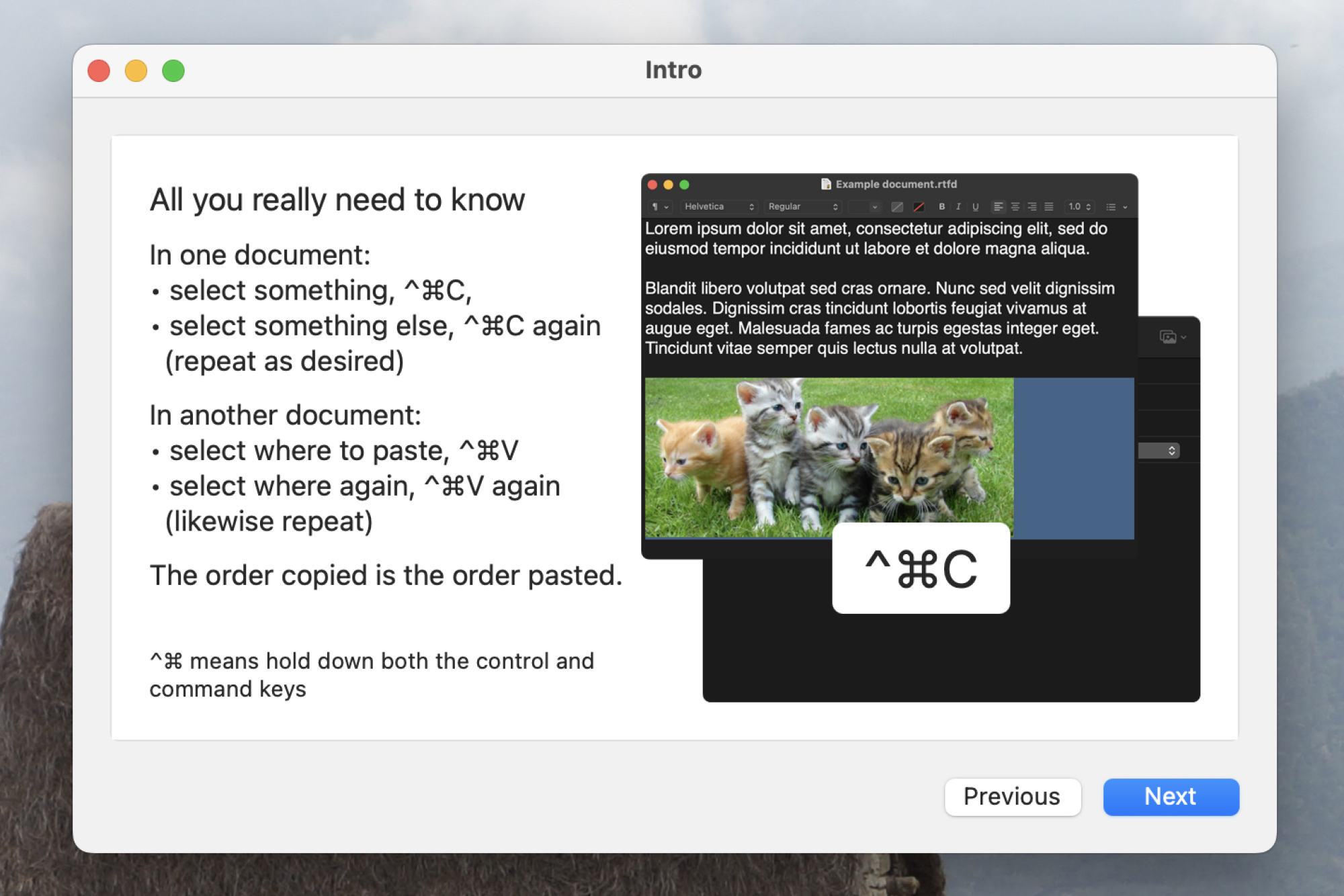
This application isn’t a clipboard manager—in fact, it can easily be used alongside one. With the application running, you can copy text, images, or files using the keyboard shortcut Cmd-Control-C to start building a batch. When you’re ready, you can paste them, one at a time starting at the beginning of the batch, using the keyboard shortcut Cmd-Control-V. You can click the menu bar icon at any time to see the current batch.
It takes a second to wrap your head around, but is quite useful in certain contexts. If, for example, you’re reading a document and want to collect a few quotes, you can copy each one to your batch and them paste them all to your notes in sequence, taking the time to add a bit of context as you go. This allows you to focus on reading instead of constantly switching back and forth between the source document and your notes.
Credit: Justin Pot
Getting started is simple. After downloading the app, you can launch it to read the quick start guide—it will talk you through using the application and ask you to enable permissions. You can access the settings by clicking the menu bar icon and clicking “Settings”. You can customize the keyboard shortcuts, decide whether the application start when your computer does, and change how many history items are visible in the menu. You can also choose for the application to ignore items copied from particular applications.
You could, in theory, use Batch Clipboard as an alternative to a clipboard manager—click the menu bar icon while holding the Option key and you can review everything you copied recently. You could also use it alongside a dedicated clipboard manager, or just open it when you specifically want to use the batch copying feature. Check it out if clipboard managers have never quite clicked with you.