
With modern Linux distributions beginning to see good support for HDR displays, if you have been looking to upgrade to a high dynamic range OLED monitor, one of the newest options that recently launched by Samsung is the Odyssey OLED G8 G81SF. I’ve been testing out the Samsung G81SF the past few weeks and it’s been working out well paired with the likes of Ubuntu 25.04 and Fedora 42 to deliver a beautiful desktop experience and a great experience for Linux gamers with supporting a 240Hz refresh rate and AMD FreeSync Premium Pro.
Category Archives: Unfiltered RSS
20 of the Best Apple TV+ Original Movies
We may earn a commission from links on this page.
Though relatively new on the Hollywood scene (its first original film was released in 2019), Apple TV+’s slate of original films has included not just charming indies, but award-winning prestige pictures. CODA was Oscar’s best picture just a couple of years ago (the first film from a streaming service to claim the honor), and the streamer’s movies earned it 13 nominations for 2023, even if it got nothing for 2024. (We all have off years.)
Given the complexities of film financing today, you might be excused for believing that many of these movies were typical theatrical releases—but, strictly speaking, these are all Apple TV+ originals. Sometimes they’re only available through the app, but other times they have small (or significant) theatrical releases built in to their distribution model, if only to ensure they’re eligible for major awards like the Oscars.
The Gorge (2025)
Miles Teller, Anya Taylor-Joy, and Sigourney Weaver star in this sci-fi/action/romance that became Apple TV’s most-streamed movie launch ever upon its February release. Teller and Taylor-Joy play snipers tasked by a mysterious woman (Weaver) with guarding two sides of the title’s gorge: He’s a former U.S. Marine with symptoms of PTSD, she’s a a Lithuanian covert operative with a dying father. The two are to stand watch for a full year in complete isolation to ensure that nothing comes out of the gorge, but things get complicated when the bored snipers start sending each other messages, increasing their communication until they start to question just what it is that they’re meant to be guarding. You can stream The Gorge here.
Fly Me to the Moon (2024)
The sort of goofy rom-com that they don’t make anymore (or so it’s said), Fly Me to the Moon rides on the strong chemistry between leads Scarlett Johansson and Channing Tatum, as well as a premise so outrageous that it just about works. Tatum is Cole Davis, a (fictional) NASA launch director during the Apollo 11 era. He finds himself saddled with Johansson’s Kelly Jones, a slightly unscrupulous marketer publicly charged with helping to sell the public on the importance of a Moon landing. But she has a secret mission, as well: She’s charged with preparing a fake landing video to air if the real one fails. These two lock horns as the actual launch approaches, with Kelly coming to question her methods in the face of true-believer Cole. Director Greg Berlanti, best known for about a million DC Comics TV shows, follows up 2018’s Love, Simon. You can stream Fly Me to the Moon here.
Killers of the Flower Moon (2023)
Though it didn’t take home Oscar gold (let’s put Lily Gladstone in more movies, please), Martin Scorsese’s latest has more than proven the octogenarian filmmaker hasn’t lost a step. A story of creeping dread and existential terror in the American west, it chronicles the injustices that follow the discovery of oil on Osage tribal land in the 1920s. A good thing quickly goes bad when white political leaders plot a string of murders to keep the wealth from staying where it belongs. The film might have gone deeper in presenting the true story from its natural Indigenous perspective, but the finished product still represents an important and harrowing story well told. You can stream Killers of the Flower Moon here.
The Tragedy of Macbeth (2021)
Joel Coen’s sole (thus far) solo directing project represents a bold choice: a beautiful, strikingly minimalist adaptation of the Scottish play—lean and mean in its production and its impact. Only a director of Coen’s confidence would mount a production like this without feeling the need to reinvent the wheel, letting Shakespeare dialogue and the performances of Denzel Washington and Frances McDormand do the heavy lifting. During the 2021/22 awards season, it received far more nominations than wins, but still stands as one of the best cinematic takes on Macbeth since Kurosawa’s Throne of Blood. You can stream The Tragedy of Macbeth here.
Blitz (2024)
British director Steve McQueen (Hunger, 12 Years a Slave, Widows) takes on the Blitz in this historical drama that’s rousingly old-fashioned while also being revisionist in its willingness to upend our notions of the fighting spirit of British civilians during World War II. Saoirse Ronan plays Rita, single mom to a biracial son—her Grenadian partner was hounded by racists until he was forced to leave the country. She’s a factory worker and a singer, struggling to survive in London’s East End, where the poor are offered less protection than those in better-off parts of the city, and a single mother with a biracial child is treated a bit less well than that. It’s not an entirely downbeat movie, and it’s full of uplifting moments, but it’s also not afraid to suggest that the Blitz of 1940 wasn’t all “Keep Calm and Carry On.” You can stream Blitz here.
Come From Away (2021)
A full cinematic adaptation of this musical about the events that unfolded at a rural airport on 9/11 was in the works before the pandemic put a stop to them. Thus, a special stage production was mounted using members of the original cast, filmed before an audience of 9/11 survivors and frontline workers. While it’s impossible to know what that other version might have been like, this one is probably better. The musical, which opened on Broadway in 2017, takes place in the Newfoundland town of Gander following the 2001 attacks. Gander had once been a major refueling hub, but that changed over time, leaving the town with an enormous airport and relatively little traffic—until airplanes were diverted there in the wake of the terrorist attacks. The stranded plane passengers briefly more than doubled the town’s population, and Gander leaders and residents pulled out all the stops to care for the unexpected guests. Based on a true story, the show has a smart sense of humor and, while it’s not cynical, it never succumb to schmaltz either. You can stream Come from Away here.
Wolfs (2024)
Jon Watts steps away from Marvel’s Spider-Man movies to direct this action comedy led by George Clooney and Brad Pitt; it’s still a little hard to process that we’re in a world where two A-list stars would get paired with a director whose grosses are in the multiple billions, and yet we’re direct-to-streaming (technically, this did get a one-week pro forma theatrical release). Regardless, the finished product is quite fun: Amy Ryan plays Margaret, a Manhattan District Attorney who meets a young man in a bar who ends up dead(-ish) in her hotel room. She contacts a fixer (Clooney) to help clean up the mess and keep her out of trouble. Meanwhile, the hotel’s owner (voiced by Frances McDormand) witnesses much of what went on, and has brought in a person of her own (Pitt) to protect her hotel from blowback. The two very solitary fixers are forced to work together, and, naturally, things get increasingly complicated: The dead young man isn’t entirely dead, as it happens, but was involved in shenanigans that include drugs and the Albanian mafia. You can stream Wolfs here.
Louis Armstrong’s Black & Blues (2022)
Sacha Jenkins does an awful lot right in this biographical documentary about the American jazz legend, starting by offering new and archival interviews with musicians who’ve been influenced by Satchmo and his art: Wynton Marsalis, Miles Davis, Amiri Baraka, Ossie Davis, etc. But what he really gets right is in allowing Armstrong to tell his own story—the legend kept shelves worth of diaries on reel-to-reel tape, and it’s quickly clear that there’s no one better suited to tell his story, his instantly recognizable voice offering frank insights that no one else could. It’s a love letter to the jazz giant, one that, smartly, doesn’t try to smooth out the rough edges. You can stream Black & Blues here.
Cha Cha Real Smooth (2022)
You might have missed Cooper Raiff’s 2020 indie Shithouse, a movie that earned great reviews on a $15,000 budget but couldn’t overcome its unfortunate title. His follow-up, Cha Cha Real Smooth, got a bit more attention. Andrew is a bar/bat mitzvah party planner who falls for Domino, a mom 10 years his senior (Dakota Johnson). It’s occasionally cloying, but Raiff’s complex script and range of characters make for a charming movie from a filmmaker to keep an eye on. You can stream Cha Cha Real Smooth here.
Still: A Michael J. Fox Movie (2023)
The easy route would have been a tearjerking portrait of an inspirational American figure—One-time Hollywood golden boy bravely faces life with a debilitating illness. There’s a bit of that in this documentary, but whenever that mood does overtake the film, it feels earned. Director Davis Guggenheim documents Fox’s life with a thematic narrative through-line (an actor who could never be still in body or mind now struggles to do just that), even as it refuses to shy away from the knocks and bruises that attend any life with Parkinson’s, nor from Fox’s own complicated personality. The film works best when dealing with the overlaps, and disconnects, between Fox as a person and Fox as a public face of Parkinson’s. You can stream Still here.
CODA (2021)
I’m not sure it was the most worthy Best Picture Oscar winner, that doesn’t detract from CODA as a charming and altogether likable film about Ruby (Emilia Jones), a young musician who is the only hearing member of her family. She struggles with the demands of the family’s fishing business even as she discovers a passion for singing and a new boyfriend. The premise involves a worn and silly trope about deaf people not understanding music, but it also depicts its characters as capable, complicated community leaders with actual sex lives. Emilia Jones is great in the lead, as are Marlee Matlin and Oscar-winner Troy Katsur as her parents. You can stream CODA here.
Finch (2021)
In a post-apocalyptic wasteland, a dying engineer named Finch (Tom Hanks) works to build a robotic companion—not to serve as his companion, but to take care of his dog when he dies. Which is 1000% relatable, and more or less the extent of the plot. As end-time movies go, this one is surprisingly charming and family-friendly—Tom Hanks is a genial companion at the end of the world, and you won’t be surprised that a story of a man having adventures just to make sure that his dog has a friend is definitely going to make you cry. You can stream Finch here.
Napoleon (2023)
Sandwiched between 2021’s superior The Last Duel and Gladiator 2, Ridley Scott’s 2023 somewhat-accurate biopic about the one-time emperor of France proves his is the only name in town when it comes to historical epics. The shorter, theatrical version of this one is a slightly muddled affair, turning on a sly, subtly comedic lead performance from Joaquin Phoenix while also building to a number of massive, more traditional set pieces (Scott smartly doesn’t ask us to be overly enamored of the man himself). When it works, it offers up the old-fashioned thrills of a gorgeously designed period drama, with the types of grand battle sequences that we don’t get in a world where every movie fight involves superheroes and spaceships. The director’s cut (my preferred version), also on Apple TV+, is, surprisingly, sharper and funnier—but it adds nearly an hour to an already-long movie, so manage your time accordingly. You can stream the theatrical cut here, and the longer director’s cut here.
The Pigeon Tunnel (2023)
The great Errol Morris (Gates of Heaven, The Thin Blue Line, The Fog of War) turns his camera on writer David Cornwell, better known as John le Carré, one-time spy and preeminent writer of espionage novels. The title comes from a memory from the author’s youth: visiting his father who was part of a pigeon-shooting concession—the pigeons were bred in captivity and then forced through a tunnel so that they’d be right in line for rich men to shoot them, just at what seemed like their moment of freedom. The metaphor of an escape that’s actually a trap became a potent one in the author’s life and work, and Morris drives into that lifelong theme with his typical depth and style. You can stream The Pigeon Tunnel here.
Wolfwalkers (2020)
Robyn Goodfellowe is apprenticed to her father as a hunter, the two of them traveling to Ireland to wipe out the last of the land’s wolves. Going off on her own, she encounters a free-spirited girl who needs Robyn’s help to find her mother; the girl’s tribe is rumored to have the ability to change into wolves, and Robyn’s alliance with her new friends threatens her relationship with her father. This stunningly hand-drawn animated film received a well-deserved Oscar nomination, and follows a thematic trilogy that began with the same filmmakers’ The Secret of Kells (2009) and Song of the Sea (2014). They’re all independent of one another story-wise, but if you love this one, you’ll undoubtedly enjoy all three. You can stream Wolfwalkers here.
Hala (2019)
Most audiences seemed to overlook Apple’s first original narrative movie when it was released back in 2019, and that’s too bad. Written and directed by Minhal Baig, a native of Chicago’s Rogers Park neighborhood, the movie has a distinctive sense of place, particularly for anyone who grew up in the Chicago area. But its primary strength is as a smart, sensitive coming-of-age story. Geraldine Viswanathan plays the title’s Hala Masood, a teenager from a strict Muslim family who falls for a non-Muslim boy at school, setting up a conflict that also brings a few family secrets out into the open. You can stream Hala here.
The Elephant Queen (2018)
Chiwetel Ejiofor narrates this nature documentary from directors Victoria Stone and Mark Deeble, following 50-year-old mother elephant Athena as she leads her family from their bucolic home into more treacherous terrain after a drought threatens their survival. The team kept track of the family in the African savannah over the course of four years, charting the intelligence and familial bonds of the animals, as well as the harsh choices imposed on them by the natural environment. You can stream The Elephant Queen here.
Swan Song (2021)
Writer/director Benjamin Cleary presents a poignant existential dilemma in this low-key science fiction drama starring Mahershala Ali as Cameron Turner, a husband and father suffering from a terminal illness. To spare his wife (Naomie Harris) and children from the trauma and pain of his impending death, he’s considering a new procedure offered by Dr. Scott (Glenn Close): He’ll continue to hide his illness from his family, and be replaced by a clone with all of his memories. He’ll spend his last months alone, but knowing his family won’t have to confront his loss. In the best sci-fi tradition, the film explores the questions of identity, meaning, and loss that such hypothetical technology raises—without feeling like an overlong episode of Black Mirror. You can stream Swan Song here.
The Velveteen Rabbit (2023)
It’s only around 40 minutes, so this blend of live-action and animation is more of a short than a feature, but its length and refusal to belabor its own point are strengths, not weaknesses.Seven-year-old William (Phoenix Laroche) moves with his family to a new home, where he struggles to settle in and make friends. A Christmas gift of the titular rabbit sets William’s imagination free, and the boy’s love gives the rabbit a life of its own alongside the other toys in the playroom. When William gets sick, the Velveteen Rabbit has a tough choice to make and, if you know the story, this is approximately when the tears start welling up in your eyes. The animated segments use a variety of gorgeous animation styles, which really sells the complexity and variety of William’s imagination. You can stream The Velveteen Rabbit here.
Sidney (2022)
Reginald Hudlin (House Party, Marshall) directs this straightforward, nevertheless essential portrait of actor, director, and diplomat Sidney Poitier. The film not only captures the scope of one of the most significant and consequential figures in film and American culture in the 20th century—it also has the poignant virtue of being Poitier’s last onscreen appearance before his death at the age 94. You can stream Sidney here.
Apple Mac Mini Fire Sale: Amazon Slashes Prices On M4 Models

We have to hand it to Apple, moving on from Intel’s x86 silicon to its own Arm-based Apple Silicon hardware was a bold and risky move, and it’s paying off. One of our first run-ins with Apple’s home brewed hardware was the 2020 Mac Mini with an M1 chip inside. Now several years later, Apple’s chips are even more powerful and efficient, and
Celsius founder Alex Mashinsky sentenced to 12 years for “unbank yourself” scam
Alex Mashinsky—the disgraced founder of the Celsius Network cryptocurrency bank who deceived hundreds of thousands into losing billions with the catchy slogan “unbank yourself”—was sentenced to 12 years in prison on Thursday.
Back in December, Mashinsky pleaded guilty to securities fraud and commodities fraud. Federal prosecutors slammed him for reaping $48 million in profits while causing billions in investor losses by artificially inflating the value of his network’s token, Cel. The Department of Justice and dozens of victims urged the court to order a maximum sentence of 20 years, while Mashinsky hoped the court would agree that he had shown remorse and should only serve one year and one day, Reuters reported.
Mashinsky’s downfall started in 2022, when the Celsius Network suddenly stopped allowing withdrawals, claiming that “extreme market conditions” were to blame, a shady move that caused some customers to question the crypto bank’s financial health. One month later, the bank filed for bankruptcy, exposing a $1.19 billion deficit in its balance sheets and still holding onto customers’ funds while scoffing at supposed “misinformation” that their money would be lost.
Don’t look now, but a confirmed gamer is leading the Catholic Church
Yesterday’s naming of Chicago native Robert Prevost as Pope Leo XIV—the first American-born leader of the Catholic church—has already led to plenty of jokes and memes about his potential interactions with various bits of American pop culture. And that cultural exposure apparently extends to some casual video games, making Leo XIV is our first confirmed gamer pope.
Speaking to NBC5 Chicago Thursday, papal sibling John Prevost confirmed that the soon-to-be-pope played a couple of games just before flying to the papal conclave earlier this week. “First we do Wordle, because this is a regular thing,” Prevost said. “Then we do Words with Friends. It’s something to keep his mind off life in the real world…”
OK, so the pope’s love of casual word games doesn’t exactly put him in the same category of people who are speedrunning Doom slaughter maps. But it’s still striking to realize that the 69-year-old pontiff is among the reported 44 percent of American Baby Boomer men who play video games regularly and the 15 percent of Americans aged 55 and over who have played Wordle specifically.
Nvidia CEO: ‘You Won’t Lose Your Job To AI, But To Someone Who Uses It’
Nvidia founder and CEO Jensen Huang has served up another blunt take on the job market as AI permeates society. From a report: “You will not lose your job to AI, but will lose it to someone who uses it,” Huang said at the Milken Institute Conference. Added Huang, “I recommend 100% take advantage of AI, don’t be that person.”


Read more of this story at Slashdot.
MeshWalkie Combines ESP32, GNSS, and LoRa in UV-K6 Radio Enclosure
OpenEmbed is developing the MeshWalkie, a handheld wireless device built around the ESP32-S3, SX1262 LoRa module, and L76K GNSS, using the enclosure of a Quansheng UV-K6 radio. The device is described as an open-source platform for LoRa, Wi-Fi, and GPS-based applications, including support for Meshtastic. The MeshWalkie integrates several hardware components to support low-power […]
Man Offers New Shells To Hermit Crabs Wearing Plastic Waste
This is a video highlighting the work of conservationist Shawn Miller’s ‘Make The Switch 4 Nature‘ program, which aids in providing hermit crabs living in plastic waste shells with real shells. It also encourages humans to leave potential hermit crabs shells on the beach instead of taking them home to populate their junk drawer or a jar in a beach-themed guest bathroom. Even aware of the hermit crab’s plight, will people stop taking their homes? I’d certainly like to think so, but a lot of people, just like the plastic these crabs stuffed their asses into, are garbage.
Samsung Galaxy Watches Are About To Get 3 Great New Features With One UI 8 Update

The next Samsung Galaxy Watch OS update is set to introduce big features taken straight from Samsung phones, such as One UI 7’s Now Bar and Now Brief. Gemini AI will also be onboard with the ability to move your calendar events, summarize emails, as well as other Google Assistant-like actions. Early reports point to Samsung skipping the next
Trump cuts tariff on UK cars; American carmakers not happy about it
The British car industry got a big break from US President Donald Trump yesterday afternoon. Trump and UK Prime Minister Kier Starmer have agreed to a bilateral trade agreement that cuts tariffs on a range of imports from the UK, including pharmaceuticals, aluminum and steel, and cars.
Now, the first 100,000 cars that come to the US from the UK will only be subject to a 10 percent tariff rather than the 27.5 percent they have been under since the start of this trade war in April.
“The car industry is vital to the UK’s economic prosperity, sustaining 250,000 jobs,” said Jaguar Land Rover CEO Adrian Mardell. “We warmly welcome this deal which secures greater certainty for our sector and the communities it supports. We would like to thank the UK and US Governments for agreeing this deal at pace and look forward to continued engagement over the coming months,” Mardell said.
FBI Warns Hackers Are Weaponizing Old Routers, Consider One Of These Upgrades

Are you holding on to an aging wireless router in hopes of stretching out the bang for your bucks? That’s admirable—no sense in throwing away and filling up a landfill with electronics that are still useful—but depending on the model, it can also pose a security threat. So says the Federal Bureau of Investigation (FBI), which has issued a
Doom: The Dark Ages review: Shields up!
For decades now, you could count on there being a certain rhythm to a Doom game. From the ’90s originals to the series’ resurrection in recent years, the Doom games have always been about using constant, zippy motion to dodge through a sea of relatively slow-moving bullets, maintaining your distance while firing back at encroaching hordes of varied monsters. The specific guns and movement options you could call on might change from game to game, but the basic rhythm of that dodge-and-shoot gameplay never has.
Just a few minutes in, Doom: The Dark Ages throws out that traditional Doom rhythm almost completely. The introduction of a crucial shield adds a whole suite of new verbs to the Doom vocabulary; in addition to running, dodging, and shooting, you’ll now be blocking, parrying, and stunning enemies for counterattacks. In previous Doom games, standing still for any length of time often led to instant death. In The Dark Ages, standing your ground to absorb and/or deflect incoming enemy attacks is practically required at many points.
During a preview event earlier this year, the game’s developers likened this change to the difference between flying a fighter jet and piloting a tank. That’s a pretty apt metaphor, and it’s not exactly an unwelcome change for a series that might be in need of a shake-up. But it only works if you go in ready to play like a tank and not like the fighter jet that has been synonymous with Doom for decades.
AI-Generated ‘Slop’ Threatens Internet Ecosystem, Researchers Warn
Researchers are sounding alarms about the proliferation of AI-generated content — dubbed “slop” — that may be overwhelming the internet’s human-created material. Fil Menczer, distinguished professor of informatics at Indiana University, who has studied social bots since the early 2010s, is now expressing serious concern about generative AI’s impact. “Am I worried? Yes, I’m very worried,” he told Bloomberg.
Another research from Georgetown University found over 100 Facebook pages with millions of followers using AI-generated images for scams. According to Tollbit, a company that helps publishers get compensated when their sites are scraped, web scraping volume doubled from Q3 to Q4 2024, causing significant strain on sites like Wikipedia during high-traffic events.
The situation creates a dangerous feedback loop where AI content is generated to please AI recommendation systems, potentially marginalizing human creators. Jeff Allen of the Integrity Institute told Bloomberg this resembles “the algae bloom that can blow up and suffocate the life you would want to have in a healthy ecosystem.”


Read more of this story at Slashdot.
Europe launches program to lure scientists away from the US
The European Commission has launched a new initiative to attract researchers and scientists to the European Union—especially those from the United States. The Choose Europe for Science program, backed with more than half a billion dollars, is designed to offer an alternative to researchers who have been forced to seek new opportunities following cuts in scientific funding imposed by President Donald Trump’s administration.
The program will invest €500 million ($568 million) between 2025 and 2027 to recruit specialists in various fields of knowledge to come and work in Europe. The initiative also includes a target for member states to allocate 3 percent of their GDP to R&D projects by 2030.
“The role of science in today’s world is questioned,” warned Ursula von der Leyen, president of the European Commission, in a statement on Tuesday. “What a gigantic miscalculation. I believe that science holds the key to our future here in Europe. Without it, we simply cannot address today’s global challenges—from health to new tech, from climate to oceans.”
Understanding the Difference Between bashrc and bash_profile
When working with Unix-like systems, it’s important to understand the role of different configuration files that influence the shell’s behavior.
Two critical files for Bash users are bashrc and bash_profile. Although they might seem similar at first glance, they are loaded under different circumstances and serve distinct purposes.
Knowing when and how these files are used can help you configure your environment more efficiently, customize your prompt, set aliases, and automate certain tasks when you log in or open a new terminal session.
The post Understanding the Difference Between bashrc and bash_profile appeared first on Linux Today.
A star has been destroyed by a wandering supermassive black hole
Back in 2024, a system set up to identify objects that suddenly brighten found something unusual. Unfortunately, the automated system that was supposed to identify it couldn’t figure out what it was looking at. Now, about a year later, we know it’s the first tidal disruption event—meaning a star being ripped apart by a supermassive black hole—identified at visual wavelengths. It’s also a rather unusual one, in that the supermassive black hole in question does not reside at the center of its galaxy. Instead, there’s an even more massive object there, which is feeding on matter at the same time.
A mystery object
The object, now called AT2024tvd, was identified by the Zwicky Transient Facility, which is set up to scan the entire northern sky over a period of just two days, after which it repeats the process. Combined with software that scans the data for changes, these repeated exposures allow the system to identify objects that suddenly brighten (or, potentially, anything that suddenly goes dark). Among the events it can identify are tidal disruption events, where a star gets spaghettified by the enormous gravity of a supermassive black hole.
Normally, supermassive black holes live at the center of galaxies. So, the software that does the scanning will only flag something as a potential tidal disruption event if it coincides with the presence of a previous light source at the same location. And that wasn’t the case with AT2024tvd, which appeared to be over 2,500 light years from the center of the galaxy. As a result, the software didn’t flag it as a potential tidal disruption event; people didn’t figure out what it was until they looked more closely at it.
4MLinux 48.0 Is Now Available for Download, Powered by Linux Kernel 6.12 LTS
Arriving a little over four months after 4MLinux 47.0, the 4MLinux 48.0 release features support for new apps and components, including the Kino IEEE 1394 DV non-linear video editor, the VVenC H.266/VVC encoder, FreeTube YouTube client, and the Bristol emulator for synthesizers, electric pianos, and organs.
The post 4MLinux 48.0 Is Now Available for Download, Powered by Linux Kernel 6.12 LTS appeared first on Linux Today.
‘Cotypist’ Adds Autocomplete to All Your Mac Apps
I don’t really use AI. At least part of this, I think, is the user interface most large language models (LLMs) are presented in: the chatbot. I never think to open a dedicated window and ask a fictional person for help—I find it a clumsy way to interact with a computer. Why can’t the AI help me in the places I’m already working?
That’s the idea behind Cotypist, a (currently) free Mac application by developer Daniel Gräfe that adds mobile-style autocomplete to every application on your Mac. The tool, which uses an offline LLM running on your device, requires an Apple Silicon processor (16 GB of RAM is recommended).
While you’re typing, predictive text (in gray) appears to the right of your cursor, no matter what application you’re using. You can hit “Tab” to accept everything suggested or “`” (the key right above Tab) to accept the next word. The idea is that the AI makes writing faster by suggesting words you were going to type anyway—accept the words you wanted and ignore the ones you didn’t. Gräfe calls this kind of writing “dancing with the AI,” which is a romantic notion.
Setting things up is fairly straightforward. After installing the application and launching it, you’ll get a short tutorial. You’ll need to enable the permissions needed by the application. You’ll also need to wait for the application to download a large language model (the application automatically picks the most powerful model likely to run well on your device). After that’s set up, you’ll start seeing suggestions.
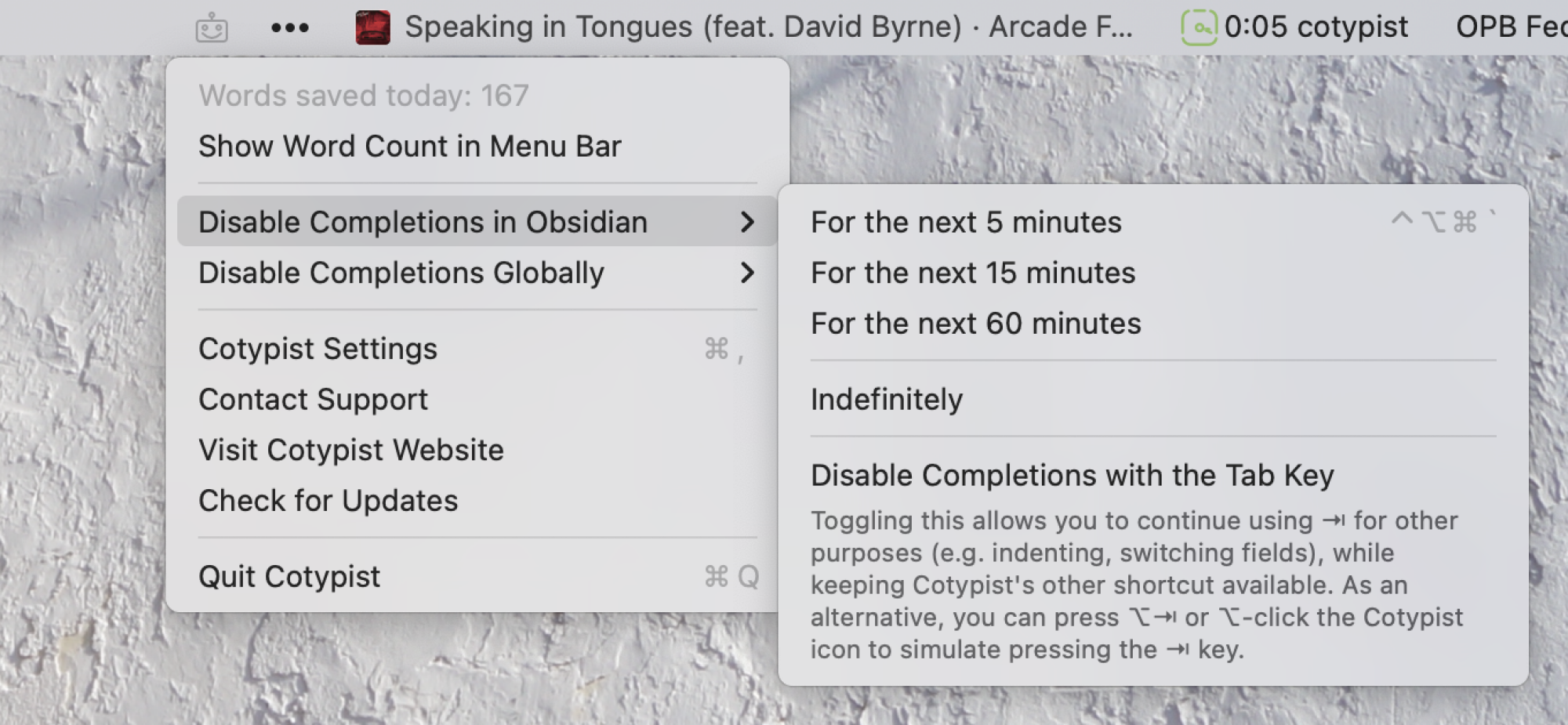
The menu bar icon allows you to disable suggestions in particular apps.
Credit: Justin Pot
Credit: Justin Pot
You can configure a few things using the menu bar icon; e.g., you can disable suggestions in a particular application for a set amount of time or indefinitely. This is helpful if you’re tripping over the suggestions in some apps but find them useful in others. You can also click the settings option to change the keyboard shortcuts for accepting suggestions.
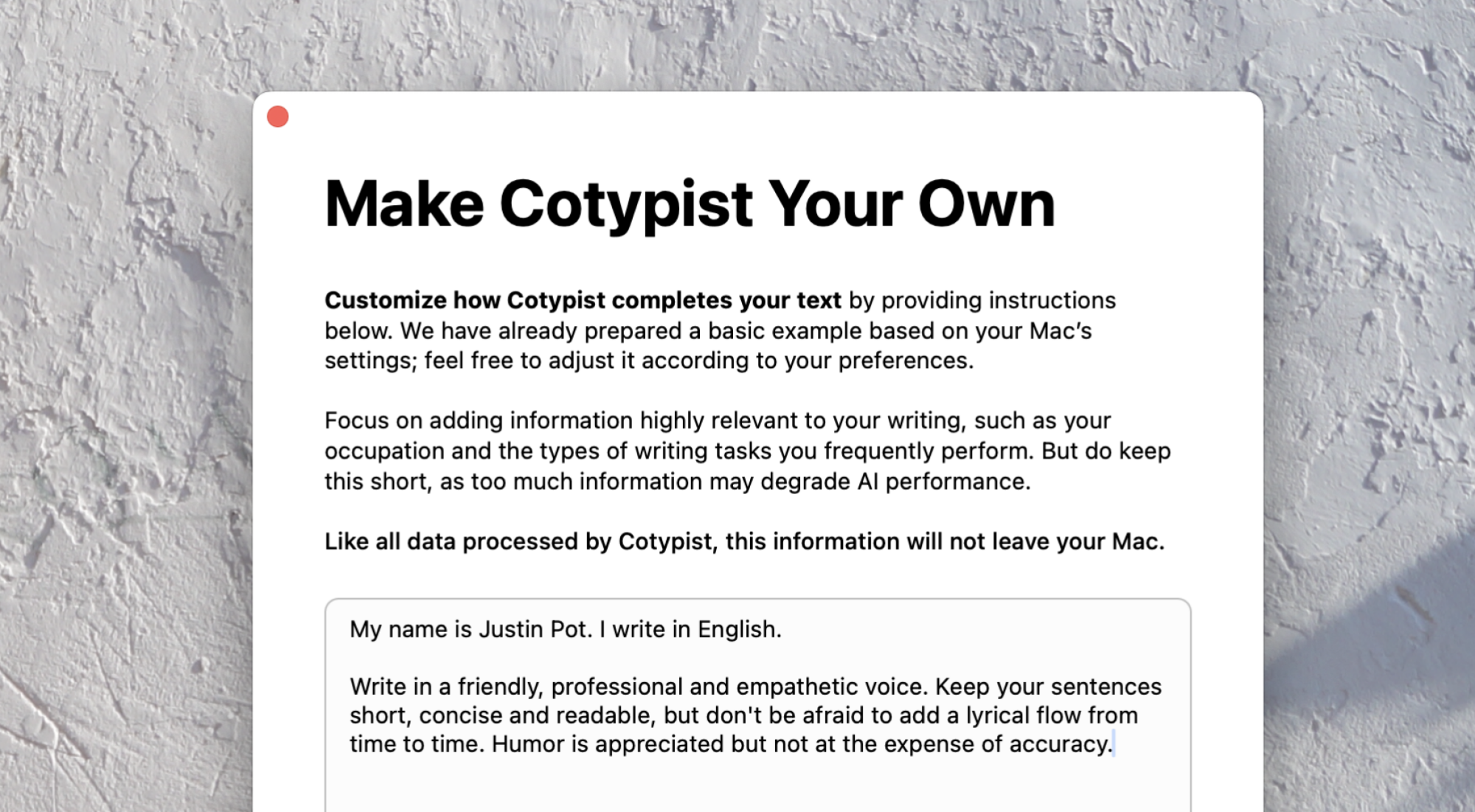
Setting a custom set of instructions for the AI in Cotypist.
Credit: Justin Pot
Credit: Justin Pot
You can also set system-wide instructions for the bot. This is basically a block of text that the AI will use to guide the suggestions it makes—the documentation suggests you include information like your name, your profession, and any guidance you want the AI to follow while writing.
I’ve been using Cotypist, off and on, for about a week now. Every once and a while it accurately predicts where I’m going and suggests the right words, saving me a few keystrokes. Most of the time, though, I find myself distracted by the suggestions. This might have something to do with my writing style—I’m a pretty fast typist, and I usually know the next word I’m going to type before I actually type it.
The thing about writing, though, is that it’s intensely personal—everyone does it a little bit differently. I can imagine this being a useful tool for someone whose brain works a little differently than mine, or someone who struggles with typing. If you’re curious whether this tool will fit your workflow, I highly recommend giving it a spin.
Forget Headphones, Razer’s Clio Turns Your Gaming Chair Into A Spatial Audio Sound Stage

It was around this time last year when I reviewed Razer’s Iskur V2 gaming chair, which I’m still using as my daily rump-rester. At the time, I didn’t anticipate that there might be first-party accessories for it, but enter Razer’s new Clio, a THX spatial audio-enabled speaker head cushion designed to turn practically any gaming chair (including
Education Giant Pearson Hit By Cyberattack Exposing Customer Data
An anonymous reader quotes a report from BleepingComputer: Education giant Pearson suffered a cyberattack, allowing threat actors to steal corporate data and customer information, BleepingComputer has learned. Pearson is a UK-based education company and one of the world’s largest providers of academic publishing, digital learning tools, and standardized assessments. The company works with schools, universities, and individuals in over 70 countries through its print and online services. In a statement to BleepingComputer, Pearson confirmed they suffered a cyberattack and that data was stolen, but stated it was mostly “legacy data.”
“We recently discovered that an unauthorized actor gained access to a portion of our systems,” a Pearson representative confirmed to BleepingComputer. “Once we identified the activity, we took steps to stop it and investigate what happened and what data was affected with forensics experts. We also supported law enforcement’s investigation. We have taken steps to deploy additional safeguards onto our systems, including enhancing security monitoring and authentication. We are continuing to investigate, but at this time we believe the actor downloaded largely legacy data. We will be sharing additional information directly with customers and partners as appropriate.” Pearson also confirmed that the stolen data did not include employee information. The education company previously disclosed in January that they were investigating a breach of one of their subsidiaries, PDRI, which is believed to be related to this attack.
BleepingComputer also notes that threat actors breached Pearson’s developer environment in January 2025 using an exposed GitLab access token, gaining access to source code and hard-coded credentials. Terabytes of sensitive data was stolen from cloud platforms and internal systems.
Despite the potential impact on millions of individuals, Pearson has declined to answer key questions about the breach or its response.


Read more of this story at Slashdot.