These Ryobi Cordless Tools Are up to 69% Off at Home Depot Right Now

We may earn a commission from links on this page. Deal pricing and availability subject to change after time of publication.

If you’re getting excited for spring and summer home improvement projects, or if you plan to expand your yard care equipment collection, the expense of new tools can be an important consideration. Getting deals on new cordless tools is a game-changer for DIYers everywhere, and the following deals can get you up to 67% off right now. Ryobi cordless tools are a go-to for many DIY enthusiasts because of the variety of tools they make that fit their batteries, their affordability, and their quality, so saving some money on this brand will allow you to add to your quality cordless tool kit as you go.

Drivers

Power drivers have come a long way from back when you only had a drill with one or two speeds and a few attachments. These days, you can use power drivers on much larger hardware and on a wider range of parts, including nuts and bolts.

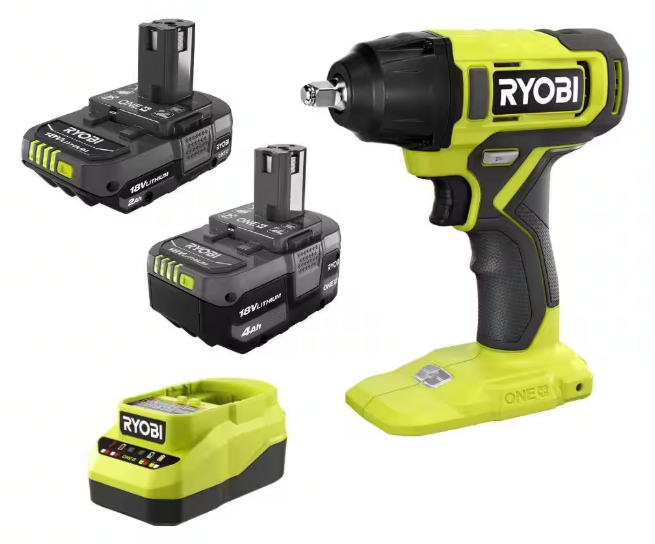
  • The 18-volt Ryobi ⅜ inch impact wrench is on sale for $99, 67% off its regular price. The driver kit comes with 2-amp-hour battery and one 4-amp-hour battery and a charger. This is a good deal if you need batteries or if you are planning on building a larger kit—it comes with everything you need to operate the tool as well as batteries you can use with all other 18-volt Ryobi tools.

  • The Ryobi 18-volt powered ratchet is on sale for $99, 65% off its usual price. This set comes with two 4-amp-hour batteries and a charger, and it’s good for driving nuts in tight spaces where a larger tool wouldn’t fit.
Cutting and trimming

Having the right type of cutting tool for your job and material is crucial for DIY success. Here are some deals of cutting tools that will get you through almost any DIY job.

  • The Ryobi 18-volt jig saw is on sale for $99, 60% off its usual price. This saw comes with one 2-amp-hour battery and one 4-amp-hour battery and a charger. A jig saw is good for making cuts that aren’t in a straight line and can be handy for trimming pieces that need custom shapes, like flooring cut to fit around a doorway.

  • The Ryobi 18-volt, 18-inch hedge trimmer is on sale for $99, 65% off its usual price. This trimmer comes with one 2-amp-hour battery and one 4-amp-hour battery.

  • The Ryobi 18-volt oscillating tool is on sale for $99, 65% off its typical price. This tool comes with one 2-amp-hour battery and one 4-amp-hour battery and a charger. The oscillating tool is more than just a cutting tool that can be used for plunge cutting and trimming, it can also be used for sanding and buffing, making it one of the more versatile tools in your cordless kit.

  • The Ryobi 18-volt angle grinder is on sale for $199, 41% off its usual price. This kit comes with one 2-amp-hour battery and two 4-amp-hour batteries. An angle grinder can be used for cutting metal or nipping off screw tips that poke out.

  • The Ryobi 18-volt reciprocating saw is on sale for $199, 59% off its regular price. This kit comes with one 2-amp-hour battery and two 4-amp-hour batteries. A sawzall can take a variety of blades for cutting many materials and can be used to trim material in tight spots where a circular saw might not fit.

Sanding and finishing

Getting a polished look on your DIY projects can feel satisfying after all your hard work, and smoothing everything out can also help to avoid splinters. Here are some deals on sanding and finishing cordless tools.

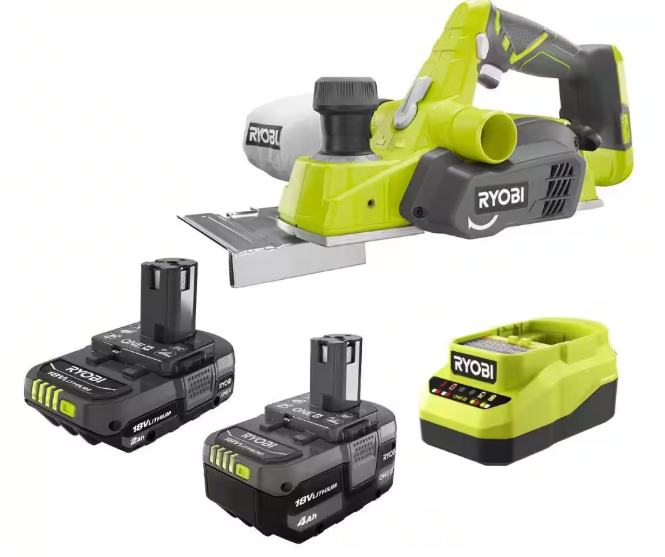
  • The 18-volt Ryobi hand planer is on sale for $99, 69% off its regular price. This kit comes with one 2-amp-hour battery and one 4-amp-hour battery, and a charger. A hand planer can be used to smooth and shape rough boards

  • The 18-volt Ryobi orbital sander is on sale for $99, 62% off its usual price. This kit comes with one 2-amp-hour battery and one 4-amp-hour battery, and a charger. A random orbital sander can help smooth rough surfaces and prep for paint.
Batteries, chargers, and accessories

While it might be an afterthought when investing in cordless tools, batteries and accessories can really make a difference in the amount of time and effort it takes to complete a project. Having extra fresh batteries means you can use multiple tools at a time without stopping to swap batteries, allowing you to work faster.

  • The Ryobi 18-volt battery starter kit is on sale for $99, 67% off its regular price. It comes with one 2-amp-hour battery and two 4-amp-hour batteries. This is a good kit if you’re starting out or if you’re expanding your kit to allow you to use multiple tools simultaneously.

  • The Ryobi gutter cleaner attachment for your Expand-It yard maintenance tool allows you to use the base edger/string trimmer handle to clear leaves and debris from your gutter. It’s on sale for $79, 39% off its usual price.

  • The Ryobi 18-volt 7 and ½ inch fan is on sale for $99, 62% off its typical price. The fan comes with one 2-amp-hour battery and one 4-amp-hour battery, and a charger. Having a fan can do more than just cool you down while you’re working. You can use it to help dry paint faster or blow dust away from where you’re working to keep your paint dust-free.


DJI Says Mavic 4 Pro Drone Is Skipping The US But Here’s Where You Can Buy It

DJI Says Mavic 4 Pro Drone Is Skipping The US But Here's Where You Can Buy It
DJI’s new and highly capable Mavic 4 Pro drone with a 360-degree rotating gimble with triple cameras has just launched. Packing a 100-megapixel 4/3-inch CMOS sensor tuned by Hasselblad plus twin telephoto cameras, the Mavic 4 Pro is set to be a aerial videographer/photographer’s wet dream. However, DJI is pulling a “Not so fast, America!”

Nintendo Boss Details Switch 2 Forecast, Best Buy To Host Late-Night Launch

Nintendo Boss Details Switch 2 Forecast, Best Buy To Host Late-Night Launch
The retail launch for Nintendo’s highly anticipated Switch 2 is approaching fast—it’s just shy of 3 weeks away. There probably won’t be additional movement in the preorder scene, but Best Buy did confirm that it will host a midnight launch event. Additionally, Nintendo President Shuntaro Furukawa provided some interesting insight into the

The next Mario movie may share its name with an SNES classic

We already know that Illumination and Shigeru Miyamoto are working away on the sequel to the absurdly successful The Super Mario Bros. Movie. Now we might also know its title, even if we aren’t supposed to.

According to The Verge, NBCUniversal (parent company of Illumination via Universal Pictures) name-dropped the upcoming movie in a press release regarding its 2025 and 2026 content slate, before swiftly removing it. Super Mario World was reportedly included in a section that listed a number of films that will stream on Peacock following their theatrical release in the next year.

Other films mentioned include M3gan 2.0, Nobody 2, The Bad Guys 2 and the upcoming live-action remake of How to Train Your Dragon. The original post also listed the next Shrek and Minion movies, but like Super Mario World, they’re absent from the amended version.

Of course, there’s always a possibility that NBCUniversal used the wrong name, or that Super Mario World is just a working title. But it does seem like an obvious choice. For one, the “World” part suggests a larger-scale adventure for Nintendo’s mustachioed mascot this time around, and (spoilers for the first film) the post-credits scene in The Super Mario Bros. Movie hinted at Yoshi’s involvement in the sequel. Nobody who owned a Super Nintendo Entertainment System in the ‘90s will need reminding which game the little green dinosaur made his debut in.

The Super Mario Bros. Movie, which Engadget’s Devindra Hardawar called “a fun but safe Mushroom Kingdom romp” when it released in 2023, made over $1.36 billion at the global box office, and is currently the highest-grossing movie based on a video game of all time. A release date of April 3, 2026 was confirmed last year for the officially as-yet untitled sequel.

This article originally appeared on Engadget at https://www.engadget.com/entertainment/tv-movies/the-next-mario-movie-may-share-its-name-with-an-snes-classic-141146941.html?src=rss

Microsoft Will Now Support Office Apps on Windows 10 Until 2028

If you’re unable or unwilling to upgrade to Windows 11 and you’re running Microsoft Office (now known as Microsoft 365, of course), there’s some good news: Support for Word, Excel, and the other Office apps is being extended for an extra three years beyond the end-of-life date for Windows 10 itself.

The end-of-life date support for Windows 10—after which no further software updates or technical support will be offered by Microsoft—has been set for Tuesday, October 14, 2025. Support for Microsoft 365 apps will now go all the way up to Tuesday, October 10, 2028.

That’s as per an updated support document published by Microsoft and spotted by The Verge. Before now, there had been some confusion about whether Microsoft would cut off support on the same date for both Windows 10 and Microsoft 365 programs running on it, so we now have some clarity.

The shift is to “help maintain security while you transition to Windows 11,” Microsoft says, so it obviously still wants you to start using Windows 11 as soon as possible. The extension applies to both the version of Office that can be purchased for a one-off fee, and the Microsoft 365 subscription version based on monthly or yearly payments.

There are also some important caveats here: Even if the Office apps are being kept up to date until 2028, you really don’t want to be running them on an unsupported operating system. If you’re sticking with Windows 10 past October this year, you’ll want to pay for Extended Security Updates ($30 a year for home users) to make sure you’re protected against hackers and viruses.

Even though you won’t be getting any new features with the Extended Security Updates, your PC will at least be patched up against whatever nasty security threats emerge, so you can carry on using Microsoft 365 without worry. The extended support for Word, Excel, and the other apps won’t cost you any extra on top of what you’ve already paid for them.

Ideally, Microsoft wants to get everyone running Windows 11, and the advice if your system doesn’t meet the required specs is to go out and buy a new PC with Windows on it. That’s more of a challenge for businesses who’ve got dozens or hundreds of workstations to upgrade, of course.

Microsoft has put splash screens in Windows 10 encouraging users to upgrade to the latest operating system, as well as telling anyone who’ll listen about the benefits of the Windows 11 experience. Windows 11 was launched back in October 2021, but it’s thought that more than 60% of PCs are still using Windows 10.

There’s another caveat when it comes to the support you can expect from Microsoft beyond October: If you ask for technical help from Microsoft with Office apps on Windows 10, and the issue doesn’t occur on Windows 11, you’ll be advised to upgrade the operating system. “If the customer is unable to move to Windows 11, support will provide troubleshooting assistance only; technical workarounds might be limited or unavailable,” Microsoft says.

US Warns Against Using Huawei Chips ‘Anywhere in the World’

President Donald Trump’s administration has taken a tougher stance on Chinese technology advances, warning companies around the world that using AI chips made by Huawei could trigger criminal penalties for violating US export controls. From a report: The commerce department issued guidance to clarify that Huawei’s Ascend processors were subject to export controls because they almost certainly contained, or were made with, US technology.

Its Bureau of Industry and Security, which oversees export controls, said on Tuesday it was taking a more stringent approach to foreign AI chips, including “issuing guidance that using Huawei Ascend chips anywhere in the world violates US export controls.” But people familiar with the matter stressed that the bureau had not issued a new rule, but was making it clear to companies that Huawei chips are likely to have violated a measure that requires hard-to-get licences to export US technology to the Chinese company.


Read more of this story at Slashdot.

This AI Video Generator Is Spreading Malware

Cyber attackers are capitalizing on user demand for AI-generated content by spreading malware targeted at creators and small businesses in the form of fake AI content services.

As Bleeping Computer reports, a new infostealer known as Noodlophile exfiltrates web browser data, including account credentials, session cookies, tokens, and cryptocurrency wallet files. The malware may also be deployed with XWorm, which gives attackers remote access to your device in order to steal sensitive information and install ransomware.

How a Noodlophile attack works

According to a threat analysis by security firm Morphisec, Noodlophile hides in fake AI video generators—notably, those named “Dream Machine.” These tools are advertised on Facebook, leading users to fraudulent websites to upload images or video to create AI-generated content.

Users are then prompted to download a completed video as a ZIP archive named VideoDreamAI.zip, which contains an executable file (Video Dream MachineAI.mp4.exe) as well as hidden folders with components to infect the target’s device with malware. The scheme uses legitimate editing tools you might find in a video editor like CapCut, as well as files disguised as PDFs and Word docs to avoid detection by both users and malware scanners.

Once deployed, Noodlophile communicates stolen information back to hackers in real time using a Telegram bot.

How to protect your data from Noodlophile

Always use caution when downloading and executing files from the internet, especially when using websites you don’t know and trust. Noodlophile hides behind a seemingly benign file name verified with a certificate created via WinAuth, so it may not seem suspicious on the surface.

But if you look at the file extension—which you should always verify—you’ll see that it’s actually a .exe, not a .mp4 video. Make sure file extensions are set to show on your device, as having these hidden allows hackers to spread malware undetected. You can also use a malware scanner to check downloads before opening them.

US warns companies around the world to stay away from Huawei chips

President Donald Trump’s administration has taken a tougher stance on Chinese technology advances, warning companies around the world that using artificial intelligence chips made by Huawei could trigger criminal penalties for violating US export controls.

The commerce department issued guidance to clarify that Huawei’s Ascend processors were subject to export controls because they almost certainly contained, or were made with, US technology.

Its Bureau of Industry and Security, which oversees export controls, said on Tuesday it was taking a more stringent approach to foreign AI chips, including “issuing guidance that using Huawei Ascend chips anywhere in the world violates US export controls.”

Read full article

Comments

Doom: The Dark Ages Dev Details Workaround To Game Crashes On NVIDIA GPUs

Doom: The Dark Ages Dev Details Workaround To Game Crashes On NVIDIA GPUs
As NVIDIA is prone to do whenever there’s a major game release, the GPU maker released a new ‘Game Ready’ driver package, version 576.40 WHQL, to get PCs ready for Doom: The Dark Ages. You’ll want to grab that if you’re planning to play the latest Doom installment. At the same time, developer id Software acknowledged that some users with NVIDIA

Marks and Spencer Confirms Hackers Stole Customers’ Personal Data; Cyber Insurance Payout To Be Worth Up To $133 Million

An anonymous reader shares a report: U.K. retail giant Marks & Spencer has confirmed hackers stole its customers’ personal information during a cyberattack last month. In a brief statement with London’s stock exchange on Tuesday, the retailer said an unspecified amount of customer information was taken in the data breach.

The BBC, which first reported the company’s filing, cited a Marks & Spencer online letter as saying that the stolen data includes customer names, dates of birth, home and email addresses, phone numbers, household information, and online order histories. The company also said it was resetting the online account passwords of its customers. FT adds: Marks and Spencer could claim for losses of as much as $133 million from its cyber insurers following a sustained hack where some customer data was stolen. The UK retailer’s cyber policy allows it to claim up to $133 million, according to people familiar with the situation.

Allianz is the first insurer on the hook for M&S’s losses, the people added, and is expected to pay at least the initial $13.3 million. Cyber specialist Beazley is also among the insurers exposed to losses at the FTSE 100 retailer, according to the people familiar with the situation.


Read more of this story at Slashdot.

You Can Now Claim a Payout From the 23andMe Data Breach

If you were affected by 23andMe’s data breach that compromised 14,000 user accounts—plus 6.9 million DNA Relatives and Family Tree profiles—you can now claim your compensation.

Following the 2023 credential-stuffing attack, 23AndMe in 2024 agreed to a $30 million payout for impacted consumers. The genetic testing company then filed for Chapter 11 bankruptcy earlier this year (introducing new privacy concerns around the potential sale of customer data), and the settlement money will soon be distributed amid the proceedings.

How much you’ll receive from 23andMe

If everyone whose account was involved received an equal payout, that would come to about $4.35 per person. However, users with an “extraordinary claim”—those who experienced identity theft or fraudulent tax filings as a result of the breach—could qualify for up to $10,000 to reimburse verified expenses, including costs for physical or cyber security systems as well as mental health treatment.

Individuals residing in Alaska, California, Illinois, and Oregon will receive roughly $100 thanks to state privacy laws, and this same amount will likely be paid to users whose personal health information was leaked.

The settlement also provided for three years of identity monitoring services through a customized program called Privacy & Medical Shield + Genetic Monitoring.

How to file a 23andMe claim

There are actually two types of claims permitted as part of 23andMe’s bankruptcy filing. Consumers who were impacted by the 2023 data breach can file a Cyber Security Incident Claim, which must be submitted by July 14, 2025. To be eligible, you must have been a 23andMe customer between May 1, 2023 and October 1, 2023 and have received a notice (via letter or email) that your information was compromised in the breach. You also must attest that you incurred damages (monetary or non-monetary) as a result of the incident.

Claims can be filed online via the Kroll Restructuring Administration portal, or you can mail a hard copy of your claim form to the address listed. To complete a claim, you must provide some personal information as well as details about the harm incurred with supporting documentation, such as bank or credit card statements substantiating losses.

If you weren’t affected by the breach but have other grievances with 23andMe, you can submit a general claim form using the same process with the same deadline.

Baidu could start testing its Apollo Go robotaxi service in Europe this year

Baidu’s Apollo Go robotaxi service is making its debut in Europe later this year, according to The Wall Street Journal. The Chinese company is reportedly negotiating with Switzerland’s PostAuto, a Swiss Post subsidiary that offers rural bus services throughout the country, to start testing Apollo Go in Switzerland. To be able to test its technology in Switzerland before the year ends, Baidu is setting up a local entity in the coming months. 

Back in March, the company announced that it was deploying 100 fully autonomous cars in Dubai, with plans to expand its fleet to 1,000 vehicles in the city by 2028. It’s also expanding its trials in Hong Kong and reportedly has plans to test its vehicles in Turkey in the future. Baidu launched Apollo Go in all “first-tier” Chinese cities, including Beijing, Guangzhou and Shanghai, in 2022. As The Journal notes, Baidu, like its Chinese competitors, is likely looking to expand in Europe instead of the US, because Chinese companies could be subject to more scrutiny in the country. 

One of the companies Baidu will be competing with in Europe is Uber, which signed a deal with Chinese self-driving startup Momenta earlier this month. Uber and Momenta are launching robotaxi services in the continent sometime in 2026. When Baidu does start testing its vehicles its Switzerland, they’ll most likely have drivers behind the wheel before the company progresses to fully driverless trials. 

This article originally appeared on Engadget at https://www.engadget.com/transportation/baidu-could-start-testing-its-apollo-go-robotaxi-service-in-europe-this-year-123054998.html?src=rss

These Beats Studio Pro Headphones Are Over 50% Off Right Now

We may earn a commission from links on this page. Deal pricing and availability subject to change after time of publication.

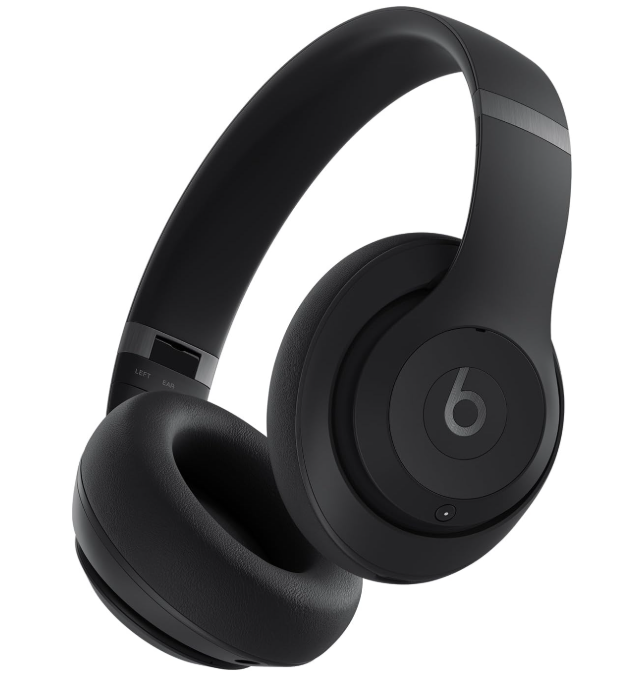
If you’ve ever owned a pair of Beats, you probably already know what to expect—flashy design, Apple-friendly features, and a sound signature that leans toward the bass-heavy side. The Beats Studio Pro continues that legacy, but right now, it’s doing it at a much better price. These headphones, which launched in 2023 at a steep $349.99, are currently going for $169.95—a 51% discount and the second-lowest price tracked so far. That makes a real difference, especially if you’re part of the Apple ecosystem.

With hands-free Siri, spatial audio with head tracking, and seamless one-touch pairing, Apple users will get the most out of these over-ears. Android compatibility exists, too, but not all features carry over as smoothly.

At this lower price, it’s easier to overlook some of the limitations reviewers pointed out at launch. PCMag gave it a “good” rating, noting its sculpted sound, comfort, and sleek design, but also made it clear that more balanced-sounding options with better ANC and customizable EQ exist at similar or lower prices. That said, for under $170, you’re still getting premium build quality, long battery life (up to 40 hours with ANC off), and fast charging that gives you around four hours of playback from a 10-minute top-up. The ANC itself won’t blow anyone away—it’s slightly above average—but it’s good enough for commutes and background office noise. And while you can’t fine-tune the sound with a manual EQ, the built-in EQ presets offer a solid workaround.

For anyone who wants spatial audio, Apple-first integrations, and a good-looking pair of over-ears that feel comfortable over long sessions, this is a compelling deal. The dual-device connection, transparency mode, and Find My support round out the convenience side of things. If you’re after fine-tuned audio controls or industry-leading ANC, you’ll want to look elsewhere. But if you want a solid all-rounder at nearly half the price, the Beats Studio Pro finally feels like it’s priced where it should’ve started.

GM Says New Battery Chemistry Will Enable 400-Mile Range EVs

General Motors is partnering with LG to develop lithium manganese-rich (LMR) batteries, which are safer, denser, and cheaper than current EV battery tech. The automaker aims to begin U.S. production by 2028 and become the first to deploy LMR cells in electric vehicles. Ford also announced it would start adopting LMR batteries for its EVs, but not until 2030. The Verge reports: GM’s current crop of electric Chevys and Cadillacs use high-nickel batteries, which supply enough energy for around 300-320 miles of range. The new LMR batteries are denser, with greater space efficiency due to their prismatic shape, enabling up to 400 miles of range, GM says. Prismatic cells are packed flat in rigid cases and are generally thought to be less complex to manufacture than cylindrical cells. Less complexity and cheaper materials will hopefully lead to lower-cost EVs, which has been a significant challenge for the auto industry’s shift to electric vehicles. “The EV growth rate is really dependent on how quickly we can bring the costs down over time,” says GM’s VP for batteries Kurt Kelty. “And this is the biggest lever we have. Batteries make up roughly 30 to 40 percent of the cost of vehicles. And if you can drop that down significantly like we’re doing here, then it ends up being a lower cost to the consumer.”


Read more of this story at Slashdot.

Eight Sleep launches the AI-powered Pod 5 sleep system

Eight Sleep has launched a new sleep system called the Pod 5, which uses the power of artificial intelligence, as one would expect from a lot of new products these days. The Pod 5 system consist of a cover, a hub, a blanket and a base that works with any mattress you already have. Its cover and hydro-powered blanket cool down or heat up from 55 to 110 degrees Fahrenheit across your whole body, adjusting their temperatures based on the biometric reading from the cover’s embedded sensors. 

If the system detects that you’re snoring through vibrations, the base automatically but gently elevates your head in response, which had been clinically proven to reduce snoring. The base is supposed to go in between your mattress and the bed frame, but it can also be used freestanding with an optional leg kit. Pod 5’s base comes with a built-in surround-sound speaker that plays audio, which the company says was designed to support relaxation and recovery. The company has added a guided meditation technique to its audio options, as well as a curated selection of white noise and calming sounds. Finally, the Hub contains the water that the system uses to regulate the cover’s and blanket’s temperatures. It also contains tech like the WiFi that connects the Pod 5 to the internet. 

The company says the whole experience is powered by its proprietary AI engine Autopilot that’s trained on almost 10 million hours of sleep data. It also learns from your own biometrics and sleep patterns, so it can adjust the system as needed. In addition, Eight Sleep has launched a set of AI-powered algorithms called Health Check that monitors your heart and respiratory rates while you sleep through the sensors in the cover. If your heart rate or breathing shows some abnormality, for instance, you’ll see a report in the system’s accompanying app notifying you of the reading. 

The Pod 5 system is now available for purchase in the US, the EU, the UK, Canada, Australia, the UAE, Mexico, Saudi Arabia, Monaco and Switzerland. Prices begin at $2,849, and you can get up to a 30-night trial and free returns in case you change your mind. 

A bed.
Eight Sleep

This article originally appeared on Engadget at https://www.engadget.com/home/smart-home/eight-sleep-launches-the-ai-powered-pod-5-sleep-system-130034283.html?src=rss

The Lucid Gravity is the coolest three-row EV on the market

As people continue to move away from sedans to larger vehicles, the distinction between SUVs, crossovers and MPVs has become even blurrier. But make no mistake, if you’re looking for a big car with tons of power, excellent handling and a true seven-person capacity, the Lucid Gravity might be the coolest three-row EV on sale today. Just don’t call it a minivan.

Not that you would be incorrect. Between its extra-long dimensions (198 inches, three inches longer than a LWB VW ID. Buzz), a smooth, sloping front end and an emphasis on aerodynamics, the Gravity certainly looks more like a Chrysler Pacifica than a brawny Rivian R1S. But as one Lucid representative told me, minivans have gotten a bad rap in recent times, due to their focus on basic practicality while eschewing anything in the way of engaging driving dynamics. This makes slapping the minivan tag on a car feel almost like a death sentence, even if the biggest difference between the Gravity and some of its cross-category rivals is the lack of sliding doors.

The Lucid Gravity features a huge 34-inch panoramic display alongside a smaller (but still big) screen for controlling music, climate and more.
Sam Rutherford for Engadget

With the Gravity’s Grand Touring spec (which starts at $94,900) packing a whopping 828 horsepower along with fancy features like standard air suspension and optional rear-wheel steering, this thing is anything but pokey. And that’s before you consider a 0 to 60 time of just 3.4 seconds, which puts most sports cars (especially gas-powered ones) to shame. So despite how it looks, there’s no doubt the Gravity offers better performance than any minivan on the planet.

The speed continues when it’s time to charge. Thanks to its 926 volt architecture, the Gravity can suck down up to 400 kW of juice, which makes this the fastest charging EV outside of China. Lucid’s charging tech is also capable of adding 200 miles of driving distance in under 11 minutes. When combined with up to 450 miles of range, this vehicle is almost single-handedly upending the idea that electric cars are bad for long road trips.

Unlike a lot of modern cars with glass roofs, the Lucid Gravity's extends all the way to its windshield.
The sky was cloudy that day.
Sam Rutherford for Engadget

Meanwhile, for those who want to travel in luxury, the Gravity has more creature comforts than minivans too, even for a class of vehicle that can often be judged by its number of cupholders. Not only are the front and second row seats heated, Lucid’s glass panoramic roof runs nearly the entire length of the car. That means unlike most rivals where the driver is stuck without a view, all you see is sky when you look up from behind the wheel. There’s even a screen for second row occupants to control music and climate (among other things).

Lucid also makes great use of the Gravity’s length. While I wouldn’t want to ride back there as an adult all the time, it has one of the most spacious third rows I’ve ever sat in. Alternatively, if you need extra cargo space, the rearmost seats fold into the floor, providing you with a flat load space featuring 56.2 cubic feet of room (and that’s with the second row still up). And while it’s not something you’ll use all the time, I love the company’s optional folding cushion that transforms the frunk into a loveseat — complete with cupholders on each side. It’s a fun little feature that makes me sad that drive-in movie theaters are becoming extinct.

The three-row Lucid Gravity at the NYIAS.
Sam Rutherford for Engadget

The most enchanting contradiction about the Gravity is what it feels like to drive. After getting into the pilot’s seat, you’re greeted by a massive 34-inch 6K OLED display. And unlike some of its competitors, it’s not two or three screens sandwiched together. It’s all a single panel that’s an absolute treat to look at. This expansiveness is only reinforced by Lucid’s squircle-shaped wheel. It’s a touch smaller than you might expect on a vehicle this size, but it also gives you increased visibility at its giant infotainment system.

The hard thing to wrap your head around though, is that for a long SUV with three rows of seats, it doesn’t drive like a big car. The cabin is spacious and airy and it feels like you could fit a pickleball court between its mirrors. And yet, thanks to features like the optional rear-wheel steering on my demo vehicle, it almost felt petite during a quick drive around New York City.

Now, I will admit that my route down the West Side Highway wasn’t the best place to really test out its driving dynamics. But there were a few spots where I got a sense of how good the Gravity will be on the open road. For example, I had to make a U-turn down near Battery Park and I thought there was no way I was going to make it without committing to a three-point maneuver. But to my delight, it just darted around the divider in a way that defies its dimensions.

Lucid’s suspension is also a work of art. For a car that weighs around 6000 pounds (depending on spec), it doesn’t lumber or bounce when it goes over bumps. It just kind of floats. You can still feel the road, but it’s just more of a gentle reminder that its surface texture is constantly changing rather than a jolt up your backside. Granted, my test vehicle was equipped with Lucid’s Dynamic Handling Package, which includes three-chamber air suspension instead of the standard two. But, honestly, that extra $2,900 feels well worth it, especially when that option also adds the rear-wheel steering.

The Gravity's third-row seats can be folded beneath the floor to create extra cargo space.
Sam Rutherford for Engadget

I also appreciate how the car automatically hunkers down when you set it to sport mode to improve performance. Even without room to get it up to top speed, it’s impossible to escape the feeling of immense power the car gets from its dual motors (a single-motor RWD is slated to come out later). The Gravity might just have the best ride quality of any EV SUV currently on sale.

However, I do have some complaints. The most obvious one is that this thing ain’t cheap at just shy of $95,000 for the initial Grand Touring version. And even when the base model eventually comes out at around $80,000, that’s still a far cry from mainstream affordability. It really makes me wonder why Lucid didn’t jump straight to making its rumored (and almost certainly more affordable) mid-size SUV.

A photo of the Lucid Gravity's nameplate.
Sam Rutherford for Engadget

I don’t love Lucid’s current color options either, which seem aimed more at boomers than younger, more EV-friendly drivers. (Though I guess that’s where the money is.) The most vibrant paint choice is either a brownish bronze or a faded olive green. I was hoping that the company had learned something from the stunning blue it uses on the Air Sapphire and carried over some of that styling to the Gravity. But here we are.

Finally, Lucid won’t have its version of Dream Drive 2 Pro hands-free driving tech available at launch. Furthermore, the company is running into issues sourcing components for its HUD system, which means you’ll have to wait a bit longer for that option. The good news is that when (or if) Lucid eventually figures out its hand-free tech, all the hardware needed to support it will already be in the Gravity, so all you’ll need is an OTA update to turn it on.

Regardless, as Lucid continues ramping production throughout the year, the Gravity already feels like the coolest big EV SUV on sale today and an immediate top contender for anyone looking for a luxurious three-row people carrier.

This article originally appeared on Engadget at https://www.engadget.com/transportation/evs/the-lucid-gravity-is-the-coolest-three-row-ev-on-the-market-120024089.html?src=rss