Jensen Huang, the head honcho at NVIDIA, poured on the praise for Nintendo’s soon-to-be-released Switch 2 console in a video posted to YouTube, saying it signals the beginning of a “bold new chapter” in gaming. A big part of that claim lies with the custom silicon inside, which NVIDIA designed, just as it did with the original Switch console
This is a video created by filmmaker Travis Bible using Google’s AI video generator VEO 3 to demonstrate just how convincing AI-generated video is now, and how it can be used to create deceiving news, or scam people out of their money. These are terrifying times we live in. I mean unless you’re an internet scammer, in which case there’s never been a better time to be alive. Obviously, now would be a good time to set some parental locks on your actual parents. Sorry mom, no more Facebook videos — if you want to internet you’re gonna have to read.
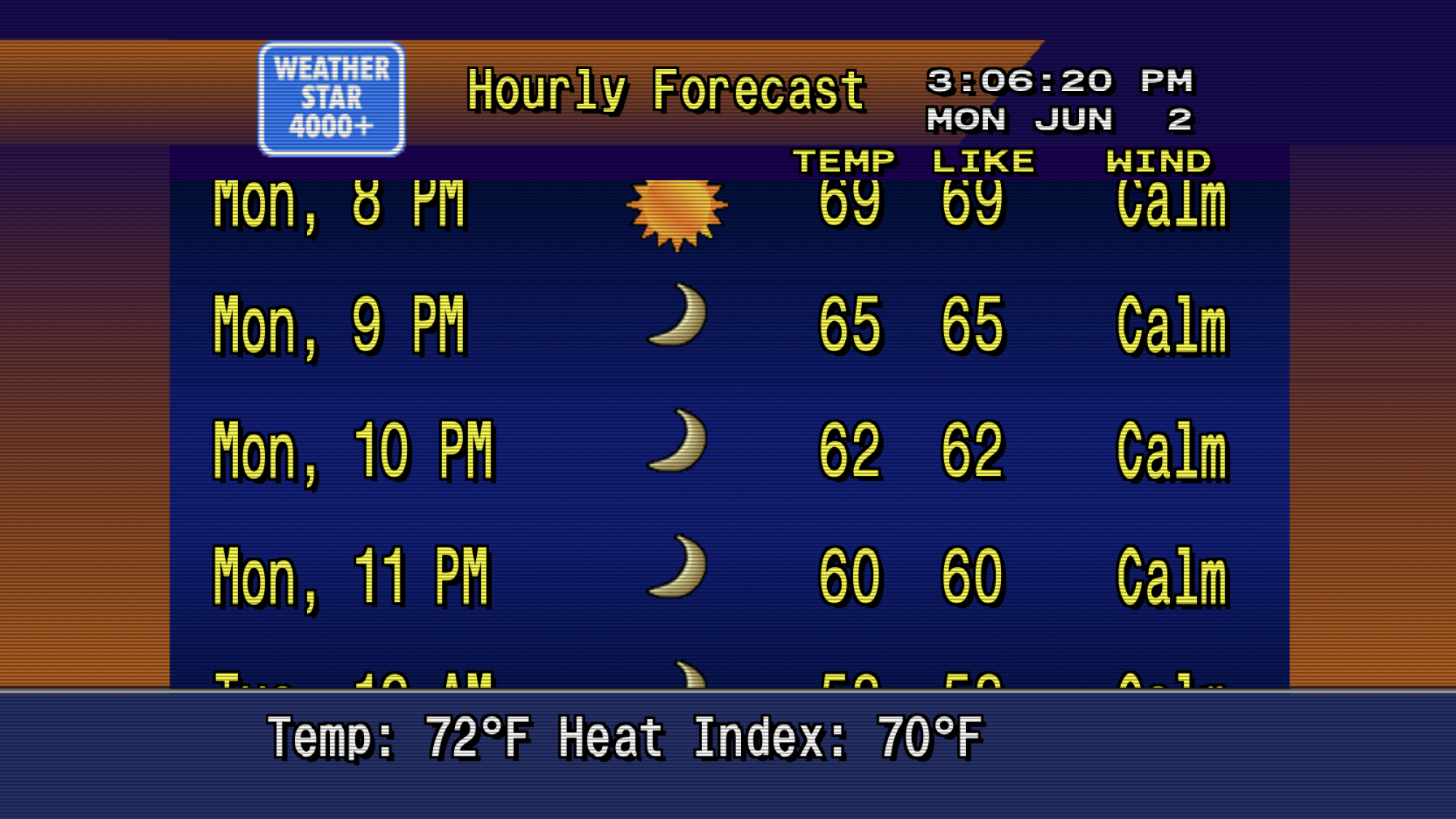
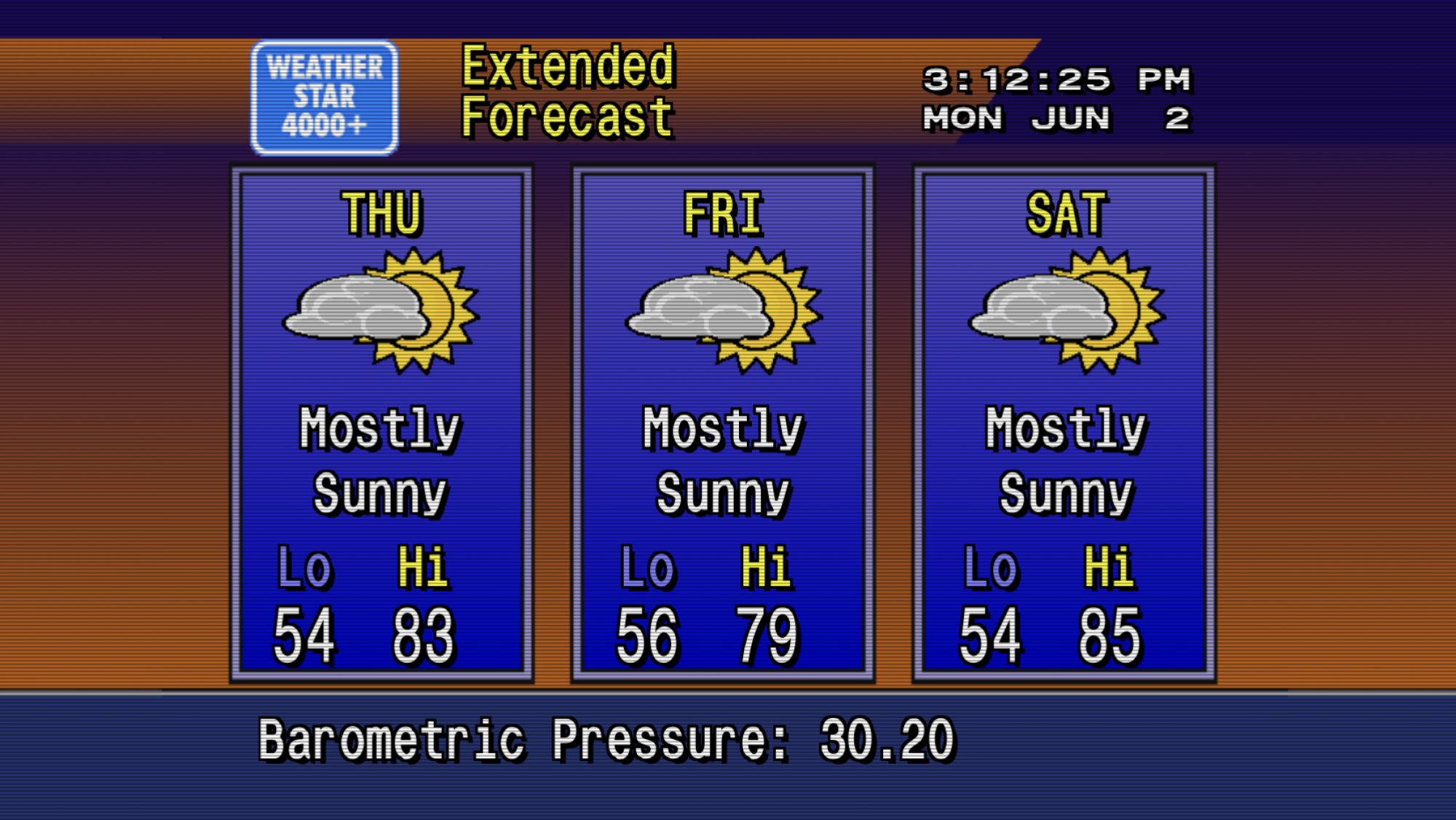
The Weather Channel, for the most part, looked like a normal TV station—until the local forecast would show up. Then it became a pixelated data dump of weather information served over a funky piano soundtrack. There’s nothing like it on the internet—well, until. now.
WeatherStar 4000 is a free website that recreates the look and feel of a vintage Weather Channel local forecast, complete with accurate visuals and optional CRT scanlines. Most importantly, it offers a period-accurate lowfi-funk soundtrack that’s perfect to chill or study to.
To get started, just go to the site and choose which features you do and don’t want using the checkbox. Then, when you’re ready, click the full-screen button in the bottom-right corner. Make sure you also unmute the music for the full effect. My editor, upon doing this, told me that it’s going to live permanently on his second monitor. I’m happy for him.
The site is the creation of programmer Matt Walsh, who made it as a variation of an older project that aimed to accurately re-create the vintage format. Walsh’s site offers new features, including a scrolling hourly forecast and support for wide screen.
Credit: Justin Pot
I love this website. It’s not going to replace my weather app, granted, but it’s a great tribute to a technology that made cable essential to many. Getting an accurate local weather forecast in the 90s was hard. The newspaper would have one, sure, but that was printed last night and was likely already outdated. You could also try to catch the weather forecast on your local TV station but it generally only aired a few times a day.
That’s where the Weather Channel came in. This combined national programing with computer generated local forecasts, broadcast every 10 minutes at minutes that ended with the number 8 (the segment was called Local On The 8s). This meant you could turn on your TV anytime you saw an eight at the end of your clock to see an extremely local up-to-date forecast.
Credit: Justin Pot
How did this work? It would have been prohibitively expensive for The Weather Channel to create hundreds of different broadcasts, all with different local forecasts, and then deliver those broadcasts individually to cable providers. The network instead provided cable providers with a computer—called the WeatherStar—that received forecast information as text and used it to create the pixelated video forecasts we all remember. It was an elaborate, automated way to provide something we now take for granted: up-to-date local weather information.
WeatherStar 4000+, you might notice, is named after this device—a fitting tribute. I recommend you turn it on, enable the music, and just vibe for a while. God knows there are less healthy things to do online right now.
In addition to the excitement this morning of the Radeon RX 9060 XT review embargo lift, today also serves as another special day at AMD as they announced they have acquired software firm Brium…
theodp writes: Way back in 2010, Microsoft and Google teamed with nonprofit partners to launch Computing in the Core, an advocacy coalition whose mission was “to strengthen computing education and ensure that it is a core subject for students in the 21st century.” In 2013, Computing in the Core was merged into Code.org, a new tech-backed-and-directed nonprofit. And in 2015, Code.org declared ‘Mission Accomplished’ with the passage of the Every Student Succeeds Act, which elevated computer science to a core academic subject for grades K-12.
Fast forward to June 2025 and Code.org has changed its About page to reflect a new AI mission that’s near-and-dear to the hearts of Code.org’s tech giant donors and tech leader Board members: “Code.org is a nonprofit working to make computer science (CS) and artificial intelligence (AI) a core part of K-12 education for every student.” The mission change comes as tech companies are looking to chop headcount amid the AI boom and just weeks after tech CEOs and leaders launched a new Code.org-orchestrated national campaign to make CS and AI a graduation requirement.
Since the National Science Foundation first started collecting postgraduation data nearly 70 years ago, the number of Ph.D.s awarded in the United States has consistently risen. Last year, more than 45,000 students earned doctorates in science and engineering, about an eight-fold increase compared to 1958.
But this level of production of science and engineering Ph.D. students is now in question. Facing significant cuts to federal science funding, some universities have reduced or paused their Ph.D. admissions for the upcoming academic year. In response, experts are beginning to wonder about the short and long-term effects those shifts will have on the number of doctorates awarded, and the consequent impact on science if Ph.D. production does drop.
Such questions touch on longstanding debates about academic labor. Ph.D. training is a crucial part of nurturing scientific expertise. At the same time, some analysts have worried about an oversupply of Ph.D.s in some fields, while students have suggested that universities are exploiting them as low-cost labor.
The numerous hardware monitoring “HWMON” subsystem updates were merged to Linux 6.16 on Tuesday for further enhancing the desktop hardware reporting capabilities and more with this next kernel release…
NVIDIA has released yet another out-of-band GeForce hotfix driver to resolve persistent crashing issues in a handful of games. Curiously, one of those games is Dune: Awakening (as pictured above), which doesn’t actually release to the public at large for another six days. Even the ‘Advanced Access’ period for those who pre-purchased the game
We may earn a commission from links on this page. Deal pricing and availability subject to change after time of publication.
If you’ve been thinking about leveling up your action or travel videos, the Insta360 X4 is down to $359.99 right now, a drop from its original $499.99 and the lowest price it’s hit so far, according to price-trackers. That’s a major cut for a camera that PCMag calls “Outstanding” and named an Editor’s Choice for 360-degree shooting. You’re getting a serious upgrade over the previous X3, with 8K video capture, a bigger screen, and better battery life packed into a rugged, waterproof body.
Insta360 didn’t change the formula too much with the X4’s design. It’s still pocketable, still easy to grip, and still built tough enough to handle a 33-foot dive without a case. What’s new is under the hood: 8K30fps 360-degree video, smoother slow-mo options, and a larger 2.7-inch Gorilla Glass touchscreen that’s bright enough for outdoor framing. It’s also got wifi 6 and Bluetooth 5.2 onboard for quicker file transfers. Controls are intuitive, and pairing with the Insta360 app takes less than a minute. The app handles editing, reframing, and exporting, making it easy to turn sprawling 360° footage into polished clips you can share fast. That said, the X4 reportedly runs warm after about 30 minutes of heavy use, and though it runs on a larger 2,290mAh battery, you’ll probably want extra batteries if you shoot long sessions, according to this PCMag review.
In the box, you get a battery, basic lens guards, a USB-C cable, and a pouch—not a ton of extras, but enough to get started. If you plan on diving deeper than 33 feet or want more rugged lens protection, you’ll need to buy accessories separately. There’s no HDMI output, but the USB-C port doubles as an external mic input if you need better audio. Overall, if you want 360-degree shooting without overcomplicating the process, and you don’t mind managing a little heat buildup on longer takes, the X4 delivers high-end features at almost $150 off right now.
Amazon’s MGM Studios is fast-tracking a movie called Artificial about OpenAI‘s 2023 boardroom drama that saw CEO Sam Altman fired and then rehired, according to The Hollywood Reporter. Luca Guadagnino (Challengers, After the Hunt) is in talks to direct and A-list actors including Andrew Garfield and Monica Barbero are reportedly interested. Shooting may start as soon as this summer in Italy and San Francisco.
The timeline of OpenAI’s travails took place over just a week and unfolded like a telenovela. It commenced with the shocking termination of Altman on November 17, 2024, reportedly for not being “consistently candid” with the board. Microsoft, a close OpenAI partner, was furious with the decision and announced shortly afterward that it was starting its own AI division with Altman at the head.
Later, the entire OpenAI staff told the board in an open letter that it would resign and join the new Microsoft subsidiary if Altman didn’t return to the company as CEO. Things were looking dire until the last minute when the board finally caved and hired Altman back. OpenAI’s original board was also disbanded and replaced with a temporary three-man board.
With that level of corporate intrigue and hundreds of billions of dollars at stake, it’s easy to see why Amazon wants to be first with a movie on the subject. The movie could star Garfield as Altman, Barbero as CTO Mira Murati and Yura Borisov (Anora) as Ilya Sutskever, an OpenAI co-founder who spearheaded the charge to fire Altman.
This article originally appeared on Engadget at https://www.engadget.com/entertainment/amazon-is-already-making-a-movie-about-the-2023-openai-and-sam-altman-boardroom-drama-133030837.html?src=rss
This week an in-space propulsion company, Impulse Space, announced that it had raised a significant amount of money, $300 million. This follows a fundraising round just last year in which the Southern California-based company raised $150 million.
This is one of the largest capital raises in space in a while, especially for a non-launch company. To understand why Impulse was able to raise so much additional money so quickly, Ars caught up with founder Tom Mueller and the company’s chief executive, Eric Romo. They explained that demand for Impulse’s efficient in-space vehicles is high, and since early missions have worked well, the company wants to seize the moment to scale up its operations.
“We had been operating relatively conservatively, in how many people we were allowing ourselves to hire and capital expenditures,” Romo said. “This will allow us to release a little bit of that conservatism and lean into some stuff like electric propulsion and potentially other vehicles that are going to allow us to grow long-term.”
NVIDIA releases a brand new video card and AMD follows up with a cheaper one. That’s basically been the cycle of the GPU industry for the last decade, with NVIDIA typically leading the pack and AMD rushing to keep up. But with the recent Radeon RX 9070 and 9070 XT, AMD finally found a winning formula with GPUs that were both cheaper than NVIDIA’s and, in many cases, more powerful. The new Radeon RX 9060 XT, which is meant to take on NVIDIA’s RTX 5060 Ti in 1080p and 1440p gaming, mostly repeats that formula. Starting at $350 with 16GB of RAM (and $300 with a paltry 8GB), it’s launching for much less than the $429 RTX 5060 Ti while delivering a similar level of performance.
Once again, the key for AMD is offering much more RAM than NVIDIA for far less money. Sure, AMD is using slower GDDR6 RAM with 320 GB/s of memory bandwidth, compared to NVIDIAs’ 448 GB/s GDDR7. But in practice, actually having a larger memory pool is more useful when you’re dealing with massive textures and 3D models in modern games. So if you’re looking for the best gaming bang for the buck under $400, the 16GB Radeon RX 9060 XT is undoubtedly a winner.
What is the Radeon RX 9060 Ti?
The least powerful member of AMD’s Radeon RX 9000 family (so far), the RX 9060 XT is basically the card you’d get if you can’t stomach spending more than $500 on a GPU. Just remember that video cards tend to jump up in cost once they actually hit stores, depending on availability and the whims of retailers. The RX 9060 XT sports 32 RDNA 4 compute units, 32 RT accelerators and 64 AI accelerators. It can reach up to 3.1GHz speeds with its boost clock and consumes up to 180W of power. In comparison, the $549 MSRP RX 9070 has 56 compute units, while the $599 RX 9070 XT has eight more.
AMD is pitching this GPU as a replacement for the RX 7600 XT, which launched at $329 last year. That card also had 16GB of VRAM, but it had a slower 288 GB/s bandwidth. While the 7600 XT was more focused on entry-level 1440p gaming, the 9060 XT’s hardware improvements make it far more capable. AMD claims it’s 46 percent faster than the 7600 XT across more than 40 games, and in my testing that figure checks out.
For this review, I tested Gigabyte’s RX 9060 XT GPU, which has three cooling fans pointed at a typical copper heatsink. There’s no fancy vapor cooling chamber or any extravagant materials on the card, but at this price range I didn’t expect much.
Devindra Hardawar for Engadget
What’s good about the Radeon RX 9060 Ti?
Across games and benchmarks, the 9060 XT clocked in just about where I expected: noticeably slower than the RX 9070, and either on-par or slightly slower than the NVIDIA RTX 5060 Ti. In 3DMark’s Steel Nomad benchmark, the 9060 XT scored 200 more points than that NVIDIA card, and it was also 90 points ahead in Timespy Extreme. But NVIDIA had a 1,000 point lead in the Speedway benchmark and it was more than 2,000 points ahead in the Luxmark HDR 4 test.
Despite those figures, I’m still impressed that the 9060 XT can stay in the same league as NVIDIA’s RTX 5060 Ti while costing a lot less. AMD’s ray tracing performance has also improved quite a bit from its previous generations, scoring 45 percent faster in the 3DMark Port Royal benchmark. NVIDIA still has the lead in ray tracing in games though, especially with the one-two punch of DLSS 4 AI upscaling and multi-frame generation. NVIDIA’s RTX 5000-series cards can produce up to three interpolate frames for every natively rendered frame, while AMD is still stuck with generating a single extra frame with its FSR 3 and 4 (Fidelity Super Resolution 4) upscaling.
None
3DMark TimeSpy Extreme
Geekbench 6 GPU
Cyberpunk (1440p RT Overdrive DLSS/FSR 3)
Blender
AMD Radeon RX 9060 XT
8,192
91,617
80fps
1,560
NVIDIA RTX 5060 Ti (16GB)
8,100
139,756
136 fps (4X frame gen)
4,220
AMD Radeon RX 9070
10,997
113,012
117 fps
N/A
AMD Radeon RX 7600
5,526
N/A
20 fps
1,013
The Radeon RX 9060 XT was able to run Cyberpunk 2077 in 1440p ray tracing “overdrive” mode at a respectable 80 fps, whereas NVIDIA’s RTX 5060 Ti hit 136 fps thanks to multi-frame generation. Still, there’s plenty of wiggle room to crank out more frames: Stepping down to 1080p got me 120 fps, and I saw 90 fps while using the less demanding ray tracing “ultra” preset in 1440p. In terms of raw performance, without any upscaling fanciness, the 9060 XT hit 114 fps in 1080p and 90 fps in 1440p.
The Radeon RX 9060 XT didn’t run very hot during my testing, but that makes sense since it’s purely focused on 1080p and 1440p gaming, During 3DMark’s Steel Nomad stress test, which repeats the benchmark 20 times in succession, the card only topped out at 54 Celsius. I’m used to seeing video cards reaching upwards of 70C under load, so the 9060 XT was a nice surprise. While idling, it sits at 42 Celsius. That’s higher than cards with vapor chamber cooling, but it’s about average for cards in this price range. I didn’t hear any annoying fan noise under load either, since it barely broke a sweat.
Devindra Hardawar for Engadget
What’s bad about the Radeon RX 9060 XT?
There isn’t really much to complain about with the Radeon RX 9060 XT, so long as you’re not expecting too much from a sub-$400 GPU. Still, it would be nice to see support for AMD’s new FSR 4 AI upscaling spread out more quickly. When the RX 9070 XT launched, the feature was only available in a handful of games like Call of Duty: Black Ops 6, and now it’s supported over 60 games. That’s still about half of the games that NVIDIA’s DLSS 4 supports (which so far includes over 125 titles).
On the RX 9060 XT, the FSR 4 user experience still isn’t as simple as activating DLSS on NVIDIA cards. I had to enable it manually in AMD’s Adrenaline software, then flip it on in Call of Duty: Warzone to activate it. On the bright side, I saw an average of 254 fps while playing a match in 1440p with extreme graphics settings, FSR 4 and frame generation flipped on. With frame gen enabled, but no FSR 4, performance dipped to 174fps. And if I removed both of those features, it fell to 110 fps. Clearly, FSR 4 and frame gen helps quite a bit, I just wish it were in more games.
Should you buy the Radeon RX 9060 XT?
Assuming retailers don’t go wild by overpricing the Radeon RX 9060 XT, it’s a solid option if you’re looking for an affordable GPU that’s dedicated to 1080p and 1440p gameplay. At $350, the 9060 XT is well below the RTX 5060 Ti’s $429 retail price, and certainly much cheaper than models being sold for more than $500.
To reach a lower $300 price point, AMD also unveiled an RX 9060 Ti with 8GB of RAM. But honestly, I’d recommend avoiding that entirely unless you only play ancient games in 1080p. It’s worth spending a bit more so you can play newer games with less headaches, and it’s practically a requirement if you want to play in 1440p.
Devindra Hardawar for Engadget
Wrap-up
The Radeon RX 9060 XT is a reminder of a world where we didn’t have to pay more than $400 to get a capable GPU. We already know more than 80 percent of PC gamers play at 1440p or lower resolutions, according to Steam’s data. So for the vast majority of players out there — the ones who aren’t using monitors with crazy high refresh rates or 4K+ resolutions — it’s all the GPU you really need.
This article originally appeared on Engadget at https://www.engadget.com/gaming/pc/amd-radeon-rx-9060-xt-16gb-review-finally-a-powerful-350-gpu-130037952.html?src=rss
Uber just announced dedicated account profiles for senior citizens, bringing a streamlined app design and features aimed at older adults. This is part of the pre-existing “family profile” feature that also allows for teen accounts.
As for these senior accounts, the biggest draw is the design. The company promises “larger text, fewer steps and easy-to-follow screens.” To that end, there are fewer buttons and larger text throughout. This should make it easier for seniors, or anyone with minor eyesight issues, to book rides.
Loved ones and caregivers can book rides on behalf of the account holder. They can also help with stuff like adjusting payment methods and checking in during trips. Family members can track rides in real time or receive text updates upon arrival. In the case of an emergency, the app offers the ability for caregivers to contact the driver.
Frequent destinations, such as the doctor’s office, can be stored for easy access. There are even some unique payment options here, like the ability to accept Medicare Flex.
Uber
If older adults don’t have access to a family profile, they can still experience a streamlined version of the app via the platform’s Simple mode. This provides the same interface, with larger text and easier navigation.
Rival Lyft recently introduced a similar suite of features, called Lyft Silver. However, Lyft’s service will match older riders with cars that are easier to get in and out of, which is something Uber doesn’t seem to be offering at this moment. Senior accounts on Uber are rolling out now throughout the US, with global availability coming at a later date.
This article originally appeared on Engadget at https://www.engadget.com/apps/uber-now-offers-a-streamlined-app-for-seniors-complete-with-flexible-payment-options-130013443.html?src=rss
Ahead of the AMD Radeon RX 9060 XT graphics card hitting retailers tomorrow, today the review embargo lifts on this latest addition to the RDNA4 family. Here are the initial Linux graphics performance benchmarks for this new $349 graphics card compared to other AMD Radeon graphics cards as well as the NVIDIA GeForce and Intel Arc competition.
Morgan Stanley has deployed an in-house AI tool called DevGen.AI that has reviewed nine million lines of legacy code this year, saving the investment bank’s developers an estimated 280,000 hours by translating outdated programming languages into plain English specifications that can be rewritten in modern code.
The tool, built on OpenAI’s GPT models and launched in January, addresses what Mike Pizzi, the company’s global head of technology and operations, calls one of enterprise software’s biggest pain points — modernizing decades-old code that weakens security and slows new technology adoption. While commercial AI coding tools excel at writing new code, they lack expertise in older or company-specific programming languages like Cobol, prompting Morgan Stanley to train its own system on its proprietary codebase.
The tool’s primary strength, the bank said, lies in creating English specifications that map what legacy code does, enabling any of the company’s 15,000 developers worldwide to rewrite it in modern programming languages rather than relying on a dwindling pool of specialists familiar with antiquated coding systems.
If you wanted soggy food, you’d put it in a pot of water. You didn’t buy an Instant Vortex air fryer for mushy results. But if time and again, you’re getting unbrowned, not crisp, floppy food, you might be making a critical mistake. If this soggy reality has been messing with your crunchy dreams of leftover fries and flaky phyllo wraps, don’t panic. There’s an easy fix. Here’s how I ensure perfectly crispy results in my Instant Vortex air fryer every time.
Don’t crowd the basket
The Instant Vortex is my go-to daily air fryer, and I’ve found its browning capabilities and even cooking to be better than most other brands. (Read my full review here if you’re considering purchasing, and compare it to these other models.) However, I know there are still folks out there churning out flopping fries. I blame crowded baskets. This is THE biggest problem I’ve seen with friends and family using their air fryers. I’d wager that 90% of the time soggy or overcooked food results from crowding the air fryer basket. My partner is a chronic offender of this when he makes roasted vegetables. The result? Sloppy steamed vegetables.
Observe: I bought some Nasoya tofu veggie dumplings and made two separate batches—one with plenty of space between each dumpling, and one where they’re piled together and overlapping in some cases. Both batches were cooked at 375°F and air fried for four minutes.
Moisture was able to evaporate easily and make way for the Maillard reaction to occur quicker. Credit: Allie Chanthorn Reinmann
Moisture becomes trapped when items are crowded into the Instant Vortex air fryer basket, leaving the dumplings pale and soft. Credit: Allie Chanthorn Reinmann
The batch with plenty of room in the basket browned evenly and the entire surface was pleasantly crisp with full-on crunchy edges. The second batch—crowded, edges touching or overlapping—cooked, but the surface was comparatively pale, soft, and only one or two exhibited any browning. They happened to be on the outskirts of the pile.
What tends to happen next when folks overcrowd the Instant Vortex (or any air fryer with a basket) is they’re unsatisfied with the crisp or color, so they throw it back in to continue cooking. This is how overcooking occurs. Your steak bites, roasted vegetables, or chicken strips look pale or soggy. Even though they’ve reached their optimal temperature, you’ve put them back in for another five to ten minutes, which leads to dryness, broken down plant cell structure (read: mushy), or tougher protein strands if you’re cooking meat.
Steam is the enemy
Prevent this from ever happening and eliminate Crisp’s worst enemy: steam. Instead, give everything enough room so steam can escape and the Maillard Reaction (responsible for the browning on cooked food and added flavor) can occur. The Instant Vortex and other air fryers have a high-powered fan running so you don’t have to be extreme with spacing. I usually leave an inch of space between bigger items, or keep smaller cut veggies, frozen French fries or pierogi in a single layer (no overlapping, folks). This allows moisture to escape and get swept out the air fryer vent immediately, rather than moisture getting trapped under other items and creating a sweaty steam chamber.
Consider a spritz of oil
Credit: Allie Chanthorn Reinmann
The other 10% of the time food doesn’t crisp and brown to utter perfection might be a simple lack of conductivity. Searing encourages browning because it’s pressed directly against the hot metal of a pan, but in an air fryer, you’re mostly dealing with indirect heat via circulating hot air. Adding a thin layer of oil to your food can help conduct the indirect heat more efficiently, crisping up and browning the surface. You can do this by tossing the food with a bit of cooking oil before adding it to the basket or by applying it with an oil sprayer.
It might seem like you’re wasting time—cooking two batches of food when you could smash it all into one batch—but you’ll benefit in the long run. The food will be cooked to perfection, and you’ll probably end up saving time if you think of how you’ll inevitably add another 10 minutes, and then another 10 minutes just to try and work all the steam out of that over-packed basket.
A federal judge has temporarily blocked Florida’s new law that bans some children from using social media and requires parental consent for others, according to court documents. Judge Mark Walker ruled in favor of two tech organizations (NetChoice and the CCIA) representing social media organizations like Meta, Snap and X, saying that the state’s bill HB3 signed into law in March this year is “likely unconstitutional.”
The law requires parent or guardian consent for 14- and 15-year-olds to make an account or use a pre-existing account on a social media platform, while children under 14 are banned altogether. Platforms must abide by requests to delete these accounts within five business days and each violation could result in a $10,000 fine. That increases to $50,000 per instance if it is ruled that the company participated in a “knowing or reckless” violation of the law.
“Floridians have the right to access lawful speech without the government controlling what they say, share or see online,” said NetChoice Director of Litigation, Chris Marchese.
The state of Florida tried to bypass normal first amendment free speech protections by employing the “narrowly tailored” rules, saying the law is designed to protect children from five addictive features of social media: push notifications, auto-play videos, live streaming, infinite scrolling and personal metrics. However, the judge ruled that the application is too broad in ways that have been shot down before by the Supreme Court.
“As applied to Plaintiffs’ members alone, the law likely bans all youth under 14 from holding accounts on, at a minimum, four websites that provide forums for all manner of protected speech: Facebook, Instagram, YouTube, and Snapchat,” Judge Walker wrote. “It also bans 14- and 15-year-olds from holding accounts on those four websites absent a parent’s affirmative consent, a requirement that the Supreme Court has clearly explained the First Amendment does not countenance.”
Children could also be banned from social media even if the platforms created youth accounts without any of the five addictive features — as long as they were available for adults. The judge also called out the law’s specificities about the ability of a child to access a platform based on how much time all children spend on the app.
The ruling does leave one provision in place. Social media companies are still required to “terminate any account held by a youth under 16 in the state upon the request of a parent or guardian,” as required by the bill.
Yahoo, the parent company of Engadget, is a member of NetChoice.
This article originally appeared on Engadget at https://www.engadget.com/social-media/floridas-social-media-law-has-been-temporarily-blocked-by-a-federal-judge-123004847.html?src=rss
Raspberry Pi Imager 1.9.4, an easy-to-use SD card preparation tool by Raspberry Pi, lands as the first official 1.9.x release, bringing a refined UI, more translations, bug fixes, and updated dependencies across platforms.