
Discover the incredible impact of Code Club: The Code Club annual survey report 2025

We’re pleased to share highlights from the 2025 Code Club annual survey report today, showcasing another year of incredible achievements and the positive impact of the global Code Club community. 

children at computers in a classroom.

Code Club is a global movement of free coding clubs where school-aged young people — called creators — develop the confidence to create with digital technologies. Code Clubs take place in schools and community venues like youth clubs, libraries, and maker spaces and are run by teachers, educators, and volunteers from all walks of life — known as mentors. These incredible mentors make Code Clubs possible and we are so grateful for their hard work.

About the 2025 survey report

This Code Club annual survey report presents key responses from 775 mentors gathered via surveys and feedback from partners.

This year, 7,494 Code Clubs have confirmed they have been active in the last two years, with clubs in 102 countries. We estimate 257,000 creators are involved in clubs and 43% of creators are female. As one UK Code Club mentor put it: “Girls who didn’t think it was for them now have confidence”.

Three learners laughing at a laptop in a Code Club.

Code Clubs have a positive impact on young creators

In 2024, an independent evaluation by the Durham University Evidence Centre for Education provided evidence of positive outcomes for young people attending Code Clubs. We are continuing to build on this evidence, with 96% of mentors responding to our surveys agreeing that creators have increased skills in computing and digital making, as well as increased confidence to engage with technology as a result of attending a Code Club. 

Here are a few of the examples mentors gave of the impact Code Club has on creators: 

  • Confidence: “[Creators become] more confident using technology and making friends. Some really come out of their shell compared to when they started.” – Code Club mentor, UK  
  • Skill development: “They come into the club with no coding skills (some barely know how to use a computer) and leave as competent, literate, coders.” – Code Club mentor, Canada
  • Enjoyment: “One of our core principles is that coding should be fun… we give them creative ways to expand on the task. They learn to push themselves a bit beyond a task, and look for more things.” – Code Club mentor, the Netherlands  
  • Social skills: “One great outcome has been the socialization that occurs. Kids in our club are definitely making friendships and improving their soft skills.” – Code Club mentor, USA  
  • Continued participation: “It has increased their passion for tech and how to create new things to solve problems.” – Code Club mentor, Ghana
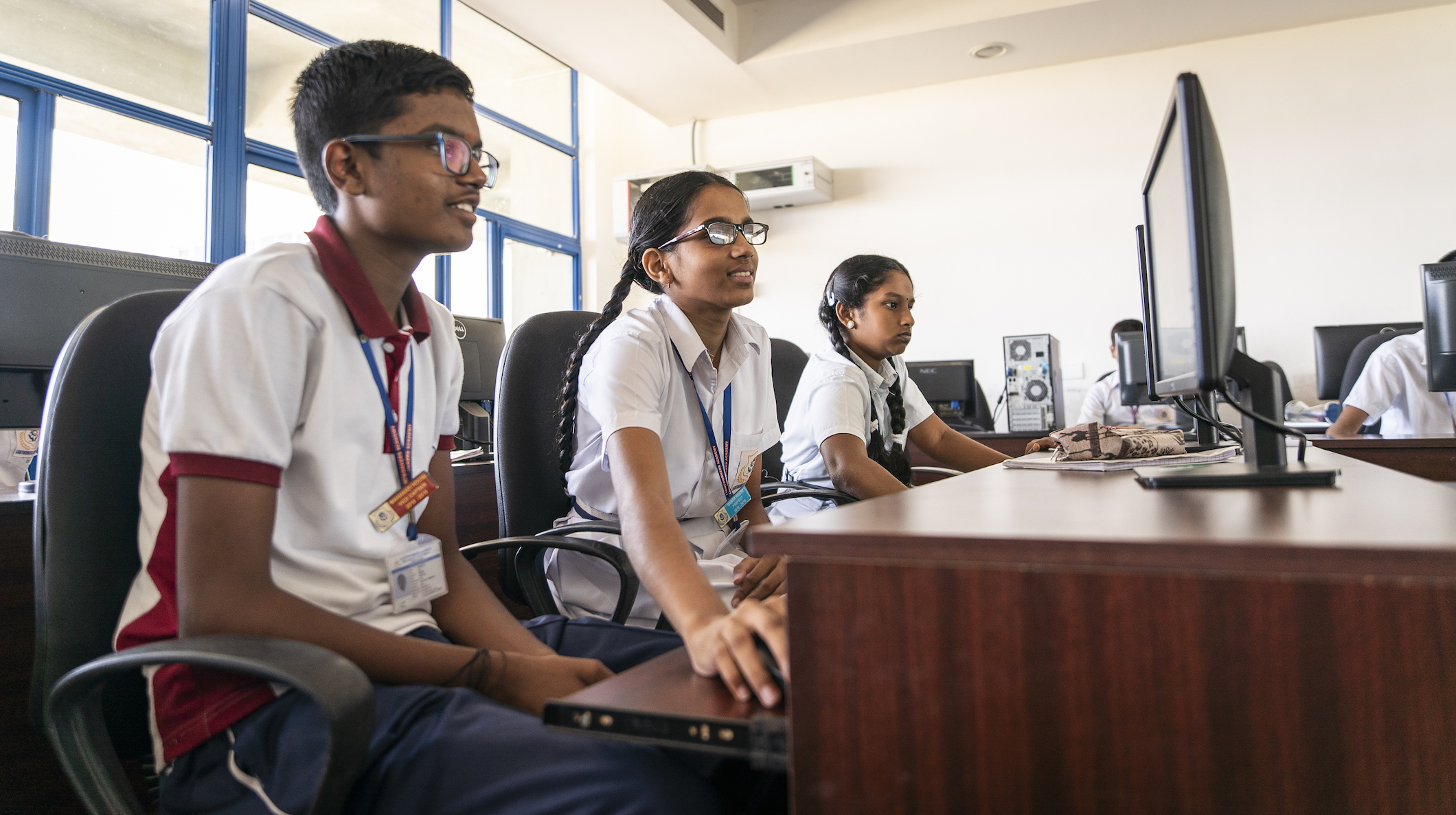
Learners in a computing classroom.

Increasing access to technology

Code Club also plays an important role in increasing access to technology for creators who would otherwise not have access. We work with partners across the world to run clubs in areas of educational disadvantage to ensure that Code Clubs are available to creators from all backgrounds to address this need.

Kenyan children work on a physical computing project.

In some regions, Code Club provides creators with their first significant encounter with digital making. A mentor in Kenya told us that Code Club ensured that creators in his area were not “left behind”. A Code Club mentor in Tunisia told us  “[…] access to coding is very limited, our club contributes to reducing this inequality”.

Next steps

Read the full report to dive deeper into the data and stories from the Code Club community!

We are an impact-focused organisation and are always looking to understand how we can improve and increase the impact we have on the lives of children and young people. Over the coming weeks we will be reviewing the feedback we have received to understand how we can support the Code Club community even better.

The post Discover the incredible impact of Code Club: The Code Club annual survey report 2025 appeared first on Raspberry Pi Foundation.

The Morning After: Everything Apple announced at WWDC 2025

Apple’s Worldwide Developer Conference (WWDC 2025) kicked off yesterday, with the usual glossy keynote from the iPhone maker. As ever, the company outlined the changes it’s made to its operating systems, all now named by year rather than version number. The biggest news is a visual overhaul of all the OSes, dubbed Liquid Glass, to bring them more in line with each other, and sharing features across the platforms. For instance, it’s redesigned the iPhone’s phone app, but it’ll also be available on macOS Tahoe as well. Plus, some updates to Apple Intelligence, which include the useful (live translation of text and speech) and the less useful (using Image Playground to make backgrounds for your group chats).

The focus here, on smaller tweaks and features with more practical utility, is welcome after last year’s show. After all, the company made some bold claims about what it was bringing to Siri, which it simply couldn’t deliver in the time allowed. Apple does its best work when it’s giving its users features that make their lives easier, not when it’s trying to shout down its Silicon Valley rivals in AI.

— Dan Cooper

Get Engadget’s newsletter delivered direct to your inbox. Subscribe right here!

The news you might have missed

Nintendo Switch 2: Early review thoughts from our first days with the gaming system

It’s a review in progress.

Image of a Nintendo Switch 2 on a white table, alongside a Lanyard, and a copy of Breath of the Wild and Mario Kart world.
Sam Rutherford for Engadget

The first Switch 2 units are still making their way to customers around the world, so there are lots of people who still don’t know what they’re about to get. That’s why the team has been working on this early thoughts story, where they’re finding out in real time all the joys and quirks the new hardware has to offer. Our full and comprehensive review is coming, but if you’re eager to get the details early, this is worth keeping an eye on.

Continue Reading.

Warner Bros. Discovery will split into two media giants

You already know the dividing lines.

There’s nothing Warner Bros. likes more than a high-profile merger, followed swiftly by an equally high-profile de-merger. Not long after its ill-advised coupling with Discovery, WBD is cleaving itself in twain, and it’s not hiding where it sees the future of its business. One company, Streaming and Studios, will hold on to Warner Bros, New Line, DC Studios, HBO and HBO Max. The other, Global Networks, includes the entity’s cable channels and brands, like CNN, HGTV Cartoon Network and Discovery. Perhaps a better name for that second outfit would be The Stuff We’d Otherwise Lose Money On When People Ditch Cable Plus A Lot Of The Merger Debt, So Let’s Cast It Into The Sea To Sink Now… Inc.

Continue Reading.

Nintendo delays The Legend of Zelda movie

But only by six weeks.

Nintendo is saying “Well, excuuuuuse me” to the 2027 cinema release schedule, punting The Legend of Zelda back to May 7. Shigeru Miyamoto said the delay was to ensure the film was as “good as it can be,” even if the phrase live-action Zelda movie chills the blood by default. Mercifully, director Wes Ball has said he’s aiming to make a movie in the spirit of a live action Miyazaki, which is the best anyone can hope for.

Continue Reading.

YouTube now allows more harmful misinformation on its platform

Oh, goody.

The New York Times reports YouTube has relaxed rules around moderating problematic content, like misinformation. It saw internal training documents telling moderators to leave up clips even if up to half of its runtime includes material that violates the platform’s policies. In a statement to Engadget, YouTube said the exceptions were broadened to preserve content that serves the public interest.

Continue Reading.

This article originally appeared on Engadget at https://www.engadget.com/general/the-morning-after-engadget-newsletter-111551630.html?src=rss

A history of the Internet, part 2: The high-tech gold rush begins

In 1965, Ted Nelson submitted a paper to the Association for Computing Machinery. He wrote: “Let me introduce the word ‘hypertext’ to mean a body of written or pictorial material interconnected in such a complex way that it could not conveniently be presented or represented on paper.” The paper was part of a grand vision he called Xanadu, after the poem by Samuel Coleridge.

A decade later, in his book “Dream Machines/Computer Lib,” he described Xanadu thusly: “To give you a screen in your home from which you can see into the world’s hypertext libraries.” He admitted that the world didn’t have any hypertext libraries yet, but that wasn’t the point. One day, maybe soon, it would. And he was going to dedicate his life to making it happen.

As the Internet grew, it became more and more difficult to find things on it. There were lots of cool documents like the Hitchhiker’s Guide To The Internet, but to read them, you first had to know where they were.

Read full article

Comments

Meta Is Creating a New AI Lab To Pursue ‘Superintelligence’

Meta is preparing to unveil a new AI research lab dedicated to pursuing “superintelligence,” a hypothetical A.I. system that exceeds the powers of the human brain, as the tech giant jockeys to stay competitive in the technology race, New York Times reported Tuesday, citing four people with the knowledge of the company’s plans. From the report: Meta has tapped Alexandr Wang, 28, the founder and chief executive of the A.I. start-up Scale AI, to join the new lab, the people said, and has been in talks to invest billions of dollars in his company as part of a deal that would also bring other Scale employees to the company.

Meta has offered seven- to nine-figure compensation packages to dozens of researchers from leading A.I. companies such as OpenAI and Google, with some agreeing to join, according to the people. The new lab is part of a larger reorganization of Meta’s A.I. efforts, the people said. The company, which owns Facebook, Instagram and WhatsApp, has recently grappled with internal management struggles over the technology, as well as employee churn and several product releases that fell flat, two of the people said.


Read more of this story at Slashdot.

IO_uring Shows Promising Potential For Linux Accelerator Drivers

Last year there was some ideas raised around potentially making use of the Linux kernel’s IO_uring functionality for graphics drivers to help with better performance and synchronization. It turns out Qualcomm engineers have recently been exploring IO_uring use for the DRM accelerator drivers with very promising results on their Cloud AI hardware in seeing around 50% speed-ups in ioctl execution time…

ROC-RK3506J-CC Board Integrates RK3506J and Dual LAN Support

The ROC-RK3506J-CC is a compact single-board computer based on Rockchip’s RK3506J processor. Designed for embedded systems with real-time demands, it supports a wide range of I/O and OS options and is available in both industrial and commercial variants. The RK3506J processor includes a tri-core ARM Cortex-A7 cluster alongside a single Cortex-M0 core, fabricated using a […]

FAA To Eliminate Floppy Disks Used In Air Traffic Control Systems

An anonymous reader quotes a report from Tom’s Hardware: The head of the Federal Aviation Administration just outlined an ambitious goal to upgrade the U.S.’s air traffic control (ATC) system and bring it into the 21st century. According to NPR, most ATC towers and other facilities today feel like they’re stuck in the 20th century, with controllers using paper strips and floppy disks to transfer data, while their computers run Windows 95. While this likely saved them from the disastrous CrowdStrike outage that had a massive global impact, their age is a major risk to the nation’s critical infrastructure, with the FAA itself saying that the current state of its hardware is unsustainable.

“The whole idea is to replace the system. No more floppy disks or paper strips,” acting FAA administrator Chris Rocheleau told the House Appropriations Committee last Wednesday. Transportation Secretary Sean Duffy also said earlier this week,” This is the most important infrastructure project that we’ve had in this country for decades. Everyone agrees — this is non-partisan. Everyone knows we have to do it.” The aviation industry put up a coalition pushing for ATC modernization called Modern Skies, and it even ran an ad telling us that ATC is still using floppy disks and several older technologies to keep our skies safe. […]

Currently, the White House hasn’t said what this update will cost. The FAA has already put out a Request For Information to gather data from companies willing to take on the challenge of upgrading the entire system. It also announced several ‘Industry Days’ so companies can pitch their tech and ideas to the Transportation Department. Duffy said that the Transportation Department aims to complete the project within four years. However, industry experts say this timeline is unrealistic. No matter how long it takes, it’s high time that the FAA upgrades the U.S.’s ATC system today after decades of neglect.


Read more of this story at Slashdot.

Engadget Podcast: Breaking down the highlights of WWDC 2025

In this special episode, recorded live in Cupertino, Cherlynn and Deputy Editor Nathan Ingraham are joined by the Washington Post’s Chris Velazco and Wired’s Julian Chokkattu to discuss Apple’s announcements at WWDC 2025. Though the announcements were all over the place and felt difficult to judge until they roll out to devices, our guests and hosts agree that they felt more meaningful than past WWDCs.

Subscribe!

Credits 

Hosts: Cherlynn Low and Nathan Ingraham
Guests: Chris Velazco and Julian Chokkattu
Music: Dale North

This article originally appeared on Engadget at https://www.engadget.com/mobile/smartphones/engadget-podcast-breaking-down-the-highlights-of-wwdc-2025-023505128.html?src=rss

If India Chokes Less, It Will Fry More

South Asia has warmed far more slowly than the rest of the world over the past four decades with temperatures rising just 0.09C per decade compared to 0.30C elsewhere on land, according to new climate research. Scientists believe this “warming hole” results from two factors that have masked the true impact of global warming: heavy aerosol pollution that reflects sunlight back to space and expanded irrigation that cools air through evaporation.

The protective effect is temporary and comes at a deadly cost. Air pollution currently kills between 2 million and 3 million people annually in South Asia, while extreme heat causes 100,000 to 600,000 deaths. As governments reduce pollution and groundwater depletion limits irrigation expansion, atmospheric scientists predict India will warm at twice the rate of the past 20 years. By 2047, the average Indian could experience a four-fold increase in dangerous heat stress days, threatening a region where only 10% of households have air conditioning.


Read more of this story at Slashdot.

ICANN Waves Hands in Protest at AFRINIC Election Arrangement

The Internet Corporation for Assigned Names and Numbers (ICANN) has called for changes to the roster of officials appointed to oversee the forthcoming election at the African Network Information Centre (AFRINIC), the latest twist in a conflict that stretches back years and has left the African regional internet registry in limbo. From a report: AFRINIC is one of the world’s five regional internet registries, the governance bodies that delegate and manage IP addresses and autonomous systems numbers in co-ordination with ICANN. The African organization has essentially been dead in the water, operating without a board or CEO since 2022. The problems started in 2020 when AFRINIC alleged that one of its members — a company called Cloud Innovation — had breached its agreement with the registry in ways that could lead AFRINIC to reclaim the company’s IP address holdings.

Cloud Innovation countered that AFRINIC acted improperly and launched multiple lawsuits in Mauritius, the Indian Ocean nation the registry calls home. Other parties also sued AFRINIC for similar reasons. The lawsuits left AFRINIC’s bank accounts frozen and meant it was unable to convene a board or run elections. In February 2025, the Supreme Court of Mauritius appointed a receiver to secure AFRINIC’s assets and reconstitute its board.


Read more of this story at Slashdot.