
A newly disclosed set of vulnerabilities has sent shockwaves through the Linux security community. Dubbed “CrackArmor,” these flaws affect AppArmor, one of the most widely used security modules in Linux, potentially exposing millions of systems to serious compromise.
Category Archives: Unfiltered RSS
GRUB Bootloader Development Moves To FreeDesktop.org
The widely-used GRUB bootloader is now being developed on FreeDesktop.org with a modern GitLab-based workflow…
Arm Preparing Live Firmware Activation Support For Linux
A new platform feature being worked on by Arm engineers for the Linux kernel is Live Firmware Activation to allow for updated firmware components to be deployed without requiring a system reboot…
Here’s BMW’s first all-electric 3 series, the 2027 i3
MALAGA, Spain—Late last year, we got our first chance to drive the new BMW iX3. An all-electric version of one of BMW’s best-sellers, the electric SUV is arguably the new head of the class in the competitive premium SUV EV segment, with good driving dynamics and an extremely efficient electric powertrain. The next new BMW EVs to use the company’s Neue Klasse platform is the one we find more interesting here at Ars, even if it won’t sell as well. It’s the 2027 i3, or BMW’s first 3 series EV, and it goes into production in Munich this August.
A proper sedan
It has been a few years since we first saw the Neue Klasse sedan concept, and it has mostly remained faithful to that design as it made the transition from concept to production model. Light has replaced chrome for BMW’s traditional kidney grille, which here contains kidneys within kidneys. Like the iX3, there’s a valley down the hood, but here the kidneys are long and wide, unlike the bucktooth look of BMW’s new SUVs.
The biggest change is at the rear. Sadly, the i3 has little of the elegance or charm of the concept aft of the rear axle, but the demands of real-life practicality meant BMW needed to raise the rear deck a few inches in order to give the car proper cargo-carrying capacity. And yes, the rear window does have the traditional “Hofmeister kink.” At launch, the i3 will be just a sedan, but BMW showed us a silhouette of a wagon variant—Touring in BMW-speak—that we very much hope crosses the Atlantic at some point.
Linux 7.0 Better Supporting The Logitech MX Master 4 Bluetooth Mouse
For those that happen to have the Logitech MX Master 4 wireless mouse or are considering this high-end ~$120 USD Bluetooth mouse, better support for it was merged yesterday to Linux 7.0…
Defense Department says Anthropic poses ‘unacceptable risk’ to national security
The Department of Defense said giving Anthropic continued access to its warfighting infrastructure would “introduce unacceptable risk” to its supply chains in a court filing submitted in response to the AI company’s lawsuit. If you’ll recall, Anthropic sued the government to challenge the supply chain risk designation it received for refusing to allow its model to be used for mass surveillance and the development of autonomous weapons.
In its filing, the department explained that its secretary, Pete Hegseth, had a provision incorporated into AI service contracts, allowing the agency to use their technologies for any lawful purpose. Anthropic refused its terms and apparently, the company’s behavior caused the Pentagon to question whether it truly was a “trusted partner” that it could work with when it comes to “highly sensitive” initiatives. “After all, AI systems are acutely vulnerable to manipulation, and Anthropic could attempt to disable its technology or preemptively alter the behavior of its model either before or during ongoing warfighting operations, if Anthropic — in its discretion — feels that its corporate “red lines” are being crossed,” the Pentagon wrote in its filing. “DoW deemed that an unacceptable risk to national security,” it added, referring to the agency as the Department of War, which is the Trump administration’s preferred name for it.
It was due to those concerns that President Trump ordered federal agencies to stop using its technology, the filing reads. The company is asking the court to issue a preliminary injunction and put a pause on a ban while it’s challenging its supply chain risk designation in court. While Anthropic’s clients could continue working with the company on non-defense-related projects, it says the label could cause it to lose billions of dollars in revenue. It’s not quite clear if Anthropic is still trying to reach a new deal with the government, as was reported before it filed its lawsuit. As The New York Times notes, Microsoft, Google and OpenAI had filed friend-of-the-court briefs in support of Anthropic since then.
This article originally appeared on Engadget at https://www.engadget.com/ai/defense-department-says-anthropic-poses-unacceptable-risk-to-national-security-094328717.html?src=rss
The Bugatti Factor One brings hypercar engineering to high-performance cycling – and it’s incredibly exclusive
Factor has partnered with Bugatti to create the Bugatti Factor One, a highly exclusive version of its aero bike, which promises “a radical fusion of hypercar engineering and elite cycling performance”.
Factor says it partnered with the luxury car manufacturer to create a bike around the two companies’ shared philosophy of an “obsessive attention to detail and performance without limits”.
The lack of limits is taken quite literally, with this aero bike not complying with UCI regulations, and instead focusing on a “no-holds-barred-approach”.
The Bugatti Factor One in detail

When the Factor One first appeared at the 2025 Critérium du Dauphiné, it caught the cycling world’s attention thanks to its radical front fork.
The fork has a similar bayonet design as the Cervélo S5 and Colnago Y1Rs, where the fork legs continue into a narrow head tube. But the One takes things a step further with a wide arch that’s said to help air pass through the fork more efficiently.
This design makes use of the UCI’s updated regulations, which specify forks can be no wider than 115mm. But Bugatti and Factor’s collaboration goes further with a special-edition fork that is wider than the UCI’s limit.

The fork also differs from the one you’ll find on the typical Factor One near the thru-axle. There are effective ‘wings’ and channels at the bottom of the fork, presumably to further smooth airflow and reduce aerodynamic drag.
“This design not only enhances high-speed efficiency but also improves front-end stability, ensuring precise handling under race conditions,” Factor says.
The bike isn’t a complete rule breaker. At 62mm deep, the Bugatti Factor One’s wheels are 3mm shy of the UCI’s maximum rim depth. Yet Factor says these Black Inc Hyper 62 wheels are far from ordinary.
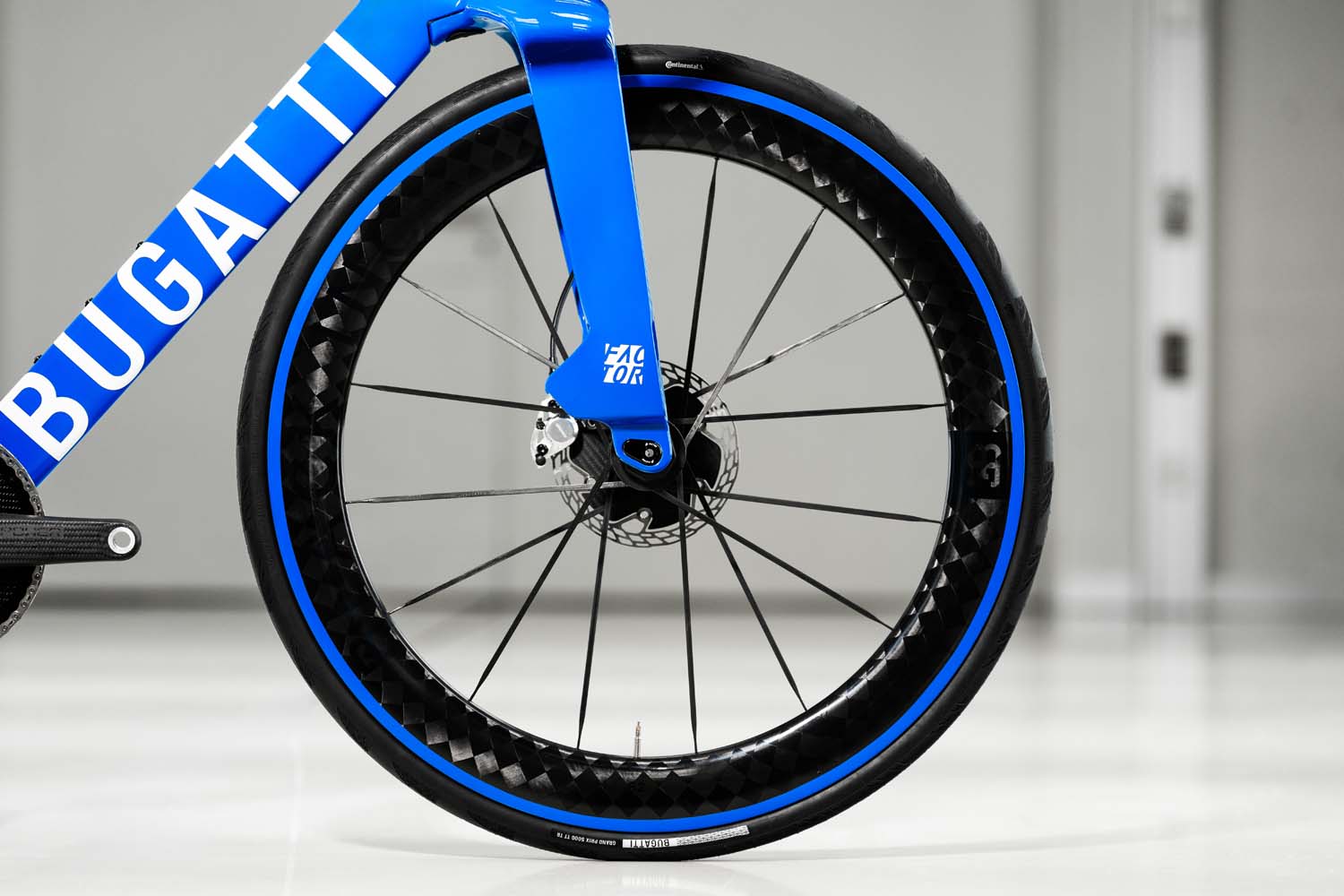
According to the brand, they are “conceived as the cycling equivalent of a hypercar wheelset, where aerodynamic science, structural integrity, and aesthetic precision converge”.
The wheelset is said to weigh 1,298g and the rim profile has been optimised for high speeds.
“The advanced carbon layup has been tuned to maximise torsional stiffness and power transfer under load, while maintaining controlled compliance for refined ride quality,” Factor adds.
Elsewhere, the aero bike has a suite of bespoke components. There are Bugatti carbon chainrings, carbon and titanium rotors, a bespoke Selle Italia saddle and Continental GP5000 TT TR tyres that have been customised exclusively for the bike.
Finally, the bike is complete with a split paintwork, which is a design signature of Bugatti’s cars, with ‘Bugatti’ written boldly across the down tube.
Who exactly is this for?

A collaboration between Factor and Bugatti might leave you scratching your head, and even more so when you know there will only be 250 bikes available, for the princely sum of $23,599 / €25,799. So the questions might be, why have they done this? And who exactly is it for?
Factor’s founder, Rob Gitelis, says: “The Bugatti Factor One is not simply a bicycle. It is a statement. This project challenged us to rethink every assumption and push engineering boundaries the same way Bugatti has done in the automotive world for over a century.”
Bugatti’s Wiebke Ståhl adds: “It translates the meticulous engineering and attention to detail of Bugatti hypercars into a completely new category. It demonstrates that our pursuit of excellence and craftsmanship extends beyond hypercars.”

So, in short, the project enables the companies to push the boundaries of what they’re doing. But whether this project is one that leads to performance gains on Factor’s UCI-legal bikes is yet to be seen.
And in terms of who the bike is for, Factor says it’s aimed at “collectors, enthusiasts and athletes”. Note the order of those words.
But all this framing probably misses something more fundamental. After all, Factor isn’t the first cycling brand to team up with a sports car manufacturer. Cervélo has collaborated with Lamborghini, Colnago has a long history of working with Ferrari, and BMC has drawn upon Red Bull Advanced Technologies’ Formula One experience.
Maybe for these cycling companies there is something irresistible about tapping into the luxury and speed of supercars, while turning a few heads in the process.
You may like
Linux Foundation kicks off effort to shield FOSS maintainers from AI slop bug reports
Big Tech donates $12.5 million to get things rollingHalf a dozen Big Tech players have together delivered $12.5 million in grants towards a project that aims to help maintainers of open source projects to cope with AI slop bug reports.…
Nvidia Announces Vera Rubin Space-1 Chip System For Orbital AI Data Centers
Nvidia unveiled its Vera Rubin Space-1 system for powering AI workloads in orbital data centers. “Space computing, the final frontier, has arrived,” said CEO Jensen Huang. “As we deploy satellite constellations and explore deeper into space, intelligence must live wherever data is generated.” CNBC reports: In a press release, the company said that its Vera Rubin Space-1 Module, which includes the IGX Thor and Jetson Orin, will be used on space missions led by multiple companies. The chips are specifically “engineered for size-, weight- and power-constrained environments.” Partners include Axiom Space, Starcloud and Planet.
Huang said Nvidia is working with partners on a new computer for orbital data centers, but there are still engineering hurdles to overcome. “In space, there’s no convection, there’s just radiation,” Huang said during his GTC keynote, “and so we have to figure out how to cool these systems out in space, but we’ve got lots of great engineers working on it.”


Read more of this story at Slashdot.
Thelio Mira Desktop Updated with Ryzen 9000 CPUs and Revised Chassis
System76 has introduced an updated version of its Thelio Mira desktop, featuring AMD Ryzen 9000 series processors, revised thermal design, and improved serviceability. The system targets workstation, development, and compute-heavy workloads, including data processing and machine learning. The refreshed Thelio Mira is offered as a configurable system alongside preconfigured Premium and Elite variants. System76 states […]
AI Job Loss Research Ignores How AI Is Utterly Destroying the Internet
An anonymous reader quotes a report from 404 Media, written by Jason Koebler: Over the last few months, various academics and AI companies have attempted to predict how artificial intelligence is going to impact the labor market. These studies, including a high-profile paper published by Anthropic earlier this month, largely try to take the things AI is good at, or could be good at, and match them to existing job categories and job tasks. But the papers ignore some of the most impactful and most common uses of AI today: AI porn and AI slop.
Anthropic’s paper, called “Labor market impacts of AI: A new measure and early evidence,” essentially attempts to find 1:1 correlations between tasks that people do today at their jobs and things people are using Claude for. The researchers also try to predict if a job’s tasks “are theoretically possible with AI,” which resulted in this chart, which has gone somewhat viral and was included in a newsletter by MSNOW’s Phillip Bump and threaded about by tech journalist Christopher Mims. (Because everything is terrible, the research is now also feeding into a gambling website where you can see the apparent odds of having your job replaced by AI.) In his thread, Mims makes the case that the “theoretical capability” of AI to do different jobs in different sectors is totally made up, and that this chart basically means nothing. Mims makes a good and fair observation: The nature of the many, many studies that attempt to predict which people are going to lose their jobs to AI are all flawed because the inputs must be guessed, to some degree.
But I believe most of these studies are flawed in a deeper way: They do not take into account how people are actually actually using AI, though Anthropic claims that that is exactly what it is doing. “We introduce a new measure of AI displacement risk, observed exposure, that combines theoretical LLM capability and real-world usage data, weighting automated (rather than augmentative) and work-related uses more heavily,” the researchers write. This is based in part on the “Anthropic Economic Index,” which was introduced in an extremely long paper published in January that tries to catalog all the high-minded uses of AI in specific work-related contexts. These uses include “Complete humanities and social science academic assignments across multiple disciplines,” “Draft and revise professional workplace correspondence and business communications,” and “Build, debug, and customize web applications and websites.” Not included in any of Anthropic’s research are extremely popular uses of AI such as “create AI porn” and “create AI slop and spam.” These uses are destroying discoverability on the internet, cause cascading societal and economic harms. “Anthropic’s research continues a time-honored tradition by AI companies who want to highlight the ‘good’ uses of AI that show up in their marketing materials while ignoring the world-destroying applications that people actually use it for,” argues Koebler. “Meanwhile, as we have repeatedly shown, huge parts of social media websites and Google search results have been overtaken by AI slop. Chatbots themselves have killed traffic to lots of websites that were once able to rely on ad revenue to employ people, so on and so forth…”
“This is all to say that these studies about the economic impacts of AI are ignoring a hugely important piece of context: AI is eating and breaking the internet and social media,” writes Koebler, in closing. “We are moving from a many-to-many publishing environment that created untold millions of jobs and businesses towards a system where AI tools can easily overwhelm human-created websites, businesses, art, writing, videos, and human activity on the internet. What’s happening may be too chaotic, messy, and unpleasant for AI companies to want to reckon with, but to ignore it entirely is malpractice.”


Read more of this story at Slashdot.
CMake 4.3 Released With Package Import/Export Using The Common Package Specification
Version 4.3 of the CMake software development tool / build system was released today. Notable with CMake 4.3 is support for importing and exporting packages described using the Common Package Specification (CPS) for greater interoperability in the ecosystem…
ASRock AI BOX-A395 Runs Ryzen AI Max+ 395 with Up to 128GB LPDDR5x
ASRock Industrial has announced the AI BOX-A395, a compact system based on the AMD Ryzen AI Max+ 395 platform. The system integrates CPU, GPU, and NPU resources within a single enclosure and is intended for local inference, content creation, and engineering workloads. The platform combines a Zen 5-based CPU with up to 16 cores and […]
Arizona Charges Kalshi With Illegal Gambling Operation
Arizona has filed criminal charges against Kalshi, accusing it of operating an illegal gambling business. “Kalshi may brand itself as a ‘prediction market,’ but what it’s actually doing is running an illegal gambling operation and taking bets on Arizona elections, both of which violate Arizona law,” Arizona Attorney General Kris Mayes said in a statement. The case could ultimately head to the Supreme Court to decide whether federal oversight by the Commodity Futures Trading Commission overrides state gambling laws. Bloomberg reports: While state regulators have taken steps to crack down on what they say is unlicensed betting on Kalshi’s site, Arizona appears to be the first state to escalate to criminal charges. The charges cited in the complaint are misdemeanors, which carry less serious penalties than felonies. […] Prediction market exchanges like Kalshi have said they should continue to be regulated by the US Commodity Futures Trading Commission despite opposition from some state officials, who argue the trading should come under state gambling laws.
Arizona’s criminal complaint follows Kalshi’s move last week to block the state’s gaming department from taking enforcement action against the company. “These are the first criminal charges of any kind filed against Kalshi in any court in the United States, but it will likely be the first of several,” said Daniel Wallach, a sports and gaming attorney.


Read more of this story at Slashdot.
Subnautica 2 might finally be entering early access in May
Subnautica 2 has weathered the storm and has rescheduled its early access release. IGN reported today that the sequel to the underwater survival game will begin early access on PC and Xbox in May, although a more specific date was not provided.
The news comes a day after a judge ruled that former Unknown Worlds Entertainment CEO Ted Gill should be rehired at the game studio. That decision capped off a dramatic year for the team behind Subnautica, which was acquired by Krafton in 2021. The studio and its new owners entered a legal battle because the purchase of Unknown Worlds included a promise of an up to $250 million payout from Krafton if the team met certain performance goals by the end of 2025. In July of that year, however, Krafton fired several studio leaders and then delayed the sequel’s early access launch. The court case has raised questions about which side was trying to either secure or avoid making that multi-million payment.
With yesterday’s ruling, a rep from Krafton said that “we are evaluating our options as we determine our path forward.” It’s unclear if that path, or the other litigation still underway over the project, will create further delays to the planned early access date.
This article originally appeared on Engadget at https://www.engadget.com/gaming/subnautica-2-might-finally-be-entering-early-access-in-may-223747369.html?src=rss
Meta will shut down VR Horizon Worlds access in June
Horizon Worlds, Meta’s first pass at a metaverse, will be inaccessible via virtual reality headset after June 15, 2026. The company shared plans to separate Horizon Worlds from Quest VR platform and focus exclusively on the smartphone version of the app in February, and now in a new post on its community forums, Meta detailed when the VR version of Horizon Worlds will be deprecated.
By March 31, Meta says individual Horizon Worlds and Events will no longer be listed in the Quest’s Store and headset owners will be unable to visit worlds like “Horizon Central, Events Arena, Kaiju and Bobber Bay.” Then, after June 15, the app will be removed from Quest headsets and worlds will be completely unavailable to visit in VR. From that point on, the easiest place to visit Horizon Worlds will be in the Meta Horizon app for iOS and Android.
Additionally, Hyperscape Capture, a recently added beta feature that allows Quest headset owners to capture, share and visit each other in detailed 3D scans of real-life locations, is also being removed from Horizon Worlds. Meta says users will still be able to capture and view Hyperscapes, “but sharing, inviting, and co-experiencing Hyperscapes with others will no longer be supported.”
While Meta’s original blog detailing its 2026 VR strategy left open the possibility that a committed Quest owner might still be able to access some part of Meta’s original VR metaverse, that apparently was never the company’s plan. Meta saw enough “positive momentum” focusing on supporting the mobile version of Horizon Worlds in 2025 that it made sense to completely abandon the VR one in 2026. While that seems to run contrary to Meta’s positioning as a “metaverse company,” it does reflect where the company is spending the most money and seeing the most (relative) success: AI and smart glasses.
This article originally appeared on Engadget at https://www.engadget.com/ar-vr/meta-will-shut-down-vr-horizon-worlds-access-in-june-222028919.html?src=rss
Rural Ohioans Seek To Ban Data Centers Through Constitutional Amendment
Residents in rural Ohio are pushing a constitutional amendment to ban large data centers over 25 megawatts, citing concerns about energy use, water consumption, and lack of transparency around proposed projects. “My biggest concern is because I love Adams County,” Nikki Gerber told Cleveland.com. “What it feels like they are doing is just taking advantage of the unzoned rural areas of Ohio, where they can go ahead and put in whatever they want.” From the report: Gerber and a handful of residents from Adams and Brown counties gathered about 1,800 signatures in eight days to start the ballot process. They submitted those petitions to the Ohio attorney general’s office on Monday. That’s the first step before supporters can begin collecting signatures statewide.
State law requires at least 1,000 valid voter signatures to begin the process. The petitions must also include the full text of the proposed amendment and a summary explaining what it would do. Attorney General Dave Yost’s office now has 10 days to decide whether the summary fairly and truthfully describes the proposal. If it does, the measure will move to the Ohio Ballot Board. Supporters would then need to gather about 413,000 valid signatures by July to place the amendment before voters this November. The report notes that a 25-megawatt limit “would effectively block most modern data centers from being built in Ohio.”


Read more of this story at Slashdot.
Building And Riding A Magnetically Levitating Skateboard
Created by inventor Colin Furze (previously), this is a video of a skateboard with a magnetically levitating top deck to help it ride smoother. I know, I know, it’s not a hoverboard. Unfortunately, we probably won’t have real hoverboards by the time I die again. “Not with the undead warlock thing again.” Oh I’m sorry, you think I wanted to die the first time? I HAD A FAMILY. Well, I had parents. I never had a wife or kids on account of being an evil warlock, but I still regret casting a death spell at that demon in the water. “It was your reflection, wasn’t it?” I didn’t have a mirror in the cave, but I assumed I was handsome.
JSFX on Fedora Linux: an ultra-fast audio prototyping engine
Introduction Writing a real-time audio plugin on Linux often conjures up images of a complex environment: C++, toolchains, CMake, CLAP / VST3 / LV2 SDK, ABI… However, there is a much simpler approach : JSFX This article offers a practical introduction to JSFX and YSFX on Fedora Linux: we’ll write some small examples, add a graphical […]
Apple releases its first Background Security Improvement for macOS, iOS and iPadOS
Apple has started providing small security updates to iOS, iPadOS and macOS devices. These are dubbed Background Security Improvements that will offer minor system updates between the larger software updates. According to the company, these are meant to “deliver lightweight security releases for components such as the Safari browser, WebKit framework stack, and other system libraries that benefit from smaller, ongoing security patches between software updates.”
These updates should download in the background, as the name implies, although the device will need to be restarted to complete the process. In practice, we found that applying a Background Security Improvement was faster than a typical software update from Apple. On an iPhone, the restart was more of a power cycle taking under a minute compared with the 5 to 10 minutes a standard update takes a device out of commission.
The inaugural Background Security Improvement was released today with a patch for WebKit. These updates will be supported and enabled on devices running iOS 26.1, iPadOS 26.1 and macOS 26.1. Details can be reviewed under the Privacy & Security section of the Settings menu.
This article originally appeared on Engadget at https://www.engadget.com/computing/apple-releases-its-first-background-security-improvement-for-macos-ios-and-ipados-214052311.html?src=rss