The UK Information Commissioner’s Office has issued its first guidance demanding manufacturers of air fryers, smart speakers, fertility trackers, and smart TVs respect users’ privacy rights after reports of excessive data collection in homes.
The regulator requires companies to ensure data security, provide transparency to consumers, and regularly delete collected information. Stephen Almond, the ICO’s executive director for regulatory risk, said smart products know who users live with, their music preferences, and medication details. The guidance addresses “internet of things” devices, including fertility trackers that record menstrual dates and body temperature before sending data to manufacturer servers.
Additionally, smart speakers that monitor family members and visitors must allow users to configure settings that minimize personal information collection. The ICO warned manufacturers it stands ready to take enforcement action in the event of noncompliance.
Google’s Search Live feature with voice input is now available on its app for iOS and Android in the US. You’ll have to opt in to AI Mode in Labs to be able to access it, but after you do, you’ll be able to have a back-and-forth voice conversation with Search. To use the feature, open the Google app and tap on the new Live icon to verbally ask a question. Google will respond with AI-generated audio, as well, and you’ll be able to ask follow-up questions naturally. Under the hood, the feature is powered by a custom version of Gemini with advanced voice capabilities.
The company says it’s the perfect feature for when you’re on the go or multitasking, like packing a bag. In the example Google used, the user asked Search how to prevent linen dresses from wrinkling in a suitcase and Gemini responded verbally. The user then asked a couple of follow-up questions without having to exit the Search Live screen or having to tap the Live icon again. You can continue your chat even if you open another app, and you can also see a transcript of Google’s responses and then type in more questions if you want to shift to written conversation.
While the feature has the potential to be a convenient tool, the sources Google takes its information from might not see any traffic from the interaction. Google does show links from across the web on the Search Live screen, but they’re displayed in tiny cards and can completely be ignored if the user is indeed doing something else while talking to Gemini.
In the coming months, the company is expanding Search Live with the capability to show and ask Search about what you’re seeing in real time. Google announced that particular ability at I/O this year. As an example, Google said you can show Search a difficult math problem and ask it to help you solve it or to explain a concept you’re having difficulty grasping.
This article originally appeared on Engadget at https://www.engadget.com/ai/googles-ai-powered-search-live-feature-is-here-to-further-cannibalize-the-internet-160018513.html?src=rss
Shimano’s new range of wireless mountain bike drivetrains is now complete, with the release of the new Deore M6200 groupset bringing wireless shifting to the affordable workhorse drivetrain.
The new Deore range features much of the same tech seen on XTR Di2 M9200 and XT Di2 M8200 groupsets – the latter also launching today – with a few cost-saving differences.
The drivetrain comprises the rear derailleur, shifter and new rear brakes. As far as we can ascertain, the crankset has been carried over from the outgoing Deore M6100 groupset.
This is the first time an electronic drivetrain has been brought down to the brand’s third-tier mountain bike components. Shimano made a similar move in 2022 with 105 Di2. Less clear is what the launch means for mechanical Deore.
The launch comes only two weeks after the long-awaited launch of the fully wireless XTR Di2.
Here’s everything we know so far about Shimano’s most affordable wireless Di2 drivetrain to date.
Read more about Shimano’s new Di2 mountain bike groupsets
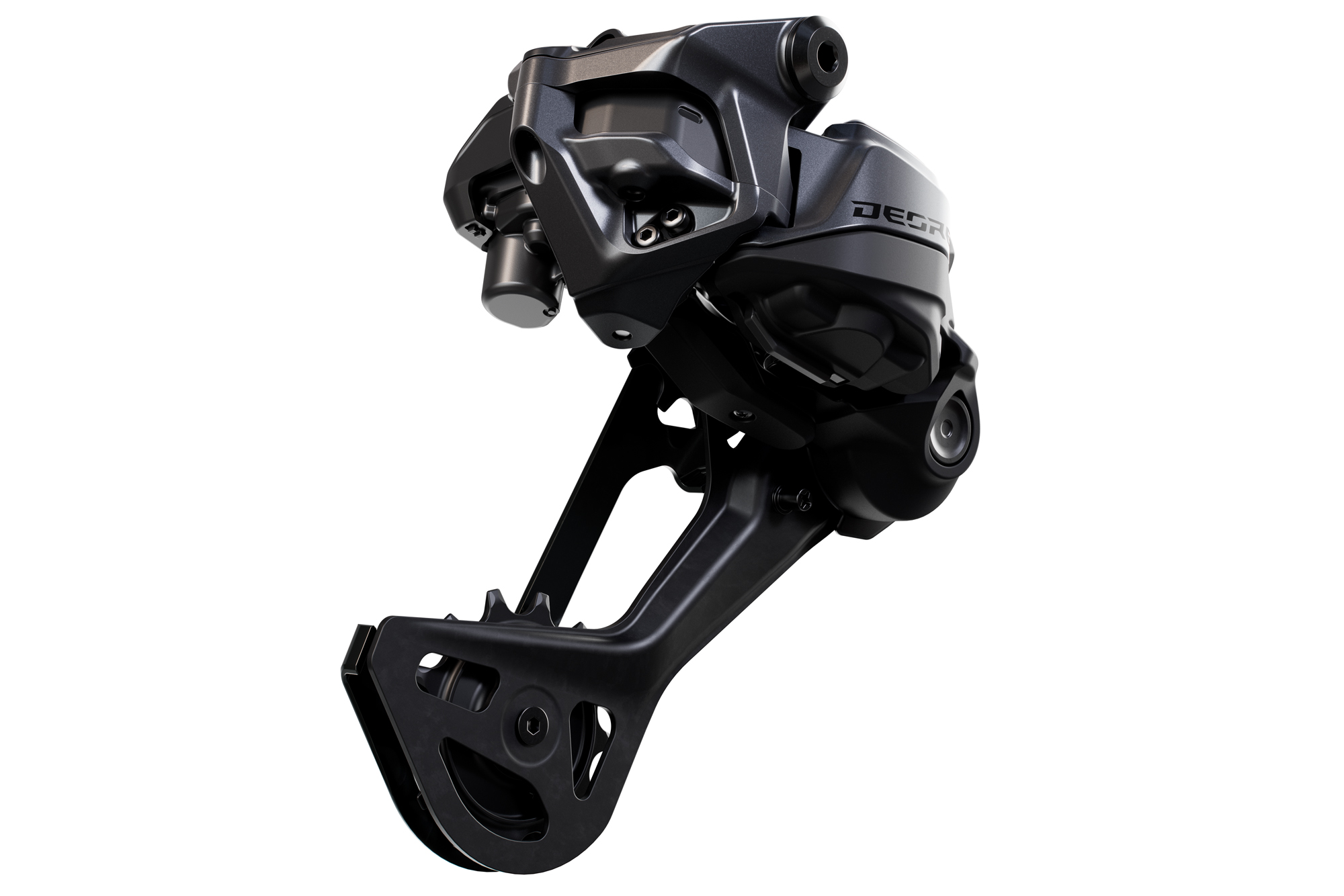
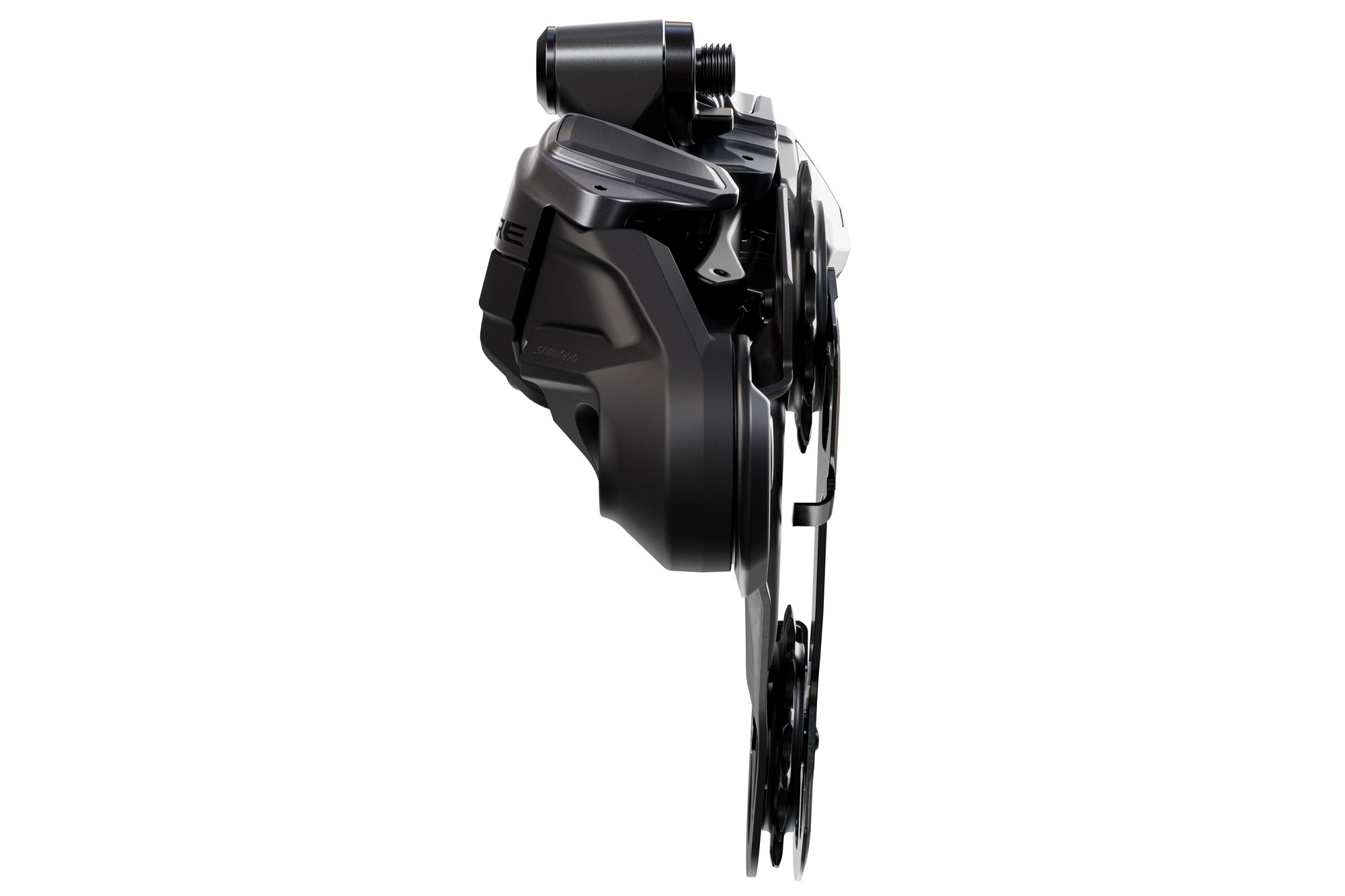
The rear derailleur shares much with the XT and XTR rear derailleurs. Shimano
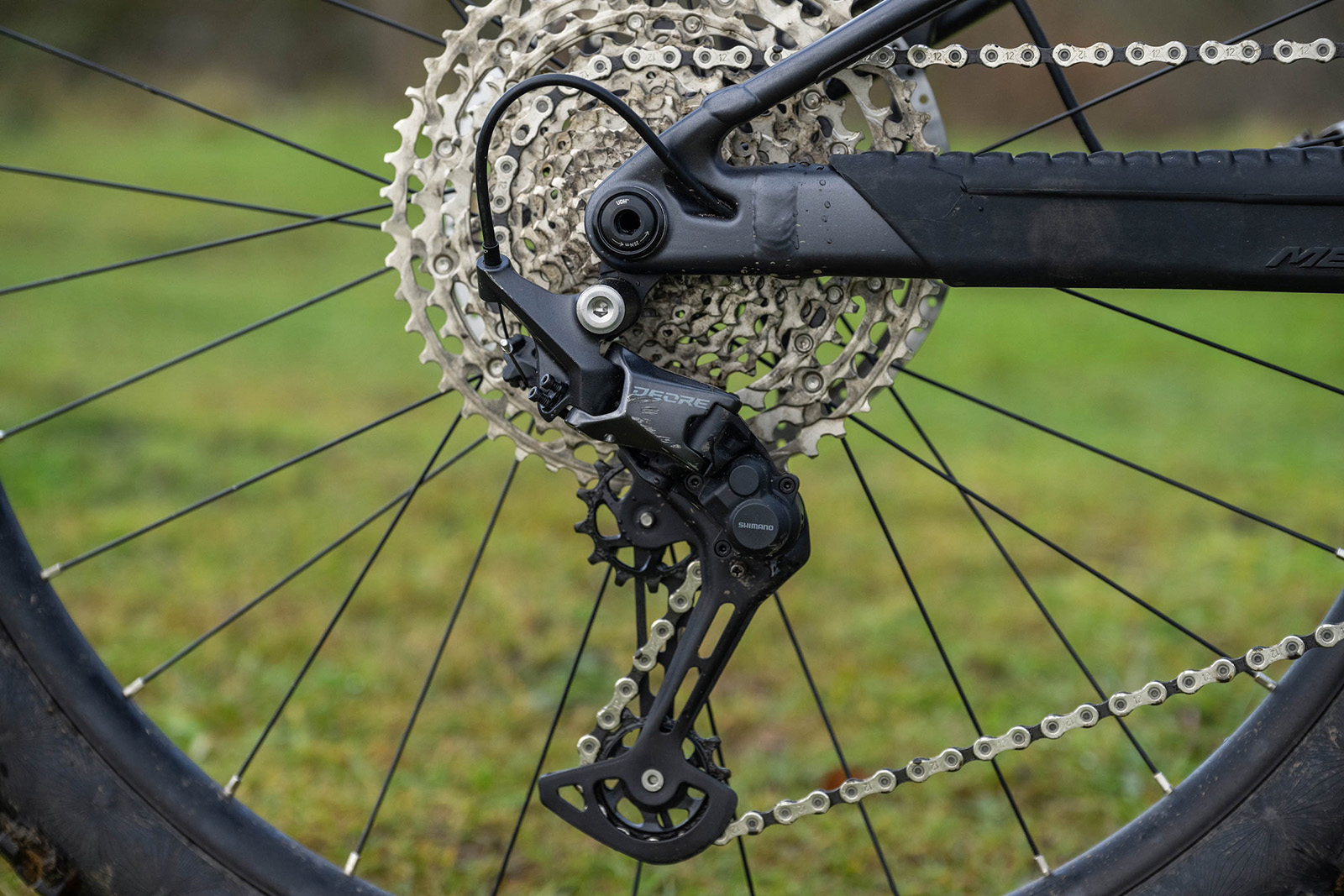
The new Deore derailleur features much of the same tech seen on Shimano’s more expensive XT and XTR options.
It mounts to your frame via a derailleur hanger (unlike SRAM’s Eagle AXS Transmission) and, just like its XT and XTR stablemates, it features low and high adjustments and a b-tension screw.
The derailleur adopts the streamlined Shadow ES profile, as seen on XTR. It’s designed to dodge roots, rocks and trail debris, while its integrated skid plate and lack of harsh edges should shrug off impacts when they do happen.
Bigger knocks are dealt with by the automatic impact-recovery function, which enables the derailleur to move rather than snap, before resetting into its original position without any input from the rider.
Shimano’s Shadow ES clutch forgoes an on/off switch – a controversial move that divided opinion with the arrival of XTR – but is claimed to deliver more chain tension on the trail.
The derailleur is set to cost £374.99, plus £39.99 for the battery and £29.99 for the charger.
Shimano Deore Di2 derailleur options
The rear derailleur is available in wired and wireless options. Shimano
Shimano is offering two versions of its Deore derailleur – one for mountain bikes and one for electric mountain bikes, with the former utilising an onboard battery and the latter drawing power from the eMTB’s main battery.
Both eMTB and ‘standard’ versions come with a long cage, making them suitable for Shimano’s 10-51t cassettes. As well as the standard 12-speed, there’s also an 11-speed version of the eMTB derailleur.
In an update to Shimano’s current Di2 eMTB-specific derailleurs, both Free Shift and Auto Shift will be available on the 12-speed setup. These features were previously reserved for 11-speed drivetrains.
Free Shift enables gears to be changed while you’re not pedalling, by independently rotating the chainring via the Shimano EP8 motor, while Auto Shift uses speed and torque sensors to shift gears automatically, without rider inputs at the shifter, to keep the pedal cadence within an optimal range.
All Deore derailleurs use a steel cage construction, which is more affordable than the alloy and carbon cages used on XT and XTR.
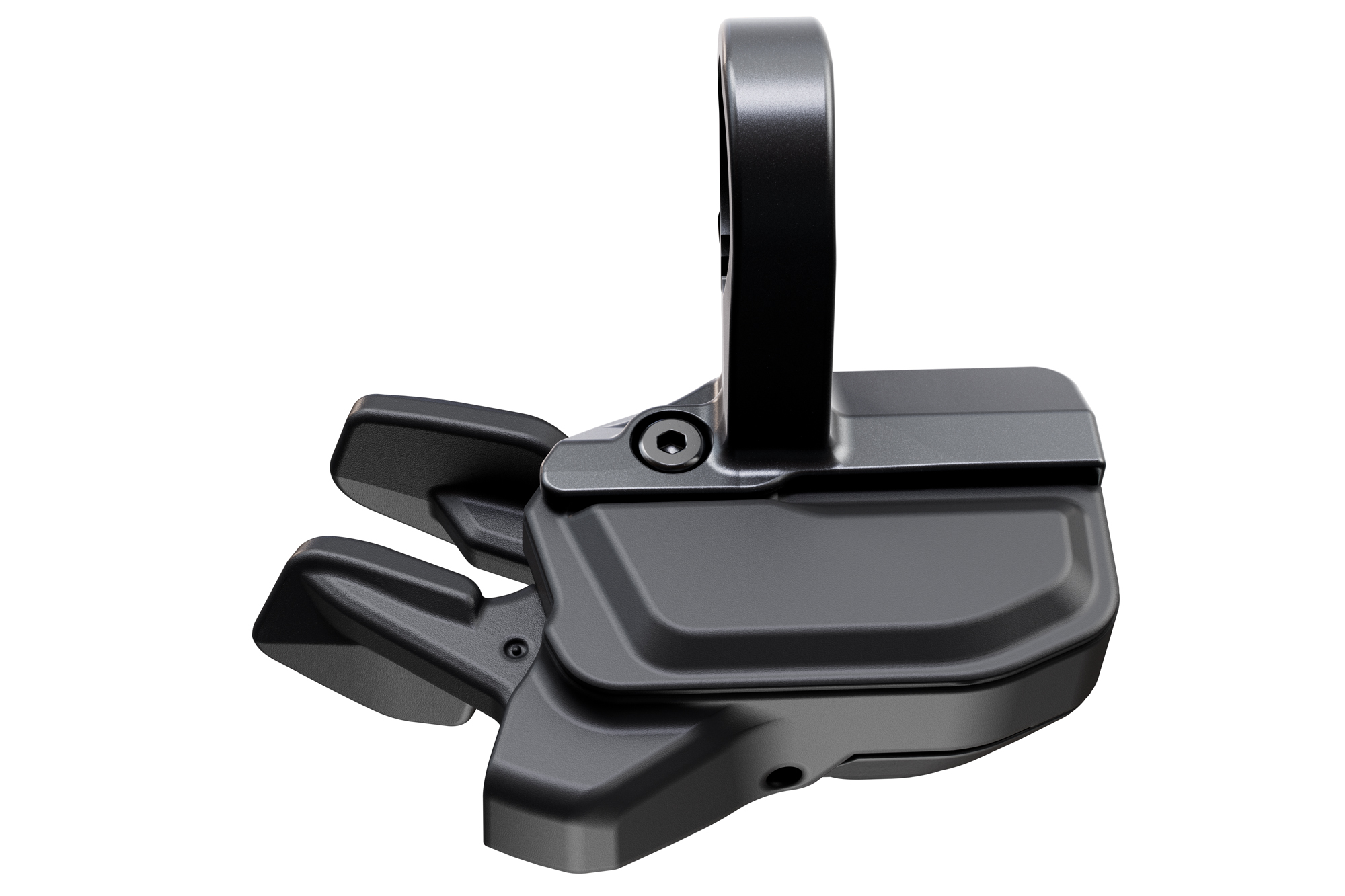
The shifter is similar in layout to its mechanical counterparts. Shimano
Shimano’s new wireless shifter closely mimics the ergonomics and feel of its ‘traditional’ cable shifters, using a familiar layout for its shift buttons, which offer a similar ‘click’ when changing gears.
The sleek new shifter sits closely under the bar and is available in two mounting options. The I-SPEC EV option mounts directly to compatible brake levers, and there’s also a standard clamp band option.
The shift buttons and paddles themselves are fully adjustable and also offer multiple shift modes, including hold-down multi-shift and click-through double shift.
A programmable third button adds customisation potential, with Shimano hinting at compatibility with Garmin bike computers and other third-party brands.
Whether or not there is much difference between the Deore shifter and the more premium XT and XTR shifters remains to be seen, but we’d hazard a guess that, like the rest of the drivetrain, the action and tech will be very similar, with the only differences to be found in some of the construction materials.
The shifter is set to cost £124.99.
Shimano Deore brakes – no details at present
Also included in the announcement is news of new Deore brakes, promising a “refined power application with consistent performance and modulation in a wider temperature range”.
Details remain scarce, and no images were supplied with the press release, so whether or not the new Deore stoppers have been treated to a complete overhaul or just an internal spruce-up (like the XT and XTR two-pot brakes) remains to be seen.
What does this mean for mechanical Deore?
M6100 is commonly specced on budget mountain bikes. Andy Lloyd / Our Media
What does this mean for the future of Shimano’s budget-friendly mechanical Deore groupset – a stalwart of the entry-level mountain bike market?
When Shimano released 105 Di2, a mechanical option was notably absent from the range. However, a mechanical groupset followed some months later.
It would be reasonable to expect similar from Deore, although the arrival of Cues – an all-encompassing budget-focused groupset that’s increasingly seen on entry-level mountain bikes – complicates matters.
Could mechanical Cues be the death of Deore, or will a mechanical groupset follow later?
We put this question to the brand, which supplied a generic response: “Mechanical groupsets still occupy an important position within the Shimano mountain bike line-up, as we are constantly in development of new products. However we do not comment on products and whether they are in development or not.”
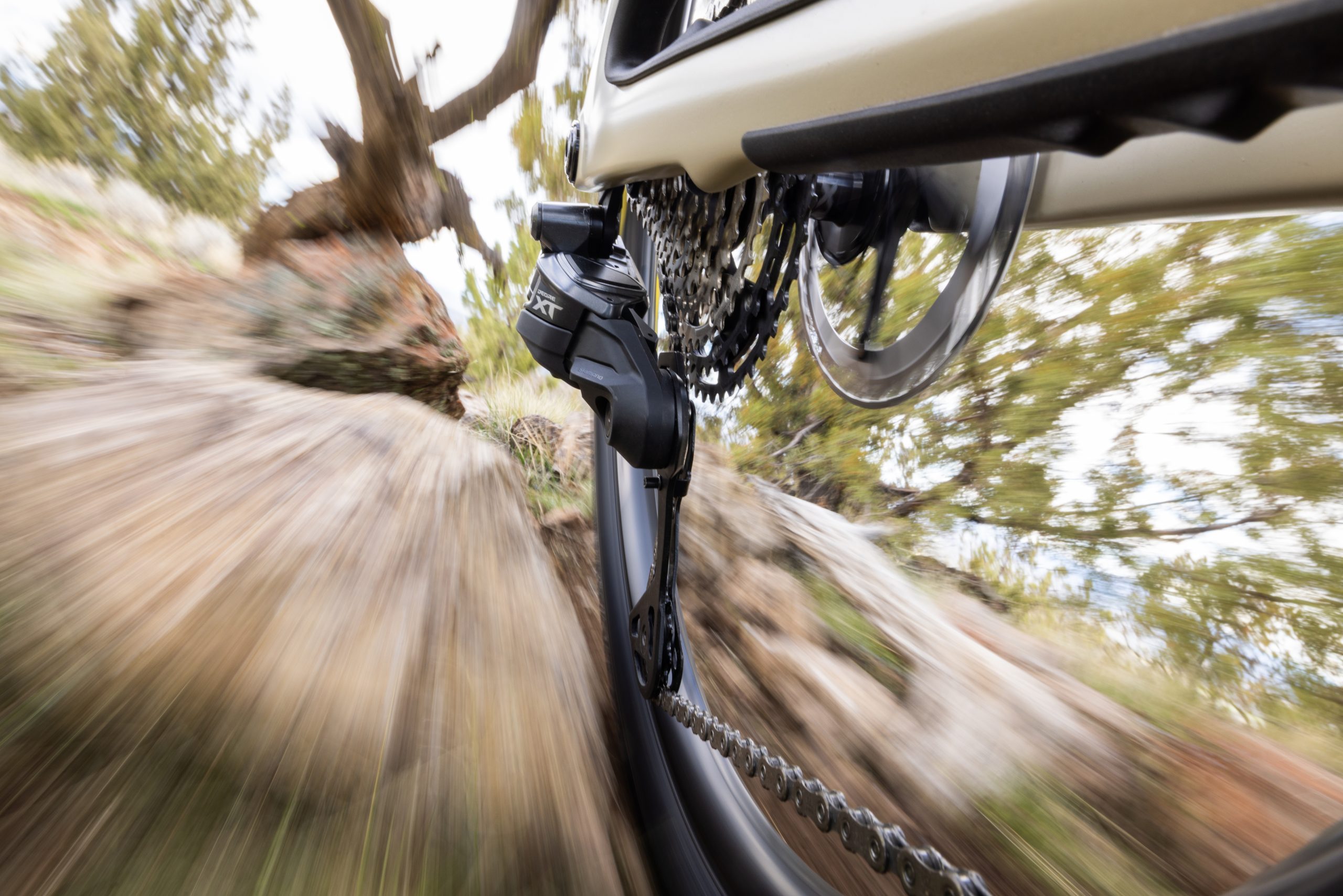
Shimano has updated its Deore XT Di2 drivetrain for the first time since 2016, adopting much of the tech seen on its flagship XTR groupset released earlier this month.
The Deore XT Di2 M8200 range features a new derailleur, shifter, cassette and crankset, as well as updated brakes and a new alloy wheelset. Also hot off the press is the more affordable Deore Di2 M6200 groupset, which completes Shimano’s trio of wireless mountain bike drivetrains.
Shimano’s XT offering has been a firm favourite among keen mountain bikers since its debut in the early 1980s, delivering much the same performance as the flagship XTR range at a more attainable price point.
The M8200 iteration is no different; it features the same technology as XTR Di2, with a few cost-saving differences. Here’s everything you need to know about the new Deore XT range.
Read more about Shimano’s new Di2 mountain bike groupsets
The rear derailleur is available in two options. Shimano
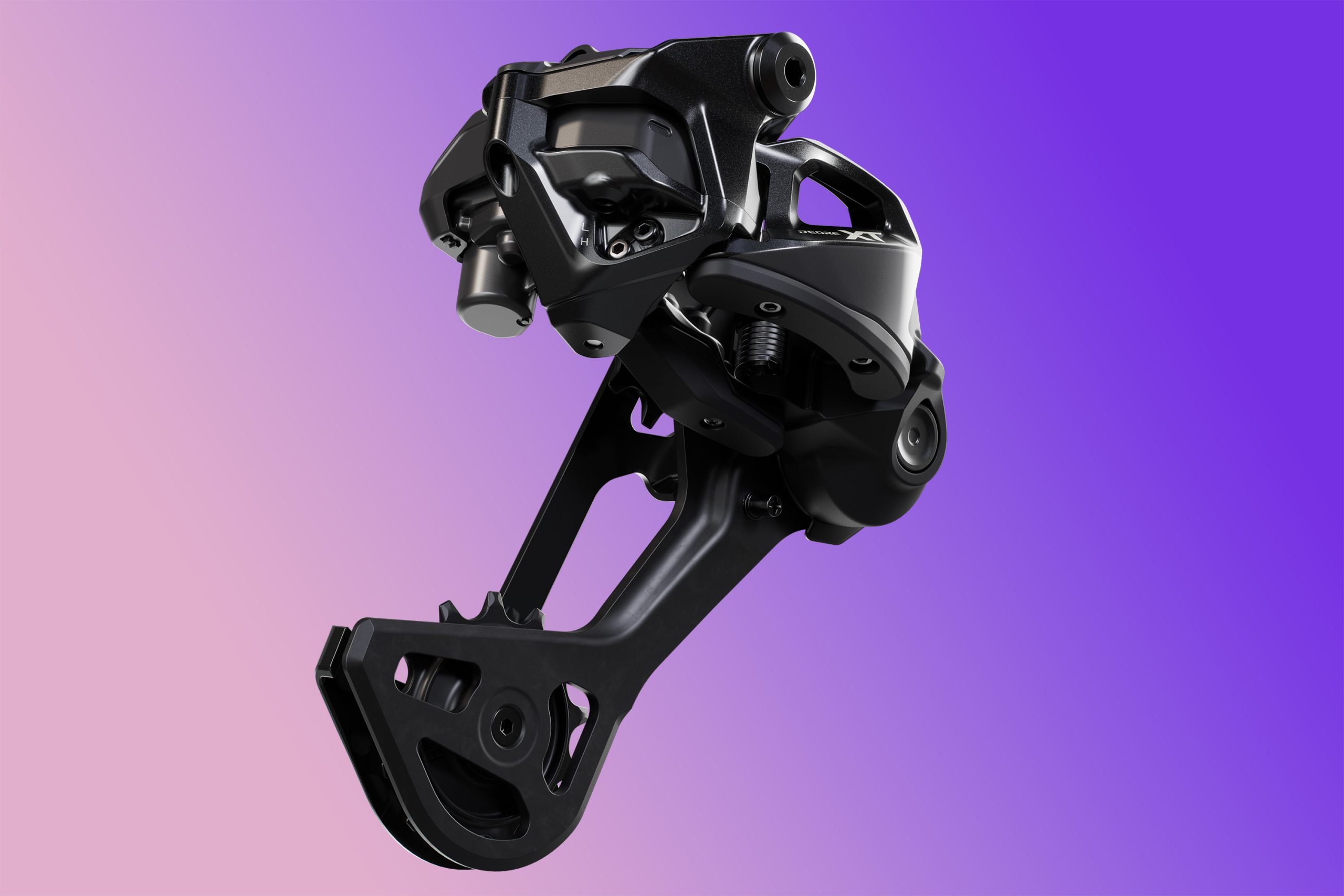
The heart of Shimano’s new wireless tech lies in its derailleurs. Just like its XTR stablemate (and unlike its direct competitor, SRAM’s Eagle AXS Transmission), the new XT derailleur connects to the frame traditionally, via a derailleur hanger.
It also features low and high adjustments and a B-tension screw to set the distance between the top jockey wheel and the cassette.
This marks a big difference compared to SRAM’s latest wireless drivetrains, which mount directly to the frame and can thereby forgo derailleur hangers and adjustment screws.
Drawing on the design introduced with the XTR M9250 rear derailleur, the Deore XT derailleur features a streamlined build that’s designed to avoid obstacles in the trail.
Its integrated skid plate and lack of harsh edges should help it glance off any obstacles it does encounter, rather than getting hung up on them.
In the event of a substantial knock, the derailleur can move out of the way before returning to its normal position, thanks to Shimano’s Automatic Impact Recovery mechanism.
The derailleur is set to cost £429.99, plus £39.99 for the battery and £29.99 for the charger.
Shimano XT derailleur options
The derailleur is available in ebike and non-assisted bike options. Shimano
Just like its XTR range, Shimano is offering two families of Deore XT – one for mountain bikes and one for electric mountain bikes. The mountain bike version has its own onboard battery, while the eMTB incarnation is powered by the bike’s main battery.
Each family will have two options – long and mid cages for the standard derailleur, and 11- and 12-speed versions for eMTBs.
The long SGS derailleur is built for the new 10-51t cassette. The mid SG derailleur is built for the new 9-45t cassette.
In an update to the current Di2 MTB and eMTB-specific derailleurs, both Free Shift and Auto Shift will be available on the 12-speed setup. These features were previously reserved for 11-speed Linkglide drivetrains.
The presence of Free Shift means you can change gears without pedalling, by independently rotating the chainring via the Shimano EP8 motor. This enables you to pre-select a gear for an upcoming trail feature.
Auto Shift uses speed and torque sensors to shift gears automatically, without rider inputs at the shifter, to keep the pedal cadence within an optimal range.
All Deore XT derailleurs use an alloy cage construction, which is less expensive than the carbon cage used on XTR.
Shimano XT shifter
The shifter layout is similar to a mechanical shifter. Shimano
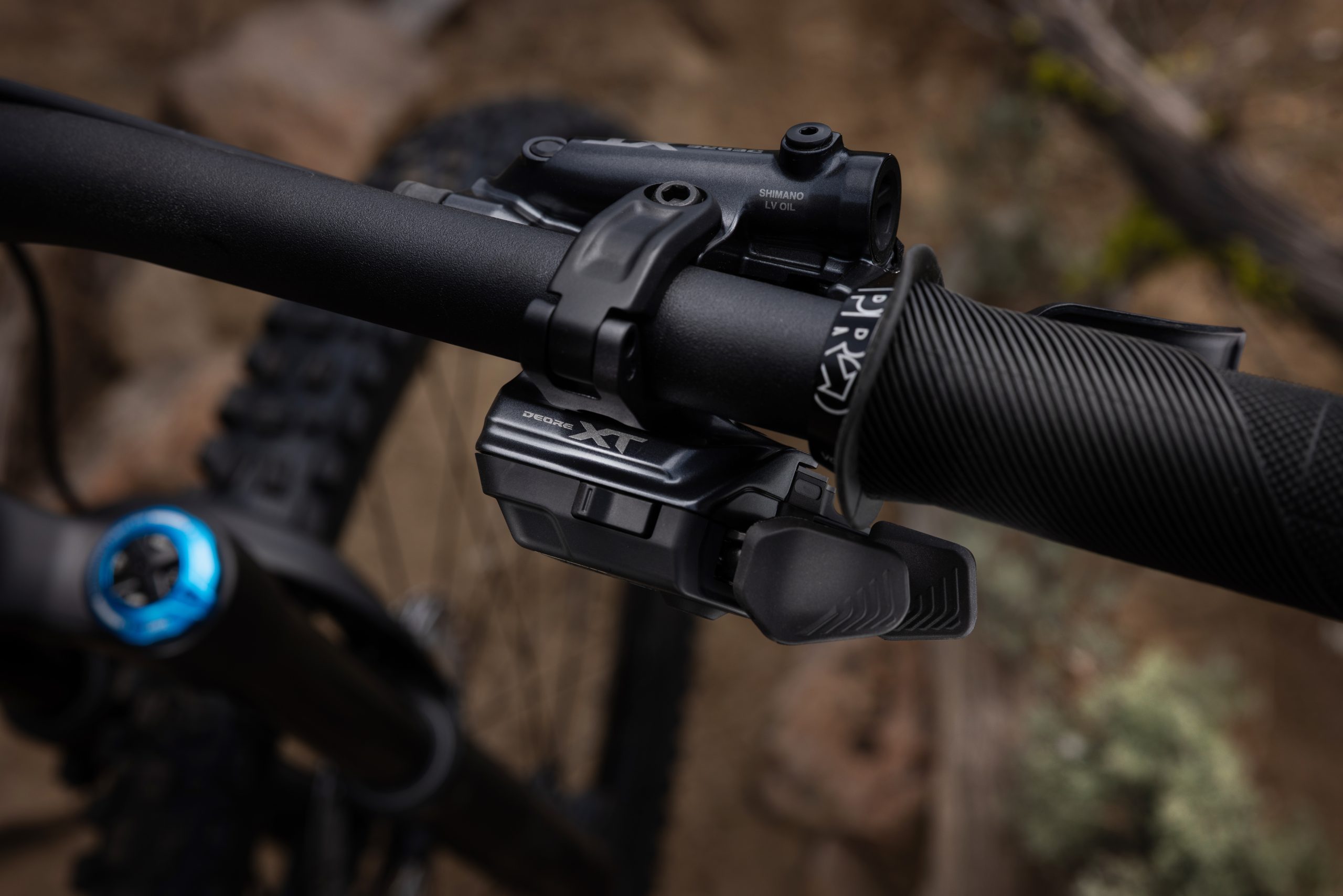
Shimano’s latest wireless shifter has been designed to replicate the feel and layout of its mechanical counterparts. The button positioning will feel instantly familiar to existing users, and Shimano says the tactile response remains reassuringly similar, with a defined click for each shift.
Tucked neatly beneath the handlebar, the shifter is offered in two mounting formats. Riders can choose between a bar clamp mount or the I-SPEC EV system, which integrates directly with compatible Shimano brake levers.
Riders can tweak both the shift paddles and button positions to suit their preferences. The system supports multiple shift modes too, such as multi-shift via a press-and-hold function or a two-step click-through shift.
There’s also a third, programmable button that expands functionality. Shimano suggests this could enable integration with devices such as Garmin head units or other third-party accessories.
Shimano Deore XT cassette and crankset
Unlike Deore, XT gets a new crankset, too. Shimano
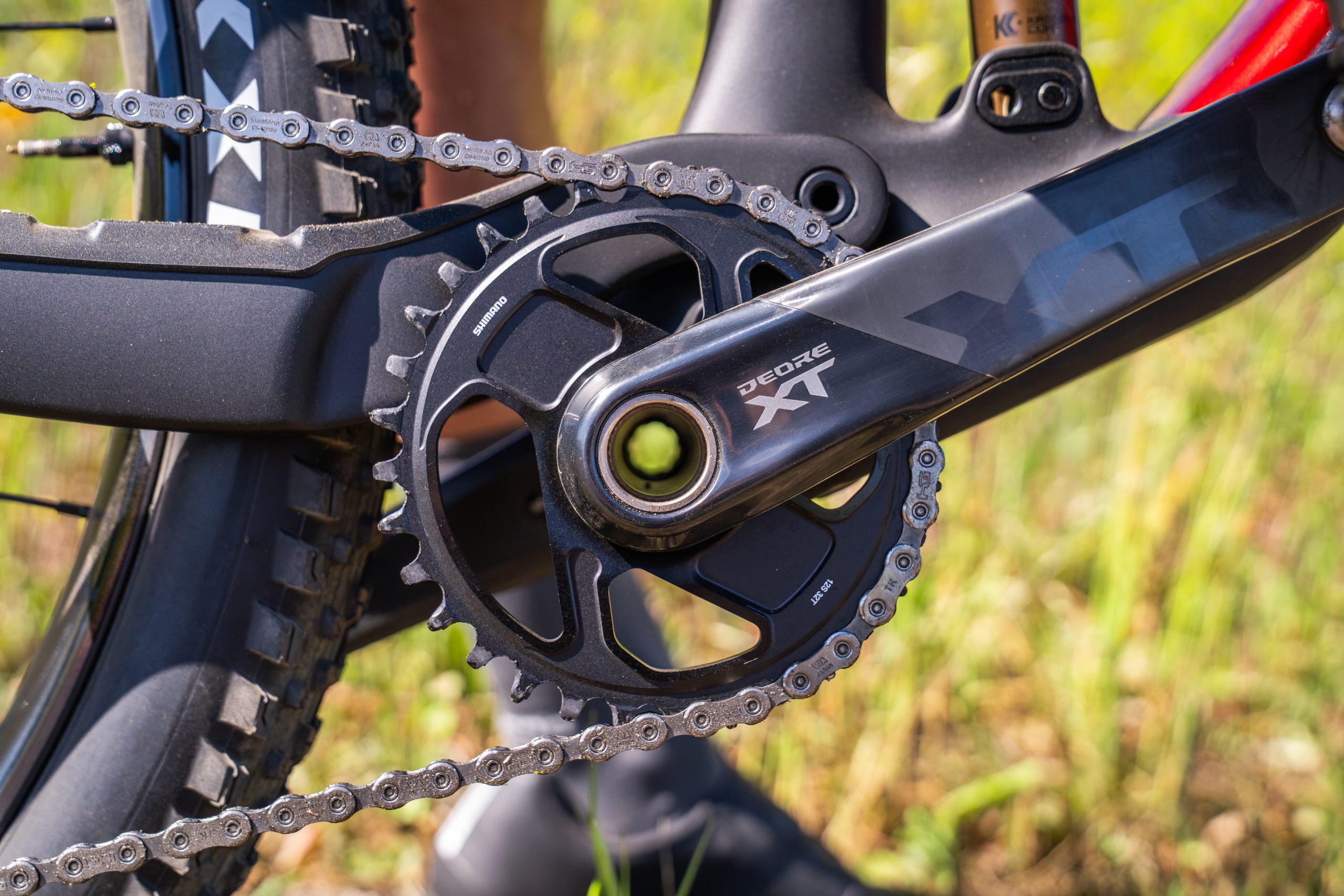
Completing the revamped XT drivetrain is a new cassette and crankset. The M8200 12-speed cassette uses the tried-and-tested Hyperglide+ tooth profiling found on current-generation cassettes and features a 10-51t range.
There’s also a new 9-45t option, aimed at riders looking to shave some weight, or increase ground clearance by running the shorter mid-cage derailleur.
Both cassettes feature a hybrid steel/alloy construction, with the largest two cogs made from aluminium and the smallest 10 cogs forged from steel.
The new XT crankset is offered in one configuration, claimed to suit trail, enduro and cross-country riders alike. The cranks feature a 176mm Q-factor with a 55mm chain line, and are available in 160, 165, 170 and 175mm lengths.
The cranks use Shimano’s Hollowtech II construction and are compatible with 28-36T direct-mount chainrings.
Shimano XT brakes
The XT-level brakes also get a refresh. Shimano
Just like the new XTR groupset, there will be two versions of the new XT brakes, aimed at trail and XC riders, respectively.
Both new brakes are claimed to address the issue of wandering bite points, which Shimano claims was due to the inconsistent nature of its mineral oil brake fluid.
As with the XTR brakes, the new XT stoppers use a new type of mineral oil that’s claimed to be less viscous and should therefore flow consistently through the system in a wider temperature range.
The new XT brake lever sits closer to the handlebar and uses a larger fluid reservoir, with the brake fluid now being pulled through the system, rather than pushed, by the master piston.
Shimano has also subtly changed the brake lever ergonomics.
The lever blade pivot has been moved closer to the bar, which is claimed to give a more natural-feeling pull, while the lever is tilted 5 degrees upwards from the pivot, to better match your finger’s position when in use.
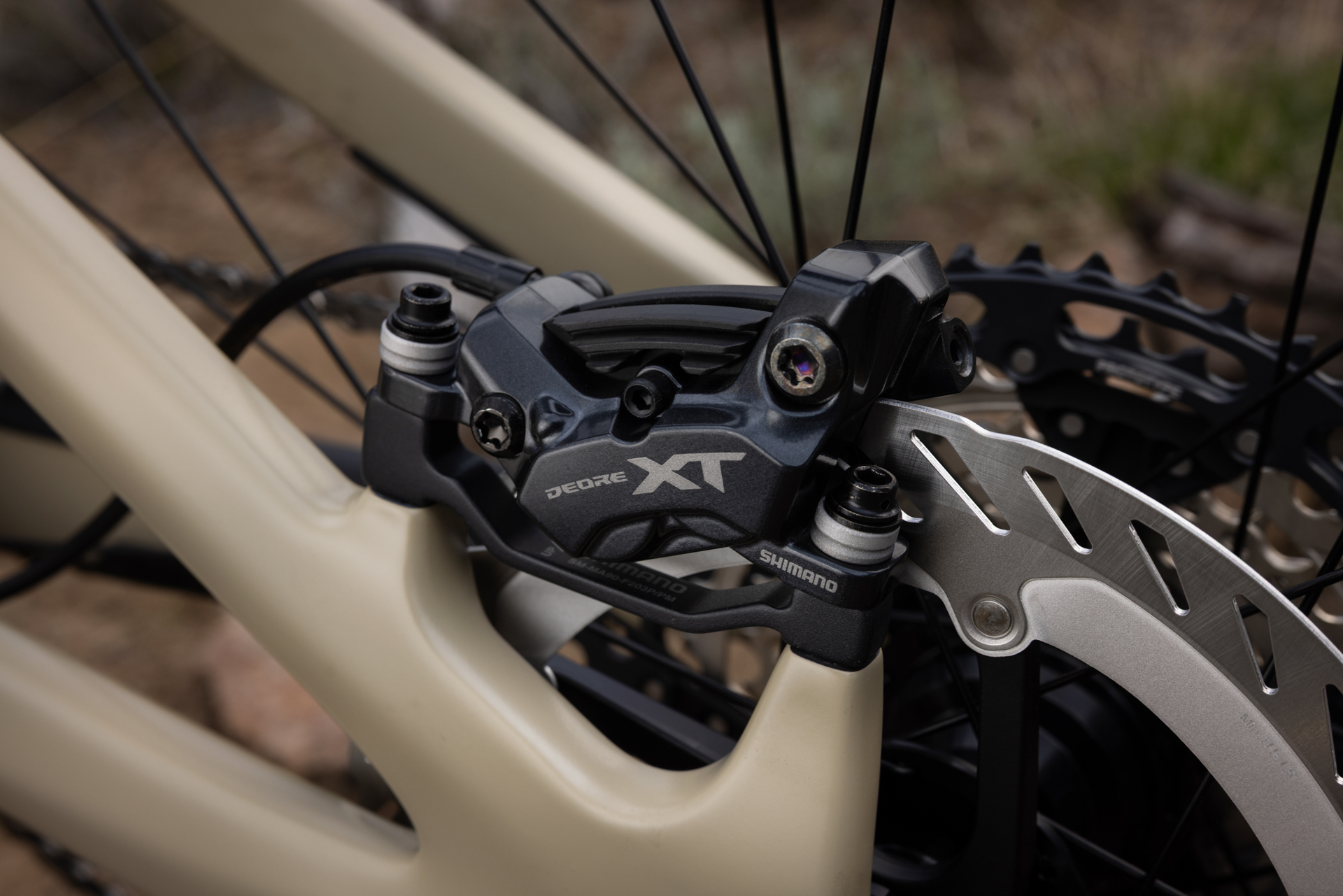
Shimano hasn’t released much information on the new XT calipers; however, if the new XTR calipers are anything to go by, we can assume the cross-country stoppers haven’t changed a whole lot, apart from getting updated seals designed to work with Shimano’s new low-viscosity mineral fluid.
The trail/enduro calipers look to have had more of an overhaul, with a larger brake pad to increase surface contact with the rotor.
Shimano XT wheels
Shimano has also released new XT wheels. Shimano
Price: £219.99 (front), £279.99 (rear)
Completing the XT overhaul is a new alloy wheelset, available in 27.5 and 29in sizes.
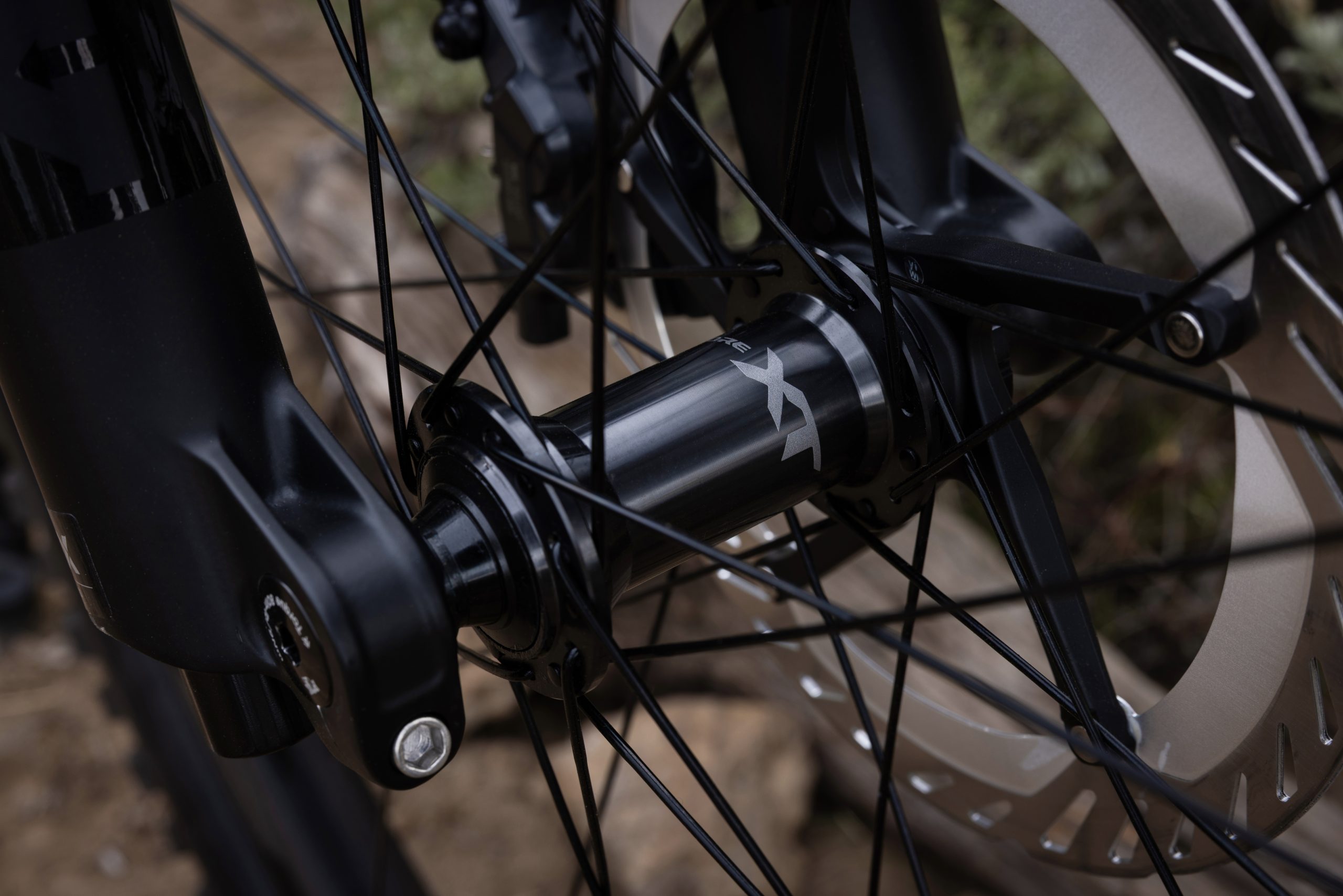
Designed for both XC and trail/enduro riding, it features a 30mm-wide rim (internal diameter), laced to Shimano’s Microspline hub by 28 stainless steel J-bend spokes.
The hub features a 3.5-degree engagement angle and uses Centerlock rotor mounts.
OWASP Nettacker is a free, open-source tool designed for network scanning, information gathering, and basic vulnerability assessment. Built and maintained by the OWASP community, Nettacker helps security pros automate common tasks like port scanning, service detection, and brute-force attacks. It offers a controlled and extensible framework for running these tests.
Google will integrate the Veo 3 video generation tool into YouTube Shorts later this summer. This was revealed by YouTube CEO Neal Mohan at a keynote during the Cannes Lions film festival that was transcribed by The Hollywood Reporter.
This means that creators will be able to whip up endless clips via prompts, as Mohan said “the possibilities with AI are limitless.” He went on to opine that “anyone with a story to share can turn their dream into a career” and “anyone with a voice can bring people together and change the world,” thanks to “cutting-edge AI technology.” Those are some high-falutin words for something that’ll likely mostly be used to create clips of dogs playing piano or whatever.
To that end, there’s the AI slop of it all. I use YouTube Shorts primarily to watch quick tutorials or clips of comedians. I don’t want AI-generated tutorials because I think they’ll probably offer incorrect information. I don’t want AI-generated comedians because they aren’t funny. So this isn’t for me. If the platform becomes too stuffed with AI I’ll just move onto TikTok or, gasp, Instagram Reels.
It’s worth noting that YouTube already uses an older version of Veo for its Dream Screen background generation tool. However, Veo 3 is a fairly massive upgrade. It can generate full clips, with both video and sound, from prompts. It’ll be able to crank out YouTube Shorts that look mostly real but maybe sort of a bit off if you squint.
There’s an elephant in this AI-generated room. Veo 3 could easily be used to deepfake celebrities and pre-existing creators. The company is trying to get ahead of this by partnering with the talent agency CAA and creators to develop a tool that gives celebrities and other high-profile people control over their likeness on the platform.
Veo 3 has digested the mother lode of ASMR content on YouTube making it an AI ASMR machine.
This one got 3.1M likes and 12k comments in 3 days.
Here’s another lingering question. Will current successful creators that actually make stuff want to share the wealth with people who spit a few words into a chat field? More than 25 percent of people enrolled in YouTube’s Partner Program make money from Shorts. This could scare some of them to rival services. We’ll keep an eye on how this Veo 3 integration impacts traffic metrics of the various short-form video platforms.
This article originally appeared on Engadget at https://www.engadget.com/entertainment/youtube/google-is-adding-the-veo-3-video-generator-to-youtube-to-slopify-shorts-155339183.html?src=rss
Tom Pidcock recorded speeds of up to 95kph descending down the Rossfeld Panorama mountain pass on the Austria-Germany border.
In a new video shared by Red Bull, which sponsors the double Olympic mountain bike champion, Pidcock is followed on the 6km road by Matthias Walker, a Dakar Rally champion, who films from a motorbike.
Pidcock adopts the supertuck position with his body onto the top tube of his bike to gain an aero advantage. In 2021, the UCI banned the position in races, but it can still be used outside of competition.
But the 25-year-old Brit still pushed on the pedals during his ride. Riding out of the saddle, he produced over 800 watts.
At the end of the descent, Walkner claps the Pidcock’s descent before towing the Q.365 rider back up the mountain road.
Pidcock is famous for his descending ability. During his Tour de France debut in 2022, when he won a stage on Alpe D’Huez, Pidcock descended down the Col du Galibier and Col de la Croix de Fer , hitting over 100kph.
In 2023, Pidcock also appeared in a video by Safa Brian, descending Tuna Canyon in Los Angeles. The viral video has now clocked up over 2.7 million views.
Aiming to transform user-generated content into actionable marketing ads, Reddit unveiled its “Community Intelligence” suite this week at the Cannes Lions International Festival of Creativity. This AI-powered platform promises to redefine how advertisers connect with their audiences by leveraging the vast and real (and only positive) conversations
Gamers with Asus devices need to update their systems ASAP: A recently disclosed vulnerability in Armoury Crate allows hackers to gain low-level system privileges, potentially compromising your OS.
How the Armoury Crate bug works
Armoury Crate is an Asus utility—often preinstalled—that manages Asus and ROG software and peripherals. This vulnerability, tracked as CVE-2025-3464, allows threat actors to skirt authentication requirements and obtain SYSTEM privileges on Windows machines. As Tech Radar reports, the flaw in the Armoury Crate kernel-mode driver verifies calls using a hardcoded SHA-256 hash of AsusCertServices.exe and a PID allowlist rather than OS-level access checks.
If exploited, the bug would permit driver access, which could result in full OS takeover. That said, attackers must already be on your system—the result of malware, phishing, or stolen credentials—to take advantage.
CVE-2025-3464 was reported by a researcher at Cisco Talos and is considered high severity (with a score of 8.4 out of 10).
This isn’t the first security issue Asus has faced in recent months. The company patched a remote code execution vulnerability in DriverHub in May and has also been a target for threat actors spreading malware. A campaign known as CoffeeLoader—identified earlier this year—impersonated Armoury Crate to deliver infostealers to user systems.
Update Armoury Crate to the latest version
While Asus says there’s no indication that the vulnerability has been exploited in the wild, users should still update to the latest version of Armoury Crate. The flaw affects all versions between 5.9.9.0 and 6.1.18.0.
To download and install updates, open the Armoury Crate app and navigate to Settings > Update Center > Check for Updates > Update.
The White House confirmed that Donald Trump has extended the deadline for a TikTok sale for a third time, Reuters reported Wednesday.
Now, China-based ByteDance has 90 days to divest its US assets or potentially be forced to shut down US operations. Trump’s announcement came one day before the June 19 deadline he established through his last extension. That extension was necessary after Vice President JD Vance failed to make a “high-level” deal expected in April, which Politico branded a “make or break moment” where Vance could have secured a big win.
Yesterday, Trump told reporters on Air Force One that China was holding up the sale, suggesting that China may have an upper hand in TikTok negotiations, and perhaps TikTok is losing its sheen as a US bargaining chip in Trump’s bigger trade war.
Nature will automatically publish peer review reports and author responses alongside all newly submitted research papers starting this week. The flagship scientific journal previously offered transparent peer review as an optional service since 2020, while Nature Communications has required it since 2016.
All exchanges between authors and anonymous reviewers will become publicly accessible (reviewer identities remain confidential unless they choose disclosure). Nature aims to open what it calls the “black box” of science by revealing the months-long conversations that shape research papers before publication.
If you’ve been wondering when Amazon will finally list a selection of Switch 2 games, the answer is right now. Sure, the Switch 2 is a brand new console (see our first impressions), but Amazon still took its time serving up games for one of the hottest game system launches of all time. We won’t hold a grudge, though, because not only has Amazon
If your YouTube app keeps crashing, you’re not alone. Following complaints from a broad swath of users, YouTube has officially confirmed issues with its app, including unresponsive button presses as well as unexpected shutdowns. These issues appear to have affected both the Android and iOS versions of the app.
The good news is, there is a fix for the problem. As spotted by 9to5Google, YouTube updated its original support page confirming that the company had squashed whatever bugs were causing app crashes and instability, thanking users for their patience. While the problems plagued both the iOS and Android versions of YouTube’s app, interestingly, YouTube only has specific advice for iPhone users to fix their issues.
How to stop YouTube from crashing on iPhone
It doesn’t seem like updating the app is enough to solve the problem. According to YouTube, iPhone users need to uninstall the YouTube app from their devices entirely. To do so, hold down on the YouTube app icon on your Home Screen, then choose “Delete App.” On the pop-up, tap “Delete” to remove the app from your iPhone.
Next, open the App Store, search for YouTube, and tap the cloud icon to redownload it to your iPhone. You’ll need to sign back into your YouTube account, but once you do, the app should be working as expected.
How to stop YouTube from crashing on Android
YouTube doesn’t say what Android users need to do to fix their apps, which suggests that either the company was able to issue a patch through a standard app update, or potentially a server-side update, the latter of which would require no action on the user’s part. Still, if your app is acting up, or you want to play it safe, you should update your YouTube app to the latest version.
To check if you’re running the latest version of YouTube, open the App Store, then search for YouTube. If there’s a new update, you’ll be able to do so from YouTube’s Play Store page. If you see an “Open” button, you have the latest software version, and there’s nothing else you need to do.
You don’t have to venture far to hear a gamer’s opinion on the current state of GPU pricing and gaming technology. Sky high prices for the latest GPUs raise concerns when the performance difference seems minimal for new generation products. Companies like NVIDIA lead with AI upscaling tech as the primary sales point, when gamers are used to
Over a decade-plus of doing gadget reviews and review-adjacent things, my wife (and, lately, my 5-year-old) have mostly stopped commenting on the ever-shifting selection of laptops I have in my bag or lying around the house at any given time. Maybe she can’t tell them apart, or maybe she just figures there isn’t that much to say about whatever black or silver metal slab I’m carrying around. Either way, they practically never elicit any kind of response, unless there are just too many of them sitting out in too many places.
But she did ask about the Framework Laptop 12, the third and latest major design in Framework’s slowly expanding lineup of modular, repairable, upgradeable laptops. With its five two-toned color options and sturdy plastic exterior, it’s definitely more approachable and friendly-looking than the Laptop 13 or Laptop 16, both metal slabs with a somewhat less-finished and prototype-y look to them. But it retains the features that a certain kind of PC geek likes about Framework’s other laptops—user-customizable and swappable ports, an easy-to-open design, first-class Linux support, and the promise of future upgrades that improve its performance and other specs.
A 146,000-year-old skull from Harbin, China, belongs to a Denisovan, according to a recent study of proteins preserved inside the ancient bone. The paleoanthropologists who studied the Harbin skull in 2021 declared it a new (to us) species, Homo longi. But the Harbin skull still contains enough of its original proteins to tell a different story: A few of them matched specific proteins from Denisovan bones and teeth, as encoded in Denisovan DNA.
So Homo longi was a Denisovan all along, and thanks to the remarkably well-preserved skull, we finally know what the enigmatic Denisovans actually looked like.
Earlier this year, Framework announced it was making a smaller, 12-inch laptop and a beefy desktop to go alongside its 13- and 16-inch notebooks. A few months later, and the former has arrived, putting the same modular, repairable laptop into a slightly smaller body. Unlike its bigger siblings, the Laptop 12 is a 12.2-inch touchscreen convertible clad in brightly colored plastic. It’s aimed at students, with a focus on robustness and quality you won’t see in the usual machines you find at the top of the bargain list. My initial impression is that it’s a damn charming piece of gear, but I immediately wonder how many kids in school will actually get to use this thing given it’s far pricier than its competitors.
Laptop 12 is the first Framework machine clad entirely in ABS plastic, available in black, pink, lavender, gray and green. As soon as you open the packaging, you’ll be instantly charmed by its look and feel given how different it is from the rest of the market. My green and off-white review unit (which the company calls “Sage”) stands out from the crowd almost by default. Framework founder Nirav Patel has long harbored dreams of bringing back the translucent and colorful aesthetics found in Nintendo’s Game Boy Color. Here, the 12 reminds me of the OLPC XO or one of the fancier LeapFrog “computers” that glowed up when you weren’t looking.
Daniel Cooper for Engadget
Its footprint isn’t dramatically smaller than the 13-inch model, but because it doesn’t taper like its bigger sibling, it feels a lot chunkier. The chassis has a metal frame clad in two layers of plastic that, the company promises, will take whatever shocks and bumps you throw at it. It also has the same quartet of expansion card slots, which are now available in a variety of colors if you want things to match (or clash). Plus, all of those cards can be shared with the other Framework machines since they’re all, mercifully, uniform size.
Framework clearly learned from making its bigger machines, adding several quality of life tweaks to the 12 for both daily use and repair. The folks who regularly open and close their Framework laptop will instantly spot the changes that will make things a lot easier. For a start, the input cover is held in place with more screws (eight, compared to the 13’s five), which better balances tension across the surface area. The input cover now slots into grooves on the front of the deck, making it easier to place than the 13. More importantly, the input cover connects to the mainboard via pogo pins rather than with a ribbon cable. I don’t think I’ve ever damaged a ribbon cable myself, but it’s always a worry if someone tries to yank off the lid without first disconnecting it from the mainboard.
Daniel Cooper for Engadget
Rather than screwing the SSD in place, Framework now uses a hinged plastic clip that you press in to secure the drive. Similarly, there’s a little flip-down plastic cover to protect the RAM, with a large printed reminder to flip it back once you’ve installed the DIMM. Naturally, the board layout has changed, as has the battery — to a smaller, 50Wh cell — so the mainboard and battery won’t work with its slightly larger sibling.
(Aside: If you’re a hobbyist hoping the 12-inch mainboard will be dramatically smaller than the 13-inch model to make smaller projects, expect to be disappointed. It is smaller, but not by such a significant degree that you probably wouldn’t rather just use the 13-inch model instead.)
Daniel Cooper for Engadget
The power button has been moved from the keyboard to the right side of the deck, next to the expansion card slots. There’s no fingerprint reader, either, which is one of several omissions you can attribute to “cost saving,” “this is a machine made for kids” or both.
Would-be buyers get the choice of a 13th-generation Core i3-1315U or a Core i5-1334U, which can support up to 48GB of DDR5 RAM, albeit only at the slower DDR5-5200. You can throw in an M.2 SSD with up to 2TB of storage, and if that’s not enough, you can get an additional 256GB or 1TB unit to sit in one of the laptop’s four expansion card slots.
Patel knows enough about keyboards and trackpads not to mess with what works, and what people like. The keyboard and touchpad are as robust and pleasing to use as you find on the 13-inch model. I’m not sure yet, but I might actually prefer typing on the 12-inch keyboard compared to the 13’s, maybe because of the former’s all-plastic build and the slightly louder, punchier keyclicks.
Daniel Cooper for Engadget
This machine was offered as a better, longer-lasting and more sustainable alternative to those dirt-cheap laptops sold to kids and students. But while everything already mentioned is more than good enough, we soon start to see where the cost-saving trims have been made. This is the first Framework to ship with a touchscreen, which is a 12.2-inch, 1,920 x 1,200 glossy LCD with a max brightness of 400 nits. In short, it’s the same sort of screen you’ll find on a lot of lower-end notebooks and so adjust your expectations accordingly. The gloss is an occupational hazard given it’s a touchscreen, but the weaker backlight means you’ll deal with the usual high-reflections and washed-out view in bright light.
Framework is presently developing its own stylus, but until that launches, the laptop is compatible with any USI 2.0 or MPP 2.0 stylus. You’ll have to source your own right now, and for the review, I was supplied with a Metapen M2 for testing. So far, however, I’ve found the pen experience to be more than a little frustrating, with the palm rejection a big issue. It needs a tweak — and I’m sure it’ll be addressed swiftly — given the amount of times I prodded open a menu or closed a window with the flesh on the side of my hand.
Similarly, the 2-megapixel webcam is a big step down from the 9.2-megapixel sensor found in the 13-inch model. Again, you can expect the same washed out, artifact-heavy video as you would find in many other low-cost laptop cameras.
Framework has worked to improve its sound quality over the last few years but the size of the 12’s chassis is a limiting factor. The pair of 2W speakers here are tinny and quiet even at full volume, but at least they don’t rattle or vibrate with heavy bass.
My review unit was equipped with a Core i5 with 16GB RAM, and it was more than able to handle the sort of stuff you’d expect to perform on a machine of this class. Writing the bulk of this review, watching videos, viewing and tweaking images are all well within this machine’s reach. Hell, I even managed to get Hardspace: Shipbreaker to play, but not very well, and while Fortnite does run, it’s janky enough to not be worth your while. Again, tweaked drivers will likely tidy those issues up, but I suspect this machine doesn’t have enough grunt for doom room gamers.
Of course, it’s a Framework laptop, so you can already guess the one major issue that pops up whenever you put the silicon under load. As usual, the fan noise is pretty noticeable when the hardware temperature rises, and I wouldn’t recommend you using this thing on your lap. And you should expect to have this thing plugged in for the duration of your time using it, as the battery life isn’t stellar. If you’re using this to run any sort of demanding app or game, you won’t get more than four hours on a single charge.
Pricing and the competition
Daniel Cooper for Engadget
Right now, you can only buy the pre-built edition in black, with the DIY version the only place you can pick your chassis color. It’s available in gray, lavender, bubblegum and sage, and I’d heartily recommend you picking any of those options over the standard black. The pre-built edition starts at $799 with an Intel Core i3-1315U, 8GB of RAM, 512GB SSD and Windows 11 Home. If you want to step that up to the higher-end Performance model with an i5-1334U, 16GB of RAM and a 512GB SSD, it’ll set you back $1,049. On the other hand, you can pick up the DIY edition for $549 (for the i3) or $699 (for the i5), leaving you to source your own RAM, SSD and OS.
I’ll admit I’m struggling to work out what the Framework 12’s competitors are, since this is a tricky machine. When announced, the company said it was an alternative to the sort of entry-level laptops bought for kids and students, which are “janky, locked-down, disposable, underpowered and frankly, boring.” This means it’s going up against $500 notebooks and Chromebooks, the likes of which you’ll normally find on sale at Best Buy. The ones that, you know, have a reputation for surviving until a week after the warranty expires, leaving you out of pocket until the next sale.
From a utilitarian perspective, the higher price is offset by the knowledge it should outlast every other computer in your kids’ cohort. Not only is it durable and repairable, but you should be able to swap out the mainboard in two or three years’ time to keep pace with technology. But, by that same utilitarian argument, you could just as easily pick up a refurbished Framework 13 with a Core i5-1340P, when available, for just $779.
Wrap-up
Daniel Cooper for Engadget
I’m fond of the Framework Laptop 12 because I can easily see it having a place in my life when I’m on the go. It’s cute, good-looking and small enough you could easily throw it into a bag when you’re in a hurry. The durability of the chassis and repairability, plus the swappable expansion cards, means it should run for years and years. And it’s fun! I love the idea of a little laptop that stands out against the endless rows of cheap black plastic or silver aluminum notebooks.
Those dirt-cheap notebooks built with low-end parts and sold to kids and students for $300 or so aren’t much good for anything. If you want quality, you’ll need to cough up for it, and this will at least last for years without endless replacements.
But. The limited performance and battery life here gives me pause and I’m not sure a machine that, right now, needs a stretch to run Fortnite would be too popular. My gut tells me Framework had intended to sell this for less before tariffs pushed the prices up beyond what made sense. But as a consequence, the Framework Laptop 12 falls between two stools: Not cheap enough to be compelling to the price-sensitive buyers and not powerful enough for people with bigger budgets. Unless you happen to have a spare SSD, RAM and Windows license kicking around that’ll bring the cost down to sticker price. My gut tells me that this laptop’s real audience will be adults looking for a quirky second device to take on the go.
This article originally appeared on Engadget at https://www.engadget.com/computing/laptops/framework-laptop-12-review-doing-the-right-thing-comes-at-a-cost-150014067.html?src=rss
Chevrolet has just pulled back the curtain on its most bonkers Corvette yet: the 2026 Corvette ZR1X. Hailed by the automaker as a “true American hypercar,” the car shatters performance benchmarks (how does sub-2 seconds 0-60 mph sound?), combining twin-turbo V8 power and hybrid technology to deliver a monstrous 1,250 horsepower and possibly
It’s that time of year again, and Amazon Prime Day is around the corner. There’s a lot to expect from this year’s extended event running July 8 to 11, the longest Prime Day ever. That’s not to say you have to wait until it starts to find great deals. Right now you can grab a pair of Anker Soundcore Space wireless earbuds at the lowest price we’ve ever seen them. Normally retailing for $80, they are on sale for $45.
The Anker Soundcore Space earbuds are currently our top pick for best budget wireless earbuds. While their performance doesn’t rival that of more premium products, we felt the Space A40’s feature set offered excellent value for such a budget-friendly set of earbuds.
These earbuds connect via Bluetooth, support connection to two devices at once, and come in a case that supports wireless charging. We were most impressed with the Space A40’s active noise cancellation (ANC), a feature rarely seen at this price point. While it’s not the most sophisticated ANC on the market, it does its job in blocking out the steady rumble of a train or jet engine. Battery life is solid for a budget pair of earbuds, reaching roughly eight to 10 hours depending on use, with another 40 hours or so supplied by the case.
In-ear fit is comfortable, as the round earpieces are pretty light and evenly balanced. The audio quality is impressive for its price point, offering a warm sound that can be fine-tuned with an EQ in the Soundcore app. A subpar built-in mic means the Space A40s don’t have the best transparency mode and aren’t the best for phone calls in noisy areas, but overall for $45 these are a great deal.
This article originally appeared on Engadget at https://www.engadget.com/deals/our-favorite-budget-wireless-earbuds-are-almost-half-off-ahead-of-prime-day-145248634.html?src=rss