NFC Release 15 Extends Tap-to-Pay Range From 0.5cm To 2cm

The NFC Forum has released NFC Release 15 (that’s what it’s calling it), extending the operating range of Near Field Communication connections from 0.5 centimeters to 2 centimeters — a fourfold increase that reduces the precision required for device alignment.

The global standards body, whose board includes representatives from Apple, Google, Huawei, Infineon, NXP, Sony, and ST Microelectronics, designed the enhancement to accelerate transaction speeds and improve reliability across NFC-enabled devices. The expanded range addresses technical challenges in smaller form-factor devices like wearables and smartphones while maintaining compatibility with existing ISO/IEC 14443 standards.

The standard also incorporates support for NFC Digital Product Passport specifications, allowing single NFC tags embedded in products to store and transmit sustainability data throughout their lifecycle.


Read more of this story at Slashdot.

Facebook Now Supports Passkeys, and You Should Probably Use Them

If you’ve had a Facebook for long enough, you probably know people who have had their accounts “hacked.” Maybe this happened to your own account—one minute, you’re minding your own business, the next, your friends and family send you texts asking, “Why did you send me this?” and “Were you hacked?”

See, your Facebook wasn’t “hacked,” so much as it was “accessed.” Someone figured out your password, either by guessing it, tricking you into sending it, or through a data breach, and logged in on your behalf. If you had two-factor authentication (2FA) set up, the chances of this happening would have been much lower, but not impossible. That’s where passkeys come in.

Facebook and passkeys

Good news: Facebook now supports passkeys. Meta announced the news in a blog post on Wednesday, saying the authentication method will roll out to iOS and Android devices “soon,” while Messenger will get the feature “in the coming months.” For what it’s worth, I see the option to create passkeys now on the iOS Facebook app.

Meta seems pretty excited about the news—and not just because the company happens to be a member of the FIDO Alliance, the organization that developed passkeys. Aside from logging into your Facebook account, Meta says you’ll be able to use passkeys to autofill your payment info when buying things with Meta Pay. You’ll also be able to use the same passkey between both Facebook and Messenger, and your passkey will act as a key to lock out your encrypted Messenger chats.

Typically, Meta is near the bottom of my list when it comes to companies that care about user privacy and security. But passkey adoption is a good thing for Facebook accounts everywhere. In fact, when you have the chance, you should probably set one up.

Why use a passkey

Passkeys combine the convenience of a password with the security of 2FA. Unlike passwords, you don’t choose a series of words, characters, or numbers to enter each time you want to log into your account. Instead, you set up a passkey with your device itself, like your smartphone. When you need to authenticate yourself, you do so on your device, through a face scan, fingerprint scan, or PIN. Your device then confirms your identity with the account holder in question, which then lets you into your account.

Since there’s no password or phrase, passkeys are effectively phishing-proof: Hackers can’t trick you into sharing your password with them, since there’s nothing to share, and you won’t need to worry about Meta losing your passkeys in a data breach. 2FA can also prevent bad actors from breaking into your account if they know your password, but even 2FA is susceptible to phishing. Since most 2FA uses a numeric code, hackers may convince you to send the code to them. Without the device tied to the passkey, however, hackers are out of luck.

Once properly set up, logging into your accounts is as easy as a face scan or a quick PIN entry on your phone—simple, yet secure.

Meta (specifically Facebook in this case) is far from the only platform to offer passkeys. Companies including Apple, Google, Microsoft, and even X have been adopting the security measure over the past couple years. In fact, Microsoft now makes passkeys the default authentication option when setting up a new account.

How to set up a passkey for Facebook

Once support for passkeys rolls out to your Facebook app, you’ll find your settings in Account Center. You can pull this up in the Menu tab, by tapping the down arrow next to your name and choosing “Go to Accounts Center.”

In Account Center, choose “Password and security,” then tap “Passkey.” From here, tap “Create passkey.” Tap “Create passkey” on the pop-up, then enter your current Facebook password. Your device will invite you to confirm passkey creation (on iPhone, for example, you can use Face ID to finish setting up the passkey).

All that said, creating a passkey won’t delete your Facebook password. It still exists, as Meta relies on it for signing into Facebook on other devices. (Some companies have alternative methods to ensure that you can sign in without needing the original device that created the passkey.) As such, make sure that your Facebook password is strong and unique (do not use the same password for Facebook as any of your other accounts), and set up 2FA for the times you ever do use a password. (Avoid SMS-based 2FA if you can.)

Via the False Claims Act, NIH puts universities on edge

Earlier this year, a biomedical researcher at the University of Michigan received an update from the National Institutes of Health. The federal agency, which funds a large swath of the country’s medical science, had given the green light to begin releasing funding for the upcoming year on the researcher’s multi-year grant.

Not long after, the researcher learned that the university had placed the grant on hold. The school’s lawyers, it turned out, were wrestling with a difficult question: whether to accept new terms in the Notice of Award, a legal document that outlines the grant’s terms and conditions.

Other researchers at the university were having the same experience. Indeed, Undark’s reporting suggests that the University of Michigan—among the top three university recipients of NIH funding in 2024, with more than $750 million in grants—had quietly frozen some, perhaps all, of its incoming NIH funding dating back to at least the second half of April.

Read full article

Comments

Xbox President: We’re Working To Ensure Windows Is the Number One Platform For Gaming

Microsoft is positioning Windows as the primary gaming platform for Xbox, according to Xbox president Sarah Bond. “We’re working closely with the Windows team to ensure that Windows is the number one platform for gaming,” Bond said in a video announcing a partnership with AMD for next-generation Xbox hardware spanning consoles and handhelds.

The statement, PCWorld points out, aligns with Microsoft’s recent “This is an Xbox” marketing campaign, which promotes phones, PCs, televisions, and traditional consoles as Xbox devices. The company’s newly announced Xbox Ally X handheld runs Windows beneath its Xbox interface, allowing access to multiple game stores unlike Valve’s Steam Deck.

Microsoft has shifted strategy following weak Xbox console sales compared to PlayStation, spending billions to acquire publishers including Bethesda and Activision Blizzard while expanding Xbox Cloud Gaming services across multiple device types.


Read more of this story at Slashdot.

Spanish blackout report: Power plants meant to stabilize voltage didn’t

The blackout that took down the Iberian grid serving Spain and Portugal in April was the result of a number of smaller interacting problems, according to an investigation by the Spanish government. The report concludes that several steps meant to address a small instability made matters worse, eventually leading to a self-reinforcing cascade where high voltages caused power plants to drop off the grid, thereby increasing the voltage further. Critically, the report suggests that the Spanish grid operator had an unusually low number of plants on call to stabilize matters, and some of the ones it did have responded poorly.

The full report will be available later today; however, the government released a summary ahead of its release. The document includes a timeline of the events that triggered the blackout, as well as an analysis of why grid management failed to keep it in check. It also notes that a parallel investigation checked for indications of a cyberattack and found none.

Oscillations and a cascade

The document notes that for several days prior to the blackout, the Iberian grid had been experiencing voltage fluctuations—products of a mismatch between supply and demand—that had been managed without incident. These continued through the morning of April 28 until shortly after noon, when an unusual frequency oscillation occurred. This oscillation has been traced back to a single facility on the grid, but the report doesn’t identify it or even indicate its type, simply referring to it as an “instalación.”

Read full article

Comments

My Four Favorite Steaks for Grilling (and How to Cook Them Perfectly)

I’ll never say no to barbecue chicken or a snappy dog right off the grill, but grilled steak always feels like a special treat. Which steak, you ask? If you haven’t noticed, there are seemingly endless cuts of beef in the grocery store and at the butcher, and in my honest opinion, you can’t really go wrong. But no one likes that answer, so I’ll go over a few of my steak grilling tips, plus top four favorite steak cuts for grilling (in no order because my mood changes every day).

The basics of grilling a steak

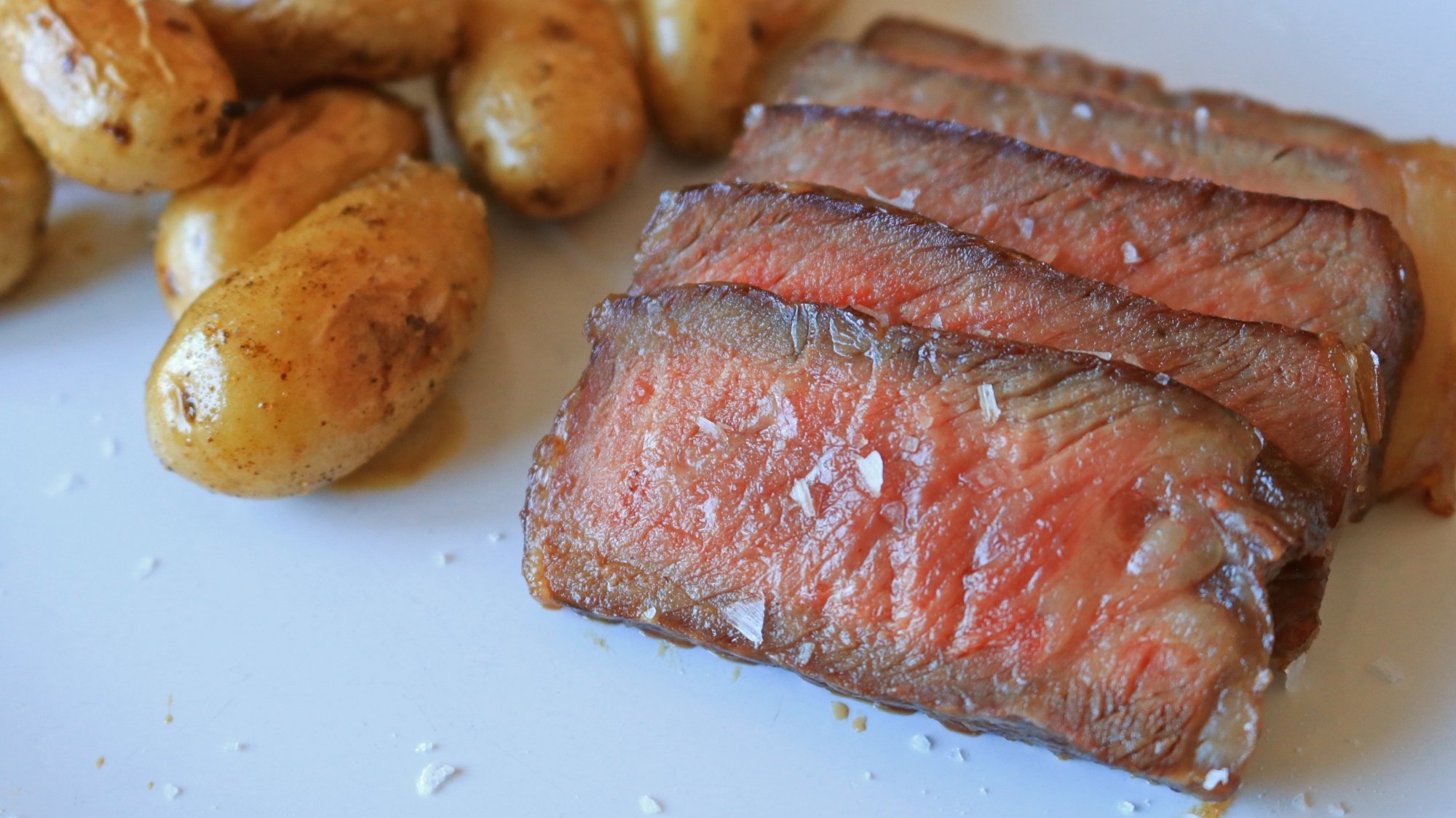
Steak sliced on a plate with small gold potatoes.

Credit: Allie Chanthorn Reinmann

Grilling steak can be intimidating at first, but stick with it and you too will become a grill boss. The pressure might feel high, but even if you overcook the meat, a grilled steak is never ruined and can easily be used for a number of other dishes. I like the following cuts best for grilling because they’re versatile (can be sliced and served in a number of dishes), they have great beefy flavor, or because you get a lot of bang for your buck—and that means more steak nights this summer.

All steaks, unless you’re slow smoking some brisket, should be grilled fast (around three to six minutes per side depending on its thickness) and over the hottest area of your grill. Be sure to let it rest for about 10 minutes off the heat before slicing. There’s no real reason to slowly cook steak unless you’re trying to do a reverse sear. Personally, I’ve never done reverse searing on a grill because it’s less predictable than doing it in an oven or in the air fryer. Additionally, my primary reason for reverse searing is to reduce smoke indoors. When I’m cooking outside, the smoke doesn’t bother me. The stinging eyes and smoky laundry is all part of the experience.

Flank steak

A more affordable cut of meat, the flank steak is taken from the underside of the cow, in front of its hind legs. Essentially, it’s the cow’s six pack. And like mine, the cow’s abs are tough with less fat marbling. Less fat means more muscle grain and those will tighten up more and more as it cooks through. Additionally, flank steaks aren’t thick, so this is a quick sear. I like to throw it on the hottest part of the grill for maybe three minutes per side. It’s enough time to get some beautiful color and loads of flavor on the outside but just warm up the inside. 

Since flank steak can be tougher, always slice your flank against, or perpendicular to, the muscle grain. Cutting across the “lines” will shorten the protein strands so it’s easier for you to chew, and that’s a much nicer eating experience. Read here for a step-by-step guide on grilling a flank steak. And when you have leftovers, try this recipe for cold flank steak with chimichurri sauce.

Skirt steak

Another somewhat cheaper cut compared to other parts of the cow, the skirt steak comes from the area right above the flank steak, below the ribs. Skirt steak has similarities to flank—thinner cut and strong beefy flavor—but it usually includes more fat marbling. Think of the fat ribbons as breaking points in the strong chains of protein. That makes a piece of meat easier to chew because it readily separates at those points. This reads as tender to our palate, and that’s always nice. 

Just like flank steak, skirt steak does well with a short and hot sear on the grill, and slicing it against the grain. I really love it thinly sliced with an herb-forward board sauce drizzled over the top, and it’s a great affordable replacement for ribeye when you’re making a cheesesteak—the bold flavor easily stands out against the bread.

Porterhouse

Surprise! Who would have thought the porterhouse steak would be at home anywhere else but in a fancy mahogany and marble embellished steakhouse. I wouldn’t consider this a cheap cut of steak, but it is one of my favorites for tossing on the grill. I don’t do this for every weekend backyard grill session, but I visited my dad for his birthday last year and we took him steak shopping for lunch. I didn’t expect him to choose a porterhouse, but I was quietly impressed by his decision to let me buy him a $35 steak. How could I be grumpy when I knew I would be sneaking some slices off his plate?

We tossed that inch-and-a-half-thick cut on the grill for longer than the skirt steaks we bought, about five minutes per side, and carved it up for the table. Besides having great flavor and fat content, the porterhouse is actually composed of two different cuts: strip steak (my other favorite grilling steak) and tenderloin. The tenderloin. As in, the filet mignon section that everyone goes bonkers for. Filet mignon doesn’t have as much flavor on its own, but when paired up with the strip steak and the bone in the center of the porterhouse, you get a well rounded experience of flavor and a delicate bite. 

Strip steak

The strip steak is my go-to steak for most cooking styles, not just grilling. It’s a great compromise between cost, flavor, and fat content. With a usual thickness of an inch or inch and a half, I also find that it’s more forgiving than skirt or flank steak when it comes to accidentally leaving it on the grill for an extra minute or so. You’re much less likely to ruin it, and the fat marbling can help keep it tender.  

The strip steak comes from the short loin of the cow and it’s not a heavily used body part which makes it a more tender cut. I find it also works well with my budget but still feels like a treat. As I mentioned, strip steaks have a decent amount of fat marbling, so you get a thick, tender steak with plenty of flavor for roughly $12 to $16 a pound. When it’s not porterhouse week, you might find that a strip steak fits the bill. I usually toss a strip steak on the hottest, or near the hottest, section of the grill and give it about five minutes per side depending on the thickness. 

What if you don’t have one of these steaks?

Bummed because you bought a chuck steak or a flat iron steak? Don’t be. As long as you keep in mind timing, heat, and slicing against the grain, you’ll be in good shape. Thinner cuts of steak (less than an inch) need two or three minutes per side over the hottest heat, and thicker steaks need two to three more minutes per side (also on high heat). All you need now is a scoop of potato salad. And maybe some charbroiled oysters. Oh, and maybe three other dishes from this list. 

Why Microsoft’s next Xbox should just run Windows already

Yesterday, Microsoft confirmed that it’s not abandoning the home console market just yet. In a short video teaser, Xbox President Sarah Bond highlighted a “strategic multi-year partnership with AMD” that will include “our next-generation Xbox consoles in your living room and in your hands.” But while we know that the “in your hands” part will include devices like the Windows-powered ROG Xbox Ally, there are still few specifics about what exactly Microsoft has planned for its future living room consoles (aside from what Bond calls “the next generation of graphics innovation”).

Reading between the lines a bit, though, we wouldn’t be surprised if Microsoft was getting ready to finally tear down the thinning wall separating gaming PCs and gaming consoles. A Windows-based, living room-focused Xbox capable of running generic Windows games could accentuate Microsoft’s strengths in PC gaming while papering over many of the company’s recent struggles in the home console market.

WindowsBox

The once-bright line separating PC gaming and TV-based console gaming has been deteriorating for years. On the hardware side, bespoke console chips and development environments long ago gave way to PC-like architectures that are simpler and easier for developers to work with. And on the PC interface side, efforts like Steam’s Big Picture mode and SteamOS as a whole have strived to make playing on a PC with a handheld controller into a more console-like experience.

Read full article

Comments

Nintendo just revealed Pauline as a surprise character in Donkey Kong Bananza

Nintendo just dropped a ton of details about the next major Switch 2 first-party game. Donkey Kong Bananza was the star of a Nintendo Direct livestream this morning and it was filled to the brim with nifty tidbits to get fans excited about the 3D platformer.

The biggest news is the addition of Pauline as DK’s sidekick. She goes all the way back to the original Donkey Kong arcade game. Nintendo really pulled a fast one here, as the first trailer showed the sidekick as an anthropomorphic rock of some kind. This would be in line with Mario’s various partners in his 3D platformers, as he’s teamed up with hats, stars and other inanimate objects.

However, it was all a ruse. Pauline is the sidekick, as she was trapped inside of that rock. Nintendo really went all in with this prank. Even the original box art showed the little rock character, which has now been replaced by Pauline. There’s even a two-player co-op mode in which one person controls Pauline. This will work on GameShare, so it only requires one copy of the game.

WHILE IT HASN’T BEEN UPDATED ON SOME RETAIL SITES, NINTENDO HAS UPDATED THE BOX ART FOR DONKEY KONG BANANZA TO FEATURE THE REVEAL OF PAULINE INSTEAD OF THE ODD ROCK #SWITCH2 pic.twitter.com/nqKziSrPEO

— FAKE (@FakePearBear) June 18, 2025

There are some major lore implications here. Donkey Kong Bananza features Pauline as a kid and the Donkey Kong arcade cabinet starred her as an adult. This throws everything we know about the arcade game into question. Was Donkey Kong just protecting his surrogate daughter from the evil mustached plumber? Remember, Donkey Kong Jr. featured Mario as the antagonist.

It’s also worth noting that Pauline last appeared in Super Mario Odyssey, as the mayor of New Donk City. Did she create the city to honor her childhood hero? I have so many questions.

Pauline wasn’t the only cool thing that Nintendo revealed today. Donkey Kong Bananza has some light RPG mechanics, in the form of a skill tree. There are outfits to purchase for both DK and Pauline, which is always fun. DK can also turn into other creatures, offering the ape new abilities. Transforming into an ostrich inexplicably grants flight and turning into a zebra lets players run on water.

The trailer also placed a heavy emphasis on the destructive nature of the gameplay. We already knew that DK could destroy just about anything, leading to novel exploration methods, but that looks to be an even bigger part of the game than we thought. Remember how much climbing up anything changed the Zelda formula with Breath of the Wild? This is Donkey Kong’s take on that.

I love that amiibo aren’t dead yet ❤️

Donkey Kong Bananza amiibo ft. DK and Pauline pic.twitter.com/iOJreOWIbf

— amiibo Alerts (@amiiboAlerts) June 18, 2025

Finally, the game will make use of the Joy-Con’s mouse functionality. There’s a bonus mode where players can sculpt rocks via mouse controls. Donkey Kong Bananza is a Switch 2 exclusive that will be available on July 17. Nintendo is also prepping an Amiibo figure that stars both Donkey Kong and Pauline. This grants a new outfit for Pauline. 

This article originally appeared on Engadget at https://www.engadget.com/gaming/nintendo/nintendo-just-revealed-pauline-as-a-surprise-character-in-donkey-kong-bananza-165132377.html?src=rss

[$] The hierarchical constant bandwidth server scheduler

The POSIX
realtime model
, which is implemented in the Linux kernel, can ensure
that a realtime process obtains the CPU time it needs to get its job done.
It can be less effective, though, when there are multiple realtime
processes competing for the available CPU resources. The hierarchical
constant bandwidth server
patch series, posted by Yuri Andriaccio with
work by Luca Abeni, Alessio Balsini, and Andrea Parri, is a modification to
the Linux scheduler intended to make it possible to configure systems with
multiple realtime tasks in a deterministic and correct manner.

Beat Saber support is ending on PS VR and PS VR2

It’s the end of the line for Beat Saber on PS VR and PS VR2. While you’ll still be able to buy and play the base game on both platforms, as well as any songs and music packs that were released before today (June 18), Beat Games is winding down support for those versions. They won’t get any new songs or music packs. As such, the final song that became available for Beat Saber on PS VR and PS VR2 was Lady Gaga’s “Abracadabra.”

Moreover, the PlayStation versions of Beat Saber will lose their multiplayer features on January 21 next year. Beat Games says that it will still provide customer support to players on those platforms.

“As we look to the future and plan the next big leap for Beat Saber, we have made the decision to no longer release updates for PS4 and PS5 starting in June 2025,” Beat Games wrote in a statement on X and its website. “Our passion for VR remains unwavering. We are excited about the possibilities that lie ahead and what we can bring to Beat Saber fans who have been on this journey with us over the past seven years.”

Beat Games announcement about PS4/PS5 support.

For more details, please visit our website: https://t.co/Vq4zGwcJGK pic.twitter.com/nCWxj2DndY

— Beat Saber (@BeatSaber) June 18, 2025

This change doesn’t impact the Steam VR version of Beat Saber. New songs, music packs and features are still coming to Beat Saber on Steam and Meta Quest platforms.

Meta bought Beat Games back in 2019. In effect, the company is ceasing Beat Saber development on platforms that do not support its own headsets

It’s most likely that Meta and Beat Games are ending their efforts on PlayStation versions of Beat Saber because they’re no longer seeing enough of a return on investment (though ending multiplayer support is an odd move). By all accounts, Meta Quest headsets have far outsold PS VR2 units. 

It could be argued that Sony hasn’t fully gotten behind its own platform. By my count, there are fewer than two dozen PS VR2-exclusive games. The most recent State of Play stream featured only one (non-exclusive) game for the platform, Thief VR: Legacy of Shadow. So, it’s maybe not surprising that Meta is pulling the plug on Beat Saber on PlayStation’s VR headsets.

It’s still a shame though, as Beat Saber arguably remains one of the best VR games around, and maybe even the killer VR app. At this point, it might be best for PS VR2 owners who have a capable-enough PC and want more Beat Saber songs to pick up the PC adaptor and play the game on that platform. After all, Beat Saber is modable on PC (and Meta Quest), and there are thousands of custom song maps available.

This article originally appeared on Engadget at https://www.engadget.com/gaming/playstation/beat-saber-support-is-ending-on-ps-vr-and-ps-vr2-164136655.html?src=rss

Insurers Want Businesses to Wake Up to Costs of Extreme Heat

Swiss Re has identified extreme heat as a significant insurance threat in its latest annual report on emerging risks with the Zurich-based reinsurer noting that up to half a million people globally die from extreme heat effects each year. The death toll exceeds the combined impact of floods, earthquakes and hurricanes. Heat waves contributed to conditions that generated $78.5 billion in insured wildfire losses globally from 2015-2024, Swiss Re reported.

The Los Angeles wildfires this year could add up to $45 billion in insured losses, according to UCLA Anderson School of Business estimates. The insurance industry has historically underestimated heat-related costs because damages spread across multiple policy types rather than appearing as a single category. Construction firms face rising medical insurance and workers compensation claims when outdoor workers suffer heat injuries, plus potential liability for inadequate cooling breaks.


Read more of this story at Slashdot.

Return to Silent Hill is coming to theaters next January

The third Silent Hill movie is still heading to theaters. According to Deadline, Return to Silent Hill will premiere on January 23, 2026. The film is directed by Christophe Gans, who also helmed the original 2006 adaptation.

Return to Silent Hill is based on the 2001 game Silent Hill 2. (Bloober Team’s 2024 remake was one of our favorite games of the year.) The movie adaptation stars Jeremy Irvine and Hannah Emily Anderson. Akira Yamaoka, the game franchise’s original composer, handles the score.

James looking in the mirror with horror. Still from the movie Return to Silent Hill.
Konami / YouTube

Like the game it’s based on, the film’s protagonist is James Sunderland (Irvine). After a crushing breakup with Mary (Anderson), James lives up to the billing and… returns to Silent Hill. What he finds is a town transformed by a mysterious evil. As James searches for Mary, he faces terrifying creatures and unravels the truth. Psychological horror commences.

In 2022, Gans told IGN that it’s “totally independent” from the last two films. “Silent Hill is a bit like Twilight Zone, the Fourth Dimension, a place where anything and everything can happen,” he said. In an interview with Le Point, Gans added that he wrote the screenplay during pandemic lockdowns. “I shot it in early 2023,” he said (translated from French). “The film was supposed to be finalized in April 2024, but because of the executive producers, it dragged on, and I finished it last January.” (Shots fired.)

The movie doesn’t yet have a full theatrical trailer. But you can check out its 2022 teaser trailer below.

This article originally appeared on Engadget at https://www.engadget.com/entertainment/return-to-silent-hill-is-coming-to-theaters-next-january-163409009.html?src=rss

Netflix will start showing traditional broadcast channels next summer

In a move that further intensifies the reflection of the cable business it’s slowly killing, Netflix will start showing broadcast channels next summer.

The world’s largest streaming provider announced today that starting next year, all Netflix subscribers in France will be able to watch broadcast channels from TF1 Group, France’s biggest commercial broadcaster, which also owns streaming services and creates content. Financial Times (FT) reported that users will be able to watch all five TF1 linear channels.

Netflix’s French customers will also gain access to “more than 30,000 hours” of on-demand TF1 content in the summer of 2026, FT reported. TF1’s content selection includes scripted dramas, reality shows like The Voice, and live sports.

Read full article

Comments

Devil May Cry and the early Mortal Kombat games join GOG’s Preservation Program

GOG’s Preservation Program launched in late 2024 and the number of included games has doubled since the initial wave, currently sitting at 183. The latest headline-grabbing additions are the first four mainline Devil May Cry games and Mortal Kombat 1+2+3.

Devil May Cry: HD Collection was first released in 2012 and includes the first three entries in Capcom’s enduring action series, all playable in 1080p/60fps (a big deal at the time). Devil May Cry 4: Special Edition, which celebrates its 10th anniversary this year, has also been added. Add to these the Mortal Kombat trilogy and you’ve got major entries in two of the most influential series in their respective genres guaranteed to be compatible with modern hardware and protected against DRM.

The GOG Preservation Program pledges to ensure classic games remain playable beyond the point that their developers stop supporting them, safeguarding them for future generations to discover. As gaming moves even further towards an all-digital future, preservation remains a hot topic in the industry, with major publishers such as Ubisoft making a point of reminding players that they don’t technically own the digital games they purchase (see: The Crew 2 players).

Until July 2, you’ll be able to purchase the newly added Devil May Cry games as a bundle for 67 percent off. Here are the other games also joining GOG’s service this month.

This article originally appeared on Engadget at https://www.engadget.com/gaming/devil-may-cry-and-the-early-mortal-kombat-games-join-gogs-preservation-program-162641095.html?src=rss

Google’s frighteningly good Veo 3 AI videos to be integrated with YouTube Shorts

Even in the age of TikTok, YouTube viewership continues to climb. While Google’s iconic video streaming platform has traditionally pushed creators to produce longer videos that can accommodate more ads, the site’s Shorts format is growing fast. That growth may explode in the coming months, as YouTube CEO Neal Mohan has announced that the Google Veo 3 AI video generator will be integrated with YouTube Shorts later this summer.

According to Mohan, YouTube Shorts has seen a rise in popularity even compared to YouTube as a whole. The streaming platform is now the most watched source of video in the world, but Shorts specifically have seen a massive 186 percent increase in viewership over the past year. Mohan says Shorts now average 200 billion daily views.

YouTube has already equipped creators with a few AI tools, including Dream Screen, which can produce AI video backgrounds with a text prompt. Veo 3 support will be a significant upgrade, though. At the Cannes festival, Mohan revealed that the streaming site will begin offering integration with Google’s leading video model later this summer. “I believe these tools will open new creative lanes for everyone to explore,” said Mohan.

Read full article

Comments

Garmin’s Sleep Band Is Real After All

We may earn a commission from links on this page.

When I wrote yesterday about three different Whoop-like bands rumored to be coming soon, I didn’t know how close we were to one of them actually launching. Today, Garmin’s Index sleep monitor is officially listed on their website, retailing for $169.99 and shipping in five to eight weeks.

What kind of device is the Index?

The Index is an armband, meant to be worn around the bicep while you sleep. It can track your heart rate like a smartwatch does, but it has no screen. The most prominent photo on the product page is of a woman sleeping peacefully while her phone and watch lie unused on her nightstand. 

The armband is 2.5 inches wide—considerably wider than a Whoop band or a typical watch band—and Garmin says it’s made of a lightweight, breathable fabric. From the photos, it looks soft and comfortable. The band appears to have a velcro type closure. The band is machine washable, but you need to remove the device before washing, which is a small pod that measures 1.6″ x 1.5″ x 0.3″. 

The band length is given as 12.8 inches for the small/medium band, and 17.8 inches for the large/XL band. You have to choose a band size when you buy the device; it doesn’t ship with both. You can buy extra bands, but they cost $49.99 each. 

What does the Index do? 

The Index has an optical heart rate sensor, the same idea as the green light on the back of a smartwatch. This includes a blood oxygen (SpO2) sensor, and from the appearance of the sensor in photos, the heart rate sensor seems to be the latest Elevate version—the same one Garmin put in the Forerunner 570 and 970, and the Venu 3. (I found this sensor to be even more accurate than the previous generation.) 

It also has accelerometers to detect motion while you sleep, and it can measure skin temperature. The battery is listed as lasting seven nights with the SpO2 sensor on, assuming you sleep eight hours per night. 

From this data, you get the same information a Garmin watch would give you about your sleep. This includes: 

  • Sleep length, stages, and sleep score (although I never trust sleep stages from a wearable) 

  • Resting heart rate

  • Respiration rate

  • “Body battery” (a Garmin-calculated number that is ideally near 100 when you wake up and drains throughout the day, depending on your activity and stress) 

  • Ovulation estimates and cycle tracking

  • Breathing variations throughout the night

The Index sends this information to your phone’s Garmin Connect app, and from there it’s also visible on your compatible Garmin watch. 

The Index also has a smart wake alarm, a feature we first saw on the Vivoactive 6. Unfortunately, the smart wake alarm never worked for me, as I detailed in my review. I’m seeing other users say it didn’t work for them, either—here’s one Redditor asking if it’s just them, and a YouTuber who had the same experience. The smart wake alarm asks you to set a 30-minute window during which the device will look for light sleep stages during which to wake you up. In all three of our experiences, the Vivoactive only ever woke us up at the last possible moment of the window, suggesting it wasn’t that “smart” after all.

This may be an armband, but it sure isn’t a Whoop killer

The Index is pretty much exactly what I expected from the rumors, but I have to say I’m disappointed in how limited it is. Since the Index has (really, is) a heart rate monitor, you would think it’s a no-brainer to provide a band that can be worn during exercise. Polar and Coros have popular armband heartrate monitors, which many users find more accurate than a watch and more comfortable than a chest strap. Garmin’s new Index costs nearly as much as both of those combined and still can’t measure your heart rate during workouts. 

Also, this goes without saying for those familiar with Whoop, but the strength of Whoop is in its app. You can read here what it was like for me to fully buy into the Whoop way of doing things, tagging my habits and using the chatbot coach to decide on workouts for the day. An armband like the Index may physically look like a Whoop band, but it doesn’t provide the experience that Whoop actually provides. That may be a pro or a con for you personally—not everybody wants the Whoop experience or the ongoing subscription, and I can respect that. 

Does the cost make sense?

A one-time price of $169.99 sure beats an ongoing subscription of $239/year like Whoop offers, which is probably how Garmin hopes you will think of this. But you can’t wear the Index for workouts, so the cost is in addition to buying a Garmin watch. (Whoop users often wear a sports watch as well, but the Whoop can still track workouts without one.) 

And since the Index doesn’t provide any metrics that your Garmin wasn’t already offering (except the smart wake alarm, which was previously only on the new Vivoactive 6), you’re really paying $169.99 to wear a device on your arm rather than your wrist while you sleep. 

One Redditor comments: “Now the question is: Can we retrofit this into a smaller band and get metrics all day long? Since no one was asking for a sleep monitor band but rather an all day band to wear with a normie watch.” (It’s not clear how long the battery would last with 24/7 wear.)

If Garmin is smart, they’ll release a sport band for this thing and offer the ability to start and stop workouts from your phone. Currently, the only way to get workout data on your phone during the workout is with a Connect+ subscription, which costs $6.99/month. Curiously, a $169.99 device plus an annual subscription at $69.99 works out to almost exactly the same cost as a $239/year Whoop Peak subscription. Just saying. 

I could definitely see this as a future direction, but I feel like it doesn’t fit with the vibe of naming this product the Index (the same name Garmin uses for its smart scale) and wouldn’t let them call the band subscription-free. Overall, I’m underwhelmed by what the Index offers, but I have to wonder if there might be a future product or upgrade on the way to make it more Whoop-like. 

Carbonating Tuna Fish

Presumably to give Gatorade a run for its money with Tunade (“Replenishes vital Omega-3’s after heavy thinking!”), culinary adventurer and Youtuber Ordinary Sausage decided to attempt carbonating tuna fish with a Philips soda maker. Yum! He says it tastes like sour tuna fish, which I believe. It also turned out incredibly watery due to the amount of liquid required. He still gave it 4/5 sausages though, leading me to believe this man is out of his mind or onto something. Do peanut butter and jelly next!

Orange Pi 5 Ultra and Max Single Board Computers Running Linux: Introduction

This is the first article in a new series looking at both the Orange Pi 5 Ultra and Orange Pi 5 Max single board computers (SBCs) running Linux. These two SBCs are identical in almost all respects with the exception of their HDMI ports.

The post Orange Pi 5 Ultra and Max Single Board Computers Running Linux: Introduction appeared first on Linux Today.