Apple revealed a language translation feature for the upcoming AirPods 3 Pro earbuds at today’s iPhone event. Here’s some good news for those who don’t want to shell out $249 for some new and shiny in-ear headphones. The tool is also coming to the AirPods 4 with ANC and AirPods Pro 2 models. This requires the latest firmware and an Apple Intelligence-enabled iPhone running iOS 26 and later.
For the uninitiated, Live Translation is exactly what it sounds like. The software translates languages in real-time while wearing the earbuds. This allows for something resembling natural conversation when interacting with a person who speaks another language.
This feature will be available in English, French, German, Portuguese and Spanish at launch, with more languages coming by the end of the year. These include Italian, Japanese, Korean and simplified Chinese.
As for the AirPods Pro 3 earbuds, they cost $249 and are available to preorder right now. These new earbuds include a heart rate monitor, improved ANC, better battery life and the ability to play spatial audio.
This article originally appeared on Engadget at https://www.engadget.com/audio/headphones/apples-airpods-4-with-anc-and-airpods-pro-2-will-also-support-live-translation-184235997.html?src=rss
Dell Pro 14 Premium Laptop: Starting At $1899, $2729 As Tested The Dell Pro 14 Premium is feature-rich, high performance laptop, with a polarizing minimalist design and excellent battery life. Gorgeous Tandem OLED Display Exceptional Battery Life Quality Laptop Sound Respectable Performance, Especially Graphics & AI Very Light Weight…
Apple’s “pro” AirPods were due for an update. Despite continuously upgrading the AirPods Pro 2 with new features since their introduction in 2022, Apple hadn’t produced another robust overhaul of its priciest earbuds yet. At today’s iPhone 17 event (or iPhone Air event, depending on who you ask), the company unveiled the latest model: the AirPods Pro 3. The company has refined the design, added heart rate sensing, improved active noise cancellation (ANC), delivered live translation and more. And most importantly, it did so without increasing the price.
My brief demo with the AirPods Pro 3 focused entirely on the refined ANC. I wasn’t able to try any sustained heart rate tracking or live translation just yet, but I hope to have other opportunities for that later this week. The product area is always set up just outside of Steve Jobs Theater and the marble floors and walls echo seemingly every voice in the large room. It’s a nightmare for trying to shoot a video, but it’s a prime testing ground for active noise cancellation.
Developing…
This article originally appeared on Engadget at https://www.engadget.com/audio/headphones/apple-airpods-pro-3-hands-on-new-design-and-improved-anc-are-impressive-183246429.html?src=rss
FEX 2509 is out today as the latest monthly update to this open-source emulator allowing unmodified x86/x86_64 games and applications to run in ARM64 Linux environments…
AirPods Pro 3, Apple’s high-end earbuds, joined the iPhone Air and new Apple Watches in the spotlight at Apple’s September 9 “awe-dropping” launch event. The first AirPods Pro 3 will ship on September 19, but pre-orders are live now. Here’s how to get your hands on a pair of the new AirPods to go with your iPhone Air.
AirPods Pro 3
This article originally appeared on Engadget at https://www.engadget.com/audio/headphones/how-to-pre-order-the-new-airpods-pro-3-173916856.html?src=rss
An incoming new iPhone model called the iPhone Air has been one of the worst-kept secrets in tech lately, and now Apple has confirmed it at its annual iPhone reveal event.
The 6.5-inch iPhone 17 Air combines the CPU and GPU of an iPhone Pro with the camera system of a regular iPhone, all in an extra-thin design (5.6 mm), with a treated titanium frame that is likely to appeal to style-conscious users and some business consumers.
Like the iPhone 17, the iPhone 17 Air has a ProMotion display with a variable refresh rate up to 120 Hz—something that was reserved for only the Pro iPhones up until this year. The Air’s display also has always-on functionality and claims 3,000 nits of peak brightness. It has Apple’s new Ceramic Shield 2 protective coating on both the front and the back, which the company claims will make it more durable and anti-reflective.
As expected, Apple’s September 9 “awe-dropping” event brought a tsunami of new hardware, including the iPhone 17 and iPhone Air. But those long-awaited models weren’t the only launches worth noting — the event also debuted three new Apple Watches: the Apple Watch Ultra 3, the Apple Watch Series 11 and the Apple Watch SE 3.
Now that the livestream is over, these three new Apple wearables are all available for pre-order. All three will ship out on September 19.
Apple Watch Ultra 3
This article originally appeared on Engadget at https://www.engadget.com/wearables/how-to-pre-order-the-apple-watch-ultra-3-apple-watch-series-11-and-apple-watch-se-3-175645177.html?src=rss
CUPERTINO, Calif.—If you’re buying one of the new iPhones or the other hardware that Apple announced today, your new devices will ship with Apple’s latest operating system updates already installed. But if you’re not looking to spend a bunch of money on Apple’s latest and greatest, the new updates will land on Apple’s other supported devices on September 15.
Apple is shifting to a year-based numbering system starting this year, wiping away the previous grab bag of all-over-the-place version numbers. No corner of Apple’s ecosystem is going untouched: we’re getting iOS 26, iPadOS 26, macOS 26 Tahoe, watchOS 26, tvOS 26, visionOS 26, and even version 26 of whatever Apple is calling the HomePod’s software these days, all on the same day.
The headliner across all of the updates is Apple’s new “Liquid Glass” UI overhaul, which adds glass-inspired transparency and translucency and bouncy animations throughout all of Apple’s software. Inspired in part by the way that UI elements in visionOS float over top of your real-world surroundings, Liquid Glass is Apple’s most comprehensive UI overhaul since the release of iOS 7 back in 2013.
CUPERTINO, Calif.—Apple’s basic iPhone 17 is the one most people will use, and the new iPhone Air will get attention for its thin design and novelty. But the iPhone Pro series is still the absolute best the company has to offer, and that continues to be true of the new iPhone 17 Pro and Pro Max that Apple announced today.
The new phones start at $1,099 and $1,199 for the Pro and Pro Max, respectively, each with 256GB of storage. Preorders start this Friday, and the phones will be available on September 19.
While the best feature of the iPhone 17 is its screen, the screens are virtually the only thing not to be overhauled for the iPhone 17 Pro, though they do get the more scratch-resistant, anti-reflective Ceramic Shield 2 coating. The new designs have a new aluminum unibody enclosure, with a glass cutout on the back to allow for wireless charging and a huge new camera bump that Apple calls the “camera plateau,” stretching all the way across the back.
Alongside all of the new iPhones, Apple Watch models and other hardware, today’s Apple event brought forth news of when you’ll be able to install iOS 26, iPadOS 26, watchOS 26 and macOS 26. You’ll be able to install these operating systems on compatible devices on September 15 when they move out of beta.
There are two major changes this year. The first is Apple’s shift to the Liquid Glass design language across its devices. It’s a significant overhaul of the design of Apple’s operating systems, with a focus on translucency and fluidity. The other big update is to the naming system of the operating systems. It might feel a little jarring to go from iOS 18 to iOS 26, but Apple is now aligning the version numbers with release years to keep everything more consistent.
The iPhone 17 lineup will come with iOS 26 pre-installed. You can also download it on iPhone 11, 12, 13, 14, 15 and 16 devices, as well as second-gen and later iPhone SE units.
Compatibility for watchOS 26 is straightforward too. It’ll be available on the latest devices, along with the second-gen Apple Watch SE, Apple Watch Series 6 or later and all Apple Watch Ultra variants.
Things get a little more complicated when it comes to iPadOS and macOS. If you’d like to try macOS 26 (aka macOS Tahoe), you’ll need one of the following Macs:
MacBook Air with Apple silicon (2020 and later)
MacBook Pro with Apple silicon (2020 and later)
MacBook Pro (16‑inch, 2019)
MacBook Pro (13‑inch, 2020, Four Thunderbolt 3 ports)
iMac (2020 and later)
Mac mini (2020 and later)
Mac Studio (2022 and later)
Mac Pro (2019 and later)
As for iPadOS 26, you’ll be able to use that on the following iPad models:
iPad Pro (M4)
iPad Pro 12.9‑inch (3rd generation and later)
iPad Pro 11‑inch (1st generation and later)
iPad Air (M2 and M3)
iPad Air (3rd generation and later)
iPad (A16)
iPad (8th generation and later)
iPad mini (A17 Pro)
iPad mini (5th generation and later)
This article originally appeared on Engadget at https://www.engadget.com/mobile/smartphones/ios-26-ipados-26-watchos-26-and-macos-26-will-be-released-on-september-15-182024821.html?src=rss
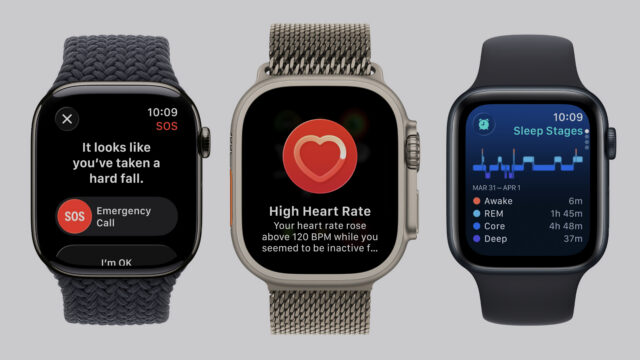
At its fall product event today, Apple updated its line of smartwatches, including the introduction of features for monitoring blood pressure and analyzing the quality of your sleep.
Apple Watch Series 11
The Apple Watch Series 11.
Credit:
Apple
The Apple Watch 11 is supposed to be able to alert users about “possible hypertension” by using data from an optical heart rate sensor “to analyze how a user’s blood vessels respond to the beats of the heart,” per its announcement.
According to Apple’s presentation, the smartwatch will look for chronic hypertension over 30-day periods. Apple’s presentation noted that the Watch Series 11 won’t be able to identify all hypertension, but the company said that it expects to notify over 1 million people with undiagnosed hypertension during the feature’s first year of availability.
An anonymous reader writes: Reuters News on Friday withdrew a four-minute video containing an exchange between Russian President Vladimir Putin and Chinese President Xi Jinping discussing the possibility that humans can live to 150 years old, after China state TV demanded its removal and withdrew the legal permission to use it.
The footage, which included the open mic exchange from the military parade in Beijing marking the 80th anniversary of the end of World War Two, was licensed by the China state television network, China Central Television (CCTV). The clips were edited by Reuters into a four-minute video and distributed to more than 1,000 global media clients including major international news broadcasters and TV stations around the world. Other news agency licensees of CCTV also distributed edits of the footage.
Reuters removed the video from its website and issued a “kill” order to its clients on Friday after receiving a written request from CCTV’s lawyer. The letter said the news agency exceeded usage terms of its agreement. The letter further criticized Reuters “editorial treatment applied to this material,” but did not specify details.
Ahead of its “Awe Dropping” iPhone 17 event, Apple has been hit with a class action lawsuit. The plaintiffs, including authors Grady Hendrix and Jennifer Roberson, claim that Apple allegedly used “Books3, a dataset of pirated copyrighted books that included their works” to train its AI models, including Apple Intelligence and OpenELM language.
Plex, the popular tool that enables users to stream their own media, has suffered another data breach and is urging users to change their passwords. This isn’t the first time the company has suffered a data breach of this kind, as it suffered a similar incident back in 2022.
In a post on its community forums, the company says that “an unauthorized
While all eyes are likely on the iPhone Air this year, Apple is introducing several new features in the iPhone 17 Pro and Pro Max that should keep its more demanding users satisfied. The company says it went back to the drawing board to develop a new unibody aluminum case, a revamped vapor chamber cooling system and the biggest batteries ever put into iPhones. There’s also a completely revamped rear design, featuring a new horizontal camera array and a combination of glass and Apple’s Ceramic Shield along the bottom half. The latter update should increase overall durability, while also allowing for MagSafe wireless charging.
While all of Apple’s new iPhones are getting massive camera upgrades this year, the Pro rightfully remains the most capable with a new 48 megapixel telephoto lens. That joins 48MP wide and ultrawide sensors, as well as the new 18MP Center Stage front-facing camera. The telephoto camera can now shoot up to 8x “optical quality” zoom at 12MP and 4x at its full 48MP. As usual, Apple shot its iPhone announcement event with its new Pro phone, and it looked on-par with a true professional camera.
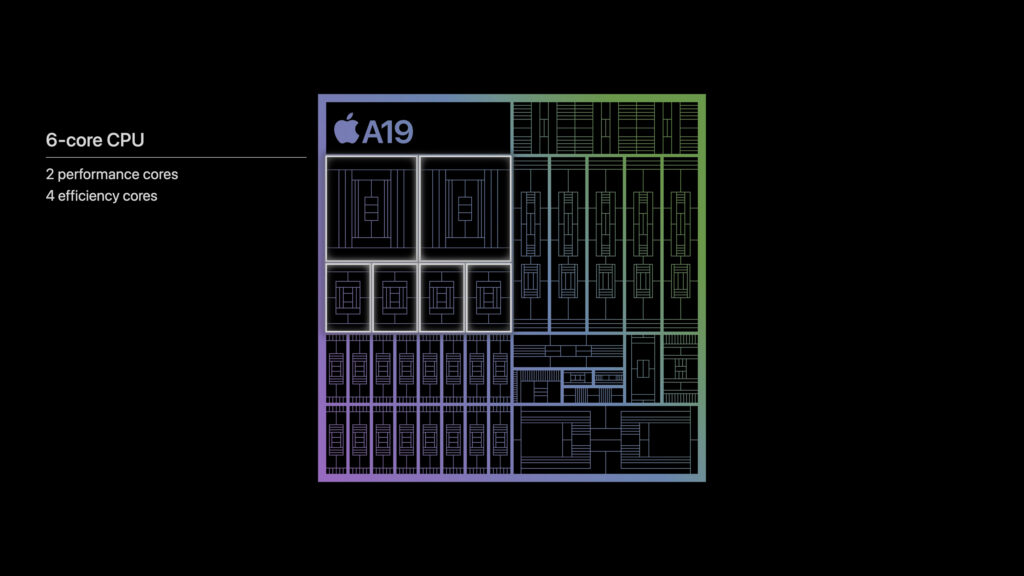
Under the hood is Apple’s new A19 Pro chip, a six-core CPU that offers “MacBook-level processing power,” according to the company. Strangely enough, the A19 Pro is also in the iPhone Air, but the iPhone 17 Pro’s vapor chamber cooling should allow for better sustained performance. (You can’t really push heat out quickly from a super-thin case, after all.)
Developing…
This article originally appeared on Engadget at https://www.engadget.com/mobile/smartphones/the-iphone-17-pro-has-an-aluminum-case-and-vapor-chamber-cooling-180141734.html?src=rss
Last week’s Fall 2025 This Season on Zwift press release included, as the first item of business, news that a fresh version of the Zwift Click controller will begin shipping today, September 9th. Keep reading to learn all about the new Zwift Click, including my full hands-on review.
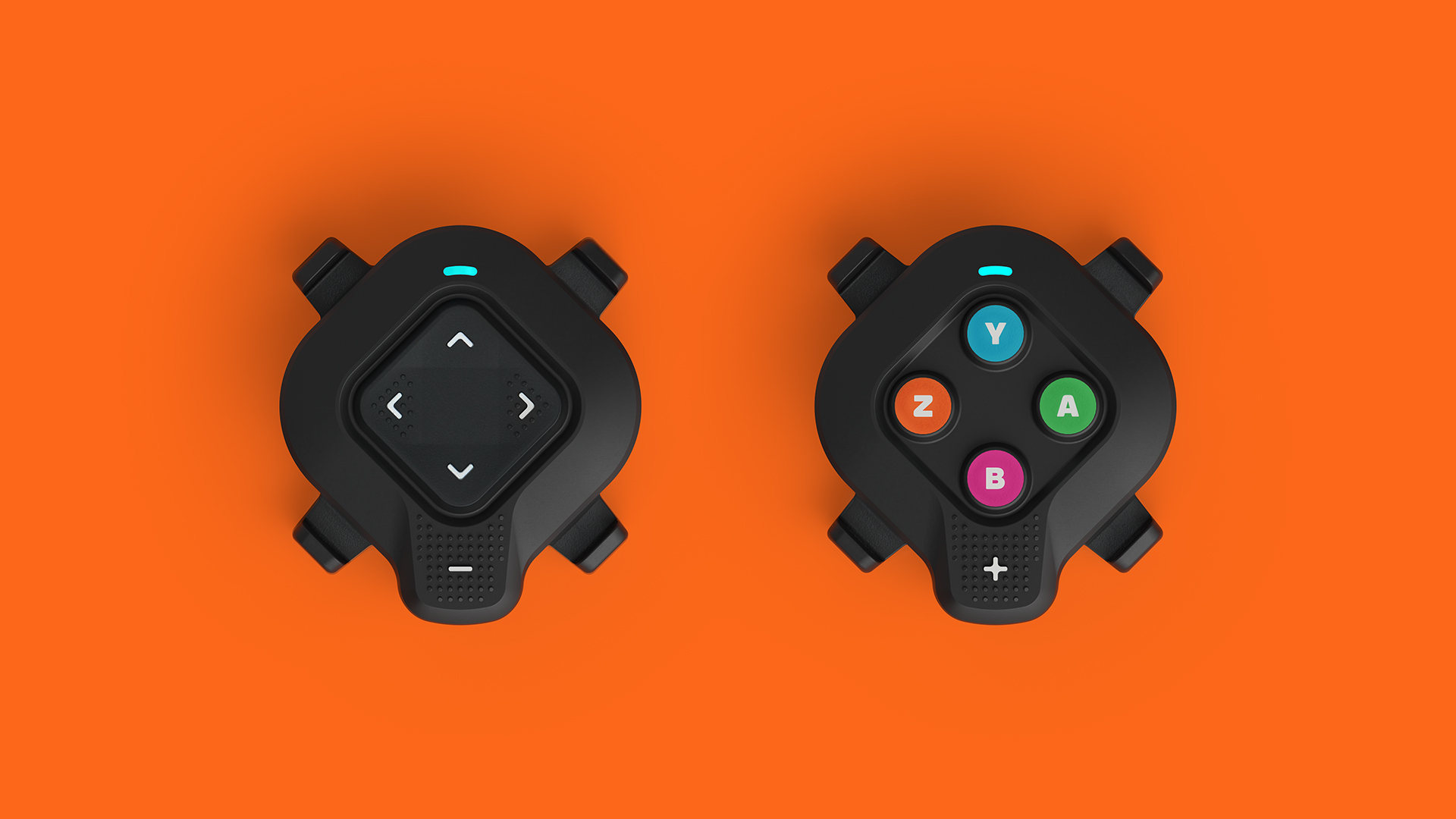
Click v2, as we’ll call it, is replacing two SKUs for Zwift. First, it replaces the original Click, a simple device with a + and – button for shifting up or down. This comes as no surprise. But the bigger news is that Click v2 is also replacing the Zwift Play controllers. (To be clear: while Zwift Play can still be used in-game, it will no longer be sold.)
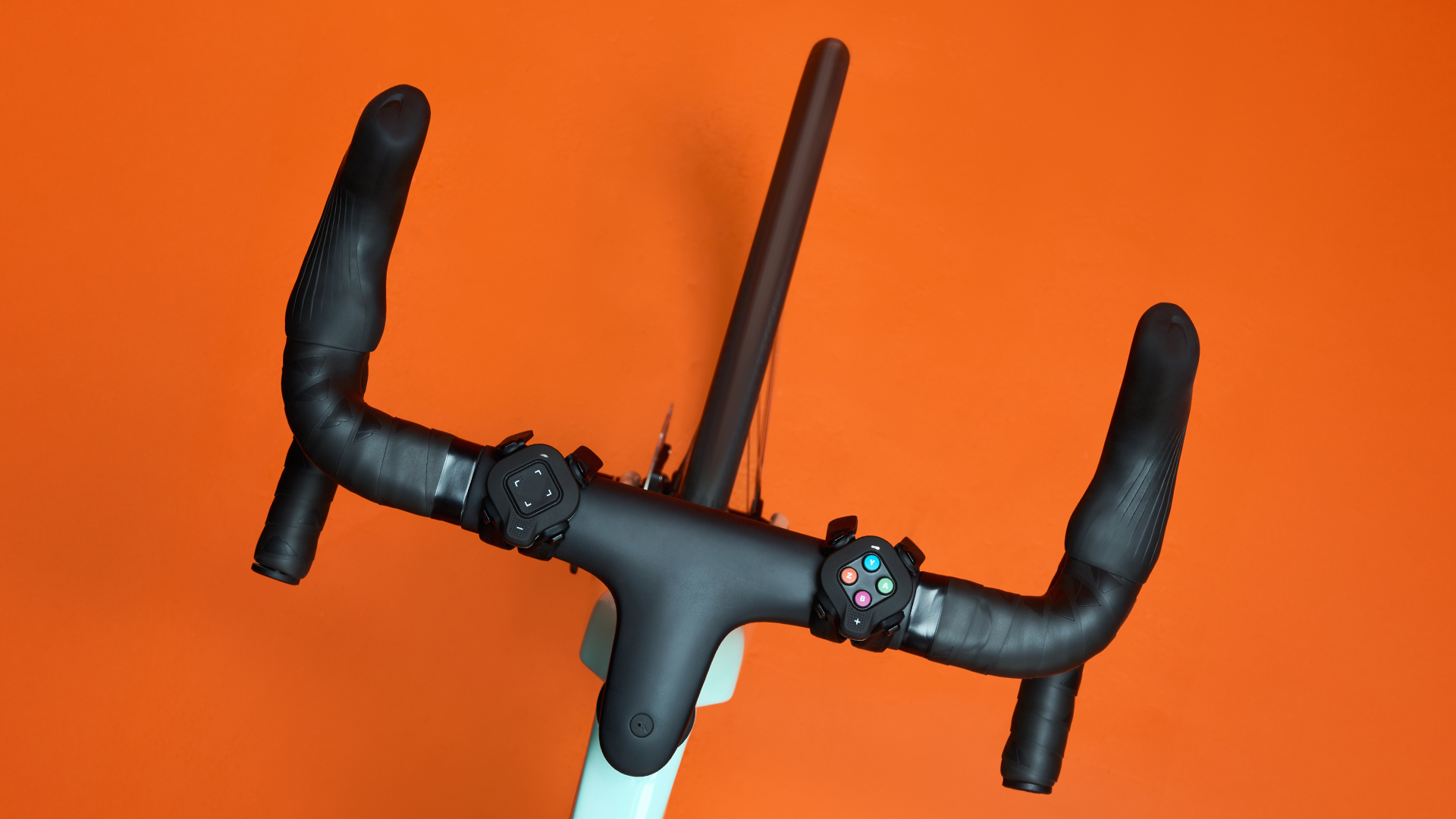
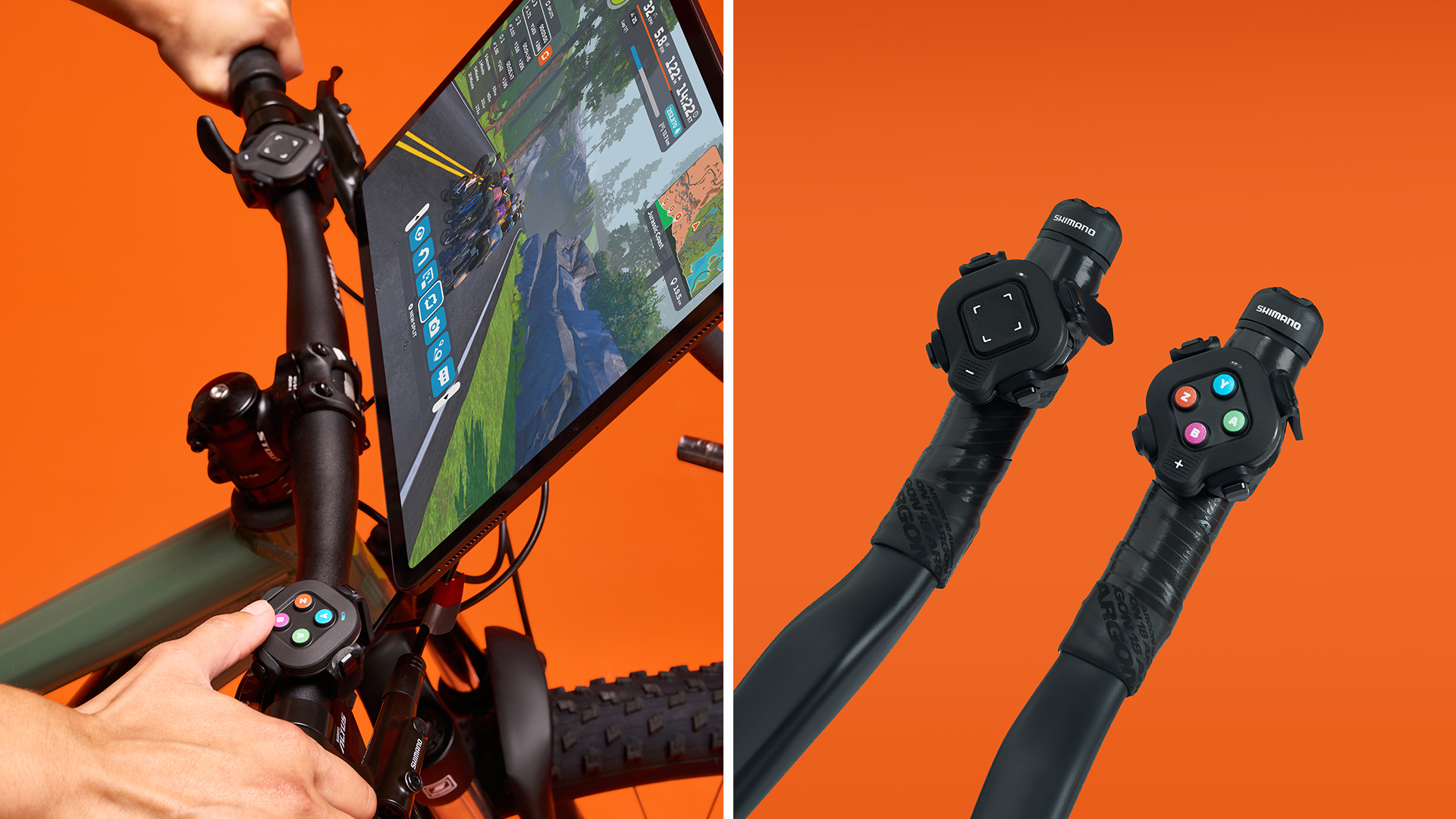
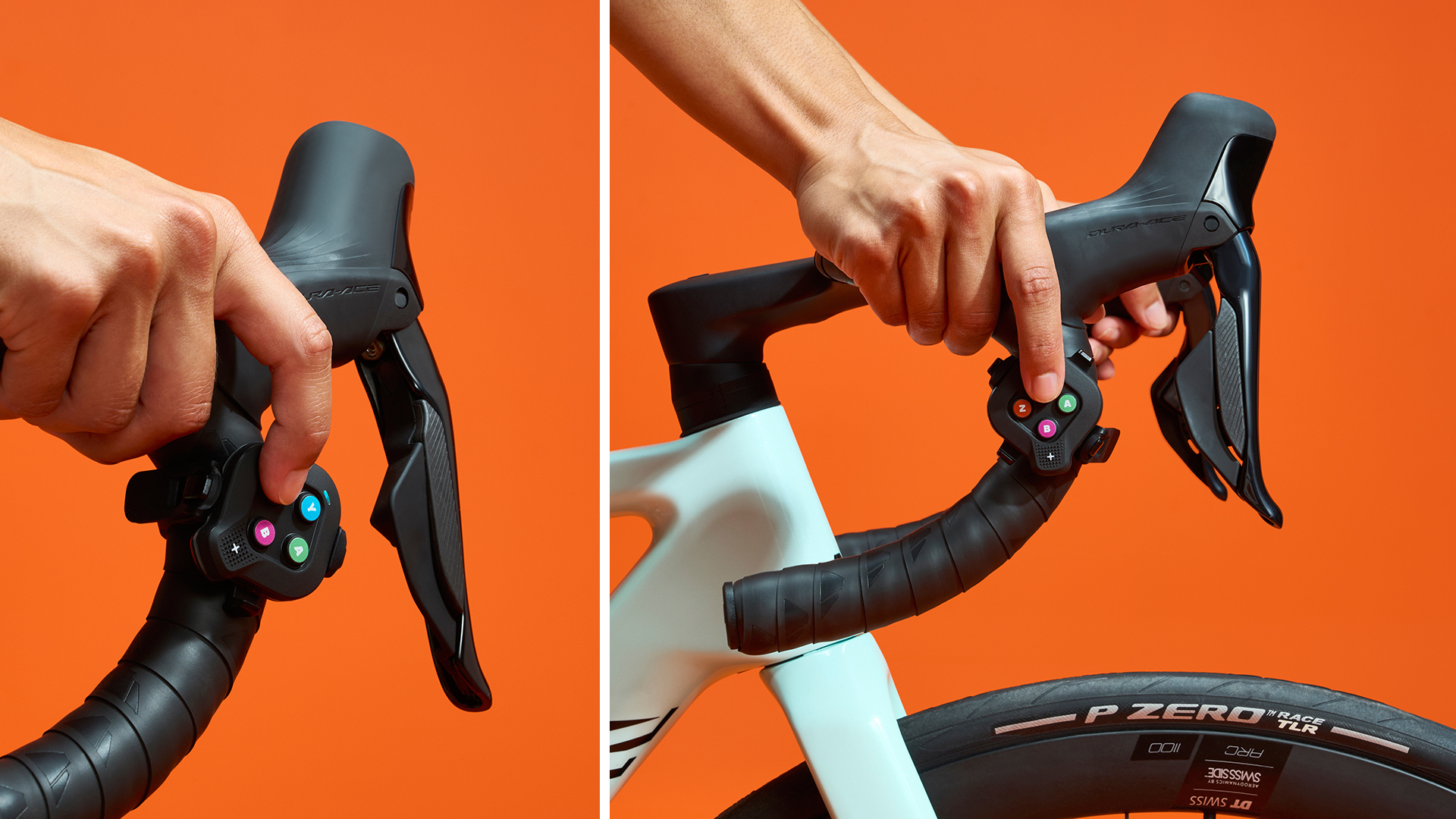
Here are some images from Zwift showing the Click v2 and how they mount easily to multiple locations on drop bars, as well as flat bars and TT bars:
Zwift is not currently selling Click v2 as a standalone item, but Zwift Cog and Click upgrade kits for all Zwift Cog-compatible trainers are available at Zwift.com now for £49.99/€49.99/$49.99:
The two units are bridged together, so they use only 1 Bluetooth connection (good news for Apple TV users)
Claimed 100-hour battery life (CR2032 coin cell)
Hands-On Experience
Setup and Onboarding
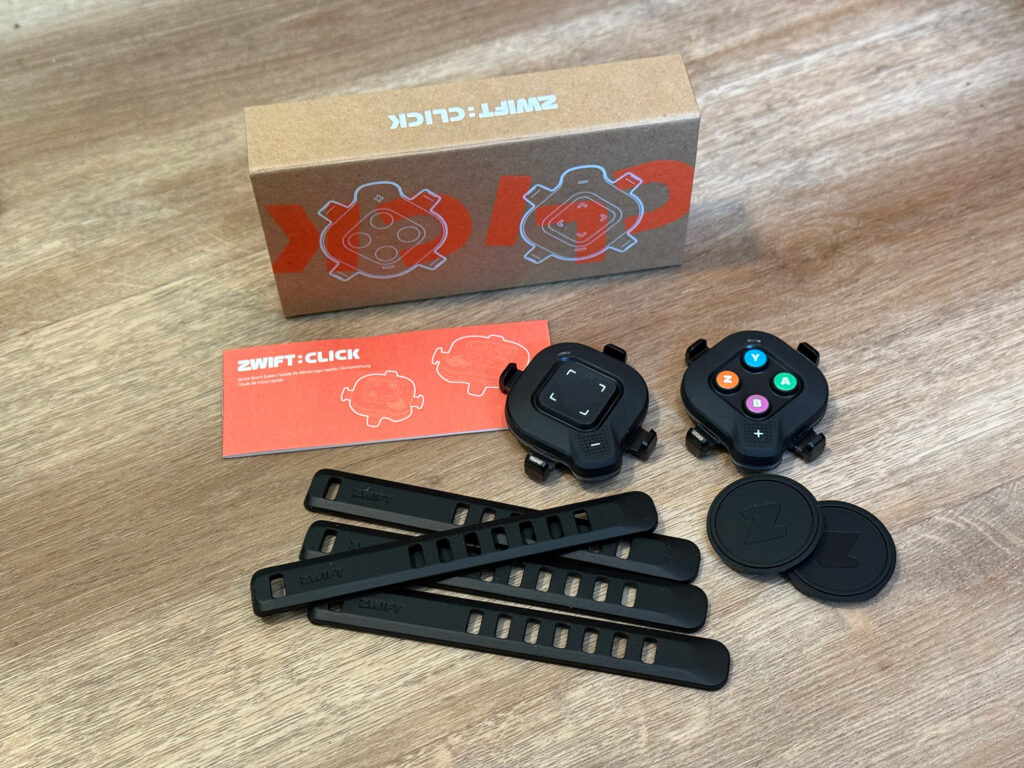
Click v2 is quick and easy to set up. In addition to the two Click controllers, the package includes four straps and two soft pads you can place beneath the controllers to more secure mounting on rounded bars:
Clicking any button on a controller activates it, and an LED at the top of the controller will begin flashing blue. It turns solid blue once connected.
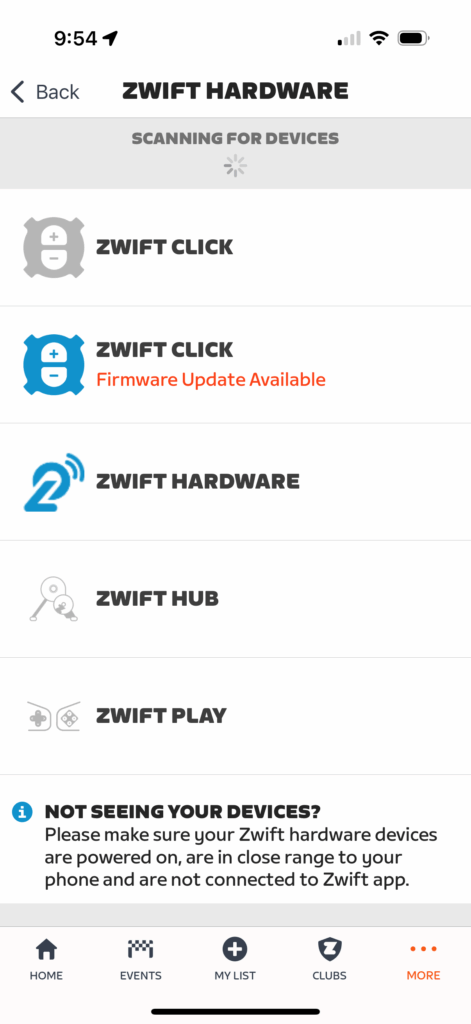
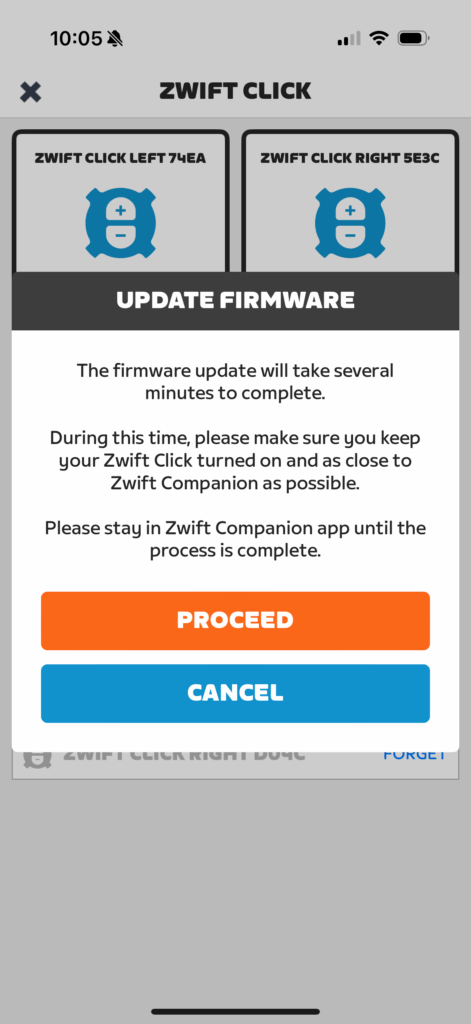
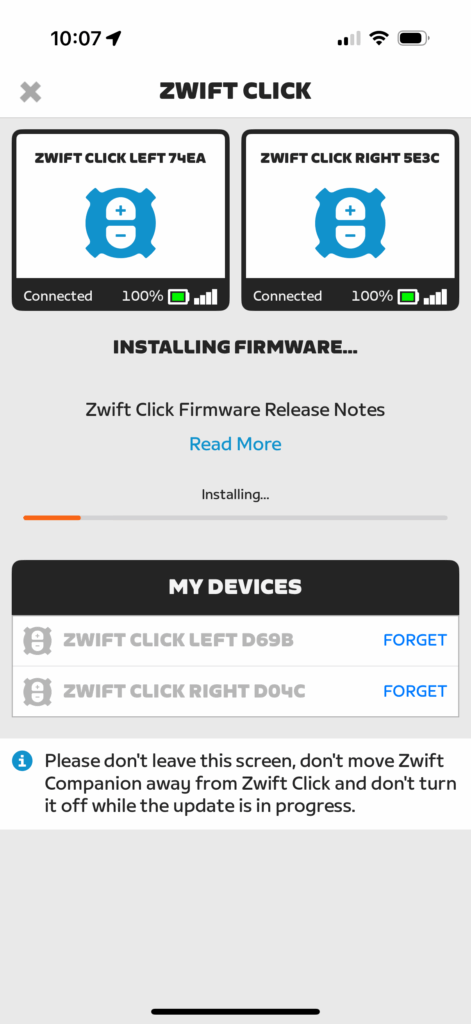
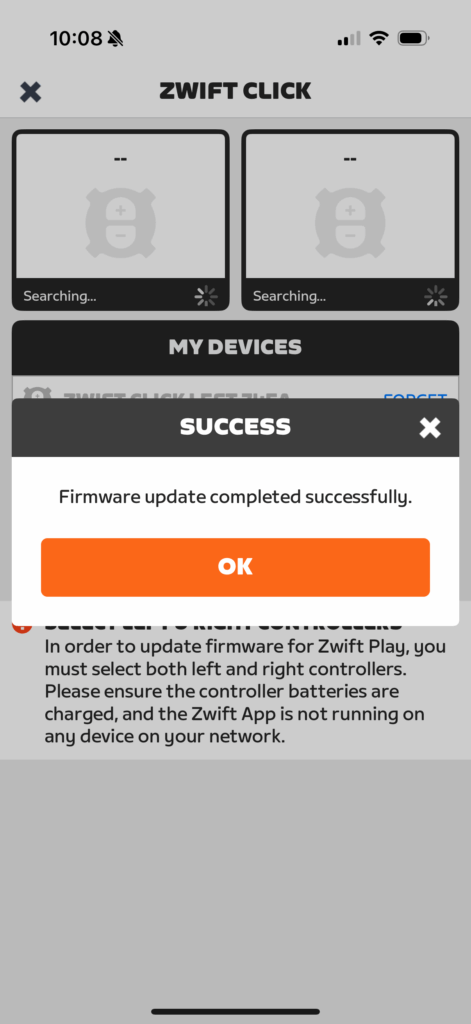
The first thing I did was open up Zwift’s Companion app and go to Zwift Hardware, where the app automatically detected the Click v2 which I had already turned on. The app then prompted me to perform a firmware update to version 1.1.0:
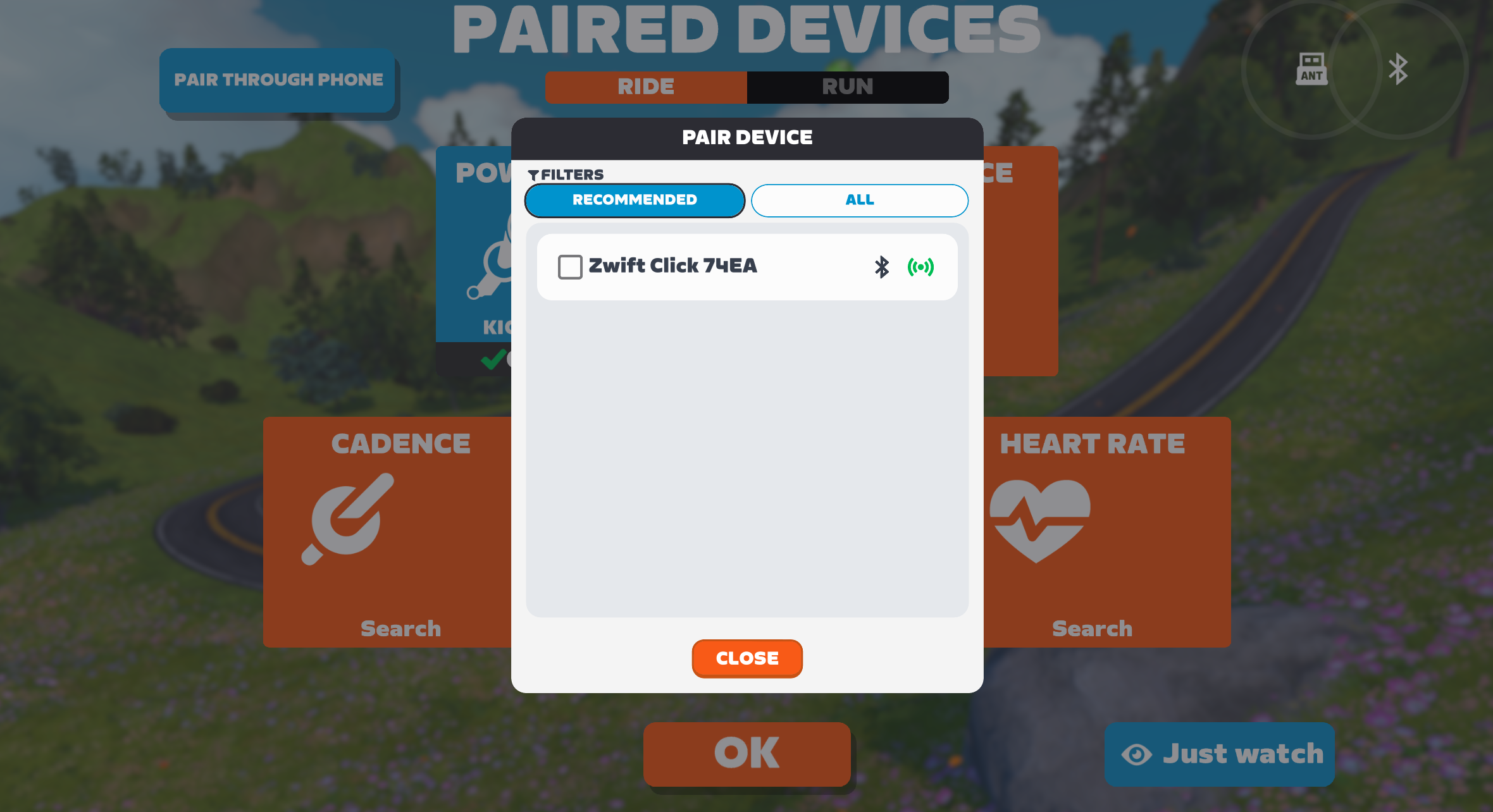
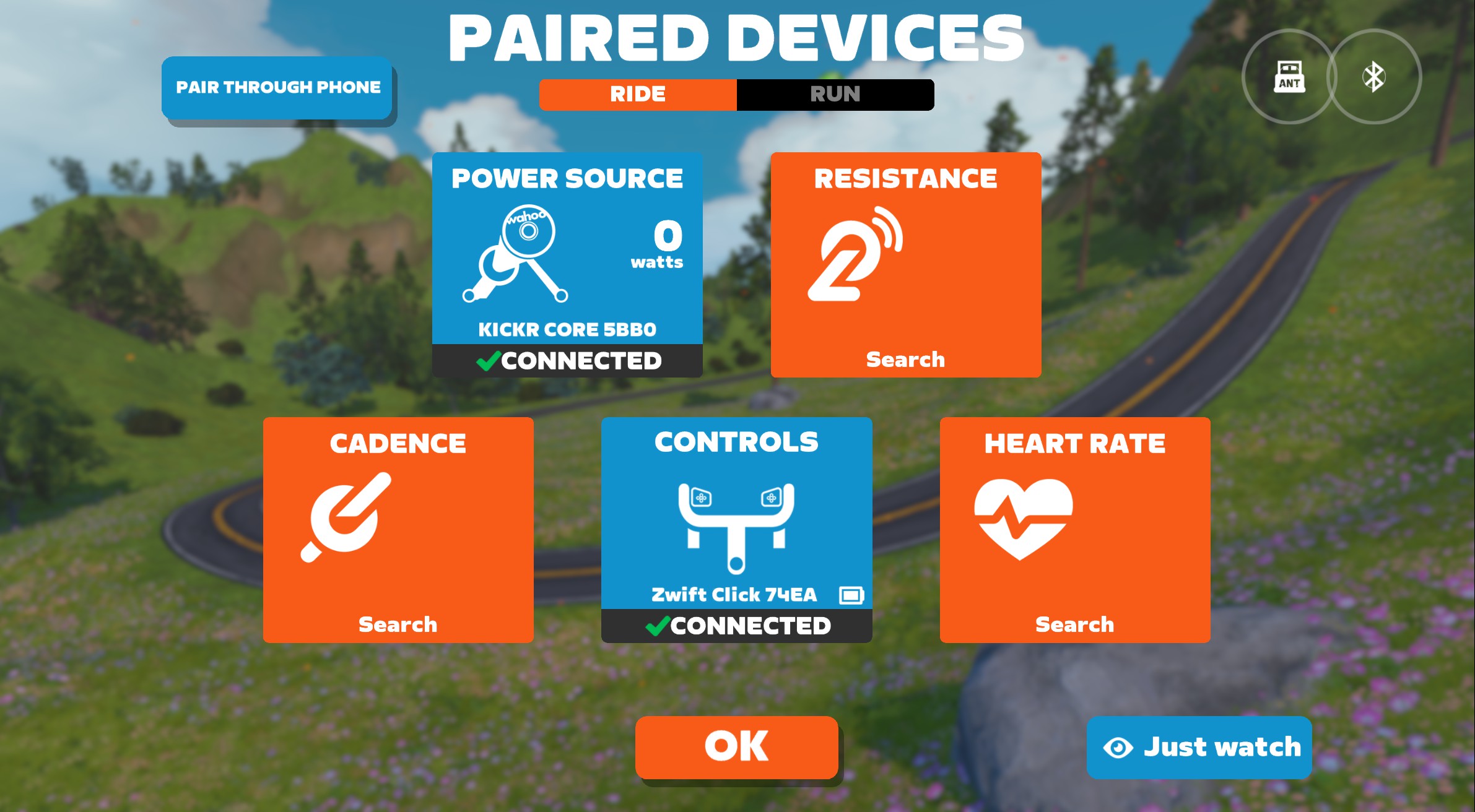
Once the Clicks were updated to the latest firmware, I started my Zwift session and paired the Click v2 (reminder: these are Bluetooth only):
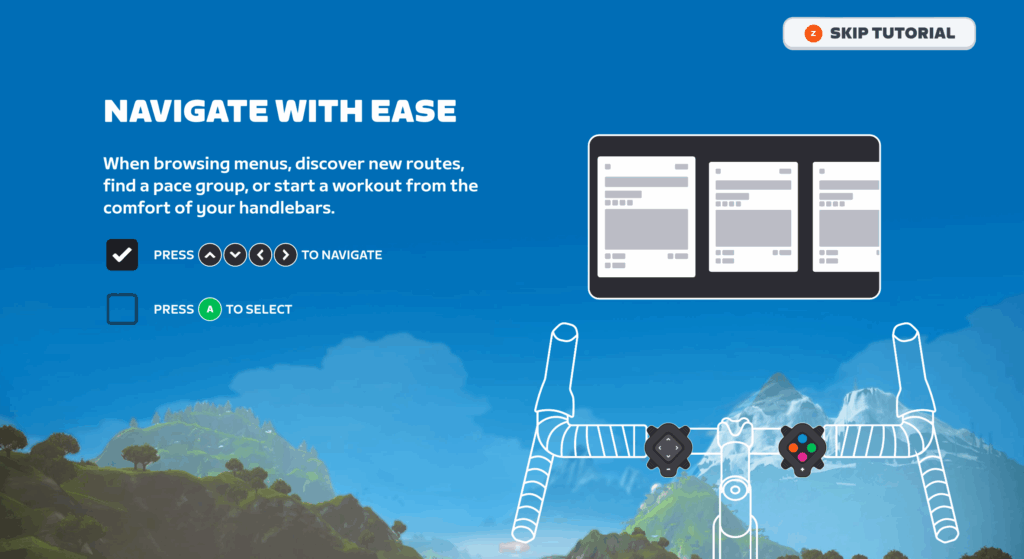
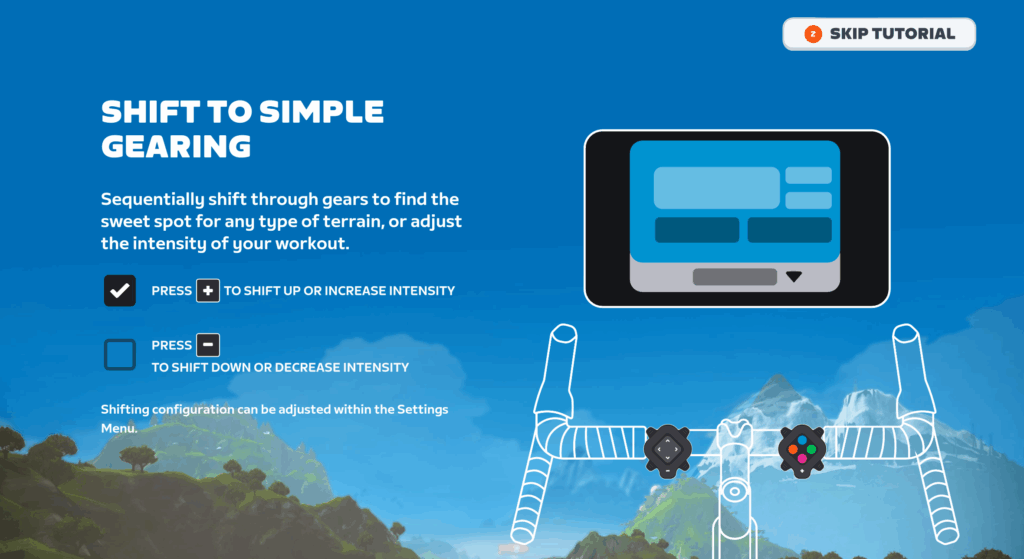
Before riding, I was greeted with a simple tutorial walking me through their capabilities:
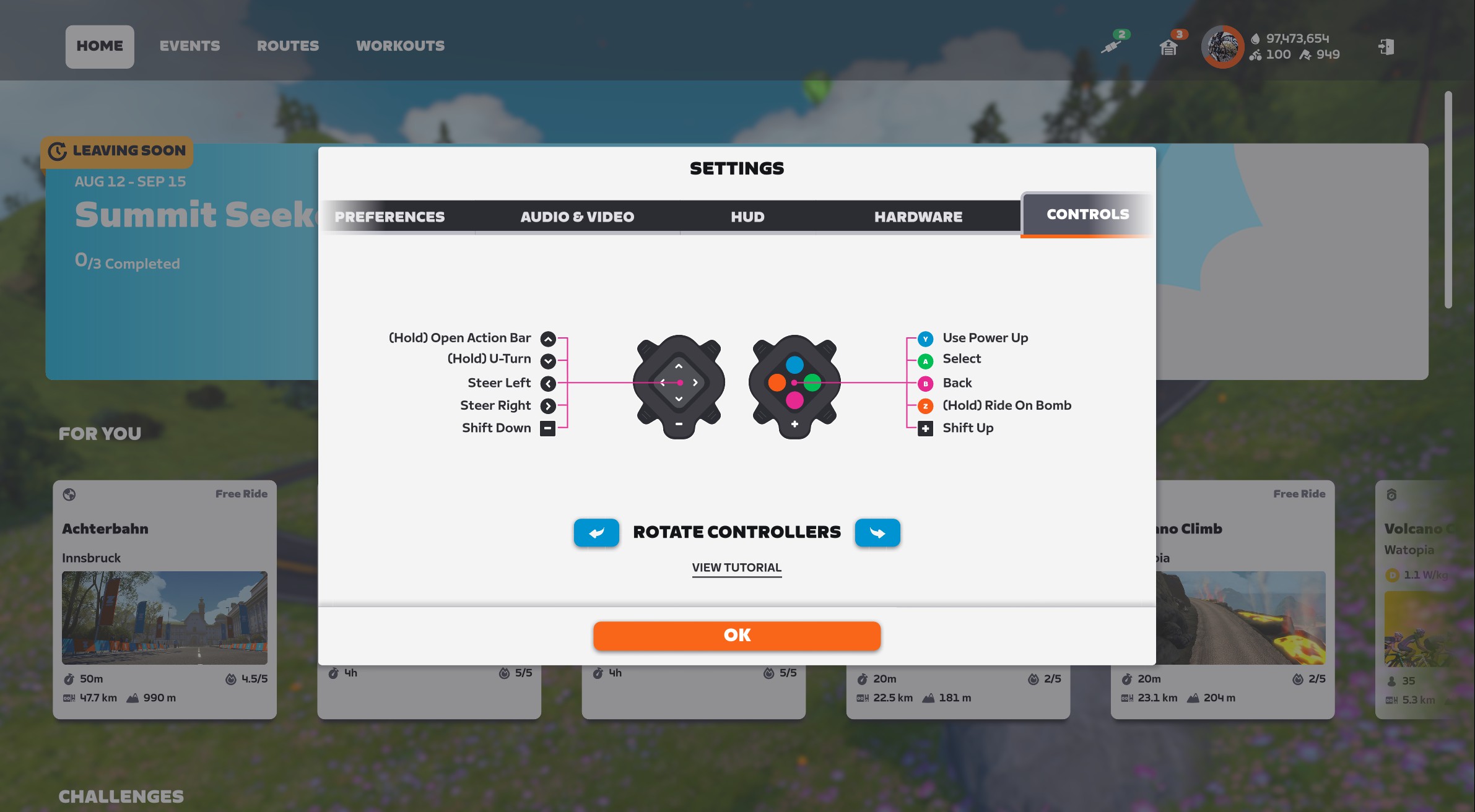
After finishing (or skipping) the tutorial, you’re ready to go! If you’d like, you can go to Settings>Controls and rotate the controllers, which may prove useful depending on how you decide to mount them.
Steering vs Intersection Selection
While the Click v2 does everything Zwift Play did (apart from braking), Zwift had to get a bit creative to squeeze all that functionality out of a pair of simple controllers.
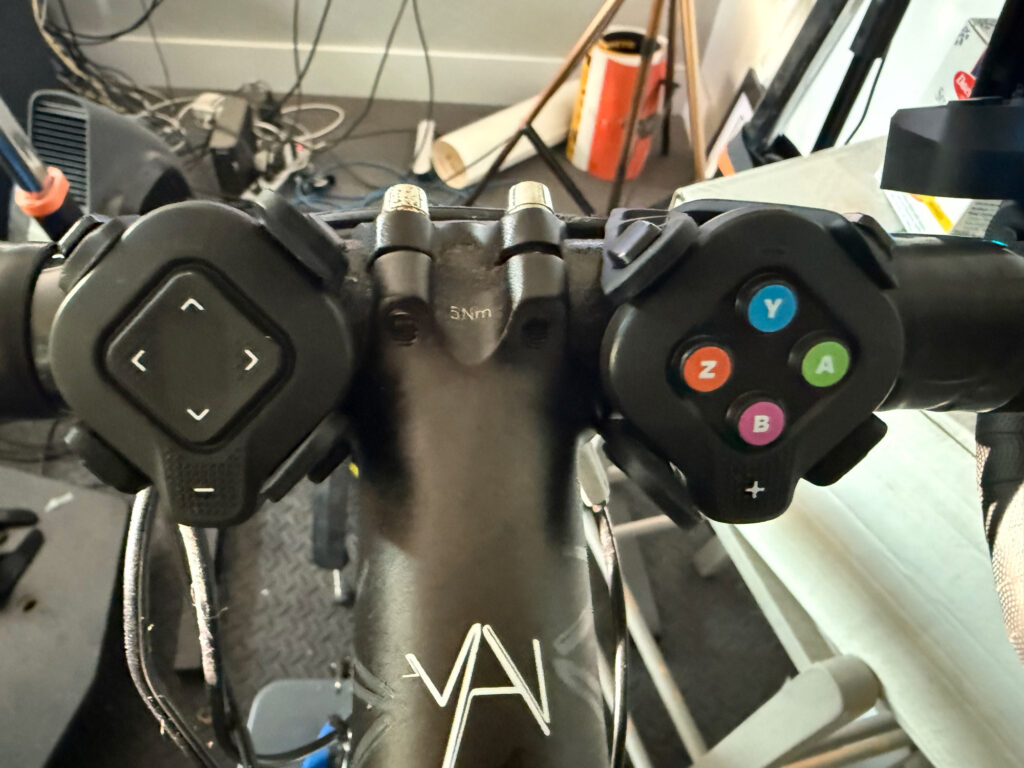
Specifically, if you want to manually choose a turn at an intersection, you have to press A when the intersection option pops up, then choose your desired intersection with left/right arrows. (On-screen text reminds you how this works.)
Apart from this little quirk, steering is simple using the left/right arrows on the left controller.
Virtual Shifting
If you have a smart trainer that supports Zwift’s virtual shifting (see list of compatible trainers), Click v2 can handle the shifting duties. The – button on the left controller shifts down to an easier gear, while the + on the right controller shifts up to a harder gear. These also modify FTP bias in ERG workouts when shifting is disabled.
Shifting with Click v2 is just as responsive as with Zwift Play and the original Zwift Click, happening quickly and reliably.
I had the Zwift Plays installed on my bike, and added the Click v2 on the flats of my bars as shown above. I found I enjoyed pairing both the Plays and the Click v2 to my Zwift session, as the Clicks came in handy as satellite shifters when I was riding on the flats.
Other Notes
I’ve been using the Click v2 on my main Zwift setup since May, which means I’ve logged over 100 hours of use. I changed the battery on one controller in my “pre-release” set early on, but they haven’t needed a battery change since.
Overall, I’ve been pleased with the feel and functionality of Click v2. The buttons are a bit easier to press than the Zwift Play, which is noticeable when you’re a Ride On bomber like myself.
Zwift has packed a lot of functionality into the new Click, and in a format that works on flat and tri bars, not just dropbars like the Zwift Play. While it doesn’t matter to me personally (I’m a roadie), that’s a smart and inclusive move on Zwift’s part for sure.
Even though they’re only being sold with the Zwift Cog at this time, the price point is so low that I’d recommend them to any Zwifter with Bluetooth capabilities in their setup, as they put all the in-game menus and steering at your fingertips, even if you can’t do virtual shifting. They’re handy, reliable, and quite bomb-proof. My bet is they’ll quickly become this season’s most popular hardware add-on for Zwifters.
Buy Zwift Click v2
As already mentioned, Zwift is not currently selling Click v2 as a standalone item. Hopefully that will happen soon.
Until then, Zwift Cog + Click upgrade kits for all Zwift Cog-compatible trainers are available directly from Zwift for £49.99/€49.99/$49.99:
CUPERTINO, Calif.—September means iPhones, and as expected, Apple has taken the wraps off a new iPhone 17 at its event today. The iPhone 17 will start at $799 for a 256GB model. Pre-orders start Friday, and the phones will be available on September 19.
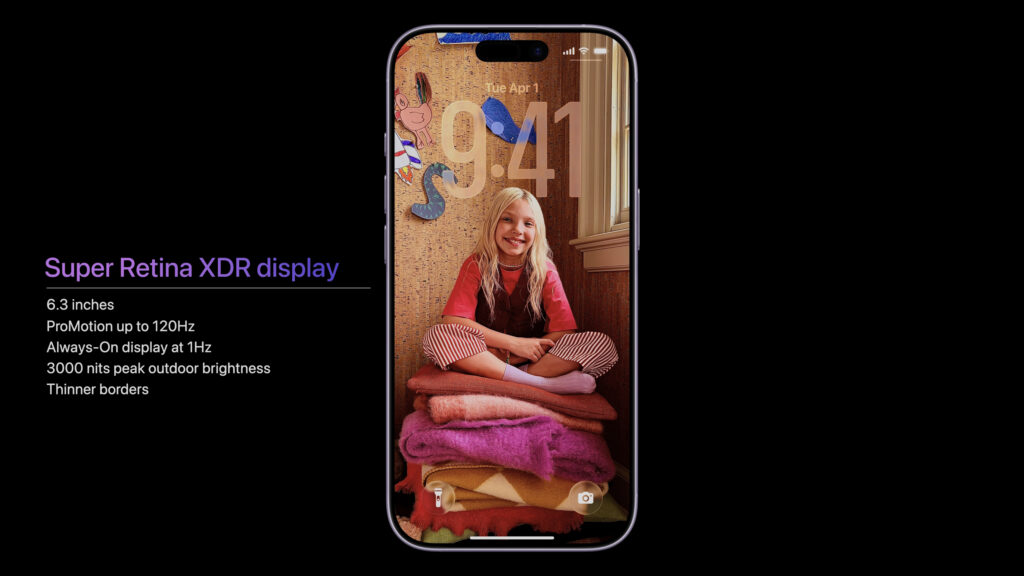
The updated OLED screen is the hero of the iPhone 17, bringing several features to the base iPhone that the iPhone Pro has enjoyed for years. The iPhone 17 steps up from a 6.1-inch to a 6.3-inch display, the same increase that came to the iPhone 16 Pro last year, and Apple has also added 120 Hz ProMotion support to the basic iPhone for the first time.
A 6.3-inch 120 Hz screen is the headlining feature of the new iPhone.
Credit:
Apple
The iPhone 17 is powered by the Apple A19 chip.
Credit:
Apple
The refresh rate adjusts dynamically based on what you’re doing, and can go as low as 1 Hz in the low-power always-on display mode. Apple has also improved the scratch-resistance of the display with Ceramic Shield 2, which the company says is three times as scratch-resistant as the old screen. The screen can also hit 3,000 nits of peak outdoor brightness.
The worst kept secret of 2025 is official. At its Awe Dropping event on Tuesday, Apple announced the iPhone Air, its thinnest iPhone to date.
Just how thin is the iPhone Air? At its thinnest point, the new model is 5.6mm thick. To put those measurements in perspective, the iPhone 16 Pro is 8.25mm thick, making the Air nearly 2mm thinner than Apple’s 2024 flagship. Prior to today, the 6.9mm thick iPhone 6 was the company’s thinnest smartphone to date. Since then, newer iPhones have been thicker to accommodate larger batteries, Face ID, multi-camera arrays and other components. The iPhone Air reverses that trend.
At the same time, Apple claims the Air is its most durable phone yet, with a frame made from recycled titanium. Additionally, the Air is encased in the company’s Ceramic Shield material, making it the first iPhone to offer a Ceramic Shield back.
Developing…
This article originally appeared on Engadget at https://www.engadget.com/mobile/smartphones/the-iphone-air-is-apples-thinnest-phone-yet-174342422.html?src=rss
With the start of September comes the promise of crisp, fall-like weather and, like clockwork, new iPhones. Apple’s “awe dropping” iPhone 17 event this year had execs showing off the latest iPhones from Cupertino and reminding folks of the changes Liquid Glass and iOS 26 will bring to their handsets in the coming week. New Apple Watches and AirPods are expected to be revealed as well. If you’re unable to watch the event live or follow along with Engadget’s liveblog, here are all of the biggest announcements coming out of Apple’s iPhone 17 event.
iPhone 17
The handsets in the standard iPhone 17 lineup have 6.3-inch, 120Hz displays with ProMotion and thinner borders. Apple’s touting improved durability thanks in part to Ceramic Shield 2, which has three times the scratch resistance as previous Ceramic Shield tech. The iPhone 17 is powered by the new A19 chipset, which is faster and more efficient than the previous processor thanks in part to an improved neural engine, a six-core CPU and a five-core GPU. Improvements in power efficiency will also get you eight additional hours of battery life on the iPhone 17.
As for the rear camera array, iPhone 17 has a 48MP main Fusion ultra wide camera and a 12MP telephoto lens. The selfie camera has been improved to be a “center stage” front camera, with better stabilization, a wider field of view and a new larger, square sensor that lets you take higher quality images and videos more easily. You also won’t have to rotate your iPhone when you want to take a photo or video in landscape mode.
AirPods Pro 3
Apple
After three years, we now have a new version of the AirPods Pro. Apple’s latest premium earbuds, the AirPods Pro 3, look much the same as the Pro 2, but now they have heart rate monitoring thanks to new built-in biometric sensors. The Fitness app has new experiences to accompany this, including new workouts you can track while wearing just AirPods Pro 3 and carrying your iPhone.
Apple’s also touting improved audio with spatial listening, better active noise cancellation (four times as effective as the ANC in the original AirPods Pro) and foam-infused eartips. Live translation is another new feature which is, unsurprisingly, powered by Apple Intelligence. A new gesture will activate live translation when you’re wearing the new buds, and it will translate words spoken to you in another language to your preferred language. To reply, all you have to do is speak naturally in your own native language, and a translation will show up on your iPhone screen for the person you’re talking with to see. As far as battery life goes, they should get at least eight hours on a single charge.
AirPods Pro 3 are available to order today for $249, and will be widely available on September 19.
Apple Watch Series 11, Apple Watch Ultra 3 and Apple Watch SE
Apple
Apple announced the Apple Watch Series 11 as its thinnest and most durable smartwatch yet. It’s twice as scratch resistant as previous watches, and it now supports 5G for the first time thanks to a new modem and improved internal tech that make it more power efficient. The watch will also be able to monitor for hypertension, or high blood pressure, using improved algorithms and the built-in heart rate monitor. If the watch identifies patterns of hypertension, you’ll get an alert in the Health app. Series 11 watches will also now get up to 24 hours of battery life on a single charge, an improvement from the previous model.
It’s been two years since we got an updated Apple Watch Ultra, and that’s been remedied now with the Ultra 3. The new watch has a bigger, better display thanks to LTPO 3 technology. A big new feature is satellite connectivity, allowing you to stay connected wherever you may go and Emergency SOS is included with all Ultra 3 watches.
On the entry-level side of the spectrum, the Apple Watch SE is getting an update with a new always-on display, optional 5G, the improved S10 chip and support for gestures like Double Tab and wrist-flick. The Apple Watch SE will also get sleep apnea notifications and the new Sleep Score feature that’s also available on the Series 11 watches. However, it’s battery life remains the same as before — up to 18 hours — although you will now get fast-charging support.
Apple Watch Series 11 starts at $399; the Ultra 3 starts at $799 and the SE starts at $249. You can pre-order them today and they’ll be widely available on September 19.
This story is developing; please refresh for updates.
This article originally appeared on Engadget at https://www.engadget.com/mobile/smartphones/everything-apple-revealed-at-the-iphone-17-launch-event-171028231.html?src=rss
Apple announced three new smartwatches at its “Awe Dropping” event today. Along with new iPhone 17 models, we now have the Apple Watch Series 11 as the rumors predicted. Engadget’s Cherlynn Low, Sam Rutherford and Billy Steele are on the ground at the event, so we’ll have hands-on coverage soon, followed by full reviews in a week or so. In the meantime, here’s everything we know about the newest Apple Watch.
Apple Watch Series 11
The keynote speech started off with dramatic testimonials of how the Apple Watch has helped people with their health and well being, alerting people to health issues and calling for help that saved their lives. And the new model will help identify hypertension.
Apple
As for what’s new this year, we heard from Stan Ng, VP of Apple Watch and health product marketing, who called the Series 11 the thinnest and most comfortable ever. The ionX glass now has a ceramic coating bonded at an atomic level making it two times more scratch-resistant than before.
Cellular connection has improved as well with 5G connectivity from most carriers at launch. The modem and antenna architecture should provide wider coverage while being more power efficient.
The wearable will ship with watchOS 26, which showcases the new Liquid Glass design — and the Apple Watch is getting a new watch face: Flow a “modern reinterpretation of a traditional regulator clock.”
This is a developing story. Check back for updates…
This article originally appeared on Engadget at https://www.engadget.com/wearables/apple-watch-series-11-includes-5g-and-a-hypertension-tracking-feature-172451506.html?src=rss