Europe, the bloc with 24 official languages and 287 spoken in total, won’t get Apple’s Live Translation with AirPods feature for now. “Live Translation with AirPods is not available if you are in the EU and your Apple Account Country or Region is also in the EU,” the company said on its iOS feature availability page. No reason was given, but it may have to do with the EU’s strict rules around artificial intelligence and how it impacts privacy.
If that’s the case, Apple may be waiting for the EU to approve or examine the feature before implementing it in the region. The AI Act is most strictly applied to “high-risk use cases” involving the potential for discrimination or violation of users’ privacy. To that end, the EU may want to ensure that date stored when using the app is kept securely and locally in the bloc.
Apple’s phrasing about availability seems to indicate that it will work for North American and other users visiting the bloc and possibly vice-versa. Only users with an Apple Europe account who are also in Europe won’t be able to access the feature.
Live Translation lets users with AirPods communicate naturally with speakers of other languages. If the other party also has AirPods, the conversation is translated and heard by both people. If you’re speaking with someone without AirPods, speech is translated onto your phone where it can be either be read or heard by the other party.
Live Translation was first introduced at WWDC as part of iOS 26 and unveiled as a key feature for the AirPods Pro 3 during Apple’s “Awe Dropping” event on Tuesday. It will work on iPhone 15 and later devices running Apple Intelligence, and be available with the AirPods Pro 3, AirPods Pro 2 and AirPods 4 once iOS 26 arrives on September 15.
Right now, Live Translation supports real-time translation between English, French, German, Portuguese (Brazil), and Spanish. However, Apple plans to add Italian, Japanese, Korean, and Chinese (simplified) support later in 2025.
This article originally appeared on Engadget at https://www.engadget.com/mobile/live-translation-with-airpods-wont-come-to-eu-based-apple-users-125410519.html?src=rss
Since the launch of the AMD EPYC 9005 series nearly one year ago, I have performed hundreds of different benchmarks on these EPYC “Turin” processors across a wide range of workloads/disciplines to really terrific performance, power efficiency, and value. AMD EPYC 9005 performs exceptionally well compared to the competition from Intel and ARM CPU vendors. One area though I hadn’t explored to this point was how well the AMD EPYC 9005 series performs for serving as the host CPU for GPU/AI servers. That changed as I recently wrapped up some benchmarks exploring that area using the AMD EPYC 9575F and it managed to accelerate past the available competition in proving capable of being the superior host processor for AI servers.
For years, the world of high-performance AI training has been a kingdom ruled by a single sovereign: NVIDIA. But the latest results from the MLPerf industry benchmark signal a powerful challenger is not just at the gates, it is breaching the walls. In a landmark submission, AMD showcased staggering performance with its Instinct MI300X GPUs that demonstrated not only record-breaking speed but a rapidly maturing software ecosystem. This isn’t just another incremental update; it’s a declaration that the AI hardware race is now a fiercely contested, two-horse race, promising a new era of innovation and competition for the entire industry.
Setting the Gold Standard with MLPerf
To understand the gravity of AMD’s achievement, one must first understand MLPerf. Organized by the MLCommons consortium, MLPerf is the Olympics of AI hardware and software. It provides a level playing field where companies like AMD, NVIDIA and Google submit their platforms to be tested on a suite of real-world, machine-learning training tasks. These benchmarks are the industry’s de facto gold standard for measuring performance, making them a critical barometer for enterprise customers deciding where to invest billions in their AI infrastructure. A strong showing here isn’t just about bragging rights; it’s about proving viability, performance and readiness for the most demanding AI workloads on the planet.
For this latest round, AMD submitted results for a standard server configuration featuring eight of its Instinct MI300X accelerators. This platform is AMD’s heavyweight contender, designed specifically to tackle the massive computational demands of training and deploying large language models (LLMs) and other generative AI systems.
Blistering Speed and Near-Perfect Scaling
The results speak for themselves. AMD’s submission demonstrated remarkable performance, particularly on some of the most popular and demanding models in use today. Using its robust ROCm 6 open software stack, the 8x MI300X server showed impressive “time-to-train” results, a critical metric that measures how quickly a system can train a model to a target level of accuracy.
One of the most significant takeaways was the platform’s scaling efficiency. In the world of AI, throwing more GPUs at a problem doesn’t guarantee a proportional increase in speed. The magic lies in making those GPUs work together seamlessly. AMD’s submission demonstrated near-linear scaling as it increased the number of GPUs, a testament to the maturity of its Infinity Fabric interconnect technology and the ROCm software. For enterprise customers, this is a crucial proof point: it means that as their AI needs grow, they can confidently scale their AMD-based infrastructure and expect predictable, powerful performance gains.
Expanding the Ecosystem with New Models
Perhaps more important than the raw performance numbers is what they were achieved on. For the first time, AMD submitted MLPerf results for training two of the industry’s most influential open-source models: Meta’s Llama 3 70B and Mistral’s Mixtral 8x7B. This is a massive strategic victory. For years, the primary barrier to AMD’s adoption in AI has not been the hardware itself, but the incumbency of NVIDIA’s CUDA software ecosystem. By demonstrating out-of-the-box, high-performance support for the very models that developers and businesses are clamoring to use, AMD is dismantling that barrier piece by piece.
This move signals that the ROCm software stack has reached a new level of maturity and usability that is capable of handling the complex demands of state-of-the-art models. It sends a clear message to the AI community that AMD is not just a hardware provider, but a serious platform contender committed to supporting the open-source models that are driving much of the innovation in generative AI.
The Head-to-Head with NVIDIA
Ultimately, every MLPerf submission is measured against the reigning champion. While direct, perfectly apples-to-apples comparisons are complex, the results place AMD’s MI300X in the same elite performance tier as NVIDIA’s formidable H100 GPUs. In several key benchmarks, AMD’s platform demonstrated performance that was not just competitive, but in some cases exceeded that of the NVIDIA submission in similar hardware categories.
This shatters the long-held perception that NVIDIA is the only viable option for cutting-edge AI training. It provides enterprise CIOs and AI researchers with what they have desperately needed: a choice. The ability to field a competitive bid from a second high-performance vendor introduces competition that can drive down prices, accelerate innovation and reduce the risks associated with being dependent on a single supplier.
Wrapping Up
AMD’s latest MLPerf results are a watershed moment for the AI industry. They represent the culmination of years of strategic investment in both silicon and software, resulting in a platform that can stand toe-to-toe with the best in the world. By delivering record-breaking performance, demonstrating near-perfect scaling and embracing the open-source models that define the modern AI landscape, AMD has proven it is no longer just an alternative but a true competitor for the AI throne. For a field that thrives on competition and innovation, this is unequivocally great news and heralds a future with more choice, better performance and faster progress for everyone.
Whether it’s a thumbnail-sized urban oasis or intended to get you through the zombie apocalypse (or something in between), keeping a home garden is a lot of fun—and a lot of work. It’s worth it, of course—aside from the natural beauty and the fresh veggies you can get from a personal garden, there are a host of physical, emotional, and mental health benefits associated with gardening. That assumes your garden is a success, of course.
If you have a brown thumb and your gardening efforts always turn into a floral graveyard, you might not be experiencing those benefits. If that describes you, the missing ingredient to your gardening triumph might be technology: There are a lot of apps and AI tools out there that can help you with everything from planning to maintaining your garden. If you’re struggling to keep things green, check out these apps and AI-powered tools you can use in your own home garden.
Planning tools
If you’ve never seriously gardened before, or just need some assistance planning it all out in terms of space, species, and layout, there are several tools that can make this process simpler for you:
VegPlotteris a simple, straightforward app ideal for folks who find complex, feature-packed tools to be difficult to use. You create a simple layout of your garden, select what you’re growing there, and the app tracks a calendar of growth and harvest times for you. It will even warn you if you don’t have enough space for your chosen plants. Cost: Free for up to 40 plantings; $22 or $35 per year for more options.
Planter is an alternative garden planner that’s easy to use—you just drag cute little pictures of plants onto a grid representing your garden. Planter automatically decides how many “squares” of your grid each plant needs, which makes it easier to lay everything out. Cost: Free, $24.99 per year, or $99 for a lifetime plan.
Garden Planneris a good choice if you need to plan out more than just plants, as it allows you to include pathways, fencing, and other landscaping features in your garden plan. It’s not as user-friendly as VegPlotter or Planter, but it’s relatively straightforward. Cost: $48 after a 15-day free trial.
Smart Gardeneris a great tool if you want to feed yourself and your family from your own vegetable garden, as it will quiz you on how many people are in the household, what zones you live in, and other basic info to help you plan what to grow and when you’ll be able to harvest it. Cost: $15 for 90 days; $40 for a year.
Reference
Seed to Spoon offers a lot of tools for planning and caring for a garden, including a robust companion plant reference that makes it stand out. The app shows you which plants will thrive together, making it simple to fill up your garden with a harmonious selection. Cost: Free version includes 10 free plants, $4.99 for 1 month, $24.99 for 6 months, and $46.99 for a year.
PictureThisis a simple, but powerful, plant ID tool. With just a quick photo of any plant, you’ll find out what you’re looking at, an assessment of its relative health, and information about its care. This is a necessity if you’re taking over an existing garden, if you’re “ungardening,” or if you wake up to discover invader plants insinuating themselves into your planned space. Cost: Free.
Journaling
A garden is a living thing, and all living things change over time. Keeping a garden journal is a crucial aspect of gardening, as it lets you track what you’ve grown, what yields were like, and what works and what doesn’t in your specific little spot. While you can certainly keep track of all this using a variety of tools (some of the other apps listed here include this feature, and there’s always old-fashioned pen and paper), Gardenize is a simple garden journal tool that makes it easy to input information about your garden. It automatically timestamps everything and makes it easy to see the impact of your choices over time. Cost: $8.99 for one month, $3.74 per month for 12 months, or $6.66 per month for three months.
All-in-one
Sometimes you don’t want a bunch of apps that do specific things—you want a single app that does everything:
Seedtimeis a comprehensive gardening app that many gardeners swear by. It includes just about everything you need, from a harvest and planting calendar generated from a list of what you want to grow to planning, layout, and journaling tools. It even tracks your inventory of seeds, fertilizer, and other supplies and lets you know when they expire or need replenishing. Cost: Free for the limited version, $7 per month for a basic subscription, or $9 for an unlimited subscription.
Growbot AI is a general AI tool—it’s basically ChatGPT but specifically for gardening. You can ask it anything you need to know and get an answer back in natural language, including specific numbers and timelines, if applicable. It’s only available on iOS, however, so if you’re an Android user, you might be stuck using a more generic AI chatbot for your questions. Cost: Free, or $29.99 annual subscription.
This route keeps us on Watopia’s southern coast for the entirety of the TTT, which is a nice change of pace. And yes, that pun is intended, because the rollers throughout this route will keep racers on their toes! Let’s discuss route details, bike choice, and all things TTT…
Looking at the Route: Southern Coast Cruise
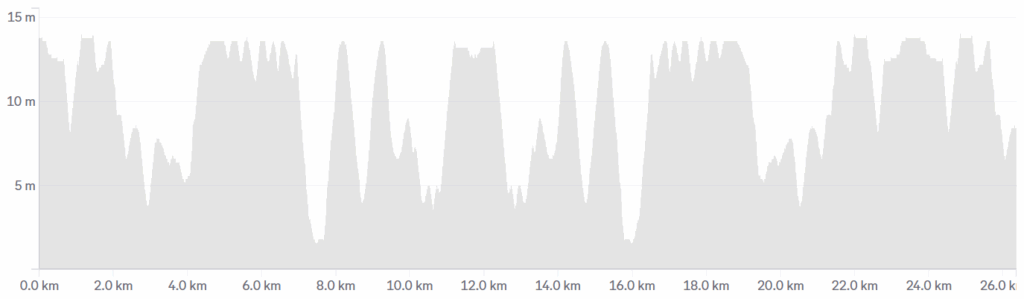
Watopia’s new Southern Coast Cruise is an out-and-back (and out?) route that is 26.3km long, with 147m of elevation gain. The lap profile below makes it look quite pitchy, until you realize each climb or descent is only changing elevation by 5-12 meters! This course is best described as fast, but constantly rolling.
This route doesn’t have any particular features like long climbs or descents worth calling out. Or perhaps the better way to say it is: this route is full of short climbs and descents, and your team must remain constantly vigilant to maintain the ideal power levels to maximize speeds! (See TTTips below for more pointers.)
This week, bike choice is easy: grab your most aero TT setup! The CADEX Tri is the fastest frame in game by a solid margin, and the new DT Swiss ARC 1100 DICUT 85/Disc wheels are the fastest wheels. If you don’t have access to that setup (level 40+) then see this post to determine the fastest TT setup available at your level.
Top Tier: CADEX Tri with DT Swiss ARC 1100 DICUT 85/Disc2nd Tier: Canyon Speedmax Disc with Zipp 858/Super9
Whatever you do, do not use a road frame. Because just like in real life, even a “slow” TT frame is much more aero than a road frame.
This round, for the first time in ZRL history, riders have access to two different speed-boosting upgrades. You’ll want to take maximum advantage of both, because your competitors will.
Bike Upgrades: A fully upgraded TT bike will be ~50 seconds faster across an hour of flat riding vs the non-upgraded version. Yes, this race will be closer to a half-hour effort, and anyone who has raced a TTT knows that’s a huge margin. Read more on this topic >
Lightning Aero Socks: These socks are unlocked by completing the Factory Tour Challenge, which was introduced in March 2025. Finishing it takes a lot of work, but the prize, the Aero Lightning Socks, will trim another ~12 seconds off an hour of riding. Read more on this topic >
Route Recon Videos and Resources
At the time this post was composed (Wednesday, September 10), the Zwift community hadn’t published any recon videos. Hard to blame them – the route wasn’t even in game until yesterday’s update, and it’s still event only.
I’ll share any recon videos or other resources here as I get them. Share in the comments section if you find or create anything useful!
Flatter courses like this week give valuable seconds to teams with big pure-power riders who can keep their power high on the front while staying in single-file formation to conserve in the draft behind. Extra seconds can also be gained by pacing smartly, ramping up the effort on short climbs and recovering a bit once you’re up to speed on the short descents.
On a course like this week’s, I highly recommend all team members set their Trainer Difficulty to the same value so you’re all feeling the gradient changes similarly. (When one rider has it set to 100% and another 25%, the first rider may ramp up power much more than the second when a climb hits, tearing your group apart.)
Your goal in a ZRL TTT is to get four riders across the line in the shortest time possible. That means every team’s pace plan will differ based on the abilities of each rider. We highly recommend having an experienced DS on Discord directing your team, especially if your team contains some inexperienced TTT riders.
If you want to go further down the TTT rabbit hole, I highly recommend Dave Edmond’s Zwift TTT Calculator tool.
Your Thoughts
Any insights or further thoughts on this race? Share below!
Tick tock Sam, just fifteen months before your first bill is dueOpenAI will pay Oracle $300 billion over the course of five years to fuel Sam Altman’s AI ambitions by providing five gigawatts of compute capacity.…
The GCC Rust compiler “gccrs” compiler developers have been keeping at it toward their goal of being able to compile the Linux kernel’s Rust kernel crate and as part of that the Rust core library…
Thomas Zimmermann of SUSE sent out today what is anticipated to be the last drm-misc-next feature pull request for DRM-Next that is targeting the upcoming Linux 6.18 kernel cycle…
Discover the latest features of DavMail 6.4, the open-source Exchange gateway that enhances email access and collaboration. Download now for seamless integration.
The Spanish authorities will deploy 1,100 officers and 400 members of the Guardia Civil this weekend in Madrid to ensure the safety of riders in the Vuelta a España amid ongoing protests against the participation of Israel–Premier Tech in the race.
The Governmental Delegation in Madrid announced the “extraordinary” reinforcement in a statement, which was agreed upon yesterday, according to AS.
Saturday’s stage 20 from Robledo de Chavela to Alto de la Bola del Mundo takes on the mountains near Madrid, and will see 400 civil guards mobilised.
On Sunday, the final stage of this year’s race from Alalpardo to Madrid will be secured by 1,100 national police officers, in what is the largest mobilisation of police since the 2022 NATO summit in Madrid.
According to AS, the Delegation emphasised the right to protest is a fundamental right that cannot be limited, and therefore the right to peaceful demonstration will be guaranteed throughout stages 20 and 21.
The police and Guardia Civil make up the police forces for the stages throughout La Vuelta, except for those in the Basque Country and Catalonia, where security is provided by local police.
Pro-Palestinian protesters waving flags at the start of the 16th stage of the Vuelta a España. Miguel Riopa / Getty Images
The regular security operation for this year’s La Vuelta has consisted of 132 civil guards and more than 70 national police officers.
Protestors have been demonstrating at the race against the participation of Israel–Premier Tech, which is co-owned by Canadian–Israeli businessman Sylvan Adams, who is a vocal supporter of the state of Israel.
Stephanie Adam, a campaigner for the Palestinian Campaign for the Academic and Cultural Boycott of Israel, which called for the protests, described the team’s participation at the race as “sportswashing pure and simple”.
Many riders have voiced concern for their safety at the race and there have been several crashes due to protests.
Yesterday, the riders’ union voted to neutralise stage 17 if there were protests and race organisers have shortened today’s individual time trial due to planned protests.
Armbian 25.8 distribution for ARM devices is now available for download with support for new boards, Linux kernel 6.16, as well as various improvements. Here’s what’s new!
Wireshark 4.4.9 has been released today as the ninth maintenance update to the latest Wireshark 4.4 stable series of this popular, open-source, free, and cross-platform network protocol analyzer software for Linux, macOS, and Windows systems.
Fwupd 2.0.15 has been released today as the fifthneenth maintenance update to the fwupd 2.0 series of this open-source Linux firmware update utility, adding support for more devices, new features, and bug fixes.
A group led by RSS co-creator Eckart Walther has launched a new protocol designed to standardize and scale licensing of online content for AI training. Backed by publishers like Reddit, Quora, Yahoo, and Medium, Real Simple Licensing (RSL) combines machine-readable terms in robots.txt with a collective rights organization, aiming to do for AI training data what ASCAP did for music royalties. However, it remains to be seen whether AI labs will agree to adopt it. TechCrunch reports: According to RSL co-founder Eckart Walther, who also co-created the RSS standard, the goal was to create a training-data licensing system that could scale across the internet. “We need to have machine-readable licensing agreements for the internet,” Walther told TechCrunch. “That’s really what RSL solves.”
For years, groups like the Dataset Providers Alliance have been pushing for clearer collection practices, but RSL is the first attempt at a technical and legal infrastructure that could make it work in practice. On the technical side, the RSL Protocol lays out specific licensing terms a publisher can set for their content, whether that means AI companies need a custom license or to adopt Creative Commons provisions. Participating websites will include the terms as part of their “robots.txt” file in a prearranged format, making it straightforward to identify which data falls under which terms.
On the legal side, the RSL team has established a collective licensing organization, the RSL Collective, that can negotiate terms and collect royalties, similar to ASCAP for musicians or MPLC for films. As in music and film, the goal is to give licensors a single point of contact for paying royalties and provide rights holders a way to set terms with dozens of potential licensors at once. A host of web publishers have already joined the collective, including Yahoo, Reddit, Medium, O’Reilly Media, Ziff Davis (owner of Mashable and Cnet), Internet Brands (owner of WebMD), People Inc., and The Daily Beast. Others, like Fastly, Quora, and Adweek, are supporting the standard without joining the collective.
Notably, the RSL Collective includes some publishers that already have licensing deals — most notably Reddit, which receives an estimated $60 million a year from Google for use of its training data. There’s nothing stopping companies from cutting their own deals within the RSL system, just as Taylor Swift can set special terms for licensing while still collecting royalties through ASCAP. But for publishers too small to draw their own deals, RSL’s collective terms are likely to be the only option.
The first 21 satellites in a constellation that could become a cornerstone for the Pentagon’s Golden Dome missile defense shield successfully launched from California Wednesday aboard a SpaceX Falcon 9 rocket.
The Falcon 9 took off from Vandenberg Space Force Base, California, at 7:12 am PDT (10:12 am EDT; 14:12 UTC) and headed south over the Pacific Ocean, heading for an orbit over the poles before releasing the 21 military-owned satellites to begin several weeks of activations and checkouts.
These 21 satellites will boost themselves to a final orbit at an altitude of roughly 600 miles (1,000 kilometers). The Pentagon plans to launch 133 more satellites over the next nine months to complete the build-out of the Space Development Agency’s first-generation, or Tranche 1, constellation of missile tracking and data relay satellites.
Amazon’s Zoox officially launched its driverless robotaxi service in Las Vegas with free rides from a few select locations. “Riders will eventually have to pay, but Zoox said it’s waiting on regulatory approval to take that step,” notes CNBC. A broader rollout is expected in the coming months. From the report: … unlike Waymo and Tesla, Zoox’s electric robotaxi doesn’t resemble a car. There’s no steering wheel or pedals, and the rectangular shape has led many in the industry to describe it as a toaster on wheels. Zoox co-founder and technology chief Jesse Levinson says, “We use robotaxi or vehicle or Zoox.” “You can shoehorn a robotaxi into something that used to be a car. It’s just not an ideal solution,” Levinson told CNBC in an interview in Las Vegas. “We wanted to do that hard work and take the time and invest in that, and then bring something to market that’s just much better than a car.”
Zoox was founded in 2014, five years after Google formed the project that became Waymo. Following Las Vegas, the company said it plans to debut an early rider program in San Francisco before the end of the year. The company has been testing a fleet of 50 robotaxis in San Francisco and Las Vegas. Austin and Miami will be Zoox’s next locations, the company said. Zoox will soon begin testing robotaxis in those markets, and said it’s already driving retrofitted test vehicles in Los Angeles, Atlanta and Seattle. “We think it’s very, very early days, and the future is not written yet,” said Levinson, during a demo ride with CNBC.
Zoox’s Las Vegas depot spans 190,000 square feet, which is about the size of three football fields. At the facility, the company houses the dozens of vehicles set to start operating around the city. Smartphone users will be able to order them from Top Golf, Area15, Resorts World Las Vegas, New York-New York Hotel & Casino and Luxor Hotel & Casino. The robotaxi features two rows of seats that face each other and can transport up to four people at a time. The front and rear are identical, with bidirectional wheels that allow it to move forward or backward without turning around. The vehicle can run for 16 hours on a single charge. Floor-to-ceiling windows provide a sightseeing experience for passengers who want a clear view of the endless rows of casinos. But the interior design is meant to enable easy conversation with fellow riders. “It’s not a retrofitted car,” said Zoox CEO Aicha Evans. “It’s built from the ground up around the rider.”