Also: Project Windless‘s publisher confirms its genAI-friendly development cycle

Also: Project Windless‘s publisher confirms its genAI-friendly development cycle
Mazda, the automaker that for years defended its scroll-wheel infotainment system as a safer alternative to touchscreens, is abandoning the approach entirely in the 2026 CX-5 in favor of a 15.6-inch touchscreen and zero physical buttons.
The current lineup — the CX-50 Hybrid, CX-70 and CX-90 — still relies on a console-mounted scroll wheel and dedicated action buttons to navigate a tablet-like screen perched atop the dashboard. Upper-trim CX-70 and CX-90 models do have 12.3-inch touchscreens, but touch input only works when parked and only inside CarPlay; it disables automatically once the car is in drive.
The new CX-5 goes the other direction entirely, eliminating all hard buttons including the volume knob and physical climate controls that current models still offer. Mazda says the touchscreen is safe because core functions like climate are pinned to a persistent bottom bar — an approach Ford, Rivian, and most of the industry adopted years ago.


Read more of this story at Slashdot.
Various forms of tools, colloquially known as “AI”, have been
rapidly pervading all aspects of open-source development. Many
developers are embracing LLM tools for code creation and review. Some
project maintainers complain about suffering from a deluge of slop-laden pull
requests, as well as fabricated bug and security
reports. Too many projects are reeling from scraperbot attacks that
effectively DDoS important infrastructure. But an AI bot flaming an
open-source maintainer was not on our bingo card for 2026; that seemed
a bit too far-fetched. However, it appears that is just what happened
recently after a project rejected a bot-driven pull request.
Snapchat is taking a page out of Meta’s handbook. The social media platform has announced it will launch creator subscriptions for users. Meta-owned Instagram and Facebook currently offer a similar feature.
On Snapchat, creator subscriptions will give users access to exclusive content across Snaps and Stories. They will also get priority replies and go ad-free on stories. Snapchat pitches the new feature as great way to give creators “freedom to experiment” and “build a recurring income stream” — all good things for keeping people on your platform.
Creators can choose exactly how much they want to charge subscribers per month. They can spread these figures out across Snapchat’s recommended tiers.
Starting February 23, select US-based Snapchat creators will be able to offer subscriptions. In the US, iOS users should then be able to subscribe to their accounts. The feature should expand to Canada, France, and the UK in the coming weeks.
This article originally appeared on Engadget at https://www.engadget.com/social-media/snapchat-is-rolling-out-creator-subscriptions-152114731.html?src=rss

The life sim will allow anyone to access an island regardless of who owns it
Wi-Fi
Nintendo’s Virtual Boy app is now available to download on Switch and Switch 2 as part of its Nintendo Classics offering. You’ll need to have a Nintendo Switch Online + Expansion Pack membership to access the launch titles, and unlike Nintendo’s other retro emulators, this one also requires a dedicated accessory.
As a reminder, the Virtual Boy was a portable tabletop system released in 1995, and the first console capable of rendering stereoscopic 3D graphics. It had a facemask with a monochrome red display built onto a bipod, so rather than wearing it like a modern VR headset, you had to awkwardly push your face towards it to play games.
Once you enter the third dimension, there’s no going back…#VirtualBoy – Nintendo Classics is available now on #NintendoSwitch2 and #NintendoSwitch, as part of #NintendoSwitchOnline + Expansion Pack! pic.twitter.com/2uLd8iYorB
— Nintendo UK (@NintendoUK) February 17, 2026
While undeniably innovative for the time, the console never took off (to put it gently), but Nintendo is giving anyone who missed out in the ’90s a chance to experience one of the strangest experiments in its history in 2026. Aesthetically, the $100 Virtual Boy add-on is a near perfect replica of the original console, with the big difference being that rather than a built-in display, it has a slot for sliding in your Switch or Switch 2. And unlike the OG Virtual Boy, this one is also wireless.
If $100 seems a bit steep for something that’ll almost certainly be collecting dust before summer rolls around, Nintendo is also selling a $25 cardboard version (unfortunately your old Labo VR headset won’t work here). Both are available to buy from the My Nintendo Store.
The Virtual Boy app is launching with the following games today: 3d Tetris, Galactic Pinball, Golf, The Mansion of Innsmouth, Red Alarm, Teleroboxer and Virtual Boy Wario Land. More games will be added in the future, including Mario Clash, Mario’s Tennis and Space Invaders Virtual Collection.
This article originally appeared on Engadget at https://www.engadget.com/gaming/nintendo/nintendos-virtual-boy-app-is-now-available-to-download-150705800.html?src=rss
Version
6.6.0 of KDE’s Plasma desktop environment has been
released. Notable additions in this release include the ability to
create global themes for Plasma, an “extract text” feature in the Spectacle screenshot
utility, accessibility improvements, and a new on-screen keyboard. See
the changelog
for a full list of new features, enhancements, and bug fixes.
The release is dedicated to the memory of Björn Balazs, a KDE
contributor who passed away in September 2025. “Björn’s drive to
“
help people achieve the privacy and control over technology that he
believed they deserved is the stuff FLOSS legends are made of.
During the flurry of CES 2026 news at the start of the year, it might have been easy to overlook Amazon’s announcement that the Fire TV user interface is getting a revamp. But that redesign is rolling out starting today for US viewers. It will be available to users as a free update.
The main visual updates for the streaming device’s UI are a lot of rounded corners. But Amazon is also emphasizing speed in this new look, claiming that the improvements will offer 20 to 30 percent faster interactions. This version of the UI also makes more apps visible on the screen at a time, with up to 20 apps able to be pinned to the homescreen compared with six in the prior design. The update also has access to the Alexa+ AI voice assistant if you want to use it to pull up viewing suggestions or to organize your viewing queue.
This article originally appeared on Engadget at https://www.engadget.com/entertainment/streaming/amazons-fire-tv-redesign-is-rolling-out-today-150000988.html?src=rss
With memory pricing being as wild as it is these days and with MRDIMMs on Xeon 6 Granite Rapids offering much more memory bandwidth than conventional DDR5 RDIMMs, you may be wondering about the performance impact when not populating all twelve memory channels on the Xeon 6900 series processors. In this article are benchmarks to demonstrate the performance difference of MRDIMM-8800 memory across using six, eight, ten, and twelve MRDIMMs with a Xeon 6980P server.
There’s little worse than losing an hour or two of hard work, just by clicking on the wrong button or pressing the wrong key in Microsoft Word—a mistake that sees your well-crafted document (or a sizable portion of it) disappear before your eyes.
A slip of the fingers isn’t the only way you can potentially lose work, either. Maybe you just have the misfortune to be busy at your computer when a power outage happens—taking your desktop, Microsoft Word, and your unsaved work along with it.
However, before you begin all over again, there are some tricks you can try to bring your work back.
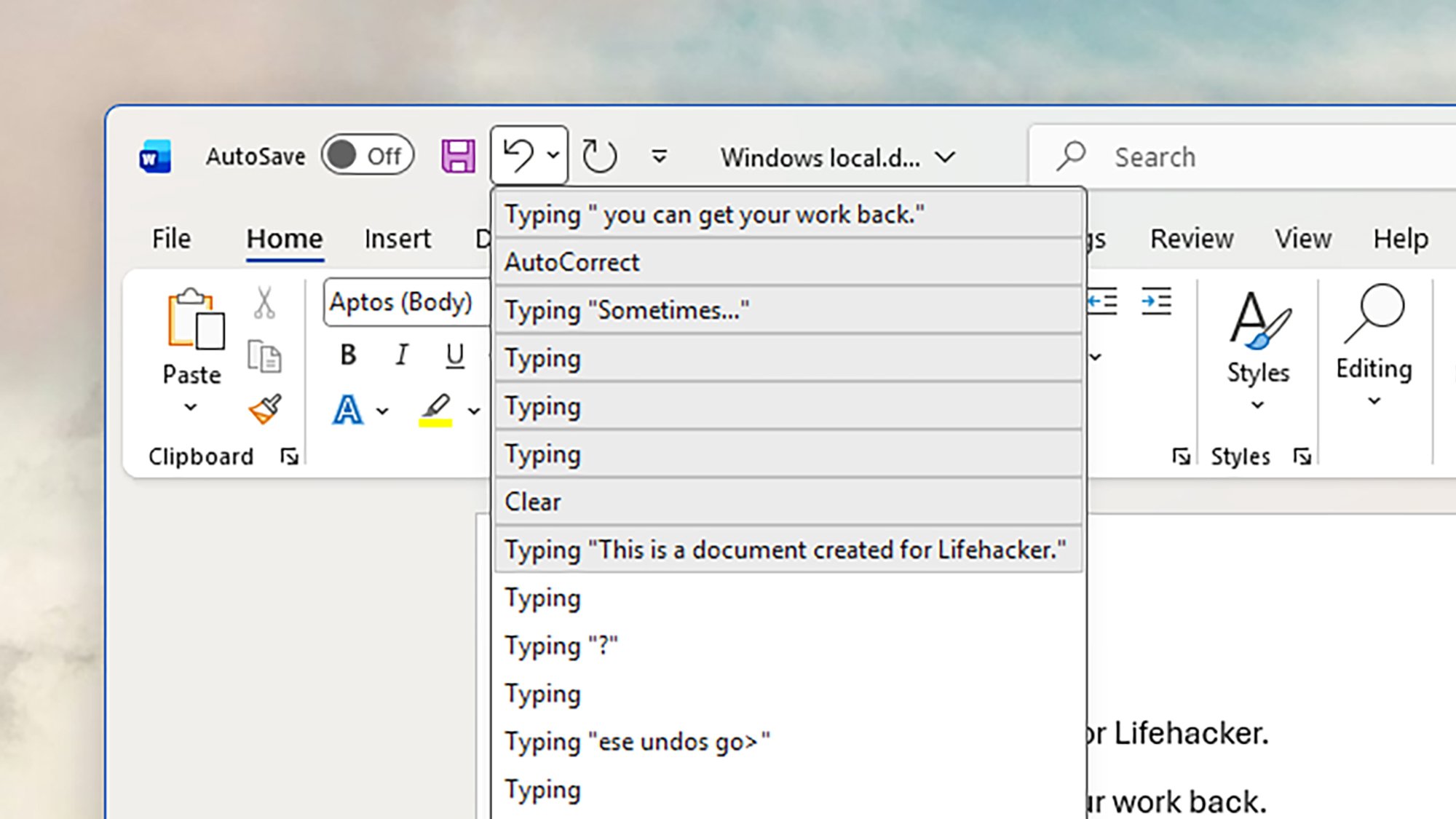
Sometimes, all you need is the undo command—hit Ctrl+Z (Windows) or Cmd+Z (macOS) to undo your last action in Word. It might be enough to restore that table you accidentally deleted, or bring back that huge block of text you moved to the clipboard and have since lost track of.
This won’t save you from a power outage, and it doesn’t include all actions (it won’t bring back a file you’ve closed, for example). However, it’ll work a lot of the time when you’ve made a mistake, and Word always keeps a record of your last 100 actions in the app, so you can go back a fair way.
There’s also an undo button up in the top left corner of the Word interface: Click on this to undo the last action, or click the arrow next to it to see a list of previous actions and choose where you want to go back to. To the right of the undo button is the redo button, which works the same way but in the opposite direction.
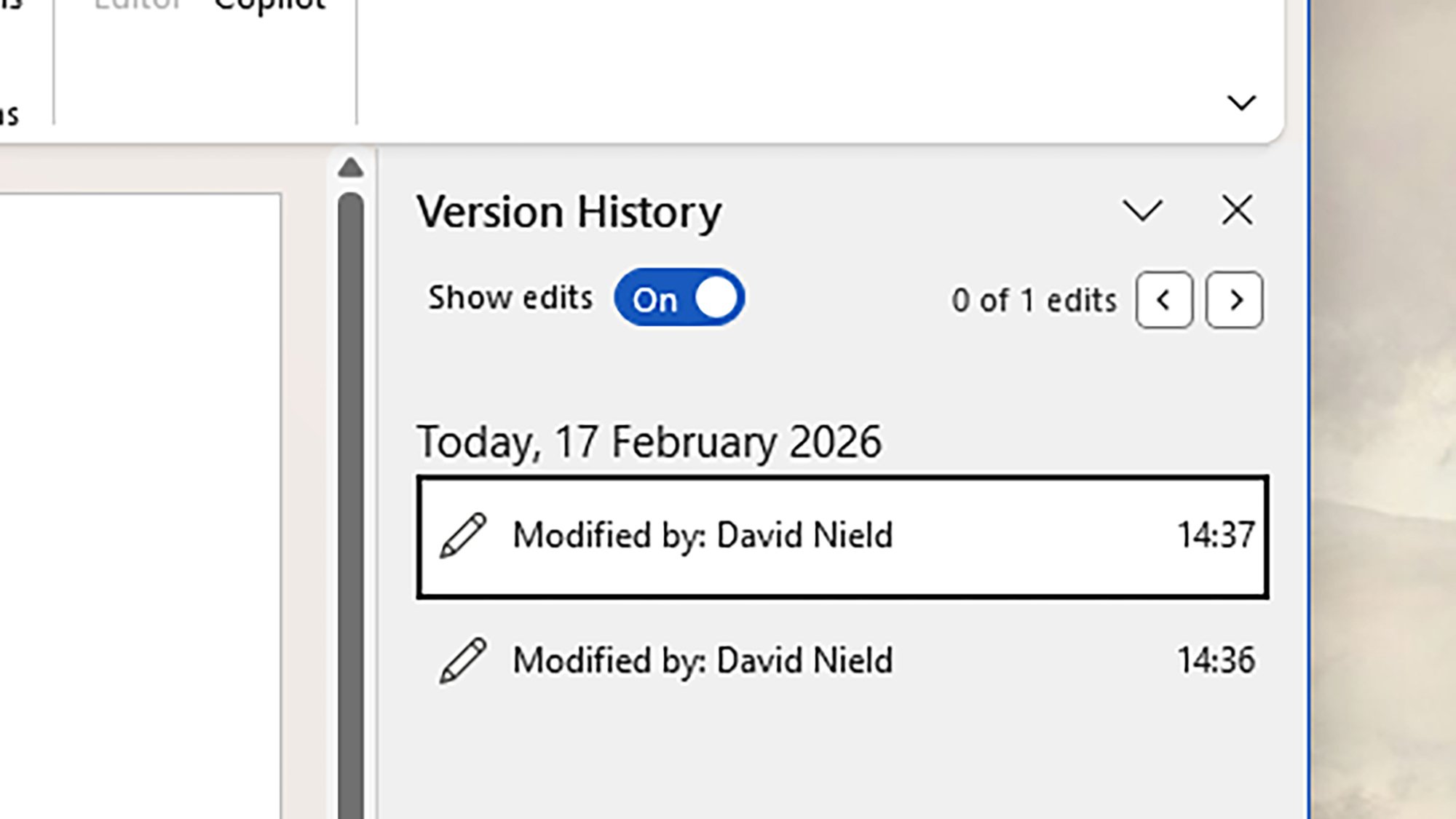
Word also has a file version history feature you can utilize to bring back lost work: It essentially saves past versions of your document at regular intervals, so you can go back in time, and even all the way back to the file’s creation. It’s like a super undo, which works between app restarts as well.
In Word for Windows, you can find these older incarnations of your document by heading to File > Info > Version History. If you’re using Word on macOS, it’s File > Browse Version History. A new sidebar opens on the right, showing all the available previous versions, and the date and time they were saved.
There is a caveat to this, though, which is you have to have your document saved in the cloud (in OneDrive) for this to work. If you’re working with a local file that’s only saved on your computer and you try and access version history, you’ll be prompted to save it to OneDrive instead (which will turn on version history).
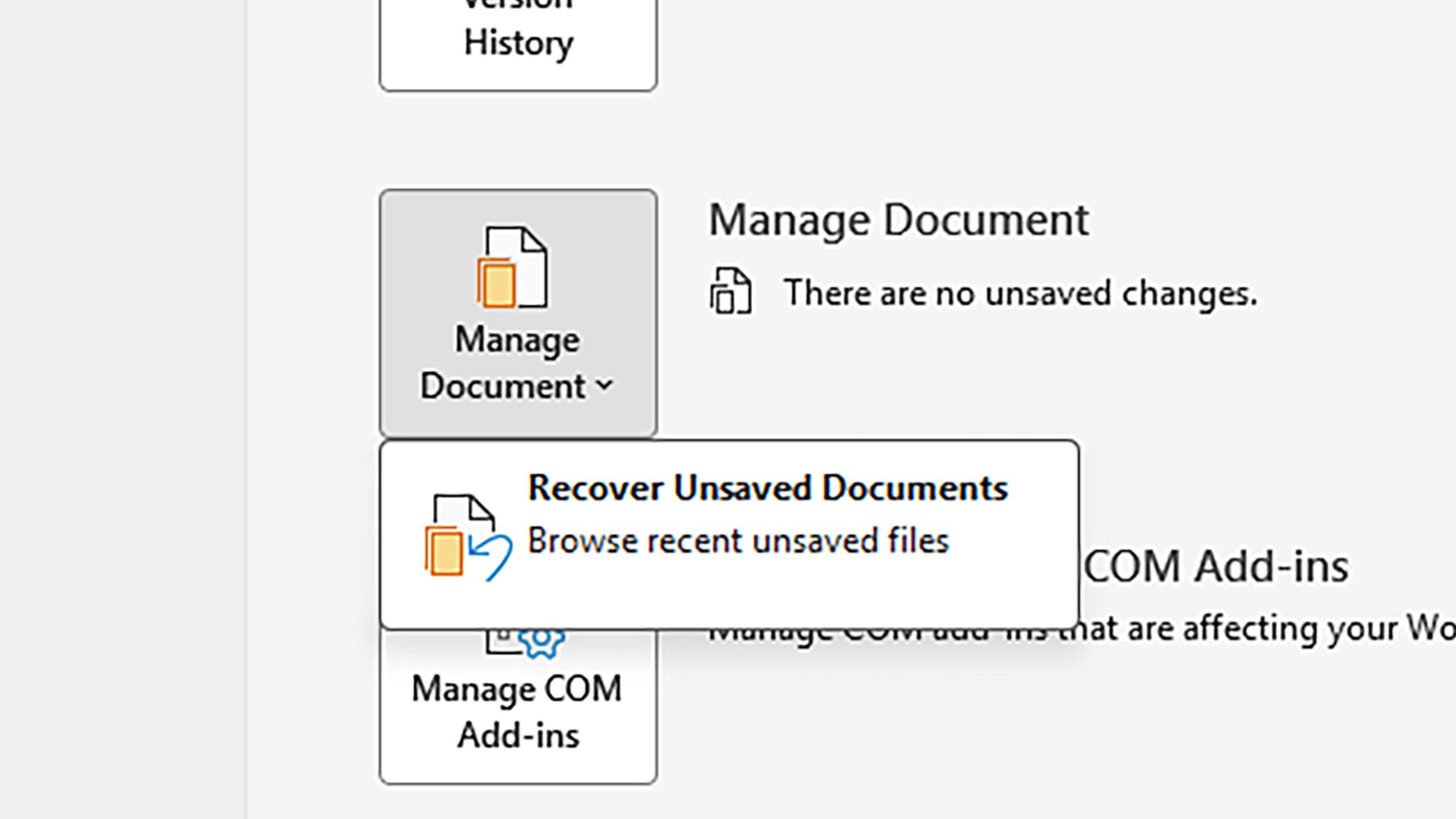
Word actually saves files temporarily to your computer every so often, so if the program crashes without warning, you should see an autorecovery dialog pop up the next time you load Word, asking if you want to recover the old file. If not, you can see partially saved files by clicking Click File > Info > Manage Document > Recover Unsaved Documents.
That’s only for Windows, however—if you’re on macOS, you’re relying on the auto-recovery process. Word for both Windows and macOS lets you set how often auto-recovery files are saved: Head to File > Options > Save (Windows) or Word > Preferences > Save (macOS). The default is every 10 minutes, but you can adjust this if needed.
If you’re still not seeing your file, you can try checking the temporary cache folder manually. On Windows, check “C:Users
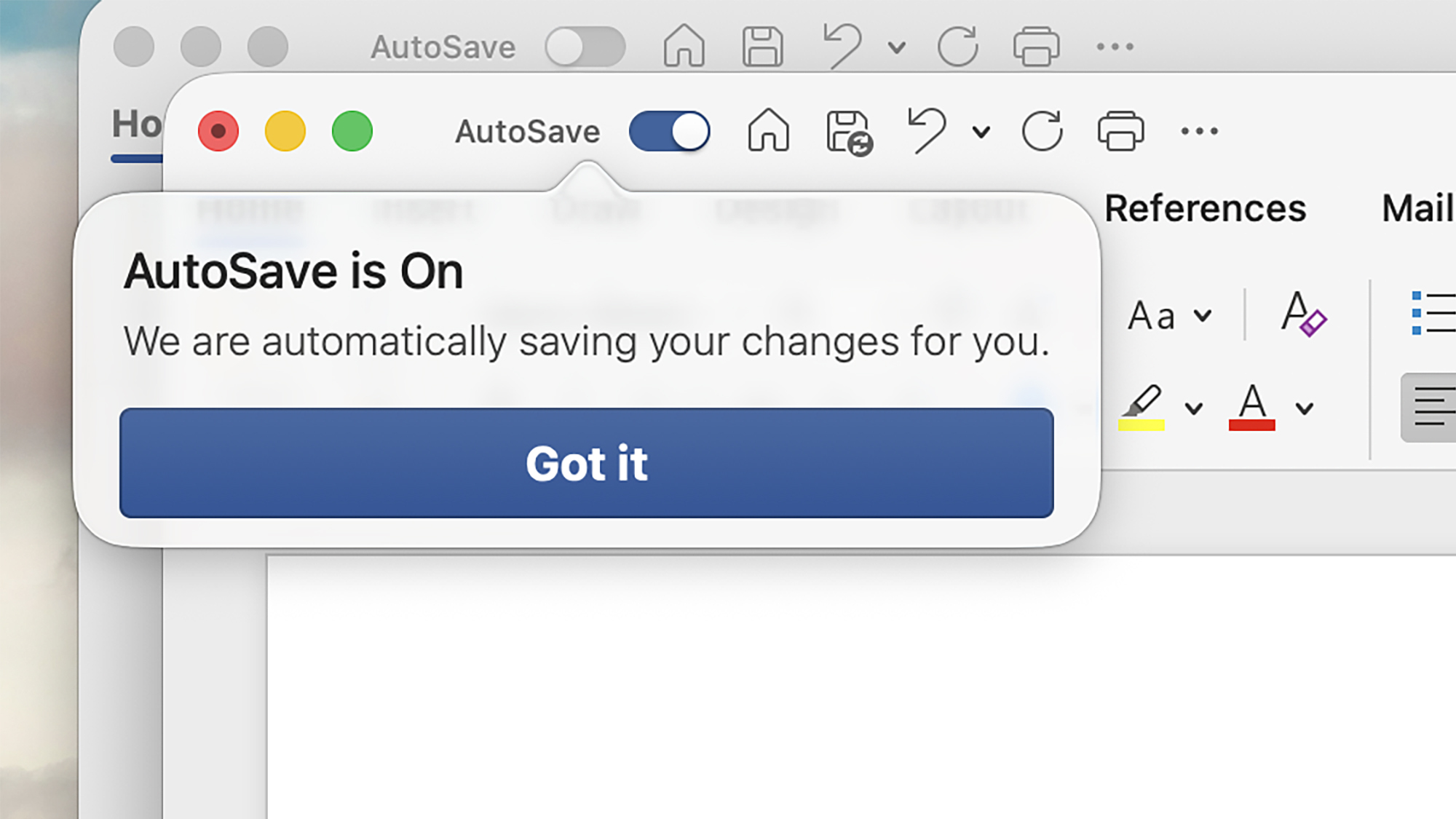
These days, Microsoft Word will tend to push you to save your work in OneDrive in the cloud. There are multiple benefits for this, including the version history feature mentioned above, and the option to collaborate on documents with other people. It also enables another handy feature: AutoSave.
This is exactly what it sounds like, and means that every time something is changed in your document, it quickly syncs to the cloud. You’ll see the AutoSave button in the top left hand corner enabled when it’s active, and the document name at the top of the app window will indicate when saves are in progress.
Should Word or your PC crash, your work should be safe. AutoSave is enabled by default for files saved to OneDrive, but you can customize this behavior by heading to File > Options > Save on Windows) or Word > Preferences > Save on macOS.

The hugely popular farming sim is a chill, easygoing experience, but it still helps to know a thing or two
Announced
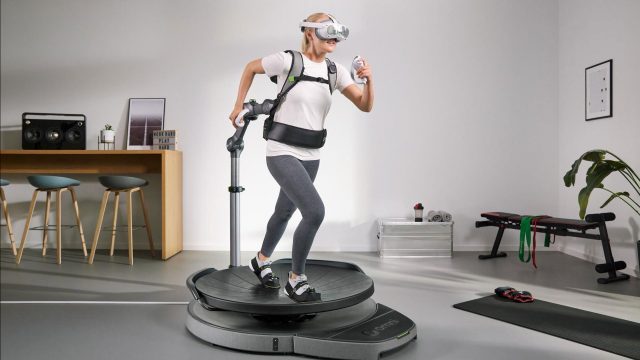

Virtuix announced it’s joined the Made for Meta program, which opens the door to bring official Quest compatibility to the company’s Omni One VR treadmill.
Made for Meta is a hardware partnership that certifies that accessories not only work with Meta devices, but also meet the company’s quality standard. Since the 2023 launch of the program, a wide range of Made for Meta accessories have been certified, including bHaptics TactSuit Pro, Logitech MX Link stylus, and Roto VR Explorer Chair.
As the latest member of the program, Virtuix says it plans to make its Omni One VR treadmill compatible with Quest headsets and games, effectively broadening Omni One’s reach to the world’s largest XR user base.
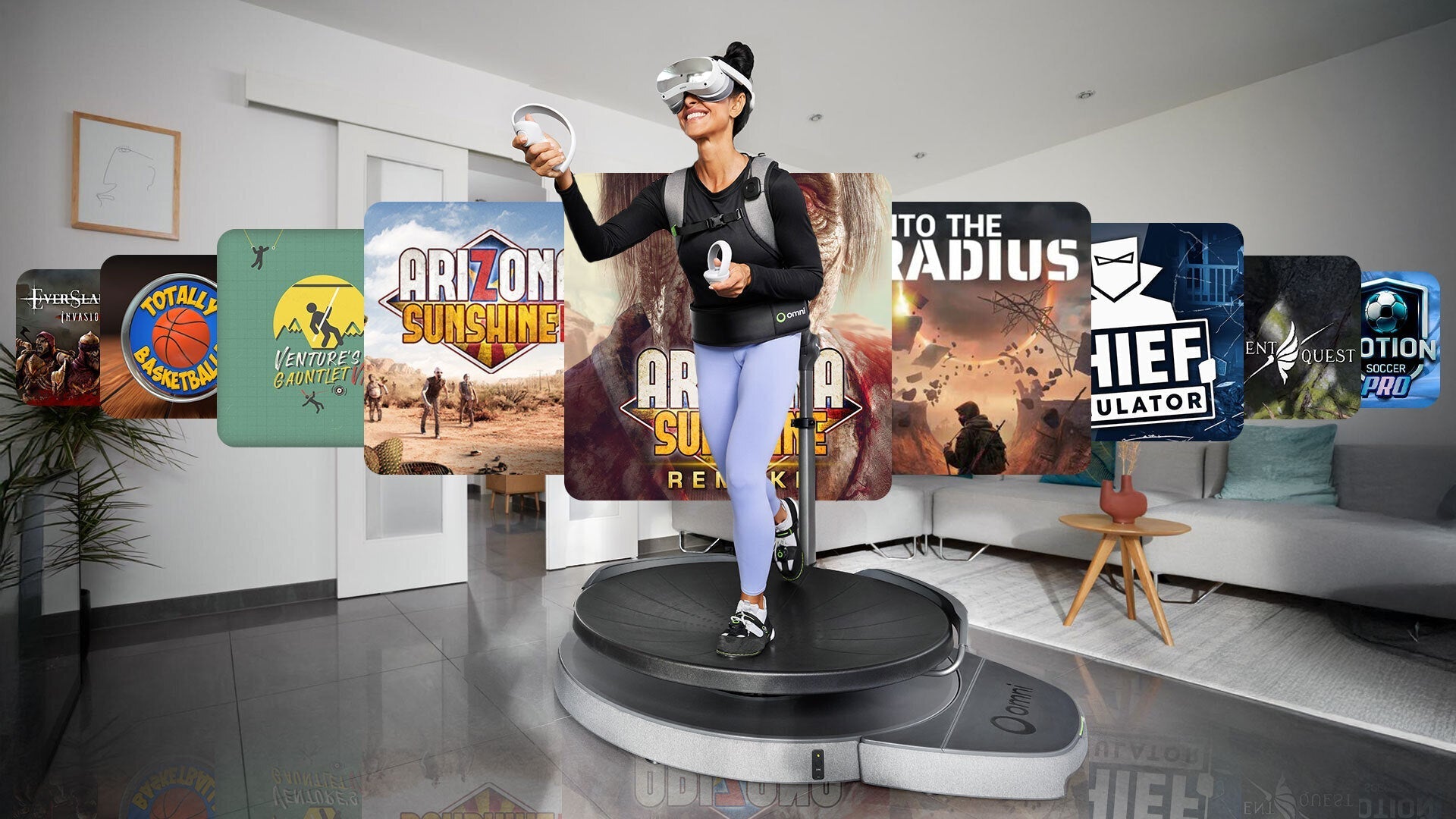
Official Quest support will be a first for Omni One. Before joining Made for Meta, the VR treadmill supported PC VR headsets through its ‘Core’ device, priced at $2,600, as well as a custom Pico 4 Enterprise Ultra headset through its ‘Complete’ system, priced at $3,500.
“Joining the Made for Meta program expands our addressable market to millions of active Quest users who already own and love their VR headset and games library,” said Jan Goetgeluk, CEO of Virtuix. “We look forward to collaborating with Meta as we continue to scale our consumer business and bring our immersive, full-body gaming experience to a mass audience.”
Speaking to Road to VR, Goetgeluk says Omni One won’t support all Quest games, however the company plans to make “a large number of games compatible,” which will include tight integration with the Omni One SDK. Goetgeluk says we’ll learn more about product and compatibility at a later date.
This follows the VR treadmill creator’s recent stock market debut on the Global Market tier of the Nasdaq, which came alongside an additional $11 million investment from Chicago Venture Partners, with an additional $50 million equity line of credit that the company says it will use to scale sales of Omni One.
The post Omni One VR Treadmill Joins ‘Made for Meta’ Program, Opening Door to Quest Compatibility appeared first on Road to VR.
The software industry’s decades-old habit of charging companies a flat fee for every employee who uses a product is running into a fundamental problem: AI agents don’t sit in chairs, and they don’t need licences.
As autonomous agents take on tasks that human workers once handled, the per-seat pricing model that made SaaS revenue so predictable is giving way to consumption-based and hybrid alternatives. Snowflake and Databricks (valued at $134 billion) already charge based on usage. Salesforce initially priced its Agentforce customer relations bot at $2 per conversation but faced customer pushback and now offers action-based pricing, upfront credits and fixed fees.
ServiceNow’s finance chief Amit Zavery said last month that some customers aren’t ready for purely consumption-based models. Goldman Sachs estimates US software spending will nearly triple to $2.8 trillion by 2037 as automated tasks blur the boundary between IT and wage budgets, but that money will no longer arrive in the neat recurring instalments that investors and private equity firms have come to expect.


Read more of this story at Slashdot.
In December 2025, Canonical announced a plan to
develop a universal Public Key Infrastructure called upki. Jon Seager has published
an update about the project with instructions on trying it
out.
In the few weeks since we announced upki, the core revocation engine
has been established and is now functional, the CRLite mirroring tool
is working and a production deployment in Canonical’s datacentres is
ongoing. We’re now preparing for an alpha release and remain on track
for an opt-in preview for Ubuntu 26.04 LTS.
Earlier this month, No More Rainbows and DigiGods developer Squido Studio announced that it was partnering up with gaming streamer jmancurly’s video game publishing company CurlyBlue to create VR experiences – the first being a colorful dungeon crawler named Wizherd.
The lore of Wizherd goes that in ancient times, the world was protected by a magical group called “the herd.” Life was once peaceful, but now zombies and other evil forces threaten the world. As a result, players now take on the role of wizards as they embark on missions to hold off the forces of darkness.
What is it?: A magic-based, dungeon-crawling adventure title that lets players conjure spells and team up with other would-be wizards.
Platforms: Meta Quest
Release Date: February 12, 2026
Developer: Squido Studio
Publisher: CurlyBlue LTD.
Price: Free To Play
As a fan of magic and fantasy games, I was curious to see Wizherd in action, especially after seeing the game’s blocky art style that calls back to the old Final Fantasy games from the original PlayStation era. Unfortunately, new players are greeted to a steep and confusing learning curve that could sour the experience for most.
When you first boot up Wizherd, you are instantly thrust into a magical hub with little in the way of an introduction to the world you and your fellow would-be sorcerers must explore. There are tutorial missions posted to a bulletin board, but they amount to little more than grinding the player’s experience level by venturing off into the wilderness to battle undead monsters. The bulletin board also features daily and weekly quests that any player can perform. Once you complete a mission, you can claim your reward by opening a treasure chest beside the board.
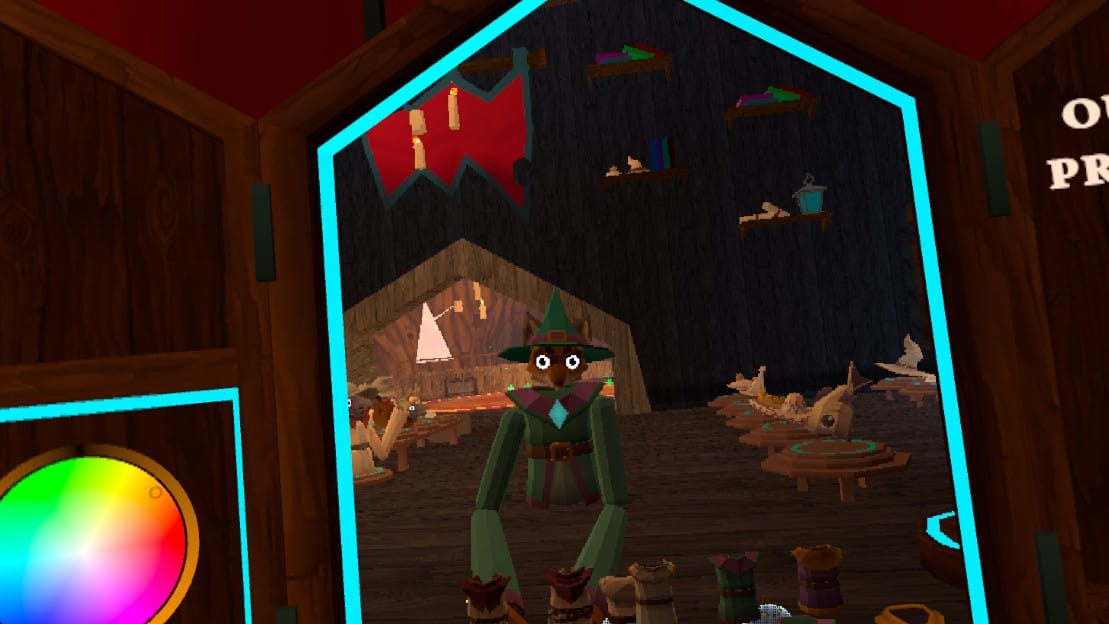
Players can move their character in one of two ways in Wizherd, by either moving the right joystick or physically swinging their arms at the ground to propel forward. The former doesn’t always work, and the latter takes some getting used to. Once the player gets a handle on moving around, the world outside the hub consists of sunny hillsides, castle-like structures, and underground caverns flooded with lava.
Wizherd’s magic system is simple enough: the player chooses between three different elemental spells at the start of the game and equips their selection to their hands. By holding down the trigger and releasing it in the middle of a tossing motion, the player can throw a ball of fire or ice at an enemy, though this action can be somewhat clunky and frustrating in the middle of a frantic battle. Melee-based spells like fire swords, on the other hand, are quite fun to swing around once you have them unlocked.
Spells can be upgraded at certain parts of the hub by spending coins and crystals. You can also customize your wizard avatar’s look by purchasing cosmetic items like robes, hats, and even animal faces you can equip at a vanity. There is even a color slider you can use to adjust your character’s skin tone.
Wizherd is free-to-play, though there are two different types of in-game currency. Coins are earned by defeating enemies, while crystals can be obtained by completing tasks or spending real-world money. The rewards for completing quests can be quite small at first, so you might have to either grind for a while or bust out your wallet.
0:00
Combat and exploration can be hit or miss.
The overall presentation can be hit or miss. As mentioned before, there is a sort of retro charm to Wizherd’s blocky graphics, but the music and sound isn’t anything you haven’t heard before in Minecraft. Most of the time you’ll be hearing the chatter of other players who are just as confused as you.
So far, Wizherd has some potential, but getting started can be tedious if you don’t want to spend due to the grind needed to get a decent loadout. There is some potential here, but only time will tell if the game has enough staying power to keep players coming back.

TeamSpeak seems to be rather enjoying the technical issues
Nintendo’s strangest Switch 2 accessory has arrived: a remarkably faithful recreation of the Virtual Boy.
Toward the end of last year, Nintendo dropped the surprise announcement that Virtual Boy games would soon be playable on Switch and Switch 2 via the company’s subscription-based membership service, Nintendo Online + Expansion Pack. For the first time in 30 years, Nintendo fans would be able to play Virtual Boy games like Red Alarm, Wario Land, and Mario’s Tennis on a current-gen Nintendo console.
Perhaps even more surprising was the announcement that the catalog of Virtual Boy games would be accompanied by two new accessories: an inexpensive cardboard “headset” priced at $24.99, and a full-on replica Virtual Boy for $99.99. In both cases, the Switch and Switch 2 slot into these accessories (like a dock) in order to play the old games.
We’re aware that not everyone knows what the Virtual Boy was, so here’s a quick rundown.
Released in 1995, Nintendo’s Virtual Boy was the first standalone home stereoscopic 3D gaming system, providing a 384×224 red-only image to each eye via its two lenses. While often described as a “VR headset”, Virtual Boy lacked any kind of head tracking, not even rotational, and had a tiny field of view of around 20 degrees. That’s not to say it wasn’t an interesting 3D device – it just wasn’t really VR.
Virtual Boy was a market failure, selling very few units, and was discontinued after just one year. But it had a lasting cultural impact in the gaming world, and is looked back on fondly by many in the VR industry.
I’ve been a Virtual Boy fan since I was 11 years old and found one sitting under the Christmas tree in 1995. I’ve written about why I think the retro system is worth experiencing (and owning) in 2026, and I’ve written about alternative ways to play the system’s tiny library of games on modern VR headsets like Meta’s Quest. So it’s quite natural that I’d have bought the new headset the moment it was announced. Which I did.
Well, it’s arrived. And it’s beautiful.
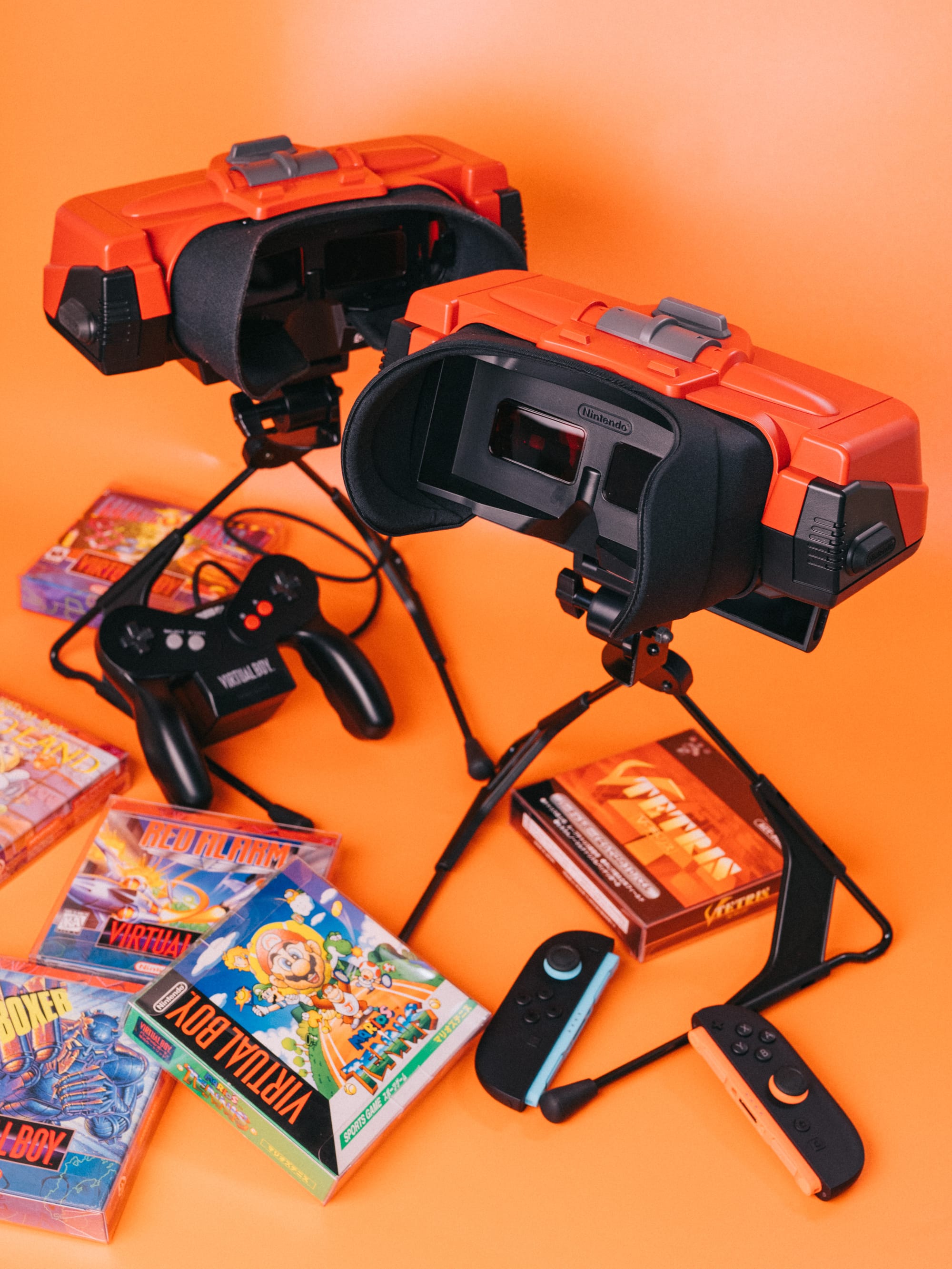
A couple of items of note: To start, due to the way that Virtual Boy games are displayed, you will need to buy one of Nintendo’s official accessory “headsets” to play the Virtual Boy’s catalog on Switch and Switch 2.
A Nintendo rep had previously stated that the old Labo cardboard headset would work just fine, but a subsequent statement issued by the company walked back that claim, saying that to play VB games, you’ll need to buy the new gear.
Second, I’m using the term “headset” loosely. Virtual Boy was never, in fact, a headset, as Nintendo opted to sell it on a stand, rather than in a configuration that allowed mounting the unit to your head. This was the right call, since the original Virtual Boy was ridiculously heavy, and though the new replica “headset” is lighter, it’s indeed a replica. The new model is not a headset, either.
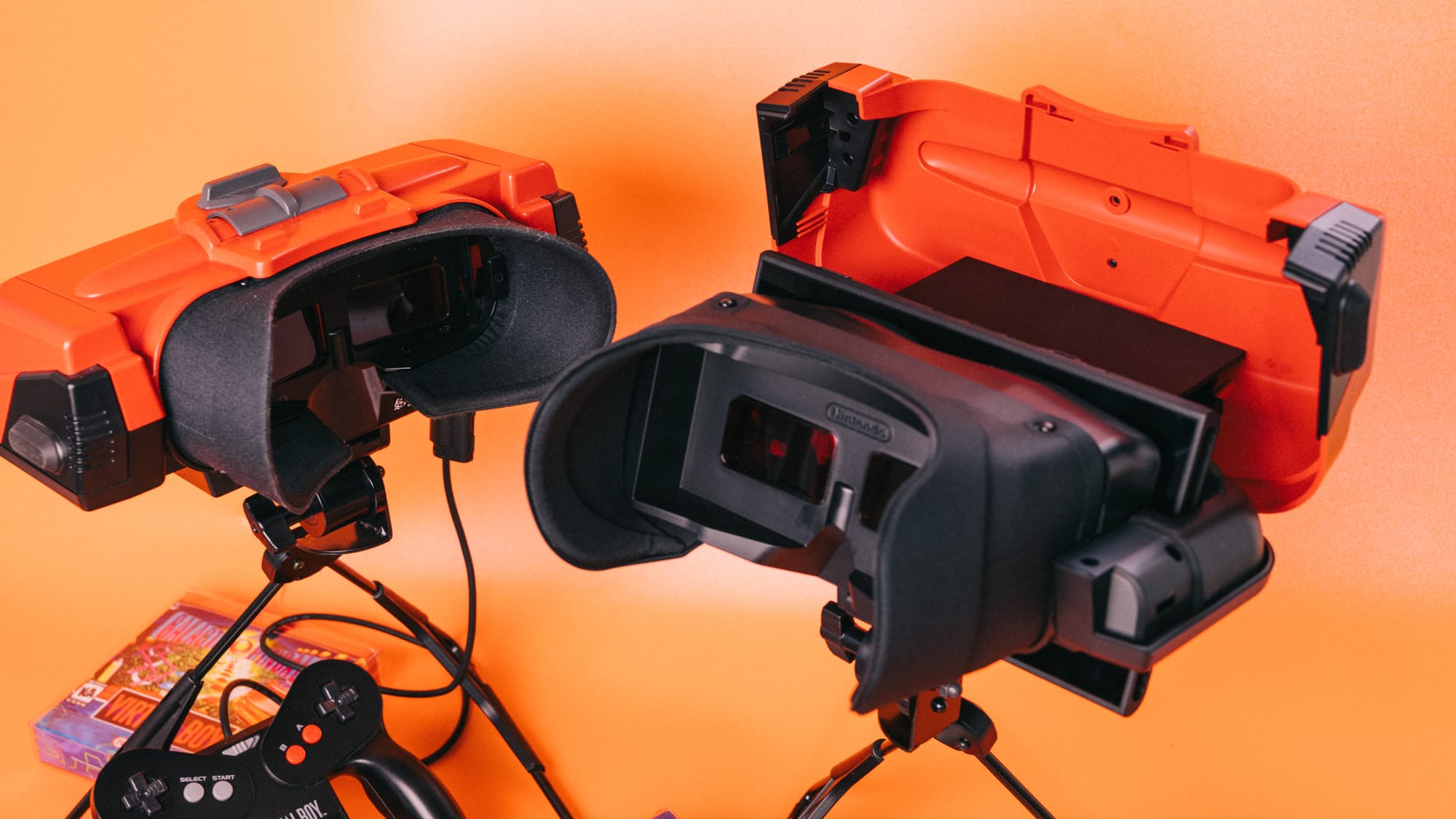
What most surprised me when the headset arrived was just how faithful its design is to the original system. Owning my launch edition Virtual Boy from 1995 gave me a great opportunity to put the two pieces of hardware side by side, to compare the units and take some photos.

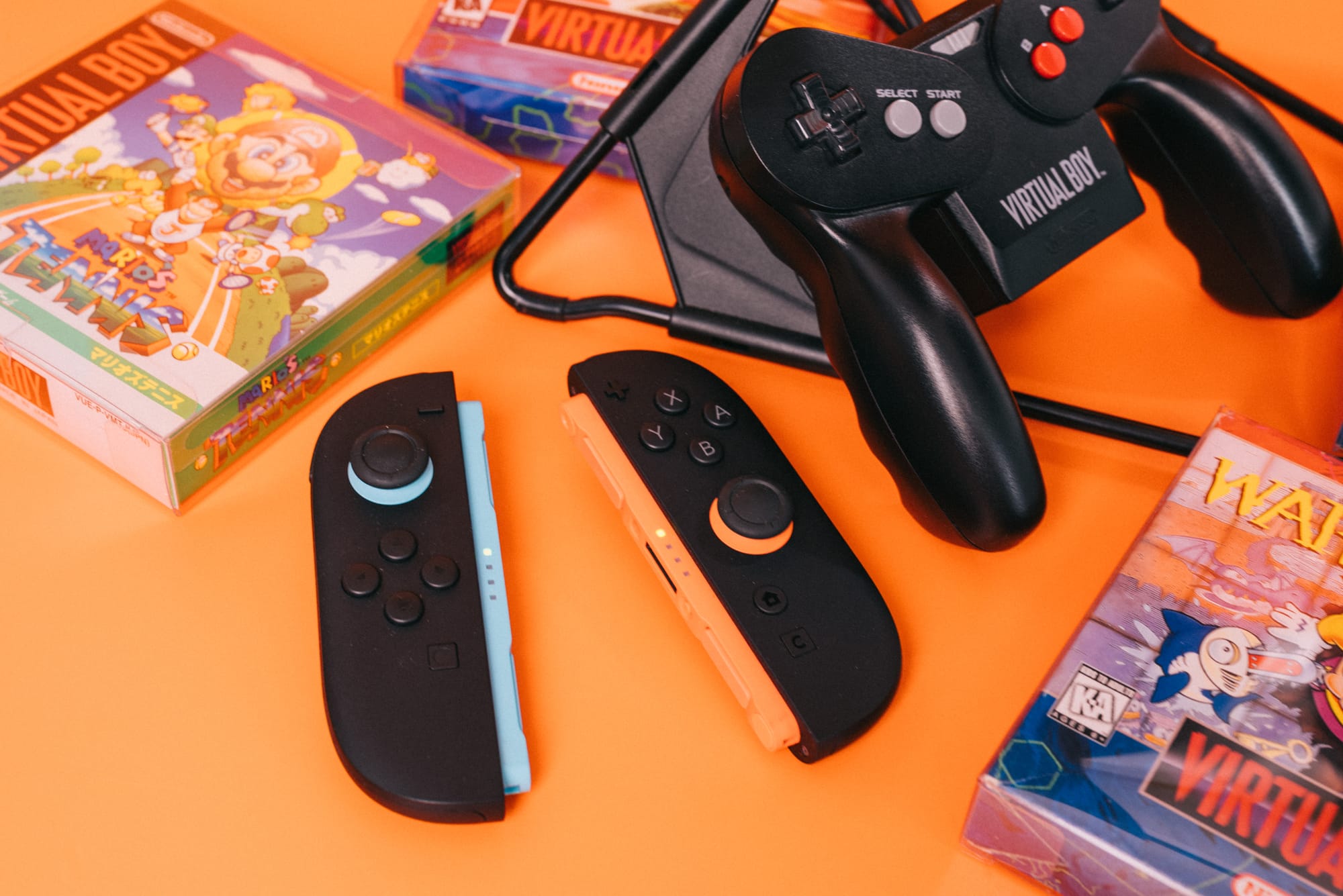
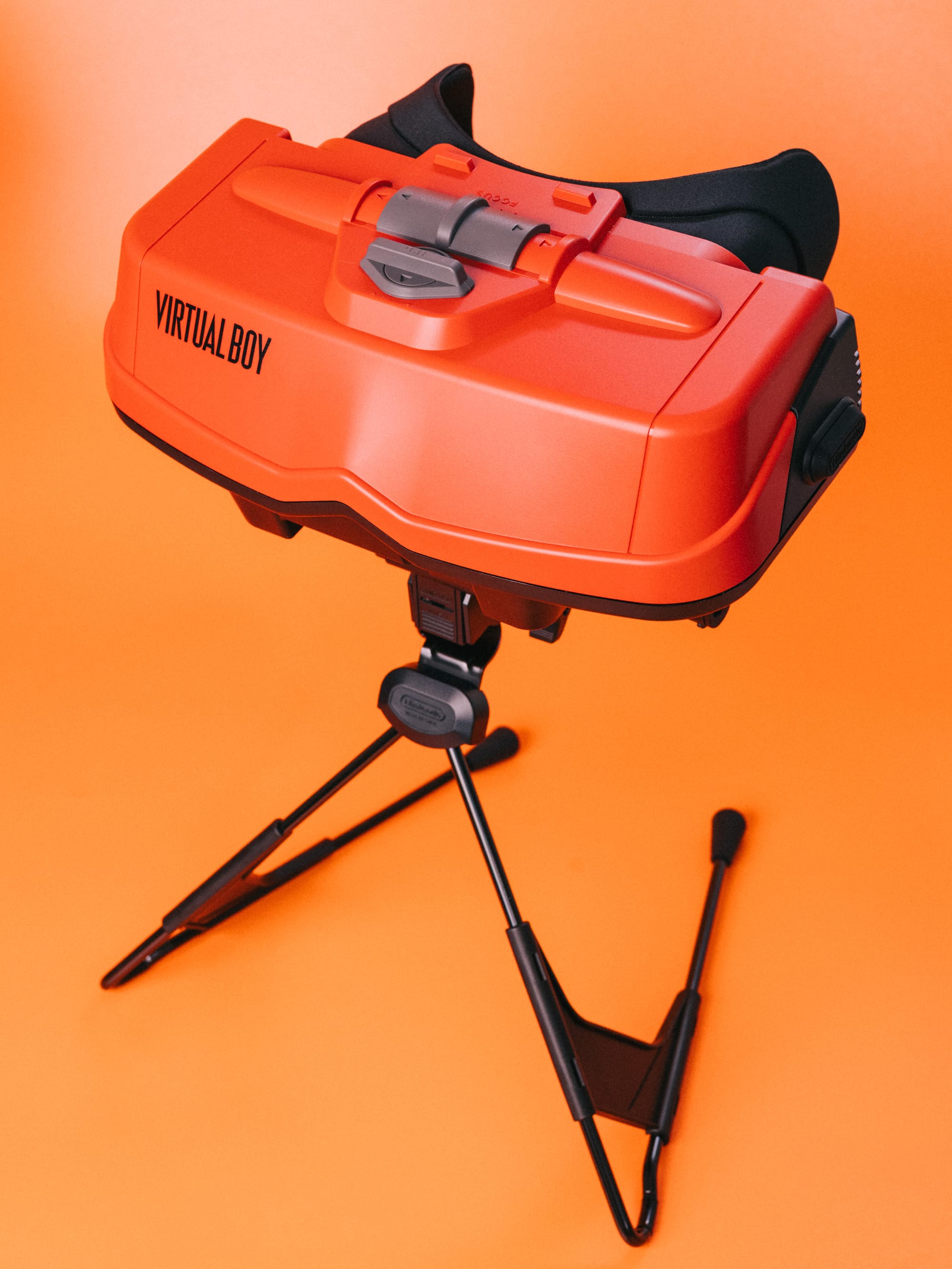
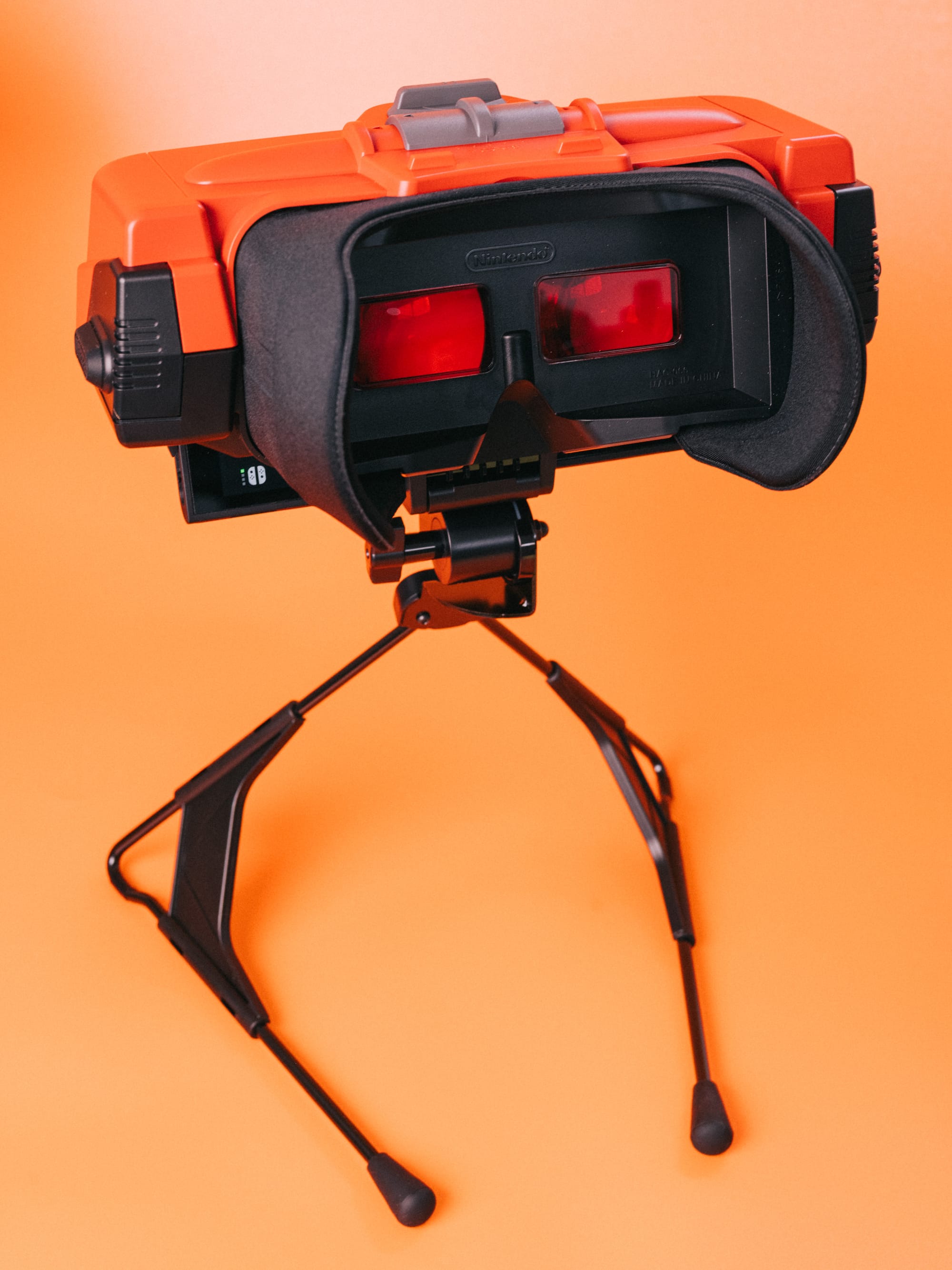
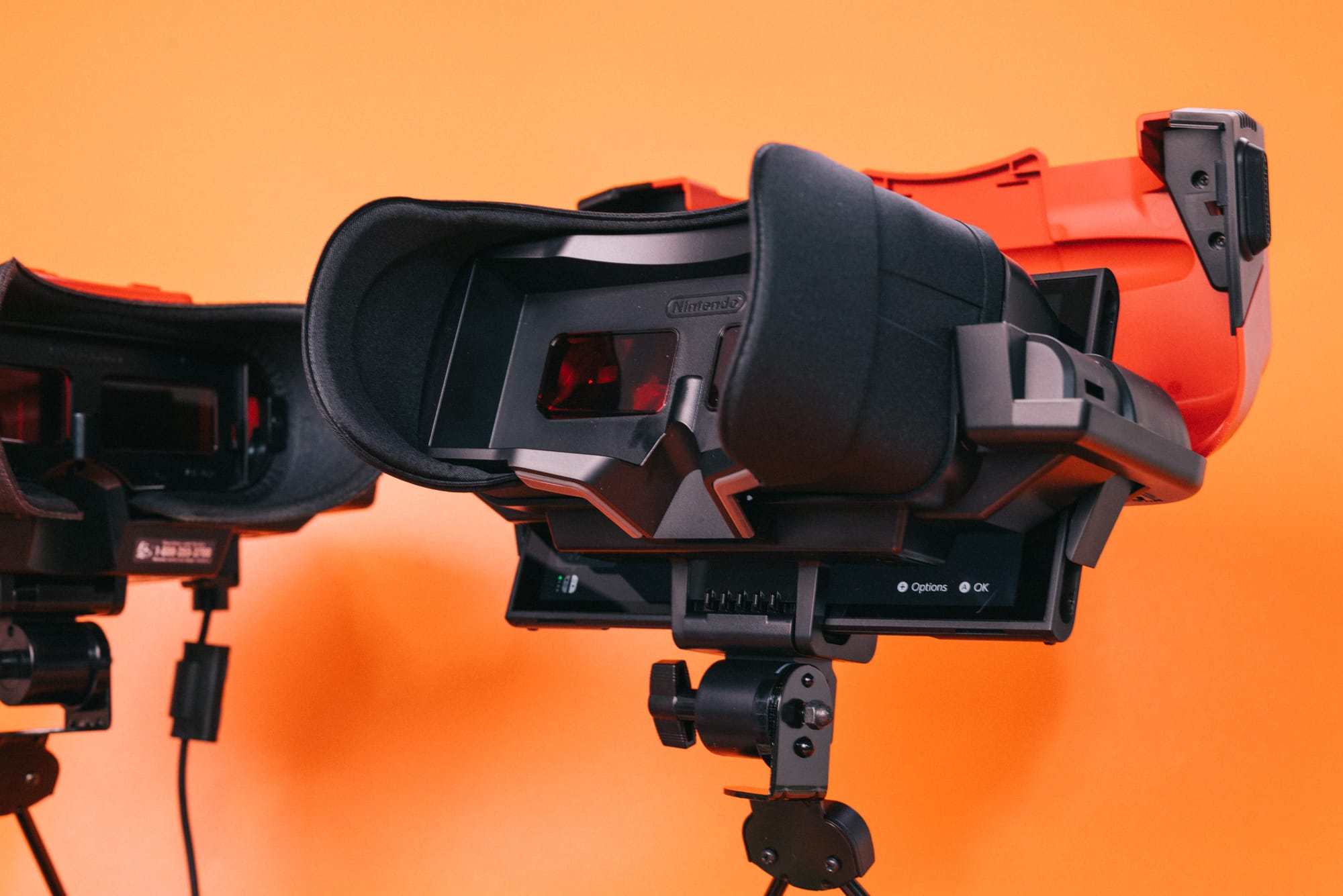
It’s so identical that my ten-year-old daughter (who I taught to solder on my original Virtual Boy when its ribbon cables detached) saw the new unit and asked, “You bought another Virtual Boy?”
It’s true that the new Virtual Boy is slightly larger than the original, but then again, we need to slot a Switch or Switch 2 inside it. That naturally requires some extra space. That said, the small details are incredibly accurate. The rubber bumpers on the side of the unit, the rubber nubs at the end of the stand’s legs, the focus and IPD controls, the (fake) volume control and headphone jack and EXT. port, they’re all here and replicated perfectly. Even the stand’s adjustment mechanism utilizes a virtually identical acorn nut as the original.
The next thing you’ll notice is that it’s remarkably well made. The stand feels good, deploys tightly, and holds the unit well. The adjustment point on the stand also cinches tightly. The plastic feels dense and solid, the spring-loaded docking cradles work beautifully and hold the Switch in place nicely, and the satin foam of the eye-shroud feels more comfortable than the original.
In short, Nintendo did a great job making an almost perfect replica of their least successful gaming system.
It should also be noted that the new Virtual Boy arrives configured to work with Switch 2. To use the original Switch, we are required to install an adapter plate, which involves unscrewing four screws, swapping the plate, and reattaching the screws. The adapter plate comes packaged with the unit.
 UploadVRJames Tocchio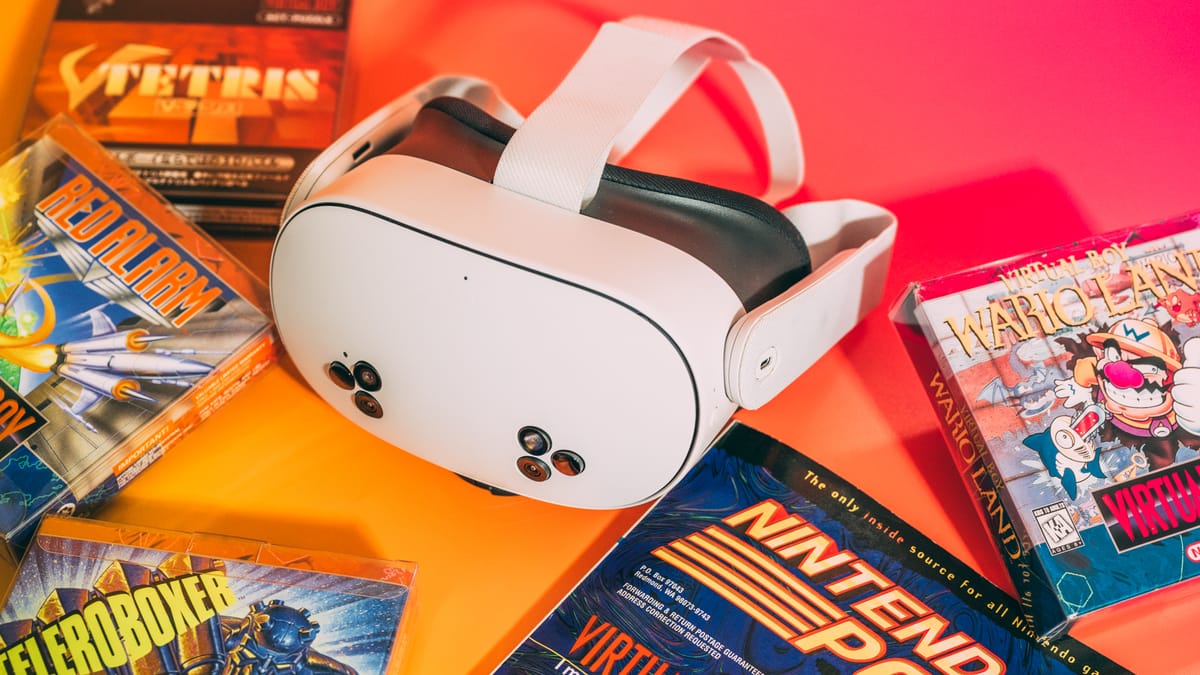
Do you need to spend $99.99 on a replica Virtual Boy headset? Probably not. Despite it being well made and effective at its one and only job, unless you’re a big fan of weird tech and oddball experimental products, you’ll almost certainly regret buying this thing.
Additional strikes against it would come down to the fact that these games are only accessible on Switch or Switch 2 via Nintendo’s subscription service. You won’t really own these games on Switch unless Nintendo releases some sort of purchasable collection. As of now, you’re buying a headset to play games that you’re essentially renting.
And if you’ve never played Virtual Boy and simply want to try out some old, weird games, there are cheaper and easier ways to experience Virtual Boy’s compact library.
But if you’re like me and love the Virtual Boy, well, you’ve probably already spent the money.
If you’d like your own Virtual Boy for Switch and Switch 2, you’ll have to be a member of Nintendo Online, and then grab one via the company’s website. We’ll have an overview of all the Virtual Boy games playable on Switch and Switch 2 soon.