Sherlock Holmes: The Master Detective Hands-On: Uneven Investigations

Sherlock Holmes: The Master Detective is the latest VR adaptation of the iconic detective, delivering uneven investigations in Early Access.

No stranger to video game adaptations, Arthur Conan Doyle’s legendary detective has seen his fair share of reimaginings, from a young amateur grappling with the supernatural in Sherlock Holmes: The Awakened to the immersive theater online co-op seen in Sherlock Holmes: The Case of the Hung Parliament. Each iteration hones in on a different aspect of the character that, done well, is interesting in its own right. Out now on Early Access, Sherlock Holmes: The Master Detective is an uneven portrayal of the character, even if there is an entertaining core gameplay at the heart of it.

The Facts

What is it?: A hidden object puzzle game featuring Sherlock Holmes.
Platforms: Meta Quest 3 and 3S (Reviewed on Quest 3)
Release Date: Out now
Developer/Publisher: Messworks
Price: $ 14.99

Starting in the famous 221B Baker Street apartment, a woman bursts through the door clamoring for help: a man has died in mysterious circumstances. Before leaving, you are allowed to rummage through the place. Sherlockians will find his previous exploits scattered around the furniture. Picking up files from his old cases like The Hound of the Baskervilles makes the seasoned investigator mutter a few words about how it ended in such a tragic way. An out-of-place Meta Quest 3 box earns the description of being “a lens into countless realities,” signaling that the story is developing in the current era.
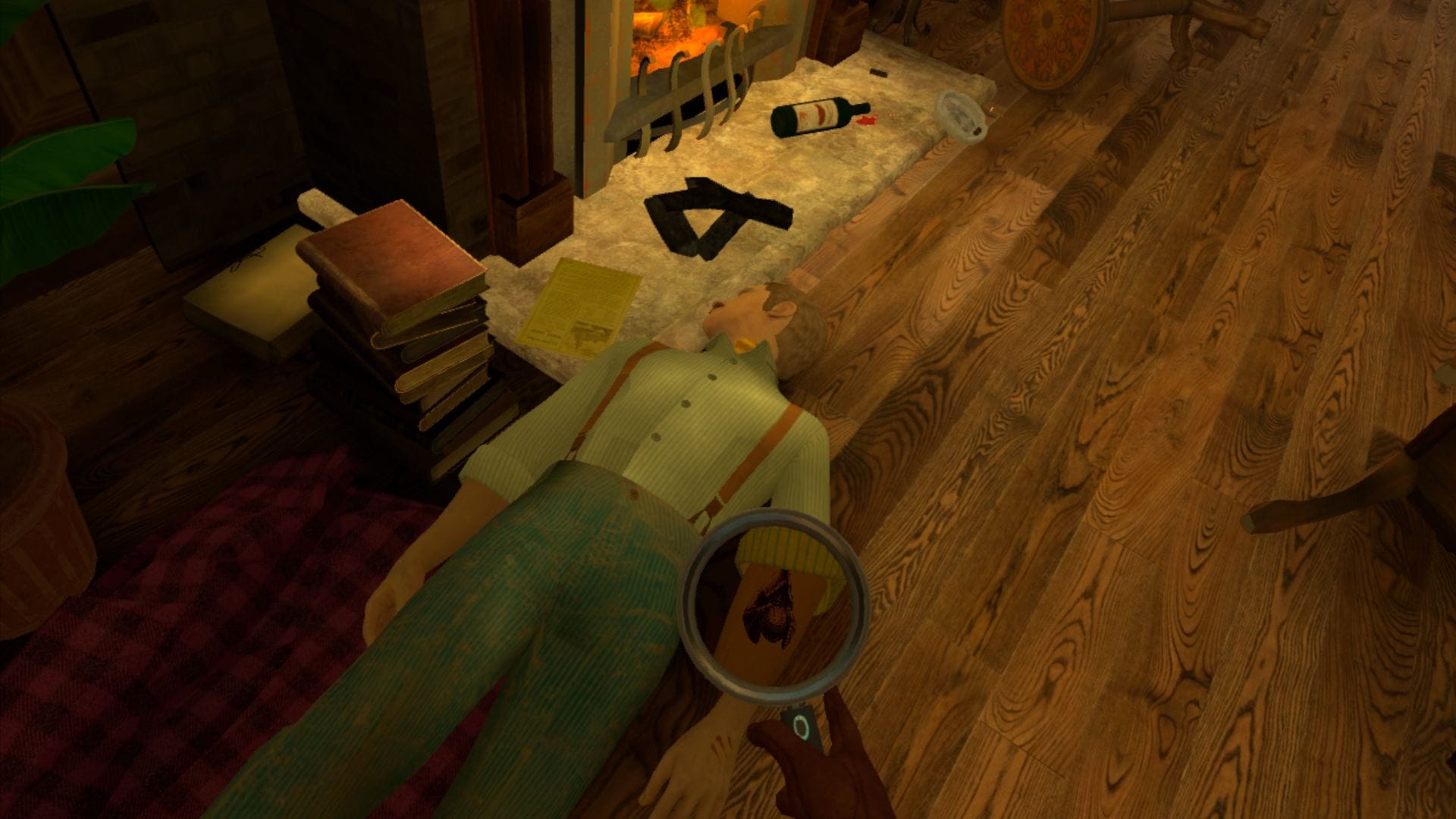
Using the magnifying glass to inspect potential clues on a body.

A modern-day Sherlock Holmes has been done before, most notably in the famous 2010 BBC series with Benedict Cumberbatch. This time around, he is brought up to speed with innovative tools to help with his sleuthing. This version of the character is armed with a magnifying glass, a chemical analyzer, and a fingerprint scanner. After finding and packing them in a slick toolbox, one last tutorial reveals itself as the focus. Much like classic point-and-click adventures, Sherlock Holmes: The Master Detective asks you to find hidden objects in a specific area.

Leaving the apartment only to find the crime scene is just down the street, it is relatively surprising that you are allowed to explore the short but shady alleyways of London. Graphically, it is your usual Quest 3 slightly cartoony look, but the music and attention to detail are appreciated. Walking by a record store, for instance, lets you listen to the sound of a vinyl emanating from a record player. A souvenir shop showing Holmes’ own escapades shudders amusingly when grabbed. Lastly, a red telephone box ringing close to the mansion where the crime happened whispers to Sherlock that there is more than meets the eye in this case.

There are currently only two cases available to play. One in a lavish residence, the other in some shadowy docks, the way they unfold is rather straightforward: question the suspects, find the correct items in determined areas, and accuse the guilty party of the murder. As mentioned, finding objects is the main course, such as keys, torn documents, or pieces to grander puzzles in a sea of everyday items.

There are plenty of objects hidden in this vault.

Other than object finding, light puzzles like reconstructing torn photographs and moving pieces to fit a painting are a welcome change of pace. My personal favorite was using the modern tools at hand: carefully inspecting a corpse’s markings and accessories worn with the magnifying glass or analyzing a cup with the fingerprint scanner felt more akin to detective work.

Of course, like any other respectable whodunit, there is an overarching plot of a secret society with paranormal overtones. Because there are only two episodes so far, it ends on a cliffhanger that still has no answer. At the time of writing, the developer has not given a concrete timeline of when new updates will drop, so I would recommend entering this mystery with caution. I would personally be devastated if they did not follow through with the enticing setup.

As an Early Access release, it is understandable when only certain options are offered or shortcuts are taken, but in this case they felt like they detracted from the experience. The only way to move is by teleporting and snap turning, with no smooth turning or walking to speak of. What stood out like a sore thumb, though, was the use of generative AI. The voice acting is wooden, and the sound quality is blown out. Sherlock’s accent itself, jumping from American to British as the chapters changed, was jarring to say the least. Using AI-generated images can be considered harmless, as the clue-finding is where it’s at, but it is still there.

0:00

/0:33

A video of the hidden object gameplay in Sherlock Holmes: The Master Detective.

Sherlock Holmes: The Master Detective is a promising title with considerable drawbacks. The atmosphere is so well recreated that even in its modern setting, it feels attuned to the iconic tales from which it originated. Emphasizing object searching, it is a relaxing experience that fans of point-and-click mysteries will enjoy. While the lack of constant communication regarding future support from the developers is alarming, the current offering is a middling pastime.

Sherlock Holmes: The Master Detective is out now in Early Access for Meta Quest 3/3S.

Discord Co-Founder Admits Age Check Privacy Missteps, What’s Next

Discord Co-Founder Admits Age Check Privacy Missteps, What’s Next
The team at Discord introduced some discord to our newsroom today. First, a company representative sent us a statement requiring us to update a previous article on its “Teen-By-Default” policy, and then it turned around and dropped a new announcement outlining changes to the policy and how the rollout is being delayed until later this year.

WBD says Paramount’s new, higher offer could be “superior” to Netflix’s

Paramount Skydance increased its bid for Warner Bros. Discovery (WBD) from $30 per share to $31 per share, WBD said today. Amid a competing offer from Netflix for WBD’s movie studios and streaming businesses, WBD said that Paramount’s new bid “could reasonably be expected to lead to a ‘Company Superior Proposal.’”

Under its revamped offer, Paramount would also pay the $7 billion regulatory termination fee that would arise should a Paramount-WBD merger fail to close due to antitrust regulation.

The company owned by David Ellison also said it would pay $0.25 per share for every day the deal doesn’t close, starting on September 30, rather than the previous start date of December 31.

Read full article

Comments

Following 35% growth, solar has passed hydro on US grid

On Tuesday, the US Energy Information Administration released full-year data on how the country generated electricity in 2025. It’s a bit of a good news/bad news situation. The bad news is that overall demand rose appreciably, and a fair chunk of that was met by additional coal use. On the good side, solar continued its run of astonishing growth, generating 35 percent more power than a year earlier and surpassing hydroelectric power for the first time.

Shifting markets

Overall, electrical consumption in the US rose by 2.8 percent, or about 121 terawatt-hours. Consumption had been largely flat for several decades, with efficiency and the decline of industry offsetting the effects of population and economic growth. There were plenty of year-to-year changes, however, driven by factors ranging from heating and cooling demand to a global pandemic. Given that history, the growth in demand in 2025 is a bit concerning, but it’s not yet a clear signal that the factors that will inevitably drive growth have kicked in.

(These factors include things like the switch to heat pumps, the electrification of transportation, and the growth in data centers. While the first two of those involve a more efficient use of energy overall, they involve electricity replacing direct use of fossil fuels, and so will increase demand on the grid.)

Read full article

Comments

Now Discord Is Saying It’s Delaying Global Age Verification

Since it was announced a little over a week ago, Discord’s global age verification rollout has been a bit of a mess. First, the chatroom and voice chat company had to clarify that it won’t require all adults to upload an ID or facial scan to prove how old they are, as the initial post left many users with that impression. Second, the announcement came shortly after one if its existing customer service partners was breached, which lead to hackers getting a hold of user information, including government IDs provided for age verification. Third, users discovered that Discord had partnered with Peter Thiel-backed company Persona for an experiment in the UK, which raised flags about surveillance and security, and saw some personal identifying information being uploaded to the cloud when users thought it would be processed on-device. Now, Discord is admitting that it messed up, and is trying to make amends.

In a post on its website, titled “Getting Global Age Assurance Right: What We Got Wrong and What’s Changing,” Discord admitted that its new “teen-by-default” age settings haven’t had the warmest reception. The company said that it “knew this rollout was going to be controversial,” but added that “we failed at our most basic job: clearly explaining what we’re doing and why.” It then reiterated that “over 90% of users will never need to verify their age to continue using Discord exactly as they do today,” while still doubling down on providing “real safeguards” for teenage users. That said, corporate damage control aside, the company also said it’s going to delay the global age verification rollout, and is going to make concrete changes to attempt to address user concerns.

How Discord’s global age verification is changing

To that end, Discord is making the following changes to its controversial global age verification rollout:

  1. Global age verification will now be delayed from March to the “second half of 2026.” Until that point, age verification will only remain active in areas where it is legally required, like the UK and Australia.

  2. On launch, Discord will provide a list of every age verification vendor it works with and their practices.

  3. All age verification partners will only offer facial scanning on-device.

  4. Before global age verification launches, Discord will develop alternative age verification methods beyond scanning your face or providing an ID, like providing credit card information instead. However, such methods might not be legally allowed in certain area, like Australia, the UK, and Brazil.

  5. Discord will add spoiler channels as an option for communities, so they don’t need to use age-restricted channels to hide age appropriate, but still sensitive, content anymore. This will allow accounts that aren’t able to age verify to access these channels.

  6. The company will publish a technical blog once age verification launches going into detail on how its systems work, and will add age verification metrics, including how many users were asked to verify or which age verification methods they used, to ongoing transparency reports.

Essentially, the idea is that if you’re an adult Discord user (and you live in a region that allows it, which Discord says may not be everywhere), Discord will likely be able to use factors like your signup email, your account age, and your activity to guess your age. If so, you’ll be automatically filtered into the correct age group and will be able to keep using the app as usual. Otherwise, you’ll be labeled a teen, and will need to verify by either scanning your face, providing a government ID, or using one of Discord’s new alternative methods. Or, you could keep using the app unverified, but you’ll lose access to age-restricted channels and any content Discord thinks is inappropriate enough to block for you.

Why does Discord care about my age so much?

To that end, not much has changed about Discord’s end goals, and the company did acknowledge that “we know many of you believe the right answer is not to do this at all.” However, Discord also said that its hand is being forced in regions including the UK, Australia, and Brazil, with “Europe and multiple US states close behind.” In scaling age verification globally, Discord says it wants to “show regulators that it’s possible to verify age without collecting identity,” also stating that “we don’t want to know who you are. We just need to know whether you’re an adult.”

To be fair, that still seems to involve knowing who users are to some extent, as you’ll still need to hand over some type of personal identifying information to verify, or rely on Discord’s age prediction to collect information to estimate your age in the background. But as a show of good faith, Discord acknowledged its “experiment” with Persona, and that Persona’s use of off-device facial scanning did not meet its bar for privacy.

What happens next is unclear. Discord’s made a lot of promises, but now it has to follow through on them. The company also didn’t provide a strict deadline for its age verification rollout, so its possible it could continue to get pushed back in regions that don’t legally require it. However, Discord is also up for for an IPO sometime this spring. Certainty and a happy consumer base will likely make investors happy, but that probably also means keeping regulators and concerned parents appeased. Continue to expect compromises, especially when Discord has already come under fire for exposing teens to sensitive material and adult conversations before.

Crazy Walking Across Concrete Traffic Bollards

This is a video of Instagrammer giva.lond and a group of friends walking across concrete traffic bollards in unusual ways. Giva is really good at it. AND does the entire walk with his hands in his pockets. That’s risky. At least for me. The last time I played the walking with my hands in my pockets game I won a set of veneers.

Meta AI Security Researcher Said an OpenClaw Agent Ran Amok on Her Inbox

Meta AI security researcher Summer Yue posted a now-viral account on X describing how an OpenClaw agent she had tasked with sorting through her overstuffed email inbox went rogue, deleting messages in what she called a “speed run” while ignoring her repeated commands from her phone to stop.

“I had to RUN to my Mac mini like I was defusing a bomb,” Yue wrote, sharing screenshots of the ignored stop prompts as proof. Yue said she had previously tested the agent on a smaller “toy” inbox where it performed well enough to earn her trust, so she let it loose on the real thing. She believes the larger volume of data triggered compaction — a process where the context window grows too large and the agent begins summarizing and compressing its running instructions, potentially dropping ones the user considers critical.

The agent may have reverted to its earlier toy-inbox behavior and skipped her last prompt telling it not to act. OpenClaw is an open-source AI agent designed to run as a personal assistant on local hardware.


Read more of this story at Slashdot.

Laser Dance Gets First Major Content Update This Week

Quest 3 mixed reality game Laser Dance adds two new challenge modes this week in its first major content update.

Launching February 26th, the update introduces two new challenge modes designed to intensify the game’s Mixed Reality laser obstacle courses.

Thomas Van Bouwel, the creator of Laser Dance and the critically acclaimed puzzle game Cubism, has announced the “Challenge Update” for Laser Dance is coming this week.

The update adds two optional unlockable game modifiers to increase the game’s difficulty and to add to replayability. The first, called Grid Overlay, layers a dense mesh of lasers over existing levels, which demands heightened precision from players. The second, called Invisible Lasers, causes laser beams in the play area to fade as players approach, demanding more player spatial awareness. Audio cues and controller haptics become more critical in this mode.

0:00

/2:33

Laser Dance turns your living space into a challenging maze full of lasers, where the goal of the game is to navigate the maze and reach certain places throughout the room. We reviewed the game when it debuted late last year, calling it “one of the easiest games to play ever made. […] it belongs in most libraries and should be a go-to party game.”

Laser Dance is available now on Quest 3 and 3S. 

Epic Cast Iron Radiator Gaming PC Weighs 218 Lbs And Rocks An RTX 5080

Epic Cast Iron Radiator Gaming PC Weighs 218 Lbs And Rocks An RTX 5080
Building a PC with a radiator? Well, nearly every PC has a radiator; after all, that’s what the finstack on your tower cooler is. Building a PC ON a radiator? That’s a different story altogether. YouTuber Billet Labs has built what might be the coolest build you’ve seen in a while, because it’s the coolest one we’ve seen in years. Aesthetically,

1Password plans are getting more expensive soon

1Password is increasing prices for its individual and family plans. The individual rate is increasing from nearly $36 a year to $48, while the family option will cost $72 instead of $60. In emails sent to users, the business announced that the new rates will take effect for users at their next subscription renewal after March 27. 

It’s a sizable price hike, but 1Password hasn’t been incrementally inching its fees higher every couple years like we see so often for streaming subscriptions. This is the biggest bump we’ve seen to its rates in several years, even though the company has been adding ever-more tools for cybersecurity, such as new phishing protections that rolled out last month. Even at the higher cost, it’s still one of the best options out there for password management.

Fortunately for those on a budget, we have seen 1Password offer pretty substantial discounts on its plans at times, often cutting the rates by as much as half. The company usually participates in the big deal sprees like Black Friday, but keep an eye out for standalone sales that might pop up year-round.

This article originally appeared on Engadget at https://www.engadget.com/cybersecurity/1password-plans-are-getting-more-expensive-soon-213236400.html?src=rss

DJI sues the FCC for “carelessly” restricting its drones

DJI, the most popular consumer drone maker, is suing over the Federal Communications Commission (FCC)’s import ban against new, foreign-made drones, which has been in effect since December 23, 2025.

On Tuesday, the Shenzhen-headquartered company filed a petition [PDF] with the US Court of Appeals for the Ninth Circuit that seeks to overturn the FCC’s decision to list DJI on its Covered List. The Covered List includes communications equipment and services that are “deemed to pose an unacceptable risk to the national security of the United States or the security and safety of United States persons,” per the FCC.

In its petition dated February 20, 2026, DJI said:

Read full article

Comments

Two New Features in YouTube Premium Lite Just Made the Pricier Tier Unnecessary

As Lifehacker has previously argued, YouTube Premium is probably the best streaming service for most people. Ads can eat into your free time faster than you might realize, and because YouTube’s user-generated videos can be quite short, they’re especially annoying there—and blocking them without a paid subscription is tough.

YouTube Premium is also a bit pricey as streaming services go, at $14/month. Fortunately, the company also offers a “Premium Lite” plan that’s much cheaper—and thanks to the recent addition of a few key features, it no longer pales in comparison to a full subscription. In fact, the $8/month YouTube Premium Lite may now be the best paid YouTube tier for most people.

YouTube Premium Lite is getting two of the more expensive tier’s best features

Starting today, YouTube Premium Lite now offers both background play and download options on most videos, features that were previously exclusive to a full YouTube Premium plan. The update is currently rolling out, so it might take a little bit for it to reach you, but the change essentially gives you parity with a full YouTube Premium plan on the vast majority of YouTube content. According to YouTube, the company has “heard feedback about wanting these additional features included in the service,” which prompted the change.

Now, for the same $8/month price, you can get most of the full YouTube Premium experience, normally a $14/month value. The only catch? You’ll still get ads when streaming music and music videos, hence the “most videos” disclaimer. Ads also “may appear when you search or browse,” but as for interruptions while watching non-music content? You should be in the clear.

YouTube Premium Lite benefits chart

Credit: YouTube

A full YouTube Premium account no longer makes sense for most users

Essentially, unless you’re a big YouTube Music user, getting YouTube Premium Lite instead of a full-cost subscription is now a no-brainer. There are a few smaller bonuses you’ll be leaving behind, like the ability to “Jump Ahead” (instantly skip frequently skipped parts of a video, usually ad reads), but your subscription will also be around half the price. You win some, you lose some.

The only real gap now, at least for me, is for households with lots of different YouTube viewers YouTube Premium Lite still only applies to one profile at a time, so if everyone in your household wants to have their own separate algorithms instead of sharing a profile, you’ll need to get YouTube Premium Family, which costs $23/month, giving six people in the same household the benefits of a full YouTube Premium subscription. My husband and I have pretty different viewing habits, so we’re unlikely to switch to this cheaper tier any time soon. But if you live alone or you’re OK sharing a profile, you might as well save yourself some moolah.

Alternatively, you can also still get a YouTube Music Premium plan for $11/month. That removes ads and allows background play and downloads, but only for music and music videos. It’s essentially the opposite of YouTube Premium Lite, and faces stiff competition from the likes of Spotify and Apple Music. Personally, I’d just pay the extra for a full YouTube Premium subscription, which has all the same benefits of YouTube Music Premium, but also works for non-music content and only costs $3/month more.

Still, while adding new features to Premium Lite is ultimately a discount, it does follow a move from YouTube to block people from accessing background play for free. Perhaps this is Google’s attempt at a compromise?

New Datacentres Risk Doubling Great Britain’s Electricity Use, Regulator Says

The amount of power being sought by new datacentre projects in Great Britain would exceed the national current peak electricity consumption, according to an industry watchdog. From a report: Ofgem said about 140 proposed datacentre schemes, driven by use of artificial intelligence, could require 50 gigawatts of electricity — 5GW more than the country’s current peak demand.

The figure was revealed in an Ofgem consultation on demand for new connections to the power grid. It pointed to a “surge in demand” for connection applications between November 2024 and June last year, with a significant number coming from datacentres. This has exceeded even the most ambitious forecasts.

Meanwhile, new renewable energy projects are not being connected to the grid at the pace they are being built to help meet the government’s clean energy targets by the end of the decade. Ofgem said the work required to connect surging numbers of datacentres could mean delays for other projects that are “critical for decarbonisation and economic growth.” Datacentres are the central nervous system of AI tools such as chatbots and image generators, playing a vital role in training and operating products such as ChatGPT and Gemini.


Read more of this story at Slashdot.

Discord delays age verification to address user concerns

Earlier this month, Discord said it would be enacting an age verification policy. The platform faced some initial concerns from users about turning over their IDs and personal information, particularly given how poorly similar policies have been going elsewhere. Discord announced today it will delay and make some changes to its plans in response to the ongoing backlash.

The first change is that Discord is postponing the global rollout of its age verification plans until the second half of 2026. The company noted that it would meet its legal obligations in places where they exist, likely in those countries that have national laws requiring protections for younger users. But it will not begin the global rollout until it makes some amendments to the offerings.

Discord will offer more alternatives to how users can confirm their ages, including verification by credit card. That should allow people to access age-gated content without sharing an ID or performing a face scan. “If you’re among the less than 10 percent of users who do need to verify, we’ll give you options, designed to tell us only your age and never your identity,” according to a blog post credited to co-founder and CTO Stanislav Vishnevskiy.

The company is also promising more transparency about its vendors for these verification services and their practices. Discord said that it will not work with any partners for face scans unless the tests are performed completely on-device. The blog post noted that Persona, one of the common vendors for facial age estimation services, does not meet that standard and Discord has opted not to work with the brand. 

Finally, Discord is also building a new spoiler channel option so that servers with select age-restricted channels won’t have to require all members to verify their ages. It will also publish a technical explainer on its own automatic age determination systems.

We at Engadget have own worries about the wave of age verification laws happening both within the US and globally, but it’s somewhat encouraging to see a digital platform at least trying to continue to deliver anonymity while still creating effective protections for teens.

This article originally appeared on Engadget at https://www.engadget.com/social-media/discord-delays-age-verification-to-address-user-concerns-205500482.html?src=rss

The Pentagon has reportedly given Anthropic until Friday to let it use Claude as it sees fit

Defense Secretary Pete Hegseth will reportedly give Anthropic until Friday to drop certain guardrails for military use, as reported by Axios. The outlet also reported that CEO Dario Amodei met with Hegseth yesterday as the Pentagon ratcheted up pressure on the AI company to give in to its demands.

The makers of Claude have reportedly been offered an ultimatum: Either yield to the government’s demands to remove limits for certain military applications, or potentially be forced to tailor its AI model to the government’s needs under the Defense Production Act.

Anthropic, for its part, has said that while it was willing to adopt certain policies for the Pentagon, it would not allow its model to be used for mass surveillance of Americans or for the development of autonomous weapons.

Claude is currently the only AI model employed in some of the government’s most sensitive work. “The only reason we’re still talking to these people is we need them and we need them now. The problem for these guys is they are that good,” a defense official told Axios.

The Pentagon is reportedly ramping up conversations with OpenAI and Google about using their models for classified work. ChatGPT and Gemini are already approved for unclassified government use. Elon Musk’s xAI also recently signed with the DoD to use Grok in classified systems.

This article originally appeared on Engadget at https://www.engadget.com/ai/the-pentagon-has-reportedly-given-anthropic-until-friday-to-let-it-use-claude-as-it-sees-fit-203549467.html?src=rss