
At the same time the rate of decline has slowed, so that’s good, right?

At the same time the rate of decline has slowed, so that’s good, right?
“This
There’s more waffling going on about the future of electric vehicles in America right now than you might expect at a Belgian breakfast buffet. Some brands like Hyundai are staying committed, some brands like Honda are dialing back, and everyone else is simply doing their damndest to provide as many propulsion options as possible
Count Audi in that last category. On the EV side, it recently launched the new Q6 E-Tron and refreshed the ballistic E-Tron GT. On the internal combustion side, it has a new A6, and there’s a full-size, three-row SUV coming in the form of the Q9. The company’s latest car, though, can be found in the middle: Meet the new RS5, Audi’s latest and greatest plug-in hybrid.
RS stands for “RennSport,” or “Racing Sport” in German, the moniker applied to Audi’s highest performing cars. RS designates an elite group of machines intended to be a bit more edgy and exclusive than your BMW M cars or Mercedes-Benz AMGs. The 2027 RS5 marks the first time an RS has come with both a big battery and a big engine, but the RS5 is much more than a novelty with a plug.
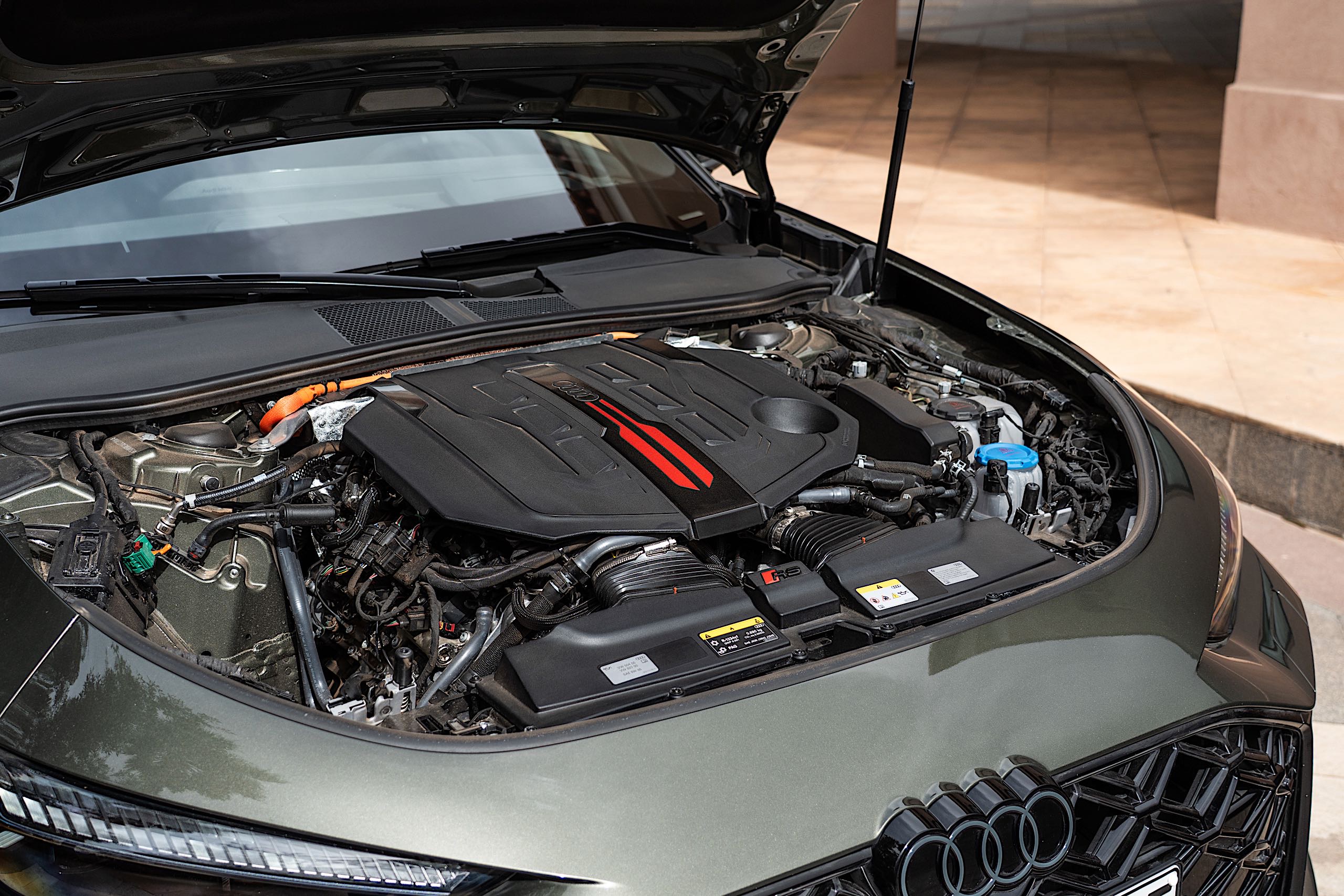
The main grunt of the new RS5 comes from a 2.9-liter, twin-turbocharged V-6 mounted up front under the hood. On its own, that engine produces 503 horsepower, a figure that you might think is plenty. Here, though, it has some help here in the form of not one but two electric motors.
The first is a typical hybrid arrangement, a 174-hp motor wedged in between the engine and transmission. This is the primary means of electric propulsion for the car, giving it a total, maximum system output of 630 hp and 609 lb-ft.
Because that motor is positioned where it is, the RS5 can still make full use of its eight-speed automatic transmission when driven only by the electric motor. That means a top speed of 87 mph before the engine kicks in. Once it does, it’ll take you all the way up to 177 mph.
There’s a second motor at the back, though, which is far more interesting. No, it isn’t there to drive the rear axle like on the RAV4 Hybrid. The RS5 has a traditional Quattro setup with a mechanical differential in the middle to distribute power between the front and rear wheels.
The small, 11-hp motor at the back exclusively controls a new type of system that Audi calls Dynamic Torque Control. This motor uses planetary gearsets to selectively and effectively magnify the power to either the left or the right axle at the back. It may be small, but this motor makes the RS5 do some wonderful things.
For maximum fun in the new RS5, dial it over to what Audi calls Torque Rear mode. This configures the new rear differential to send maximum twist to the outside rear wheel. Combine that with the center differential, which can send up to 85 percent of the engine’s power to the rear, and the result is a remarkably willing drift partner.
After less than 30 seconds behind the wheel on a closed track in Marrakesh, I was confidently sliding my way through a set of cones in a slalom, then pirouetting around a cone at the end in a tight circle, clouds of tire smoke hanging in the air. Normally, drifting a 5,200-pound, 630-hp machine rolling on sticky tires is a real nightmare. It’s delightfully easy in the RS5.
The car’s differential setup not only makes this easy but also tracks just how successful you are at it. It records the time, length and even angle of your most dramatic drifts. You can even replay them on the touchscreen if you’re so inclined, scrubbing back and forth to see what kinds of G forces you were generating.
This is part of a new extension to its infotainment system called the Audi Driving Experience. It’ll also track lap times around race tracks, giving you a bit more information in the timeless pursuit of tenths of a second.
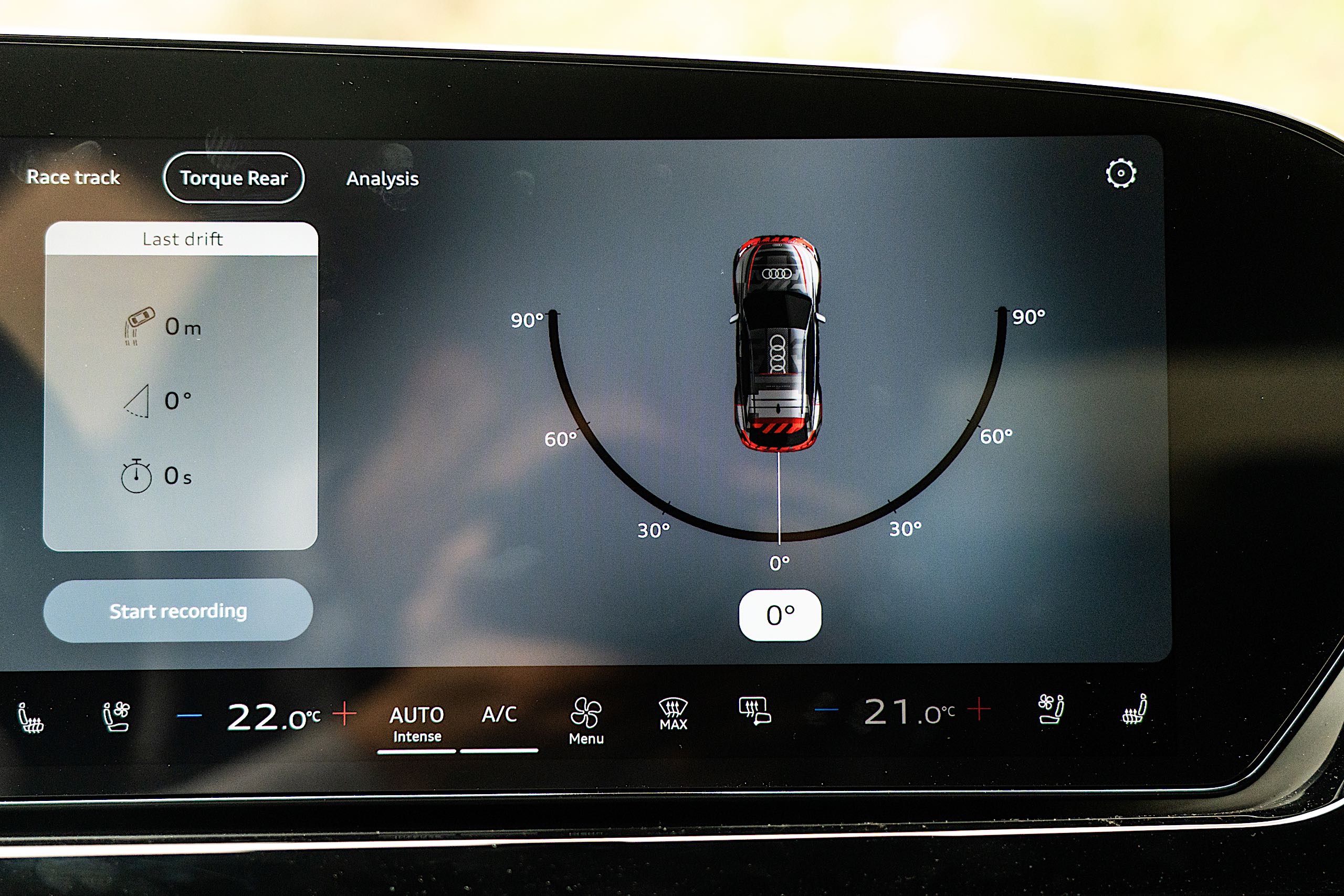
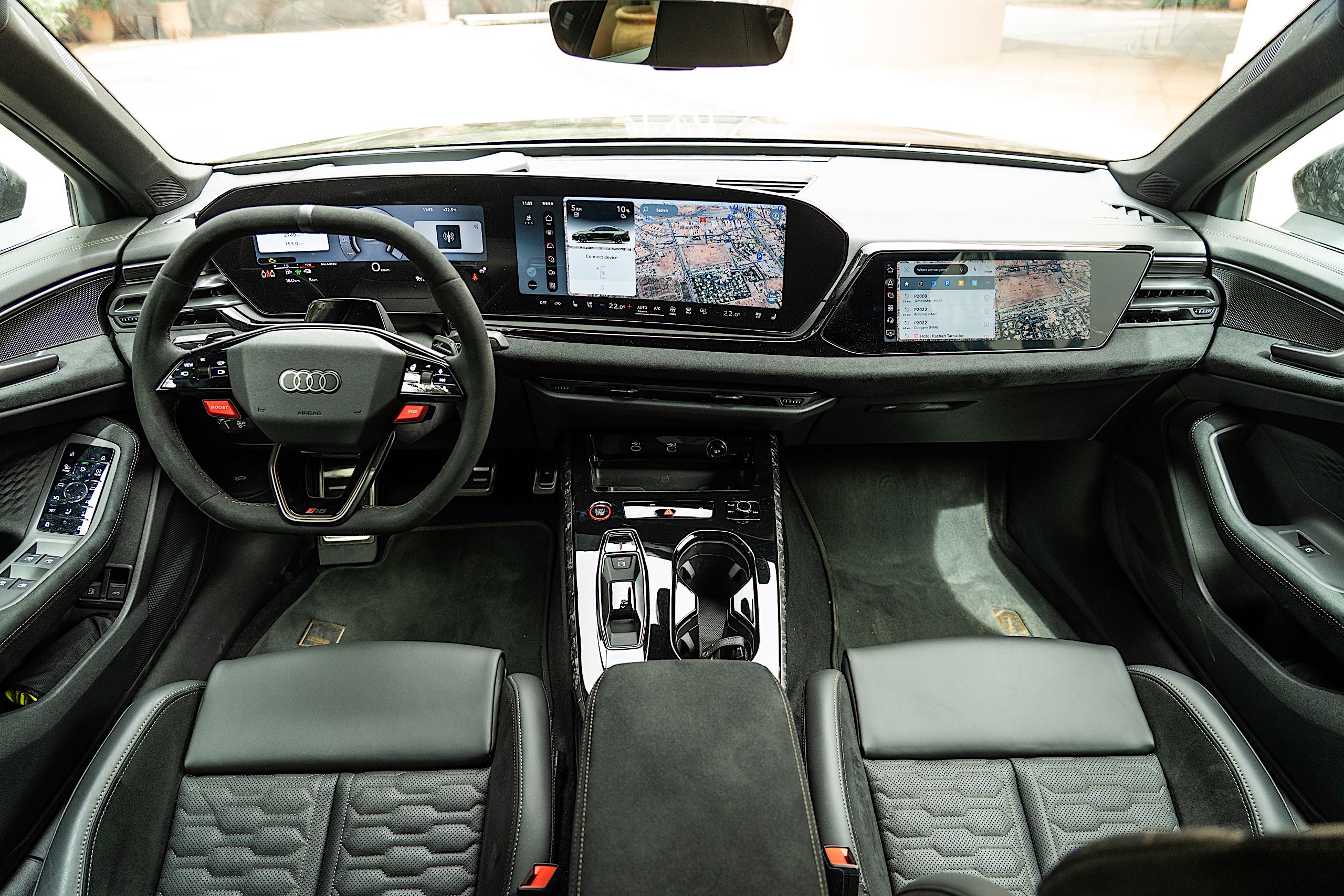
Audi also added a few custom screens showing the power distribution of the car and letting you monitor things like critical system temperatures and tire pressures at every corner. Otherwise, though, it’s much the same interface as seen on most new Audis, with a 14.5-inch central touchscreen, an 11.9-inch gauge cluster and an optional 10.9-inch display way over on the right for the passenger.
That’s a lot of displays, with the left two encased within an oversized, sweeping panel that stands tall and proud out of the dashboard. Too tall, actually. If big bezels ruin your day, look away, because there’s a lot of wasted space here.
Likewise, if you don’t like steering wheels with capacitive touch controls, you’re not going to love the RS5. Audi has brought back the little scroll wheels under your thumbs, at least, but everything else on there is just a flat surface.
I spent the better part of a day driving the RS5 through the wild streets of Marrakesh and up into the Atlas Mountains to the south. In the city, I left the car in EV mode, letting that primary electric motor and the car’s 25.9-kilowatt-hour battery (22 kWh net) do the heavy lifting. Audi says the car can cover up to 54 miles in this mode, and while I didn’t have time to go that far on battery power, it seemed like an achievable estimate.
The car is perfectly pleasant in this mode, silent and even reasonably quick. In Comfort mode, the suspension is at its softest, and despite those giant wheels, the RS5 did perfectly fine over the decidedly imperfect Moroccan roads. But it wasn’t until I got far away from the city that I could start to open things up a bit, working my way through the various drive modes and eventually all the way up to RS Sport, the most performance-oriented.
Here, the suspension is at its stiffest and the throttle at its sharpest, transmission swinging through its ratios eagerly to keep the engine singing. Jump on the gas, and the car really does leap forward, the electric motor doing its part to cover the power delay caused by the turbochargers in the mix.
You can feel that rear differential here, too, adding an extra bit of pivot to the rear when you’re powering out of corners. But, on the way in, you really can feel the substantial weight of this car, the front end scrubbing and pushing forward when you ask too much of it.
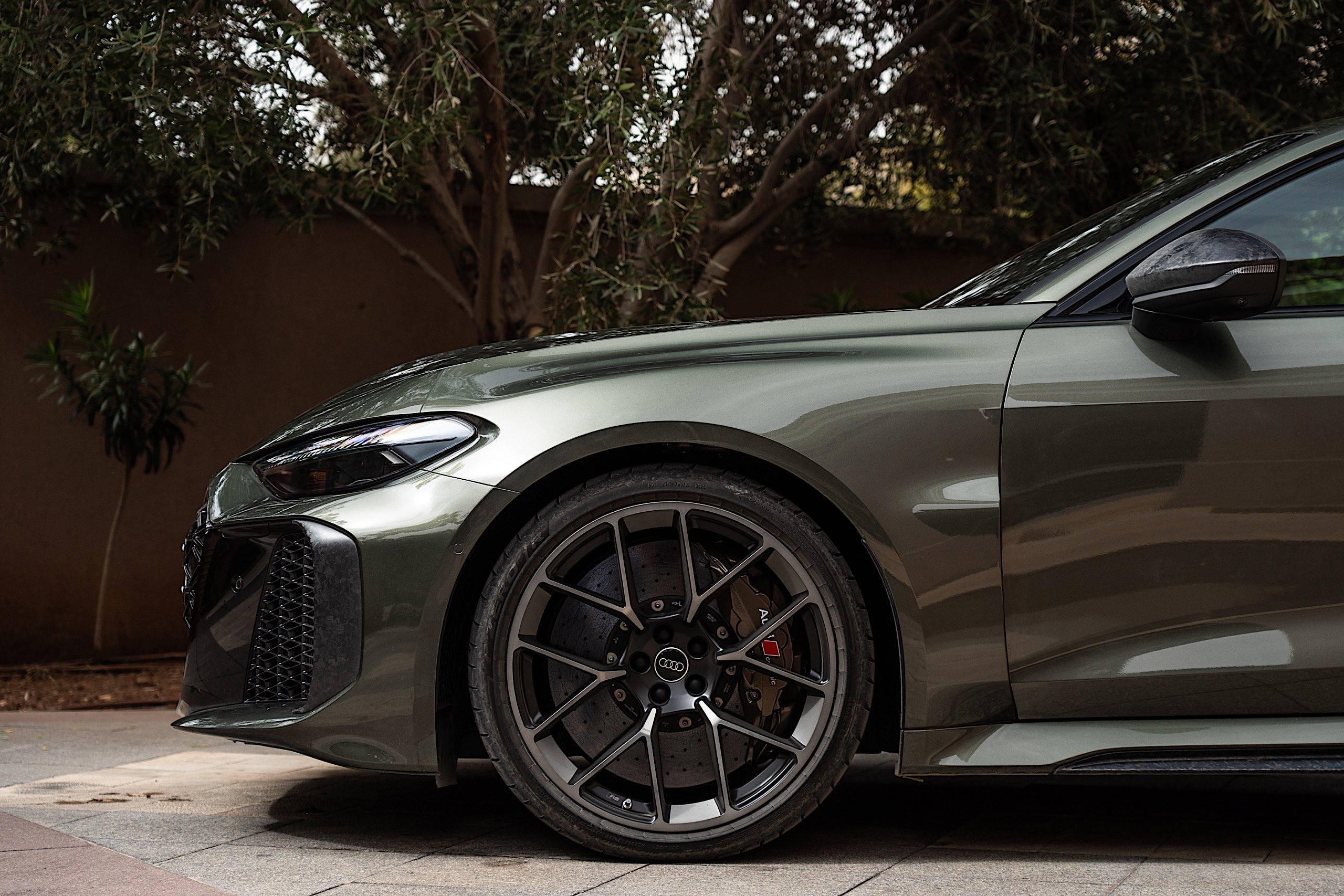
Again, this model gained more than 1,000 pounds over the old RS5, and though the improved suspension, drivetrain, tires and even giant, ceramic brakes all help to reduce its feel, there’s no hiding that much mass.
Yes, the RS5 has gained a lot of weight, and that hurts its nimbleness on track, but remember that this is a large, luxury sedan. It was never meant to be a lithe track toy. Despite that, the new RS5 actually feels far more fun and aggressive than its predecessor, a characteristic at least partially due to that trick new rear differential and the instant response of the new hybrid system. 54 miles of emissions-free range doesn’t hurt, either.
The big question is cost, and sadly, Audi’s not ready to answer that one yet. You do, at least, have a little time to save. The new RS5 doesn’t hit American shores until sometime in 2027.
This article originally appeared on Engadget at https://www.engadget.com/transportation/2027-audi-rs5-first-drive-big-thrills-with-a-big-battery-152057907.html?src=rss
Apple updated its low-end MacBook Pro with the Apple M5 back in October of last year, but the higher-end 14-inch and 16-inch Pros stuck with the M4 Pro and M4 Max chips. This morning Apple circled back around and updated the rest of the lineup, adding the M5 Pro and M5 Max to the higher-end machines and bumping the base storage—the M5 Pro now comes with 1TB of storage by default, while M5 Max chips come with 2TB of storage by default. The internal storage is said to be “up to 2x faster” than the previous-generation Pros. Apple is also bumping the base storage for the M5 MacBook Pro from 512GB to 1TB.
Unlike Apple’s other announcements this week, though, these upgrades also come with increases to their starting prices; the 14-inch MacBook Pro with an M5 Pro now starts at $2,199 instead of $1,999, and the 16-inch model with an M5 Pro starts at $2,699 instead of $2,499. The M5 MacBook Pro now starts at $1,699, up from $1,599. Granted, you’re getting double the storage you used to get in those old base models, but you no longer have the option to pay less if you don’t need 1TB of space.
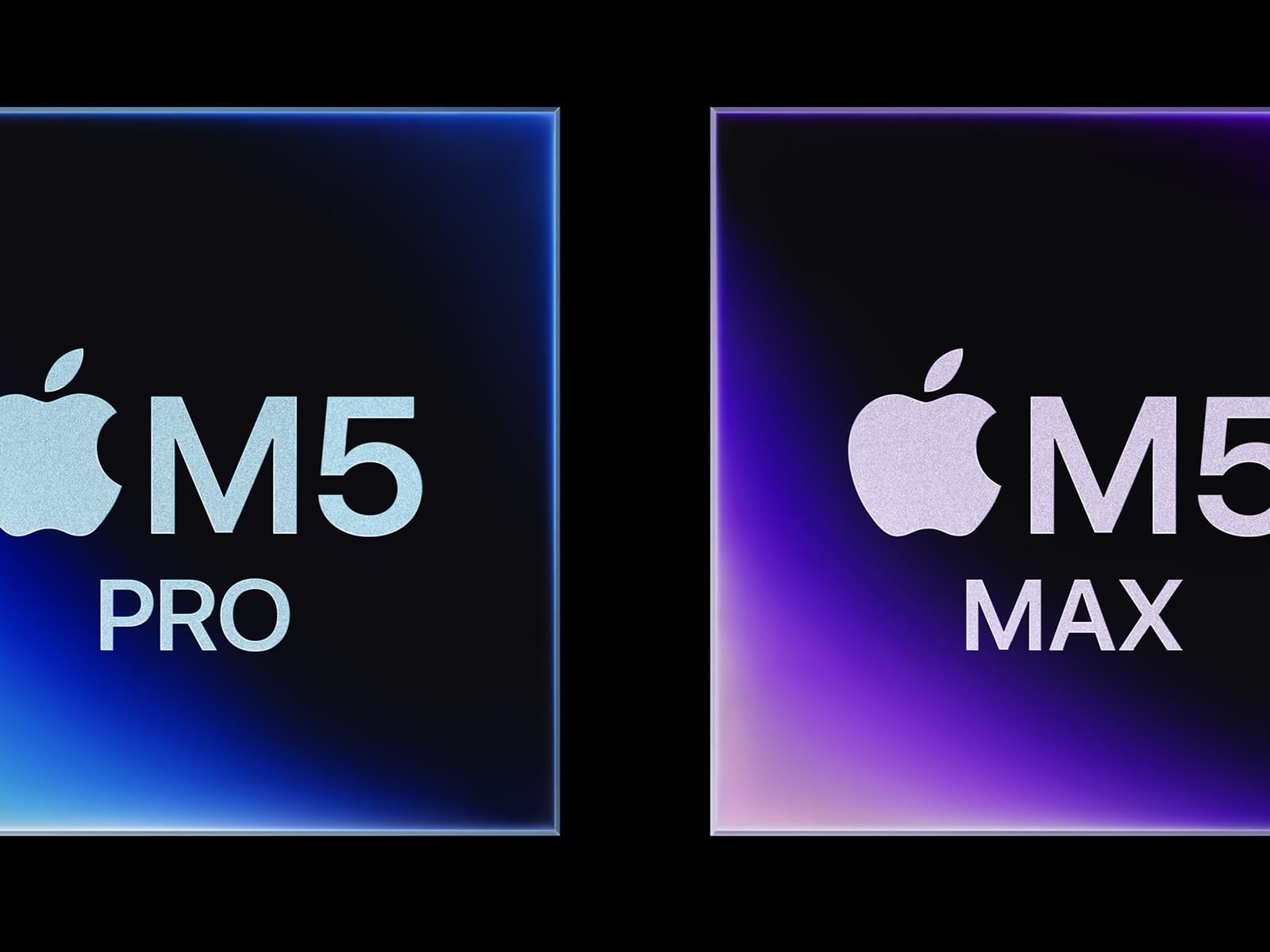
The M5 Pro and M5 Max look like fairly major updates from the M4 Pro and M4 Max. Both use an 18-core CPU with six higher-performing cores and 12 lower-performing cores, but Apple is changing how it talks about each kind of core. The high-performance cores are now called “super cores,” a change that Apple says will retroactively apply to the high-performance cores in the basic Apple M5; M5 has four of them, and M5 Pro and M5 Max have six of them.
Apple announced today the new Fusion Architecture with the M5 Pro and M5 Max SoCs that also feature a next-generation GPU…
One of the contradictions of the modern open-source movement is
that projects which respect user freedoms often rely on proprietary
tools that do not: communities often turn to non-free software for
code hosting, communication, and more. At Configuration Management
Camp (CfgMgmtCamp) 2026, Jan Ainali spoke
about the need for open-source projects to adopt open tools;
he hoped to persuade new and mature projects to switch to open
alternatives, even if just one tool, to reduce their dependencies on
tech giants and support community-driven infrastructure.
Apple is continuing to announce new products ahead of its big March 4 event. Yesterday, it was the iPhone 17e and M4 iPad Air. Today, it’s all about the Mac. Apple made a number of announcements: a new M5 MacBook Air, M5 Pro and M5 Max MacBook Pros, and new Studio Display options for anyone who wants to take out a mortgage on their external displays. All of these new products will be available preorder tomorrow, and go on sale March 11.
This first announcement isn’t all that exciting, but it does make sense for Apple. The company is now shipping MacBook Airs with the M5 chip, following the M5 MacBook Pro it launched in October. That doesn’t come with any real design or feature changes: These are largely the same 13 and 15-inch MacBook Airs you can buy with M4. However, you do get Apple’s latest-gen chip, which comes with performance upgrades.
M5 comes with a 10-core CPU and four “super” cores and six efficiency cores, up to a 10-core GPU, a 16-core neural engine for AI processing, and 153GB/s memory bandwidth. Apple says that M5 can process AI tasks up to four times faster than M4, and comes with 28% more memory bandwidth. While those are the direct comparisons with M4, many of Apple’s stats in its press release compare the M5 to M1, likely for two reasons. The year-over-year gains between chips aren’t huge, and, because of that, people tend to hold onto M-series Macs for a long time. Apple is likely trying to target M1 MacBook Air users who might be starting to think about an upgrade.
The biggest change aside from M5 is the starting storage amount: The M5 MacBook Air now comes with 512GB of storage in the base model, so 256GB is no longer an option. That’s good news, as the latter can run out fast, but it does mean the MacBook Air now starts at $1,099, rather than the $999 the machine has been known for. You can configure the new Airs with up to 4TB of storage, too, if you need it, though any storage you get is going to be faster than previous MacBook Airs. Apple says the new SSDs are 2x faster in regard to both read and write speeds.
The M5 chip also supports Wi-Fi 7 and Bluetooth 6, which is an upgrade over M4’s support for Wi-Fi 6E and Bluetooth 5.3. Apple is shipping the new Airs with a 40W “Dynamic Power Adapter” that can charge up to 60W.
If you’re looking for the fastest MacBooks money can buy, turn your attention to the MacBook Pros. This is bigger news than the MacBook Air, as Apple already shipped products with the M5 chip. Now, the company is debuting M5 Pro and M5 Max for the first time in the new MacBook Pros—though, once again, these chips are really the only thing new about these machines.
Still, that’s a big deal, if you take Apple at its word. The company says that M5 Pro and M5 Max have the world’s fastest CPU Core (“using shipping competitive systems and select industry-standard benchmarks”), and are built using Apple’s new “Fusion Architecture.” That means these chips combine two dies on one chip, with a CPU up to 18 cores and a GPU up to 20 cores (M5 Pro) or 40 cores (M5 Max). M5 Pro can be configured with up to 64GB of RAM and 4TB of storage, while M5 Max can go up to 128GB of RAM and 8TB of storage.
The name of the game for Apple here is AI processing. The company says that M5 Pro can generate AI images 3.7 times faster than M4 Pro, and process LLM prompts 3.9 times faster. Meanwhile, M5 Max can generate AI images 3.8 times faster than M4 Max, and LLM prompt processing is four times faster. The gains are even larger when compared to M1 Pro and M1 Max, of course, which Apple highlights for similar reasons to the M5 MacBook Air: M1 Pro and M1 Max MacBook Pro owners are holding onto their laptops.
As with the M5 MacBook Air, Apple is doubling the read/write speeds of the SSDs in these MacBook Pros. The base model M5 Pro MacBook Pro now comes with a 1TB SSD, while the M5 Max comes with 2TB. It also comes with Wi-Fi 7 and Bluetooth 6 support. Those upgrades come at an increased base cost, however: The 14-inch M5 Pro MacBook Pro now starts at $2,199, while the 16-inch MacBook Pro with M5 Pro starts at $2,699—$200 more than before.
Apple also announced refreshes to its external displays—Studio Display and Studio Display XDR. The Studio Display refresh is rather minor: It now comes with a 12MP Center Stage camera, with some image enhancements and support for Desk View—Apple’s feature that lets you show off your desk with just the webcam. It also has improved microphones and speakers, and Thunderbolt 5 support. But the display itself is much the same as the previous model, and still starts at $1,599.
If you want features like a high refresh rate 120Hz display, you’ll need to look to the Studio Display XDR. This display packs Apple’s “pro” features: It comes with a 27-inch 5K display with mini-LED, and can reach 1,000 nits of brightness (2,000 nits in HDR). Those features come at a cost, however: $3,299, to be exact.

Game Pass has some certified bangers coming to the service this month
COLUMBUS, Ohio—Protestors stood in the snow outside the offices of Ohio’s utility regulator in January to say they were fed up with rising electricity rates.
Even a few years ago, the scene would have been hard to imagine, considering the complexity of utility costs and the obscurity of state regulatory agencies. But rate hikes in Ohio and across the country have provoked frustrated consumers to demand answers.
“It’s just getting harder and harder now to live,” said Steve Van Kuiken, a United Church of Christ pastor in Columbus who is part of a community group opposing rate increases. “The working class is really getting squeezed, and everything’s going up.”
The Moon has received a lot of attention in recent months, particularly the surface of Earth’s cold and dusty companion.
This has largely been driven by a decision from SpaceX founder Elon Musk to pivot, at least in the near term, from Mars to lunar surface activities and the potential for using material there to build large satellites. But there has been a notable shift from NASA, too, which has started talking a lot more about building up elements of a base on the surface rather than an orbiting space station known as the Gateway.
In short, the world’s most successful space company and the largest space agency have both increased their lunar ambitions, suggesting a greater frequency of missions to the Moon in the coming years.
Clones are everywhere. Last week I talked about the rumor that actor Selena Gomez is a clone or a double (she is not). This week, it’s Jim Carrey. Many online are wondering whether the rubber-faced comedian/actor is not what he seems to be. Maybe he’s a clone. Maybe he has a doppelgänger. Maybe it’s a prank.
This is all obviously dumb, but unlike the Selena Gomez story, there’s some evidence that supports the idea. It’s not good evidence, but it’s at least a little more interesting than most conspiracy theories.
The theories started flying last week, when Jim Carrey was given the César Award in Paris. The 64-year-old comedian hasn’t been seen much in public for the past couple of years, and he delivered a speech in French at the awards presentation, despite never having publicly spoken the language. And he looked different than he used to. See for yourself:
This was enough evidence for the world’s conspiracy theorists to conclude that Carrey is a clone, or that he has been replaced by a multilingual double or something. So people took to X, instagram, and TikTok to spread the theory in posts like this:
This Tweet is currently unavailable. It might be loading or has been removed.
And this:
This Tweet is currently unavailable. It might be loading or has been removed.
His eyes are a different color, people said. His face has a totally different shape. Not the same guy, they concluded. But the rabbit hole goes deeper than just “he looks different.”
On March 1, Alexis Stone, an online person, seemed to take credit for portraying Carrey at the award show with the following post on Instagram bearing the caption “Alexis Stone as Jim Carrey in Paris.”
Stone has gained over a million followers online for their ability to impersonate celebrities to an uncanny level using latex and special effects makeup. Check out this Jack Nicholson:
So it’s not impossible, right?
It wasn’t long before internet sleuths tracked down a David Letterman interview with Carrey where he says he’s used a “Jim Carrey double.” “I send him off in one direction, and he sucks all the press in that direction, and I can just have my day,” Carrey told David Letterman.
So he admits it! The plot thickens.
Carrey is no stranger to pranking the media. During the filming of the Andy Kaufman bio pic Man on the Moon, Carrey would show up to the set dressed as Kaufman’s alter ego Tony Clifton, refusing to break character and abusing the crew and director Milos Forman. He supposedly re-ignited Andy Kaufman’s feud with wrestler Jerry Lawler. In the behind-the-scenes documentary Jim & Andy: The Great Beyond, Carrey says he “lost himself” in the character of Kaufman. So maybe Carrey pulled the prank himself as publicity stunt for a movie. If anyone could pull it off, surely it would Jim Carrey.
To recap: Jim Carrey is known for pranking the media; he showed up out of nowhere in Paris, spoke a different language, doesn’t look the same, admits to using doubles in the past, and Alexis Stone seems to have taken credit for appearing as Carrey’s double. So is it really that far-fetched to think that this could be the one real case of a celebrity double?
Yes, it is that far-fetched.
It was not a clone. As discussed in this column previously, human cloning is theoretically possible, but you can only clone embryos, not full-grown Canadian comedians, so unless the switcharoo was planned in the early 1960s, it wasn’t a clone that accepted the César Award for Jim Carrey last weekend.
It was not a body double, either. If Stone had appeared as Carrey, why would they do such a bad job? Why wouldn’t fake Jim Carrey look how people expect him to look? Why go with the wrong face shape and the wrong eye color? Besides, latex face appliances can look good in photos, but as soon as someone wearing it tries to talk, it’s obviously fake.
It was Jim Carrey. His people confirmed it, but even if they hadn’t, it would still be obvious. Carrey’s French was halting, because he’d learned it just to give that speech. His comments to Letterman were a joke, because he’s a comedian. While the actor has pranked the media in the past, the César Award is as prestigious a filmic honor as there is; it’s not the kind of thing you mess with. Besides, Carrey attended the ceremony with an entourage of 16 people, including his daughter Jane, his grandson Jackson, and his girlfriend Mina. So are they all in on it? Or did the double fool them too?
The most compelling evidence that the man who spoke at the French awards show last week was the real Jim Carrey is that he looks exactly like Jim Carrey. It’s the same eye color: In dark-eyed people, bright, direct light can make brown eyes appear lighter. It’s the same face. He looks older than he did when he was Ace Ventura, and he looks like he had cosmetic work done, but that is Jim Carrey, and no matter how many lines people draw on downloaded images, it’s still going to be Jim Carrey.
After OpenAI announced a partnership with the U.S. Department of Defense, U.S. uninstalls of ChatGPT surged 295% in a single day. Meanwhile, rival Anthropic “gained enough popularity to earn the number one spot on the App Store’s Top Free Apps leaderboard,” reports Engadget. TechCrunch reports: This data, which comes from market intelligence provider Sensor Tower, represents a sizable increase compared with ChatGPT’s typical day-over-day uninstall rate of 9%, as measured over the past 30 days. […] In addition, ChatGPT’s download growth was impacted by the news of its DoD partnership, with its U.S. downloads dropping by 13% day-over-day on Saturday, shortly after the news of its deal went public. Those downloads continued to fall on Sunday, when they were down by 5% day-over-day. (Before the partnership was announced, the app’s downloads had grown 14% day-over-day on Friday.)
[…] Consumers are also sharing their opinions about OpenAI’s deal in the app’s ratings, where 1-star reviews for ChatGPT surged 775% on Saturday, then grew 100% day-over-day on Sunday, Sensor Tower said. Five-star reviews declined during the same period, dropping by 50%. Other third-party data providers back up Sensor Tower’s findings.


Read more of this story at Slashdot.


The Evil Dead star says he’s aiming to return in the fall to promote his new movie
Matthew Garrett examines
the factors that go into the decision about whether to install a
firmware update or not.
I trust my CPU vendor. I don’t trust my CPU vendor because I want
to, I trust my CPU vendor because I have no choice. I don’t think
it’s likely that my CPU vendor has designed a CPU that identifies
when I’m generating cryptographic keys and biases the RNG output so
my keys are significantly weaker than they look, but it’s not
literally impossible. I generate keys on it anyway, because what
choice do I have? At some point I will buy a new laptop because
Electron will no longer fit in 32GB of RAM and I will have to make
the same affirmation of trust, because the alternative is that I
just don’t have a computer.
Reports had suggested that Apple wasn’t going to reveal a refreshed MacBook Air with an M5 chip during its week of announcements, but whaddyaknow? Apple just went ahead and did that exact thing.
Let’s deal with the bad news first: Apple is reverting a price cut from last year. It dropped the M4-powered MBA’s starting price down to $999, but for the M5-equipped model, you’ll need to shell out at least $1,099.
The company claimed the M5 MacBook Air will be able to deliver four times faster performance in AI tasks than the M4 MBA. Compared with the M1 MacBook Air, you’ll get up to 9.5 times faster performance, the company said.
Along with swapping in a more powerful chip, Apple has upgraded the starting storage by doubling it from 256GB to 512GB. The company says the SSD has “2x faster read/write performance compared to the previous generation.” You can kit out the MacBook Air with 4TB of internal storage if you have the will and the means.
You’ll also get 16GB of RAM for starters. The memory has 153GB/s of bandwidth, which Apple said is a 28 percent improvement over the M4 MBA. The latest MacBook Air can be equipped with up to 32GB of memory.
Just like it did with the latest iPad Air, Apple has upgraded the connectivity hardware. Thanks to the inclusion of the company’s N1 wireless chip, the M5 MacBook Air supports Wi-Fi 7 and Bluetooth 6.
As you’d imagine, the M5 MacBook Air runs on macOS Tahoe and it supports Apple Intelligence features. It has a Liquid Retina display, 12MP Center Stage camera, a sound system with Spatial Audio support and a pair of Thunderbolt 4 ports, which allows the laptop to support up to two external displays. Apple claims the M5 MacBook Air will run for up 18 hours on a single charge.
The M5 MacBook Air is available in 13-inch and 15-inch models, with the latter starting at $1,299. It’s available in sky blue, midnight, starlight and silver. Pre-orders start on March 4 at 9:15AM ET. The laptops will be available in stores in 33 countries and regions on March 11.
This article originally appeared on Engadget at https://www.engadget.com/computing/laptops/the-macbook-air-m5-starts-at-1099-up-100-from-the-m4-141612909.html?src=rss

The presentation showed off indie games coming to Switch and Switch 2
As part of its big week of announcements, Apple has unveiled a new pair of M5 chips alongside two new MacBooks. The new M5 Pro and M5 Max chips will power the new MacBook Pro that was just announced today, while the new MacBook Air comes with the base M5. According to the company’s press release, the M5 Pro and M5 Max come with an “advanced GPU with Neural Accelerators and higher unified memory bandwidth for a massive increase in AI compute.”
At the heart of the M5 Pro and M5 Max are what Apple is calling a new “Fusion Architecture” that “combines two dies into a single system on a chip (SoC).” The chips both feature a new 18-core CPU, six of which Apple is now calling “super cores, that are the word’s fastest CPU core.”
The other 12 are “all-new performance cores, optimized for power-efficient, multithreaded workloads.” Altogether, Apple says these CPU changes improve performance by “up to 30 percent for pro workloads.” Meanwhile, the GPU is a jump over the next-gen design we saw in the M5, as it goes to up to 40 cores. Each GPU core has a Neural Accelerator in it, and together with the higher unified memory bandwidth, the company says the M5 Pro and M5 Max offer “over 4x the peak GPU compute for AI compared to the previous generation.”
Apple added that graphics performance is also getting a substantial boost, by up to “35 percent for apps using ray tracing” compared to the M4 Pro and M4 Max.
To be clear, this isn’t the first time Apple has claimed it has the “world’s fastest” core. According to our resident Apple Silicon expert Devindra Hardawar, the benchmarks have proven the company’s claims true. It’s also worth noting that the two-die design isn’t novel or unique, as companies like Intel and AMD have been doing similar.
The M5 Pro and M5 Max will first show up in the new MacBook Pro, which is available for pre-order starting March 4, and will arrive on Wednesday, March 11.
This article originally appeared on Engadget at https://www.engadget.com/computing/apple-unveils-the-m5-pro-and-m5-max-chips-which-feature-new-faster-super-cores-141533420.html?src=rss
It happened much later than we expected, but Apple’s announcement of MacBook Pros with its M5 Pro and M5 Max chips has finally arrived. These more powerful variants on Apple’s silicon will be available in the 14-inch and 16-inch models of the laptops. Pre-orders will open on March 4 with an expected ship date of March 11. You’ll want to save some extra coin this time, though, as prices have gone up compared to the prior generation.
The new 14-inch MacBook Pro can be kitted out with either an M5 Pro or M5 Max. The Pro option for the chip boasts a CPU with 15 or 18 CPU cores and 16 or 20 GPU cores. For the M5 Max, users will have 18 CPU cores along with 32 or 40 GPU cores. The base model with an M5 Pro has either 24 or 48GB of RAM and now starts with 1TB of storage, up from 512GB as was standard before.
If you’re eyeing the 16-inch MacBook Pro, it starts with the M5 Pro with 18 CPU cores and 20 GPU cores. You can also get the same two M5 Max configurations as you can on the 14-inch model.
Perhaps most significantly, Apple has raised prices on its entire MacBook Pro lineup. The 14-inch M5 model previously started at $1,599; it’s now priced at $1,699. At least you’re getting something for that cash, as Apple has doubled its base storage to 1TB.
The same goes for the new M5 Pro and Max options. The 14-inch with the M5 Pro now starts at $2,199 instead of $1,999, while the 16-inch starts at a whopping $2,699 instead of $2,499. That 16-inch model comes with 24GB of RAM and 1TB of storage now as standard; that’s again double the storage space from the prior model. The M5 Max model starts with 2TB of storage and 36GB of RAM for $3,599 (14-inch) or $3,899 (16-inch).
Running down the rest of the specs: Apple says the storage in the new MacBook Pro is twice as fast as the prior generation — so you’re getting more, faster storage than before for the extra cash. The laptops also include the Apple-designed N1 chip for Wi-Fi 7 and Bluetooth 6 connectivity, and Apple says the MacBook Pro is rated for up to 24 hours of battery life. It has the same excellent Liquid Retina XDR display as we’ve seen for multiple years now, as well as a 12-megapixel “Center Stage” front-facing camera.
It’s a little unusual for these heavy-duty upgrades to Apple’s MacBook Pros to be announced so much later from the news of its latest silicon updates. The company debuted the M5 chip last fall as usual, but spent several months before it revealed these major hardware additions for housing it. And the M5 MacBook Pro that was announced in October shortly after the M5 chip news came with zero fanfare.
This article originally appeared on Engadget at https://www.engadget.com/computing/laptops/apple-brings-its-m5-pro-and-max-silicon-to-the-next-macbook-pro-generation-141553279.html?src=rss