

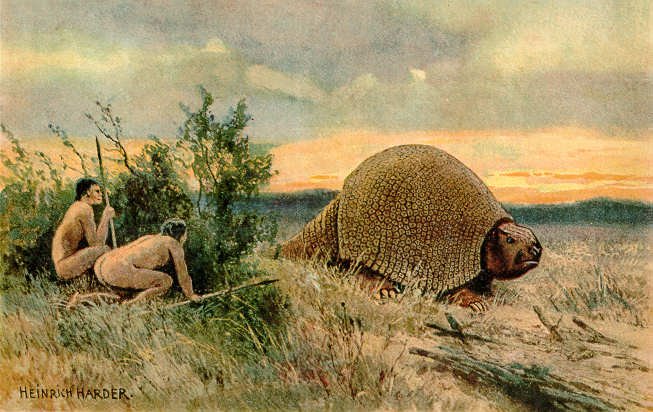
Enlarge / Humans living in Argentina 14,000 years ago were hunting giant armadillos. This one looks especially grumpy. (credit: Heinrich Harder)
For over a decade, evidence has been piling up that humans colonized the Americas thousands of years before the Clovis people. The Clovis, who are the early ancestors of today’s Native Americans, left abundant evidence of their lives behind in the form of tools and graves. But the mysterious pre-Clovis humans, who likely arrived 17,000 to 15,000 years ago, have left only a few dozen sources of evidence for their existence across the Americas, mostly in the form of campsites where they processed animals during hunting trips. Now a fresh examination of one such campsite, a 14,000 year-old hunter’s rest stop outside the city of Tres Arroyos in Argentina, has given us a new understanding of how the pre-Clovis people might have lived.
Archaeologists are still uncertain how the pre-Clovis people arrived in the Americas. They came after the end of the ice age, but at a time when glaciers and an icy, barren environment would still have blocked easy entrance into the Americas via Northern Canada. So it’s extremely unlikely that they marched over a land bridge and into the Americas through the middle of the continent—most scientists believe they would have come via a coastal route, frequently using boats for transport. That would have explain why many pre-Clovis sites are on the coast, on islands, or on rivers that meet the ocean.
These early settlers were hunter-gatherers who used stone tools for a wide range activities, including hunting, butchery, scraping hides, preparing food, and making other tools out of bone and wood. Many of the pre-Clovis stone tools look fairly simple and were made by using one stone to flake pieces off the other, thus creating sharp edges. At the campsite in Argentina, known as the Arroyo Seco 2 site, archaeologists have found over 50 such tools made from materials like chert and quartzite. They’re scattered across an area that was once a grassy knoll above a deep lake, which is rich with thousands of animal bone fragments that have been carbon dated to as early as 14,000 years ago. There are even a couple dozen human burials at the site, dated to a later period starting roughly 9,000 years ago. The spot has the characteristic look of a hunter’s camp, used for processing animals, that was revisited seasonally for thousands of years.
Read 7 remaining paragraphs | Comments
Source: Ars Technica – 14,000-year-old campsite in Argentina adds to an archaeological mystery