

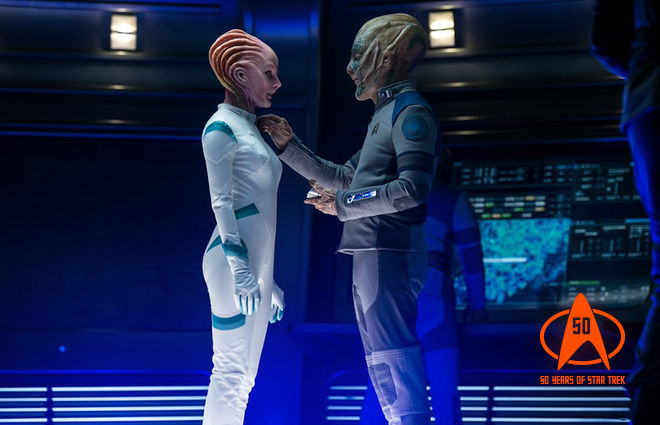
Enlarge / Jeff Bezos (right) in his cameo as an alien in Star Trek: Beyond.
At Blue Origin’s headquarters near Seattle, one of the highlights of any tour is Jeff Bezos’ dazzling collection of space and science fiction memorabilia. The world’s fourth richest man grew up enthralled with space, and his collection includes everything from real-world spacesuits, to a full-size Battlestar Galactica pressure door, to a hidebound photo album kept by a soldier stationed in the 1970s at Baikonur, where the Soviets launched Yuri Gagarin’s rocket into space. Among these displays are several Star Trek collectibles, including a model Starship Enterprise used in the first three Star Trek movies.
A self-admitted Trekkie, Bezos founded Blue Origin 16 years ago this month, and the company stands at the vanguard of the new space movement. He, along with Elon Musk, and to a lesser extent others like Microsoft’s Paul Allen, have begun to shake up the stodgy aerospace industry with new companies and new ideas. They have injected personal capital and innovation into spaceflight for a single, overarching reason—they want to see humanity expand into space. And the impetus for this came early in life, largely from Star Trek and its optimistic vision of humanity as a species that had mastered spaceflight and set about exploring the galaxy.
For Trek fans of a certain age, spreading humanity across the cosmos does not seem like an impossible dream. Bezos, 52, and Musk, 45, grew up in the 1970s, an anything-was-possible era. NASA had just sent humans to the Moon, and Voyager probes were flying out into the solar system. The space agency, too, was developing the space shuttle, which promised to send hundreds if not thousands of people to space, as well as plant the seeds for a vibrant, in-space economy.
Read 9 remaining paragraphs | Comments
Source: Ars Technica – Without Star Trek, there would be no SpaceX or Blue Origins