

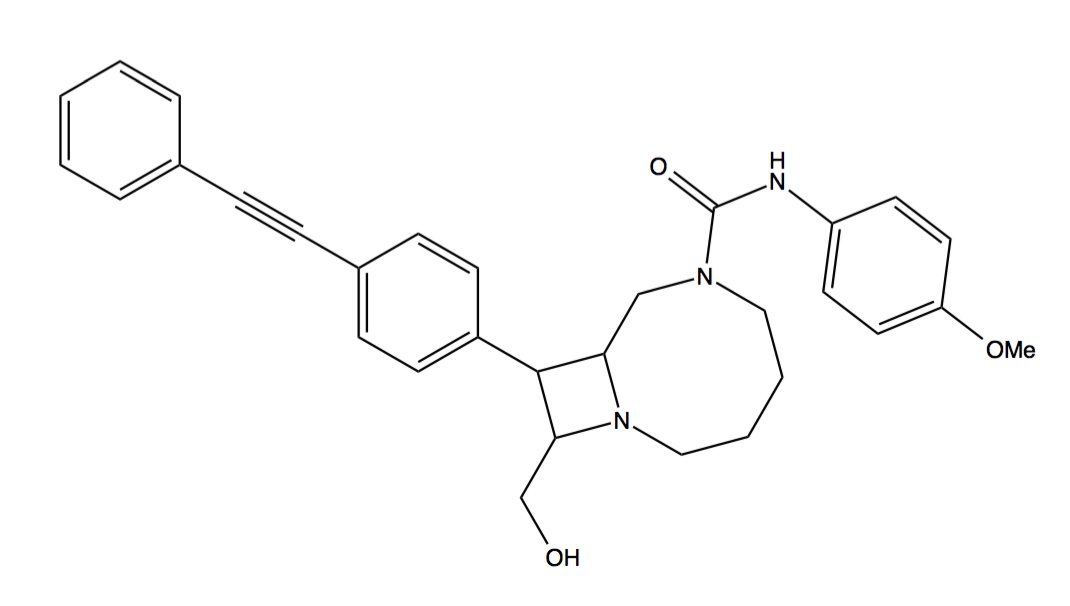
Enlarge / The drug is what chemists might refer to as a bit of a beast. (credit: John Timmer)
Last year, there were over 200 million cases of malaria, and they resulted in nearly half a million deaths. Efforts to control the disease have had limited success. The mosquitos that carry it have rapidly evolved resistance to insecticides like DDT, and there are now areas of the globe where the parasite that causes the disease are resistant to even our most effective treatment.
Efforts to develop new drugs are challenging. The malarial parasite, Plasmodium, is a eukaryote like us, and thus it shares a lot of basic biochemistry. That makes it harder to find a drug that targets the parasite but not human cells. Plasmodium also has a complex life cycle, with stages that are rather distinct. That makes generating vaccines difficult, and it ensures some treatments only work on a subset of these stages.
But new approaches to screening drugs have turned up a number of promising leads in recent years. One success, reported this week in Nature, involves a drug that targets a Plasmodium protein that no other drug works on. In tests on mice, the drug was able to clear an infection with a single dose.
Read 9 remaining paragraphs | Comments
Source: Ars Technica – New drug clears malaria from mice in a single dose