
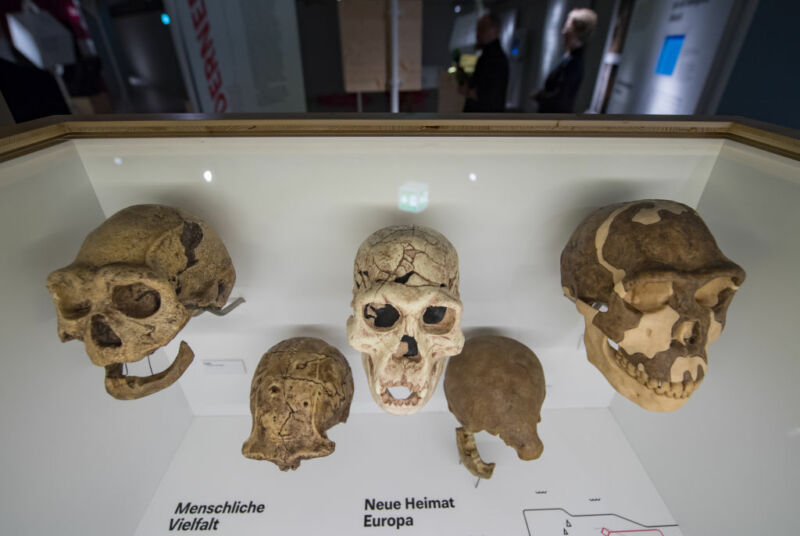
Enlarge / OK, which one of you is the father? (credit: picture alliance / Getty Images)
Shortly before the publication of the first Neanderthal genome, a number of researchers had seen hints that there might be something strange lurking in the statistics of the human genome. The publication of the genome erased any doubts about these hints and provided a clear identity for the strangeness: a few percent of the bases in European and Asian populations came from our now-extinct relatives.
But what if we didn’t have the certainty provided by the Neanderthal genome? That’s the situation where we find ourselves now, as several studies have recently identified “ghost lineages“—hints of branches in the human family tree for which we have no DNA sequence but find their imprint on the genomes of populations alive today. The existence of these ghost lineages is based on statistical arguments, and so it is very dependent upon statistical methods and underlying assumptions, which means they’re prone to being the subject of disagreement within the community that studies human evolution.
Now, researchers at the University of Utah are arguing they have evidence of a very old ghost lineage contributing to Neanderthals and Denisovans (and so, indirectly, possibly to us). This is undoubtedly going to be a claim that others in the field contest, in part because the evidence comes from an analysis that would also revise the dates of many key events in human evolution. But it’s interesting to look at in light of how scientists deal with a question that may never be answered by definitive data.
Read 18 remaining paragraphs | Comments
Source: Ars Technica – Neanderthals may have interbred with a much older human lineage