
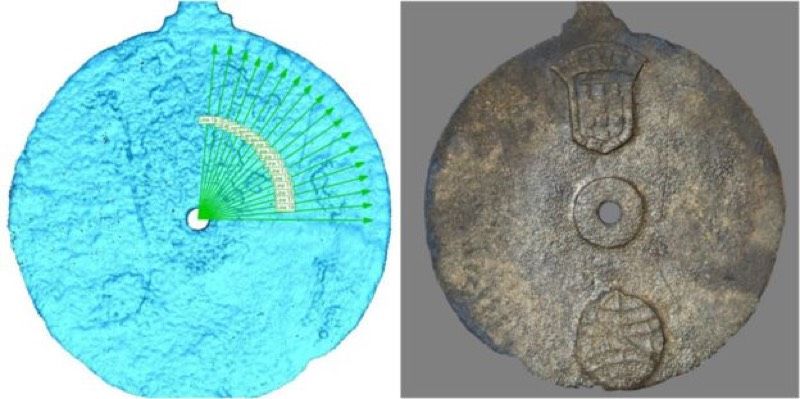
Enlarge / Left: A laser imaging scan of the so-called Sodre astrolabe, recovered from the wreck of a Portuguese Armada ship. Right: The astrolabe is believed to have beeb made between 1496 and 1501. (credit: David Mearns/University of Warwick)
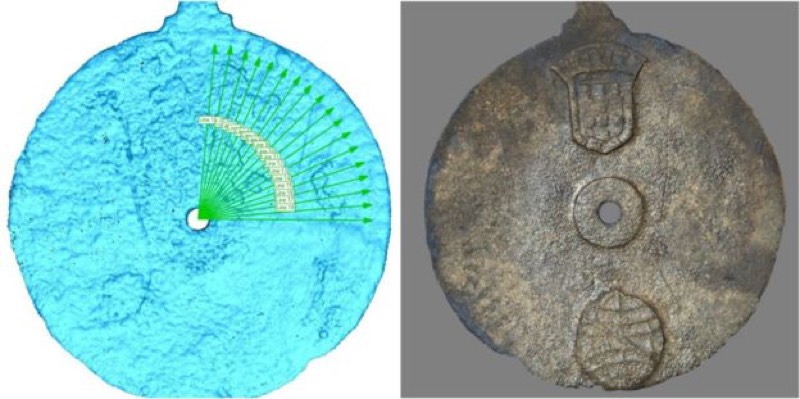
A mariner’s astrolabe recovered from the wreck of one of Portuguese explorer Vasco da Gama’s ships is now officially the oldest known such artifact, according to a new paper in the International Journal of Nautical Archaeology. It’s even going into the Guinness Book of world records, along with the ship’s bell, now that both have been independently verified as the oldest of their kind in the world.
Key distinction: this is the oldest known mariner’s astrolabe. Astrolabes are actually very ancient instruments—possibly dating as far back as the Second Century, B.C.—for determining the time and position of the stars in the sky by measuring a celestial body’s altitude above the horizon. They were mostly used for astronomical studies, although they also proved useful for navigation on land. Navigating at sea was a bit more problematic, unless the waters were calm.
The development of a mariner’s astrolabe—a simple ring marked in degrees for measuring celestial altitudes—helped solve that problem. It was eventually replaced by the invention of the sextant in the18th century, which was much more precise for seafaring navigation. Mariner’s astrolabes are among the most prized artifacts recovered from shipwrecks; only 108 are currently catalogued worldwide.
Read 5 remaining paragraphs | Comments
Source: Ars Technica – This medieval astrolabe is officially world’s oldest known such instrument