

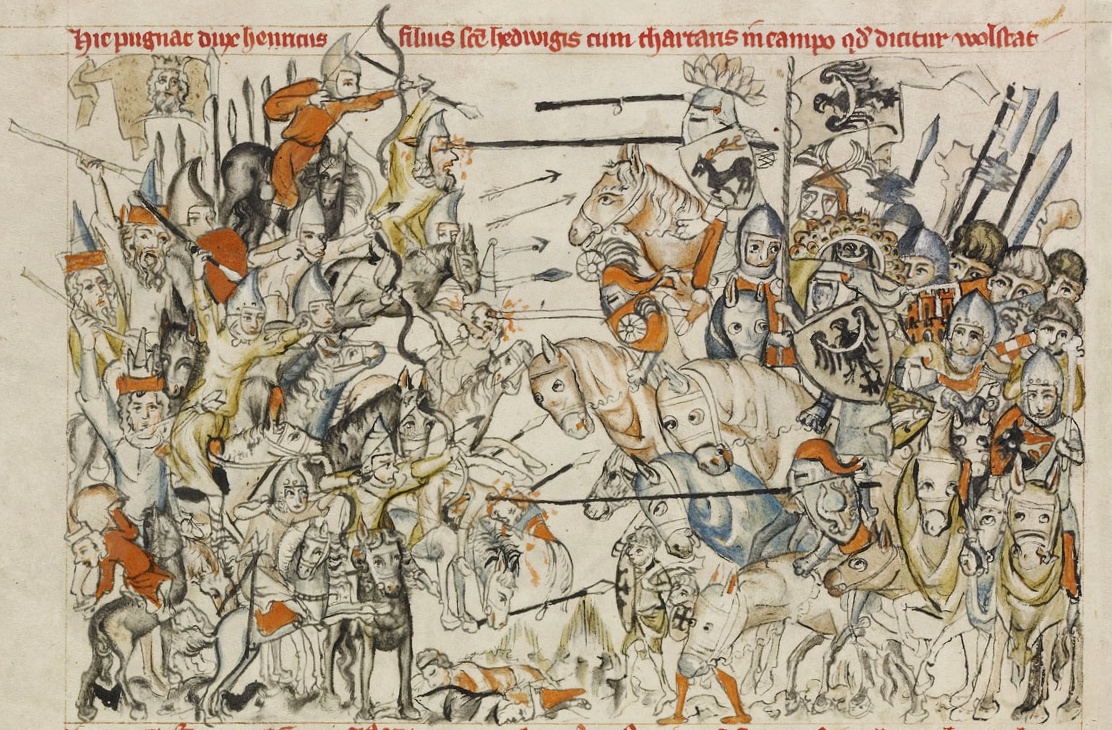
Enlarge / The battle of Liegnitz, 1241. From a medieval manuscript of the Hedwig legend. (credit: Wikimedia Commons)

Next time you picture a Mongol horde sweeping across the Asian steppes on horseback, imagine that about two-thirds of them have liver disease. Hepatitis B is a virus that attacks the liver, causing scarring, organ failure, and sometimes cancer. Its origins and evolutionary history are still a bit of an enigma, but viral DNA left behind in the bones and teeth of ancient people from the Asian steppe may help reconstruct part of our long history with the disease.
The virus showed up in what have been considered extraneous sequences of DNA that are associated with DNA samples but not part of the human genome. Typically, software gets rid of these sequences and uses what’s left to assemble the human genome.
Viruses and genomes
While DNA sequencing has focused on the human portion of human genome data, that’s starting to change. “Originally, this was nothing we paid much attention to. It was just expensive and kind of a waste product, but now we’ve started investigating this waste product for possible positives,” said Copenhagen University evolutionary geneticist Eske Willerslev. It’s how his team found evidence that Mongol warriors from the steppe carried an early form of the pathogen that would later become the 541-542 CE Justinian Plague.
Read 25 remaining paragraphs | Comments
Source: Ars Technica – Genghis Khan’s Mongol horde probably had rampant Hepatitis B