

Enlarge / Don Pedro Reservoir was down to 61 percent of its normal level in 2015 but filled to 134 percent by early 2017 after a very wet winter. (credit: NASA Earth Observatory)
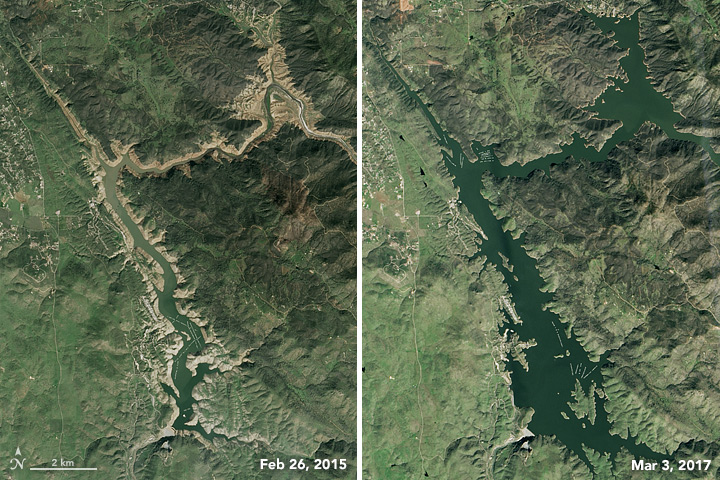
As the last few years have reminded us, California weather means you have to be prepared for anything. From 2012 to 2016, the Golden State saw a historic drought that led to water restrictions—and saw land areas sinking as groundwater use increased to compensate. But the winter of 2016 brought too much rain, producing flooding and evacuations below the Oroville Dam.
Variable rainfall is a natural component of California’s climate, but what will happen as climate change continues to play out? That’s the question a team led by UCLA’s Daniel Swain recently set out to answer.
Sim California
Though climate change projections show a warmer California, total rainfall isn’t expected to change much. But in this case, the researchers used climate model simulations to analyze precipitation variability, specifically, rather than just annual totals. They compared historical weather records, an 1,800-year-long simulation of the climate pre-Industrial-Revolution, and 40 simulations of climate change from 1920 to 2100 (assuming high future greenhouse gas emissions). These long simulations allowed them to accumulate meaningful statistics for different weather patterns.
Read 9 remaining paragraphs | Comments
Source: Ars Technica – California can look forward to more extreme dry-wet “climate whiplash”