

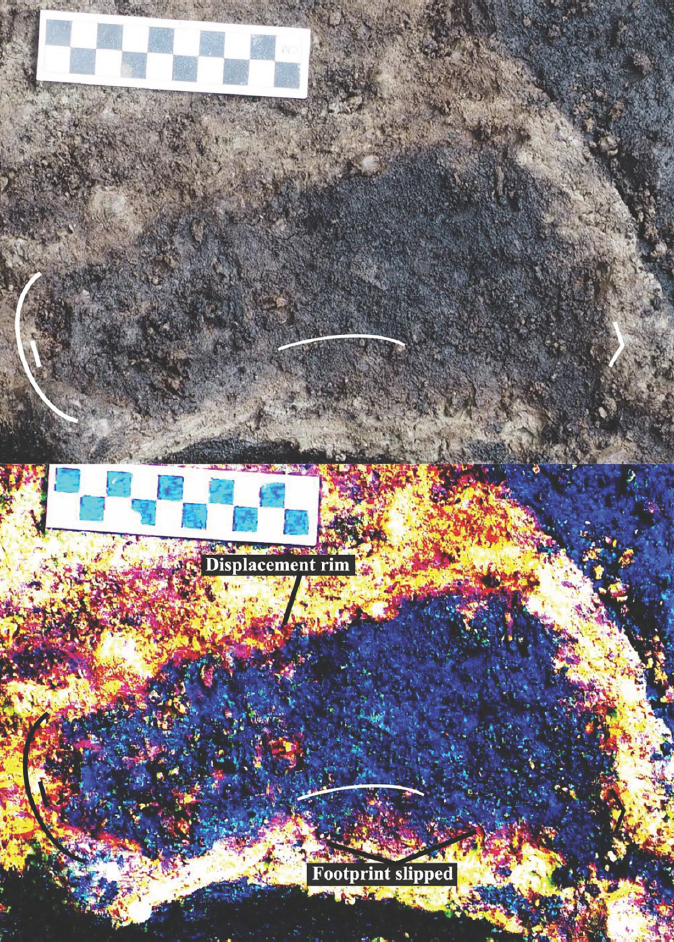
Enlarge / Track #20, showing a slip mark. (credit: Douglas McLaren)
Thirteen thousand years ago, a small group of people walked on a beach on one of the thousands of low islands off the coast of British Columbia. These walkers were some of the first humans to settle here.
A team of archaeologists led by Duncan McLaren of the Hakai Institute and the University of Victoria unearthed 29 footprints on the shore of Calvert Island, British Columbia, embedded in a layer of light-brown clay 60cm below today’s sandy beach. Radiocarbon dating of a small piece of wood embedded in the clay puts the footprints at 13,317 to 12,633 years old, making them some of the earliest clear evidence of human presence this far north on Canada’s Pacific Coast.
The footprints offer proof that people were on the west coast of Canada in the final stages of the last glacial period, when a huge expanse of ice called the Cordilleran Ice Sheet stretched to Canada’s Pacific Coast. The ice sheet seems to have receded from the shoreline in patches, creating small areas of thawed land called refugia, just large enough to support plants and large animals—including humans, if they could get there. It’s possible that the first North Americans made their way south along the edges of the Cordilleran Ice Sheet after crossing the Beringia Land Bridge.
Read 12 remaining paragraphs | Comments
Source: Ars Technica – Humans walked on a Canadian beach 13,000 years ago