

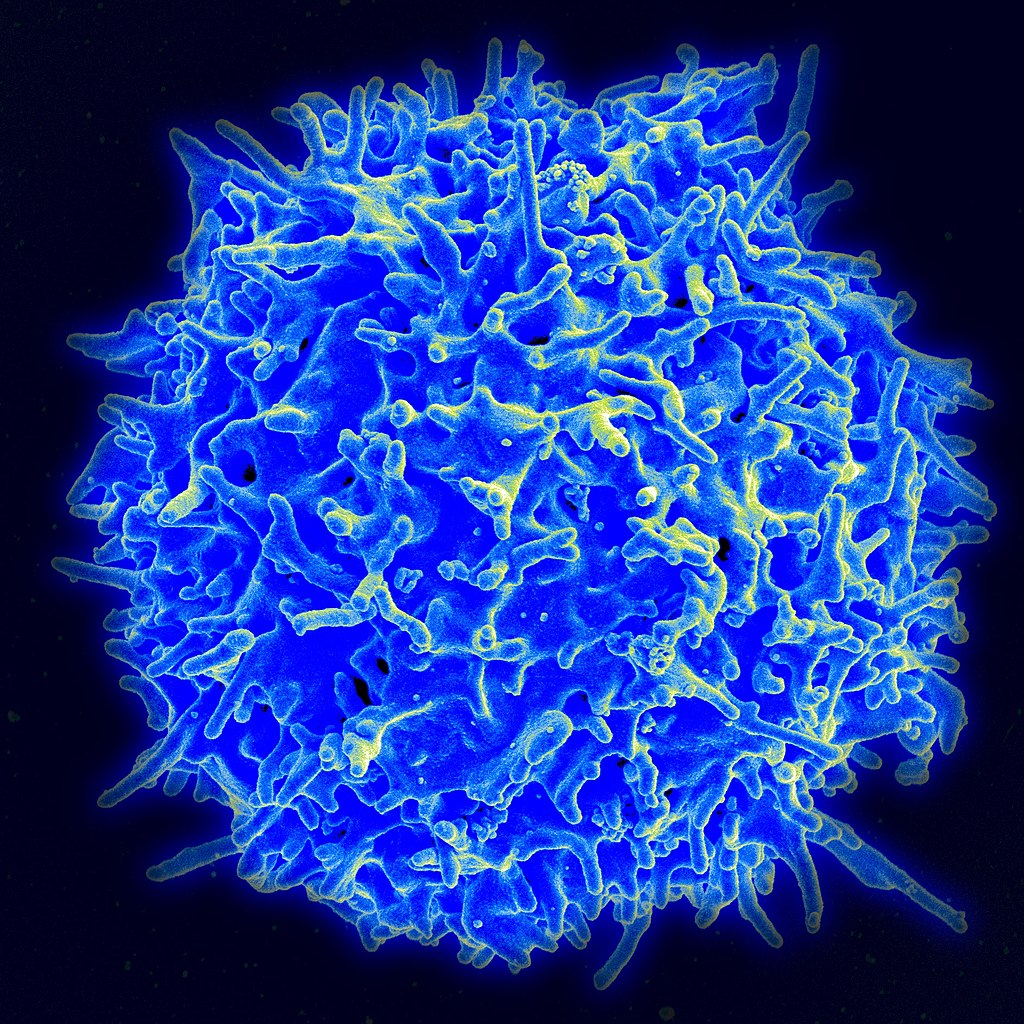
Enlarge / T cells are central to the immune system’s response to cancer. (credit: NIAID)

The dominant idea about how cancer gets started is called the “two-hit hypothesis.” First proposed by Alfred Knudson in 1971, it holds that a cancer starts when one cell gets a mutation in both of its copies of a gene that normally blocks cancer formation (two hits). These two mutations disable the tumor-suppressing function in that cell, which then becomes cancerous. Eventually, the idea was expanded to include two hits not necessarily in the same gene but, rather, in genes controlling the same tumor-suppressing pathway.
But a new idea is challenging the two-hit hypothesis, shifting the focus to the role of the immune system in suppressing cancers. It’s an idea that could have big implications for treatments.
Taking a hit
Getting two hits in one cell was considered to be a random and unlucky event. Since mutations occur each time a cell divides, the more times each cell divides, the greater the chances that it would happen. This was why, it was thought, cancer incidence increases with age; the longer a cell has been around, and the more times it has divided, the more opportunities it has had to accrue the two requisite mutations in the same tumor-suppressor pathway.
Read 10 remaining paragraphs | Comments
Source: Ars Technica – As we age, cancer rates go up as immune system winds down