

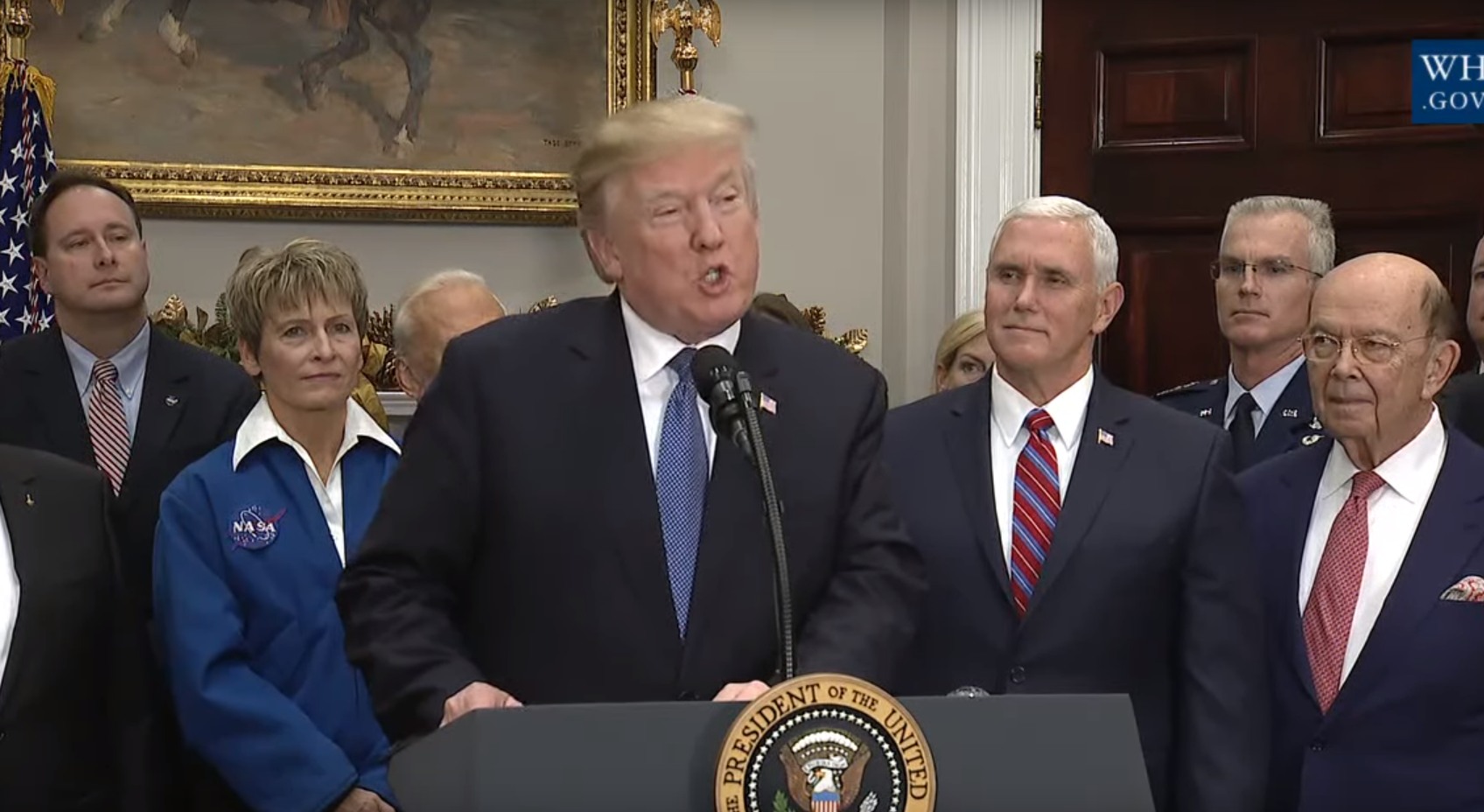
Enlarge / President Trump making remarks Monday during a ceremony for signing Space Policy Directive-1. (credit: NASA TV)
NASA has had a big problem since the agency triumphantly landed humans on the Moon nearly half a century ago. Namely, after the Apollo landings delivered a solid US victory in the Cold War, human exploration has no longer aligned with the strategic national interest. In other words, sending humans into space has represented a nice projection of soft power, but it has not been essential to America’s domestic and foreign policy aims.
As a result, NASA’s share of the federal budget has declined from just shy of five percent at the height of the Apollo program to less than 0.5 percent today. At the same time, NASA’s mandate has grown to encompass a broad array of Earth science, planetary science, and other missions that consume more than half of the agency’s budget.
With less buying power for human exploration, NASA has had to scale back its ambitions; and as a result, astronauts have not ventured more than a few hundred miles from Earth since 1972. Twice before, presidents have attempted to break free of low-Earth orbit by proposing a human return to the Moon, with eventual missions to Mars. President George H.W. Bush did so with the Space Exploration Initiative in 1989, on the 20th anniversary of the Apollo 11 Moon landing. And George W. Bush did so in 2004, with the Vision for Space Exploration. Neither of these were bad concepts—indeed, both offered bold, ambitious goals for the space agency—but they died due to a lack of commitment and funding.
Read 9 remaining paragraphs | Comments
Source: Ars Technica – President Trump says we’re going back to the Moon