

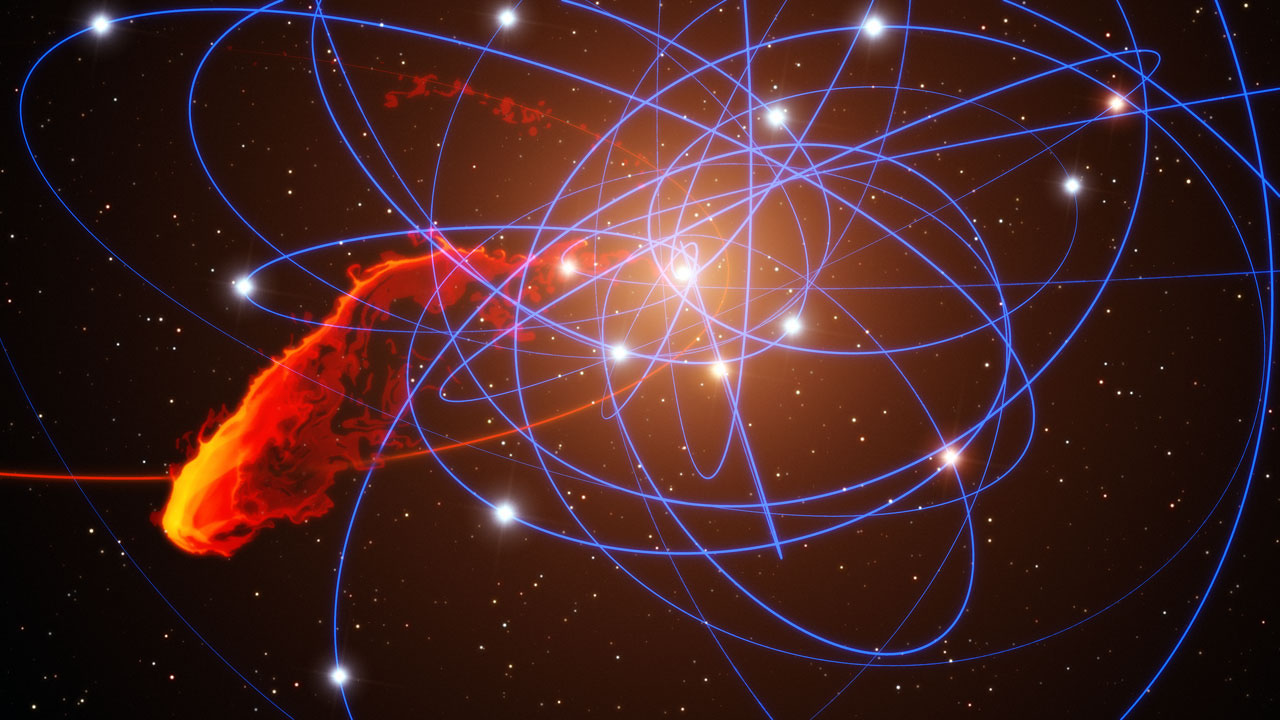
Enlarge / The orbits of stars and gas around the Milky Way’s black hole. (credit: M. Schartmann and L. Calcada/ European Southern Observatory and Max-Planck-Institut fur Extraterrestrische Physik.)
Testing general relativity is a fraught business. The theory has proven to be so robust that anyone who thinks it’s wrong gets slapped around by reality in a pretty serious way. The tests that we apply are also limited by our environment, in that we can only look at gravity with precision where it’s rather weak: in the lab, or by tracking the motion of planets. That’s a whole range of scales and forces, but it doesn’t cover where it might truly matter, which is right next to a black hole.
Observing orbits around a black hole would take a career’s worth of measurements and, frankly, who has the time? It is also a rare benefactor who will fund a couple of decades worth of telescope time. Luckily, telescopes have been collecting data for a while, and some of that happens to include the vicinity of some black holes. Recently, some scientists decided to dig up the data and test general relativity in the vicinity of a supermassive black hole.
Beware of the black hole
At the center of our galaxy, there lies a black hole, which like the Rabbit of Caerbannog, fiercely devours unwary wanderers. Nevertheless, there are a few foolhardy stars that orbit close to the rabbit black hole. These stars have orbits of just a couple of decades, and they experience rather large gravitational forces. So, astronomers expect that accurate observations of these stars might pick out deviations from general relativity.
Read 13 remaining paragraphs | Comments
Source: Ars Technica – Data mining astronomical records fails to falsify Einstein