

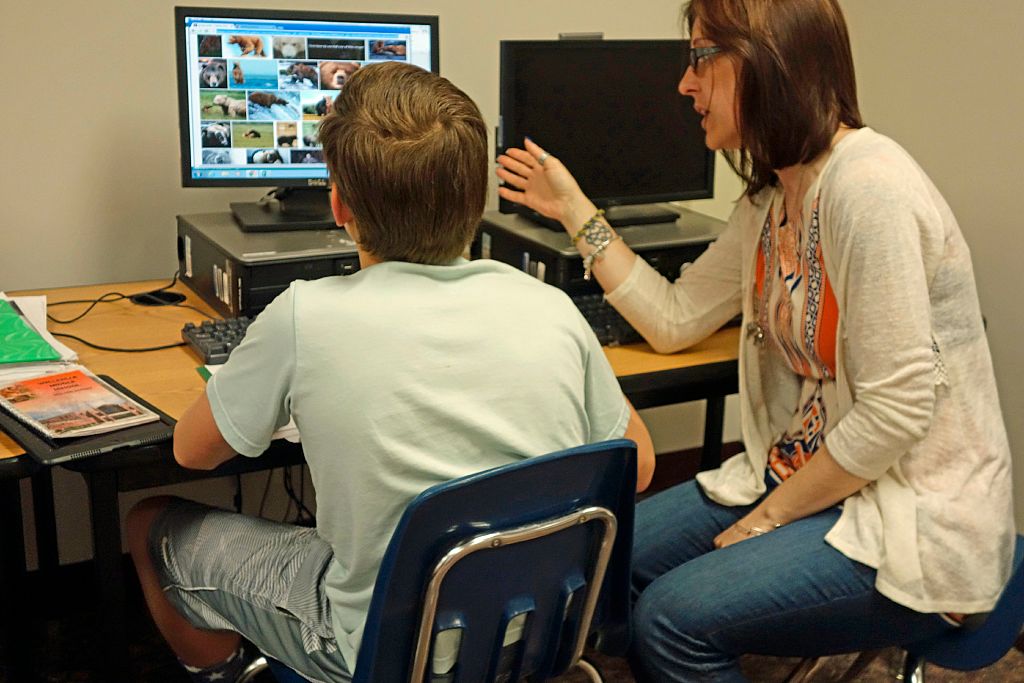
Enlarge / 6th Grade Teacher Helping Student at Computer, Wellsville, New York, USA. (Photo by: Education Images/UIG via Getty Images) (credit: Getty Images)
The Library of Alexandria was one of the most important libraries of the ancient world. Its vast number of scrolls, collections of works, lecture halls, and meeting rooms were a boon to education. In many ways, the cloud has the potential to have just as revolutionary an effect as the Library of Alexandria—it can liberate education, enabling teachers to be innovative and spontaneous.
Teachers are incorporating cloud tools and content into instruction in ways that change how they interact with students both in and outside the classroom. They are no longer limited to face-to-face instruction or constricted by class schedules. Instead, teachers are using both tools that are imposed by administrators and more ad-hoc resources. For example, algebra teachers can spend more time troubleshooting individual students’ problems by using content like Khan Academy to cover the core material. In other cases, Khan Academy can be used as additional support material.
Mark Miazga, an English and Language Arts teacher at Baltimore City College High School, is an example of a teacher who’s taking the more ad-hoc approach. Miazga, who also mentors new teachers and writes curriculum for Baltimore City Public Schools, was featured with his English I class in the documentary Experiencing Shakespeare, produced by the Folger Shakespeare Library. Miazga regularly uses Folger’s resources, including Hamnet, Folger’s online catalog plays by Shakespeare and other eminent playwrights, and an image repository called Luna.
However, Miazga said the largest role that the cloud has played in his teaching has been in shaping his students’ writing process. “Most essays in our classes are turned in electronically via Google Docs,” he explained. “Students share their essays with a peer or their teacher, and we offer live comments. The student can then resolve the comment and make the changes.”
Read 12 remaining paragraphs | Comments
Source: Ars Technica – How teachers see the classroom redefined by the cloud