

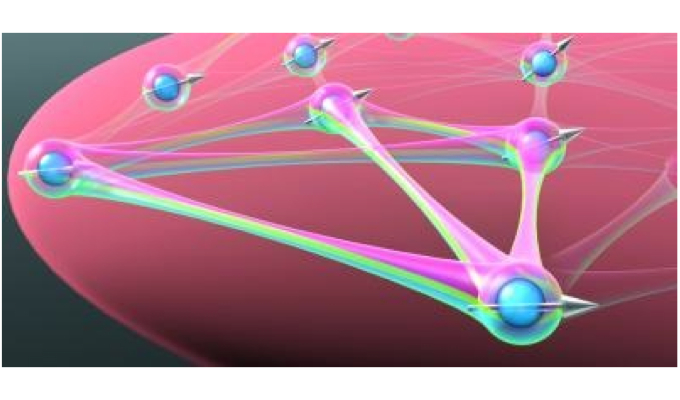
Enlarge / A quantum many-body spin system, visualizing the complicated interactions among the particles. (credit: Gorshkov Group, Johns Hopkins)
It’s notoriously difficult to make sense of Quantum mechanics, and it’s equally difficult to calculate the behavior of many quantum systems. That’s due in part to the description of a quantum system called its wavefunction. The wavefunction for most single objects is pretty complicated on its own, and adding a second object makes predicting things even harder, since the wavefunction for the entire system becomes a mixture of the two individual ones. The more objects you add, the harder the calculations become.
As a result, many-body calculations are usually done through methods that produce an approximation. These typically involve either sampling potential solutions at random or figuring out some way to compress the problem down to something that can be solved. Now, though, two researchers at ETH Zurich, named Giuseppe Carleo and Matthias Troyer, have provided a third option: set a neural network loose on quantum mechanics.
Getting spooky
This additional method could be useful, because there are a lot of cases where the existing methods fail. Random sampling is used in a variety of fields (it’s technically called Monte Carlo sampling, after the games of chance played in the famous casino there). But random sampling is only effective if the number of likely possible solutions isn’t too large. If it is, then you’re unlikely to randomly sample the relevant ones. The alternative, called compression, relies on cases where it’s possible to represent the wavefunction in a computationally efficient form. Not every quantum system is amenable to that approach.
Read 8 remaining paragraphs | Comments
Source: Ars Technica – Neural network trained to solve quantum mechanical problems