

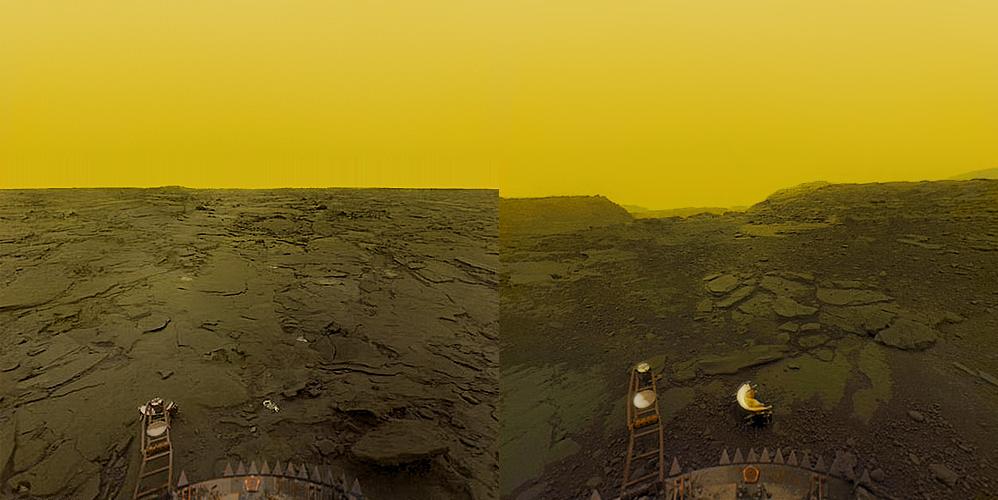
Venus is one of the most inhospitable places in the solar system. Descending through the clouds of boiling sulphuric rain is actually the easy bit—it’s the surface temperature of 470°C (878°F) and atmospheric pressure (about 90 times that of Earth, the same as swimming 900 metres under water) that get you.
The longest survival time for a human-made object on Venus was 127 minutes, back in 1981 when the Soviet spacecraft Venera 13 landed there. Not dying for two hours, and netting our first ever colour photos of the planet’s surface, was considered a huge success; the probe had only been designed to live for 32 minutes before it was cooked, crushed, and dissolved by its environs. Three more spacecraft followed, all Soviet—Venera 14, Vega 1, Vega 2—but we haven’t tried to land anything on Venus since 1985.
One of the core problems of exploring Venus is that normal digital computers don’t really work there. Standard silicon chips can hang in to around 250°C, but eventually there’s just so much energy in the system that the silicon stops being a semiconductor—electrons can freely jump the bandgap—and everything stops working. The Venera landers kept their electronics cool with cumbersome hermetically sealed chambers, and sometimes the innards were also pre-cooled to around -10°C before being dropped into the atmosphere by the parent orbiter.
Read 11 remaining paragraphs | Comments
Source: Ars Technica – We finally have a computer that can survive the surface of Venus