

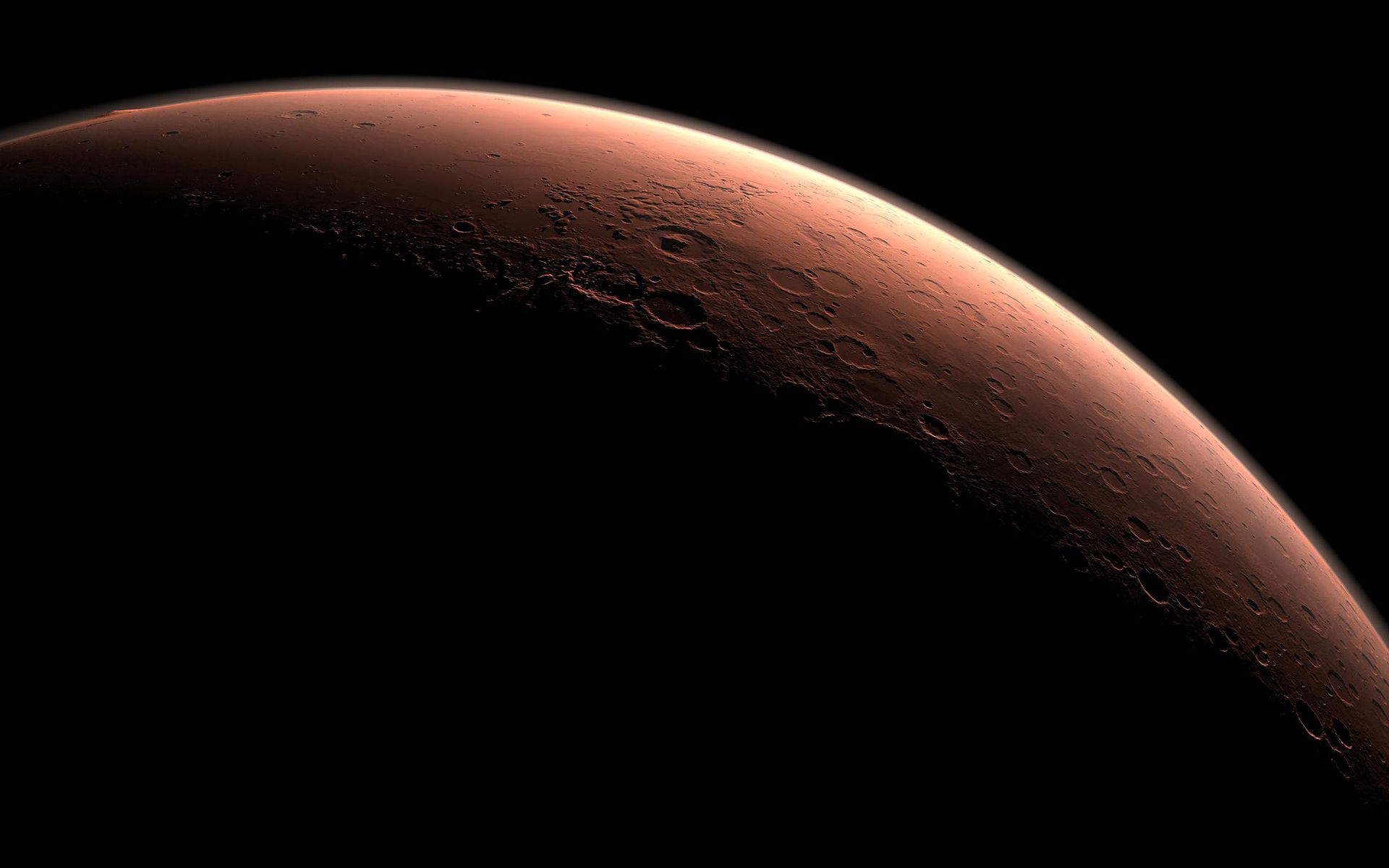
Enlarge / Mars at the boundary between night and day. Gale Crater is the crater with a mound inside it near the center of the image, beginning to catch morning light. Northward is to the left. This view was created using three-dimensional information from the Mars Orbiter Laser Altimeter, which flew on NASA’s Mars Global Surveyor orbiter. (credit: NASA/JPL-Caltech)
Even though Mars is currently too cold and has too little pressure to prevent water from freezing, the planet had liquid water on its surface in the distant past. That could happen if the ancient Martian atmosphere, thicker than its present-day counterpart, had enough greenhouse gasses to keep the planet warm and the water liquid. So over the past decades of our observations and robotic visitations of Mars, researchers have been looking for evidence for Mars’ past carbon dioxide levels.
The evidence we’ve gathered indicates there was some CO2 present but not nearly enough to keep water liquid, especially given that the early Sun was less active than it is at present. So far, these estimates contained large uncertainties, so it remained possible that there was enough carbon in the atmosphere to allow the ancient water to flow.
A team of researchers has created a new estimate of Mars’ ancient carbon levels using data collected by the Curiosity rover. They’ve also concluded that there was nowhere near enough CO2 to warm the planet to the point where water on the surface would remain liquid.
Read 9 remaining paragraphs | Comments
Source: Ars Technica – Early Mars didn’t have enough CO2 to keep water liquid, Curiosity finds