

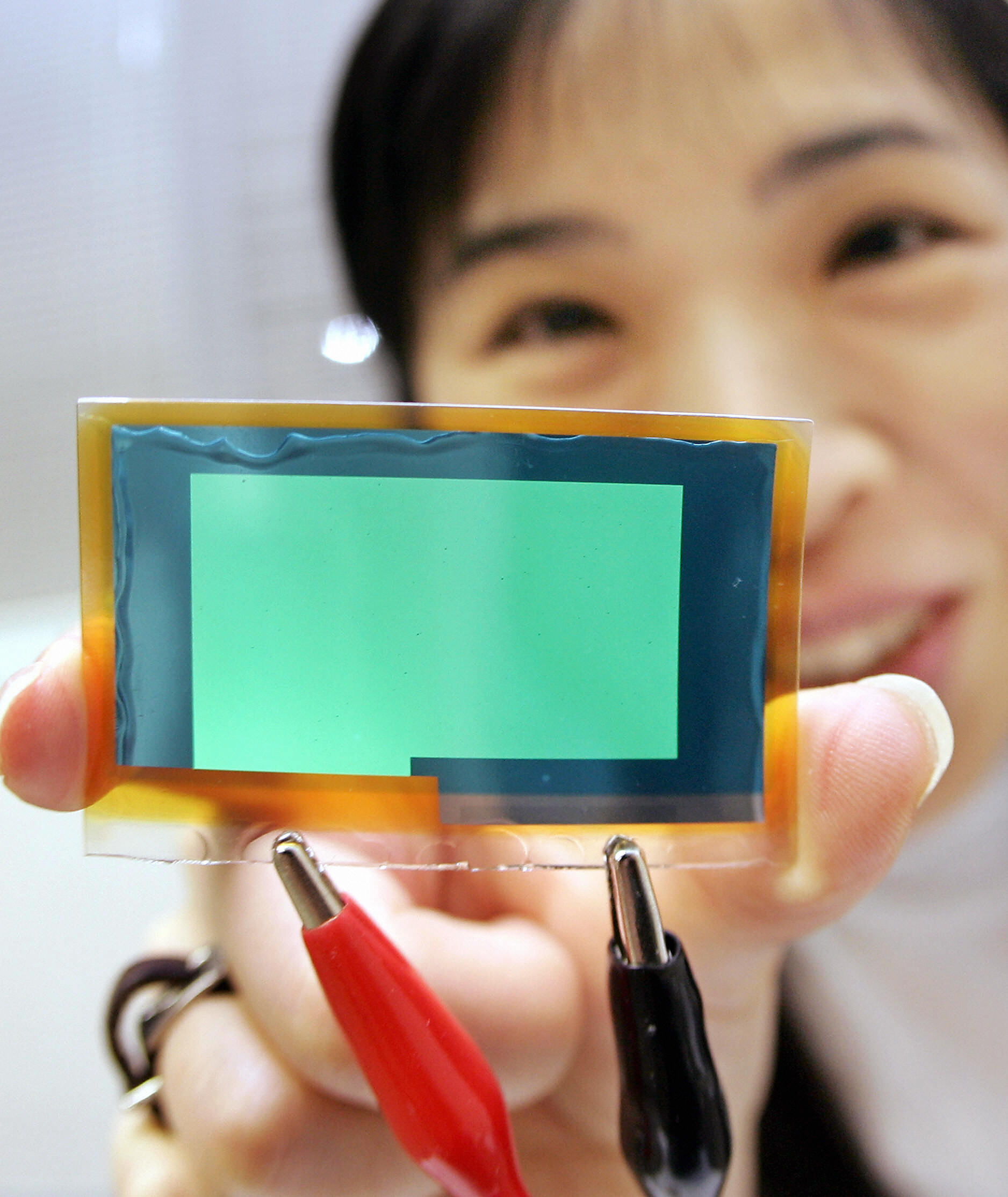
Enlarge / A 2005 photo of a Pioneer employee holding a bendable prototype of an OLED panel in Tsurugashima city, suburban Tokyo. (credit: Yoshikazu Tsuno/AFP/Getty Images)
In our recent look at the state of OLED televisions, we focused on the present—but what about the future?
With OLED (short for “organic light-emitting diodes”), there’s good reason to believe we’ll see far more of the tech in years to come, given its extreme contrast ratios and super-thin screens. To understand just where OLED might be going—and why companies are embracing the tech in different ways—it first helps to understand where OLED came from and how a $100 million deal with Kodak paved the way for our current reality.
Cooking in Kodak’s labs
In the late 1980s, Eastman Kodak took a surprising lead on display technology. This was well before personal computing displays of all sizes dominated the market—and at a time when Kodak wasn’t producing a significant number of display panels itself. The company’s work on what it called organic light-emitting diodes received its first major unveil in 1987, and it differed greatly from the other flat-screen display technology of the time, liquid-crystal displays (LCD).
Read 26 remaining paragraphs | Comments
Source: Ars Technica – Deep blacks, bright future—where OLED screens go from here