

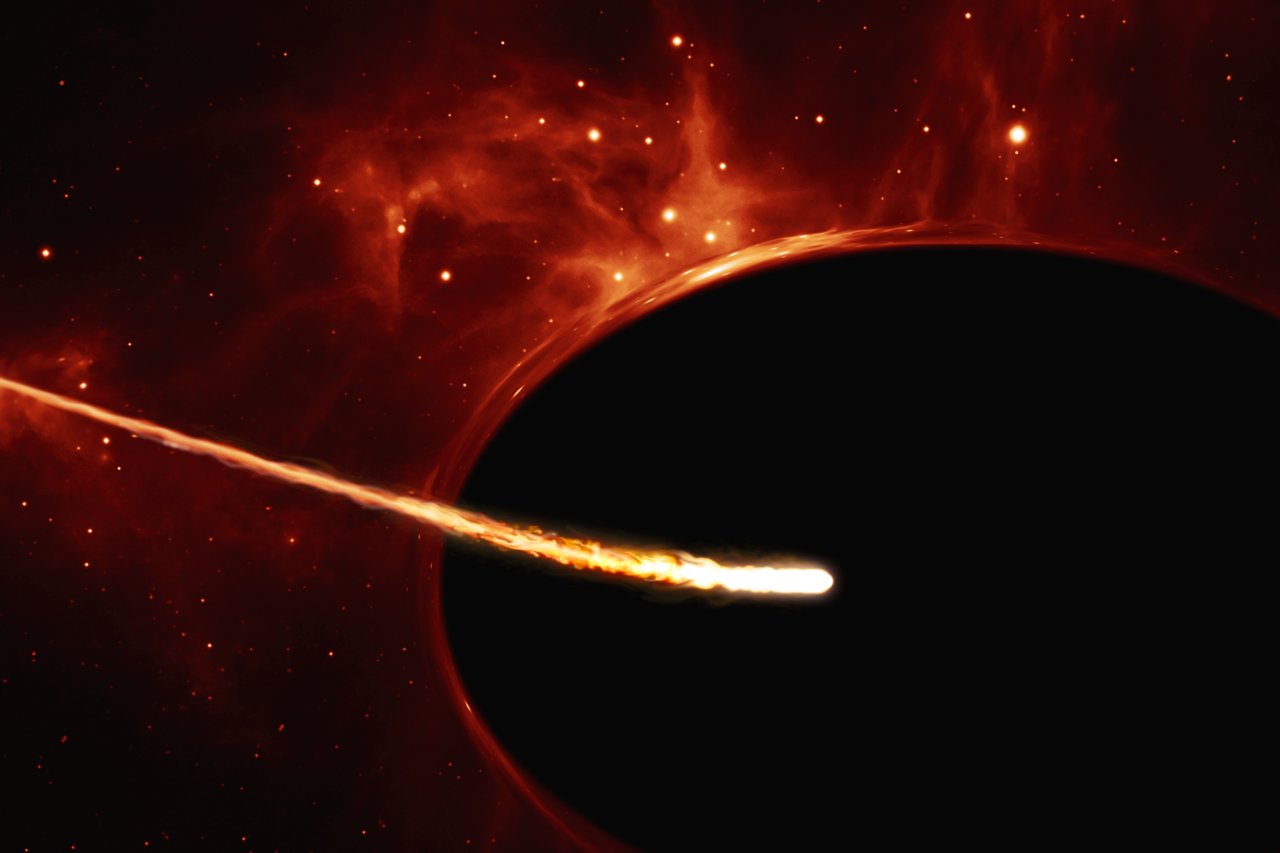
Enlarge / Artist’s impression of a star like the Sun circling in toward a supermassive black hole, being torn apart by its tidal forces. The distortion around the black hole’s edges is due to light from background stars being bent by the black hole’s immense gravity. (credit: ESO, ESA/Hubble, M. Kornmesser)
In late May of 2015, scientists noticed something twice as bright as the brightest known supernova ever seen. Researchers initially thought the object, which they dubbed “ASASSN-15lh,” was probably a supernova—and the most luminous yet.
That startling discovery attracted the interest of the astrophysics community, and an international team continued observing the source for the next ten months. The team used an impressive array of ground- and space-based telescopes, including the Very Large Telescope at ESO’s Paranal Observatory, the New Technology Telescope at ESO’s La Silla Observatory, and the NASA/ESA Hubble Space Telescope. Over that time they’ve seen it exhibit some weird behavior for a supernova—so weird, in fact, that they’ve now concluded it’s probably not a supernova at all.
Instead, the pattern of 15lh’s changing temperature over time, its location in a distant galaxy, as well as some other factors, convinced the researchers that the bright flash was probably caused by a star being torn apart and spaghetti-fied. Its dazzling destruction is thought to be thanks to the incredible tidal forces from a nearby supermassive black hole, which has more than 100 million times the Sun’s mass. (Its mass is implied from that of its host galaxy, as a galaxy’s mass is proportional to that of its supermassive black hole).
Read 16 remaining paragraphs | Comments
Source: Ars Technica – Brightest-ever supernova isn’t a supernova after all