

Enlarge (credit: Schrecklicher Blattsteiger/Wikimedia Commons)
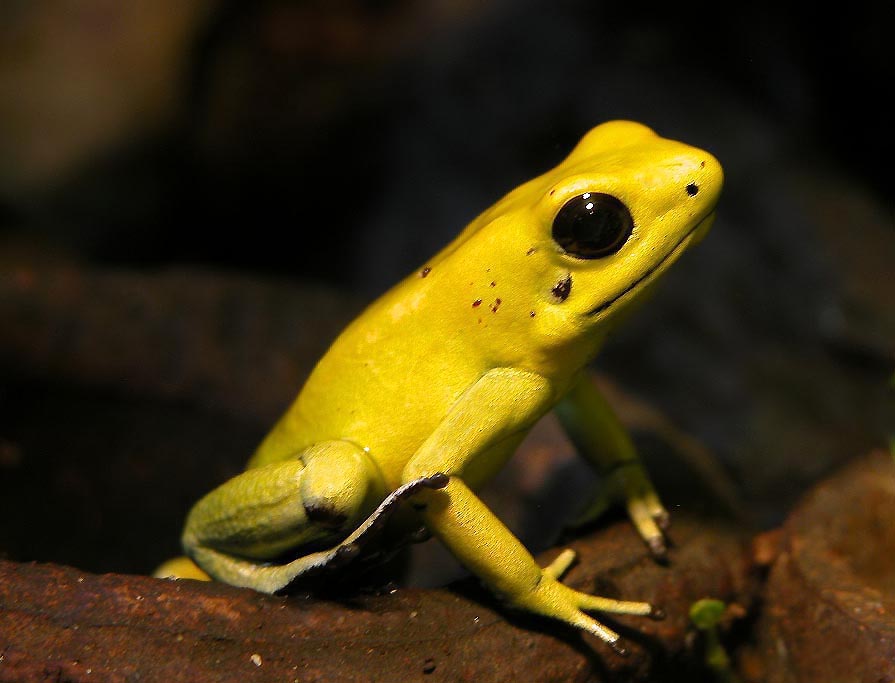

The endangered golden poison arrow frog Phyllobates terribilis lives in the rain forests along the northern Pacific coast of Colombia. Its skin contains batrachotoxin, a lethal poison that prevents nerve and muscle cells from firing properly. That substance makes muscles contract and leads to heart failure or fibrillation. Each frog contains about a milligram of the toxin, enough to kill 10,000 mice, 20 people, or two elephants. A whale might survive ingesting the frog, but anything else that eats this frog dies.
Batrachotoxin works by activating proteins called voltage gated sodium ion channels. These are specialized proteins located within cell membranes that respond to changes in voltage across the cell membrane by opening up a central pore. This allows positively charged sodium ions to flow into the cell before the pore quickly closes up again. This helps the cell reset the voltage differential cross the membrane, allowing future electrical signals and messages to be propagated along the length of neurons.
The frog toxin binds to the inner pore of the channel and props it open, allowing sodium ions to continuously flood into the cell. The cell never resets, so any signal it transmits will be its last.
Read 7 remaining paragraphs | Comments
Source: Ars Technica – The poison arrow frog’s toxin has an anti-toxic evil twin