

Enlarge / How the Sun can alter the Moon’s orbit around the Earth. (credit: Bob King/Sky & Telescope)
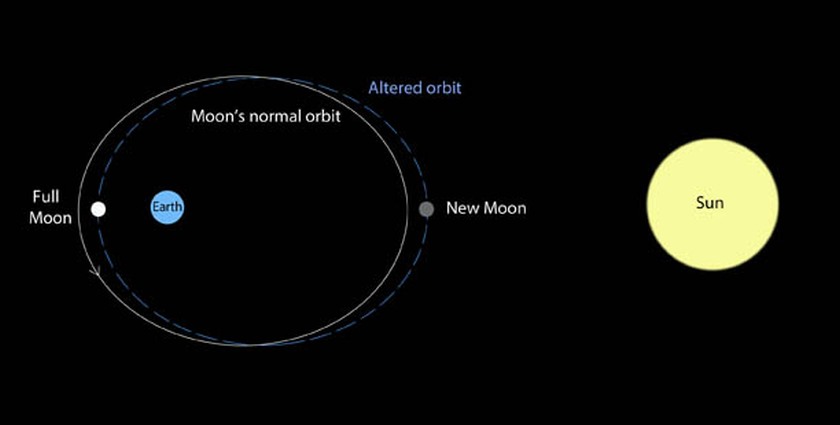
The Moon follows an elliptical path around the Earth, with an average eccentricity of about 0.055 (a perfect circle has an eccentricity of 0). This means that, at its closest approach, the Moon comes within 363,400km of our planet, and at its most distant the Moon is 405,500km. When the Moon is full at the perigee of this orbit, it has come to be known as a “Supermoon.”
And yes, we use the designation “Supermoon” because, even though it was originally coined back in 1979 by an astrologer, NASA has now adopted it. We shall too, partly because the astronomy of why this month’s Supermoon has gotten so much attention is interesting. Supermoon is also an easier term to use than, say, a perigee full Moon.
But this month’s Supermoon is special. The eccentricity above is calculated based upon the Earth-Moon system, but other celestial bodies also influence the Moon’s orbit through gravity. The Sun plays the largest role, but so too does Jupiter and even some of the smaller planets. When factoring in these other influences, the eccentricity of the Moon’s orbit can actually vary by as little as 0.026 and as much as 0.077.
Read 4 remaining paragraphs | Comments
Source: Ars Technica – A special Supermoon comes—but what causes it?